
Languages of Niger
All languages of Western Africa →fluent beta classical · classes by phone with Maya at ranas.ai/maya
Niger Travel Guide — Sahara Dunes, Trans-Saharan Trade Cities & a Country Currently Off the Map
I need to be straight with you before anything else: this is a guide I’ve written differently than any other on this site. Niger is extraordinary — the Aïr Massif’s volcanic peaks rising out of the Ténéré desert, the mudbrick minaret of Agadez that has stood since the 1500s, a nomadic gathering each September that is one of the great unphotographed spectacles left on Earth. It’s also, as of this writing, a country both the US State Department and the UK Foreign Office advise against visiting entirely — Level 4, “Do Not Travel,” the same tier as active war zones. So this guide is not a “go now” pitch. It’s the honest version: what makes Niger remarkable, what has gone wrong, and what to do with that information — whether you’re planning a trip for a future when things stabilize, researching for work, or just curious about a country most people couldn’t place on a map.
In This Guide
- Overview — A Sahelian Giant Most Travelers Skip
- Cure Salée — The Gathering That Usually Happens in September
- Best Time to Visit Niger (In Ordinary Times)
- Getting There — Diori Hamani International & Overland Borders
- Getting Around Niger
- Top Regions — Niamey, Agadez & the Sahel Belt
- Culture & People — Hausa, Zarma, Tuareg, Fulani, Kanuri
- A Food Lover’s Guide to Niger
- Off the Beaten Path (and Currently Off-Limits)
- Practical Information & Safety
- Budget Breakdown — What Travel to Niger Actually Costs
- Planning — Or Why You Might Wait
- Frequently Asked Questions
Overview — A Sahelian Giant Most Travelers Skip
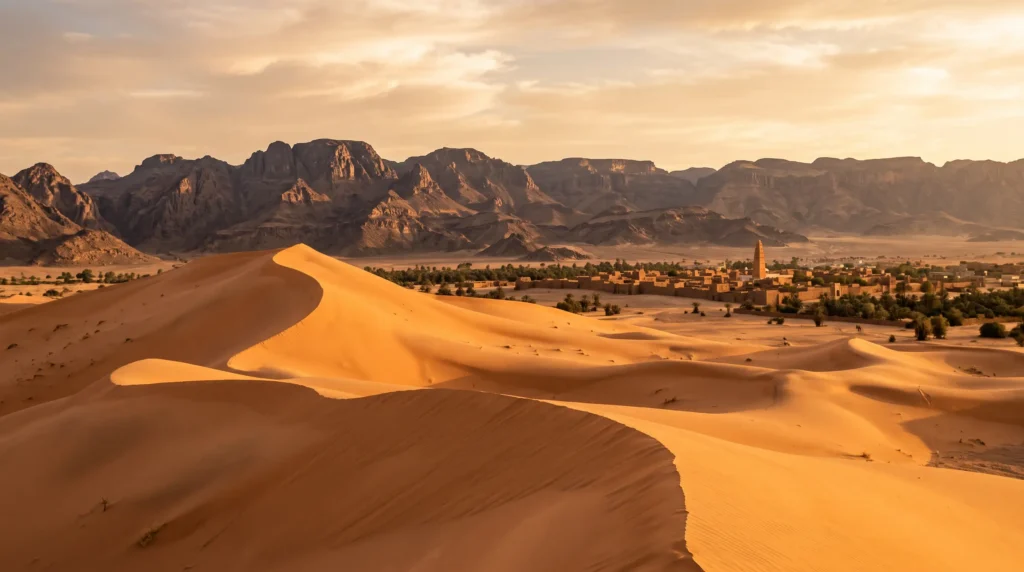
Niger is the sixth-largest country in Africa, a landlocked expanse of roughly 1.27 million square kilometres wedged between seven neighbors — Libya, Chad, Nigeria, Benin, Burkina Faso, Mali and Algeria. More than 80% of that territory lies inside the Sahara, with a narrow, greener Sahelian band along the south holding most of the country’s roughly 26.3 million people. The capital, Niamey, sits on the Niger River in the far southwest — a city of wide boulevards, a genuinely good river-view restaurant scene, and, in calmer years, one of West Africa’s more relaxed capitals to walk around.
The country’s draw for travelers has always been the north: the Aïr Massif, a range of volcanic peaks rising out of the Ténéré, and the mudbrick caravan city of Agadez, whose Grand Mosque — rebuilt in its current form in 1844 on foundations from 1515 — is one of the tallest earthen structures on the continent. Niger holds three UNESCO World Heritage sites: the Aïr and Ténéré Natural Reserves, W National Park, and Agadez’s historic centre. That is a genuinely serious UNESCO portfolio for a country of this size and profile.
But the honest overview has to include the last three years. A July 2023 military coup deposed President Mohamed Bazoum, installed a junta under General Abdourahamane Tchiani, and pulled Niger out of ECOWAS into a new bloc with Mali and Burkina Faso. French and then American forces withdrew; jihadist groups linked to al-Qaeda and ISIS have expanded operations along the Malian and Nigerian borders and, as of early-to-mid 2026, have struck targets in and around the capital itself. That combination — genuine cultural and geological riches, layered over genuine risk — is why this guide reads differently than our others.
Cure Salée — The Gathering That Usually Happens in September
In ordinary times, late September brings the Cure Salée (“salt cure”) to the grasslands around In-Gall, north of Agadez — an annual gathering of Wodaabe (Bororo Fulani) and Tuareg herders who bring their cattle to graze on mineral-rich pasture at the end of the rains. It’s also the setting for the Wodaabe’s Gerewol courtship dances, where young men spend hours on elaborate face paint and performance to be judged by women of the community — one of the most striking cultural spectacles in the Sahel, and, in good years, a modest but real draw for the handful of tour operators willing to run it.
I’m flagging it here rather than building an itinerary around it, because event dates, road access and whether any operator is running trips at all now depend entirely on the security situation in the Agadez region in a given year — check current on-the-ground status with a specialist operator and your government’s latest advisory before assuming this is happening as described.
Best Time to Visit Niger (In Ordinary Times)
October – February · Cool dry season
The most comfortable climatic window: daytime heat moderates from the brutal extremes of the hot season, nights in the Sahara and Sahel can turn genuinely cold, and this is when Cure Salée and any Aïr Massif travel would traditionally happen.
March – May · Hot season
Temperatures climb into the mid-40s Celsius across much of the country ahead of the rains — a punishing window for anyone not acclimatized, with or without the security picture.
June – September · Rainy season
The Sahel greens up and the Niger River rises, but many rural roads become difficult or impassable, and this is also cholera season in parts of Tahoua and Zinder.
None of these seasonal notes override the current advisory picture, which we cover in full under Practical Information. Climate tells you when Niger would be pleasant to visit; it says nothing about whether it’s currently advisable.
Getting There — Diori Hamani International & Overland Borders
Diori Hamani International Airport sits about 9km southeast of Niamey and is the country’s only real international gateway, with historical service from Air France (Paris), Ethiopian Airlines, Turkish Airlines and regional carriers like ASKY and Royal Air Maroc connecting through West and North African hubs. That said, the airport itself has been the target of militant attacks in early and mid-2026, repelled by Nigerien security forces but a stark marker of the current threat level right at the point of entry. Route availability, frequency and even which foreign carriers are still flying shifts with the security and diplomatic situation — verify directly with the airline before booking anything.
Overland routes exist from Mali, Burkina Faso, Benin, Nigeria, Chad, Algeria and Libya, but essentially all of these border zones carry their own severe advisories — the Malian border in Tillabéri, the Diffa region near Lake Chad, and the far north beyond Agadez are repeatedly named as the highest-risk areas in official guidance. Overland entry is not a workaround for the situation — if anything it concentrates the risk.
Getting Around Niger
In normal circumstances, Niger’s domestic transport is thin: a handful of paved highways link Niamey to Zinder, Maradi and Agadez, supplemented by shared bush taxis and occasional domestic flights when carriers operate them. Distances are vast — Niamey to Agadez is roughly 900km by road — and road conditions deteriorate quickly outside the paved corridors.
Current guidance from both the US and UK is blunter than any ordinary “getting around” advice: movement outside Niamey is subject to state-of-emergency restrictions in many regions, and the US Embassy notes that even official personnel require military escort to travel beyond the capital. For anyone who does travel to Niger for work or essential reasons right now, “getting around” effectively means working through a specialist logistics or security provider, not renting a car or flagging a bush taxi.
Top Regions — Niamey, Agadez & the Sahel Belt
Niamey
The capital and, relatively speaking, the country’s calmest corner — a river city with a national museum, a lively Grand Marché, and the closest thing Niger has to a functioning restaurant and hotel scene. “Relatively calmer” is not the same as “advised” — both the US and UK advisories cover Niamey along with the rest of the country.
Agadez & the Aïr Massif
Historically Niger’s second tourism engine after Niamey, before the Tuareg rebellion of 2007–2009 suspended European charter flights and gutted the industry for years. Agadez today functions mainly as a uranium-transport and logistics hub and a transit point for trans-Saharan migration, with tourism a shadow of its former self. The Aïr and Ténéré Natural Reserves beyond it have sat on UNESCO’s List of World Heritage in Danger since 1992, and decades of insecurity have coincided with the local extinction of species like the addax antelope.
Zinder
Niger’s historic second city and former colonial capital, known for its old walled quarter (Birni) and traditional Hausa architecture — culturally rich, but sitting closer to security concerns along the Nigerian border than Niamey.
Maradi
A major commercial center near the Nigerian border, important for regional trade but similarly affected by cross-border security concerns.
Tillabéri Region
The so-called tri-border zone with Mali and Burkina Faso, named specifically in US and UK guidance as one of the highest-risk areas in the country.
Diffa Region
The Lake Chad Basin corner of Niger, similarly flagged as high-risk due to militant activity spilling over from neighboring Nigeria and Chad.
W National Park (Niger’s slice of the W-Arly-Pendjari complex)
A tri-national reserve shared with Benin and Burkina Faso, home to some of West Africa’s last wild elephants and a fraction of the region’s remaining cheetahs — and, tragically, the site of repeated militant attacks on rangers and soldiers in recent years.
Culture & People — Hausa, Zarma, Tuareg, Fulani, Kanuri
Niger’s population is roughly 53% Hausa, 21% Zarma-Songhay, 11% Tuareg, 6.5% Fulani (Fulfulde-speaking), and 6% Kanuri, with smaller communities besides — a genuinely diverse Sahelian mix, and around 99% Muslim. In March 2025 the junta-era constitution made Hausa — spoken by close to half the population — the national language, replacing French, with French and English retained only as “working languages”; ten other languages including Zarma, Tamasheq, Fulfulde, Kanuri and Arabic hold recognized national status. It’s a striking, fast-moving marker of the sovereignty politics playing out since 2023 — this is one of very few countries anywhere to have constitutionally swapped its official language in the last few years.
The Tuareg and Wodaabe Fulani nomadic traditions — indigo-dyed tagelmust veils, camel caravans, the Gerewol courtship dances at Cure Salée — are what most outside coverage of Niger’s culture focuses on, and for good reason; they’re genuinely distinctive. But the Hausa and Zarma urban and agricultural traditions of the south, less photographed, are where most Nigeriens actually live their daily lives, centered on extended family compounds, weekly markets, and a strong oral storytelling and griot tradition.
A Food Lover’s Guide to Niger
Niger’s food culture runs on millet, sorghum and rice as staples, paired with sauces built from baobab leaf, okra, peanut or tomato, and meat when it’s available — goat and mutton more than beef, given the pastoral economy. Tuwo (a thick millet or sorghum porridge) with a leafy or peanut sauce is the everyday plate across much of the country, closely related to dishes eaten across the wider Hausa world in northern Nigeria.
Along the Niger River, grilled river fish — capitaine (Nile perch) especially — turns up at Niamey’s better restaurants and riverside grills. Tea culture matters too: three rounds of strong, sweet Sahelian mint tea, brewed and poured with ceremony, is a social institution shared with neighboring Mali and Mauritania. Street food in Niamey’s markets includes grilled brochettes and fried dough snacks; as with anywhere in the region, stick to food cooked fresh in front of you and bottled or treated water.
Off the Beaten Path (and Currently Off-Limits)
This section is unusual for us: everything in it is more “for the record” than “go here.” The Ténéré desert — one of the most extreme, dune-and-gravel expanses of the Sahara, home to the fossil-rich Gadoufaoua badlands and the Tree of Ténéré’s famous, now-fallen predecessor — is about as far off the beaten path as travel gets anywhere on Earth. In practice it sits deep inside the highest-risk zone of an already Do Not Travel country.
The Aïr Massif’s volcanic peaks, some rising past 2,000 metres out of the desert floor, hold prehistoric rock art sites that rank among the Sahara’s best — again, part of a reserve that has been on UNESCO’s endangered list since 1992 largely because of instability. Agadez’s old town, with its distinctive mudbrick architecture and the Grand Mosque’s stepped minaret, would be a genuine highlight of any West Africa itinerary in calmer times.
We’re describing these places because they’re real, remarkable, and worth knowing about — not because we’re suggesting you go find them right now. If and when the security and diplomatic situation genuinely improves, this section is the one to revisit.
Practical Information & Safety
Safety — read this first. As of the sources checked in July 2026, the US State Department rates Niger Level 4, “Do Not Travel,” citing violent crime, active terrorist plotting including kidnapping of foreign nationals, state-of-emergency movement restrictions, and severely limited medical care; only essential US government personnel are permitted in-country, and the embassy cannot guarantee services outside Niamey. The UK FCDO advises against all travel to the entire country for the same core reasons — terrorism, kidnapping risk, and instability since the July 2023 coup — and notes that UK government assistance is provided remotely from Lagos, not from inside Niger. Travel insurance can be voided by disregarding this kind of advisory — check your policy explicitly before assuming you’re covered.
Visas. Most nationalities need a visa arranged in advance through a Nigerien embassy or consulate; there is no e-visa system, though a “flyer visa” confirmed in advance by Niger’s national police can sometimes be issued on arrival in Niamey. ECOWAS nationals travel visa-free, as do a short list of others including Chad, Morocco, Mauritania and Tunisia. Per the sources checked, US nationals have at points faced outright entry refusal — a reminder that policy here can shift fast and needs checking immediately before any trip, not assumed from this or any other guide.
Health. Yellow fever vaccination is required for all travelers over nine months old. Malaria risk is present countrywide with chloroquine-resistant strains, so prescription prophylaxis is strongly advised; meningococcal vaccination is recommended for dry-season (December–June) travel, and cholera has been reported in Tahoua and Zinder. Medical facilities are described as severely limited, with medical evacuation a real possibility even for minor issues.
Money. The West African CFA franc (XOF) is used across eight UEMOA countries and pegged to the euro at a fixed 655.957:1, issued by the Central Bank of West African States. Card acceptance is thin outside a handful of Niamey hotels; cash is essential.
Connectivity & practicalities. Mobile networks cover Niamey and major towns reasonably well but thin out fast in rural and northern areas. Plugs are the European two-round-pin style at 220V. Time zone is UTC+1 year-round, no daylight saving.
Budget Breakdown — What Travel to Niger Actually Costs
Ordinary backpacker or mid-range leisure tourism, in the sense our other country guides describe it, isn’t really operating in Niger in 2026. Travel that does happen tends to fall into two buckets, both pricier than the region’s per-day norms.
Essential/business travel (roughly USD $150–300/day): Niamey hotel with reliable power and water, private vetted drivers rather than shared transport, meals at hotel restaurants, and typically some form of local security briefing or fixer arrangement.
Specialist/security-supported travel beyond the capital (USD $400+/day): the kind of trip run, when it runs at all, by operators experienced in high-risk environments — armed or unarmed security escort, satellite communications, contingency evacuation planning, and premium insurance built for exactly this risk tier.
There is no meaningful “budget backpacker” tier to quote honestly right now, and we’re not going to invent one.
Planning — Or Why You Might Wait
If you’re reading this as a genuine trip-planning exercise rather than out of curiosity, the honest advice is to treat Niger as a “watch and wait” destination: follow your government’s travel advisory directly, and don’t plan an itinerary around this guide or any other travel content — advisories change, and they’re the only source with real-time authority here.
If what’s drawing you to Niger is the Sahara, Sahel culture, or Trans-Saharan trade history, there are currently more accessible ways into that same world. Our Morocco guide covers the northern end of the old caravan routes Agadez once fed into. Our Senegal guide shares Niger’s French colonial history, CFA franc currency zone and much of its Sahelian culture, with a functioning tourism infrastructure. Ghana and Chad (Niger’s own eastern neighbor, itself carrying its own advisories worth checking) round out a wider picture of the region.
Frequently Asked Questions
Is it safe to travel to Niger right now?
Both the US State Department (Level 4, “Do Not Travel”) and the UK FCDO (advise against all travel) currently cover the entire country, citing terrorism, kidnapping risk, and instability since the 2023 coup. This isn’t a regional caveat — it applies nationwide, including Niamey. Check the current advisory directly before any trip.
Can tourists still visit Niger in 2026?
Technically yes — the airport has reopened and visas can be obtained — but mainstream leisure tourism has essentially stopped. What travel does happen skews toward essential business, diplomatic, or specialist high-risk-region operators, not independent sightseeing.
Do I need a visa for Niger?
Most non-ECOWAS nationalities do, arranged in advance through a Nigerien embassy since there’s no e-visa system; a police-confirmed “flyer visa” on arrival exists as an alternative route. Rules can shift quickly with the political situation, so confirm directly with a Nigerien mission before booking anything.
What happened in Niger’s 2023 coup, and is the situation stable now?
In July 2023, Niger’s presidential guard detained President Mohamed Bazoum and installed General Abdourahamane Tchiani as head of a military junta, which later withdrew Niger from ECOWAS to form a new Sahel bloc with Mali and Burkina Faso. As of 2026 the junta remains in power, and Western governments continue to rate the country as unsafe for travel.
What’s the one thing worth knowing about Niger’s culture?
In March 2025, Niger became one of the only countries anywhere to constitutionally change its official language in recent years, replacing French with Hausa — spoken by nearly half the population — while keeping French and English as working languages. It’s a small fact that says a lot about the country’s current direction.
If not Niger right now, where should I go for a similar Sahara/Sahel experience?
Morocco’s south (see our Morocco guide) delivers Sahara dunes and caravan-town history with full tourism infrastructure; Senegal shares Niger’s French-Sahel heritage and currency with far easier access. Both are safer near-term substitutes for the landscape and culture Niger offers.
What We’d Actually Tell a Friend
If a friend asked us about Niger today, we’d tell them what’s in this guide: it’s a country with a genuinely remarkable Sahara-Sahel landscape and culture, three UNESCO sites, and one of the more interesting living cultural traditions left in West Africa — and it’s also, right now, a country two major governments say not to visit at all. Bookmark this guide for when that changes. In the meantime, follow your government’s official advisory, not ours, for anything time-sensitive.
Explore More
- Morocco Travel Guide — the accessible northern end of the Trans-Saharan trade routes
- Senegal Travel Guide — shared French-Sahel heritage and CFA franc currency, with functioning tourism
- Ghana Travel Guide — a stable, welcoming West African alternative
- Chad Travel Guide — Niger’s eastern neighbor, sharing much of its Sahelian geography
How this guide was built
Published as part of Facts From Upstairs’ country guide series. Built from Wikipedia entity pages on Niger’s geography, languages, visa policy, the 2023 coup, Diori Hamani International Airport, Agadez, and W National Park; UNESCO’s World Heritage listing for the Aïr and Ténéré Natural Reserves; the US State Department and UK FCDO current travel advisory pages for Niger; the US CDC traveler health page for Niger; and Global Voices’ reporting on Niger’s 2025 constitutional language change. Given the seriousness of the current safety situation, security- and advisory-related claims lean on the primary US/UK government sources rather than secondary summary. Numeric and checkable claims carry inline citations.
Sources cited on this page
- Wikipedia — Niger
- UNESCO — Aïr and Ténéré Natural Reserves
- Wikipedia — W National Park
- Wikipedia — West African CFA Franc
- Wikipedia — Diori Hamani International Airport
- Wikipedia — Agadez
- Wikipedia — 2023 Nigerien coup d’état
- Wikipedia — Visa policy of Niger
- Wikipedia — Languages of Niger
- US State Department — Niger travel advisory
- UK FCDO — Niger travel advice
- US CDC — Niger traveler health page
- Global Voices — Hausa replaces French as Niger’s official language
More country guides you might like
Plan your trip to Niger
The booking tools we use ourselves. FFU may earn a commission at no extra cost to you.
Plan & book your trip to Niger
Booking through these searches supports our guides at no extra cost to you.