
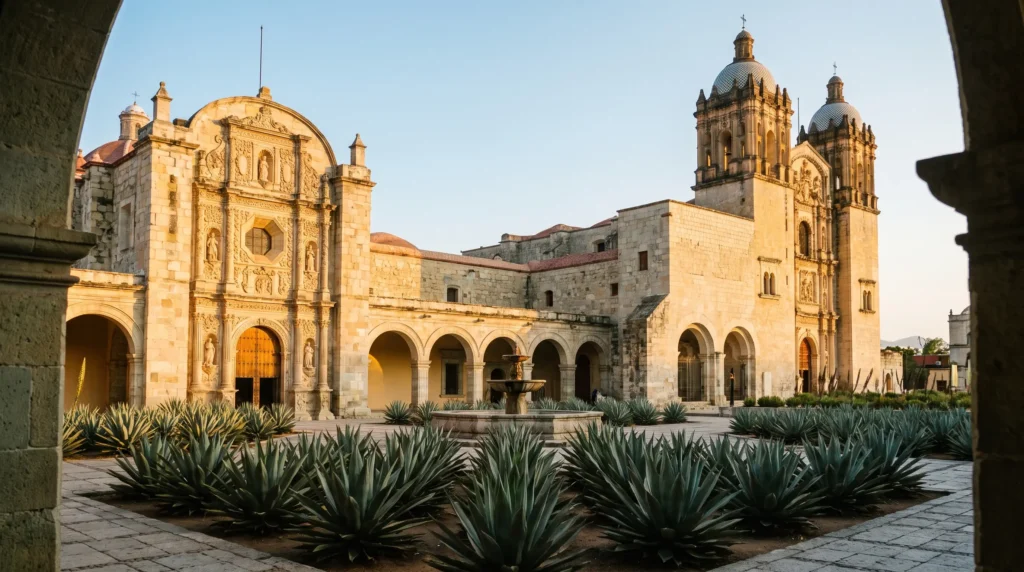
Oaxaca City Guide — Mezcal, Moles & Mexico’s Best-Eating Colonial Capital
I’ve told people for years that if you can only eat in one Mexican city, skip the beach resorts and go to Oaxaca. It’s a place where the cooking is treated as a living inheritance rather than a menu category — seven named moles, a mezcal culture that produces roughly 90% of the country’s supply , and a Saturday tortilla still patted out by hand at the market because the machine version tastes like cardboard to the woman selling it. Oaxaca de Juárez sits at 1,555 metres in a highland valley , ringed by the Sierra Madre and dotted with Zapotec ruins older than the Roman Forum. UNESCO inscribed the historic centre and the Monte Albán archaeological site as a single World Heritage property back in 1987, and walking between the two is basically walking between two different Oaxacas that happen to share a bus route. None of this is secret anymore — Oaxaca has had its moment on every “best city” list going — but it hasn’t yet been ruined by that attention, and that combination is getting rarer every year.
In This Guide
- Overview — Why Oaxaca Is Mexico’s Food and Culture Capital
- Guelaguetza — Late July’s Indigenous Dance Festival
- Best Time to Visit Oaxaca (Season by Season)
- Getting There — OAX Airport & Overland Routes
- Getting Around — Walking, Colectivos & Taxis
- Neighborhoods — Centro, Jalatlaco, Xochimilco & Beyond
- Culture & People — Zapotec, Mixtec & Living Craft Traditions
- A Food Lover’s Guide to Oaxaca
- Off the Beaten Path
- Day Trips — Monte Albán, Hierve el Agua & the Valles Centrales
- Practical Information
- Budget Breakdown — What Oaxaca Actually Costs in 2026
- Frequently Asked Questions
Overview — Why Oaxaca Is Mexico’s Food and Culture Capital
Oaxaca de Juárez is the capital of Oaxaca state, founded by the Spanish in 1529 as Antequera in a valley already occupied by Zapotec communities, and it kept enough of its colonial grid and green cantera-stone buildings intact that the historic centre reads like an open-air museum you can also get a decent breakfast in. The city proper holds around 259,000 people, with close to 714,000 across the wider metro area — small enough to walk end to end, large enough to have a real restaurant scene, a real market culture and a real art scene that doesn’t exist purely for tourists.
What sets Oaxaca apart from Mexico City or the beach circuit is depth rather than scale. This is one state, arguably the most ethnically and linguistically diverse in the country, home to Zapotec, Mixtec and more than a dozen other indigenous groups, many still speaking their own languages day to day. It’s also the mezcal capital of the world by a wide margin — Oaxaca is home to roughly 570 of Mexico’s 625 registered mezcal production facilities. Layer on top of that the cooking — seven canonical moles, tlayudas, chapulines, the best hot chocolate in the country — and you understand why food writers treat Oaxaca as a pilgrimage rather than a stopover.
None of that means it’s undiscovered. Oaxaca has been a fixture on “next big food city” lists for a decade, rents in Centro have climbed accordingly, and the historic centre gets genuinely crowded during Guelaguetza and Día de los Muertos. But step three blocks off the tourist grid and you’re back in a city that is, first and foremost, still a working Mexican state capital — markets full of locals doing their actual weekly shop, not a performance for visitors.
Guelaguetza — Late July’s Indigenous Dance Festival
If you can time a trip around one event, make it the Guelaguetza, held on the two Mondays following July 16 each year — “Los Lunes del Cerro” — with delegations from all of Oaxaca’s regions performing traditional dance, music and costume on a hillside amphitheatre above the city. The name comes from a Zapotec word roughly meaning “offering” or “reciprocal gift,” and the festival’s roots go back to pre-Hispanic harvest ritual before it was folded into a Catholic feast honoring Our Lady of Mount Carmel and later relaunched as a civic celebration in the 1920s. In practice it means two weeks of parades (calendas), mezcal tastings, artisan markets and free community performances stacked on top of the ticketed main event — book accommodation early if your dates land in late July, because this is the single highest-demand stretch on the Oaxaca calendar and prices spike to match.
The other unmissable date is Día de los Muertos, October 31 to November 2, when the Day of the Dead — inscribed by UNESCO as Intangible Cultural Heritage in 2008 — turns Oaxaca’s cemeteries and streets into candlelit altars and comparsa processions. It’s arguably even more atmospheric than Guelaguetza, and also the single hardest week of the year to find a hotel room at a normal price.
Best Time to Visit Oaxaca (Season by Season)
October – April · Dry season (peak)
Warm days, cool highland nights (pack a layer — 1,555 metres up gets genuinely chilly after dark), and the driest, most reliable weather of the year. This window also holds the two biggest events — Día de los Muertos in early November and, further out, Guelaguetza edges into late July — so December and Semana Santa (Easter week) fill up fast too.
May – June · Shoulder
Hot and mostly dry before the rains arrive, with thinner crowds and lower rates than winter. A good window if your priority is value over festival timing.
June – September · Rainy season
Short, heavy afternoon downpours are typical, mornings are usually clear, and the surrounding valleys turn a green you don’t see the rest of the year. Guelaguetza (late July) falls squarely in this window and is worth the trade-off in weather predictability. Roads to some day-trip villages can get muddy after storms; build slack into any Hierve el Agua or Sierra Norte plans.
Getting There — OAX Airport & Overland Routes
Oaxaca-Xoxocotlán International Airport (OAX) sits about 7 kilometres south of the city centre and takes direct flights from Mexico City, several US gateways on seasonal or year-round routes, and connecting service through Mexico City for most other origins — a 15–20 minute taxi or shared shuttle gets you into Centro.
Overland, first-class ADO buses run frequently from Mexico City (about 6–7 hours), Puebla, and down to the Pacific coast towns of Puerto Escondido and Huatulco (roughly 6–8 hours on the newer highway, longer on the older mountain route). The Mexico City–Oaxaca run is comfortable and a reasonable way to see the country between stops if you’re not in a hurry; flying is worth it if you are.
Getting Around — Walking, Colectivos & Taxis
Centro Histórico and the neighborhoods that matter to most visitors — Jalatlaco, Xochimilco, Reforma — are compact and genuinely walkable, and honestly the best way to experience Oaxaca is on foot, market stall to church courtyard to mezcalería. Streets are cobbled and sidewalks narrow, so pack shoes that can handle uneven ground.
For anything further — the airport, San Bartolo Coyotepec, the outer bus terminals — metered or app-based taxis are cheap and simple. Colectivos (shared vans) run set routes out to nearby craft villages and day-trip sites for a few pesos and are how most locals actually get around the valley; tourist shuttles and organized day tours cover the same ground with more comfort and a fixed schedule. There’s no metro or formal transit system — this is a walking-and-taxi city, not a subway city.
Neighborhoods — Centro, Jalatlaco, Xochimilco & Beyond
Centro Histórico
The UNESCO-listed core: the Zócalo, the Templo de Santo Domingo de Guzmán with its gold-leaf interior, the Cultural Museum of Oaxaca, and the Mercado Benito Juárez and Mercado 20 de Noviembre food halls. Almost everyone stays here or within a few blocks of it, and for good reason — everything is in walking distance.
Jalatlaco
A former separate village now absorbed into the city, all pastel colonial facades and cobblestone lanes a short walk east of Centro. Quieter, increasingly gentrified with boutique cafés and small hotels, and a nice contrast to the busier Zócalo blocks.
Xochimilco
West of Centro and one of Oaxaca’s oldest barrios, with a strong tradition of textile and craft workshops and a more residential, lived-in feel than the postcard center.
Reforma
An upscale, leafy residential area north of Centro popular with longer-term expats and digital nomads — good for apartment-style stays, quieter nights, still a walkable distance to the action.
San Felipe del Agua
Up in the foothills at the edge of the city, greener and cooler, with hiking access into the surrounding hills. Worth a half-day even if you’re not staying there.
Culture & People — Zapotec, Mixtec & Living Craft Traditions
Oaxaca state is widely considered Mexico’s most ethnically and linguistically diverse, home to Zapotec and Mixtec communities alongside more than a dozen other indigenous groups, with well over 300,000 residents statewide speaking an indigenous language as their primary tongue. This isn’t heritage-as-museum-piece — it’s visible daily in the languages spoken in the markets, the black pottery of San Bartolo Coyotepec, the woven textiles of the Sierra Norte, and the alebrije wood-carving workshops of Arrazola and San Martín Tilcajete just outside the city.
Guelaguetza, covered above, is the biggest single expression of that diversity — but the underlying concept of guelaguetza, communal reciprocity and mutual aid, runs through everyday Oaxacan life well beyond the festival itself. Craft villages around the valley operate on informal cooperative structures where skills and materials are still passed and shared along family and community lines rather than purely commercial ones, which is part of why buying direct from a workshop rather than a Centro souvenir shop tends to get you both a fairer price and a better piece.
A Food Lover’s Guide to Oaxaca
Start with mole — Oaxaca is famous for seven distinct regional moles, most famously mole negro, a dark, complex sauce built from chiles, chocolate and dozens of other ingredients, traditionally served over chicken or turkey. Order it at a sit-down comedor rather than a tourist-menu restaurant if you can; the difference is real.
Tlayudas — a large, crisp-griddled tortilla topped with black bean paste, cheese, cabbage and your choice of meat, folded like a giant taco — are the city’s defining street food, best eaten at an evening tlayuda stand with mezcal on the side. Chapulines (toasted, chile-lime seasoned grasshoppers) are the classic adventurous snack, sold by the bagful in every market. Breakfast means chocolate oaxaqueño whipped into hot water or milk with cinnamon and almond, alongside pan de yema.
Mezcal deserves its own paragraph: Oaxaca produces roughly 90% of Mexico’s supply and holds the vast majority of its registered production facilities. A proper mezcalería tasting flight, guided by someone who’ll talk you through espadín versus wild agave varieties, is worth more than any souvenir bottle bought at the airport. Be honest with yourself about the difference between a real palenque (small-batch distillery) tour and a bus-parking-lot tasting stop built purely for tour groups — both exist, and only one is worth your afternoon.
For markets, Mercado 20 de Noviembre’s “pasillo de humo” (smoke alley) grills meat to order right in front of you, and Mercado Benito Juárez is the place for produce, cheese, chocolate and quesillo (Oaxacan string cheese). Both are as much a cultural experience as a meal.
Off the Beaten Path
Sierra Norte pueblos mancomunados
A network of Zapotec highland villages a couple of hours north of the city, cooperatively run for community-based ecotourism — hiking and mountain-biking trails between pine forests, cloud-forest ridgelines, and simple cabañas, with almost none of the crowds of the valley towns.
Teotitlán del Valle
The center of Zapotec natural-dye weaving, where family workshops still use cochineal, indigo and other plant and insect dyes to color wool rugs on backstrap and pedal looms. Buying direct here supports the weavers rather than a middleman markup.
San Martín Tilcajete & Arrazola
Twin villages specializing in alebrijes, the fantastical hand-carved and painted wooden creatures that have become one of Oaxaca’s best-known crafts — workshop visits here beat anything sold in a Centro gift shop.
Cuilapam de Guerrero
A half-finished 16th-century Dominican monastery a short drive from the city, atmospheric and almost entirely without other tourists — the kind of ruin you get to wander alone.
Day Trips — Monte Albán, Hierve el Agua & the Valles Centrales
Monte Albán is the unmissable one — a Zapotec (later Mixtec) hilltop city occupied for roughly 1,500 years, with terraced pyramids, ballcourts and tombs carved directly into the mountain, part of the same UNESCO inscription as the city’s historic centre. It’s a short drive or organized tour from Centro and easily fills a half-day.
Hierve el Agua, roughly 70 kilometres east of the city, is the valley’s natural spectacle: mineral-rich springs that have deposited petrified, waterfall-shaped rock formations over centuries, with turquoise pools perched at the cliff edge for swimming. Go early to beat both the tour-bus crowds and the midday sun; it’s commonly combined with Mitla’s Zapotec-Mixtec ruins and a mezcal palenque stop in Santiago Matatlán, the self-declared “world capital of mezcal,” on the same day trip.
Mitla itself is worth its own stop for its distinctive geometric stone mosaic friezes, a Zapotec-Mixtec architectural style found nowhere else in Mesoamerica. Combine Monte Albán, Mitla and Hierve el Agua as a two-stop or three-stop day depending on your pace — trying to rush all three plus a craft village in one day is the classic overreach; pick two and enjoy them properly.
Practical Information
Money. The Mexican peso floats freely and has recently traded around MX$17–18 to the US dollar. Cards are widely accepted in Centro restaurants and hotels; carry cash for markets, colectivos, small craft workshops and tips.
Safety. The US State Department rates Mexico overall at Level 2 (Exercise Increased Caution) for crime and other risks, and explicitly notes no travel restrictions for Oaxaca City or Monte Albán. In practice, Centro and the tourist-frequented neighborhoods feel relaxed and walkable well into the evening, but standard city precautions apply — stick to licensed taxis or ride-hailing apps at night, and check current government advisories before you travel, since risk profiles vary sharply by Mexican state.
Health. The CDC recommends being current on routine vaccines plus hepatitis A for most travelers to Mexico, with hepatitis B and typhoid worth considering depending on your itinerary. Stick to bottled or purified water, and give yourself a day to acclimatize to the 1,555-metre elevation if you’re sensitive to altitude — it’s not extreme, but newcomers do sometimes feel it.
Connectivity. An eSIM or local SIM covers you well in the city; connectivity thins out in the Sierra Norte and more remote craft villages. Plugs: US-style Type A/B, 127V. Time zone: Central Standard Time (UTC-6), with daylight saving observed.
Budget Breakdown — What Oaxaca Actually Costs in 2026
Oaxaca is one of Mexico’s better values relative to what you get — genuinely excellent food and craft at prices well below Mexico City’s trendier neighborhoods, let alone US or European equivalents.
Budget (US$35–60/day): Hostel dorm or basic guesthouse, market meals and street tlayudas, colectivos over taxis, free walking tours and church visits.
Mid-range (US$80–160/day): Boutique Centro hotel, sit-down comedor and mid-tier restaurant meals, a guided Monte Albán/Mitla/Hierve el Agua day trip (roughly US$40–70 with transport), a proper mezcal tasting flight.
Luxury (US$250+/day): Design hotels in restored colonial buildings, tasting-menu dinners at Oaxaca’s best-known kitchens, private guided day trips, palenque tours with a dedicated mezcalier.
Fixed costs to expect: the FMM tourist card fee on arrival (roughly US$57, often bundled into flight tickets), and modest entry fees at Monte Albán and most archaeological sites. Tipping 10–15% is standard at restaurants where it isn’t already included.
Planning Your First Trip to Oaxaca
Three to four nights is enough to cover Centro properly, eat well, and do one or two day trips without rushing; five to seven lets you add the Sierra Norte or the Pacific coast. A common pairing is Oaxaca plus Mexico City for the country’s two strongest food-and-culture cities back to back, or Oaxaca plus the beaches of Cancún for a highlands-then-coast split. If your dates land in late July, book Guelaguetza-week accommodation as early as possible — it’s the single busiest week on the calendar.
Frequently Asked Questions
Is Oaxaca City safe for tourists in 2026?
The US State Department rates Mexico overall at Level 2 and specifically notes no travel restrictions for Oaxaca City or Monte Albán. Centro and the main tourist neighborhoods feel relaxed day and night; use licensed taxis or apps after dark and check current advisories before travel, as safety perceptions of “Mexico” nationally often overstate the risk in specific, well-trafficked tourist cities like Oaxaca.
Do I need a visa?
US, UK, EU, Canadian and most Western passport holders enter visa-free for stays up to 180 days, but everyone needs the FMM tourist entry form, which airlines typically bundle into your ticket. Keep your stamped copy — you may need it to exit.
How many days do I need in Oaxaca?
Three nights covers the essentials — Centro, one market, one day trip. Five to seven lets you add craft villages, the Sierra Norte, or a coast extension without feeling rushed.
Is it walkable, or do I need a car?
Centro and the neighborhoods most visitors stay in are entirely walkable. Skip renting a car — colectivos, taxis and organized day-trip tours cover everything beyond walking distance more easily than self-driving cobbled valley roads.
What’s the food scene really like — is it overhyped?
No. Mole, tlayudas, chapulines and the mezcal culture are genuinely as good as the hype, but the best versions are usually at unglamorous market comedores and family mezcalerías, not the highest-Instagram-visibility restaurants — ask locals, not just review apps.
Guelaguetza or Día de los Muertos — which should I plan around?
Guelaguetza (late July) is the bigger performance spectacle and best for dance, costume and music; Día de los Muertos (Oct 31–Nov 2) is more intimate and atmospheric, centered on family altars and cemetery vigils. Both spike prices and crowds — book well ahead for either.
Ready to Explore Oaxaca?
Seven moles, a mezcal culture that runs deeper than any tasting flight can cover, Zapotec ruins carved into a mountaintop, and a colonial core that still feels lived-in rather than staged. Oaxaca rewards slowing down more than almost anywhere else in Mexico — go hungry, and go with a few empty days on the calendar.
Explore More
- Mexico Travel Guide — the full country picture beyond Oaxaca
- Mexico City Guide — pair the capital with Oaxaca for Mexico’s two best food cities
- Cancún Guide — swap highlands for Caribbean coast
- Guatemala Travel Guide — more Maya ruins and indigenous highland culture next door
How this guide was built
Published as part of Facts From Upstairs’ city guide series. Built from authoritative sources — UNESCO’s inscription page for the Historic Centre of Oaxaca and Archaeological Site of Monte Albán, the US State Department’s Mexico travel advisory, the US CDC traveler page for Mexico, the US Federal Reserve’s exchange-rate release, and Wikipedia entity pages for Oaxaca City, Hierve el Agua, the Guelaguetza, Día de los Muertos, mezcal, the Mexican peso and Mexico’s visa policy. Numeric claims carry inline citations.
Sources cited on this page
- Wikipedia — Oaxaca City
- UNESCO — Historic Centre of Oaxaca and Archaeological Site of Monte Albán
- US State Department — Mexico
- US CDC — Mexico traveler page
- Wikipedia — Visa Policy of Mexico
- Wikipedia — Mexican Peso
- US Federal Reserve — H.10 Foreign Exchange Rates (Mexico)
- Wikipedia — Mezcal
- Wikipedia — Guelaguetza
- Wikipedia — Day of the Dead
- Wikipedia — Hierve el Agua
More city guides you might like
Plan your trip to Oaxaca
The booking tools we use ourselves. FFU may earn a commission at no extra cost to you.
Plan & book your trip to Oaxaca
Booking through these searches supports our guides at no extra cost to you.