
Languages of Ukraine
All languages of Eastern Europe →fluent beta classical · classes by phone with Maya at ranas.ai/maya
Ukraine Travel Guide — What to Know Now, and What’s Waiting When It’s Safe to Go Back
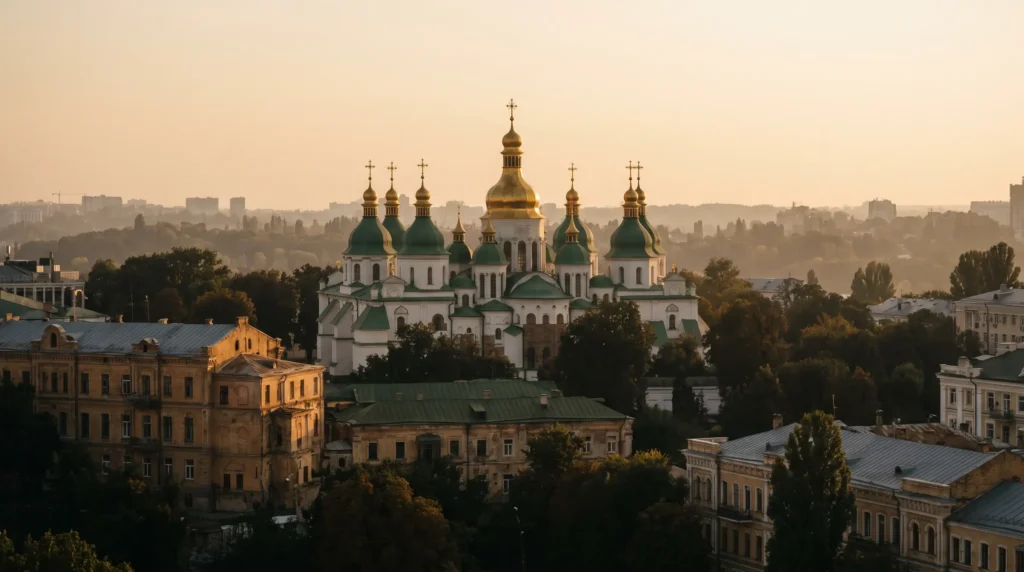
I have to open this one differently than any other guide on this site. Ukraine is currently under a US State Department Level 4 “Do Not Travel” advisory, the strongest warning the government issues, and the UK’s FCDO advises against all travel to most of the country and against all but essential travel to its five safest western regions. Ukrainian airspace is closed to commercial aviation, and Russia’s war against Ukraine has been ongoing since February 2022. This is not a guide telling you to book a flight. It is the guide I’d want to read myself — honest about what’s happening, respectful of a country that is very much still open, working and proud, and genuinely useful for the day travel there looks normal again, or for family, aid, and business travelers who have real reasons to be here now regardless. Ukraine is enormous, deeply historic, and — Saint-Sophia’s gold domes, borscht simmering in a hundred variations, Carpathian wooden churches older than most nations — worth understanding properly, war or no war.
In This Guide
- Overview — A Country Twice the Size of Most People’s Mental Map of It
- Why Ukraine Moved Christmas to December 25
- Best Time to Visit Ukraine — For When Travel Is Advisable Again
- Getting There — Closed Airspace, Land Borders & Rail
- Getting Around — Trains, Curfews & Checkpoints
- Top Regions — Kyiv, Lviv, Odesa & the Carpathians
- Culture & People — Language, Identity & Resilience
- A Food Lover’s Guide to Ukraine
- Off the Beaten Path (For When It’s Time)
- Practical Information & Safety
- Budget Breakdown — What Ukraine Costs in 2026
- Frequently Asked Questions
Overview — A Country Twice the Size of Most People’s Mental Map of It
Ukraine is the second-largest country in Europe by area after Russia, at roughly 603,628 square kilometers — bigger than France, bigger than Texas. It borders Russia to the east and northeast, Belarus to the north, Poland, Slovakia and Hungary to the west, Romania and Moldova to the southwest, and the Black Sea and Sea of Azov to the south. The capital, Kyiv, sits on the Dnipro River and is one of the oldest cities in Eastern Europe, with roots claimed back to the ninth century. Ukraine is a semi-presidential republic, independent from the Soviet Union since 1991, a founding UN member, and currently pursuing EU and NATO membership.
None of that geography or history is the reason Ukraine has been in the news since February 2022. Russia’s full-scale invasion has meant sustained ground combat in the east and south, and missile and drone strikes reaching cities nationwide, including the capital. The US State Department rates the whole country Level 4, “Do Not Travel”; nine western oblasts — Volyn, Lviv, Zakarpattia, Ivano-Frankivsk, Chernivtsi, Ternopil, Rivne, Khmelnytskyi and Zhytomyr — sit one notch lower at Level 3, “Reconsider Travel,” but remain within range of attacks. The UK’s FCDO advises against all travel to most of the country and against all but essential travel even to its calmer western corner.
What that means practically: this guide is not written for someone weighing Ukraine against Portugal for a beach week. It’s written for the people who do have real reasons to be here — visiting family, humanitarian and reconstruction work, journalism, business — and for anyone who wants to understand a country whose culture, cities and cuisine deserve attention on their own terms, independent of the war, and to have this guide ready the day it’s genuinely safe to visit again. Before the invasion, Ukraine was one of the world’s largest grain exporters and a growing stop on the Eastern European travel circuit; both are things worth rooting for, not things to write off.
Why Ukraine Moved Christmas to December 25
Here’s a small, telling story about a country redefining itself in real time. Since 1917, most Ukrainians had celebrated Christmas on 7 January, following the Julian calendar shared with the Russian Orthodox Church. In 2023, Ukraine’s parliament voted to move the official holiday to 25 December and the Orthodox Church of Ukraine adopted a Revised Julian calendar to match — meaning 2023 was the first year since the Russian Revolution that Ukrainians opened presents on the same day as most of Europe. The change, pushed through parliament within weeks of being proposed, was explicitly framed as cultural de-Russification — one more deliberate, symbolic step away from Moscow’s calendar and toward a European one.
It’s a useful lens for the whole country right now: Ukrainian identity is being actively, visibly reasserted — in language use, in street names, in which saints get a day off — even as the war continues. Independence Day on 24 August remains the other major date on the calendar, marking the 1991 vote to leave the USSR, though public gatherings have understandably scaled back since 2022 for security reasons.
Best Time to Visit Ukraine — For When Travel Is Advisable Again
The honest first answer: right now, “best time” isn’t the operative question — whether to go at all is, and for leisure travel the current advisories from the US and UK both say no. With that said, Ukraine’s climate is straightforwardly continental, and it’s worth knowing for planning ahead.
May – September · Warm season
The most comfortable stretch, with long days, average summer highs in the low-to-mid 20s°C across much of the country, and the Black Sea coast around Odesa warm enough to swim. This is also when pre-war tourism peaked.
October – November · Shoulder
Cooling fast, golden Carpathian foliage, fewer daylight hours — energy infrastructure strain has historically worsened here as winter approaches.
December – February · Winter
Cold, often snowy, especially inland and in the Carpathians. Winters have coincided with the heaviest strikes on the power grid and a declared nationwide energy emergency in recent years, so this is also historically the hardest season for anyone actually in the country.
When the security situation genuinely changes, watch the same advisory pages cited throughout this guide rather than general news — they update faster and more specifically than headlines do.
Getting There — Closed Airspace, Land Borders & Rail
There is currently no commercial air option: Ukrainian airspace has been closed since February 2022, and the FAA prohibits US aviation operations there entirely. Everyone entering Ukraine right now does so overland or by rail, typically via Poland (the Medyka–Shehyni crossing is the busiest), Romania, Hungary, Slovakia or Moldova, then onward by Ukrainian Railways, which has kept remarkably reliable service running even under wartime conditions and blackout risk.
For anyone with an actual, essential reason to travel — family, humanitarian work, journalism, business — expect thorough document checks at the border (passport, visa if required, proof of purpose of travel, roughly $60/day in demonstrable funds, and medical insurance), plus martial-law-related security measures once inside. Note too that Ukrainian men aged roughly 18 to 60 are generally barred from leaving the country under martial law and subject to mobilization — a real complication for dual nationals and anyone with Ukrainian family.
Getting Around — Trains, Curfews & Checkpoints
Domestic air travel is off the table while airspace stays closed, so Ukrainian Railways’ extensive network is doing the heavy lifting it always did, moving people between Kyiv, Lviv, Odesa and beyond on overnight sleeper trains that have become something of a symbol of wartime normalcy. Long-distance buses and private drivers cover routes trains don’t.
Curfews are in force nationwide, timing varies by city and shifts with the security situation, and checkpoints with document checks are routine on intercity roads. Blackouts from the energy emergency affect traffic lights, metro service and daily rhythms in ways that would surprise anyone used to Western European infrastructure reliability — locals plan around it; visitors should build in serious slack.
Top Regions — Kyiv, Lviv, Odesa & the Carpathians
Kyiv
The capital and cultural heart, home to two of Ukraine’s UNESCO World Heritage sites in one listing: Saint-Sophia Cathedral and the Kyiv Pechersk Lavra monastery complex, both inscribed in 1990 and both now on UNESCO’s endangered list because of the war. Kyiv has kept functioning — cafés, theatres and markets operate around air-raid alerts — but it remains squarely within a Level 4 zone.
Lviv
The historic centre of Lviv, a UNESCO site since 1998 and also now endangered, is Ukraine’s best-preserved old town — cobbled squares, Habsburg-era architecture, a serious coffeehouse culture. It sits in Lviv Oblast, one of the nine regions at the comparatively lower Level 3 advisory, and has functioned as an informal safe harbor and transit hub for the west of the country — though “comparatively lower” still means real risk, not an exemption.
Odesa
The Black Sea’s great port city, its historic centre added to the World Heritage list in 2023 and placed on the endangered register the same year — a UNESCO designation issued specifically to flag ongoing wartime threat to the site. Odesa’s grand 19th-century architecture, Potemkin Stairs and beach culture made it one of Ukraine’s biggest pre-war draws; it has also taken sustained strikes on port and energy infrastructure.
Zakarpattia & the Carpathians
The far southwest — Zakarpattia and Ivano-Frankivsk oblasts — holds Ukraine’s share of the Wooden Tserkvas of the Carpathian Region, eight timber churches shared with Poland on the UNESCO list, plus a slice of the Ancient and Primeval Beech Forests of the Carpathians, a transnational natural World Heritage site spanning 18 countries. This is mountain country — hiking, thermal baths, a Hungarian- and Romanian-influenced borderland feel — and sits among the Level 3 regions, furthest from the front lines.
Chernivtsi
Home to the Residence of Bukovinian and Dalmatian Metropolitans, a fantastical 19th-century seminary complex now part of Chernivtsi National University and a UNESCO site since 2011 — one of the country’s most architecturally surprising buildings, tucked in another of the nine lower-advisory western oblasts.
Kharkiv, Dnipro & the East
Ukraine’s second city, Kharkiv, and the industrial heartland around Dnipro sit closest to the fighting and have absorbed the heaviest damage of the war. There is no responsible tourism framing for this region right now; if you have essential reasons to be here, lean entirely on current advisory guidance and local contacts, not this or any other travel guide.
Culture & People — Language, Identity & Resilience
Ukrainian is the sole official language, though Russian and a blended vernacular called Surzhyk remain widely spoken, especially in the east and south — a linguistic map the war has actively reshaped, with a marked shift toward Ukrainian in daily life, media and signage since 2022. Cossack heritage runs deep in national identity — folk traditions, embroidered vyshyvanka shirts (worn proudly on Vyshyvanka Day each May), and a strong choral and folk-music tradition all trace back to it. The Orthodox Church of Ukraine, independent from the Russian Orthodox Church since 2019, is the majority faith.
The other defining cultural note of this decade is wartime civil society itself: volunteer logistics networks, drone-fundraising drives, and a blunt, dark, resilient national humor that shows up everywhere from graffiti to grocery-store small talk. Population figures are genuinely hard to pin down mid-war — pre-invasion Ukraine counted roughly 41 million people, and current estimates for government-controlled territory run lower amid displacement, with millions of Ukrainians registered as refugees abroad. Whatever the exact number, it’s a country whose diaspora right now is as large and as active as the population that remains.
A Food Lover’s Guide to Ukraine
Borscht is the headline dish — a beet-based soup with more regional variations than most countries have national dishes — and it carries a distinction few foods anywhere hold: UNESCO fast-tracked “the culture of Ukrainian borscht cooking” onto its Intangible Cultural Heritage in Need of Urgent Safeguarding list in 2022, explicitly because the war was disrupting the families and communities who keep the tradition alive. It’s a rare case of a soup recipe being recognized as an act of cultural survival.
Beyond borscht: varenyky (dumplings, sweet or savory — potato, cherry, and cottage cheese are classics), holubtsi (cabbage rolls), salo (cured pork fat, treated with genuine reverence), and medovik honey cake for dessert. Lviv in particular built a serious café culture pre-war, with its own coffee-roasting tradition and a playful “Lviv Handmade Chocolate” scene. Ukrainian wine (Odesa region) and horilka, the local vodka, round out the table.
Off the Beaten Path (For When It’s Time)
The Carpathian wooden tserkvas
Scattered timber churches across Zakarpattia and Ivano-Frankivsk, some centuries old, built without a single nail — a UNESCO-listed tradition shared with Poland and largely unknown outside architecture circles.
Kamianets-Podilskyi
A dramatic canyon-ringed old town in western Ukraine built around a medieval fortress — one of the country’s most photogenic, least internationally known sites.
Chersonese Taurica
An ancient Greek colony on the Crimean coast, UNESCO-listed since 2013 — currently entirely inaccessible to Western travelers given the peninsula’s occupation, and a stark reminder of how much of Ukraine’s heritage the war has placed out of reach.
Practical Information & Safety
Safety — read this first. The US rates all of Ukraine Level 4, “Do Not Travel,” citing active combat, missile and drone strikes reaching civilians nationwide, closed airspace, martial law and exit restrictions for Ukrainian men. The UK FCDO advises against all travel to most of the country and against all but essential travel even to its calmer western oblasts, and reports monthly civilian casualty counts in the thousands as of mid-2026. Travel insurance is typically invalidated once you travel against your government’s advice — factor that in fully before any essential trip.
Money. The hryvnia trades under a managed float against the US dollar (roughly 42–45 UAH per dollar through 2026), a policy the National Bank of Ukraine adopted in October 2023 after the initial wartime peg. Cards work widely in functioning cities; cash matters more where power and connectivity are unreliable.
Health. The CDC rates Ukraine Level 1 — “practice usual precautions” — for routine travel health, recommending standard and hepatitis A/B vaccination, and flags tick-borne encephalitis and Crimean-Congo hemorrhagic fever for extensive outdoor exposure. That rating covers disease risk only — it does not weigh conflict risk, which sits entirely in the State Department and FCDO advisories above.
Connectivity & power. A declared nationwide energy emergency has caused rolling blackouts affecting heat, water and internet in recent winters; a power bank and offline maps are not optional extras here. Time zone: UTC+2 (EET), UTC+3 in daylight saving months.
Budget Breakdown — What Ukraine Costs in 2026
These figures are reference points for essential travelers — family visits, humanitarian and reconstruction work, journalism, business — not a leisure-trip pitch. Ukraine remains inexpensive by European standards.
Budget (US$35–60/day): guesthouse or hostel in a functioning city, canteen-style meals and street food, rail and bus transport.
Mid-range (US$70–130/day): a mid-tier hotel, restaurant meals, private drivers where trains don’t reach.
Business/upscale (US$200+/day): Kyiv or Lviv’s better hotels (many now house press, NGO staff and business travelers), private security arrangements where warranted.
Fixed costs to plan for: proof of roughly $60/day in funds at the border, mandatory medical insurance, and travel insurance that — read the fine print — may not cover a country under a Do Not Travel advisory at all.
Planning Your First Trip to Ukraine
For nearly everyone reading this, the honest plan is: not yet — bookmark this guide, follow your government’s advisory page rather than headlines, and revisit when the picture genuinely changes. If you do have essential, non-tourism reasons to travel, route through a neighboring EU country first: most overland access runs via Poland (the Medyka crossing and Warsaw’s rail links), Hungary or Slovakia from the southwest, or Romania from the south — all worth their own trip regardless of what’s happening next door, and all covered on this site.
Frequently Asked Questions
Is it safe to travel to Ukraine right now?
No — not for leisure travel. The US rates the entire country Level 4, “Do Not Travel,” and the UK FCDO advises against all travel to most regions and against all but essential travel to the calmer western oblasts. Anyone with genuinely essential reasons to go should read both advisories in full and plan around martial law, closed airspace and unpredictable strikes, not around this or any general-interest guide.
Can I still fly into Ukraine?
No. Ukrainian airspace has been closed to commercial aviation since the February 2022 invasion, and the FAA prohibits US carriers from operating there. All entry currently happens overland or by rail via neighboring countries.
Do I need a visa?
For travel undertaken today, citizens of the US, UK, EU and Canada, along with over 100 other nationalities, can enter visa-free for up to 90 days in any 180-day period, and must show roughly $60/day in funds and proof of medical insurance at the border.
What about Ukrainian men leaving the country — does that affect dual nationals?
Yes. Ukraine’s martial law generally bars men of Ukrainian nationality aged roughly 18–60 from leaving, and dual nationals should expect this to apply to them too — a serious consideration for anyone with Ukrainian family links planning a visit.
Which UNESCO sites does Ukraine have, and are they at risk?
Eight: Kyiv’s Saint-Sophia Cathedral and Pechersk Lavra, the historic centres of Lviv and Odesa, the Carpathian wooden tserkvas, the Bukovinian Metropolitans’ Residence in Chernivtsi, the Struve Geodetic Arc, the transnational Carpathian beech forests, and Chersonese Taurica in occupied Crimea. Three — Kyiv, Lviv and Odesa — are formally listed as endangered because of the war.
What can I do if I’m not traveling but want to support Ukraine?
Beyond this guide’s scope for specific charities, cooking a real Ukrainian borscht, seeking out Ukrainian-owned businesses in your own city, and simply staying informed via primary sources rather than headlines all matter more than they might seem — and cost nothing.
A Country Worth Understanding, War or No War
I don’t have a cheerful send-off for this one, and I’m not going to manufacture one. Ukraine is a vast, historic country currently fighting for its existence, and the responsible version of a travel guide right now is one that tells you plainly not to go for a holiday, points essential travelers to the real safety resources, and keeps the door open — genuinely, factually open — for the day this guide gets to be about lobster-festival-style fun again instead of advisory levels. Until then: read, learn, cook the borscht, and keep half an eye on the State Department and FCDO pages linked throughout.
Explore More
- Poland Travel Guide — the main overland gateway for Ukraine access, and a serious destination in its own right
- Hungary Travel Guide — bordering Zakarpattia, with its own thermal-bath and Danube culture
- Romania Travel Guide — the southern border crossing and Ukraine’s Carpathian neighbor
- Slovakia Travel Guide — the compact western crossing point into Ukraine’s safer oblasts
How this guide was built
Published as part of Facts From Upstairs’ country guide series. Built from authoritative sources — the US State Department’s Ukraine travel advisory, the UK FCDO’s Ukraine travel advice, the US CDC’s Ukraine traveler health page, UNESCO’s Intangible Cultural Heritage inscription for Ukrainian borscht cooking, the National Bank of Ukraine’s official exchange rate data, Ukraine’s official Visit Ukraine entry-rules portal, and Wikipedia entity pages for Ukraine, its UNESCO World Heritage sites, and the 2023 Christmas calendar change. Numeric and safety claims carry inline citations, and given the fast-moving security situation, readers are urged to check the State Department and FCDO pages directly for the current advisory before making any decisions.
Sources cited on this page
- Wikipedia — Ukraine
- US State Department — Ukraine Travel Advisory
- UK FCDO — Ukraine Travel Advice
- US CDC — Ukraine traveler page
- Wikipedia — List of World Heritage Sites in Ukraine
- National Bank of Ukraine — Official Exchange Rates
- Visit Ukraine — Entry Rules 2026
- Wikipedia — Christmas in Ukraine
- UNESCO ICH — Culture of Ukrainian Borscht Cooking
More country guides you might like


Plan your trip to Ukraine
The booking tools we use ourselves. FFU may earn a commission at no extra cost to you.
Plan & book your trip to Ukraine
Booking through these searches supports our guides at no extra cost to you.