
Languages of Tanzania
All languages of Eastern Africa →fluent beta classical · classes by phone with Maya at ranas.ai/maya
Tanzania Travel Guide — Great Migration Safaris, Kilimanjaro & Zanzibar Spice Islands
Tanzania Travel Guide
📋 In This Guide
- Overview — Why Tanzania Belongs on Every Bucket List
- 🦓 Great Migration Serengeti 2026 — Calving Plains & River Crossings
- Best Time to Visit Tanzania (Season by Season)
- Getting There — Flights & Arrival
- Getting Around — Bush Flights, Ferries & the SGR
- Top Cities & Regions
- Tanzanian Culture & Etiquette
- A Food Lover’s Guide to Tanzania
- Off the Beaten Path
- Practical Information
- Budget Breakdown
- Planning Your First Trip to Tanzania
- Frequently Asked Questions
Overview — Why Tanzania Belongs on Every Bucket List
Tanzania is the rare country that holds almost every African postcard in a single passport stamp. In one fortnight a traveller can watch the Great Migration thunder across the Serengeti plains, stand on the 5,895 m summit of Kilimanjaro at dawn, descend into the 260 km² Ngorongoro Crater for the densest large-mammal game drive on Earth, and finish the trip barefoot on a reef-fringed Zanzibar beach eating coconut curry for a few dollars a plate. Few destinations pack this much scale into one itinerary.
Geographically, the United Republic of Tanzania covers 947,300 km² in East Africa, bordering eight countries and holding Africa’s highest point (Kilimanjaro) alongside parts of its deepest and largest lakes — Lake Tanganyika and Lake Victoria respectively. The country’s population is roughly 67 million and climbing fast, concentrated along the Indian Ocean coast, the northern safari circuit around Arusha, and the shores of the Great Lakes. Swahili and English share official status, and Swahili in particular functions as the unifying national language across more than 120 ethnic groups.
Culturally, Tanzania is one of the most peaceful and politically stable countries in sub-Saharan Africa. It was forged in 1964 by the union of mainland Tanganyika and the Zanzibar archipelago, under the socialist-leaning leadership of Julius Nyerere, and the country has never had a civil war. Zanzibar remains semi-autonomous with its own president, parliament and immigration stamp — a quirk visitors notice at the ferry terminal in Dar es Salaam. The mainland skews Christian, the coast and Zanzibar are predominantly Muslim, and the blend is visibly relaxed: mosques, churches and Maasai boma villages sit within the same half-hour drive across much of the north.
The bucket-list draws deliver at every scale. Seven UNESCO World Heritage Sites span the Serengeti, Ngorongoro, Kilimanjaro, Selous (now Nyerere National Park), Stone Town, Kondoa Rock-Art and the Kilwa-Songo Mnara ruins. The national cuisine runs from charcoal-roasted nyama choma and ugali on the mainland to cardamom-scented pilau and coconut curries on the Swahili coast. A bottle of Tanzanian Kilimanjaro lager on the beach costs under two dollars; a sundowner on the rim of Ngorongoro costs about the same as a London pint; and a full-board tented safari camp on the Serengeti plains will run several times what a European safari would, in exchange for lion roars at breakfast. Most travellers return within a decade.
🦓 Great Migration Serengeti 2026 — Calving Plains & River Crossings
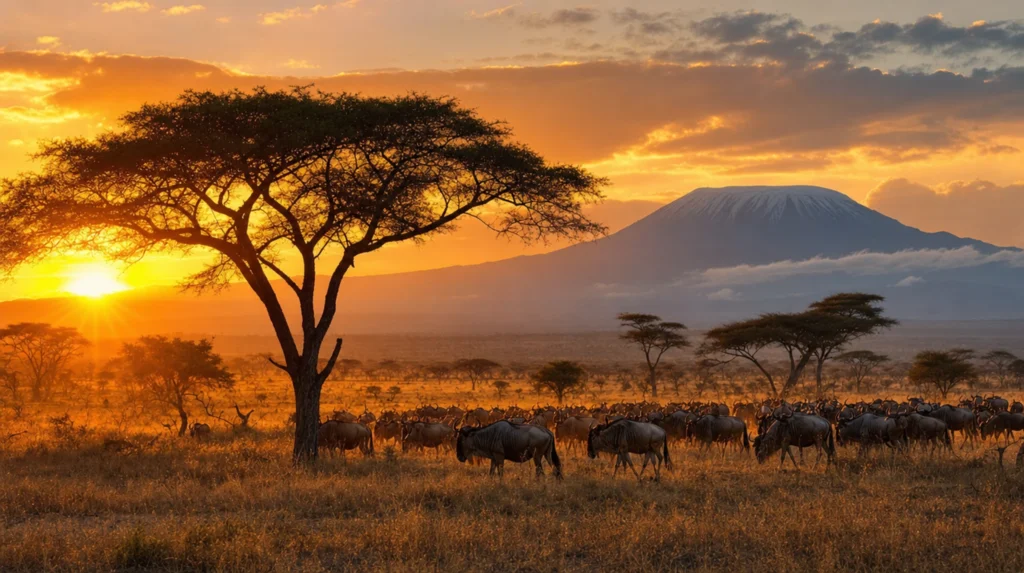
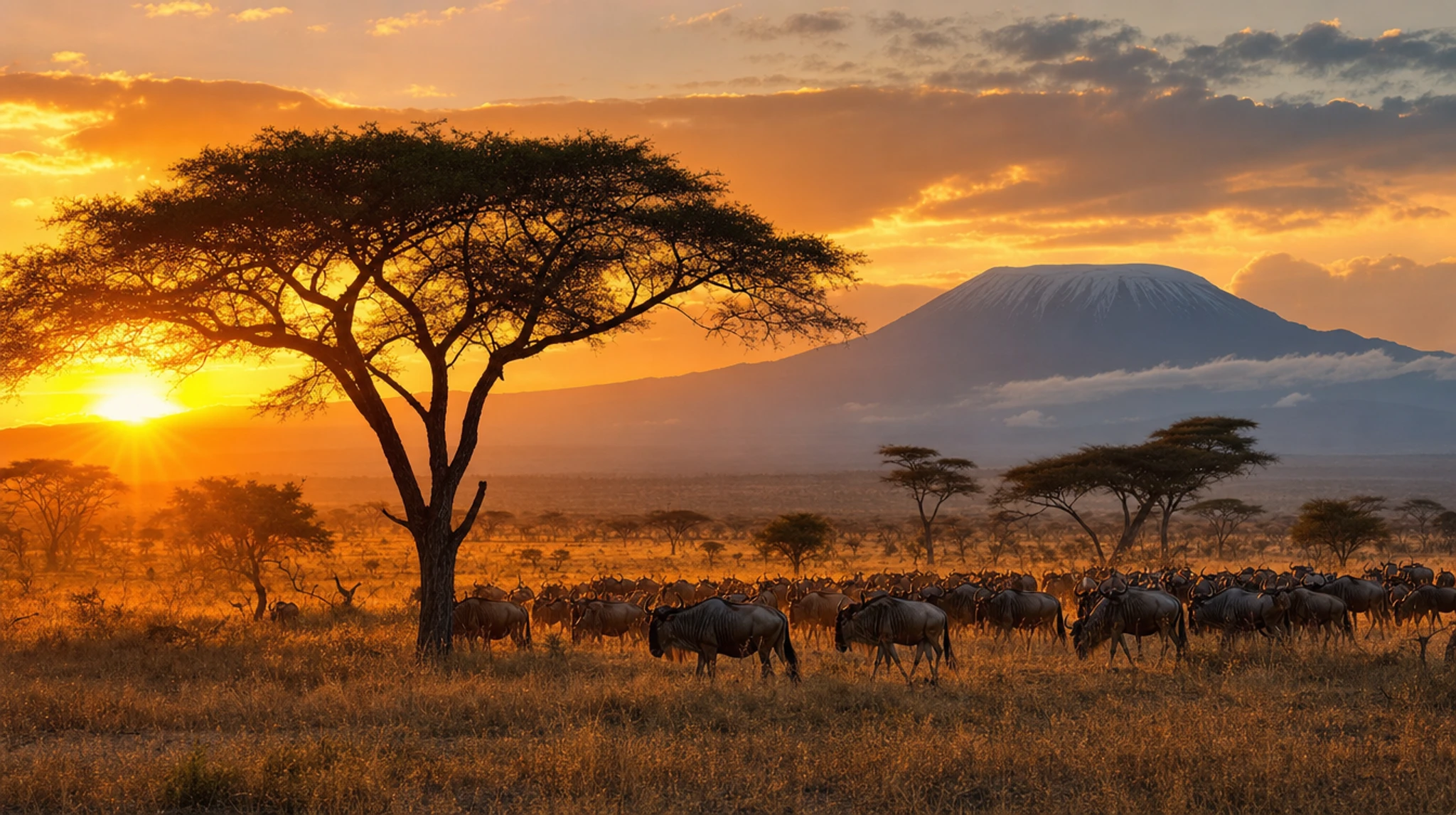
The Great Migration is not a single event — it is a year-round clockwise loop of roughly 1.5 million wildebeest, 300,000 zebra and 500,000 Thomson’s gazelle through the Serengeti-Mara ecosystem, of which Tanzania holds about 80%. Two moments sit above the rest on a bucket list. In late January and February the herds mass on the southern short-grass plains around Ndutu to calve, dropping more than 500,000 newborns in a three-week window that draws the highest predator concentration of the year. From June the herds swing northwest through the Grumeti and Western Corridor, reaching the Mara River in July; the dramatic crocodile-punctuated river crossings play out from July into October before the herds return south with the short rains.
Picking a camp location by month matters more than picking an operator. Mobile tented camps on the Ndutu plains, the Grumeti, and the Mara River follow the migration; fixed camps anchor on whichever section suits the season.
- First calving: late January 2026 (Ndutu short-grass plains, southern Serengeti)
- Peak calving window: 25 January – 20 February 2026
- Grumeti crossings: mid-June – mid-July 2026 (Western Corridor)
- Mara River crossings (Tanzania side): late July – mid-October 2026
- Southward return: November 2026 with the short rains (Loliondo, Lobo, central Serengeti)
- Ndutu (NCA) calving base: Ndutu Safari Lodge and mobile camps between the Serengeti and Ngorongoro boundaries
Best Time to Visit Tanzania (Season by Season)
Tanzania sits just south of the Equator, so it does not run on a four-season Northern-Hemisphere calendar. Expect two dry seasons and two wet ones — and plan around what each gives you in terms of wildlife, altitude climbs and beach weather. The northern safari circuit, Zanzibar coast and Kilimanjaro all follow the same rhythm, with minor altitude-driven variations.
Short Dry / Calving (Dec–Feb)
Temperatures run 20–32°C on the plains and coast. This is calving season in the southern Serengeti, peak beach weather on Zanzibar, and a strong secondary Kilimanjaro climbing window with clear skies between the rains. The Sauti za Busara music festival fills Stone Town in early February and the short dry window ends abruptly in early March. Book at least 6–9 months ahead for Ndutu-based camps and north-coast Zanzibar villas, which hit Christmas-and-New-Year peak pricing with minimum stays.
Long Rains (Mar–May)
Daily thunderstorms soak the northern circuit and 18–30°C days can feel much hotter with humidity. Many private mobile camps close entirely and some Zanzibar hotels shut for renovations, especially in late April and May. The upside is low-season pricing — savings of 30–50% on lodge rates — plus almost empty Ngorongoro Crater drives and vivid-green landscapes. Kilimanjaro climbs are risky in this window, with wet, slick forest sections and low summit success.
Long Dry / Migration (Jun–Oct)
The peak window. Days are 15–28°C, skies are clear, dust hangs on the plains, and wildlife concentrates at shrinking waterholes. Mara River crossings unfold July–October; Kilimanjaro’s Machame and Lemosho routes run near-continuous daily departures with the highest summit success rates of the year. The Zanzibar International Film Festival (ZIFF) lands in early July, adding a Stone Town cultural anchor. Book Serengeti northern-sector camps 9–12 months out and expect international rates to peak in July–August.
Short Rains (Nov–early Dec)
Afternoon storms return but mornings stay drivable, with temperatures of 19–30°C. The migration herds start moving south from the Mara toward the calving plains, so central and northern Serengeti camps still see superb game. Rates drop 20–35% from the August peak, and Zanzibar’s beaches remain warm with occasional heavy showers. A good value window if you can tolerate an hour of rain on most days.
Shoulder-season tip: Late June and late October are the sweet spots — dry enough for game viewing and climbing, but without the peak-August pricing or the crowds at Mara River crossing points.
Getting There — Flights & Arrival
Tanzania has three international gateways, each serving a different itinerary. Julius Nyerere in Dar es Salaam handles the commercial and Zanzibar-ferry traveller. Kilimanjaro International is the airport for the northern safari circuit and any Kilimanjaro climb. Abeid Amani Karume receives direct flights from Europe and the Gulf straight onto Zanzibar, skipping the mainland altogether.
- Julius Nyerere International (DAR) — Tanzania’s largest airport; 12 km from central Dar with taxis to the CBD in 30–45 minutes.
- Kilimanjaro International (JRO) — 50 km from Arusha, the safari capital; most lodges offer shuttle transfers to northern-circuit gateways.
- Abeid Amani Karume International (ZNZ) — 7 km from Stone Town with taxis in about 20 minutes.
Flight times: London to Kilimanjaro or Dar es Salaam is about 9–10 hours non-stop on KLM, British Airways or Turkish Airlines via Istanbul; Dubai to Dar is 5 hours with Emirates and flydubai; New York to Dar is a 17-hour one-stop via Doha or Addis Ababa.
Flag carriers: Air Tanzania plus regional links on Precision Air, Coastal Aviation and Auric Air.
Visa / entry: Most nationalities need an eVisa issued online before arrival, at USD $50 for a single-entry tourist visa and up to 90 days. Zanzibar issues a separate arrival stamp even for mainland arrivals.
Getting Around — Bush Flights, Ferries & the SGR
Tanzania is large, roads outside the main corridors are slow, and most safari itineraries string together a chain of light-aircraft hops between bush airstrips. A typical northern-circuit trip arrives into Kilimanjaro, spends two or three nights in Arusha/Ngorongoro by road, then charter-flies in and out of Serengeti airstrips before returning south. Zanzibar is a separate 25-minute flight or 2-hour ferry from Dar es Salaam.
- Standard Gauge Railway (SGR): Dar es Salaam–Morogoro–Dodoma; modern electric, max speed 160 km/h.
- Dar es Salaam → Zanzibar: ~2h ferry with Azam Marine or ~25 min flight on Coastal Aviation.
- Arusha → Serengeti (Seronera airstrip): ~1h 10m light-aircraft charter.
- Arusha → Ngorongoro Crater (road): ~3h / 180 km on the B144 via Karatu.
Domestic flights: Coastal Aviation, Auric Air, Precision Air and Air Tanzania link the main safari and coastal airstrips. A one-way JRO–ZNZ fare typically costs USD $140–220 when booked a month ahead.
Car hire & safari vehicles: Self-drive is possible but almost everyone uses a guided 4×4 with a driver-guide at USD $180–350 per vehicle per day including fuel and park entry. Petrol was TSh 3,190 per litre in early 2026.
Urban transport: Dar has BRT (Dar Rapid Transit) phases 1 & 2 running on Morogoro and Kawawa roads; dala-dala minibuses cover everywhere else. Zanzibar Stone Town is walkable, and taxis negotiate a flat fare.
Apps: Bolt runs in Dar, Arusha and Zanzibar; Uber is spottier; Google Maps handles navigation; maps.me works offline in the parks.
Top Cities & Regions
📍 Map of Tanzania: Every Place in This Guide
🏙️ Dar es Salaam
Tanzania’s largest city and economic capital — but, unusually, not the political capital. Dar wraps around a natural Indian Ocean harbour and functions as the commercial engine, the main international gateway and the ferry port for Zanzibar. It is hot, loud, humid and genuinely Swahili in feel: Muslim calls to prayer at dawn, Kivukoni dhow fishermen by 7 am, and nyama choma grills smoking from 6 pm. Food is pilau rice, coconut fish curry and grilled mishkaki from waterfront stalls.
- National Museum and House of Culture — Olduvai Gorge artefacts and Nyerere-era independence exhibits
- Kivukoni Fish Market and the dhow harbour at dawn
- Coco Beach, Oyster Bay and Slipway Waterfront for sunset
🏛️ Dodoma
Tanzania’s official political capital since the National Assembly formally relocated in 1996, Dodoma sits on the arid central plateau and is very different in tempo to Dar. Parliament (Bunge) meets here, most ministries have their headquarters here, and the surrounding Central Line railway terminus and Dodoma vineyards — Tanzania’s small but real wine region — give it a quieter, drier character. Food is ugali, nyama choma and Maasai-style roast goat.
- Parliament (Bunge) buildings and the Nyerere Square civic district
- Central Line terminus and the Dodoma vineyards (Cetawico and Alko tastings)
- Kondoa Rock-Art Sites (UNESCO) within a 150 km day-trip radius
🦓 Serengeti
Tanzania’s flagship safari ecosystem and arguably the most famous savannah on Earth. Serengeti National Park covers 14,763 km² of short-grass plains, kopjes and river systems, and forms the core of a larger Serengeti-Mara ecosystem spanning Tanzania and Kenya. The Great Migration cycles through year-round and the central Seronera area offers dense resident game. Food here is bush breakfast buffets, nyama choma at camp, and coffee brewed over acacia-wood coals.
- Great Migration calving (Ndutu) and Mara/Grumeti River crossings
- Seronera Valley central plains — lions, cheetahs and leopards year-round
- Hot-air balloon safaris at sunrise followed by champagne breakfast
🌋 Ngorongoro
A UNESCO-listed volcanic caldera and the highest-density large-mammal destination in Africa. The crater floor covers 260 km² and holds a resident population of roughly 25,000 large mammals including lion, elephant, rhino, buffalo and hippo. Maasai communities co-manage the surrounding Ngorongoro Conservation Area, giving the region a living-cultural dimension the parks further north lack. Food is ugali with roast goat from a Maasai boma, plus full-board lodge breakfasts on the crater rim.
- Crater floor game drive — Big Five typically seen in a single morning
- Olduvai Gorge archaeology site and the Leakey family’s dig trails
- Maasai boma cultural visits on the crater rim
🏔️ Kilimanjaro
Africa’s highest point at 5,895 m and the world’s tallest freestanding mountain, climbable without technical equipment. Roughly 50,000 climbers attempt Uhuru Peak each year, with summit success rates running 60–85% depending on route and days allocated. Moshi is the base town — a relaxed coffee-farm hub with a thriving trekking industry — and Marangu, Machame, Lemosho and Rongai are the main ascent routes. Food is machalari (banana-and-meat stew), ugali and plenty of porter-style carbs.
- Uhuru Peak summit by the Marangu, Machame or Lemosho route (6–9 days)
- Shira Plateau volcanic terrain and the Barranco Wall scramble
- Moshi coffee-plantation tours and Chagga village homestays
🏝️ Zanzibar
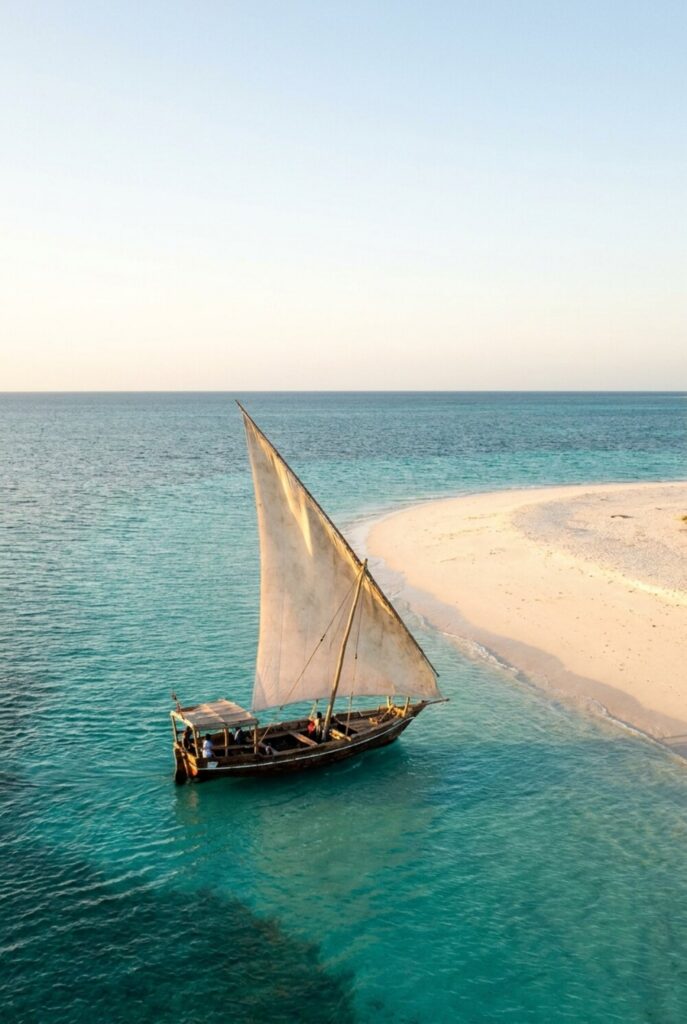
A semi-autonomous Indian Ocean archipelago with its own president, parliament and immigration stamp. Stone Town’s UNESCO-listed old quarter is a 19th-century Swahili-Arab-Indian trading town; the north-coast beaches at Nungwi and Kendwa are the country’s beach headline; and inland spice farms are the origin story for Zanzibar’s historic role in the global clove trade. Food is coconut curry, cardamom pilau, Zanzibar pizza and urojo soup at Forodhani Gardens night market.
- Stone Town UNESCO old quarter — Forodhani Gardens, House of Wonders, Old Fort
- Nungwi and Kendwa north-coast beaches (non-tidal swimming)
- Jozani Chwaka Bay — red colobus monkey forest and mangrove boardwalk
Tanzanian Culture & Etiquette — What to Know Before You Go
Tanzania is one of Africa’s most diverse countries — more than 120 ethnic groups, from the pastoralist Maasai and Sukuma of the mainland to the Swahili-Arab-Indian blend of the coast — and yet it functions with unusual social cohesion. Swahili is the glue. Nearly everyone speaks it as a first or second language, and its use across schools, parliament and markets was a deliberate post-independence policy under Julius Nyerere. Religion divides roughly evenly between Christian (mainland) and Muslim (coast and Zanzibar) communities, and the two sit alongside each other with unusual grace; the Zanzibar stamp reminds you the archipelago is formally 99% Muslim, and dress norms there are more conservative than on the mainland.
The Essentials
- Greet before you ask anything. A full “Habari yako?” or “Mambo?” followed by a handshake or fist-bump is the default — skipping straight to a question is read as rude.
- Tipping is expected: 10% at urban restaurants; USD $15–25 per guest per day combined to safari guide/tracker teams; USD $10–15 per day to Kilimanjaro porters (split among the team).
- Dress modestly off the resort beaches — shoulders and knees covered in Stone Town, mosques and Maasai villages; swimwear belongs on the sand, not in town.
- Use the right hand for eating, greeting and passing items. The left is considered unclean for any shared action.
- Photograph people only after asking — “Naomba picha?” (“May I take a photo?”) costs nothing and is often answered with a smile. Maasai villages charge a small fee.
Safari Lodge & Kilimanjaro Etiquette
- Stay inside the safari vehicle at all times in national parks unless your guide has dismounted first; predators read a 4×4 as one non-prey shape.
- Tip the Kilimanjaro porter team through the KPAP-recognised envelope system on the final descent day, not individually mid-trek.
- Whisper around a sighting and keep phones on silent; clicking shutters are fine but flash is forbidden.
- Neutral clothing (khaki, brown, olive) in the bush; avoid bright white and dark blue (tsetse-fly attractant).
A Food Lover’s Guide to Tanzania
Tanzanian food splits neatly in two. On the mainland, the staple plate is charcoal-grilled meat and a carbohydrate — nyama choma with ugali in the north, pilau or wali (rice) with beans further south, mishkaki skewers at every roadside stand. On the Swahili coast and Zanzibar, Indian Ocean trade rewrote the recipe book: coconut milk, cardamom, cloves, tamarind, ginger and chilli turn fish and rice into something closer to a Kerala or Omani kitchen than to a Great-Lakes one. Expect to pay TSh 8,000–15,000 (USD $3–6) for a local lunch, TSh 30,000–60,000 (USD $12–24) for a mid-range dinner with a Kilimanjaro lager, and USD $90–180 per person for full-board dining at a premium safari lodge.
Must-Try Dishes
| Dish | Description |
|---|---|
| Ugali | Stiff white maize-meal porridge eaten with the right hand, pinched into a ball and used to scoop stew. The everyday starch across mainland Tanzania and the closest thing the country has to a national dish. |
| Nyama choma | Swahili for “grilled meat” — charcoal-roasted goat, beef or chicken served in bone-in chunks with kachumbari (tomato-onion-chilli relish) and ugali. The default weekend meal across the mainland. |
| Pilau | Zanzibar-style spiced rice cooked with cardamom, cumin, cloves and cinnamon, plated with beef, chicken or goat. A wedding-day favourite and the Swahili-coast counterpart to biryani. |
| Samaki wa nazi (coconut fish curry) | Coastal Swahili curry built on fresh coconut milk, tamarind, ginger and locally landed kingfish, snapper or tuna. Served over rice; Zanzibar’s signature dinner dish. |
| Mishkaki | Marinated beef or goat skewers charred over open coals at roadside stands from Dar to Mwanza. The country’s default street food — usually served with ugali, chips mayai omelette or hot chapati. |
| Zanzibar pizza & urojo | Forodhani Gardens night-market classics: a thin flatbread folded around egg, meat and vegetables (Zanzibar pizza) plus urojo mango-turmeric soup served with bhajia fritters and cassava chips. Eaten standing up by the harbour wall. |
Markets, Street Food & Swahili Coffee Culture
Tanzania’s food culture lives on the street, not in the supermarket. Forodhani Gardens in Stone Town turns into a nightly open-air grill from about 6 pm, with 40–50 stalls selling Zanzibar pizza, urojo and grilled lobster. Kivukoni Fish Market in Dar is the dawn theatre of the city’s day — fishermen landing kingfish, snapper and octopus off dhow sterns. On the mainland, Shoprite and Village Supermarket chains cover imported needs, and roadside mama ntilie stalls serve the cheapest real meals in town. Kilimanjaro lager is the default beer; Tusker crosses over from Kenya; and the Dodoma winery region produces a small but respectable output. Tanzanian Arabica coffee — grown on the slopes of Kilimanjaro and Mount Meru — is the country’s quiet culinary win.
- Markets & grills: Forodhani Gardens (Stone Town), Kivukoni Fish Market (Dar), Chef’s Pride and Mamboz Corner BBQ (Dar), Khan’s BBQ (Arusha)
- Signature items: Kilimanjaro lager, Amarula cream liqueur, dates and samosas from Stone Town, Tanzanian Arabica coffee
- Coastal fruit routine: Mafia Island mangoes, Zanzibar spice-farm pineapples, coconut water from a machete-cut shell for TSh 1,000
Vegetarians and vegans do well in Tanzania. Indian restaurants in Dar, Stone Town and Arusha (Khan’s BBQ, Chowpatty, Chapan Bhog) run full meat-free thalis for TSh 15,000–25,000, and coastal coconut curries with beans or okra are standard on almost every menu. Rural mainland menus lean meat-forward, but maharagwe (red-bean stew) and mchicha (African spinach in coconut) are nearly always available.
Off the Beaten Path — Tanzania Beyond the Guidebook
Ruaha National Park
Tanzania’s largest national park at 20,226 km² and the anchor of the southern safari circuit. Ruaha holds roughly 10% of Africa’s remaining lion population and some of the continent’s largest elephant herds, set in miombo woodland and baobab-studded savannah that looks nothing like the Serengeti. Access is by 1h 45m charter flight from Dar or a full-day drive from Iringa. Camps are a fraction of the price of the northern circuit and vehicle densities are rarely above two or three at a sighting.
Nyerere National Park (formerly Selous)
Upgraded in 2019 from a hunting reserve to Africa’s largest national park at 30,893 km². The Rufiji River threads through the park and enables boat safaris and fly-camping river walks that no northern-circuit park can offer. Lion, leopard, wild dog, hippo and crocodile are reliably seen; the park also holds one of the largest remaining populations of African wild dog in the world.
Mafia Island Marine Park
A small Indian Ocean island south of Zanzibar, reachable by 30-minute flight from Dar, with almost none of Zanzibar’s resort density. Whale sharks congregate in Kilindoni Bay from October to February and can be snorkelled with on short boat trips. Pole Pole, Kinasi and Butiama are the three longest-running lodges. The coral reefs inside Mafia Island Marine Park are the most intact in the country and dive sites like Dindini Wall and Chole Bay outperform the equivalents off Unguja.
Mahale Mountains National Park
On the eastern shore of Lake Tanganyika, Mahale is one of only two places on Earth where travellers reliably see wild chimpanzees (the other is Gombe, just north). A community of roughly 60 habituated chimps lives on the forested slopes above the lake. Getting there requires a charter flight into Mahale airstrip and a 2-hour boat transfer along the world’s second-deepest lake. Greystoke Mahale has been a National Geographic pick for years.
Kondoa Rock-Art Sites
A cluster of Sandawe and Irangi rock shelters near the village of Kolo, inscribed as a UNESCO World Heritage Site in 2006 for a collection of paintings that includes some dated at least 2,000 years old and some possibly reaching back 19,000 years. The sites are a 3-hour drive from Dodoma along rough dirt tracks; local guides out of Kolo village handle the scramble up to the shelters and the interpretation.
Practical Information
The table below covers the questions travellers ask most often. Every row cites an official government or industry source, and the currency, visa and vaccination rows in particular should be rechecked the week of departure. The Tanzanian shilling and eVisa portal are the two moving targets — confirm both 10 days out.
| Currency | Tanzanian shilling (TSh / TZS); 1 USD ≈ 2,550 TSh (April 2026). |
| Cash needs | Cash-first economy outside top-tier lodges and Stone Town boutiques. Carry USD notes (post-2013, unmarked) for visas, park fees and tips; TSh for meals, taxis and markets. |
| ATMs | CRDB, NMB, NBC and Stanbic ATMs in Dar, Arusha, Moshi, Stone Town and Dodoma. Daily withdrawal caps are typically TSh 400,000–1,000,000. |
| Tipping | Restaurants 10%; safari guide/tracker USD $15–25 per guest per day combined; Kilimanjaro porter team USD $10–15 per guest per day split. |
| Language | Swahili and English are both official; Swahili dominates daily life and English covers almost all tourist-facing services. |
| Safety | US State Department Level 2 (Exercise Increased Caution) — petty theft in Dar and Stone Town at night; otherwise low violent-crime risk. |
| Connectivity | Vodacom, Airtel or Halotel SIM for TSh 15,000 with 10–20 GB; Airalo eSIM from USD $6. 4G covers cities and main safari corridors; no signal in central Serengeti and Nyerere. |
| Power | Type D and G plugs, 230V / 50Hz. A UK adapter covers most outlets. |
| Tap water | Not potable — stick to sealed bottled water or lodge-filtered supplies. Avoid ice outside premium hotels. |
| Healthcare | Aga Khan Hospital (Dar) and The Arusha Lutheran Medical Centre handle travellers with insurance; yellow fever certificate required from certain countries; malaria prophylaxis recommended year-round. |
Budget Breakdown — What Tanzania Actually Costs
💚 Budget Traveller
USD $55–90 (TSh 140,000–230,000) per day covers a backpacker-style trip outside the main safari parks. Dorm beds in Stone Town, Dar and Moshi run TSh 25,000–45,000; local guesthouses (nyumba za wageni) run TSh 40,000–80,000 for a private room. A mama ntilie lunch costs TSh 5,000–8,000 and Zanzibar pizza at Forodhani is TSh 6,000–10,000. National park fees make the Serengeti itself impossible at this level, but Nyerere (Selous) offers shared camps from USD $180 per night and Mikumi has self-drive camping for USD $35.
💙 Mid-Range
USD $350–650 (TSh 890,000–1.66M) per day is a realistic per-couple mid-range budget when the trip includes a northern safari. A 3★ lodge in Karatu, Moshi or Arusha runs TSh 250,000–500,000 per room, restaurant dinners with beer come in at TSh 35,000–60,000 per head, and park fees alone are USD $82.60 per person per day for the Serengeti and Ngorongoro. A shared game-drive vehicle with a driver-guide is USD $250–350 per day; charter flights JRO–Serengeti add USD $220–340 one-way.
💜 Luxury
From USD $1,400 (TSh 3.57M) per person per day upward, with no real ceiling. Flying-safari itineraries at Singita, andBeyond, Nomad, Asilia and Legendary Expeditions run USD $1,500–3,800 per person per night all-inclusive, covering twice-daily game drives, all meals, imported spirits, laundry and lodge charter transfers. A private Kilimanjaro climb on the 8-day Lemosho route with a leader-to-climber ratio of 1:2 runs USD $5,500–8,000 per person. A Zanzibar north-coast villa at Mnemba Island or &Beyond Benguerra equivalents books at USD $2,400–4,800 per couple per night.
| Tier | Daily (USD) | Accommodation | Food | Transport |
|---|---|---|---|---|
| Budget | $55–90 | Dorm TSh 25,000–45,000 | Mama ntilie TSh 5,000–10,000 | Bus / dala-dala / ferry |
| Mid-Range | $350–650 | 3★ lodge TSh 250,000–500,000 | Restaurant TSh 35,000–60,000 | Shared 4×4 USD $250–350/day |
| Luxury | $1,400+ | Lodge USD $1,500–3,800 | Full-board at camp | Charter flights + helicopter |
Planning Your First Trip to Tanzania
First trips to Tanzania stumble in predictable ways — visitors underestimate the charter-flight costs, skip the yellow-fever certificate, or try to climb Kilimanjaro on a 5-day Marangu itinerary and fail to summit. Work through the five steps below in order and the rest of the planning clicks into place.
- Apply for the Tanzania eVisa online at least 10 days before departure. A single-entry tourist visa is USD $50 for up to 90 days; most nationalities qualify online.
- Pick the loop: Northern Circuit (Tarangire + Ngorongoro + Serengeti + Zanzibar) is the classic 10–14-day trip; add Kilimanjaro for a 17–20-day combination; swap to Nyerere / Ruaha for a lower-cost southern-circuit alternative.
- Book Serengeti camps and premium Zanzibar villas 9–12 months out for July–October and December–February; shoulder periods can still be booked 3–4 months ahead.
- Visit a travel clinic 6 weeks out for yellow fever (required if arriving from certain countries), malaria prophylaxis and routine boosters.
- Pick your Kilimanjaro route with care. Marangu is the cheapest but shortest and has low summit rates; Machame is the most popular; Lemosho (7–8 days) has the highest success rates and best acclimatisation profile.
Classic 14-Day Itinerary: 1 day Arusha arrival → 2 days Tarangire → 2 days Ngorongoro Crater & Karatu → 4 days Serengeti (central + northern) → 5 days Zanzibar (Stone Town + Nungwi or Kendwa) departing ZNZ.
Frequently Asked Questions
Is Tanzania expensive to visit?
It depends on whether your trip includes the northern safari circuit. Outside the parks, Tanzania is one of the cheaper destinations in sub-Saharan Africa — a local lunch is USD $3–6 and Zanzibar beach bungalows start at USD $80. Inside the parks, fees alone push daily costs to USD $600–1,500 per couple. Budget the trip in two halves.
Do I need to speak Swahili?
No — English is the working language of tourism, signage and business, and almost every guide, lodge and driver speaks it fluently. Learning a few Swahili phrases is warmly received: Jambo (hello), Asante sana (thank you very much), Karibu (welcome), Hakuna matata (no problem) and Pole pole (slowly, slowly — the Kilimanjaro mantra).
Is the Tanzania eVisa worth applying for in advance?
Yes, always. The official online system at eservices.immigration.go.tz costs USD $50 for a single-entry tourist visa and issues the approval in 7–10 working days. Visa-on-arrival is still theoretically available at Kilimanjaro, Dar and Zanzibar airports, but queues regularly exceed two hours in peak season and some airlines now refuse boarding without a pre-approved eVisa.
Is Tanzania safe for solo travellers?
Broadly yes. The US State Department rates Tanzania Level 2 — Exercise Increased Caution — largely for petty theft in urban areas. Dar and Stone Town require the normal big-city caution after dark; safari lodges and Zanzibar beaches are extremely safe. Solo female travellers consistently report smooth trips; dressing modestly off resort beaches and sticking to registered taxis at night are the main practical precautions.
When is the best time for a safari?
Two clear windows. June–October is the long dry season with Mara River crossings, sparse vegetation and the highest-quality all-round game viewing. January–February is calving season in the southern Serengeti — peak predator action at 30–40% lower rates than August. The long rains (March–May) are cheap but many camps close.
Can I get by as a vegetarian or vegan?
Yes, especially in Dar, Arusha and Stone Town, which have strong Indian restaurant scenes offering full thalis. Coconut-based curries with beans, okra and spinach are standard on every coastal menu; maharagwe (red-bean stew) and mchicha (spinach in coconut) cover mainland meals. Safari lodges cater easily.
Do I need a separate visa for Zanzibar?
No separate visa, but yes a separate immigration stamp. Zanzibar is semi-autonomous with its own immigration authority, so ferry and flight arrivals from the mainland are processed through a dedicated counter at the terminal. The Tanzania eVisa covers both mainland and Zanzibar.
Ready to Explore Tanzania?
From Ndutu calving plains at dawn to Uhuru Peak summit photographs and Nungwi dhow sunsets, Tanzania delivers more variety per fortnight than any country on the continent. Plan around the dry seasons, budget for one or two charter flights, and leave a few unplanned afternoons for the Zanzibar beach that you will not want to leave.
Explore More
Cities we cover in Tanzania
Cities to explore in Tanzania
Deep-dive guides to specific cities, neighbourhoods, and food scenes — written with the same magazine voice.
More country guides you might like
Plan your trip to Tanzania
The booking tools we use ourselves. FFU may earn a commission at no extra cost to you.
Plan & book your trip to Tanzania
Booking through these searches supports our guides at no extra cost to you.