
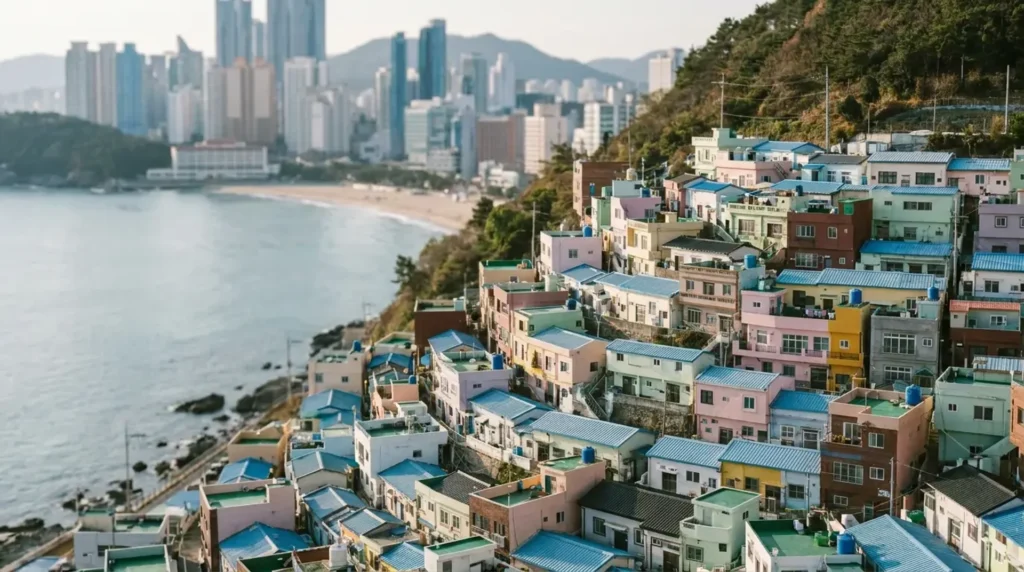
Busan, South Korea: Where Seafood Markets Meet Neon Beach Bridges
Part of our South Korea travel guide.
Busan City Guide
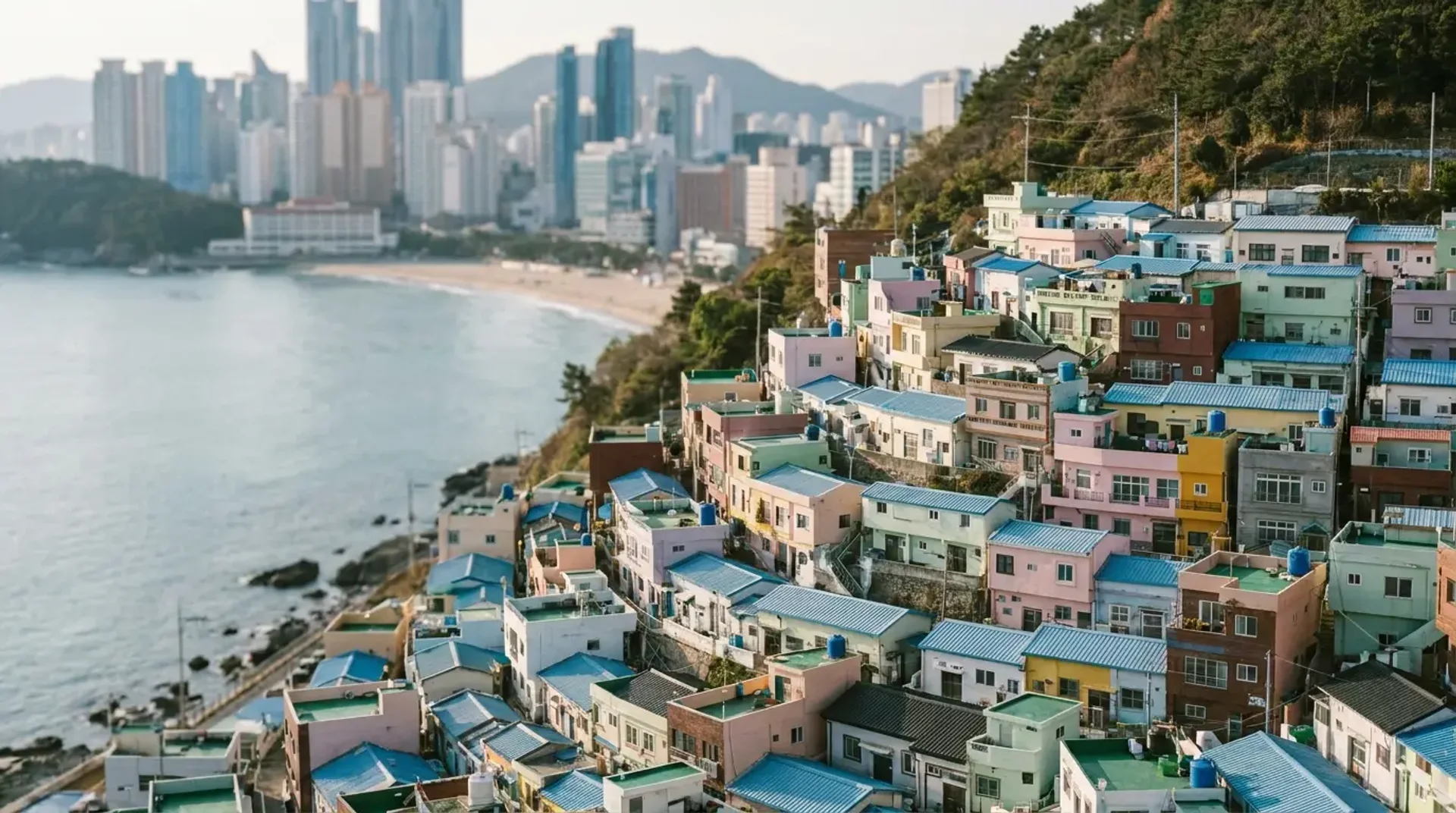
Table of Contents
Why Busan?
Busan is the port city where Korea unbuttons its collar. South Korea's second-largest metropolis and its busiest seaport, Busan runs a 380-kilometre horseshoe of coastline from Haeundae's resort beach in the east to Dadaepo's estuary sunsets in the west, pinned together by seven public beaches, the LED-lit 7.4-kilometre Gwangan Bridge, and a fish market that has been selling mackerel off the same quay since 1889. Where Seoul is vertical, formal and freshly-pressed, Busan is horizontal, coastal and loud: the waitresses shout in the Gyeongsang-do dialect, the baseball fans at Sajik Stadium wear supermarket plastic bags on their heads as good-luck helmets, and the ajummas at Jagalchi will slap a live octopus onto a cutting board in front of you without breaking eye contact.
At 3.3 million residents inside the city limits and roughly 5 million across the Busan-Ulsan-Gimhae mega-region, Busan is the industrial engine of the south-east, the home port for more than 40% of Korean-flagged container traffic, and — for one weekend every October — the film capital of Asia, when the Busan International Film Festival (BIFF) lights up the 4,000-seat Busan Cinema Center and spills down onto BIFF Square in Nampo-dong. It is also the warmest of Korea's three big cities, with a sub-tropical-leaning coastal climate that keeps January daytime highs around 8°C while Seoul is at -6°C, a differential that turns Busan into the domestic "summer capital" from mid-May through early October and still drives Seoulites down on the 2h15 KTX for New Year's Day sunrises at Haeundae.
Busan was designated a UNESCO Creative City of Film in 2014 and hosts the only major international film festival in East Asia with a permanent architect-designed home — the 163-metre cantilevered roof of the Busan Cinema Center, the longest in the world at the time of its 2011 completion. The other superlative worth flagging is Jagalchi: Korea's largest seafood market by volume, moving tens of thousands of tonnes of product a year through a seven-storey steel-and-glass complex remodelled in 2006. Over the course of this guide you will get our pick of ten neighbourhoods worth structuring a visit around — from the painted Korean-War refugee slopes of Gamcheon Culture Village to the Joseon-era hot-spring waters at Dongnae — a full tour of Busan milmyeon noodles, dwaeji gukbap pork-and-rice soup and Jagalchi sashimi, practical routes to Haedong Yonggungsa's cliffside temple and the 28-minute KTX hop across to UNESCO-listed Gyeongju, plus the 2026 festival calendar, from the Haeundae Sand Festival in late May to BIFF in late September and the Busan Fireworks Festival over Gwangan Bridge at the end of October.
Neighborhoods: Finding Your Busan
📍 Busan Map: Every Place in This Guide
Busan is divided into 15 gu (districts) and 1 gun across 770 km² of coast, ridge and river-delta, but travellers only need to learn a shortlist. Eight separate mountain spurs push down to the coast, so the centre is less a single plain and more a necklace of distinct harbour pockets linked by Line 1 and Line 2. First-timers tend to base in Haeundae for the beach or Seomyeon for shopping, then commute outward. The ten neighbourhoods below cover every itinerary from a two-night seafood sprint to a seven-day deep-dive, each anchored to a subway exit or bus route. Together they touch all seven public beaches, both KTX stations, the two main fish markets (Jagalchi and Millak), the Busan Cinema Center, and the city's three most-visited temples.
Haeundae
Haeundae is Busan's resort front door: a 1.5-kilometre crescent of white sand bracketed by the Chosun Beach hotel at one end and the Westin Josun at the other, with a Marine City skyline of Signiel-branded luxury towers rising directly behind. It is the single most-photographed slice of Busan and the neighbourhood where most first-time visitors should base themselves. The beach itself opens officially for swimming 1 June – 31 August and runs supervised lifeguard service, 700 rented parasols, and showers for ₩2,000. Behind the sand the streets stack restaurants, raw-fish rooms and the glittering Busan Aquarium (Sea Life), and the eastern end of the beach rises into Dongbaek Island, a 1-kilometre shaded coastal walk circling a headland of camellia trees to a clifftop viewing pavilion with the best sightline in the city across to the Gwangan Bridge. Haeundae Market, a five-minute walk north of the beach, is the local dinner option for affordable hoe and hotteok.
- Haeundae Beach — 1.5 km of supervised sand, official swim season Jun-Aug.
- Dongbaek Island coastal path — 1 km camellia-forest walk to APEC Nurimaru House.
- The Bay 101 — waterfront bar and marina with the viral Marine City night-skyline shot.
- Busan Aquarium (Sea Life) — three-floor tank complex under the promenade.
Best for: beach resorts, first-timers, family seafood dinners. Access: Line 2 Haeundae Station, Exit 3 or 5.
Seomyeon
Seomyeon is Busan's downtown core, the interchange of Line 1 and Line 2 and the neighbourhood the locals actually spend their Friday nights in. The six-block shopping grid around Seomyeon 1-beonga fires up around 18:00 with street-food stalls, Olive Young beauty flagships, Uniqlo, Zara and Daiso. Seomyeon is also home to Medical Street, a two-block concentration of plastic-surgery and dermatology clinics that pulls medical tourists from across Asia. Lotte Department Store Busan Main and the adjacent Lotte Hotel Busan are the anchor retail-and-accommodation pairing for travellers who want to be in the centre of everything, and the underground shopping arcade that runs for 600 metres beneath Seomyeon Station (more than 500 individual stalls) is the rainy-day plan. Hotels here run from capsule dorms at ₩25,000 to the 5-star Lotte at ₩280,000 per night, and the commute to Haeundae is 18 minutes on Line 2, to Nampo 8 minutes on Line 1.
- Seomyeon 1-beonga food alley — 4 blocks of BBQ, pojangmacha and chimaek.
- Lotte Department Store Busan Main — 11-floor flagship with rooftop sky garden.
- Seomyeon Medical Street — 200+ clinics in a two-block grid.
- Seomyeon Underground Shopping Centre — 600 m arcade linked to the station.
Best for: first-timers, shopping, central hotels and connections. Access: Lines 1 & 2 Seomyeon Station (interchange), Exit 7.
Nampo-dong & Busan Station
Nampo is the old harbour downtown, stretched between Busan Station (the KTX terminus) and the Jagalchi waterfront. This is where travellers arriving from Seoul on the 2h15 KTX will first step out, and it is also the neighbourhood of BIFF Square, Gukje Market, the 120-metre Busan Tower in Yongdusan Park, and the food-stall chaos of Kkangtong Market. The pedestrianised main drag of Gwangbok-ro closes to cars most weekend afternoons for street performance and is where the Busan Christmas Tree Festival strings up 1.5 million lights from December to early January. Nampo is grittier and more working-port than Haeundae, with an older demographic, cheaper seafood, and a film-history thread that runs from the 1950s when Busan doubled as the wartime film production capital through BIFF's 1996 founding and the Walk-of-Fame handprints embedded in the square's paving.
- Jagalchi Market — Korea's largest seafood market (see §Food).
- BIFF Square — handprint-star plaza, open-air cinema screen.
- Gukje Market — 1,500+ stalls, post-Korean-War refugee bazaar origin.
- Busan Tower — 120 m observation tower in Yongdusan Park (₩12,000).
Best for: seafood hunters, KTX arrivals, film-history walkers. Access: Line 1 Nampo Station (Exit 1) or Jagalchi Station (Exit 10); Busan Station (KTX + Line 1).
Gwangalli
Gwangalli is Busan's "second beach" and arguably the more stylish of the two — a 1.4-kilometre strip of cafes, rooftop cocktail bars and sashimi rooms facing directly onto the illuminated 7.4-kilometre Gwangan Bridge. The beach itself is shorter and less sheltered than Haeundae but makes up for it with the night skyline: the Gwangan Bridge's LED lighting runs choreographed colour shows year-round, and every Saturday at 20:00 the Busan Metropolitan Government stages a free 500-drone light show directly over the water, a programme launched in 2023 and expanded to 1,000 drones during BIFF. The beach-front strip of Gwangan-ro is dense with craft-cocktail bars and natural-wine rooms, and the Millak Raw Fish Town — a three-floor municipal sashimi complex — sits on the beach's eastern edge with 60 individual fish-tank stalls. The Namcheon-dong cafe alley, one block inland, is the third-wave-coffee cluster pulling Seoulites down for weekend day-trips.
- Gwangalli Beach — 1.4 km strand facing Gwangan Bridge.
- Gwangan Bridge — 7.42 km LED-lit double-decker, nightly colour shows.
- Millak Raw Fish Town — 60-stall sashimi complex, pay-to-eat-upstairs system.
- Namcheon-dong cafe strip — third-wave roasters and natural-wine rooms.
Best for: nightlife, bridge photography, craft-cocktail weekends. Access: Line 2 Gwangan Station, Exit 3 or 5.
Gamcheon Culture Village
Gamcheon is the most photographed hillside in South Korea after Bukchon: a terraced refugee village on the slopes above Toseong-dong, built from the early 1950s by displaced Korean War families and reinvented as a public-art neighbourhood from 2009 under a municipal revitalisation programme. The houses are painted in pastel pinks, mints and blues, stacked on 45-degree lanes drawing constant comparisons to Santorini. It is still a living residential neighbourhood — roughly 4,000 people live here — so rules are strict: no photography of residents' doorways, and a map-stamp trail with 12 checkpoints keeps tourist flow on waymarked streets. Pick up the stamp map (₩2,000) at the Gamcheon Information Centre. The Little Prince & Fox sculpture is the most Instagrammed spot; the Haneul Maru sky observatory is free and gives the full panorama. Allow 2 hours plus a cafe stop.
- Little Prince & Fox sculpture viewpoint — 2013 art installation.
- Haneul Maru sky observatory — free panoramic deck at the top of the village.
- Gamcheon Map Stamp Trail — 12 stamp points, ₩2,000 map from the info centre.
- Sky-blue staircase cafe cluster — third-wave coffee above the village.
Best for: photography, slow walking, public art. Access: Line 1 Toseong Station (Exit 6) + bus 2, 2-2 or Sacheon 1-1 up the hill.
Yeongdo
Yeongdo is the peninsular island district connected to downtown by drawbridge, best known for Taejongdae Resort Park at its southern tip — a 4-kilometre coastal cliff loop of pine forest, white lighthouse and carved stone arches where the park train (Danubi Train, ₩4,000 all-day) loops the headland for anyone who doesn't feel like walking the full circuit. The Jeoryeong Coastal Walk, a 6.4-kilometre boardwalk along the eastern cliffs, is one of the most dramatic coast-side hikes in any Korean city, and the Huinyeoul Culture Village on the island's north coast is a smaller, quieter cousin to Gamcheon with painted seaside houses clinging to the cliff edge and a dense row of cafes facing the container-ship traffic at Busan Port. Yeongdo's industrial heritage (shipbuilding, fish canning) still operates alongside the tourism, which gives the district a lived-in feel Haeundae has lost.
- Taejongdae Resort Park — 4 km clifftop loop with 1906 lighthouse.
- Jeoryeong Coastal Walk — 6.4 km boardwalk along east cliffs.
- Huinyeoul Culture Village — cliff-edge painted-house cluster.
- National Maritime Museum — free, with Busan-port history galleries.
Best for: coastal hiking, cinematic ocean walks, half-day nature escapes. Access: Line 1 Nampo Station + city bus 8, 13, 30, 66 or 186.
Centum City & Marine City
Centum City is the planned 21st-century waterfront built on reclaimed Suyeong Bay land and holds three of the most visited buildings in the city: Shinsegae Centum City (the Guinness World Record holder for the world's largest department store at 293,905 m² of retail floor), the Busan Cinema Center (the BIFF home, with its 163-metre cantilevered LED-lit roof, the longest in the world at completion in 2011), and BEXCO (the convention centre). Marine City, immediately east, is a ring of 60-storey luxury towers and hotels (Signiel Busan, Park Hyatt Busan) arranged around a marina. A 3 km waterside walking loop from Centum City through BEXCO to the Haeundae APEC Nurimaru House makes the classic cross-Centum itinerary. Come here for department-store shopping, Spa Land jjimjilbang inside Shinsegae, and the film festival in late September.
- Shinsegae Centum City — Guinness World Record largest department store.
- Busan Cinema Center — 4,000-seat BIFF home with LED-lit cantilevered roof.
- BEXCO — 93,000 m² convention centre.
- Spa Land at Shinsegae — premium spa with 22 thermal rooms.
Best for: shopping, film festival, convention visitors, luxury stays. Access: Line 2 Centum City Station, Exit 6 or 12.
Dongnae & Oncheonjang
Dongnae is the Joseon-era administrative district north of the city core, pre-dating the harbour settlements by several centuries and built around the hot-spring waters at Oncheonjang, where bath culture has operated continuously for roughly 1,300 years. Heosimcheong Spa here is the world's largest hot-spring bathhouse at around 3,000 m² of water area, with 40 individual baths spread across multiple temperatures and mineral compositions, and is the reason most Busan locals still take a Sunday afternoon for a three-hour soak. Dongnae-eupseong Fortress, a reconstructed Joseon-era walled town on a hilltop ten minutes' walk from the station, gives a good 1.5-hour walking circuit with four gates and a restored command post; the 1592 Battle of Dongnae against the invading Japanese is the historical event commemorated at the adjacent shrine. The Bokcheon-dong Burial Mounds Museum displays roughly 150 Gaya Kingdom tombs (3rd-6th century CE) uncovered in situ, and is the city's most important pre-historic site.
- Heosimcheong Spa — world's largest hot-spring bathhouse.
- Dongnae-eupseong Fortress walking trail — Joseon-era reconstructed walled town.
- Bokcheon-dong Burial Mounds Museum — in-situ Gaya-era graves.
- Dongnae Hyanggyo — Confucian school hall.
Best for: hot-spring spas, Joseon history, older-demographic locals. Access: Lines 1 & 4 Dongnae Station (interchange).
Songdo Beach
Songdo Beach, on the western side of the harbour and not to be confused with Songdo in Incheon, is Korea's oldest designated public bathing beach: it opened in 1913 and served as the primary seaside escape for Busan residents for most of the 20th century before Haeundae overtook it in the 1990s. It has had an architectural renaissance since 2017 with the 365-metre Songdo Skywalk (free) and the Songdo Air Cruise Cable Car (₩20,000 return), a 1.62-kilometre aerial line that swings across the bay between Songnim Park and Amnam Park at a maximum height of 86 metres. The beach itself is 800 metres of smaller-grained sand and more sheltered water than Haeundae — a better choice for families with young children. Amnam Park on the cable car's western terminus is a rocky-coast nature reserve with a boardwalk and a small museum of Busan-coast marine life.
- Songdo Beach — Korea's first public beach (1913), 800 m sand.
- Songdo Air Cruise Cable Car — 1.62 km aerial ride (₩20,000 return).
- Songdo Skywalk — 365 m curved boardwalk over the bay.
- Amnam Park coastal reserve — rocky-shore boardwalk.
Best for: families with young children, cable-car photography, historic-beach interest. Access: Line 1 Jagalchi Station + bus 6, 7, 9, 30 or 71.
Haedong Yonggungsa & Osiria Coast
The north-eastern coast of Busan is the least-visited of the travel-worthy zones and the one with the single most important religious site in the city: Haedong Yonggungsa, a cliffside Buddhist temple founded in 1376 and perched directly over the East Sea, unusual for a Korean temple in being coastal rather than mountain-bound. The 108-step granite stairway descending from the car-park gate to the main hall is the signature approach; time a visit for sunrise, particularly around 1 January when Koreans travel from across the country for the new-year first light. Immediately inland, the Osiria Tourism Complex bundles Lotte World Adventure Busan (the country's newest theme park, opened March 2022), the Osiria Railbike along the former coastal line, the Ananti Cove luxury resort, and the National Marine Museum annex. Songjeong Beach, 1.2 kilometres long and popular with surfers, is two stops east on the Donghae Line.
- Haedong Yonggungsa Temple — 1376 cliffside Buddhist temple (free).
- Lotte World Adventure Busan — opened March 2022, ₩59,000 day pass.
- Songjeong Beach — 1.2 km surf beach.
- Osiria Railbike — coastal railbike on the decommissioned Donghae line.
Best for: sunrise temple photography, theme parks, surfers. Access: Line 2 Haeundae + bus 181; or the Donghae Line Osiria Station directly.
The Food
Busan's food identity is simple to state and endlessly rewarding to explore: this is Korea's saltwater kitchen. The city catches, lands, auctions and serves more seafood than any other in the country, and the three dishes Busan claims as its own — milmyeon wheat-noodle cold soup, dwaeji gukbap pork-and-rice soup, and raw hoe sashimi — are all postwar inventions from the 1950s refugee-rebuild years, when displaced northern cooks worked with whatever starches and proteins were available. Seafood at Jagalchi and Millak is sold live and priced by the kilogram downstairs then cooked or served raw at a modest per-head fee upstairs; a two-person hoe dinner with banchan, soju and a view of the Gwangan Bridge clocks in around ₩70,000 (~$51) and is the defining Busan meal. The city also has a distinct (and spicier) chilli-and-garlic profile compared to Seoul — visitors coming down from the capital consistently report dwaeji gukbap, kal-guksu and any hoe-deopbap rice-bowl running two ticks hotter in Busan than the Seoul equivalent.
Busan Seafood: Milmyeon, Dwaeji Gukbap & Hoe
Start with the three city-signature dishes. Milmyeon is Busan's answer to Pyongyang naengmyeon: thin wheat noodles (milgaru, not buckwheat) in an icy beef-broth served with mustard, vinegar and a wedge of hard-boiled egg, invented by North Korean refugees in the 1950s when buckwheat was unavailable. Dwaeji gukbap is the pork-bone-and-rice soup that you'll smell wafting out of every alley in Seomyeon and the Dwaeji Gukbap Street near Busan Station — a milky simmered-for-ten-hours pork broth over rice with boiled pork slices, served with a plate of saeujeot salted-shrimp and gochu-jang for seasoning your own bowl at the table. Hoe (Korean sashimi) is the Jagalchi main course, traditionally eaten with ssamjang, raw garlic and lettuce leaf in the ssam wrap style. Other Busan-signature dishes: eomuk (fish cakes, the Busan-made brand Samjin is Korea's oldest running since 1953), ssiat-hotteok (seed-stuffed pancake invented at BIFF Square in the 1960s), and ajjimaek-gua (Busan-style kimchi pancake).
- Nampo Myeonok (Nampo-dong) — 60-year-old milmyeon reference house. ₩8,500 (~$6.25) for the standard bowl.
- Halmae Gukbap (Seomyeon) — the default dwaeji gukbap order in Busan, open 1956. ₩9,000 (~$6.60).
- Ssangdungi Dwaeji Gukbap (Seomyeon) — the other end of the pork-soup rivalry, family-run since 1946. ₩9,500 (~$7).
- Chowon Bokguk (Nampo) — puffer-fish (bokguk) soup, a premium winter speciality. ₩15,000 (~$11).
- Samjin Eomuk Flagship (Yeongdo) — eat-in fish-cake bakery opened 1953. Skewers from ₩2,000 (~$1.50).
Jagalchi & Millak: Market Dining
Jagalchi is the country's largest seafood market by volume, occupying a seven-storey steel-and-glass complex at the Nampo-dong waterfront that was remodelled in 2006 to replace the earlier canvas-and-tarpaulin stalls that had operated on the same quay since 1889. The ground floor is the live-fish sales floor where the ajumma vendors will haggle you down on a kilogram of flounder, halibut, sea urchin, abalone or the famous Busan king crab; the second floor is the sashimi restaurant floor, and the rule is that if you bought the fish downstairs you pay a flat ₩5,000 per person surcharge to have it cleaned, sliced and served upstairs with banchan and a soju cup. Expect to spend ₩40,000-90,000 (~$29-66) for two people including drinks. The fourth-floor market restaurants serve cooked seafood (haemul-pajeon pancakes, jjigae stews, haemul-tang) at fixed prices if you'd rather skip the negotiation. Closed the first and third Tuesday of each month. Millak Raw Fish Town on Gwangalli Beach is the alternative with bay views: 60 individual stalls stacked three floors, same pay-to-serve system, with the added bonus that your dinner table looks directly across the water at the LED-illuminated Gwangan Bridge.
- Jagalchi Market 1F/2F hoe system — buy downstairs, pay ₩5,000/pp upstairs to serve. Total ₩40,000-90,000 (~$29-66) for 2-3 pax.
- Millak Raw Fish Town (Gwangalli) — 60-stall sashimi complex with bridge view. ₩60,000-100,000 (~$44-74) for 2.
- Gomso Halmae Jip (Jagalchi) — grilled eel (jangeo gui). ₩35,000 (~$26).
- Haeundae Market Hoe row — 15 walk-in sashimi rooms one block north of Haeundae Beach. Set menu ₩45,000 (~$33) for 2.
- Modeum-hoe platter (Jagalchi 2F) — mixed-fish tasting-portion sashimi ₩50,000-80,000 (~$37-59).
- Sea-urchin bibimbap (Gijang Market) — ₩25,000 (~$18) speciality at Busan's north-east fishing harbour.
Korean BBQ: Busan's Charcoal Room
Busan sits within the beef-producing Gyeongsang-do region and is the country's second-best city for Korean barbecue after Seoul, with a Haeundae-and-Seomyeon corridor of hanwoo houses serving premium Korean beef at slightly gentler prices than the Gangnam equivalents. The classic Busan BBQ assembly is the same as the national one — samgyeopsal pork belly or hanwoo beef grilled on charcoal, wrapped in lettuce with ssamjang, raw garlic and kimchi — but two local variants worth hunting: dwaeji-galbi (marinated pork short rib, traditionally sweeter in Busan than Seoul) and the charcoal-only speciality houses in the Gupo neighbourhood that still fire oak sut-bul (hardwood charcoal) rather than gas or briquette. Lunch BBQ sets start around ₩11,000 per person; a Haeundae hanwoo dinner runs to ₩60,000-80,000 per 150 g portion of premium beef. Most mid-range places will grill the first round for you and leave you to flip the rest; Haeundae premium houses keep a dedicated attendant throughout.
- Haeundae Amso Galbijip — 1964-founded hanwoo galbi speciality house. ₩55,000 (~$40)/portion.
- Geumgang Sikdang (Seomyeon) — oak-charcoal samgyeopsal, local crowd. ₩14,000 (~$10)/portion.
- Gupo Myeongga (Gupo) — dwaeji-galbi marinated pork rib. ₩13,000 (~$9.50)/portion.
- Miga Hanu (Centum City) — premium hanwoo omakase, inside Shinsegae. ₩90,000 (~$66) per tasting.
- Saeng Galbi Alley (Seomyeon 1-beonga) — six-stall cluster of under-₩15,000 charcoal-grill houses.
Michelin & BIFF-Fringe High-End
Busan does not yet have a Michelin Guide of its own — only Seoul and Busan's larger sibling cities are published — but the Korean Blue Ribbon Survey and Diners Club Tabelog guides have built a clear upper tier, and the BIFF fringe each September-October brings in a wave of Seoul-based chefs and Japanese omakase masters running week-long pop-ups. The premium scene is concentrated in three neighbourhoods: Haeundae (resort-hotel rooms and omakase counters), Centum City (department-store fine dining) and the Cheongsapo headland cafe strip east of Haeundae. Omakase sushi menus start around ₩120,000 per head at the mid-tier and climb to ₩250,000+ at the top end (Mori, Taesung, Kyojin), with reservations opening 30 days out on Catch Table or by direct WhatsApp. The best-value upper-tier experience is one of the hotel Sunday brunches: the Park Hyatt Busan Living Room brunch is ₩180,000 per head (~$132) with an 18-course bay-view buffet and is widely rated the single best weekend dining deal in the city. Dress codes at the omakase counters are smart-casual at a minimum.
- Mori (Haeundae) — Busan's most celebrated omakase sushi, 10-seat counter. ₩180,000 (~$132).
- Fiotto (Centum City) — Italian fine dining with Jeju and Busan seafood focus. ₩95,000 (~$70) tasting.
- Park Hyatt Dining Room (Marine City) — 30th-floor bay-view contemporary Korean. ₩150,000 (~$110) dinner.
- Taesung Sushi (Haeundae) — premium edomae omakase. ₩220,000 (~$162).
- Signiel Busan Fabian — 67th-floor French, the city's highest dining room. ₩200,000 (~$147).
Beyond Hoe: Street Food, Chimaek and Night Markets
Busan's street-food strongholds are BIFF Square in Nampo-dong and Kkangtong Market (literally "tin-can market"), the covered night-market alley that runs parallel to BIFF Square and fires up every evening from 19:00 to 23:30. The signature BIFF-Square bite is ssiat-hotteok — a syrup-filled fried pancake cut open and stuffed with sunflower, pumpkin, peanut and sesame seeds, invented here in the 1960s and now priced at ₩2,000 (~$1.50) each. Kkangtong Market runs a longer menu: Busan-style tteokbokki, ddakkochi (grilled chicken skewers, ₩3,000), twigim (fried vegetables, ₩5,000 for a variety plate) and grilled eomuk fish cakes on skewers. Gukje Market, directly adjacent, adds sundae (blood-sausage) and mandu (Korean dumplings) at the west entrance. Chimaek — fried chicken and beer — is everywhere; the Busan-originated brand BHC Chicken operates a flagship in Seomyeon and the beach-blanket delivery culture at Gwangalli and Haeundae is as strong as anything in Seoul's Han River parks, with Baemin scooters dropping chicken sets onto the sand between 18:00 and midnight. Expect to spend ₩25,000-32,000 (~$18-24) for a whole fried chicken plus two draught beers for two people. The Busan-specific drinking pairing to know: grilled eomuk with soju at a pojangmacha tent by the harbour — ₩3,000 a skewer, ₩4,000 a soju bottle, and all the briny salt-and-charcoal atmosphere the postcard promised.
Cafes, Convenience Stores & Breakfast
Busan has developed a strong third-wave-coffee identity in the last five years, concentrated in Namcheon-dong (one block inland from Gwangalli), the Cheongsapo headland east of Haeundae, and around the Bosu-dong Book Alley west of BIFF Square. Signature venues: Momos Coffee (Jeonpo branch), the 2019 World Barista Champion's roastery; Cafe Gulle, perched on the Huinyeoul cliff edge of Yeongdo with a view directly onto container-ship traffic; and Waveon, a three-storey ₩7,000-coffee waterfront cafe at Gijang that is arguably the most photographed cafe in South Korea after any of the Seoul flagships. The Cheongsapo strip alone holds more than a dozen sea-view cafes stacked along the cliff road between Haeundae and Songjeong, with lines out the door on weekend afternoons and a standard pour-over-plus-dessert order landing around ₩15,000 (~$11) per head. Convenience stores — CU, GS25, 7-Eleven, Emart24 — are a genuine eating category: a Busan commuter breakfast is a triangle gimbap (₩1,200), a banana-milk, and a microwave-hot gyeran-bbang (egg bread) at the counter, for a total under ₩4,000. Korean breakfast proper is not a distinct meal category — the same hansik rice, soup and banchan that appear at lunch reappear at breakfast — but the Busan speciality morning order is haejang-guk (hangover soup) at a Jagalchi workers' kitchen or a dwaeji gukbap at any Seomyeon basement house, 05:30 onward, ₩9,000-10,000 (~$6.60-7.40). Banchan are free and refillable in Busan as elsewhere in Korea; ask "banchan jom deo juseyo" for more. A pojangmacha tent-bar dinner of eomuk skewers, soju and spicy rice-cake is the defining Busan night-eating experience and sits under ₩20,000 (~$15) for one. For a distinctly Busan sweet finish, hunt down Gijang-style ssiat-hotteok from the BIFF Square carts or a slice of dalgona honeycomb candy at Gukje Market (₩2,000) — both are postwar refugee-era inventions that have survived into the city's modern cafe culture unchanged.
Cultural Sights
Haedong Yonggungsa Temple (해동 용궁사)
Haedong Yonggungsa is Busan's signature religious site and one of the few Korean Buddhist temples built directly over the sea rather than in a mountain valley. Founded in 1376 by the monk Naong during the Goryeo Dynasty, rebuilt after Japanese colonial destruction in the 1930s, and rebuilt again in 1970, the complex clings to a rocky promontory on the East Sea coast north of Haeundae. Admission is free and the temple opens daily from 04:30 to 19:30 for visitors. The approach is a 108-step granite stairway through a stone gate archway (the number corresponds to the 108 earthly desires of Buddhist doctrine) descending to the main Daeungjeon hall; the Haesu Gwaneum Daebul golden Bodhisattva sits on a cliff platform facing the open ocean and is the most photographed single element. Time the visit for sunrise — Koreans travel from across the country for new-year's first light here on 1 January, and the main shrine bell is rung 33 times at midnight on 31 December. Allow 60 minutes.
Beomeosa Temple (범어사)
Beomeosa, tucked into a valley of Geumjeongsan mountain in northern Busan, is the oldest major temple in the city and one of the five great head temples of the Jogye Order of Korean Seon (Zen) Buddhism. Founded in 678 CE during the Silla Dynasty, Beomeosa's one-pillar entrance gate (Iljumun) dates to the early 17th-century reconstruction after the Imjin War, and the present three-storey stone pagoda at the main hall is designated a national treasure. Admission is free (donations welcomed). Sunrise and sunset are particularly atmospheric; the temple is a 5-minute bus ride up from Line 1 Beomeosa Station. Beomeosa also runs a Templestay programme — one-night cultural stays in monks' quarters with vegetarian meals, meditation sessions, and a 04:00 dawn ceremony, priced ₩70,000-90,000 per head. The 1.5-kilometre hike up to the Geumjeong Fortress ridge above the temple is the best half-day mountain walk inside Busan city limits.
Gamcheon Culture Village
Gamcheon is a living residential neighbourhood and a free public-art zone rather than a paid attraction, although the ₩2,000 map-stamp trail is effectively the entry ticket. The village dates to the early 1950s Korean War refugee settlement and has been a public-art project since 2009, when the Busan city government funded 11 commissioned installations across the hillside's 4,000 residential units to anchor a tourism-regeneration programme. Photography restrictions apply at residents' private doorways; the map-stamp trail (12 checkpoints, ₩2,000 from the Information Centre) is the approved walking route. Open 09:00-18:00 for facilities, but the alleys themselves are always open. Allow 2-3 hours for a thorough walk. Dress for steep stairs.
Jagalchi Market
Jagalchi is Korea's largest seafood market and a Busan icon in its own right; it is covered in depth in the Food section, but the market complex also functions as a daytime sightseeing walk even if you don't plan to eat. Origins go back to 1889 when the first formal mackerel-landing quay was built on this site; the present seven-storey glass-and-steel rebuilt in 2006 covers around 33,000 m² of floor. Hours: 05:00-22:00 (second-floor restaurants to 23:00), closed the first and third Tuesday of each month. The Jagalchi Festival runs in October and is the city's largest food event. Free entry. Combine with the adjacent BIFF Square and Gukje Market for a three-hour Nampo walking loop.
Busan Tower & Yongdusan Park
The 120-metre Busan Tower has stood on the Yongdusan ridge above Nampo-dong since 1973 and was comprehensively refurbished as Diamond Tower Busan in 2021, with a new observatory experience, a 360-degree bay-view deck, and an expanded LED-light night show. Observatory admission is ₩12,000 (~$8.80), open 10:00-22:00 daily. The surrounding Yongdusan Park is a green-lung ridge accessible by free escalator from the Gwangbok-ro shopping street or by the slightly more scenic 250-step climb; the park also holds a statue of Admiral Yi Sun-sin, a floral clock installation, and the main Jagalchi Fireworks viewpoint on festival nights. The tower's lower floors contain a K-pop wax museum and a small Busan maritime-history exhibition.
UN Memorial Cemetery
The United Nations Memorial Cemetery in Nam-gu is the only UN-designated cemetery in the world, established in 1951 for the remains of UN Command soldiers killed during the Korean War and formally dedicated in 1955. It holds 2,300 interments from 11 nations (UK, Turkey, Canada, Australia, Netherlands, France, Korea, USA among them) on 14 hectares of manicured lawn, water basins and a memorial service hall. Admission is free, open 09:00-17:00 daily. The adjacent Peace Park is a quieter space with sculptures. Understated but historically significant; budget 45-60 minutes and pair with the Busan Museum across the street.
Gwangan Bridge & Busan Cinema Center
Two landmark pieces of 21st-century architecture that define modern Busan. Gwangan Bridge (opened 2003) is a 7.42-kilometre twin-deck suspension crossing Suyeong Bay, illuminated by a programmable LED system that runs choreographed colour shows every evening and full 500-drone shows every Saturday at 20:00. The Busan Cinema Center (opened 2011, home of BIFF) is the most-published contemporary building in the city, its 163-metre cantilevered LED-lit roof the longest in the world at completion, holding a 4,000-seat outdoor cinema, two indoor cinemas and a 200-seat theatre under the canopy. Tours of the Cinema Center are free (self-guided) and the outdoor cinema screens free films year-round on a rolling schedule. Together these two buildings frame the city's night silhouette across Suyeong Bay and make the standard Centum-City-plus-Gwangalli evening loop. The Busan Fireworks Festival, held over Gwangan Bridge every late October, is Korea's largest fireworks event with an audience of 1-1.5 million.
Entertainment
Haeundae & Gwangalli Beach Festivals
Beach festivals are the Busan entertainment calendar anchor. The Haeundae Sand Festival, held in late May on the main beach, is Korea's largest sand-sculpture event with roughly 30 international and Korean carvers building ₩100-million-won competition pieces over a week on the strand; admission is free and crowd sizes regularly top 1.5 million across the four festival days. The Busan Sea Festival in early August is a ten-day city-wide beach programme running across Haeundae, Gwangalli, Songdo and Dadaepo with night concerts, fireworks, paddleboard races and a floating stage; again free entry, again 1.5-2 million cumulative attendance. Third comes the Busan Fireworks Festival at the end of October over Gwangan Bridge — 100,000 fireworks in 45 minutes — and the Polar Bear Swim on 1 January at Haeundae, when 3,000 locals and tourists plunge into the 9°C East Sea.
Gwangalli Drone & Firework Shows
The Gwangalli Drone Light Show is one of the best free night-time attractions in any Asian city. The Busan Metropolitan Government has run weekly 500-drone performances every Saturday at 20:00 directly over Gwangalli Beach since launching the programme in 2023, with the drone count expanding to 1,000+ during BIFF in late September. The shows last roughly 12-15 minutes and tell themed stories (Korean folktales, BIFF film scenes, Busan city-history vignettes) through choreographed sky formations reflecting off the Gwangan Bridge water. Arrive by 19:30 for beach-blanket positions; the Gwangalli boardwalk and the rooftop bars along Gwangan-ro give the better photographic angles. Free. Pairs naturally with a chimaek-and-soju dinner at Millak Raw Fish Town beforehand.
Jjimjilbang Bathhouses (Heosimcheong, Spa Land)
Busan's hot-spring bath culture predates most of modern Korea — Oncheonjang's waters have been in continuous commercial use for around 1,300 years — and the city operates two of the largest jjimjilbangs in the country. Heosimcheong Spa in Dongnae is the Guinness-record-holder for the world's largest hot-spring bathhouse at 3,000 m² of water area, with 40 separate baths spread across alkaline-mineral and iron-bearing sulphate compositions; admission ₩12,000 (~$8.80), open 05:30-22:00 daily. Spa Land at Shinsegae Centum City is the premium alternative — ₩20,000 for a 4-hour ticket with 22 thermal rooms (including a Roman-style pyramidtherapy room and a jade-rock cave), and full access to the adjacent department-store floors. Dress code: nothing (gender-segregated bathing pools), then pajama uniforms in the mixed common-lounge area. Bring your own towels or buy on-site for ₩2,000.
BIFF & Year-Round Cinema
The Busan International Film Festival is the biggest annual event in the city and the premier film festival in East Asia, running for ten days in late September-early October each year since its 1996 founding. The 2026 edition is scheduled for late September through early October at the Busan Cinema Center, BEXCO, Lotte Cinema Centum City and the open-air screen at Busan Cinema Center's outdoor theatre. Individual screening tickets start at ₩7,000 (~$5) for regular sessions, ₩10,000-15,000 for galas and opening/closing nights; tickets open to the general public in mid-September for online sale and sell out within hours for marquee titles. Year-round, the Busan Cinema Center continues to screen films at its three indoor cinemas (including one 423-seat theatre), and BIFF Square in Nampo-dong hosts free outdoor screenings every summer on Tuesday evenings. For casual film-fans, the Cinema Center self-guided architecture tour is worth an hour at any time of year.
KBO Baseball at Sajik
The Lotte Giants of the KBO baseball league play at Sajik Baseball Stadium, a 28,500-capacity park in Dongnae that has some of the most intense fan culture in Asian sport. Tickets start at ₩8,000 (~$6) for outfield bleacher seats and run up to ₩30,000 (~$22) for field-level infield. The season runs April-October; home games are typically 18:30 weeknights and 17:00 weekends. The Giants have not won a championship since 1992, but that hasn't dampened the singing, orange-trash-bag head-wrapping or the raucous outfield cheer sections — the standing joke among KBO fans is that Sajik is the loudest stadium in the country per dollar of ticket. Tickets sell through Interpark Global and at the stadium gate. Chicken-and-beer delivery is permitted directly to your seat.
Nampo-dong Night Markets & Pojangmacha
Nampo-dong's BIFF Square and Kkangtong Market turn into a full night-food-and-entertainment district every evening from 19:00 to 23:30, with street-food carts, buskers, handprint-celebrity photo ops and the first-run cinema houses on Nampo-dong film row lit up on Gwangbok-ro. Gukje Market next door adds a working-market buzz into early evening. For a full Busan night-out flow, chain these four anchors: dinner at a Jagalchi 2F hoe stall (20:00), walk through Gukje Market for dessert hotteok (21:00), drink at a Nampo-dong pojangmacha tent with eomuk-and-soju (22:00), and finish at a coin-noraebang booth in the side alleys (23:00, ₩1,000 for two songs). The whole circuit runs under ₩40,000 (~$29) per person.
Day Trips
Gyeongju (28 minutes by KTX)
Gyeongju is the UNESCO-listed capital of the ancient Silla Kingdom (57 BCE – 935 CE), and the single most important historical day trip in all of Korea. From Busan Station, the KTX runs directly to Singyeongju Station in 28 minutes for ₩11,000 (~$8.10) one-way, making Gyeongju effectively a suburb of Busan for day-trip purposes. The core UNESCO sites are the Bulguksa Temple complex (original construction 528, reconstructed 1969-1973, admission ₩6,000 ~$4.40), the Seokguram Grotto above it (₩6,000, 8th-century Buddhist cave shrine), the Tumuli Park royal burial mounds (free), and Anapji Pond (illuminated at night, ₩3,000). The full Gyeongju circuit takes a full day; bus 700 or the Gyeongju City Tour bus (₩10,000 all-day) links the sites. Trains back to Busan run until 22:30. Budget ₩40,000-50,000 (~$29-37) for the day including two meals.
Tongyeong (2 hours by express bus)
Tongyeong, known as the "Naples of Korea" for its harbour ring of 150+ small islands, is reached in 2 hours by express bus from Busan Seobu Bus Terminal (Sasang Station, Line 2) for ₩14,300 (~$10.50). The signature experience is the Hallyeo Waterway cable car, an 1,975-metre aerial ride up Mireuksan mountain for a full harbour panorama (₩19,000 round trip), plus the Dongpirang Mural Village on a seaside cliff, the Tongyeong Central Market for gulbi (dried yellow corvina fish) and the Jungang Market mussel-and-oyster stalls. The Jungang Fish Market boats at the pier run ₩10,000 harbour-cruise tours that pass the naval shipyards where Admiral Yi Sun-sin's turtle-ship fleet was originally built in the 1590s. Return bus to Busan by 22:00. The Tongyeong Triennale art biennial runs in odd-numbered years; 2027 is the next edition.
Haeinsa Temple (2 hours 10 minutes by bus)
Haeinsa, deep in the Gayasan National Park north-west of Busan, is a UNESCO World Heritage Site and one of the three "Jewel Temples" of Korean Buddhism (the Dharma Jewel). It houses the Tripitaka Koreana, the world's most complete surviving corpus of Buddhist scripture carved onto 81,258 wooden printing blocks in the 13th century, preserved in two centuries-old wooden halls ingeniously designed for climate control. Admission ₩3,000 (~$2.20). Getting there is the hard part: take the KTX or ordinary bus from Busan to Daegu Dongdaegu (about 50 minutes), then the intercity bus from Daegu Seobu Terminal to Haeinsa (90 minutes, ₩8,000). Total door-to-door around 2h 10min. Day-trip tour buses from Busan run ₩85,000-100,000 (~$62-74) per head and handle the routing plus lunch. Closed on major holidays; the vegetarian temple-lunch in the visitor hall is a worthwhile ₩10,000 add-on.
Geoje Island & Oedo Botanical Garden (1h 40min by bus)
Geoje is Korea's second-largest island (after Jeju) and was the emergency rear base for the UN Command during the Korean War; it is reached in 1 hour 40 minutes via the 8.2-kilometre Geoga Bridge from Busan Sasang Bus Terminal, with express buses running every 30 minutes for ₩11,200 (~$8.25). The island's signature attraction is Oedo Botania, a 13-hectare sub-tropical garden island accessed by 15-minute ferry from Haegeumgang port (₩30,000 return combined ferry + admission) with 3,000 species of exotic plants, pool-garden terraces and marble sculpture installations. Windy Hill on the south coast gives a clifftop windmill photograph; the Geoje POW Camp Memorial Park documents the 1950-1953 UN prisoner-of-war facility, which at its 1952 peak held 170,000 North Korean and Chinese soldiers. Expect to spend ₩60,000-80,000 (~$44-59) on a full day including meals, ferry and bus.
Ulsan (23 minutes by KTX)
Ulsan is the industrial port city 45 kilometres north-east of Busan, best known as the home of the Hyundai Motor Ulsan Plant (the world's largest single-site car factory) and for the Bangudae Petroglyphs UNESCO-nominated rock carvings of Neolithic whaling scenes dating to 5,000-3,500 BCE. KTX from Busan to Ulsan Station runs in 23 minutes for ₩10,700 (~$7.85). Visitor highlights: Daewangam Park (a windswept East Sea clifftop where a legendary Silla queen is said to have become a dragon upon her death, with a scenic walking loop and small lighthouse), the Jangsaengpo Whale Museum on the waterfront (admission ₩2,000), and the Ulsan Grand Park for cherry-blossom season. Car-factory tours of the Hyundai plant require advance booking through the Ulsan tourism office and are available only for organised groups. Return trains to Busan run until 22:45.
Seasonal Guide
Spring (March – May)
Daytime temperatures rise from 8°C in early March to 22°C by mid-May, with cherry blossoms peaking the second week of April at Oncheoncheon Stream, Samgwangsa Temple and Dalmaji-gil north of Haeundae. The headline event is the Haeundae Sand Festival in late May (27-31 May 2026 scheduled), which closes the main beach to beach traffic for four days of international sand-sculpture competition. The Busan Port Festival in early May and the Samgwangsa Lotus Lantern Festival around Buddha's Birthday (24 May 2026) round out the programme. Crowds are moderate; cherry blossoms are one week later than Seoul due to the coastal maritime lag. Accommodation premiums modest, typically 10-15% at three-star hotels in the first two weeks of April; book 60 days ahead for Haeundae beachfront.
Summer (June – August)
Busan's peak domestic-tourism season. Beach opening ceremonies on 1 June at Haeundae, Gwangalli and Songdo signal the start of official swim season (through 31 August), and water temperatures hit 25-26°C by late July. The jangma monsoon runs late June to mid-July with 300-400 mm of rain in a three-week window, and typhoon season extends from late July through September — typically 1-2 tropical systems affect the city each year. Daytime highs are 22-30°C; August is the hottest and most humid. The Busan Sea Festival (early August, 10 days) is the city's biggest summer draw, with beach concerts, fireworks and paddleboard races across four beaches. Hotel rates peak at 40-60% above baseline in late July and early August; reserve 90 days ahead. Beaches are busy enough that parasol and mat rentals sell out by 09:00 at Haeundae weekends.
Autumn (September – November)
Autumn is widely considered Busan's best travel season. Temperatures drop from 26°C in early September to 10°C by mid-November, humidity falls sharply after the typhoon window closes in late September, and the foliage peak runs the last week of October into the first week of November at Beomeosa Temple, Taejongdae and the Gupo headland. The Busan International Film Festival (late September to early October 2026) and the Busan Fireworks Festival over Gwangan Bridge (27 October 2026 scheduled) together draw around 3 million visitors across the season. Hotel rates spike 30-50% during BIFF week; outside the festival window autumn is moderately priced. Crowds dense at foliage sites on the last October weekend.
Winter (December – February)
Busan has the mildest winter of any major Korean city, with daytime highs 0-10°C and only occasional light snowfall (perhaps 1-3 events per year, quickly cleared). This makes it the winter refuge for Seoulites — the 2h15 KTX arrival window between 10:00 and 13:00 is visibly busier on January weekends than summer ones. The signature seasonal events are the Haeundae Polar Bear Swim on 1 January (3,000 participants plunge into the East Sea at 10:00), the Christmas Tree Festival lighting up Gwangbok-ro from 1 December to early January with 1.5 million LEDs, and the Seollal Lunar New Year (17 February 2026), which closes many museums and restaurants for two to three days. Jjimjilbangs do their best business of the year; Heosimcheong runs 30% longer sessions on average in January.
Getting Around
Busan Metro — Four Lines Plus Light Rail
The Busan Metro has four numbered heavy-rail lines, one Busan-Gimhae Light Rail Transit (BGL) line connecting the airport, and the separate Donghae Line commuter rail that runs east along the coast to Osiria and Ilgwang. The network is smaller than Seoul's — 131 stations across 132 kilometres of track — but the four core lines cover every travel-worthy district. Line 1 (orange) is the historic north-south spine from Nopo to Dadaepo, running through Busan Station, Nampo, Jagalchi and Toseong; Line 2 (green) is the east-west coastal line from Jangsan (beyond Haeundae) through Centum City, Gwangan, Seomyeon and onward to Sasang and Yangsan; Line 3 (brown) is a shorter north-south link at the northwest; Line 4 (blue) is a light-metro feeder through Dongnae. Base fare is ₩1,550 (~$1.15) for up to 10 kilometres, rising to ₩1,750 for longer trips; transfers between lines on a Cashbee or T-money card are free within 30 minutes of tap-out. Service runs 05:30-24:00 on weekdays. All stations have English signage, numerical station codes and wheelchair-accessible elevators.
Cashbee & T-money — One Tap for Everything
Cashbee is Busan's home-grown prepaid IC card and is functionally equivalent to Seoul's T-money — in fact, both cards work interchangeably on every subway, bus and taxi in Busan. Buy either card for ₩2,500-4,000 (~$1.85-2.95) at any CU, GS25, 7-Eleven or Busan Metro vending machine; top up in ₩1,000 increments with cash or card at convenience-store registers or station kiosks. If you already have a Seoul T-money card it works at Busan's gates without any reconfiguration; there is no need to buy a second card. Unused balances up to ₩20,000 can be refunded at a ₩500 service fee at major station exit desks. Virtual Cashbee can be provisioned to Android phones via the app; iPhone support is limited as of early 2026.
Airport Access — Gimhae International (PUS)
Gimhae International Airport (PUS, IATA: PUS) sits 14 km west of central Busan on reclaimed land near the Nakdong River delta. It handles domestic flights plus regional international services (Tokyo, Osaka, Shanghai, Beijing, Ho Chi Minh City, Bangkok, Manila, Hong Kong); most long-haul passengers still arrive via Incheon with an onward KTX or a short domestic connection.
- Busan-Gimhae Light Rail (BGL) — 45 minutes to Sasang + Line 2 connection, ₩1,600 (~$1.20) total.
- Limousine Bus (Gimhae → Seomyeon / Haeundae) — 55-75 minutes, ₩7,000-10,000 (~$5.15-7.40).
- Taxi (Gimhae → central Busan) — 35 minutes off-peak, ₩20,000-28,000 (~$15-20.50) including tolls.
- KTX from Seoul — alternative long-haul arrival via ICN-AREX + KTX, 2 hours 15 minutes Seoul Station to Busan Station, ₩59,800 (~$44) standard.
Taxis, Kakao T & Onnuri International
Busan's regular silver or white taxis have a flag-fall of ₩4,800 (~$3.55) for the first 1.6 km and then ₩100 every 132 metres, with a 20% late-night surcharge between 22:00 and 04:00 — the same tariff as Seoul. Kakao T is the dominant ride-hail app; the Busan-specific Onnuri International Taxi service runs English-speaking drivers and flat fares from the airport (₩25,000 to Haeundae, ₩22,000 to Seomyeon). Uber operates in premium-car tier only. Most taxis accept T-money and Cashbee IC-card tap payment; contactless Visa and Mastercard work in the Kakao T app.
Buses, Donghae Line & KTX
Busan's city buses are colour-coded the same as Seoul's (blue trunk, green feeder, red intercity, yellow circular) with a flat fare of ₩1,500 (~$1.10) on Cashbee. The Donghae Line commuter rail runs east along the coast to Osiria (for Lotte World Busan) and Ilgwang (for quiet-beach access), integrated on the same Cashbee fare system as the metro. For intercity travel, KTX runs from Busan Station to Seoul in 2h 15min to 3h 0min (₩59,800 standard, ₩109,800 first-class); SRT is the alternative high-speed service operating from Gupo Station (one stop north of Busan Station on Line 3) at slightly cheaper fares to Seoul Suseo. Express buses for Tongyeong, Gyeongju by road and inland destinations leave from the Nopo Central Bus Terminal (Line 1 Nopo Station) or the Seobu Bus Terminal (Line 2 Sasang Station).
Navigation Tips
As in Seoul, Google Maps is functional for walking directions but returns no driving or transit routing because South Korea has not released national map data to Google. Use Naver Map or Kakao Map instead — both have full English interfaces, real-time subway arrivals, and door-to-door walking directions. For taxis use Kakao T (accepts foreign-registered Visa and Mastercard as of 2024). The Subway Korea app is worth installing for offline fare calculations. Busan Metro's own app shows current-position train tracking on Lines 1-4.
Budget Breakdown: Making Your Won Count
The Korean won sits around ₩1,360 to USD 1 in early 2026; all dollar figures below use that rate . Busan is noticeably cheaper than Seoul at the mid-range (hotel rates about 25-30% lower at equivalent quality, seafood dinners 30-40% lower) but converges at the top end — Park Hyatt and Signiel Busan rates run close to their Seoul equivalents because those properties are all 2018-2023 openings. The biggest daily-cost variable here is accommodation: a Seomyeon guesthouse dorm is ₩22,000 but a Park Hyatt Busan city-view suite runs above ₩420,000 in BIFF week. Food and transit barely scale with tier — a ₩9,000 bowl of dwaeji gukbap is one of the city's most-loved dishes regardless of your budget, and the subway costs the same ₩1,550 whether you stay in a hostel or Signiel Busan. Most travellers find a ₩120,000-160,000 daily budget (~$88-118) is the sweet spot. Hotels are priced notably higher in late July / early August (beach festival) and late September (BIFF); the best-value windows are mid-November, late January post-Seollal, and mid-March.
| Tier | Daily | Sleep | Eat | Transport | Activities | Extras |
|---|---|---|---|---|---|---|
Budget |
₩65,000 (~$48) | ₩22,000 hostel dorm | ₩13,000 (gukbap + market) | ₩4,000 Cashbee | ₩3,000 (Gamcheon map/temple) | ₩10,000 |
Mid-Range |
₩180,000 (~$132) | ₩100,000 3-star Seomyeon | ₩45,000 (seafood dinner + 2 meals) | ₩7,000 (metro + taxi) | ₩20,000 (tower + cable car) | ₩20,000 |
Luxury |
₩550,000+ (~$404+) | ₩350,000 Park Hyatt / Signiel | ₩200,000 omakase + wine | ₩30,000 taxi / KTX | ₩80,000 BIFF gala / yacht charter | ₩60,000 |
Where Your Money Goes
The single biggest spend variable in Busan is accommodation: a Nampo-dong guesthouse dorm is ₩22,000 but a bay-view suite at the Park Hyatt Busan or Signiel Busan runs above ₩420,000 in high season. Food and transit barely scale with tier — a ₩9,000 bowl of dwaeji gukbap at Halmae Gukbap is arguably the most satisfying meal in the city at any price bracket, and the subway costs the same ₩1,550 whether you sleep in a hostel or a Marine City penthouse. Most travellers report that a ₩120,000-160,000 daily budget (~$88-118) lands in the sweet spot for a private hotel room, three solid meals, a temple or cable-car visit, and full-day transit. Entertainment is unusually affordable by global standards: the Gwangalli drone show is free, a KBO Sajik baseball game starts at ₩8,000, a Heosimcheong bathhouse afternoon is ₩12,000, and a Busan Tower observation ticket is ₩12,000. The heaviest non-accommodation line items are premium omakase (₩180,000+ per head) and BIFF opening-night gala tickets (₩50,000+).
Money-Saving Tips
- Buy the Visit Busan Pass (24/48-hour versions, ₩59,000-89,000 ~$43-65) if you plan 3+ paid attractions. Includes Busan Tower, Songdo Cable Car, Spa Land and the Busan Aquarium.
- Eat hoe at lunch, not dinner — Jagalchi 2F restaurants discount 20-30% on their lunch set menus (₩35,000-45,000 ~$26-33 for 2) versus ₩60,000+ dinner rates.
- Use the BGL airport light-rail (₩1,600) rather than a taxi (₩25,000+) — the time penalty is only 10-15 minutes and the saving buys a full seafood lunch.
- Sleep in Seomyeon rather than Haeundae if you don't specifically want the beach — comparable-quality hotels run 25-35% cheaper and the metro puts you at Haeundae in 18 minutes anyway.
- Skip taxi rides from 22:00-04:00 (the 20% late-night surcharge can push a Haeundae-to-Seomyeon fare to ₩18,000+). The night bus routes run until 04:00 at flat ₩2,500.
- Book BIFF accommodation by February at the latest — BIFF-week hotel rates rise 40-60% above baseline, and the best-value Haeundae 3-stars sell out by late June.
Practical Tips
Language & the Gyeongsang-do Dialect
Korean is the only official language; English signage is mandatory at all Busan Metro stations, Gimhae Airport and major tourist attractions, and the national 1330 Korea Travel Hotline is free 24 hours in English, Chinese and Japanese. What sets Busan apart is the Gyeongsang-do dialect — different intonation, faster rhythm, and unique vocabulary items. Standard Korean is understood everywhere in tourist contexts, but taxi drivers and older market vendors default to Gyeongsang intonation. Outside tourist zones English drops sharply; use Papago (Naver's free translation app) or the Kakao translator.
Cash vs. Cards
South Korea is one of the most card-dependent economies in the world; plastic-credit-card penetration exceeds 95%, and contactless T-money / Cashbee IC-card payment is accepted at virtually every convenience store, restaurant, subway gate, taxi and department store. Carry a small cash reserve (₩50,000 in ₩1,000-₩10,000 notes) only for the Jagalchi live-fish downstairs vendors, older taxis, and the temples. ATMs at major banks (KB, Shinhan, Woori) accept foreign cards carrying a Global logo; 7-Eleven ATMs are the most reliable for after-hours withdrawals in Busan.
Safety
Busan consistently ranks among the safest major port cities in Asia, and petty street crime is rare even in Haeundae and Gwangalli at 02:00. The main caveats are natural-hazard rather than criminal: typhoon season runs late July to mid-September with typically 1-2 tropical systems affecting the city per year (Korean Meteorological Administration typhoon alerts are pushed to the Emergency Ready app free on iOS and Android), and the east-facing beaches (Haeundae, Gwangalli, Songjeong) can develop strong rip currents in the afternoon sea-breeze — swim within the supervised lifeguarded area only. The general emergency number is 112 (police), 119 (fire/ambulance).
What to Wear
Beach casual in summer, layered smart-casual at dinner, and shoulder-covering required at Beomeosa and Haedong Yonggungsa temples (free shawls at the gates). Busan's coastal climate is noticeably more humid than Seoul's inland equivalent — bring breathable fabrics for June-September — but milder in January, when a good fleece and light down jacket suffice rather than the Arctic-grade parka required in Seoul. Waterproof footwear helps in the late-June to mid-July monsoon. Swimsuits required in jjimjilbang mixed pools; same-gender bathing pools are skin-only.
Cultural Etiquette
Same core Korean etiquette as Seoul: two hands when giving or receiving (cash, business cards, gifts); a small bow from the waist at greetings; do not write names in red ink; at the table, wait for the eldest person to lift chopsticks first and do not stick them upright in rice; turn your head slightly away when drinking with elders. Busan-specific nuance: locals are noticeably more direct and warmer than Seoulites, and the Gyeongsang regional identity is strong — expect more small-talk from taxi drivers and market vendors than you would get in Seoul. Shoes off at guesthouses, some traditional restaurants, and all private homes. At Jagalchi, haggling is expected and respected (aim for 15-20% below the opening price); at Shinsegae Centum City it is not.
Connectivity & Mobile Data
South Korea has the world's highest average mobile download speeds and the fastest 5G penetration rate, and public Wi-Fi is universal in subway stations, cafes and shopping malls. The simplest tourist option is to pick up a pocket Wi-Fi router or eSIM at Gimhae Airport arrivals: KT, SKT and LG U+ all run counters, with rates around ₩3,300-5,500 (~$2.40-4.05) per day for unlimited LTE/5G. eSIM data plans via Airalo or KT roaming start at around $12 for 10 GB/30 days. Voice calls require a separate Korean number on most tourist SIMs; WhatsApp and KakaoTalk work over data.
K-ETA & Entry Requirements
Since September 2021, most visa-waiver nationals must obtain a Korea Electronic Travel Authorization (K-ETA) online before boarding, at ₩10,000 (~$7.40) and valid for three years. The Ministry of Justice temporarily exempted 22 countries (including the United States, United Kingdom, Canada, Australia, Japan, Singapore, Germany and France) from the K-ETA requirement through 31 December 2025, after which the K-ETA is required again for 2026 travel per Korea Tourism Organization notices. File the application at least 72 hours before departure and receive the approval email to board. An e-Arrival Card site (launched 2024) replaces the paper Arrival Card for travellers who complete it online pre-arrival. Busan-specific: Gimhae Airport has its own K-ETA fast-track desk but no dedicated international arrivals hall on the scale of Incheon, so immigration queues can spike during the Saturday-night Tokyo and Osaka inbound window.
Typhoons, Beach Rules & Storage
Typhoon season peaks August to mid-September; if a tropical storm warning is issued, the beaches close, ferry services to Jeju and Tongyeong suspend, and KTX to Seoul may run at reduced frequency. Beach rules are strict during official swim season (1 June – 31 August): swim inside the lifeguard-flagged zone, no glass bottles on the sand, no drone photography over the beach after 20:00 on weekends, and no barbecues. Luggage storage: Busan Station has 24-hour coin lockers at ₩3,000-6,000 per day, Gimhae Airport runs a staffed desk at ₩5,000-12,000 per day, and most major station concourses (Seomyeon, Haeundae, Nampo) have T-Luggage self-service lockers. Power is Type-C and Type-F at 220 V / 60 Hz — the same standard as Seoul and continental Europe; North American devices need an adapter.
Frequently Asked Questions
How many days do I need in Busan?
Three full days is the minimum for a first-time visit that covers one day at the beaches (Haeundae plus Gwangalli for the drone show), one day in Nampo-dong (Jagalchi, BIFF Square, Gamcheon Culture Village) and one day for a Gyeongju day-trip by KTX. Four to five days is more comfortable and adds Haedong Yonggungsa Temple, Yeongdo coastal walks, a Heosimcheong jjimjilbang afternoon and a Beomeosa Templestay option. Seven days unlocks Tongyeong or Haeinsa as a second day-trip, the Lotte World Busan theme park, and the quieter Songdo and Dadaepo beaches. Most visitors underestimate the time cost of the Jagalchi-BIFF-Square-Gukje Market triangle — budget a full half-day for it alone.
Is Busan good for solo travellers?
Busan is one of the most comfortable solo-travel cities in Asia, especially for solo female travellers; the crime rate is extremely low, English signage is universal on transit, and many restaurants accept single diners without the awkwardness sometimes encountered in other parts of Asia. The specific gaps for solo travellers are Korean BBQ (many places still have a two-person minimum order — workarounds include samgyeopsal chains at Seomyeon and gopchang-only counter bars) and hoe / sashimi sit-down restaurants at Jagalchi and Millak (two-person minimum for most platters — solo diners should grab counter-seat tables at the market sashimi bars rather than upstairs restaurant rooms). Jjimjilbangs are fully solo-friendly, and the Gwangalli drone show and Haeundae Sand Festival are easy solo activities.
Do I need a KR Pass, and is Busan worth a KTX from Seoul?
The KTX from Seoul to Busan runs in 2 hours 15 minutes to 3 hours and costs ₩59,800 (~$44) for a standard one-way ticket, making Busan viable as a day-trip or (more commonly) a 2-3 night extension. The 3-day consecutive KR Pass (Korea Rail Pass) at ₩131,000 only pays off if you're doing Seoul-Busan-Gyeongju-Jeonju multi-city routing; for a simple Seoul-and-Busan round trip, two individual tickets at ₩119,600 total work out cheaper. For movement inside Busan itself, no pass is needed — a Cashbee or T-money card loaded with ₩20,000 covers three days of subway and bus use for most itineraries. The Visit Busan Pass (48-hour, ₩89,000) is worth buying if you plan 3+ paid attractions.
What about the language barrier and the Busan dialect?
Manageable in the core tourist neighbourhoods (Haeundae, Seomyeon, Nampo, Gwangalli), where staff speak enough English to take orders. Papago translation app handles menu photos and signs instantly, and Naver Map / Kakao Map display destinations in Hangul and English. The Gyeongsang-do regional dialect sounds noticeably different from Seoul Korean — faster, more intonated — but everyone in tourist-facing roles understands standard Korean, and menu Hangul is the same nationwide. The drop-off happens with older taxi drivers and older market vendors; always have your destination saved in Hangul on your phone to show them.
When are BIFF and the Busan Fireworks Festival in 2026?
The 31st Busan International Film Festival (BIFF) is scheduled for late September through early October 2026 at the Busan Cinema Center, BEXCO, Lotte Cinema Centum City and the outdoor screen at Busan Cinema Center's open-air theatre. Individual screening tickets start at ₩7,000 and open to the general public online in mid-September. The Busan Fireworks Festival over Gwangan Bridge runs the last Saturday of October (27 October 2026 scheduled) with around 100,000 fireworks in 45 minutes and an audience of 1-1.5 million; free to watch from any Gwangalli or Haeundae-facing public ground, paid reserved seats ₩50,000-80,000. Book accommodation by June for either event — rates rise 40-60% in the festival weeks.
Can I use credit cards everywhere?
Yes, with very few exceptions. South Korea is one of the most card-forward economies in the world, and Visa and Mastercard (both contactless and chip) are accepted at virtually every restaurant, convenience store, subway machine, taxi and department store. American Express is slightly less universal (hotels and larger chains accept, small cafes may not). The exceptions are traditional-market food stalls at Jagalchi and Gukje, some older taxis, and temple donation boxes — carry ₩50,000 cash for those. Most modern taxis now also accept contactless card and T-money / Cashbee tap payment.
Is Busan warmer than Seoul in winter?
Yes, substantially. Busan's coastal maritime climate keeps January daytime highs around 8°C (versus Seoul's -6°C), and overnight lows rarely drop below -3°C even in the coldest weeks; snow is rare (1-3 light events per year, quickly cleared). This is why Busan doubles as a winter domestic-getaway for Seoulites. The Haeundae Polar Bear Swim on 1 January (East Sea water 9°C) is the signature event, the Christmas Tree Festival along Gwangbok-ro runs 1 December to early January with 1.5 million LEDs, and the jjimjilbang circuit — Heosimcheong in Dongnae, Spa Land at Shinsegae Centum City — does its best business of the year in January. Seollal Lunar New Year (17 February 2026) closes many museums and smaller restaurants for two to three days; avoid that window unless you specifically want the holiday rituals.
Ready to Experience Busan?
Busan rewards travellers who treat it as a coastline to be walked rather than a grid to be ticked — one morning at Jagalchi bargaining for a plate of hoe, one afternoon climbing the painted lanes of Gamcheon, one evening on a Gwangalli blanket for the Saturday drone show, and one midnight pojangmacha tent of eomuk and soju on the harbour. For the full country context, routes to Seoul, Jeju and Gyeongju, and the national seasonal calendar, read the South Korea Travel Guide. Pair Busan with a 2-3 night extension north on the KTX for a complete peninsular trip.
Explore More City Guides
Where to Stay
Busan hotels guide — district-by-district accommodation pick from Haeundae beach resorts to Seomyeon business hotels to Nampo-dong KTX-station budget stays and Park Hyatt / Signiel Marine City luxury.
- Seoul City Guide — the capital, 2h15 north by KTX.
- Jeju City Guide — volcanic island 55 minutes by domestic flight from Gimhae.
- Gyeongju City Guide — Silla Dynasty capital, 28 minutes by KTX.
- South Korea Country Guide — peninsula-wide travel planning.
- All City Guides — the full FFU city index.
Alex the Travel Guru
Alex has spent 18 years building travel guides for first-time and repeat visitors to East Asia, with particular time in Korea's port cities during their post-BIFF modern renaissance. For the Busan brief alone he has cross-referenced Visit Busan data, Busan Metropolitan Government statistics, the Korea Tourism Organization calendar, the BIFF 2026 programme notes, Korail KTX schedules, and on-the-ground staff reports from the Jagalchi Market tourist information desk, the Gamcheon Culture Village info centre and the Gimhae International Airport arrivals desk. If a figure changes — and in Busan they change quickly, especially around festival weeks — he updates the page. The goal of every FFU city guide is a plan you can actually follow on the morning you land.
More city guides you might like
Plan your trip to Busan
The booking tools we use ourselves. FFU may earn a commission at no extra cost to you.
Plan & book your trip to Busan
Booking through these searches supports our guides at no extra cost to you.