
Languages of Sri Lanka
All languages of Southern Asia →fluent beta classical · classes by phone with Maya at ranas.ai/maya
Sri Lanka Travel Guide — Ancient Rock Fortresses, Scenic Trains & Tea-Country Dreams
Sri Lanka Travel Guide
📋 In This Guide
- Overview — Why Sri Lanka Belongs on Every Bucket List
- 🐘 Esala Perahera 2026 — Kandy’s Festival of the Tooth
- Best Time to Visit Sri Lanka (Season by Season)
- Getting There — Flights & Arrival
- Getting Around
- Top Cities & Regions
- Sri Lankan Culture & Etiquette
- A Food Lover’s Guide to Sri Lanka
- Off the Beaten Path
- Practical Information
- Budget Breakdown
- Planning Your First Trip to Sri Lanka
- Frequently Asked Questions
Overview — Why Sri Lanka Belongs on Every Bucket List
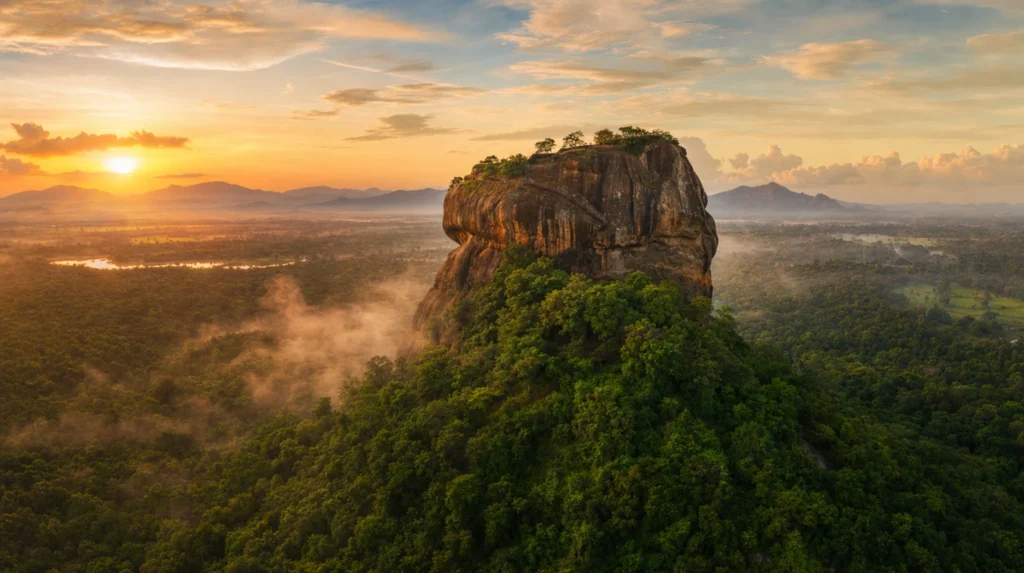
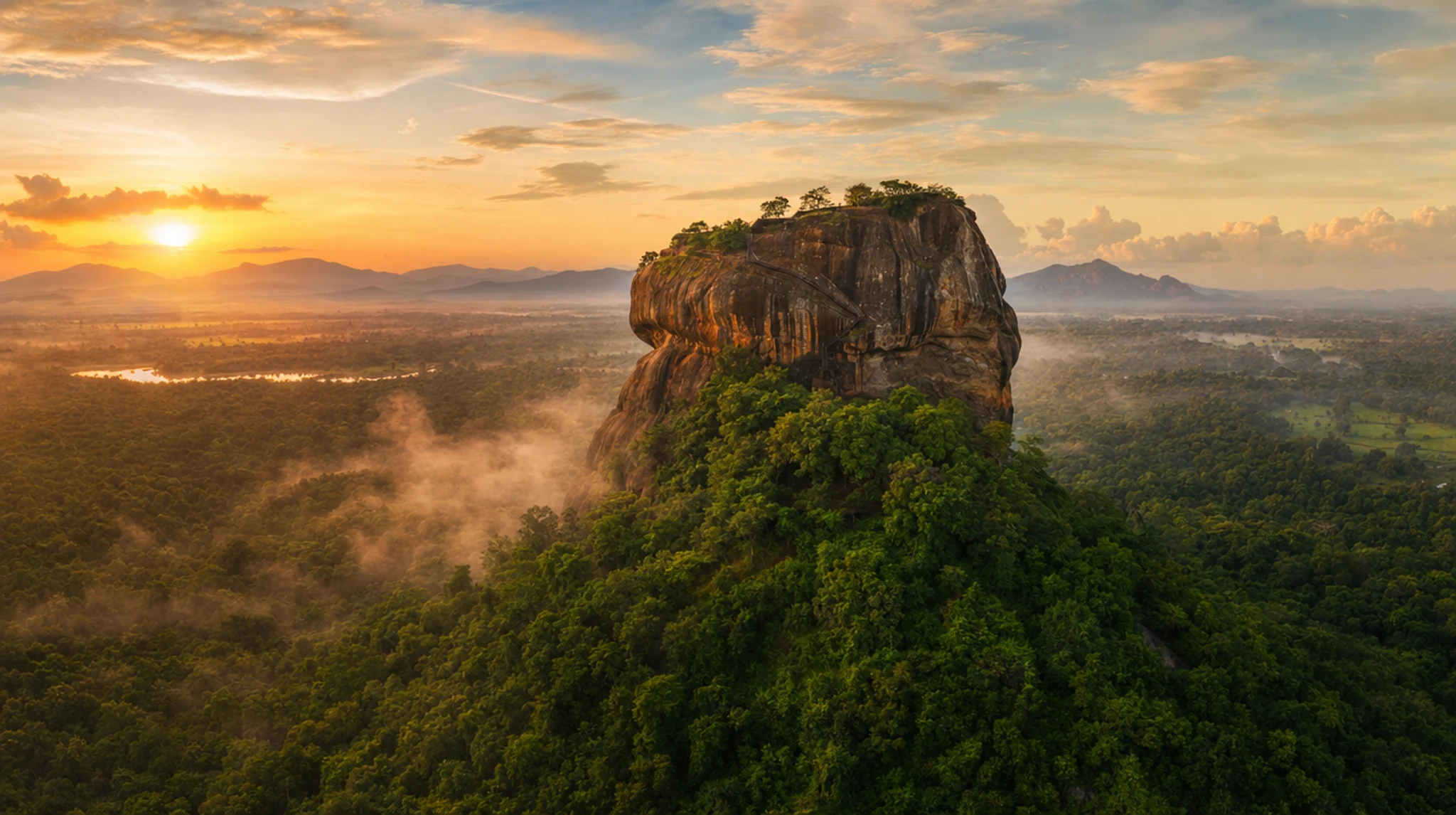
Sri Lanka is the teardrop-shaped island off the southern tip of India that manages to pack a continent’s worth of landscapes into a country of roughly 22 million people and 65,610 square kilometres. In a single week-long trip you can walk the 17th-century Dutch ramparts at Galle at sunrise, climb the 5th-century Sigiriya Rock Fortress by mid-morning, watch elephants bathe in a Minneriya reservoir at dusk, and fall asleep on an overnight train through the central tea country. Few destinations of this scale offer quite this much variety — jungle, beach, archaeology, hill station, surf break, and safari all on a single compact island.
Geography does the heavy lifting. The island stretches about 435 km from the northern Jaffna Peninsula to the southern Dondra Head, and 225 km at its widest, yet climate zones shift dramatically within a few hours of driving. The central highlands rise past 2,500 metres with Adam’s Peak and the tea-estate town of Nuwara Eliya, while the coastal belt ringing the island is almost entirely tropical. Two alternating monsoons — the southwest (Yala) from May to September and the northeast (Maha) from October to January — mean there is almost always a dry coast somewhere in the country, which changes the calculus of when to visit.
Cultural texture is the second unforgettable layer. About 75% of Sri Lankans are Sinhalese and predominantly Theravada Buddhist; roughly 15% are Tamil (concentrated in the north and central hill estates) and mostly Hindu; about 9% are Muslim, and 7% are Christian, largely Catholic along the western coast. The result is a cultural weave of Buddhist temples and cave monasteries, Hindu kovils crowned with multicoloured gopurams, whitewashed Portuguese and Dutch churches, and colonial-era Colombo architecture. Eight UNESCO World Heritage Sites — Kandy, Anuradhapura, Polonnaruwa, Sigiriya, Galle Fort, Dambulla, the Sinharaja rainforest, and the Central Highlands — mean the country punches far above its population weight on the world-heritage ledger.
Sri Lanka’s tourism sector recovered strongly in 2023–2025 following the 2022 economic crisis, and the country is once again running normally — fuel, hotels, trains, guides, and rupee ATMs all operating without the shortages of the crisis period. A bowl of kottu roti costs about LKR 600–1,200 at a street stand, a proper rice-and-curry set lunch runs LKR 500–1,200 outside tourist zones, and a cup of Ceylon tea is almost free. For travellers who want depth, variety, and warmth without long-haul exhaustion, Sri Lanka is one of Asia’s great small islands.
🐘 Esala Perahera 2026 — Kandy’s Festival of the Tooth
If you are picking dates for Sri Lanka in 2026, the single biggest cultural draw is the Esala Perahera — the ten-night torchlit procession in Kandy honouring the Sacred Tooth Relic of the Buddha. The festival is held over approximately two weeks in July and August, building from the inner Kumbal Perahera to the grander Randoli Perahera, and culminating on the Nikini full-moon poya with a daylight water-cutting ceremony at the Mahaweli River. Expect 50 to 100 caparisoned elephants per night, Kandyan drummers, whip-crackers, fire-dancers, and temple flag-bearers processing through the illuminated lake-side streets around the Temple of the Sacred Tooth Relic.
- First Kumbal Perahera night: approximately 24 July 2026 (Kandy — confirmed annually against the Buddhist lunar calendar)
- Peak window: final five Randoli Perahera nights, approximately 4–8 August 2026
- Water-cutting ceremony: morning after the final procession, Mahaweli River at Getambe
- Vesak Poya (nationwide Buddha celebrations): 31 May 2026
- Sinhalese & Tamil New Year (Aluth Avurudda): 13–14 April 2026 (nationwide public holidays)
Kandy’s hotel inventory around the Temple of the Tooth and Kandy Lake fills four to six months before the festival; grandstand seating along Dalada Veediya sells out earlier still. Expect warm, muggy evenings of 22–28°C, intermittent rain showers, and tightly marshalled crowd-control corridors near the Temple.
Best Time to Visit Sri Lanka (Season by Season)
West & South Dry Season (Dec–Mar)
The high season on the south and west coasts — Galle, Mirissa, Weligama, Bentota, and Colombo — with daytime temperatures of 28–32°C, reliably dry days, and calm surf-friendly seas. This is the prime window for blue- and sperm-whale boats out of Mirissa (December–April) and for the Cultural Triangle inland, where mornings at Sigiriya and Polonnaruwa are warm but not yet punishing. Book Galle Fort and south-coast beach hotels four to eight weeks ahead for Christmas, New Year, and Chinese New Year, when rates typically double.
Inter-Monsoon & Hot Season (Apr–May)
The hottest stretch of the year. Lowland temperatures push 32–35°C and the first pre-monsoon thunderstorms build across the island. Sinhalese and Tamil New Year (13–14 April) brings almost every Sri Lankan family back to their village, so inter-city traffic, long-distance train tickets, and domestic resorts fill up for the long weekend. Late May sees the southwest monsoon begin on the west coast — a good moment to escape uphill to Nuwara Eliya and Ella, or east to Arugam Bay where the surf season is just starting.
East Coast & Highlands Dry (Jun–Sep)
The southwest (Yala) monsoon is wet on Galle and Mirissa, but the east coast is dry and sunny — Trincomalee, Nilaveli, Uppuveli, Passekudah, and the Arugam Bay point break all peak between June and September. Highland towns stay pleasantly cool at 15–22°C. Plan the Esala Perahera in Kandy during late July and early August for the country’s biggest cultural event. Expect crowded Kandy, but the rest of the island is quieter and cheaper than peak season.
Northeast Monsoon (Oct–Nov)
The second inter-monsoon shifts the rain back to the east and north. Trincomalee and Arugam Bay wind down, while the south and west coasts enter a green, lower-cost shoulder window before the December high season locks in. Expect 26–30°C, short violent thunderstorms, and excellent deals on Galle boutique hotels and Ella hill-country guesthouses. November is arguably Sri Lanka’s best-value month for a circuit trip covering Colombo, the Cultural Triangle, Kandy, Ella, and Galle.
Shoulder-season tip: Late November on the south and west coasts delivers dry beaches, lower rates than December, and minimal crowds at Sigiriya and Galle Fort. Combine with an eastbound hill-country train segment before the rain sets in around the Knuckles range.
Getting There — Flights & Arrival
Almost every international visitor arrives at Bandaranaike International Airport (CMB), 35 km north of Colombo. The flag carrier SriLankan Airlines operates direct long-haul routes across Asia, the Middle East, and Europe; Emirates, Qatar Airways, Etihad, Singapore Airlines, and regional carriers from Chennai, Bangalore, Male, and Bangkok handle the bulk of connections.
- Bandaranaike International (CMB) — Colombo’s main gateway, 35 km north via expressway; taxi 45–60 min (LKR 4,000–6,000), airport bus 187 to Colombo Fort LKR 200
- Mattala Rajapaksa International (HRI) — southern Sri Lanka near Hambantota; limited international service, useful for south-coast arrivals
- Jaffna International (JAF) — regional flights from Chennai and occasional domestic service to the Tamil-majority north
Flight times: Chennai–Colombo about 1 hr 15 min; Singapore–Colombo roughly 4 hr; Dubai–Colombo about 4 hr 30 min; London–Colombo around 11 hr nonstop on SriLankan Airlines.
Flag carrier: SriLankan Airlines (UL); domestic charters run on Cinnamon Air seaplanes and FitsAir regional turboprops.
Visa / entry: Most visitors require a Sri Lanka Electronic Travel Authorization (ETA) before arrival — double-entry, valid for a 30-day stay, USD 50 online.
Getting Around — Trains, Tuk-Tuks & the Scenic Kandy–Ella Line
Sri Lanka Railways runs one of the most rewarding rail networks in Asia for travellers — slow, colonial-era, and ludicrously scenic through the tea country. Intercity buses cover everywhere the train does not, and tuk-tuks plus the PickMe ride-hailing app handle short hops inside every city.
- Kandy ↔ Ella scenic train: 6–7 hr through the central highlands; reserved 1st-class observation saloon LKR 1,500–2,500, 2nd-class reserved around LKR 1,000
- Colombo Fort ↔ Kandy (intercity express): 2 hr 30 min to 3 hr
- Colombo Fort ↔ Galle (coastal line): roughly 2 hr 30 min down the palm-fringed south coast
- Colombo ↔ Jaffna (Yal Devi): 6–7 hr on the restored northern line
- Sigiriya / Cultural Triangle: no rail — use a driver-guide or intercity bus via Dambulla
Rail pass: There is no national tourist rail pass — reserved-seat tickets are sold per route, typically via eservices.railway.gov.lk or through tour operators. Book the Kandy–Ella observation saloon 30+ days in advance; it is the single most in-demand seat in the country.
Tuk-tuks and ride-hail: PickMe is the local Grab/Uber equivalent and runs a metered tuk-tuk service in Colombo, Kandy, Negombo, and Galle. Uber also operates in Colombo. Outside the app network, confirm a fare before you climb in.
Driver-guides: A private driver with an air-conditioned car for the classic seven-night cultural-triangle-plus-hill-country-plus-south-coast loop runs USD 60–90 per day including fuel. It is the easiest way to see the country if you are short on time.
Apps: PickMe, Uber, Google Maps, 12Go Asia.
Top Cities & Regions
📍 Map of Sri Lanka: Every Place in This Guide
🏙️ Colombo
Sri Lanka’s commercial capital and main arrival city — a humid, low-rise, high-growth metropolis of around 5.6 million in the greater region, wrapped around the reclaimed Port City development and the long Galle Face seafront promenade. Plan one to two days before or after your circuit trip for the colonial Fort district, a proper Pettah market walk, and the rooftop bars above Colombo 3.
- Galle Face Green seafront promenade at sunset, Independence Square arcade, and Viharamahadevi Park
- Colombo Fort district, Old Dutch Hospital shopping courtyard, and the Pettah bazaar (Main Street, Federation of Self Employees Market)
- Gangaramaya Temple on Beira Lake, Seema Malaka, and the National Museum; dinner of kottu roti, Ministry of Crab chilli crab, or Nuga Gama village-style rice and curry
🛕 Kandy
The sacred hill capital and last Sinhalese kingdom — a lake-ringed city of around 150,000 people at 500 metres altitude, and the religious heart of Theravada Buddhism on the island. Home of the Temple of the Sacred Tooth Relic and the Esala Perahera procession, Kandy deserves two nights minimum on any first trip.
- Sri Dalada Maligawa (Temple of the Sacred Tooth Relic) — dawn puja at 05:30, midday puja at 09:30, evening puja at 18:30
- Kandy Lake evening walk, the Royal Botanical Gardens at Peradeniya, and the Udawatta Kele forest reserve
- Kandyan cultural dance show at the Kandy Lake Club; dinner of rice and curry, string hoppers, and kiribath
🏰 Galle
The 17th-century Dutch fort on the south coast — cobbled lanes, whitewashed colonial villas, and a sunset rampart walk with three kilometres of seawall above the Indian Ocean. Galle Fort was inscribed on the UNESCO World Heritage List in 1988 as “the best example of a fortified city built by Europeans in South and Southeast Asia.”
- Galle Fort ramparts (UNESCO World Heritage, 1988) — walk the full circuit at dusk
- Dutch Reformed Church (1755), the Maritime Museum, and the 1848 lighthouse
- Unawatuna and Jungle Beach day-trips; dinner of fresh crab curry, fish ambul thiyal, and hoppers
🗿 Sigiriya & Dambulla (Cultural Triangle)
The country’s archaeological heartland — a triangle between the ancient capitals of Anuradhapura and Polonnaruwa, centred on the 5th-century Sigiriya rock fortress and the Dambulla cave temples. Best done as a two- to three-night base in Sigiriya or Habarana, with a driver for the day-trips.
- Sigiriya Rock Fortress (UNESCO, 1982) — climb for sunrise before the heat and crowds
- Dambulla Royal Cave Temple (UNESCO, 1991) — 80 caves and 153 Buddha statues carved across 22 centuries
- Pidurangala Rock sunrise alternative, Minneriya elephant safari (Jul–Sep), and the Polonnaruwa ruins by bicycle
🚂 Ella (Hill Country)
The tea-country hill town that anchors most scenic-train itineraries — a compact village at 1,040 metres altitude, surrounded by tea estates and short day-hikes, with the Nine Arch Bridge just below town.
- Nine Arch Bridge (train crossings at 06:40, 09:20, 12:25, and 15:00 — confirm with the station masters)
- Little Adam’s Peak and Ella Rock day-hikes, plus Ravana Falls five kilometres out
- Halpewatte and Uva Halpewatte tea factories for a Ceylon tea tasting; dinner of egg hoppers with pol sambol and hill-country rice and curry
🏖️ Mirissa & Weligama (South Coast)
The south-coast beach belt — blue- and sperm-whale boats depart Mirissa harbour between December and April, while Weligama Bay has the island’s best beginner surf and longboard break.
- Blue and sperm-whale watching from Mirissa harbour (December–April)
- Weligama Bay beginner surf lessons (best November–April) and the Secret Beach at Mirissa
- Coconut Tree Hill, the Weligama stilt-fisherman viewpoint, and Parrot Rock at sunset; dinner of fresh seafood curry and king coconut (thambili)
Sri Lankan Culture & Etiquette — What to Know Before You Go
The Essentials
- Greet with Ayubowan or Vanakkam. “Ayubowan” (Sinhala — “may you live long”) paired with a slight bow and palms pressed together is the universal greeting in Sinhalese-majority areas; “Vanakkam” is the Tamil equivalent in the north and east.
- Cover shoulders and knees at every temple. This applies to Buddhist viharas, Hindu kovils, and mosques alike. Remove shoes AND hats before entering any shrine, and do not step on door sills — step over them.
- Never turn your back on a Buddha statue for a selfie. Posing with your back to a Buddha is illegal and has resulted in tourist deportations. Face the image, stand a respectful distance, and keep the statue higher in frame than your head.
- Use your right hand for eating and greeting. Traditional rice-and-curry is eaten with the right hand; passing anything with the left is considered mildly impolite.
- Tipping is modest. Round up tuk-tuk fares, leave LKR 200–500 for restaurant waitstaff where no service charge applies, and USD 5–10 per day for a driver-guide is standard.
Buddhist Temple Etiquette
- Dress code is strict. Shoulders fully covered, skirts or trousers below the knee. Sarongs are usually available at entrances to rent.
- Shoes and hats off at the gate, not the door. Many temples have a shoe-minder just inside the main perimeter — tip LKR 50–100 on the way out.
- Circumambulate stupas clockwise. Keep the relic or image to your right as you walk.
- Do not point your feet at a Buddha statue or a monk. When sitting, tuck your feet underneath you or to the side.
- Do not touch or pat the head of a monk or a child in a temple. The head is considered spiritually significant.
A Food Lover’s Guide to Sri Lanka
Must-Try Dishes
| Dish | Description |
|---|---|
| Rice and Curry | The national meal — a mound of steamed rice with 4–8 small side curries (dhal, beetroot, jackfruit, pumpkin, fish or chicken), coconut sambol, and papadam. Every family has a different rotation; LKR 500–1,200 at a local kade, more in tourist zones. |
| Kottu Roti | Chopped godamba roti stir-fried on a hot griddle with egg, vegetables, and meat or cheese — the metallic clatter of the cleavers is Sri Lanka’s signature street-food soundtrack. LKR 600–1,200 per plate. |
| Hoppers (Appa) | Bowl-shaped fermented rice-flour pancakes cooked in a small wok — the egg hopper cracks a whole egg into the centre; string hoppers (idiyappam) are steamed rice-noodle nests eaten at breakfast with coconut sambol and dhal. |
| Lamprais | Burgher-community specialty: rice, meat curry, frikkadels (Dutch-style meatballs), ash plantain curry, and seeni sambol wrapped together in a banana leaf and oven-baked. Colombo’s single most iconic Dutch-era holdover. |
| Fish Ambul Thiyal | Sour dry fish curry from the south coast, cooked with goraka (garcinia cambogia) until jet black and intensely tangy. Traditionally a fisherman’s long-keeping preparation — still the Galle regional speciality. |
| Pol Sambol & Lunu Miris | Freshly grated coconut pounded with red chilli, lime, Maldive-fish flakes, and salt (pol sambol); lunu miris is a fierier onion-and-chilli paste. Accompanies almost every rice-and-curry spread. |
| Kiribath & Kithul Jaggery | Milk rice cooked in thick coconut milk and cut into diamonds, eaten with kithul palm jaggery or lunu miris on auspicious mornings — most famously at Sinhalese and Tamil New Year. |
Short Eats & Bakery Kades
Sri Lanka’s short-eats (kada kama) culture is the cheapest and most enjoyable way to graze your way through the country. Every town has a bakery and a tea-stall kade serving samosas, fish cutlets, chicken and vegetable rolls, vadai (Tamil lentil fritters), and isso wade (prawn fritters) from a glass case by the counter. Prices typically run LKR 50–150 per piece, with a cup of milky Ceylon tea for LKR 60–120. The national bakery chains Perera & Sons and Fab are reliable in every mid-sized town, and at most rural junction stops a bus-stand tea kade will fill a brown-paper bag with five or six hot short-eats for less than a dollar. Plain tea (kahata), ginger tea (inguru tea), wood-apple cordial (divul), and iced faluda are the classic drinks; on a hot day, grab a king coconut (thambili) by the roadside for LKR 100–200 — the vendor machetes the top off and hands it to you with a straw. For a proper dining-out splurge in Colombo, book Ministry of Crab in the Old Dutch Hospital courtyard, Nuga Gama at the Cinnamon Grand for village-style rice and curry, or Upali’s on Sir Chittampalam Gardiner Mawatha for a clean, affordable everyday lamprais and hopper night.
- Chains: Perera & Sons, Fab, Green Cabin, Pilawoos (kottu roti)
- Signature items: fish cutlets, vegetable rolls, isso wade, egg rotty, vadai, and short-eat trays at every major bus station
Off the Beaten Path — Sri Lanka Beyond the Guidebook
Jaffna & the Northern Peninsula
The Tamil-majority north, isolated for decades by the civil war that ended in 2009, has opened to travellers over the past fifteen years. Jaffna itself is a flat, tree-lined town of about 88,000 people centred on the huge Nallur Kandaswamy Kovil (a Hindu temple whose 25-day Nallur Festival in late August is among the country’s great religious spectacles). Day-trip to Delft Island by causeway and ferry, or eat a proper Jaffna crab curry and palmyra-palm sweets. The Yal Devi train from Colombo takes about 6–7 hours.
Arugam Bay (East Coast)
Sri Lanka’s best right-hand point break, hidden in plain sight on the east coast near Pottuvil. The surf season runs May to October — precisely when the south and west are wet — and the scene is a low-key strip of surf camps, beach bars, and guesthouses between LKR 3,000 and LKR 20,000 per room. Crocodile-sighting lagoon safaris and a day trip to the rock monastery at Kudumbigala or the lesser-known Lahugala elephant park round out the stay.
Knuckles Mountain Range
The UNESCO-listed cloud forest east of Kandy — a cooler, greener, and far quieter alternative to Horton Plains. Multi-day treks with village homestays cross montane forests, leech territory in the wet season, cardamom plantations, and the open pana grasslands. Book guides through the Forest Department office in Kandy or via guesthouses in Meemure.
Yala & Wilpattu National Parks
Sri Lanka is the best place in Asia to see a wild leopard, and Yala’s Block 1 has one of the highest recorded leopard densities on Earth. For a quieter safari, skip Yala and head to Wilpattu — the country’s largest national park, covering about 1,317 square kilometres, with leopard, sloth bear, and water buffalo across its characteristic willu (natural lakes). Dawn safaris are cheaper, cooler, and far less crowded.
Trincomalee & Uppuveli
The east coast’s deep-water harbour city, once one of the finest natural ports in the world, has long, quiet beaches at Uppuveli and Nilaveli, the clifftop Koneswaram Temple on Swami Rock, and dolphin-pod boats out of Nilaveli harbour between May and September. It is the island’s most underrated regional capital and pairs beautifully with a detour to the Pigeon Island National Park snorkelling reef.
Practical Information
| Currency | Sri Lankan Rupee (LKR, Rs); 1 USD ≈ 300 LKR (April 2026) |
| Cash needs | Cards widely accepted in Colombo, Kandy, Galle, and tourist hotels; carry LKR 10,000–20,000 in notes for tuk-tuks, kades, and rural guesthouses. |
| ATMs | Commercial Bank, Sampath, and HNB ATMs accept foreign Visa and Mastercard. Withdrawal limits are typically LKR 40,000–100,000 per transaction; post-2022 supply issues have fully normalised. |
| Tipping | Round up tuk-tuk fares; LKR 200–500 for restaurant waitstaff where no service charge applies; USD 5–10 per day for a driver-guide. |
| Language | Sinhala and Tamil are both official; English is widely understood in tourist areas, hotels, and among drivers. Google Translate works offline for both scripts. |
| Safety | US State Department currently lists Sri Lanka at Level 2 — Exercise Increased Caution. Petty theft and tuk-tuk overcharging are the main travel risks; violent crime against tourists is uncommon. |
| Connectivity | Dialog, Mobitel, and Airtel tourist SIMs at CMB from LKR 1,000–2,500; Airalo eSIM works nationwide. 4G strong on the south-west coast and highlands. |
| Power | Type D, G, and M plugs (British-style three-pin dominant), 230V / 50Hz |
| Tap water | Not considered potable — stick to bottled, filtered, or boiled water. Ice in reputable hotels and restaurants is generally fine. |
| Healthcare | Private hospitals in Colombo (Asiri, Nawaloka, Lanka Hospitals) are the best option for foreign travellers; carry comprehensive travel insurance that covers medical evacuation. |
Budget Breakdown — What Sri Lanka Actually Costs
💚 Budget Traveller
Sri Lanka remains excellent value on a modest budget. A backpacker bed in a guesthouse dorm or a basic fan room runs LKR 2,500–6,000 per night; a rice-and-curry lunch or a plate of kottu runs LKR 500–1,000; a local train in 2nd or 3rd class between Colombo and Kandy costs about LKR 250–500 per leg. Daily all-in spend for a budget traveller sits comfortably around USD 25–40 per person per day, beer and long-distance train fares included.
💙 Mid-Range
Mid-range travellers targeting boutique Galle Fort stays, an air-conditioned driver-guide for a week-long loop, and the reserved observation-saloon on Kandy–Ella generally budget USD 80–160 per person per day. A clean twin room in a small hotel runs LKR 8,000–20,000; a sit-down dinner of crab curry and king coconut runs LKR 1,500–3,500; driver-guide with air-conditioned car costs USD 60–90 per day plus tip.
💜 Luxury
Luxury Sri Lanka leans into Geoffrey Bawa villas, Cape Weligama cliffside pools, Tea Trails tea-bungalow circuits, and private Yala safari camps. Rates for Cape Weligama, Amangalla, Aman Tri, and Ceylon Tea Trails sit USD 600–1,800 per night. A private driver-guide with an Aero chauffeur service, a chef-hosted rice-and-curry lunch at a Kandyan walauwa, and private charter seaplanes push luxury daily budgets into USD 500–1,500 per person.
| Tier | Daily (USD) | Accommodation | Food | Transport |
|---|---|---|---|---|
| Budget | $25–40 | Guesthouse / dorm LKR 2,500–6,000 | Kade rice & curry, short eats | 2nd/3rd class trains, local buses |
| Mid-Range | $80–160 | Small hotel LKR 8,000–20,000 | Restaurant mains LKR 1,500–3,500 | Driver-guide USD 60–90/day, reserved trains |
| Luxury | $500–1,500 | Bawa-villa / tea bungalow USD 600–1,800 | Tasting menus, hotel chefs | Private car, seaplane charters |
Planning Your First Trip to Sri Lanka
- Apply for the ETA. Fill the online form at eta.gov.lk at least 72 hours before your flight — double-entry, 30-day stay, USD 50. Use only the official .gov.lk site; avoid third-party agents.
- Pick coasts by monsoon. December–March for the south and west (Galle, Mirissa, Weligama); June–September for the east (Arugam Bay, Trincomalee). The Cultural Triangle and the highlands are workable almost year-round.
- Book the Kandy–Ella observation saloon early. Reserved 1st-class seats sell out 30+ days in advance via eservices.railway.gov.lk or through a tour operator.
- Choose a driver-guide or self-drive alternative. A seven-night circuit with an English-speaking driver-guide in an air-conditioned car runs USD 60–90 per day; this is the easiest way to combine Colombo, Sigiriya, Kandy, Ella, and the south coast.
- Pack for temples, trains, and leeches. Light trousers and a shoulder-covering shirt for shrines; a fleece for early-morning Sigiriya and highland train mornings; leech socks for any Knuckles or Sinharaja trek in the wet season.
Classic 10-Day Itinerary: 2 nights Colombo + Negombo, 2 nights Sigiriya / Cultural Triangle, 2 nights Kandy, 2 nights Ella (hill country), 2 nights Galle / Mirissa (south coast) — Colombo to Colombo by driver-guide and train.
Frequently Asked Questions
Is Sri Lanka expensive to visit?
No. Sri Lanka remains one of South Asia’s best-value destinations. Budget travellers manage on USD 25–40 per day; mid-range trips with a driver-guide and reserved observation-saloon trains sit at USD 80–160. Imported wine, luxury tea-country lodges, and private Yala safari camps are what push budgets up. Post-2022 currency stabilisation has made pricing far more predictable than during the crisis years.
Do I need to speak Sinhala or Tamil?
No. English is widely spoken in tourist areas, hotels, and among most drivers and guides. Sinhala and Tamil are both official languages, and signage appears in all three scripts. A few courtesy phrases — Ayubowan (hello), Istuti (thank you) in Sinhala, or Vanakkam and Nandri in Tamil — go a long way. Google Translate works offline for both.
Is the Kandy–Ella train worth it?
Yes — it is one of the highlights of any Sri Lanka trip. The 6–7 hour journey climbs through the central highlands past tea estates, waterfalls, and the Nine Arch Bridge. Book a reserved seat in the 1st-class observation saloon (LKR 1,500–2,500) via eservices.railway.gov.lk at least 30 days ahead; 2nd-class reserved (around LKR 1,000) is also comfortable.
Is Sri Lanka safe for solo travellers?
Generally yes. The US State Department currently places Sri Lanka at Level 2 — Exercise Increased Caution. Petty theft and tuk-tuk overcharging are the main concerns; violent crime against foreign travellers is uncommon. Solo female travellers should expect more staring outside resort areas. Standard precautions apply — agreed fares, avoid isolated beaches after dark.
When is whale-watching season in Mirissa?
Blue- and sperm-whale boats out of Mirissa harbour run between December and April, with best visibility in February and March. Boats depart around 06:30 and cost LKR 8,000–15,000 per person; look for operators affiliated with the Mirissa Fisheries Harbour that follow the responsible-whale-watching code.
Can I get by as a vegetarian or vegan?
Easily. Sri Lankan cooking is heavily plant-based by default — rice and curry spreads typically include 4–6 vegetable curries (dhal, beetroot, pumpkin, jackfruit, ash plantain, beans) alongside coconut sambol and papadam. Tamil and Hindu vegetarian traditions are especially strong in Jaffna. Ask for “no fish” — Maldive-fish flakes are common in sambols.
Is Sri Lanka safe now after the 2022 economic crisis?
Yes. The acute fuel, medicine, and power shortages of 2022 ended in 2023 as the IMF programme stabilised the economy. Tourism infrastructure — trains, hotels, guides, fuel stations, hospitals, ATMs — has been operating normally since 2024. Street protests are now rare and the country is visibly rebuilt.
📘 Book Your Sri Lanka Trip
Start with an ETA at eta.gov.lk, lock in the Kandy–Ella observation-saloon seats 30+ days ahead, and cross-check the monsoon-by-coast calendar.
Ready to Explore Sri Lanka?
From Sigiriya at sunrise to the Nine Arch Bridge at midday, and a south-coast sunset over Galle Fort — Sri Lanka rewards travellers who go slow and follow the monsoon. Whether you are coming for the Esala Perahera, a surf month in Arugam Bay, or a Bawa-villa honeymoon on the south coast, there is a circuit waiting for you. Start with the ETA, book the scenic train, and let the driver-guide handle the rest.
Explore More
More country guides you might like
Plan your trip to Sri Lanka
The booking tools we use ourselves. FFU may earn a commission at no extra cost to you.
Plan & book your trip to Sri Lanka
Booking through these searches supports our guides at no extra cost to you.