
☰ On this page
- 📋 In This Guide
- Overview — Why Ho Chi Minh City Belongs on Every Southeast Asia Trip
- 🌺 Late-April / Early-May 2026 — Why You’re Right in the Window
- Best Time to Visit (Season by Season)
- Getting There — Tan Son Nhat & Arrival
- Getting Around — Metro, Grab, Motorbikes
- Top Districts & Neighbourhoods
- 🗓️ Sample Itineraries
- Saigon Culture & Etiquette
- A Food Lover’s Guide to Saigon
- 📸 Photography Notes
- Off the Beaten Path — Beyond District 1
- Practical Information
- Budget Breakdown — What Saigon Actually Costs
- ✅ Pre-Trip Checklist
- 🤔 What Surprises First-Timers
- Frequently Asked Questions
- Ready to Explore Ho Chi Minh City?
- Explore More
Ho Chi Minh City, Vietnam — Saigon Soul, Boulevard Cafés & a Megacity in the Mekong Delta
Part of our Vietnam travel guide.
Ho Chi Minh City is two cities at once. There is Saigon — the name almost everyone still uses in conversation, the name on the bus tickets, the name on the airport code (SGN), the name that means a particular boulevard-and-cafe energy that survived French colonial planning, three wars, and the abrupt reunification of 1975. And then there is Ho Chi Minh City, the official designation since May 1976, the administrative megacity of nine million people, with its glass-and-steel District 1 skyline, the Bitexco Financial Tower’s helipad fin, and the Metro Line 1 that finally opened in December 2024 after two decades of delay. The contradiction is the city.
Saigon sits at the southern tip of Vietnam, 70 kilometres inland from the South China Sea, on a bend of the Saigon River as it threads toward the Mekong Delta. It is the country’s economic engine — roughly a quarter of Vietnam’s GDP comes from here — and it grows by about 200,000 people a year. The motorbike density is the city’s signature: roughly 7.4 million registered scooters for 9 million residents, more bikes per capita than almost any city on Earth, and the river of them at the District 1 intersections at 5:30 p.m. is a phenomenon that takes most first-time visitors three days to read. The trick is to walk steadily and not stop. The bikes flow around you.
This guide covers Ho Chi Minh City end to end — the colonial spine in District 1, the backpacker grid of Pham Ngu Lao, the food-tour streets of District 5’s Cho Lon (the city’s Chinatown), the cafe-and-art belt of District 3, and the way the city pivots into the Mekong as a base. For the rest of the country, see our Vietnam travel guide; for the cooler, slower-paced capital in the north, our Hanoi city guide. Day-trippers across the border should look at our Cambodia travel guide, and for a regional comparison the Bangkok city guide reads as the obvious sister-city.
📋 In This Guide
- Overview — Why Ho Chi Minh City Belongs on Every Southeast Asia Trip
- 🌺 Late-April / Early-May 2026 — Why You’re Right in the Window
- Best Time to Visit (Season by Season)
- Getting There — Tan Son Nhat & Arrival
- Getting Around — Metro, Grab, Motorbikes
- Top Districts & Neighbourhoods
- 🗓️ Sample Itineraries — 2, 4 and 7 Days
- Saigon Culture & Etiquette
- A Food Lover’s Guide to Saigon
- 📸 Photography Notes
- Off the Beaten Path — Beyond District 1
- Practical Information
- Budget Breakdown — What Saigon Actually Costs
- ✅ Pre-Trip Checklist
- 🤔 What Surprises First-Timers
- Frequently Asked Questions
- Ready to Explore Ho Chi Minh City?
Overview — Why Ho Chi Minh City Belongs on Every Southeast Asia Trip
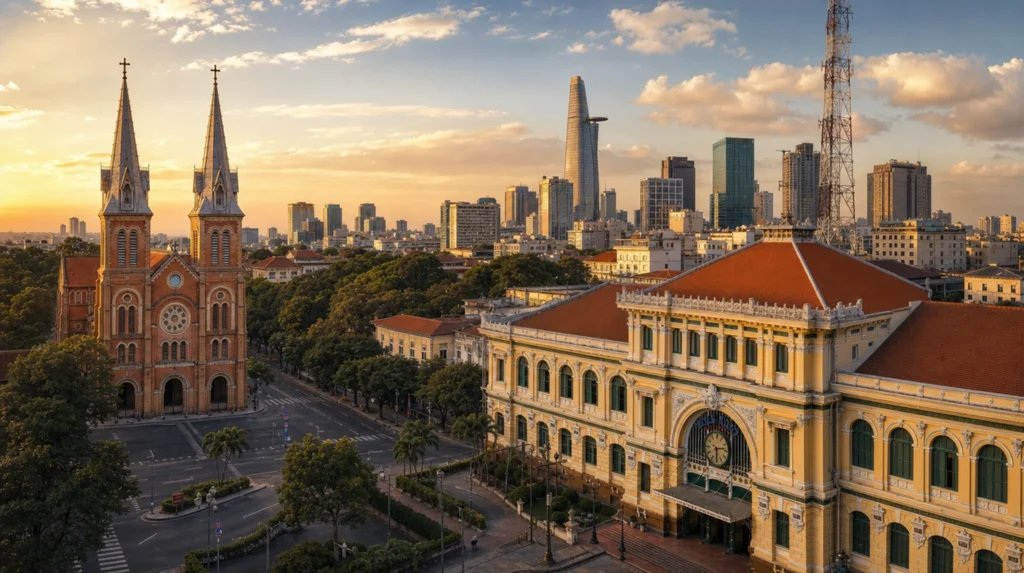
Saigon was a Khmer fishing village called Prey Nokor until the late 17th century, when a Vietnamese expansion southward absorbed it. The French arrived in 1859, took the city by gunboat, and spent the next 90 years building the Saigon you still walk through in District 1 — wide boulevards, a Notre-Dame Cathedral copied (with red brick imported from Toulouse) in 1880, a Beaux-Arts Central Post Office designed under the supervision of Gustave Eiffel’s firm, an opera house that opened in 1900, and a Hôtel de Ville that has been the seat of city government in three successive states. Independence came in 1954, the southern Republic of Vietnam built its capital here, and at the end of the Vietnam War in April 1975 the North Vietnamese Army’s tanks rolled through the gates of the Independence Palace at 11:30 a.m. on April 30. The reunification followed a year later. The renaming was formal a year after that.
The city’s modern character is the product of Đổi Mới — the 1986 economic reforms that opened Vietnam to private enterprise — landing here harder and faster than anywhere else in the country. Saigon was where the smuggled-in TV sets first arrived, where the first joint-venture hotels opened in the early 1990s, and where the start-up scene now produces about 70% of Vietnam’s tech unicorns. Per-capita income in HCMC is roughly 2.5 times the national average. The skyline visible from the Bitexco observation deck — the Landmark 81 tower (461 metres, the country’s tallest building, finished 2018), the under-construction Empire City complex in District 2, the older Vietcombank Tower — is a skyline that did not exist in 2010.
For a traveller, the practical consequence is that you are visiting a city that lives at three speeds simultaneously. There is the colonial-spine speed — slow, cafe-paced, the Continental Hotel where Graham Greene wrote The Quiet American across the street from the opera house. There is the motorbike speed — the surge across Hai Ba Trung at 7 a.m., the fish-market deliveries, the office workers in ao dai blouses with helmets dangling from the handlebars. And there is the hyper-modern speed — the Metro at 6:30 a.m., the District 2 expat coffee shops with cold-brew menus, the rooftop bars on the 67th floor of EON 51 with cocktail prices that would not embarrass Soho. You can visit any one of those Saigons. The city becomes interesting when you start crossing between them.
🏛️ Historical Context
The Reunification Palace — formerly the Independence Palace, the seat of South Vietnam’s government from 1966 to 1975 — has been preserved exactly as it was on April 30, 1975, the day a North Vietnamese T-54 tank crashed through its gates and ended the war. The clocks in the basement war rooms are stopped. The president’s office still has the same yellow upholstery. The basement bunker contains the original communications equipment, the maps marked with battle lines, and the helicopter pad on the roof from which the last South Vietnamese officials evacuated. Tank No. 843, the one that broke the gate, sits permanently on the front lawn. Entry is 65,000 VND. The audio guide, in 11 languages including Vietnamese and Russian, is the most comprehensively narrated state-museum experience in Southeast Asia.
🎌 Did You Know?
Vietnamese coffee culture in Saigon is built on a single technical detail: the lack of fresh milk in the colonial-era city. French planters who wanted café au lait substituted sweetened condensed milk because dairy didn’t survive the climate. The result — cà phê sữa đá, a strong dark robusta brewed slowly through a small metal phin filter, poured over ice and sweetened condensed milk — became the city’s signature drink. Vietnam is now the world’s second-largest coffee producer (after Brazil), and roughly 95% of its production is robusta beans, the higher-caffeine, more bitter cousin of arabica. Saigon’s third-wave cafes (The Workshop, Là Việt, Shin Coffee) now offer arabica options, but the proper Saigon answer to “do you have coffee” is still a phin filter dripping into condensed milk on a low plastic stool by the curb.
🌺 Late-April / Early-May 2026 — Why You’re Right in the Window
Late April is the hottest stretch on Saigon’s calendar — daytime highs sit around 35°C, and the humidity is a steady 75–85% — but it is also the most culturally loaded ten days of the year. April 30 is Reunification Day, the public holiday that marks the 1975 fall of Saigon, and 2025 was the 50th anniversary, which means 2026 inherits the upgraded infrastructure: cleaner sidewalks in District 1, restored colonial facades on Dong Khoi street, and a refreshed Reunification Palace that completed major preservation work in late 2025. May 1 is International Labour Day, fused with April 30 into a five-day national holiday window most years (April 30 to May 4 in 2026), which means many Vietnamese workers travel home — Saigon’s traffic eases by perhaps 30% during the holiday days themselves.
The other reason this window matters is the Metro. Line 1, the city’s first urban rail, finally opened to passengers on December 22, 2024, after 17 years of construction, running 19.7 km from Ben Thanh Market in District 1 to Suoi Tien Park in Thu Duc City. By April 2026 it has been operating for sixteen months — long enough that the wrinkles are out, the multilingual signage is reliable, and the connection between the Ben Thanh underground station and the city’s most photographed market is genuinely seamless. Lines 2 and 3 are still under construction, but Line 1 alone has shifted the city’s rhythm. The traffic on Vo Nguyen Giap, the main road it parallels, is measurably lighter.
One important caveat for late April: the heat is real. The pre-monsoon dry season peaks at the end of April with the highest sustained temperatures of the year, and the rains that break it typically arrive in the second week of May. Plan walking tours and Cu Chi Tunnels day trips for early morning (depart 7 a.m.), retreat indoors between 11 a.m. and 3 p.m., and emerge for the second wave of activity from 5 p.m. onward. Hydration is non-negotiable. Saigon’s pharmacies sell oral rehydration salts (ORS) at every counter for about 5,000 VND a sachet — buy a strip on day one and use one daily.
⚠️ Important — Reunification Day Crowds
April 30 itself is a national holiday with a major parade and ceremonies at the Reunification Palace. The Palace, the War Remnants Museum, Notre-Dame Cathedral and the entire Dong Khoi corridor are extraordinarily crowded on April 29-30, and the Reunification Palace closes briefly for ceremonial events. If your interest is the Vietnam War history, visit on April 28 or May 2 instead. The fireworks on the night of April 30 over the Saigon River are best watched from the Bitexco observation deck (book ahead — sells out a week prior) or from the riverside promenade in front of the Renaissance Riverside hotel.
Best Time to Visit (Season by Season)
Saigon has two seasons — dry and wet — and the city’s mood shifts perceptibly between them. The latitude is 10.8°N, deeply tropical, with a roughly 12-hour daylight cycle year-round. Average daytime temperatures stay between 28°C and 35°C all year. The variable that matters is rain.
Dry Season Peak (December – February)
The genuinely pleasant window. Daytime highs sit at 30–32°C, humidity drops to 65–70%, evenings are cool enough for an open-collar shirt at a rooftop bar without sweat. The city celebrates Tết — the lunar new year, falling between late January and mid-February — and shuts down for about a week. Many shops, restaurants and street stalls close for three to five days during Tết itself. If you must visit during Tết, book hotels two months ahead and pick the days immediately after the second day of the new year, when reopened businesses begin to function. The Tao Dan flower market and the Nguyen Hue walking street’s pre-Tết flower display are the genuine cultural events of the season.
Pre-Monsoon Heat (March – May)
The hottest stretch. Daytime temperatures climb steadily through March, peak around April 20–30 (the historical hottest week), and break with the first proper monsoon thunderstorms typically in the second week of May. Humidity is high, and the heat is genuinely tropical — afternoon temperatures of 36°C in the shade are not unusual. The cultural compensation is Reunification Day (April 30) and the school-holiday energy of the city in late April. Crowds at major sites are 25% lower than peak December because most international travellers avoid the heat.
Monsoon (May – October)
The southwest monsoon. Most days produce a 30–60 minute thunderstorm in the late afternoon — typically between 3 p.m. and 6 p.m. — that drops 20–40 mm of rain in a single burst, then clears. Mornings remain dry. The city has adapted: every café has a sheltered awning, every Grab driver carries a poncho, every street vendor folds and unfolds plastic sheeting on a five-minute cycle. The flooding is the genuine inconvenience — District 1 streets like Nguyen Hue and Le Loi can hold 20–30 cm of water for an hour after a heavy storm. Pack quick-dry shoes and a compact umbrella. Hotel rates drop 20–30% off dry-season peak.
Late Monsoon to Early Dry (October – November)
The shoulder window. Storms taper through October, the rain becomes intermittent rather than daily, and by mid-November the air begins to dry. Average highs sit at 31°C with measurable evening relief. This is the sweet spot for travellers who want lower prices than December but more reliable weather than May. Mid-Autumn Festival (Tết Trung Thu) typically falls in mid-September with the children’s lantern parades through Cho Lon — a quieter, less commercialised version of the lunar new year.
🧳 Travel Guru Tip
If you have one week and want Saigon at its weather-perfect best, book the second half of January or all of February — but specifically avoid the Tết week itself unless you are prepared for closures. The first two weeks of December are also reliably excellent and significantly less crowded than late December (when Christmas-week travellers stack up). Locals call this stretch “the cold season,” which means daytime highs of 28°C and a hint of breeze that you can feel on Nguyen Hue at 8 p.m. Most international guides treat all six dry-season months as identical; they aren’t.
| Experience | Best months | Best districts | Notes |
|---|---|---|---|
| Walking tours | Dec – Feb | District 1, District 3 | Sub-30°C only realistically Nov–Mar |
| Mekong Delta day trip | Nov – Mar | Ben Tre, My Tho, Can Tho | Wet-season trips include floating-market mud |
| Cu Chi Tunnels | Year-round (early AM) | Cu Chi, 70 km NW | Pack water; the tunnels are 28°C inside |
| Rooftop bars | Year-round (post-storm clear) | District 1, District 2 | Best skyline visibility Dec–Feb |
| Cho Lon Chinatown | Lunar new year window | District 5, District 6 | Lantern displays peak Tết and mid-autumn |
| Reunification Day | Apr 30 | District 1 (Palace area) | Major crowds; book hotels 2 months ahead |
Getting There — Tan Son Nhat & Arrival
Saigon is served by Tan Son Nhat International Airport (SGN), eight kilometres northwest of District 1 — the closest airport-to-downtown distance of any major Southeast Asian capital, and a standard 25–45 minute taxi ride depending on traffic. SGN is Vietnam’s busiest airport, handling roughly 41 million passengers in 2024, and it is operating well above its design capacity of 28 million. The new Long Thanh International Airport, 40 km east in Dong Nai province, is scheduled to open phase one in 2026 — when it does, the long-haul international routes will progressively shift over, but until late 2026 SGN remains the main gateway.
From North America, expect 17–22 hours of flying time including one stop in Tokyo (Narita or Haneda), Seoul (Incheon), Hong Kong or Taipei. Direct service from the US west coast is available on EVA Air via Taipei, Korean Air via Incheon, and ANA via Tokyo, with one-stop pricing typically $850–1,400 round-trip in shoulder season. From Europe, direct flights run from London Heathrow (Vietnam Airlines, 13 hours), Paris CDG (Vietnam Airlines, 12 hours), Frankfurt (Vietnam Airlines), and Amsterdam (codeshare); expect £550–900 round-trip. Within Southeast Asia, low-cost carriers run 90-minute flights from Bangkok, Singapore, Kuala Lumpur and Phnom Penh for $80–180 round-trip on Vietjet or AirAsia.
Tan Son Nhat is divided into Terminal 1 (domestic) and Terminal 2 (international), connected by a five-minute walk. Immigration runs on the e-visa system that has been mandatory for most nationalities since 2023; landing is typically efficient with a 15–25 minute wait at the international counters. Three options into District 1: a metered taxi (Vinasun or Mai Linh — the green and white liveries are the trustworthy companies, around 180,000 VND to Ben Thanh); a Grab ride-hail (140,000–200,000 VND, the default for most travellers with a working phone); or the Bus 109 to Ben Thanh (40 minutes, 20,000 VND, runs every 15 minutes). The metro is being extended to the airport but is not yet operational.
✨ Pro Tip
Vietnam’s e-visa now covers more than 80 nationalities including the US, UK, Canada, Australia and most of the EU. It costs $25, takes about three working days, allows multiple-entry stays of up to 90 days, and must be applied for at evisa.xuatnhapcanh.gov.vn — that is the genuine government domain, not the lookalike commercial sites that charge $80–150 for an unnecessary “service.” Print the e-visa twice and keep one copy on your phone. The immigration officer will scan the printed barcode.
Getting Around — Metro, Grab, Motorbikes
Saigon’s transport reality changed in December 2024 when Metro Line 1 finally opened. The line runs 19.7 km from Ben Thanh in District 1 east through Ba Son, Van Thanh, Tan Cang (where it surfaces and crosses the Saigon River on a striking yellow bridge), and continues through Thu Duc City to Suoi Tien terminus. Stations include Opera House (which connects directly to the Caravelle and the Reunification Palace’s neighbourhood), Ba Son (the under-development riverside district), and Thao Dien (the expat-heavy District 2 quarter). A single ride is 6,000–20,000 VND depending on distance; a daily pass is 40,000 VND. The trains run 5 a.m. to 10 p.m. at 5–10 minute frequency. Lines 2 (the District 1-Tan Phu cross-town line) and 3 (the airport line) remain under construction; expected completion is late 2027 and 2028.
For everywhere the metro doesn’t reach, Grab is the default. Vietnam’s adapted version of Uber dominates the market: Grab Bike (a motorbike taxi, you ride pillion in a provided helmet, fares from 18,000 VND for short hops within District 1, the fastest way through traffic), Grab Car (standard four-door cab, fares from 50,000 VND), and Grab Taxi (the metered-cab integration). The app accepts foreign cards, runs in English, and the GPS tracking is a meaningful safety feature for solo travellers. Cash is still widely accepted but increasingly secondary; most drivers prefer in-app payment.
Renting a motorbike yourself is a rite of passage many travellers consider and most experienced visitors advise against — Saigon’s traffic moves on a different logic than what most foreign drivers are trained for, and the accident rate among tourist riders is genuinely high. If you have prior motorbike experience and want to try, rent from a licensed shop in District 3 (Tigit Motorbikes, Saigon Scooter Centre — 200,000–350,000 VND/day with helmet and insurance), avoid the District 1 commercial intersections in rush hour, and never ride at night. Walking remains the right choice for District 1’s compact core: Ben Thanh to the Opera House to Notre Dame to the Post Office is a 1.2 km loop you can walk in 25 minutes if the heat allows.
⚠️ Important — Crossing the Street in Saigon
The motorbike river at peak intersections like Hai Ba Trung and Le Thanh Ton, or the roundabout at Ben Thanh, looks impossible to cross. The technique that works: step into the road at a steady, predictable walking pace, do not stop, do not run, do not change direction unexpectedly. The bikes flow around you exactly the way water flows around a steady rock. Hesitation creates the actual hazard — the riders cannot predict where you will be. Experienced visitors learn to walk at the same calm speed they would on a quiet sidewalk. The first crossing takes courage; by day three it is genuinely automatic.
Top Districts & Neighbourhoods
📍 Ho Chi Minh City Map: Every Place in This Guide
Ho Chi Minh City is administratively divided into 22 districts and is currently being merged with surrounding provinces under a 2025 reform that will rename and consolidate boundaries — but for a traveller the practical map remains the central districts most worth knowing: District 1 (the colonial spine), District 3 (the cafes and embassies), District 4 (the riverside redevelopment), District 5 and 6 (Cho Lon Chinatown), and District 2/Thu Duc City (the expat enclaves and Thao Dien).
🏙️ District 1 — The Colonial Spine
The downtown core where almost every first-time visitor stays. District 1 contains the Reunification Palace, Notre Dame Basilica, the Saigon Central Post Office, the Opera House, Ben Thanh Market, the Bitexco Tower, the Nguyen Hue walking street, and the bulk of the city’s four-and five-star hotels. The compact heart of it — bounded roughly by Le Duan, Hai Ba Trung, Ham Nghi and the river — is walkable in any direction in twenty minutes if the heat allows.
The signature street is Dong Khoi (formerly Rue Catinat under the French, then Tu Do Street during the South Vietnamese era), running from Notre Dame Cathedral to the river. Graham Greene set the protagonist’s apartment in The Quiet American on this street; the Continental Hotel where he wrote in 1951 still operates at the south end. The newer tourist artery is the Nguyen Hue walking street, pedestrianised in 2015, anchored by the Saigon City Hall (the canary-yellow Beaux-Arts town hall, 1908) at the north end and the river promenade at the south. Nguyen Hue at 9 p.m. on a Saturday is a genuine social space — families, teenagers, dance crews, the occasional tourist photoshoot — and one of the most pleasant places in the city.
- What to do: Walk the Dong Khoi to Notre Dame to Post Office to Opera House loop; tour the Reunification Palace (2 hours minimum); browse Ben Thanh Market (mornings only — afternoon is tourist-trap territory); rooftop sundowner at the Saigon Saigon Bar at the Caravelle (where war correspondents drank in the 1960s).
- Signature eats: Bánh mì from Bánh Mì Huỳnh Hoa on Le Thi Rieng — the legendary 65,000 VND sandwich with eight different cured meats; pho at Pho Hoa Pasteur (open since 1968).
- Access: Metro Line 1 Ben Thanh and Opera House stations both serve District 1.
☕ District 3 — Cafes, Embassies & Old Saigon
Just west of District 1 and architecturally indistinguishable from it at the borders, District 3 is where Saigon’s cafe culture lives. The boulevards of Vo Van Tan, Pasteur and Nguyen Thi Minh Khai are lined with French villas turned into independent coffee shops, French embassy compounds, and the city’s best concentration of independent bookshops. The War Remnants Museum is here, on Vo Van Tan — the most visited museum in the country and the most direct presentation of the Vietnamese view of the American War. It is harrowing, especially the Agent Orange and tiger-cage exhibitions; allow 90 minutes minimum and pace yourself.
The Tao Dan Park, between District 1 and 3, is where the city’s elderly meet at 5:30 a.m. for tai chi, badminton and the bird-cage social ritual — men carry their songbirds in elaborate bamboo cages to hang in the trees while they drink iced coffee and discuss the news. It is the single most photographable Saigon scene that Saigonese still consider their own.
- What to do: War Remnants Museum (40,000 VND); Cafe Apartments at 42 Nguyen Hue — a 1960s residential block converted into a vertical strip of independent cafes, each floor a different concept; Tao Dan Park morning walk.
- Signature eats: Cơm tấm (broken rice with grilled pork) at Cơm Tấm Ba Ghiền on Dang Tran Con — a Michelin Bib Gourmand recipient.
- Access: Walking distance from District 1; closest metro station is Ben Thanh (Line 1).
🏮 Cho Lon (District 5 & 6) — Saigon’s Chinatown
Five kilometres west of District 1, Cho Lon (“Big Market”) is the largest Chinatown in Vietnam and one of the largest in Southeast Asia, settled by Hokkien and Cantonese merchants from the 17th century onward. It feels like a different city — narrower streets, a Cantonese signage layer underneath the Vietnamese one, temple incense thicker in the air, and a market culture (Binh Tay Market is the wholesale heart) that operates on a slower commercial rhythm than the District 1 tourist scrum. Thien Hau Pagoda, dedicated to the Goddess of the Sea and built by Cantonese settlers in the 1830s, is the most photogenic temple — its courtyard has 200 hanging incense coils that take 21 days to burn through.
Food is the genuine reason to come. The dim sum at Tiem Ha Ky on Bui Huu Nghia, the duck noodles at Mi Vit Tiem Tu Ky, the Hokkien-style braised pork at Kim Hoa, the proper Sino-Vietnamese pho — all in District 5 within a 1.5 km radius. The Saigon Food Tour by Vespa (a popular evening operation, around 1.6 million VND per person) runs precisely this circuit on the back of vintage Vespas, which is a competing way to do it, but a Grab Bike and a curiosity are sufficient.
- What to do: Thien Hau Pagoda; Binh Tay Market (mornings only); the Cha Tam Catholic Church where President Ngo Dinh Diem was captured in 1963 hours before his assassination.
- Signature eats: Hu tieu My Tho (Mekong-Delta-style noodle soup) at Hu Tieu My Tho Thanh Xuan; Cantonese roast goose at Tiem Vit Quay Phat Ky.
- Access: Grab from District 1 (15 minutes, 70,000 VND); no metro yet — Line 2 will eventually serve it.
🌳 Thao Dien & Thu Duc City (District 2) — Expat Saigon
Across the Saigon River from District 1 — connected by the Thu Thiem Tunnel (opened 2011) and now by Metro Line 1 (Tan Cang and Thao Dien stations) — Thu Duc City is the consolidated administrative super-district that includes Thao Dien, the international school neighbourhood, and the new Thu Thiem riverside development. Thao Dien specifically is where most of Saigon’s long-term expats live: tree-lined streets, English-language signage, third-wave coffee, the Australian and British international schools, and an expat dining scene (Annam Gourmet, Esta Eatery, Pizza 4P’s flagship) that anchors Saturday brunch culture.
It is the easiest district for travellers who want a softer landing — the streets are walkable, the air is measurably cleaner than central districts, the river is on your doorstep, and Metro Line 1 puts you at the Opera House in 18 minutes. The trade-off is the airport bubble feel; Thao Dien is where Saigon comes second.
- What to do: Saigon Outcast (a small art-and-music space converted from a riverside warehouse); the Mekong Quilts cooperative shop; sunset on the Saigon River from Eon51’s lower-priced sister bar Saigon Skydeck.
- Signature eats: The Decked Out Pancakes brunch at Mad House; Korean-Vietnamese fusion at Anan Saigon (the District 2 outpost of the Michelin-starred original).
- Access: Metro Line 1 Thao Dien and An Phu stations; Grab from District 1 in 15–25 minutes (90,000–150,000 VND).
🛶 District 4 & the Saigon River
The narrow finger of land between District 1 and the River, District 4 was the city’s tougher commercial dock district — Marlon Brando’s Saigon-set scenes in Apocalypse Now were the District 4 mood — and is now in the middle of the redevelopment cycle. The seafood street on Vinh Khanh is the genuine reason to come: a 600-metre stretch of cheap seafood restaurants where shellfish, snails, scallops and grilled fish are sold by the kilo to a young, mostly local crowd. Quan Oc Dao on Vinh Khanh is the locals’ favourite — point at what’s on ice, ask for it grilled with garlic and chilli, expect to pay 250,000–400,000 VND for two.
The river itself runs the eastern edge of District 4. The Saigon River dinner cruise — most depart from the Bach Dang Wharf in District 1 at 7:30 p.m., return 10 p.m., 600,000–1,200,000 VND including dinner — gives you the city’s skyline at night, which is genuinely the best view in town. The Indochina Junk operation runs the highest-quality boat; cheaper options trade on the same skyline.
- What to do: Vinh Khanh seafood street (evenings); Bach Dang dinner cruise; walk the Bach Dang riverside park at sunset.
- Signature eats: Snails (ốc) — a Saigon specialty, grilled, steamed or stir-fried, eaten with toothpicks at low plastic-stool tables. Quan Oc Dao or Oc Dao 1 are the institutions.
- Access: 10-minute walk south from District 1’s Le Thi Hong Gam over the Khanh Hoi Bridge.
🌾 Beyond the City — Cu Chi Tunnels & Mekong Delta Gateway
Saigon is the natural base for two major day trips. The Cu Chi Tunnels — a 250 km network of tunnels dug by Viet Cong fighters between 1948 and 1975, with the surviving 120 km network preserved as a memorial — sit 70 km northwest of the city. The most-visited section is at Ben Duoc; the smaller Ben Dinh section is closer and slightly less crowded. Half-day tours run 350,000–600,000 VND including transport, and the experience of crawling 30 metres through a widened tunnel section (the original tunnels are too narrow for most foreign bodies — they have been enlarged) is genuinely educational. Combine it with a stop at the Cao Dai Holy See in Tay Ninh (the cathedral-mosque-pagoda hybrid built by Vietnam’s syncretic religion, founded 1926) for a full-day trip.
The Mekong Delta starts about 90 km southwest of Saigon at My Tho. Day trips into the delta — a sampan ride through coconut-tree-lined canals, a stop at a coconut-candy workshop, a lunch at a fruit-orchard farm — are the most popular Saigon excursion (around 1 million VND for a full-day tour). For travellers with two more days, an overnight to Can Tho (the Delta’s capital, four hours’ drive) gets you to the Cai Rang floating market, which is genuine wholesale commerce — boats trading fruit and vegetables to other boats — at 5–7 a.m.; the day-trip versions from Saigon arrive at 9 a.m. and miss the actual market activity.
- What to do: Cu Chi Tunnels half-day; My Tho/Ben Tre Mekong day-trip; Can Tho overnight (the proper version) for the Cai Rang floating market at sunrise.
- Signature eats: Coconut candy from Ben Tre’s home-workshops; “elephant ear fish” (cá tai tượng) — a Delta specialty, deep-fried whole and rolled into rice paper at riverside restaurants.
- Access: Day-trip operators leave District 1 at 7:30 a.m.; overnight Can Tho via Phuong Trang sleeper bus from Mien Tay station, 4 hours, 180,000 VND.
“The night was no different. Saigon was no different. The same blue light glittered on the metal of the helicopter, on the metal of the umbrella stands, on the metal of the spoons in the cafe.”
— Bao Ninh, The Sorrow of War (1990)
🗓️ Sample Itineraries
Saigon rewards travellers who pace themselves through the heat and punishes those who try to do everything in two days. Below are three templates that work; pick the one that matches your time, then adjust by season. The morning-evening rhythm — heavy activity 7 a.m. to 11 a.m., light activity 11 a.m. to 3 p.m., heavy activity 3 p.m. to 9 p.m. — applies year-round.
2 Days — Saigon Compressed
Day 1: Arrive Tan Son Nhat morning, Grab to District 1, drop bags. Walk Notre Dame, Central Post Office, Reunification Palace (2 hours, audio guide), late lunch at Pho Hoa Pasteur, afternoon at War Remnants Museum, sunset at the Saigon Saigon Bar at the Caravelle, dinner at Quan Bui (modern Vietnamese, District 2 branch is the original), nightcap on Bui Vien backpacker street if you have the energy. Day 2: Cu Chi Tunnels half-day morning tour, return for late lunch on Vinh Khanh seafood street in District 4, afternoon at Cho Lon (Thien Hau Pagoda, Binh Tay Market), Bitexco Skydeck or Saigon River dinner cruise to wrap. Evening departure or one more night.
4 Days — Saigon + Mekong
Day 1: Arrive, District 1 colonial loop, evening Nguyen Hue walking street. Day 2: Cu Chi Tunnels and Cao Dai Holy See full-day. Day 3: Cho Lon morning food tour (book through Saigon Walking Tours, 1.4 million VND), afternoon nap, evening at the Cafe Apartments on Nguyen Hue, dinner Vinh Khanh seafood. Day 4: Day-trip to My Tho/Ben Tre Mekong sampan tour, return Saigon for a final dinner at Anan Saigon (the Michelin-starred Vietnamese-Cantonese fusion, around 2 million VND for two with wine), late departure or one more night.
7 Days — Saigon & the Mekong Properly
The version most well-travelled visitors regret not doing. Day 1: Arrive, District 1 settle. Day 2: War history day — Reunification Palace, War Remnants Museum, lunch on Pasteur, late afternoon at the Independence Palace gardens. Day 3: Cu Chi half-day, afternoon Cho Lon. Day 4: Saigon to Can Tho (4 hours by car/bus), afternoon Cai Rang outskirts, sleep Victoria Can Tho or Azerai Can Tho. Day 5: Cai Rang floating market at sunrise (5:30 a.m. boat), afternoon biking through Phong Dien, sleep Can Tho. Day 6: Drive to Ben Tre via riverside route, coconut workshops, sampan through the Mekong tributaries, return Saigon evening. Day 7: Reserve as float day for whatever you missed — a District 3 cafe day, a Thao Dien brunch, a final shopping run at Ben Thanh, departure.
🎯 Strategy
If you only have one Saigon trip, do the 4-day version with the Mekong day-trip rather than the 7-day overnight version — the overnight Can Tho experience is significantly better than the day-trip, but the additional logistics absorb planning energy you should be spending on Saigon itself. Save the proper Mekong for a separate trip that pairs with Phu Quoc island. The 2-day version genuinely undersells the city; if you only have two days, treat it as a stopover, not a destination.
Saigon Culture & Etiquette
Saigonese are warmer and more talkative than their northern counterparts in Hanoi — the southern Vietnamese stereotype within Vietnam is closer to the Italian-of-the-south stereotype within Italy. Conversations open easily, locals invite travellers to share a table at street stalls without preamble, and the fabric of public life happens on the sidewalk rather than indoors. The city’s social-circle radius is large and porous; English-speakers in District 1 are happy to chat, and the language barrier is genuinely lower than in most Asian capitals (Vietnam’s English proficiency ranking improved to 58th globally in 2024).
The single mandatory etiquette point is shoes-off when entering homes, temples and many small restaurants. The doorway pile of slippers and sandals is the cue. Pagodas and Cao Dai temples will have a sign or a designated rack. Modest dress (covered shoulders, knees) is required in the Cao Dai Holy See and most Buddhist temples; sleeveless tops and shorts above the knee are not acceptable. Small temples may lend you a wraparound; pack a light scarf or a long-sleeved shirt to be self-sufficient.
The political dimension is easier to navigate than most travellers expect. Public criticism of the Communist Party is unwise, photographs of military installations or police checkpoints are forbidden, and political conversation with strangers is best left avoided. But ordinary Saigonese — particularly the older generation — talk openly about the war and reunification with travellers who ask thoughtfully. The American War remains the dominant historical reference, and the Vietnamese name for it (the American War, not the Vietnam War) is worth using.
💬 The Saying
“Cà phê đá, ngồi vỉa hè.” Roughly: “Iced coffee on the sidewalk.” It is the answer to almost any social question in Saigon. Need to talk about something? Get an iced coffee on the sidewalk. Need to wait for someone? Iced coffee on the sidewalk. Tired? Iced coffee on the sidewalk. The low plastic stool, the metal phin filter dripping over condensed milk, the particular angle of midday sun cut by a banyan tree — this is the city’s vernacular language. Travellers who learn to do it correctly (no rush, no phone, the coffee takes its time) absorb the city more than the museums teach them.
A Food Lover’s Guide to Saigon
Saigon food is the most diverse and innovative food scene in Vietnam — the southern climate produces year-round herbs and produce, the colonial era added French baking and dairy, the Cantonese in Cho Lon brought wok-fire technique, and the ongoing wave of Mekong migration keeps the regional specialties refreshing. The city has nine Michelin Bib Gourmand restaurants and four starred restaurants as of the 2025 guide. Street stalls remain at the centre.
Pho is the national dish, but Saigon pho differs from Hanoi pho — it is sweeter, includes more herbs (the southern bowl arrives with a side plate of bean sprouts, basil, lime, and chillies), and is typically eaten as breakfast or late-night supper. Pho Hoa Pasteur (since 1968) and Pho Le in Cho Lon are the institutions. A bowl is 60,000–95,000 VND. Beef pho (pho bo) is the standard; pho ga (chicken) the lighter alternative.
Banh mi — the colonial sandwich — is a Saigon specialty. The bread is a French-Vietnamese baguette hybrid: lighter, with a crispier crust and an airier interior than European baguettes, baked in small batches throughout the day. The classic filling combines pâté, cured pork, ham, headcheese, pickled daikon and carrot, cucumber, cilantro and chilli. Banh Mi Huynh Hoa on Le Thi Rieng (open since 1989) is the famous one; the version with eight cured meats costs 65,000 VND and is genuinely the best mass-produced sandwich on the planet. Banh Mi 37 (a tiny stall on Nguyen Trai with no seating) is the locals’ alternative.
Com tam (“broken rice”) is the city’s classic working-lunch — a plate of broken-grain rice topped with grilled pork chop, a steamed pork-and-egg meatloaf, an over-easy egg, and a side of pickled vegetables. Com Tam Ba Ghien on Dang Tran Con is the Michelin Bib Gourmand recipient; the chop is marinated overnight in lemongrass and fish sauce. Around 100,000 VND for a full plate.
Bun bo Hue (the spicy beef noodle soup from central Vietnam) and hu tieu (the southern-Cantonese noodle soup) are the lesser-known specialties worth seeking out. Bun Bo Ganh on Mac Thi Buoi is a Saigon institution; Hu Tieu My Tho Thanh Xuan in Cho Lon is the Mekong-style version. Both around 70,000 VND.
Banh xeo is the savoury rice-flour crepe — yellow with turmeric, filled with pork, shrimp and bean sprouts, eaten by tearing pieces and wrapping them in lettuce leaves with herbs and dipping in fish sauce. Banh Xeo 46A on Dinh Cong Trang is the address. 110,000 VND for a full pancake that genuinely feeds two.
Vietnamese coffee deserves a separate evening. The traditional version is cà phê sữa đá (iced with condensed milk), but the city’s third-wave roasters now offer arabica pour-overs, cold brew, and the bizarre but genuinely delicious egg coffee (cà phê trứng — invented in Hanoi in 1946 but adopted in Saigon’s hipster cafes). The Workshop on Ngo Duc Ke is the third-wave landmark; Là Việt and Shin Coffee are the artisan roasters.
Anan Saigon, the modern-Vietnamese restaurant on Ton That Dam, holds Vietnam’s only Michelin-star-as-Vietnamese (the others are French or Japanese kitchens in Saigon). Chef Peter Cuong Franklin reinterprets Vietnamese street food at fine-dining scale — the pho-flavoured wagyu sandwich, the Phu Quoc squid with caviar, the banh mi made with foie gras — for around 2.5 million VND tasting menu including pairing.
📸 Photography Notes
Saigon is a photographer’s city in two registers: the chaos of motorbike-river street scenes and the quiet of colonial-era courtyards. The light is the trick. Tropical sun at 11 a.m. is harsh, contrasty, and unflattering for almost any subject; the city’s best light arrives in the post-storm window from 5 p.m. to 6:45 p.m. when the air clears and everything turns golden, and the second window is dawn from 5:30 a.m. to 7 a.m. when the city wakes up gradually.
Best light by month: December–February 6:30–7:30 a.m. and 5–6 p.m. for clear-sky golden hours; March–May 6:00 a.m. for the only cool window of the day, 6–7 p.m. for hazy back-light against backlit dust; June–October post-storm 5:30–6:30 p.m. for dramatic sky reflections in wet streets; November 6:00–7:00 a.m. and 5:00–6:00 p.m. for the year’s most reliable colour.
Five locations worth the detour:
- Bitexco Tower observation deck (10.7724°N, 106.7045°E) — the city’s classic skyline shot, 49 floors up. 200,000 VND entry. Best at sunset for the river-and-skyline composition.
- Nguyen Hue walking street & Cafe Apartments (10.7755°N, 106.7016°E) — the 42 Nguyen Hue building’s vertical lit-up cafe stack at night, framed against the Saigon City Hall yellow facade.
- Tao Dan Park bird-cage hour (10.7764°N, 106.6926°E) — 5:30–6:30 a.m., the elderly-men-and-songbirds scene. The single most photographable Saigon vernacular tableau.
- Notre Dame at golden hour (10.7798°N, 106.6991°E) — the red-brick basilica from the Dong Khoi side at 5:30 p.m., when the western sun reflects off the brick. Construction scaffolding remains in place into 2026 — check progress before relying on a clean shot.
- Cho Lon’s Thien Hau Pagoda incense coils (10.7522°N, 106.6614°E) — overhead view from the centre courtyard. Diffused-light interior, 1/60s minimum.
Drone rules: Vietnam strictly regulates drones, more strictly than most regional peers. Foreign drone users require a permit from the Ministry of National Defense (process takes 4–6 weeks); flying without one is illegal and confiscation at airports is common. District 1 and the airspace within 5 km of Tan Son Nhat are no-fly zones. The Reunification Palace and most government buildings are no-fly. Most travellers leave the drone at home; the photography-heavy itinerary works perfectly without one.
✨ Pro Tip — Street Photography Ethics
Saigonese are generally relaxed about photography in public spaces — the sidewalk-cafe culture is publicly performed and people expect to be in shots — but a friendly nod or a “xin chào” before the camera comes out is the courteous standard. Vendors and stallholders are usually happy to be photographed if you’ve bought something from them; an unsolicited zoom-lens shot of someone working without a transaction is the wrong way around. Children should never be photographed without their parents’ explicit permission. Buddhist monks should be asked, not assumed.
Off the Beaten Path — Beyond District 1
The District 1 colonial spine accounts for the majority of foreign visits to Saigon and roughly 8% of the city’s actual surface. The 92% beyond it is harder to read for first-timers, less Instagram-saturated, and much closer to the Saigon Saigonese actually use.
🏯 Cao Dai Holy See, Tay Ninh
The cathedral-mosque-pagoda hybrid temple in Tay Ninh, 95 km northwest of Saigon, is the headquarters of Caodaism — the syncretic religion founded in 1926 that combines Buddhism, Catholicism, Taoism, Confucianism and a roster of “saints” that includes Victor Hugo, Sun Yat-sen and Joan of Arc. The main temple’s noon ceremony (12 p.m. daily) is open to respectful visitors: white-robed faithful chant for an hour, the architecture is genuinely beautiful (a bright-yellow facade, a divine eye on every column, papal-style doors), and the experience is unlike anything else in Southeast Asia. Most Cu Chi tour operators add Cao Dai as a combined day. The drive each way is 2.5 hours.
🌊 Can Gio Mangrove Forest
The 700 km² UNESCO Biosphere Reserve at the mouth of the Saigon River, 65 km southeast of the city. Can Gio is a working mangrove forest — replanted after Agent Orange destroyed nearly all of it — that now hosts long-tailed macaques, crocodiles, monitor lizards and a fishing-village culture that has not yet been touristed. The Vam Sat Nature Reserve has guided boat tours through the channels (around 250,000 VND per person), and the Mongtao Bridge to the village of Thanh An connects you to a still-functioning fishing community. Day trip from Saigon is 4 hours each way.
🍜 Phu Nhuan District Eating Tour
The district immediately north of District 3, between the airport and the centre. Phu Nhuan is dense, residential, and hosts some of Saigon’s best non-touristed eating — the bun bo Hue at Bun Bo Ganh on Phan Xich Long is what locals queue for, the bahn cuon (steamed rice rolls) at Banh Cuon Tay Ho on Phan Dinh Phung is the morning ritual, and the snail stalls along Phan Xich Long’s eastern stretch get the locals at 7 p.m. when District 1’s tourist stalls are charging double. Take a Grab Bike, wear closed shoes, and skip lunch beforehand.
🛕 Giac Lam Pagoda & Binh Soup Shop
Giac Lam, in Tan Binh district north of the centre, is the city’s oldest pagoda — built in 1744 and largely unchanged since the 1798 reconstruction. The seven-story stupa is photogenic, but the interior is the genuine reason — 184 hand-carved wooden statues including a 7-foot Bodhidharma carving from a single piece of jackfruit wood. Combine the visit with lunch at Pho Binh on Ly Chinh Thang in District 3, the unassuming pho restaurant that historians later confirmed was the secret meeting point for the Viet Cong’s planning of the 1968 Tet Offensive — the upstairs room where the operation was coordinated is now a small museum.
🎨 The Factory Contemporary Arts Centre & Saigon Outcast
Saigon has a contemporary art scene that has flourished since 2010, and most of it lives outside District 1. The Factory in District 2 is the city’s first independently-run contemporary arts space (a converted warehouse, free admission, exhibitions rotate every 6–8 weeks); Saigon Outcast on the same side of the river hosts art-music-food events on Sunday afternoons; San Art on Pham Viet Chanh in Binh Thanh is the older, more academic gallery space that has been the city’s Vietnamese contemporary art incubator since 2007.
Saigon by Numbers
- 9.4 million — city population (2024 estimate)
- 7.4 million — registered motorbikes
- 22 — administrative districts (pre-2025 reform)
- 461 m — height of Landmark 81, Vietnam’s tallest building
- ~25% — share of Vietnamese GDP generated in HCMC
- 1986 — year of Đổi Mới reforms that opened the city to private enterprise
Practical Information
Currency: Vietnamese đồng (VND). Saigon is increasingly cashless — credit and debit cards are accepted at most hotels, mid-range restaurants, and modern cafes, but street stalls, smaller cafes and traditional markets remain cash-only. ATMs are everywhere; most foreign cards work seamlessly with a 3.5% withdrawal fee. As of late 2025, USD 1 = roughly 25,400 VND. Most travellers carry a 1,000,000 VND working balance and refresh from ATMs every two days. Tipping is appreciated but not expected; rounding up to the nearest 10,000 VND at small restaurants and 5–10% at mid-range Western-style restaurants is the local standard.
Visa & entry: Vietnam’s e-visa covers 80+ nationalities including the US, UK, Canada, Australia, NZ and most of the EU. Apply at evisa.xuatnhapcanh.gov.vn (the genuine government site — not the lookalike commercial sites that charge $80–150 for an unnecessary “service”), $25 fee, 3-day processing, allows multi-entry stays of up to 90 days. Visa-on-arrival is no longer the standard option; the e-visa is the easier and cheaper route. Citizens of 25 countries (most of ASEAN, plus Japan, South Korea, UK and the Nordic countries) currently get visa-free 45-day stays — check the official Vietnam Immigration website for your specific status.
Language: Vietnamese is the official language. English fluency is improving rapidly — Vietnam’s English Proficiency Index ranking moved into the top 60 globally in 2024 — and is genuinely high in District 1, Thao Dien, the major hotels and tourist restaurants. Outside those areas, basic Vietnamese phrases (“xin chào” hello, “cảm ơn” thank you, “không” no, “đúng rồi” yes/correct) and Google Translate’s camera function go a long way. The tonal nature of Vietnamese (six tones in the southern dialect) means a word repeated with the wrong tone is genuinely a different word; most locals will rescue you patiently.
Connectivity: 4G covers the entire city plus the Mekong Delta and Cu Chi region. 5G launched commercially in October 2024 and now covers most of District 1, District 3, and the Thao Dien expat zones. Local SIMs from Viettel, Vinaphone or Mobifone cost 100,000–200,000 VND for 30 days with 60–90 GB data; eSIM equivalents (via Airalo, Holafly, or Saily) cost slightly more but work without changing physical SIM. Free Wi-Fi is universal in cafes, hotels, restaurants and most shopping centres.
Tap water: Not drinkable. Saigon’s tap water is technically treated but the distribution system is old enough that most locals filter or boil it for cooking, and bottled water is universal for drinking. A 19-litre bottle delivered to your hotel costs 30,000 VND; supermarket 500ml bottles are 8,000–12,000 VND. Ice in established restaurants and cafes is made from filtered water and safe; ice from genuinely informal street stalls is the marginal risk worth being slightly cautious about.
Plug type: Type A, C and G (the city accepts US, European and UK plugs in most hotels). 220V/50Hz. Universal travel adapters are sold at every electronics shop for 80,000 VND if you arrive without one.
Budget Breakdown — What Saigon Actually Costs
Saigon is one of the cheaper major capitals in Asia — significantly less expensive than Bangkok, Singapore or Hong Kong, broadly comparable to Phnom Penh and Manila, more expensive than Vientiane and Yangon. The structural reasons are a low cost of labour, abundant local production, and an exceptionally efficient food economy at street level. The places where costs climb are imported alcohol, Western-quality hotels, and the occasional fine-dining tasting menu.
💚 Budget Traveller — $25–55 / day
Hostels in Pham Ngu Lao or District 4, $8–15/night for a dorm bed. Pho or banh mi at street stalls, 60,000–100,000 VND a meal. Bia hơi (fresh draft beer) at outdoor stalls, 20,000 VND a glass. Grab Bike for short hops (18,000–40,000 VND). Free entry at most public temples and markets. The trick is to eat where Saigonese eat — the locals’ breakfast bun is half the price of the hotel buffet and twice as good.
💙 Mid-Range — $80–160 / day
Three-or four-star hotel double in District 1, $55–110/night. Restaurant dinner with a beer or wine, 350,000–700,000 VND. One major activity per day (Cu Chi tour 450,000 VND, Mekong day-trip 1,000,000 VND, river cruise 750,000 VND). Grab Cars rather than walking in midday heat. This is the realistic shoulder-season cost for a couple staying central.
💜 Luxury — $250+ / day
The high end runs from $200–600 a night for the Reverie Saigon, the Park Hyatt Saigon (the Opera Square address), the Caravelle Saigon (the historic 1959 hotel where war correspondents bunked), the Mandarin Oriental (opening 2026), or the Hotel des Arts. Tasting-menu dinner at Anan Saigon, 2.5 million VND with pairing. Chauffeur-driven private day-tour to the Mekong, 4–5 million VND. Saigon’s high-end is a genuine value play compared to other Asian capitals — a four-star hotel in District 1 is typically half the price of the equivalent in Bangkok or Singapore.
| Item | Budget (VND) | Mid-range (VND) | Luxury (VND) |
|---|---|---|---|
| Bed (per night) | 200,000–400,000 | 1,400,000–2,800,000 | 5,000,000–15,000,000+ |
| Dinner | 60,000–150,000 | 350,000–700,000 | 2,500,000+ (tasting menu) |
| Daily transport | 50,000 (bus + Grab Bike) | 200,000 (Grab Cars) | 1,500,000 (private driver) |
| One activity | 40,000 (museum entry) | 450,000 (Cu Chi tour) | 5,000,000 (private guide + driver) |
| USD daily | $25–55 | $80–160 | $250+ |
🧳 Travel Guru Tip — The Bia Hơi Hour
Bia hơi is fresh-brewed draft beer that has not been pasteurised and does not keep beyond 24 hours — every neighbourhood has its outdoor bia hơi stall, plastic stools on the sidewalk, the day’s keg attached to a tap on a stained metal cart. A glass costs 15,000–25,000 VND (under $1), the beer is genuinely good, and the social fabric of the early evening — Saigonese workers stopping for a glass between work and dinner — is the most pleasant hour in the city. Pho 24’s stall on Phan Xich Long, the corner stalls on Bui Vien, and Quan Bia 4U on Le Lai are accessible to non-Vietnamese-speakers without judgment. Pair with banh trang nuong (Vietnamese rice-paper pizza) or grilled snails.
✅ Pre-Trip Checklist
The minimum kit and admin to have sorted before you fly. Saigon punishes underprepared travellers in two specific ways: heat-related dehydration, and the confused tourist’s habituated assumption that everything works the way it does in Bangkok or Hong Kong. The cultural calibration takes about 36 hours.
- Documents: Passport valid 6 months past return date. E-visa printed twice. Hotel reservation printout (immigration occasionally asks). Travel insurance card. Save offline copies of bookings and the e-visa to your phone.
- Insurance: Travel insurance with cover for adventure activities (Cu Chi tunnels, Mekong sampans), motorbike accidents (most policies exclude motorbike riding without an explicit add-on — read carefully), and medical evacuation. World Nomads, SafetyWing and IMG Patriot are the standard options.
- Clothing: Lightweight breathable layers — linen, cotton, technical synthetics. One pair of long trousers and a long-sleeved shirt for temple visits. A light rain shell for monsoon season. Avoid heavy denim — it does not work in 35°C and 80% humidity.
- Footwear: Closed walking shoes for Cu Chi and Mekong stops; sandals or comfortable walking shoes for District 1 days. Avoid open-toe footwear on motorbikes (Grab Bike drivers will tell you this politely).
- Sun protection: SPF 50 sunscreen (locally available but pricier than at home), brimmed hat, polarised sunglasses. The midday sun at 10°N is direct in a way most Northern travellers underestimate.
- Health: Oral rehydration salts (ORS) sachets. Imodium. A basic first-aid kit. Routine vaccines current; Hepatitis A and Typhoid are the standard travel-medicine recommendations for Vietnam. Anti-malarial prophylaxis is not generally needed for HCMC but is recommended for the deeper Mekong Delta.
- Apps to download: Grab (the rideshare and food-delivery app — non-negotiable), Google Translate with Vietnamese offline pack, Maps.me with offline Vietnam map, XE Currency, Vietnam Visa for e-visa management. Most travellers also install Saigon Travel Guide for the metro map.
- Cash: $200 USD in 20s and 50s as a fallback. Most ATMs work seamlessly; the cash backup is for the rare card-decline moment.
- Credit card: A no-foreign-transaction-fee Visa or Mastercard. Amex acceptance is patchy outside major hotels.
🤔 What Surprises First-Timers
- The motorbike river is genuinely safer than it looks. Vietnam’s road accident statistics are higher than Western averages, but District 1 pedestrian fatalities are vanishingly rare — riders are highly skilled at avoiding pedestrians who walk steadily and predictably. The instinct to dart between gaps is the actual hazard. Walk like a stone in a river.
- Saigon is significantly cheaper than Hanoi for hotels — and slightly more expensive for food. The reverse of what most regional guides claim. Hanoi’s hotel sector has not yet developed Saigon’s competitive density, while Saigon’s restaurant scene has been pricier than Hanoi’s for a decade. The effective overall daily-spend is similar.
- Sidewalks are working spaces, not walking spaces. The sidewalks of District 1 belong to motorbike parking, food carts, plastic-stool restaurants, sleeping security guards and fruit vendors. The walking happens in the road, alongside parked motorbikes. This is normal and not a sign of dysfunction; the road has space for it.
- Tipping creates confusion at small restaurants. Saigon restaurant culture has not adopted the tipping reflex; leaving a 50,000 VND note on a 250,000 VND bill at a pho shop will confuse the staff (they may chase you down to return it). At Western-style mid-range restaurants and hotels, 5–10% is the new norm; at street-level eateries, round the bill up to the nearest 10,000 VND or skip it.
- The afternoon heat is genuinely incapacitating between March and May. Peak temperatures of 37°C combined with 80% humidity produce a heat index above 45°C. The “rest indoors 11 a.m. to 3 p.m.” advice is not soft — it is what locals do. Plan around it.
- The Saigon-Hanoi cultural gap is real. Northern Vietnamese accents are noticeably different (the southern accent merges several initial consonants), the food is sweeter and more herb-heavy, and the social manner is markedly warmer in Saigon. Travellers who come from Hanoi often comment on the change in mood within an hour of landing.
- Public toilets are rare; cafes are your friend. District 1 has perhaps a dozen public toilets in a working area of 4 km². The unwritten rule: buy a coffee at any cafe and you can use the bathroom. Highlands Coffee, The Coffee House and Phuc Long are the chain options that always have clean facilities.
Frequently Asked Questions
Saigon or Ho Chi Minh City — what should I call it?
Both. Officially the city is Ho Chi Minh City and has been since May 1976. Saigon is the colloquial name almost everyone still uses in conversation, on bus tickets, in the airport code (SGN), and in business names (Saigon Beer, the Saigon Times newspaper). The official Communist Party documents use Ho Chi Minh City; the people who live there call it Saigon. Travellers can use either without giving offence; “Saigon” reads as familiar and warm, “Ho Chi Minh City” as formal and bureaucratic.
Is Saigon safe for solo travellers?
Yes, with normal urban awareness. Saigon’s violent crime rate is significantly below most Western capitals; the genuine risks are pickpocketing in tourist areas (Pham Ngu Lao at night, crowded sections of Ben Thanh Market), motorbike snatch-thefts of bags and phones (carry your phone in a closed pocket on the side away from the road), and traffic accidents if you choose to ride a motorbike yourself. Solo female travellers consistently report Saigon as one of the easier solo destinations in Southeast Asia.
How many days do I need in Saigon?
Three days minimum to do the city justice (one day for District 1 history, one for Cu Chi, one for Cho Lon and food). Four to five days is the comfortable version that includes a Mekong Delta day-trip. Seven days is the richer version that allows an overnight in Can Tho. Two-day stopovers work as a compressed introduction but undersell what the city offers.
Should I take a bus or a motorbike to the Mekong?
Bus or organised tour, not a self-rented motorbike. The 90-km drive from Saigon to My Tho passes through industrial corridors and unfamiliar traffic patterns; the time saved over an organised mini-bus tour is minimal, and the rental insurance does not generally cover Mekong-Delta-area incidents. The Phuong Trang sleeper bus to Can Tho (4 hours, 180,000 VND) is the locals’ choice for the deeper trip.
Is the War Remnants Museum biased?
The museum presents the Vietnamese government’s view of the American War, which is unsurprisingly sharper than the equivalent presentation in a US museum. The Agent Orange and unexploded-ordnance galleries document genuine and well-substantiated American military actions; the rhetorical framing leans heavily into a narrative the US would frame differently. Visitors should expect this and read accordingly. The museum remains the single most informative public space about the war’s effects in Saigon and is genuinely worth visiting; balance it with the Reunification Palace audio guide, which is more measured.
Is Vietnamese food really that good?
Yes — and Saigon is the best place in Vietnam to eat. The combination of street-level abundance (a banh mi for under $3), the depth of the regional repertoire (every Vietnamese region’s specialty has at least one specialist restaurant in Saigon), and the new Michelin-recognised fine-dining tier produces a food scene that ranks with Tokyo, Bangkok and Hong Kong for sheer variety. Three days of disciplined eating in Saigon will recalibrate your sense of what street food can be.
How does Saigon compare to Bangkok?
Saigon is rougher, less polished, less English-speaking, less efficient, and significantly less expensive than Bangkok. Bangkok’s transport infrastructure is a generation ahead. Saigon’s food scene is comparable, perhaps with a slight edge in variety. The colonial architecture is denser and more intact in Saigon. The party scene is bigger in Bangkok. Most travellers who do both regions on the same trip prefer Bangkok for first-timer comfort and Saigon for repeat-travel depth.
Can I visit Saigon and Hanoi on the same trip?
Yes — Vietnam Airlines, Bamboo Airways and Vietjet operate roughly 60 flights per day between SGN and HAN, 2 hours, $40–120 round-trip. Most well-planned Vietnam itineraries include both, plus a stop in central Vietnam (Hoi An, Hue or Da Nang). The classic structure is Hanoi (3 days) → Halong Bay (2) → Hue/Hoi An (3) → Saigon + Mekong (4) over 12 days.
What’s the one thing first-timers always regret skipping?
Cho Lon at night. Most Saigon visitors stick to District 1 for evening dining and miss the genuine Cantonese-Vietnamese-syncretic eating culture in District 5 — the dim sum, the Hokkien noodles, the family-run hu tieu shops. A Grab Bike to Cho Lon at 7 p.m., a wander down Hai Thuong Lan Ong street, and a sit-down at any of the multi-generational eateries delivers the most genuinely “old Saigon” eating experience in the city.
Ready to Explore Ho Chi Minh City?
Saigon rewards travellers who slow down with the heat and follow the food. The colonial spine, the motorbike rivers, the Cho Lon courtyards, the Mekong tributaries, the Cu Chi history, the Reunification Palace clocks stopped at 11:30 a.m. on April 30, 1975 — they will be there. The mood, the rain pattern, and your appetite will decide the order. Build the itinerary, then let the cà phê đá take over.
For a tailored Saigon trip — including 2026 Reunification Day routing, Mekong Delta overnight logistics, or a District 1 long-weekend with the food-tour focus — start with our trip-planning team. We can match you with the right hotel district, food-tour operator and Mekong itinerary.
Explore More
🇻🇳 Vietnam travel guide
The country end-to-end — from the rice terraces of Sapa to the limestone of Halong Bay to the Mekong Delta below Saigon.
🏯 Hanoi city guide
The cooler, slower northern capital — the Old Quarter, the lakes, the egg coffee that Saigon adopted.
🇰🇭 Cambodia travel guide
The natural Saigon follow-up — Phnom Penh by bus or a six-hour van across the Bavet border, then Angkor Wat.
🛺 Bangkok city guide
The regional megacity comparison — Bangkok’s transport-and-food scene as Saigon’s larger, more polished cousin.
🗺️ Plan a custom trip
Tell us when you’re going and we’ll design a day-by-day Saigon itinerary that respects the heat and the holiday calendar.
More city guides you might like
Plan your trip to Ho Chi Minh City
The booking tools we use ourselves. FFU may earn a commission at no extra cost to you.
Plan & book your trip to Ho Chi Minh City
Booking through these searches supports our guides at no extra cost to you.