
Languages of Austria
All languages of Western Europe →fluent beta classical · classes by phone with Maya at ranas.ai/maya
Austria Travel Guide — Habsburg Palaces, Alpine Peaks & Coffeehouse Afternoons
Austria Travel Guide
📋 In This Guide
- Overview — Why Austria Belongs on Every Bucket List
- 🎭 Vienna Opera Ball 2026
- Best Time to Visit Austria (Season by Season)
- Getting There — Flights & Arrival
- Getting Around — ÖBB Railjet & the Klimaticket
- Top Cities & Regions
- Austrian Culture & Etiquette
- A Food Lover’s Guide to Austria
- Off the Beaten Path
- Practical Information
- Budget Breakdown
- Planning Your First Trip to Austria
- Frequently Asked Questions
Overview — Why Austria Belongs on Every Bucket List
Austria is a small, Alpine, conservatively tidy country that once ran half of Europe. In 83,879 square kilometres — roughly the size of the US state of Maine — it packs the old imperial capital of the Habsburgs, the birthplace of Mozart, the original Alpine skiing culture, twelve UNESCO World Heritage sites, and the city that the Mercer survey has repeatedly named the world’s best place to live. About 9.16 million people share the country with the marmots, and the number of overnight visitors in 2024 was roughly five times that.
Geography does most of the introducing. Roughly 62% of Austria is mountainous, with the Alps running east to west across seven of the nine federal states (Bundesländer). The country’s highest peak, the Grossglockner, crests at 3,798 metres above the Pasterze glacier in Carinthia, and the flat eastern edge at Lake Neusiedl is a Pannonian steppe that feels more Hungarian than Austrian. Between the two, the Danube cuts a 350-km diagonal past the Wachau vineyards, the Melk abbey and the imperial city of Vienna, and nine federal Bundesländer — each with its own parliament, dialect, dumpling and ski resort — hold it all together as a federal republic re-founded in 1955.
Culturally, Austria runs on a quiet sense of inherited grandeur. Vienna alone fits an imperial palace complex, a world-class opera house and 450-plus coffeehouses inside a 24-kilometre ring road; Salzburg is a Baroque stage-set still running Mozart concerts six nights a week; Innsbruck has a cable-car station in the city centre that delivers you to 2,256 metres in twenty minutes. Austrians are reserved, punctual and formal with strangers — titles matter (“Herr Doktor”, “Frau Professor”), handshakes are firm, and the Sie/du distinction in German is still enforced. And yet the same country invented the ski holiday, the Sachertorte, and a Kaffeehaus tradition that UNESCO put on its Intangible Cultural Heritage list because it takes loafing with a newspaper seriously.
Practically, Austria is one of Europe’s easiest countries to travel. It ranks third on the 2024 Global Peace Index, English is universal in tourist areas, the Railjet is on time, and everything is clean in a way even German visitors remark on. Prices sit a notch below Switzerland and above Germany: a Melange in a Vienna coffeehouse is about €5, a Wiener schnitzel at Figlmüller is €20, a Salzburg Festival gallery ticket starts around €40. At the end of it is the thing nobody mentions until they have been — an evening in a Heurigen wine garden, a brass band across the vineyard, and the sense that somebody has done this well for a very long time.
🎭 Vienna Opera Ball 2026 — The World’s Most Famous Ball Night
The Wiener Opernball is not a metaphor. Every year on the Thursday before Ash Wednesday, the Vienna State Opera lifts out its stalls seats, floors over the auditorium, and hosts a white-tie ball for roughly 5,000 guests, broadcast live on Austrian national television. In 2026 the date is Thursday, February 12, and the debutante couples — 144 of them, tailcoats and white floor-length gowns with tiaras — open the night with a polonaise at exactly 10pm. The ball season around it runs from New Year’s Eve through Shrove Tuesday, with more than 450 balls across Vienna — the Coffeehouse Owners’ Ball, the Doctors’ Ball, the Hunters’ Ball, the Flower Ball — each in its own venue and each serious about etiquette.
- Opening ceremony: Thursday, February 12, 2026, 10:00 pm at the Wiener Staatsoper on the Ringstraße
- Debutante couples: 144 selected annually, drilled for months by the Elmayer dance school
- Ticket price: entry starts at €350 per person; private boxes run into the five figures
- Rudolfina Redoute (nearby alternative): held the Monday of Shrove Week at the Hofburg — the only masked ball of the season, women in half-masks, men in white tie
- Kaffeesiederball: mid-February at the Hofburg — the most elegant second-tier option
- Dress code: white tie with tails (black tie not sufficient); floor-length gown. Vienna rents tail coats from €90.
Best Time to Visit Austria (Season by Season)
Spring (Mar–May)
Shoulder-season sweet spot in the cities, late-winter in the Alps. Daytime temperatures climb from 8°C to 19°C in Vienna and the eastern lowlands and reach 20°C by May in the Wachau. Ball season wraps by mid-February, the Spanish Riding School resumes morning training sessions in the Hofburg, and Wachau apricot and cherry blossoms peak in April. Karwoche Easter markets fill Vienna, Salzburg and Graz through Holy Week. Downside: high-altitude Alpine passes (Grossglockner, Timmelsjoch) stay closed until late May, and ski lifts below 2,000 m largely shut by the end of April.
Summer (Jun–Aug)
Peak season and festival season. Temperatures run 20–28°C in Vienna and the valleys and often spike past 34°C in July and August; the Alps stay cooler, with huts at 2,000 m typically 10–15°C warmer during the day. The Salzburg Festival runs late July through the end of August, the Bregenzer Festspiele lake-stage opera plays on Lake Constance, and Vienna’s MuseumsQuartier and Rathausplatz Film Festival turn the city into a long open-air evening. Warnings: pre-book Hallstatt parking and Innsbruck cable cars, beat the 9am tourist buses at Hallstatt, and expect muggy Vienna nights with little air-conditioning.
Autumn (Sep–Nov)
The underrated season. Temperatures drop gently from 22°C to 5°C over the three months, Wachau vineyards and Styrian wine roads harvest Grüner Veltliner and Sauvignon Blanc in September and October, Heurigen wine gardens in Grinzing and Gumpoldskirchen light their pine-bough signs, and the Danube and Salzkammergut lakes turn mirror-still. Vienna’s museums (Belvedere, Leopold, MAK) are uncrowded from mid-September. By late November, the first Christmas markets open at Rathausplatz and Schönbrunn — arguably Austria’s best value, best light, best-weather window.
Winter (Dec–Feb)
Christmas-market and ski country. Vienna’s markets at Rathausplatz, Spittelberg, Schönbrunn and Am Hof run late November through December 23; Salzburg’s Christkindlmarkt occupies the Domplatz under the cathedral. The Alpine ski season opens mid-December and runs into mid-April, with glacier skiing at Sölden, Kitzsteinhorn and Hintertux extending to May. Cities run −2°C to 4°C; Alpine valleys regularly hit −15°C. Opera Ball season opens New Year’s Eve and peaks February 12, 2026. January is the quietest, cheapest time to see Vienna and the Salzkammergut between holidays.
Shoulder-season tip: Early October (Wachau harvest + first autumn colour + warm coffeehouse afternoons + pre-Christmas pricing) and early May (apricot blossom + Spanish Riding School back in session + Alpine meadows waking up + pre-peak pricing) are the two windows most first-time visitors miss.
Getting There — Flights & Arrival
Austria has one intercontinental hub (Vienna) plus four useful regional airports — pick your entry by region: Vienna (VIE) for the east, Salzburg (SZG) for the festival and Alps, Innsbruck (INN) for Tyrol and ski season.
- Vienna International Airport (VIE) — Austria’s main gateway handling 31.7 million passengers in 2024. The non-stop City Airport Train (CAT) reaches Wien Mitte in 16 minutes for €14.90; the S7 regional line takes 25 minutes for €4.30.
- Salzburg W.A. Mozart Airport (SZG) — the Sound of Music and festival gateway. Bus 2 runs to Salzburg Hauptbahnhof in 20 minutes for €2.60.
- Innsbruck Airport (INN) — Tyrolean Alps and ski-country arrival. Bus F reaches Innsbruck Hauptbahnhof in 15 minutes for €2.90.
- Graz Airport (GRZ) — Styrian gateway; S5 train to Graz Hauptbahnhof in 12 minutes for €3.00.
- Klagenfurt Airport (KLU) — Carinthia and Lake Wörthersee entry point; Bus 42 to Klagenfurt Hauptbahnhof in 15 minutes.
Flight times: New York–Vienna 8 hours 30 minutes nonstop; London–Vienna 2 hours 15 minutes; Tokyo–Vienna 13 hours 15 minutes on ANA; Dubai–Vienna 6 hours 15 minutes.
Flag carriers: Austrian Airlines (Lufthansa Group, Star Alliance), Eurowings Europe, Lauda Europe.
Visa / entry: Schengen rules apply — US, UK, Canadian, Australian, Japanese, Korean and 60+ other passports enter visa-free for up to 90 days in any 180-day window. From late 2026, visa-exempt travellers will need a €7 ETIAS authorisation applied online before departure.
Getting Around — ÖBB Railjet & the Klimaticket
Austria runs on rail. The ÖBB (Österreichische Bundesbahnen) operates one of Europe’s most punctual networks, with Railjet trains hitting top speeds of 230 km/h on the east–west main line and regional trains reaching every market town. Cars earn their keep in the Alps and lake districts; everywhere else, the train is faster, cheaper and considerably more civilised.
- Railjet: top speed 230 km/h on the Vienna–Salzburg–Innsbruck West Line.
- Vienna → Salzburg: 2 hours 22 minutes direct Railjet (every 30 minutes).
- Vienna → Graz: 2 hours 40 minutes via the new Koralm tunnel, opened December 2025.
- Salzburg → Innsbruck: 1 hour 50 minutes by Railjet.
- Vienna → Innsbruck: 4 hours 14 minutes direct Railjet.
Klimaticket: Austria’s national climate pass — €1,095 per year for unlimited travel on every train, S-Bahn, U-Bahn, tram and regional bus in the entire country, including the Railjet. Regional variants (Ö-Klimaticket Region) start around €550. For most short-trip visitors, ÖBB Sparschiene advance tickets are the better deal — €19–39 for Vienna–Salzburg booked 6 weeks early.
City transit cards: Vienna (Wiener Linien day pass €8.20), Salzburg (SVV 24h card €6.00), Graz (Holding 24h €6.20), Innsbruck (IVB 24h €6.00). All accept contactless credit-card tap.
Apps: ÖBB Scotty (the official rail app with live platform info), WienMobil (Vienna’s integrated transit + e-bike app).
Top Cities & Regions
📍 Map of Austria: Every Place in This Guide
🎼 Vienna
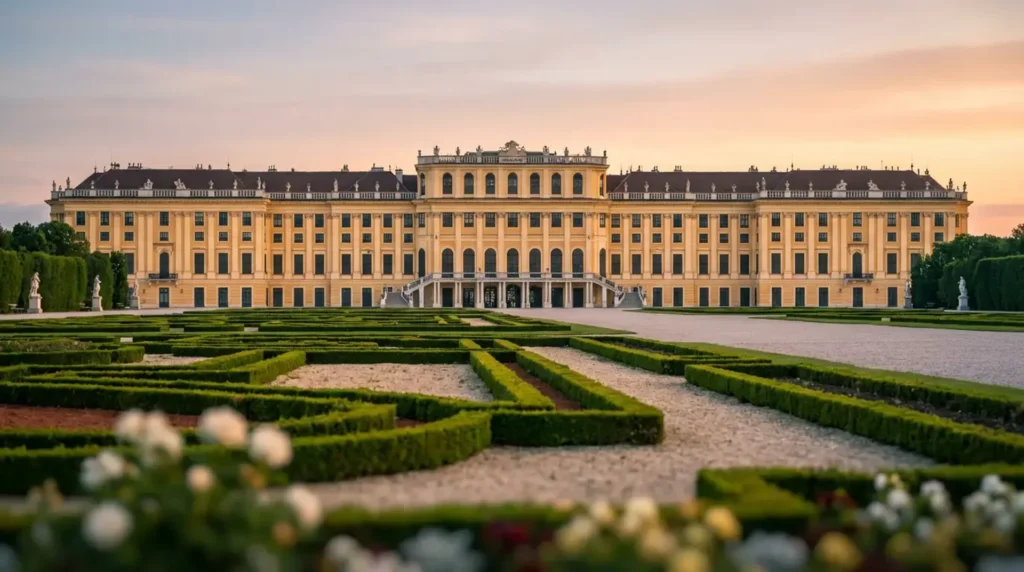
Austria’s imperial capital and, on almost every international quality-of-living index, the most liveable city in the world. Vienna fits a Habsburg palace complex, an opera house, a symphony, 450-plus coffeehouses and 1.98 million residents inside a 24-kilometre Ringstraße. The UN has one of its four global headquarters here; the former imperial summer palace, Schönbrunn, has 1,441 rooms; and the city’s public housing stock dates to 1920s Red Vienna. Classical music is effectively the civic religion.
- Schönbrunn Palace (UNESCO-listed Habsburg summer residence and gardens)
- Hofburg complex (winter palace), Spanish Riding School morning exercises, Sisi Museum
- MuseumsQuartier, Belvedere (Klimt’s “Kiss”), St. Stephen’s Cathedral, Naschmarkt
Signature eats: Wiener schnitzel at Figlmüller, tafelspitz at Plachutta, Sachertorte and a Melange at Café Sacher or Café Central, Heurigen wine and platter in Grinzing.
🎻 Salzburg
Mozart’s birthplace and The Sound of Music city — a UNESCO-listed Baroque old town pressed between the Salzach river and Hohensalzburg Fortress above. The historic centre is small enough to cross in 15 minutes, dense enough to occupy three days, and the whole place transforms every July and August for the Salzburg Festival — 200+ opera, concert and theatre performances running from late July through the end of August.
- Hohensalzburg Fortress (built 1077, the largest fully preserved castle in central Europe)
- Mozart’s Birthplace on Getreidegasse and Mozart’s Residence on Makartplatz
- Mirabell Gardens, the Sound of Music film locations, Hellbrunn Palace trick fountains
Signature eats: Salzburger Nockerl (a three-peak sweet soufflé the size of a hat), Mozartkugel chocolate, tafelspitz at Sankt Peter Stiftskeller (operating since 803 AD).
🏔️ Innsbruck
Capital of the Tyrol — the only European capital where you can ride a funicular from the old town and be on a 2,256-metre ridge inside 20 minutes. Twice host of the Winter Olympics (1964 and 1976), Innsbruck is the gateway to the Arlberg and Ötztal ski regions, and its compact old town around the Goldenes Dachl is framed on three sides by the Nordkette mountain wall.
- Goldenes Dachl (Golden Roof, 2,657 gilded copper tiles added for Emperor Maximilian I in 1500)
- Nordkettenbahn cable car from the city centre to Hafelekar (2,256 m)
- Ambras Castle, Swarovski Crystal Worlds (20 minutes east), Hungerburg funicular
Signature eats: Tiroler Gröstl (pan-fried potato, bacon and egg), Kaiserschmarrn and plum compote at a mountain hut, speck and mountain cheese on a Brettljause board.
🏛️ Graz
Austria’s second-largest city and a UNESCO Creative City of Design — a red-roofed old town pressed between the Mur river and the Schlossberg, a forested hill with a 16th-century clock tower at the top. Graz is Styrian Austria at its most relaxed: pumpkin-seed oil drizzled on everything, Buschenschank farm-taverns opening their doors on the surrounding hills, and two universities making the nightlife younger than Vienna’s.
- Schlossberg & the Uhrturm clock tower (1560) reached by funicular or 260 carved steps
- Kunsthaus Graz — Peter Cook’s 2003 “friendly alien” blob-architecture gallery
- Murinsel, Eggenberg Palace (UNESCO-listed), and the Landeszeughaus (world’s largest historical armoury)
Signature eats: Steirisches Backhendl (Styrian fried chicken), pumpkin-seed oil, Buschenschank cold-cut platters.
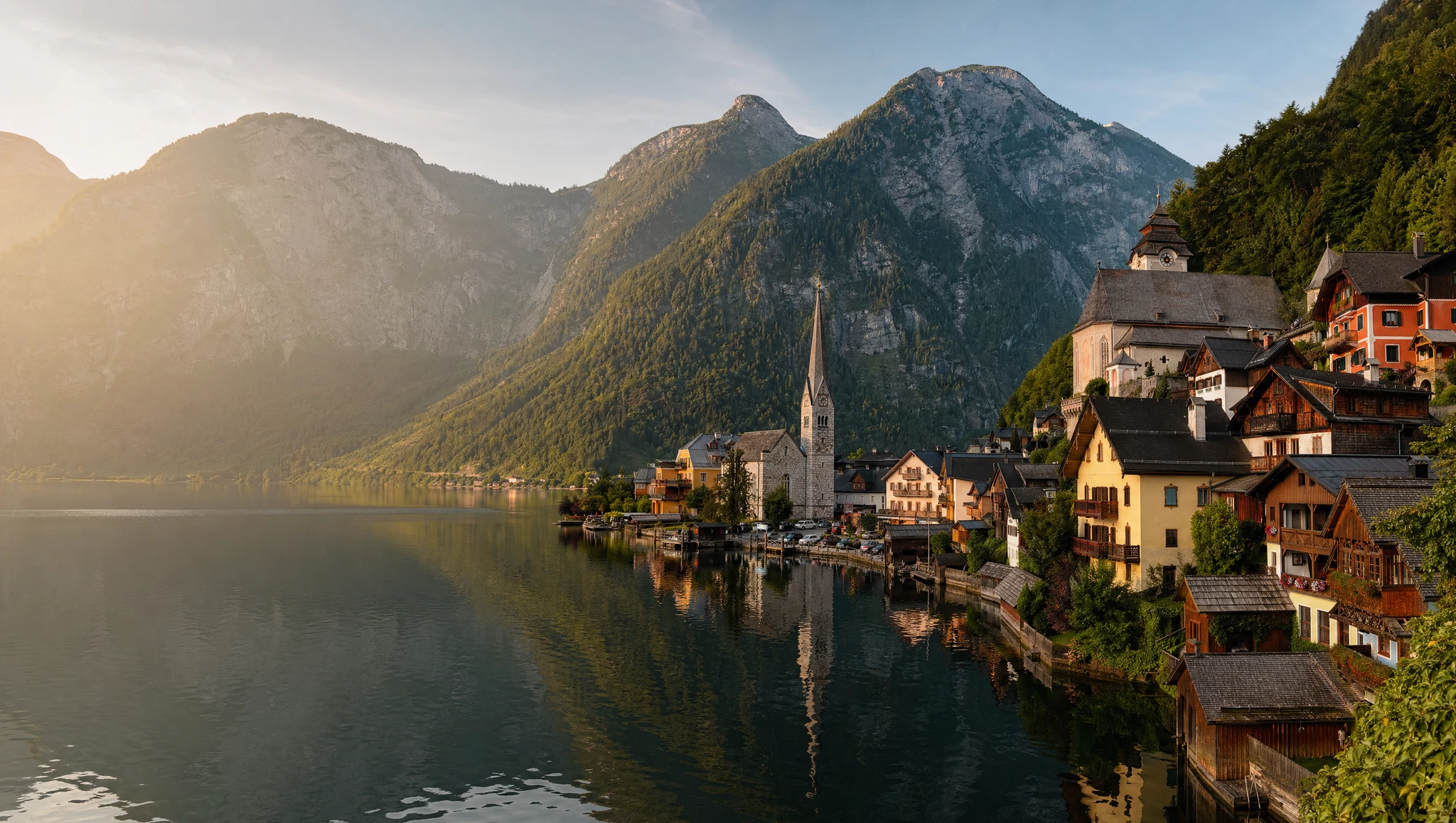
⛰️ Hallstatt & Salzkammergut
A 7,000-year-old salt-mining village of roughly 780 residents pinned between the Dachstein mountains and Hallstätter See, plus the lake district around it.
- Hallstatt Salt Mine (oldest working salt mine in the world, with a 64-metre underground slide)
- Beinhaus (charnel house with 1,200 painted skulls), Dachstein Krippenstein Skywalk
Signature eats: Reinanke (local lake fish pan-fried with brown butter), Kaiserschmarrn at the Lodge am Krippenstein.
🍇 Wachau Valley
A 40-km UNESCO-listed Danube stretch between Melk and Krems — terraced Grüner Veltliner vineyards, apricot orchards, and twin fortress-abbeys above the river.
- Melk Abbey (Benedictine, founded 1089; Baroque library with 100,000 volumes)
- Dürnstein castle ruin (where Richard the Lionheart was held 1192–93) and a Melk→Krems boat cruise
Austrian Culture & Etiquette — What to Know Before You Go
Austrian culture rewards formality, quiet competence, and the unhurried enjoyment of a good afternoon. Austrians are reserved with strangers, warm once introduced, and fond of the small rituals of a table — a Melange with a glass of water, a Heurigen owner pouring before you sit. Bureaucracy is famously thorough: registering an address or opening a bank account is slower than in Germany, a feature visitors mostly notice as impeccable queuing. Dress runs slightly more formal than in Germany — for the opera, ball or a good restaurant, a jacket is expected.
The Essentials
- Greet with a firm handshake and direct eye contact; use Sie and titles — “Herr Doktor”, “Frau Professor” — until invited to switch to du.
- Say “Grüß Gott” (literally “greet God”) when entering shops, cafés and hotels; “Servus” in informal Tyrol and Carinthia. “Moin” is German, not Austrian.
- Punctuality is tight for business and trains, relaxed by about 10 minutes socially. Arriving on time to dinner is correct.
- Jeans are fine in cafés; for the opera, Salzburg Festival or Michelin-starred dinners, jacket and collared shirt. Tracht (dirndls, lederhosen) is unironic festive dress.
- Cash is common in traditional Beisl taverns, Alpine huts, Würstelstände and rural markets. Keep €50–100 in small notes.
Coffeehouse Etiquette
- Order at the table, not the counter. The waiter (Herr Ober) is a trained profession — tip 5–10% by telling him the total.
- Order one coffee per hour of table-occupation; you may read newspapers and write a novel without being asked to leave. This is the unwritten Kaffeehaus contract.
- Use the right name: Melange (espresso, steamed milk, foam), Einspänner (double espresso, whipped cream, glass), Verlängerter (espresso lengthened with hot water). Asking for “a latte” marks you as a tourist.
- Water is served free alongside every coffee — Vienna’s piped Alpine water. Drinking it after the coffee is correct.
A Food Lover’s Guide to Austria
Austrian food is imperial, regional and seasonal, in that order. The old Habsburg Empire left Vienna with a cuisine that borrowed from Bohemia (dumplings), Hungary (goulash, paprika), northern Italy (Marillenknödel, polenta) and the Balkans (Kaiserschmarrn), and the country’s nine Bundesländer each defend their own version of every dish. Wine follows the same pattern — Grüner Veltliner from the Wachau, Sauvignon Blanc from southern Styria, sweet Ausbruch from Burgenland’s Lake Neusiedl — and beer is the ballpark drink: Stiegl in Salzburg, Gösser in Leoben, Ottakringer in Vienna.
Must-Try Dishes
| Dish | Description |
|---|---|
| Wiener Schnitzel | Thin-pounded veal, breaded in fine semmelbrösel and pan-fried in clarified butter until the breading balloons off the meat in a golden puff. By Austrian law the genuine “Wiener Schnitzel” must be veal; pork is “Wiener Schnitzel Art”. Served with parsley potatoes, lemon and lingonberry jam — Figlmüller in Vienna plates a schnitzel larger than the plate underneath it. |
| Tafelspitz | Boiled beef from the tri-tip cut, simmered in broth with root vegetables, served with apple-horseradish, chive sauce and crispy rösti — reportedly Emperor Franz Joseph’s daily lunch. Plachutta in Vienna built a multi-branch empire around a single copper pot. |
| Sachertorte | Dense chocolate sponge with a thin layer of apricot jam under a mirror-smooth dark chocolate icing, invented in 1832 by 16-year-old apprentice Franz Sacher. Eaten with a side of unsweetened whipped cream (Schlagobers) and an Einspänner coffee — the Hotel Sacher and Demel spent decades in court over the rights to the name “Original Sacher-Torte”. |
| Kaiserschmarrn | “Emperor’s mess” — a thick, torn-up pancake fluffed with beaten egg whites, caramelised with sugar, dusted with icing sugar, and served with plum (Zwetschgenröster) or apple compote. Invented in the imperial kitchen; Alpine huts serve a version the size of a pizza pan. |
| Tiroler Gröstl | A Tyrolean hut dish of pan-fried diced potato, smoked bacon and onion, finished with a fried egg on top and a pinch of caraway. Built for a post-ski appetite — every Tyrolean inn above 1,500 m has its own version. |
| Knödel (Dumplings) | Austria’s carb of choice in bread, potato or sweet fruit form: Semmelknödel with goulash, Germknödel (sweet yeast-dough dumpling stuffed with plum jam and drowned in vanilla sauce), Marillenknödel (apricot potato dumplings with brown-butter breadcrumbs — a Wachau speciality in July). |
| Käsekrainer | The Austrian ballpark sausage: pork with small nuggets of cheese inside that melt on the grill. Called an “Eitrige” in Viennese slang and sold at every Würstelstand with dark bread, sweet mustard and a Stamperl of spirit. |
Coffeehouse & Würstelstand Culture
Austria’s signature food institution is not a restaurant but the Kaffeehaus. Vienna’s coffeehouse culture has been inscribed on UNESCO’s list of Intangible Cultural Heritage since 2011, and the institution dates to 1683 — the legend says Polish soldier Jerzy Kulczycki opened the first café with Ottoman beans left behind after the Siege of Vienna. The other institution, democratic and street-level, is the Würstelstand — sausage kiosks open late, where a Käsekrainer with bread and mustard is €4–6 and a Stamperl of Stroh rum is €2.
- Houses: Café Central (1876), Café Sperl (1880), Café Hawelka (1939), Café Landtmann (1873), Demel (imperial confectioner, 1786).
- Signature items: Melange (the Viennese cappuccino), Einspänner (double espresso topped with whipped cream), Verlängerter (lengthened espresso), Sachertorte, Apfelstrudel with vanilla sauce, and Buchteln (sweet yeast buns) served late at Café Hawelka by the late owner’s tradition.
Off the Beaten Path — Austria Beyond the Guidebook
Grossglockner High Alpine Road
A 48-km toll road built between 1930 and 1935 over the Hohe Tauern mountains, climbing to 2,504 m at Edelweißspitze with 36 hairpin bends and a frontal view of Austria’s highest peak — the 3,798-m Grossglockner itself. Open only from early May through late October, the road is one of Europe’s great driving experiences: cyclists climb it as the “Austrian Stelvio”, marmots whistle at the Kaiser-Franz-Josefs-Höhe visitor centre, and the Pasterze glacier (the longest in the Eastern Alps, though retreating visibly each year) fills the valley below. Pair it with a night in Heiligenblut at the foot of the climb.
Semmering Railway
Europe’s first mountain railway and Austria’s first UNESCO World Heritage site (inscribed 1998) — built 1848–1854 across 14 tunnels, 16 viaducts and 41 kilometres of rock cutting, climbing from Gloggnitz to Mürzzuschlag. Ride the ÖBB Semmering heritage route, walk the Bahnwanderweg along the viaducts, and stay overnight at a Belle Époque villa in Semmering village — a Habsburg-era aristocrat’s summer retreat 90 minutes from Vienna that tourism largely forgot after 1918.
Burgenland & Lake Neusiedl
Austria’s easternmost, flattest and sunniest state — Pannonian plains that feel more like Hungary than the Alps, with Lake Neusiedl (77 km², shared with Hungary, shallow reed-ringed and UNESCO-listed as a cultural landscape) at its centre. White-stork villages like Rust, paprika-tinged Austro-Hungarian cooking, world-class sweet wines from Ruster Ausbruch since the 17th century, and in spring the cellars of Gols open their doors for long Kellergassen walks between vineyard rows.
Hohe Tauern National Park
At 1,856 square kilometres, the largest national park in the Alps — 266 peaks above 3,000 m, the 8-km Pasterze glacier, the 380-m three-tier Krimml Waterfalls (Austria’s tallest), and the Gschlöss Valley, a U-shaped glacial valley that has featured in Austrian school textbooks for a century. Base in Heiligenblut or Matrei in Osttirol and hike the 11-hut Tauern High Trail. Marmots and ibex are regular company above 2,200 m.
Southern Styrian Wine Road
Rolling vineyards of the Südsteirische Weinstraße along the Slovenian border — Austria’s “Tuscany” with klapotetz wind-rattles scaring birds from Sauvignon Blanc and Welschriesling vines. Buschenschenke (farm-taverns that open only when the grower hangs a pine bough over the door) pour cold wine and slice Brettljause platters drizzled with pumpkin-seed oil. Base in Gamlitz or Leutschach, hire bicycles on the Sulmtalradweg, and detour to the 18th-century stud farm at Piber where the Spanish Riding School’s Lipizzaner stallions are bred.
Practical Information
| Currency | Euro (€ / EUR); 1 USD ≈ 0.94 EUR (April 19, 2026) |
| Cash needs | More cash-accepting than Scandinavia or the Netherlands. Würstelstand sausage stands, Alpine mountain huts, traditional Beisl taverns and many bakeries run cash-only or cash-preferred. Keep €50–100 in small notes for the countryside. |
| ATMs | Bankomat machines ubiquitous at Erste Bank, Bank Austria, Raiffeisen and every post office. Decline dynamic currency conversion — always choose EUR for the interbank rate. |
| Tipping | Not automatic. Round up 5–10% by telling the server the total before payment (“Zweiundzwanzig, bitte” for a €20.40 bill). No tipping at bakeries or counter service; €1–2 per bag for hotel porters. |
| Language | German is the national language. Austrian German differs in vocabulary (Erdäpfel for potatoes, Paradeiser for tomatoes). English is universal in Vienna, Salzburg and ski resorts; thinner in rural Burgenland and small Styrian villages. |
| Safety | Very safe — Austria ranks 3rd on the 2024 Global Peace Index, one of the top ratings in Europe. Petty pickpocketing on Vienna’s U3 metro line and around Stephansplatz is the main risk. |
| Connectivity | 4G/5G blanket coverage from A1, Magenta and Drei. eSIMs (Airalo, Holafly) work nationwide from the moment you land; post offices sell prepaid tourist SIMs for €10–20. |
| Power | Type F (Schuko) plugs; 230V / 50 Hz |
| Tap water | Excellent nationwide and normally served free in restaurants. Vienna’s tap water is piped directly from the Styrian and Lower Austrian Alps through an aqueduct opened in 1873. |
| Healthcare | EU-standard public hospitals; EHIC cards work for EU visitors, others need travel insurance. Apotheken (green-cross pharmacies) have a night Nachtdienst rotation posted on every closed pharmacy door; dial 141 for the doctor on duty. |
Budget Breakdown — What Austria Actually Costs
💚 Budget Traveller
Hostels (Wombats, A&O, MEININGER in Vienna and Salzburg), Billa and Hofer grocery stops, a Vienna day pass or regional single tickets, and long-distance ÖBB Sparschiene fares booked six weeks out. Doable at €80–120 per day (~US$85–130), with Graz and Linz the cheapest big cities and Salzburg the priciest in festival season. A Würstelstand Käsekrainer under €5, a supermarket Kornspitz-and-ham under €3, a Melange and Apfelstrudel at a side-street Kaffeehaus €8, and a half-litre of Ottakringer pilsner under €4.
💙 Mid-Range
3-star hotel or a Vrbo/Airbnb apartment, one sit-down restaurant meal and one café meal per day, ÖBB Sparschiene advance tickets, and a couple of paid sights (Schönbrunn grand tour €29; Hohensalzburg Fortress combined ticket €16.80; Dachstein Skywalk €35.90). Plan €180–270 per day (~US$190–290). Salzburg during the festival (late July – end August) and Vienna during ball season (February) push the top of the range.
💜 Luxury
5-star hotels (Hotel Sacher Vienna and Sacher Salzburg, Park Hyatt Vienna, Hotel Imperial, Arlberg Hospiz), Railjet first class, Michelin-starred tasting menus with wine pairings, and private transfers to Hallstatt and the Wachau. Plan €490+ per day (~US$520+). An Opera Ball ticket with a private box is a five-figure night on its own, and the Salzburg Festival’s best seats for “Jedermann” on the Domplatz or a Vienna Philharmonic concert in the Großes Festspielhaus start around €450. Two Michelin stars in Austria (Steirereck in Vienna, Obauer in Werfen) run roughly €230–310 for a tasting.
| Tier | Daily (USD) | Accommodation | Food | Transport |
|---|---|---|---|---|
| Budget | $85–130 | Hostel €32–50 / budget pension €75–100 | €22–38/day | City day pass Vienna €8.20; regional singles €5–20 |
| Mid-Range | $190–290 | 3-star hotel €130–220 | €55–85/day | Railjet Sparschiene €19–39 intercity |
| Luxury | $520+ | 5-star hotel €400–850+ | €160–320/day | Railjet first class / private transfers €180–260/day |
Planning Your First Trip to Austria
- Pick your theme. Choose ONE: Imperial Vienna + Salzburg, Alpine Tyrol, or the Wachau + Styrian wine belt. Two themes fit inside 10 days on the Railjet.
- Book Railjet 6 weeks early on oebb.at. Sparschiene fares start at €19–39 for Vienna–Salzburg or Vienna–Graz.
- Consider the Klimaticket (€1,095/year). Overkill for a 10-day trip, but for a month or longer one pass covers every train, tram, U-Bahn and bus nationwide.
- Lock your seasonal pick. Opera Ball (February 12, 2026), Salzburg Festival (late July – end August), Christmas markets (late Nov – Dec 23), Wachau harvest (Sep–Oct), ski season (mid-Dec – mid-Apr). Book 6+ months ahead for Salzburg summer and Vienna February.
- Dress the part. Pack one jacket — opera, Salzburg Festival, Michelin-starred dinners and old-school coffeehouses expect collared shirts.
Classic 10-Day Itinerary: Days 1–3 Vienna (Hofburg, Schönbrunn, MuseumsQuartier, Grinzing Heurigen) · Day 4 Railjet to Melk + Wachau boat to Krems · Day 5 Railjet to Salzburg · Days 6–7 Salzburg (old town, Hohensalzburg, Sound of Music loop) · Day 8 day trip to Hallstatt · Day 9 Railjet to Innsbruck · Day 10 Nordkette cable car + fly from INN.
Frequently Asked Questions
Is Austria expensive to visit?
Cheaper than Switzerland, slightly pricier than Germany, comparable to northern Italy. Budget travellers get by on €80–120 per day with hostels and Würstelstand food; mid-range plan €180–270 per day. Graz and Linz are the affordable big cities; Salzburg in festival season and Vienna in ball season run 20–30% higher.
Do I need to speak German?
No. English is universal in Vienna, Salzburg, Innsbruck and ski resorts, and almost all Austrians under 40 speak it comfortably. A few local words warm every interaction: “Grüß Gott”, “Bitte”, “Danke”, “Zahlen bitte”. Austrian German has its own vocabulary — Erdäpfel (potatoes), Paradeiser (tomatoes), Jänner (January).
Is the Klimaticket worth it?
For most visitors, no — unless you are staying three months or longer. The full-Austria Klimaticket is €1,095 per year, which beats ÖBB Sparschiene only if you cross the country constantly for weeks. For a 10-day itinerary, Railjet Sparschiene fares booked six weeks out are cheaper.
Is Austria safe for solo travellers?
Very — Austria ranks 3rd in the 2024 Global Peace Index. Violent crime against visitors is rare, solo women report feeling comfortable on Vienna’s U-Bahn late at night, and Alpine trails are well marked. Main risks: pickpocketing on the U3 around Stephansplatz and Praterstern, and rapid weather changes in the mountains.
When is the Salzburg Festival and when is the Opera Ball?
The Salzburg Festival runs late July through the end of August — more than 200 opera, concert and theatre performances. The Vienna Opera Ball falls on the Thursday before Ash Wednesday; in 2026 that is February 12. Book festival tickets from January.
Can I get by as a vegetarian or vegan?
Easily in cities, thinner in Alpine huts. Vienna has one of the best per-capita vegan restaurant scenes in Europe, and traditional menus offer Käsespätzle, Kaspressknödel, Eiernockerl, Marillenknödel and Gemüsestrudel. In remote valleys, ask for “fleischlos” and expect cheese-and-carb plates.
Isn’t Austria basically the same as Germany?
No, and locals notice when visitors assume it is. Austria has its own republic (re-founded 1955), its own dialect and vocabulary, its own sweeter Czech-Hungarian-leaning cuisine, and coffeehouse and ball cultures that UNESCO treats as distinct intangible heritage. Saying “Grüß Gott” rather than “Guten Tag” already signals you know.
Ready to Explore Austria?
Austria rewards travellers who let the Railjet do the work, book six weeks ahead, learn five German words and dress one notch up. Start in Vienna for the imperial history, Salzburg for the festival and Mozart, Innsbruck for the Alps, or the Wachau for the river and the wine.
Explore More
Cities we cover in Austria
Cities to explore in Austria
Deep-dive guides to specific cities, neighbourhoods, and food scenes — written with the same magazine voice.
More country guides you might like

Plan your trip to Austria
The booking tools we use ourselves. FFU may earn a commission at no extra cost to you.
Plan & book your trip to Austria
Booking through these searches supports our guides at no extra cost to you.