
Abu Dhabi Travel Guide — Grand Mosques, Desert Islands & the UAE’s Quieter Capital
Everyone books Dubai and treats Abu Dhabi like an afternoon side trip. That is a mistake I made myself the first time, and I have been correcting it on every visit since. Abu Dhabi is the capital of the UAE, sits on a T-shaped island barely 250 metres off the mainland, and is home to roughly 2.19 million people in the city proper — smaller and calmer than its flashier neighbor, but holding the country’s best museum, its most jaw-dropping mosque, and a genuinely serious Formula 1 weekend. It is also more conservative and more government-planned than Dubai, which cuts both ways: cleaner, safer-feeling streets, but fewer of the anything-goes nightlife scenes. What I want you to know going in — the good, the hot, and the genuinely complicated regional politics of the last few months — is below.
In This Guide
- Overview — Why Abu Dhabi Is Not Just “Dubai’s Quiet Sibling”
- December Means Formula 1 Under the Lights
- Best Time to Visit Abu Dhabi (Season by Season)
- Getting There — Zayed International Airport & Overland from Dubai
- Getting Around — Taxis, Buses & Why There’s No Metro (Yet)
- Neighborhoods — Corniche, Saadiyat, Yas & Beyond
- Culture & People — Emirati Life in a Majority-Expat City
- A Food Lover’s Guide to Abu Dhabi
- Off the Beaten Path
- Day Trips — Al Ain, the Desert & Sir Bani Yas
- Practical Information
- Budget Breakdown — What Abu Dhabi Actually Costs in 2026
- Frequently Asked Questions
Overview — Why Abu Dhabi Is Not Just “Dubai’s Quiet Sibling”
Abu Dhabi is the capital and the seat of government of the United Arab Emirates, built on a T-shaped island connected to the mainland by a handful of bridges — the oldest, Maqta Bridge, dates to 1968, and the newest, the sail-shaped Sheikh Zayed Bridge, opened in 2010. The city itself holds around 2.19 million people, with the wider emirate — which stretches deep into the desert toward Al Ain and Liwa — home to roughly 3.8 million.
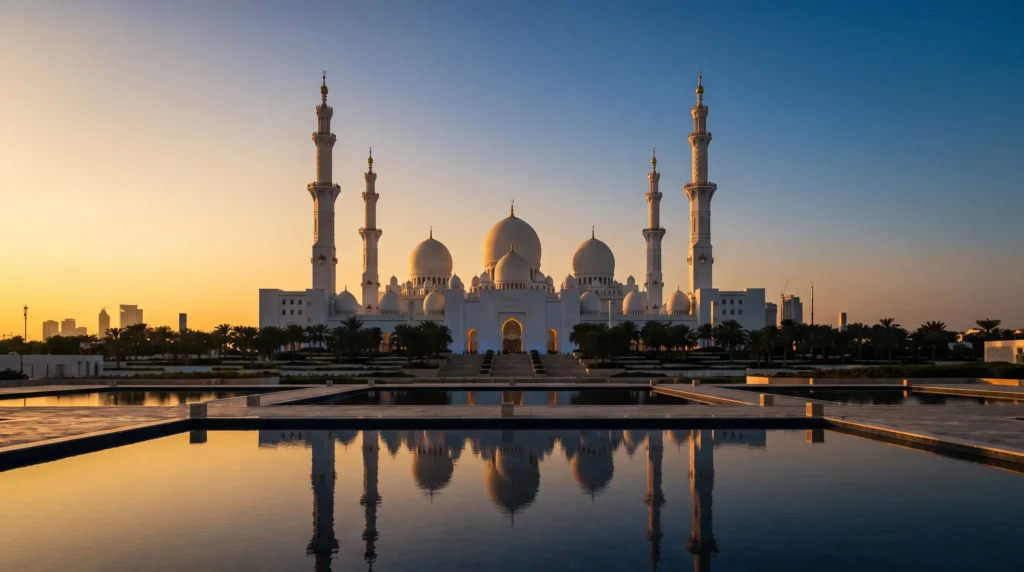
What sets it apart from Dubai isn’t scale, it’s temperament. Abu Dhabi holds the country’s oil wealth and its political center of gravity, and it shows in the way the city is built: wider boulevards, more green space per capita, museums funded like national infrastructure rather than tourist bait. The Sheikh Zayed Grand Mosque — 82 domes, more than 1,000 columns, capacity for tens of thousands of worshippers, and the world’s largest hand-knotted carpet in its main prayer hall — opened in 2007 as a monument as much as a mosque. A decade later, the Louvre Abu Dhabi opened on Saadiyat Island under a 180-metre latticed dome designed by Jean Nouvel, the first “universal museum” in the Arab world.
None of that means Abu Dhabi is sleepy. Yas Island alone packs in Ferrari World, Yas Marina Circuit’s F1 night race, a Warner Bros. theme park and a waterpark onto reclaimed land that didn’t exist twenty years ago. This is a city that builds its bucket-list attractions the way other places inherit them — deliberately, at speed, and usually air-conditioned.
December Means Formula 1 Under the Lights
Yas Marina Circuit has hosted the season-closing Formula 1 Abu Dhabi Grand Prix every year since 2009, and the contract now runs through at least 2030. The 2026 race weekend is scheduled for early December, run partly under floodlights as the sun sets mid-session — it is genuinely one of the more theatrical events on the F1 calendar, with the after-parties on Yas Island (past headliners have included major global pop and hip-hop acts) as much a draw as the race itself.
Book hotels on Yas Island or the Corniche six-plus months out if you want the race weekend — rates spike hard and rooms sell out early. If F1 isn’t your thing, the same December-into-March window is simply the best weather stretch of the year, so treat the Grand Prix as a scheduling landmark even if you skip the ticket.
Best Time to Visit Abu Dhabi (Season by Season)
November – March · Cool season (peak)
Daytime highs in the pleasant high-20s to low-30s°C, low humidity, blue-sky days for the Corniche, desert trips and outdoor dining. This is also peak price season, sharpened further by the December F1 weekend and the winter holiday crowd.
October & April · Shoulder
Warm but manageable, thinner crowds, noticeably better hotel rates. My pick for a first visit if you can be flexible.
May – September · Summer (off-peak, and genuinely brutal)
July and August are the peak of a hot desert climate, with average daily maximums pushing past 40°C (104°F) and humidity that makes the coast feel like a sauna. Hotel rates crater and malls, indoor attractions and beach clubs stay fully air-conditioned, so it’s not impossible — just plan your day around staying indoors from late morning to early evening.
Getting There — Zayed International Airport & Overland from Dubai
Zayed International Airport (AUH), about 30 kilometres east of the city, is the gateway, served by roughly two dozen airlines flying to well over a hundred destinations, with Etihad Airways as the home hub carrier. The new Terminal A, opened in October 2023, is a single massive facility that replaced the airport’s three older terminals and handled nearly 29.5 million passengers in 2024 alone.
Most nationalities — including the US, UK, EU, Canada and Australia — get visa-free entry on arrival, typically stamped for 30 days, with no advance application needed; just make sure your passport has at least six months’ validity left. Coming from Dubai, it’s a straightforward 90-minute to two-hour drive or bus ride down Sheikh Zayed Road, and plenty of visitors do both cities in a single trip.
Getting Around — Taxis, Buses & Why There’s No Metro (Yet)
Unlike Dubai, Abu Dhabi has no metro or tram system running today — everything moves by road. Metered taxis (silver sedans, government-regulated) are cheap and everywhere; ride-hailing apps work reliably and are often the easier option for tourists who don’t want to flag a cab. The public bus network covers the city and connects out to Al Ain and Dubai for a fraction of taxi cost, though schedules reward patience over precision.
The Corniche itself is entirely walkable and increasingly cycle-friendly, with a dedicated bike path running its full length. Getting between islands — Saadiyat, Yas, Reem — really does require a car or taxi; distances look short on a map but the road network and heat make walking between them impractical for most of the year. Rental cars are inexpensive and the highways are excellent if you want to self-drive out to Al Ain or the desert.
Neighborhoods — Corniche, Saadiyat, Yas & Beyond
The Corniche & Downtown
The city’s front porch: an eight-kilometre curve of manicured waterfront promenade, white-sand public beaches, cycling paths and skyline views back toward the financial district. This is where you get your bearings — walk it at sunset, then head a few blocks inland for the older downtown grid of markets and mid-rise apartment towers.
Saadiyat Island
Abu Dhabi’s cultural gambit: the Louvre Abu Dhabi, the Zayed National Museum, a planned Guggenheim, plus a genuinely lovely public beach and a cluster of resort hotels. Budget a full day here for the Louvre alone — the building is as much the exhibit as the art inside it.
Yas Island
The theme-park-and-adrenaline zone: Ferrari World, Yas Waterworld, Warner Bros. World, Yas Marina Circuit (F1 track and, off-season, a public driving experience), a golf course, and Yas Mall. Families and thrill-seekers base themselves here; it’s a distinct trip from the culture-first pace of Saadiyat.
Al Maryah & Al Reem Islands
The newer financial and residential districts — glass towers, high-end shopping at The Galleria, rooftop bars, and a skyline that looks more like a compact Manhattan than the desert capital a generation earlier.
Al Bateen & Al Mina
Quieter, more local corners: Al Bateen’s dhow shipyard and waterfront villas, and Al Mina’s fish and produce markets, worth an early-morning visit before the trading floor closes for the day.
Masdar City
A purpose-built low-carbon district on the city’s edge, walkable and largely car-free by design, with a driverless pod-car system and a genuinely interesting look at how the UAE is trying to hedge its oil-economy bet.
Culture & People — Emirati Life in a Majority-Expat City
Emirati nationals are a minority in their own capital — the vast majority of Abu Dhabi’s population is made up of expatriate workers and residents from South Asia, Southeast Asia, the wider Arab world, Europe and North America, which shows up in the food, the languages you’ll overhear, and the sheer range of neighborhoods within a few kilometres of each other. Arabic is official, but English functions as the working language for tourism, business and most day-to-day interactions.
Islam shapes public life visibly: the call to prayer, modest dress expectations in malls and government buildings (shoulders and knees covered is the safe default, stricter still inside mosques), and reduced restaurant hours during Ramadan. Alcohol is legal and served in licensed hotels, resorts and some standalone restaurants and bars, but not in most standard street-level restaurants — this is one of the genuine adjustments for first-time visitors from more permissive drinking cultures. The majlis tradition of hospitality and gathering still underpins a lot of Emirati social life, and traditional falconry and camel racing (Al Wathba Camel Racing Track hosts regular meets in cooler months) remain living practices, not museum pieces.
A Food Lover’s Guide to Abu Dhabi
Emirati home cooking centers on slow-cooked, spiced dishes: machboos (spiced rice with meat or fish, similar to biryani’s Gulf cousin), harees (a wheat-and-meat porridge traditionally eaten during Ramadan and Eid), and luqaimat, deep-fried dough balls drizzled in date syrup, sold everywhere from heritage villages to shopping-mall kiosks. Karak tea — strong, sweet, cardamom-spiced — is the ubiquitous street-corner ritual, best had from a no-name tea stall rather than a hotel lobby.
Because the resident population is so international, the city’s best food is often not Emirati at all: outstanding Levantine mezze and grills, some of the best Indian, Pakistani and Filipino food outside those countries, and an increasingly serious fine-dining scene inside the big hotel groups. Al Mina’s fish market is the place to buy fresh catch and have it grilled to order nearby. Friday brunch — a long, often boozy, multi-restaurant institution at hotel properties — is worth doing once even if it’s not your usual style.
Off the Beaten Path
Qasr Al Hosn
The city’s oldest surviving stone structure, originally a watchtower and later the ruling family’s fort and seat of government, now a free museum telling Abu Dhabi’s pre-oil history — a useful counterweight to all the glass towers.
Abu Dhabi Mangrove National Park
Kayak or electric-boat through one of the largest mangrove forests in the UAE, a five-minute drive from downtown skyscrapers and a genuinely calm, birdlife-rich contrast to the rest of the itinerary.
Heritage Village
A recreated pre-oil Emirati settlement on the Corniche breakwater — palm-frond houses, a working potter and weaver, and camels on-site. Touristy by design, but a fast, free way to visualize what the coastline looked like two generations ago.
Al Wathba Camel Racing Track
Free-to-watch camel races, often with robot jockeys controlled by owners driving alongside on the inside track — a genuinely strange and memorable Friday-morning outing in cooler months.
Day Trips — Al Ain, the Desert & Sir Bani Yas
Al Ain — the “Garden City”
About a 90-minute to two-hour drive inland, Al Ain is home to the UAE’s only UNESCO World Heritage Site: the Cultural Sites of Al Ain, a serial listing of Hafit-period tombs, the Hili archaeological site, Bidaa Bint Saud and the historic oasis areas, inscribed in 2011 as evidence of continuous human settlement in a desert region since the Neolithic period. Pair the ruins with a walk through Al Ain Oasis’s shaded date-palm groves and, if you have a car, the switchback drive up Jebel Hafeet for sweeping desert views.
Liwa Oasis & the Empty Quarter
Roughly three hours southwest, Liwa sits on the edge of the Rub’ al Khali (Empty Quarter), one of the largest continuous sand deserts on Earth. Overnight desert camps here, or closer options nearer the city, are the standard way to do dune-bashing, camel treks and a night under genuinely dark skies.
Sir Bani Yas Island
A protected wildlife reserve island off the Western Region coast with free-roaming Arabian oryx, giraffes and gazelle, reachable by ferry or short flight — an unusual half-day or overnight safari option that most visitors never realize exists this close to a Gulf capital.
Practical Information
Money. The UAE Dirham (AED) has been pegged at 3.6725 to the US dollar since 1997, so exchange-rate math is simple and stable. Cards are accepted almost everywhere in the city; carry small cash for taxis, markets and tipping.
Safety and the current regional picture. Day to day, Abu Dhabi is one of the lower-crime, more orderly cities you’ll visit — but I’d be doing you a disservice not to flag this clearly: hostilities between the US and Iran that began in late February 2026 pushed the US State Department to a Level 3 “Reconsider Travel” advisory for the UAE, citing the threat of drone and missile attacks and heightened terrorism risk, an advisory that as of this writing (last updated March 2026) has not been downgraded. The situation has since eased: an 8 April 2026 ceasefire and a June 2026 US–Iran understanding led the UK’s FCDO to lift its own warning on 18 June 2026, and flights, malls and daily life across the UAE are running normally again. Still, both agencies describe the underlying situation as capable of flaring up again with little notice — check your own government’s current advisory the week before you fly, register with your embassy’s traveler program, and don’t treat “things look calm now” as a permanent state.
Health. No special vaccines are required to enter, but routine immunizations (including MMR, given rising global measles cases) should be current, and hepatitis A and typhoid are commonly recommended. Tap water is treated and generally safe, but bottled water is cheap and the local default. Sun and heat exposure, not infectious disease, is the practical daily risk here.
Connectivity. Free Wi-Fi is common in malls and cafes; a local SIM or eSIM is cheap and easy at the airport. Plugs: UK-style three-pin (Type G), 230V. Time zone: UTC+4 year-round, no daylight saving.
Budget Breakdown — What Abu Dhabi Actually Costs in 2026
Abu Dhabi runs a shade cheaper than Dubai on the mid-range and up, but budget travel here is genuinely harder to pull off than in most of Southeast Asia or Central America — this is a Gulf capital, priced like one.
Budget (US$70–120/day): Budget hotel or hostel dorm away from the Corniche, food-court and cafeteria-style meals, public bus travel, free attractions (Corniche, Heritage Village, mosque exterior visits).
Mid-range (US$200–380/day): Three- or four-star hotel, restaurant meals including one nicer dinner, taxis between islands, entry to the Louvre Abu Dhabi and one theme park on Yas Island.
Luxury (US$600+/day): Beachfront resort on Saadiyat or Yas, private guided desert safari, fine dining, F1 weekend hospitality packages (book these many months ahead).
Fixed costs to expect: a municipality/tourism fee added to hotel bills, and paid entry (with modest, separately priced add-ons like abaya rental if needed) for most major sights beyond the mosque and Corniche.
Planning Your First Trip to Abu Dhabi
The efficient first-timer split is culture + island time: two nights based centrally or on Saadiyat for the Sheikh Zayed Grand Mosque, Qasr Al Hosn and the Louvre, then two nights on Yas Island for the theme parks and, if timing allows, the F1 weekend. Add a day trip to Al Ain if you have four-plus nights, or extend into the desert at Liwa if you have a week. Most visitors pair Abu Dhabi with Dubai given the short drive between them — see our Dubai city guide for that half of the trip — and a growing number are stacking in Doha or Muscat for a wider Gulf-capitals itinerary; check our Doha guide and Muscat guide for those.
Frequently Asked Questions
Is Abu Dhabi safe to visit right now?
Day-to-day crime is low and the city itself feels orderly and well-policed. The bigger factor right now is the regional security picture: the US State Department still has the UAE at a Level 3 “Reconsider Travel” advisory dating to the February–March 2026 US–Iran hostilities, though the UK’s FCDO lifted its own warning in June 2026 after a ceasefire held. Check your own government’s current advisory close to your travel date rather than relying on this guide or older headlines.
Do I need a visa?
Most Western passport holders — US, UK, EU, Canada, Australia — get visa-free entry on arrival, typically valid for 30 days, with no advance application. Confirm your specific nationality’s rule before booking, and make sure your passport has six months of validity left.
Is alcohol legal in Abu Dhabi?
Yes, but it’s licensed and confined mostly to hotels, resorts and specific restaurants and bars — you generally won’t find it at a standard street-level restaurant or in shops outside licensed outlets. Public intoxication is taken seriously.
Abu Dhabi or Dubai — which one first?
If you only have a few days, Dubai’s density of attractions edges it out for a first trip. If you have five-plus days or care more about museums, architecture and a calmer pace, do both — they’re close enough that splitting a week between them is the norm, not the exception.
What should I wear?
Casual, modest clothing (shoulders and knees covered) is the safe default for malls, government buildings and cultural sites; swimwear is fine at hotel pools and beaches. Visiting the Sheikh Zayed Grand Mosque requires full-length, loose clothing and a headscarf for women — abayas are available to borrow on-site.
How hot is too hot?
June through September regularly clears 40°C (104°F) in the shade. It’s doable if you structure the day around air-conditioned museums, malls and pools, but it’s not the season to plan on much outdoor walking.
Ready to Explore Abu Dhabi?
A mosque that stops conversations mid-sentence, a museum under a dome that filters light like nothing else in the region, and a Formula 1 grid lighting up under the desert night sky every December — Abu Dhabi earns its own trip, not just a layover from Dubai. Just check the current safety advisories before you book, same as you would for anywhere with recent regional tension, and go see the capital properly.
Explore More
- Dubai City Guide — the ninety-minute neighbor most visitors pair it with
- Doha City Guide — another Gulf capital reinventing itself around culture and sport
- Muscat City Guide — Oman’s quieter, mountain-backed answer to the UAE
- Oman Travel Guide — for fjords, forts and the wider Arabian Peninsula
How this guide was built
Published as part of Facts From Upstairs’ city guide series. Built from authoritative sources — the UNESCO World Heritage Centre’s Cultural Sites of Al Ain inscription, the UAE Central Bank’s dirham peg documentation via Wikipedia, the US State Department’s UAE country information and travel advisory pages, the UK FCDO’s UAE travel advice, the US CDC traveler page for the UAE, Visit Abu Dhabi’s official tourism site, and Wikipedia entity pages for Abu Dhabi, Zayed International Airport, the Sheikh Zayed Grand Mosque, the Louvre Abu Dhabi and the Abu Dhabi Grand Prix, cross-checked against the official Abu Dhabi Grand Prix event site. Numeric and safety claims carry inline citations, and the safety section in particular was written directly from the State Department and FCDO pages current as of this guide’s publish date — recheck them before you travel, since the regional situation was still described by both agencies as capable of changing quickly.
Sources cited on this page
- Wikipedia — Abu Dhabi
- UNESCO — Cultural Sites of Al Ain
- Wikipedia — UAE Dirham
- Wikipedia — Zayed International Airport
- Wikipedia — Sheikh Zayed Grand Mosque
- Wikipedia — Louvre Abu Dhabi
- Wikipedia — Abu Dhabi Grand Prix
- Official Formula 1 Etihad Airways Abu Dhabi Grand Prix
- Visit Abu Dhabi — official tourism site
- US State Department — UAE country information
- US State Department — UAE travel advisory
- UK FCDO — United Arab Emirates travel advice
- US CDC — UAE traveler page
More city guides you might like

Plan your trip to Abu Dhabi
The booking tools we use ourselves. FFU may earn a commission at no extra cost to you.
Plan & book your trip to Abu Dhabi
Booking through these searches supports our guides at no extra cost to you.