
Aswan Travel Guide — Nubia, Lake Nasser & Egypt’s Slowest, Sunniest City
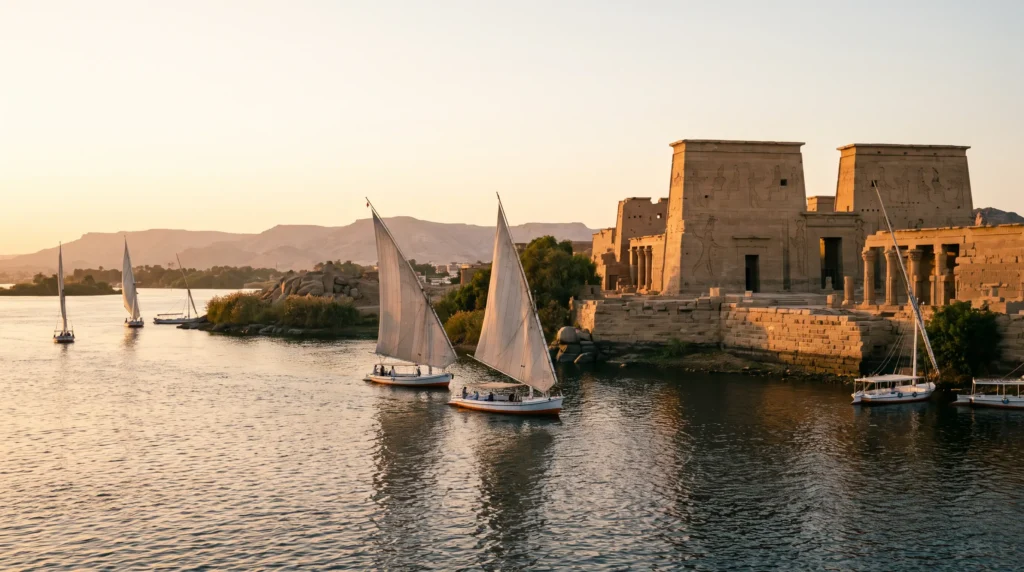
Aswan is where the Nile stops rushing and starts performing. Every other Egyptian city I’ve visited feels like it’s racing the desert; Aswan just leans into it — granite islands scattered across the river like something got left mid-sentence, felucca sails leaning into the wind at golden hour, and a whole neighborhood of Nubian houses painted the colors of a spice rack. This is Egypt’s southernmost major city, sitting almost on the Sudanese border, and it has been continuously inhabited for something like 2,600 years. It’s also, by most measures, one of the hottest and driest cities on the planet — annual rainfall barely registers, and the city banks roughly 4,000 hours of sunshine a year. People come for Abu Simbel and the reflex-photo of Philae, and they’re right to — but the reason to actually stay three or four nights is the pace: this is the one stop on the classic Egypt run where you’re supposed to slow down, hire a felucca instead of a schedule, and let the afternoon disappear.
In This Guide
- Overview — Why Aswan Is the Nile’s Best Slow Chapter
- The Abu Simbel Sun Festival — Twice a Year, Ramses Lights Up
- Best Time to Visit Aswan (Season by Season)
- Getting There — Airport, Train & Nile Cruise
- Getting Around — Feluccas, Taxis & the Corniche
- Key Neighborhoods & Islands
- Culture & People — Nubia on the Nile
- A Food Lover’s Guide to Aswan
- Off the Beaten Path
- Day Trips — Abu Simbel & Beyond
- Practical Information
- Budget Breakdown — What Aswan Actually Costs in 2026
- Frequently Asked Questions
Overview — Why Aswan Is the Nile’s Best Slow Chapter
Aswan sits at Egypt’s first Nile cataract, in Upper Egypt near the Sudanese border, with a metro population around 371,000 — small by Egyptian standards, and it feels it. The wider Aswan Governorate, which stretches south to cover most of Lake Nasser, holds closer to 1.7 million people. Ancient Egyptians called it Swenett — the root of both “Aswan” and, via Greek, “syenite,” the pink granite quarried here that built obelisks and colossi across the entire Nile Valley.
What makes Aswan different from Cairo or even Luxor is geography: the river braids around a scatter of granite islands and outcrops, so instead of one riverbank you get a whole archipelago — Elephantine Island, Kitchener’s Island’s botanical garden, the Nubian villages on the west bank, and Agilkia Island, where the Temple of Isis at Philae was rebuilt stone by stone after the Aswan High Dam threatened to drown it. That dam, completed in 1970, created Lake Nasser — one of the largest reservoirs on Earth, stretching roughly 500 kilometers south into Sudan — and it’s the reason a UNESCO-led rescue operation spent two decades in the 1960s–70s dismantling and relocating a dozen threatened temples, the most famous being Abu Simbel.
All of that is the postcard version. The lived-in version is a Nubian city: warm, unhurried, full of people whose ancestors were resettled here when their original villages went under Lake Nasser’s water, and who’ve rebuilt their culture — indigo dye, call-and-response music, cobalt-and-ochre house paint — on the Nile’s west bank. Aswan rewards travelers who give it more than a one-night Abu Simbel layover.
The Abu Simbel Sun Festival — Twice a Year, Ramses Lights Up
Time a trip around one of two mornings — 22 February or 22 October — and you’ll watch three-thousand-year-old engineering do something no modern lighting rig replicates. At sunrise on those two dates, sunlight travels 60 meters into the Great Temple at Abu Simbel and lights up the inner sanctuary statues of Ramses II, Amun and Ra-Horakhty, while the fourth figure, Ptah (god of the underworld), stays deliberately in shadow. The dates are widely tied to Ramses II’s coronation and birth, though the temple’s 1968 relocation to save it from Lake Nasser shifted the exact alignment by roughly a day from the ancient original.
Both dates now draw a genuine festival atmosphere — buses arrive from Aswan before dawn, there’s Nubian music and dancing at the site through the day, and hotel rooms in Aswan and at Abu Simbel itself book out weeks ahead. If those two mornings don’t fit your calendar, don’t worry: the temples are spectacular any day, just without the light show.
Best Time to Visit Aswan (Season by Season)
Late November – February · Peak season
Daytime highs settle into the pleasant 20s°C, evenings can be genuinely cool on the water, and this is when Nile cruise ships and dahabiyas run at full capacity. It’s also when the Sun Festival’s February date falls, so book Abu Simbel accommodation early if your trip lands near the 22nd.
March – April & October · Shoulder
Warm, still comfortable, thinner crowds than winter, and October carries the second Sun Festival date. A genuinely good compromise season.
May – September · Extreme heat, lowest prices
Aswan is one of the hottest inhabited places on the planet in summer, with daytime highs routinely above 40°C (104°F) and sometimes touching 50°C. Locals and long-stay travelers manage it — early starts, indoor midday hours, felucca rides at dusk — but this isn’t a season for marathon sightseeing, and it’s genuinely risky for anyone with heat sensitivity. In exchange, hotel and cruise rates drop sharply and the major sites are nearly empty at opening time.
Getting There — Airport, Train & Nile Cruise
Aswan International Airport (ASW) sits about 16 kilometers southwest of the city and functions mainly as a domestic hub, with EgyptAir, Nile Air and Air Cairo running frequent flights from Cairo (roughly 1.5 hours) and connections onward to Abu Simbel. There is essentially no scheduled international service direct into Aswan — nearly everyone routes through Cairo first.
The overnight sleeper train from Cairo (via Luxor) is the classic slow approach — roughly 12–14 hours, cabins with a fold-down bed, and you wake up on the Nile. Daytime trains also run the Cairo–Aswan corridor in about 12–13 hours if you’d rather see the Nile Valley go by in daylight. The other classic route is by water: a 3–5 night Nile cruise or a slower dahabiya sailboat trip from Luxor, which is how most visitors actually experience the stretch between the two cities, stopping at Edfu and Kom Ombo along the way.
Getting Around — Feluccas, Taxis & the Corniche
Central Aswan is compact and walkable along the Corniche el-Nil, the riverfront promenade lined with hotels, cafes and the entrance to the souk. But the city’s real transport network is the river itself: a public ferry runs from the Corniche landing to Elephantine Island roughly every 30 minutes and is the cheapest way across, while private motorboat taxis and traditional felucca sailboats can be chartered by the hour from the same landings for trips to Kitchener’s Island, the Nubian villages, or simply a sunset sail around the islands.
On land, metered taxis and ride-hailing apps cover the city center and the road out to the High Dam and the Unfinished Obelisk quarry; agree a price up front if a taxi has no working meter, which is common. Horse-drawn caleche carriages still work some tourist routes, and for Abu Simbel — 290 kilometers south — most travelers join a convoy bus tour, book a private driver, or take the short EgyptAir/Air Cairo hop, since it’s too far for a casual taxi day trip.
Key Neighborhoods & Islands
The Corniche & Downtown Aswan
The riverfront spine of the city — hotels, felucca docks, the Old Cataract Hotel’s terrace, and the Aswan souk running parallel a block inland, one of Egypt’s better markets for spices, textiles and Nubian crafts without Cairo’s intensity.
Elephantine Island
A short ferry ride from the Corniche, Elephantine is the largest island in the Aswan archipelago and blends deep archaeology with everyday Nubian village life. On it: the ruins of the Temple of Khnum, a 3,000-year-old Nilometer used to measure Nile flood levels, the small Aswan Museum, and the twin Nubian villages of Siou and Koti, where houses are still painted in the traditional bright color schemes.
Agilkia Island (Philae Temple)
Reached by short motorboat from the Aswan High Dam boat landing, Agilkia now hosts the entire Temple of Isis complex, moved here stone by stone between 1977 and 1980 to escape the rising waters of the dam. A sound-and-light show runs most evenings.
Kitchener’s Island (El Nabatat)
A slender botanical garden island gifted to Lord Kitchener in the 1890s, now a shaded escape of palms and exotic trees collected from across the former British Empire — a nice cooldown between temple visits.
The Nubian Villages (West Bank)
Nubian communities resettled after Lake Nasser’s flooding rebuilt their houses on Aswan’s west bank in bold indigo, ochre and turquoise, often decorated with hand-painted motifs. Many families host visitors for tea or a meal — a respectful, arranged visit (through a guide or hotel) is the way to do this properly rather than wandering in uninvited.
The High Dam Area & Unfinished Obelisk
South of the city center, the Aswan High Dam itself is a quick, slightly bureaucratic stop (security checks, a small museum), most interesting for grasping the scale of Lake Nasser. Closer to downtown, the granite quarries hold the Unfinished Obelisk — abandoned mid-carving after a crack appeared, and at roughly 42 meters it would have been the largest obelisk ever raised in Egypt had it been completed.
Culture & People — Nubia on the Nile
Aswan is Egypt’s Nubian capital in every practical sense. Nubian identity here predates the Pharaohs and survived Arabization, colonization, and — most disruptively — the 1960s displacement, when Lake Nasser’s rising waters submerged dozens of ancestral Nubian villages and forced tens of thousands of people to resettle around Aswan, Kom Ombo and elsewhere. The Nubian Museum, opened in Aswan specifically to preserve this heritage, walks through Nubian history, crafts and the story of the UNESCO relocation campaign that saved both the temples and, in effect, cultural memory of what was lost underwater.
Nubian languages (Nobiin and Kenuzi-Dongola, among others) are still spoken at home alongside Arabic, and Nubian music — call-and-response vocals, the tar frame drum, oud — turns up in felucca-deck performances aimed at tourists but rooted in something real. Ramadan and the two Eid holidays shift daily rhythms citywide; if your visit overlaps, expect shops to open later and restaurants to fill after sunset.
A Food Lover’s Guide to Aswan
Aswan’s food leans lighter and more Nubian-inflected than Cairo’s. Look for ful medames (stewed fava beans) and koshari for breakfast and quick lunches, but the more distinctive local dish is Nubian-style grilled fish straight from the Nile, often cooked simply with lemon, garlic and cumin at riverside restaurants and Nubian village homes.
Hibiscus tea — karkade — is Aswan’s signature drink, served hot or iced, tart and deep red, and grown in the region; it’s worth buying dried flowers in the souk to take home. Pair it with molokhia (a garlicky green stew, usually with chicken or rabbit), fresh-baked aish baladi flatbread, and dates — Aswan sits amid some of Egypt’s best date-growing country, and the souk sells a dozen varieties by the kilo. Sugarcane juice stalls (asab) are everywhere and genuinely refreshing in the heat.
Off the Beaten Path
Monastery of St. Simeon
A ruined 7th-century Coptic monastery on the desert edge of the west bank, reached by camel or a hot walk from the river — mudbrick walls, empty cells, and total quiet a few hundred meters from the Nile’s green strip.
Sehel Island
A short felucca ride upriver, Sehel is Nubian village life without the tour-bus crowds, plus ancient rock inscriptions recording Nile flood levels carved directly into the granite boulders along its shore.
Wadi el-Seboua & the Lake Nasser Temples
Several of the relocated Nubian Monuments — Wadi es-Sebua, Amada, Kalabsha — sit around Lake Nasser and see a tiny fraction of Abu Simbel’s visitors, reachable by chartered boat or as an add-on to a Lake Nasser cruise.
Gharb Soheil at Dusk
The colorful Nubian village opposite Elephantine Island is a well-known photo stop by day; arrive instead for the last ferry before sunset, when the crowds thin and the cobalt-blue houses catch the light.
Day Trips — Abu Simbel & Beyond
Abu Simbel
The reason most people fly to Aswan at all: Ramses II’s two rock-cut temples, relocated in 1968 to escape Lake Nasser and reinaugurated on higher ground, are about 290 kilometers south of Aswan near the Sudanese border. Most visitors go by early-morning convoy bus (roughly 3–3.5 hours each way) or a 25-minute flight; either way, plan it as a full day.
Kom Ombo & Edfu
Usually visited en route between Luxor and Aswan by river cruise or as a shared taxi day trip: Kom Ombo’s unusual double temple (dedicated to Sobek and Horus) and Edfu’s Temple of Horus, one of Egypt’s best-preserved.
Lake Nasser Cruise
A quieter alternative to the Nile cruise circuit — smaller ships spend several days on Lake Nasser itself, stopping at the relocated temples along its shore with a fraction of the Nile route’s boat traffic.
Practical Information
Money. The Egyptian pound floats freely and has moved significantly in recent years; expect roughly 50 EGP to the US dollar as of mid-2026, but check a live rate before you travel. Cards work in hotels and larger restaurants; carry small EGP notes for the souk, taxis, tips and temple sites, where change is often scarce.
Visa. Most Western nationalities can get an Egyptian e-visa in advance (~US$25) via the official government portal, or a visa on arrival at major airports (~US$30) — apply only through the official site, as third-party lookalikes charge markups.
Safety. Both the US State Department and UK FCDO specifically carve out the Nile Valley tourist circuit — Luxor, Qena, Aswan, Abu Simbel and the Valley of the Kings — from broader restrictions affecting the Sinai and Western Desert border regions, and travelers should still register with their embassy, buy solid medical evacuation insurance, and stay alert in crowds.
Health. The CDC recommends hepatitis A and typhoid vaccination for most Egypt travelers and flags schistosomiasis risk from untreated freshwater — don’t swim in Nile canals or irrigation channels. Drink bottled or filtered water, and pace yourself in summer heat.
Connectivity. A local SIM or eSIM (Vodafone, Orange, Etisalat) is cheap and covers the city and most Nile cruise routes; hotel Wi-Fi is generally reliable in the center. Plugs: European-style two-pin (Type C/F), 220V. Time zone: UTC+2, no daylight saving.
Budget Breakdown — What Aswan Actually Costs in 2026
Aswan runs cheaper than Cairo’s tourist zones or a Red Sea resort, but temple entry fees and the Abu Simbel trip add up fast.
Budget (US$30–55/day): Guesthouse room, felucca sunset sail split with other travelers, koshari and ful stalls, public ferry to Elephantine, shared taxi to the High Dam and Unfinished Obelisk.
Mid-range (US$90–170/day): Nile-view hotel, private felucca or motorboat charter, Philae and Nubian Museum entry, a shared Abu Simbel convoy tour with driver and guide.
Luxury (US$300+/day): A stay or afternoon tea at the Old Cataract Hotel, a multi-night dahabiya or small Nile cruise, private Abu Simbel flight-and-guide day trip, chartered Lake Nasser excursions.
Fixed costs to plan for: separate ticket windows for most major sites (Philae, Nubian Museum, the Unfinished Obelisk, High Dam), and Abu Simbel’s entry fee plus transport, which is the single biggest line item most visitors pay in Aswan. Tipping (baksheesh) is expected widely — for guides, drivers, felucca captains and even site custodians who point things out — so carry a stock of small notes.
Planning Your First Trip to Aswan
The classic itinerary treats Aswan as the southern bookend of a Cairo–Luxor–Aswan run: fly or take the sleeper train down from Cairo, spend two or three nights around Luxor’s temples, then continue south — by cruise, train or flight — to Aswan for a felucca sunset, Philae, the Nubian villages, and a full day at Abu Simbel. Three nights in Aswan is a comfortable minimum; four lets you add Sehel Island or a Lake Nasser side trip without rushing. If you’re continuing on to other ancient-wonder destinations, our Jordan guide covers Petra, another rock-cut marvel worth pairing on a longer Middle East loop, and our Petra city guide goes deeper on that site specifically.
Frequently Asked Questions
Is Aswan safe for tourists in 2026?
Yes, broadly — both the US State Department and UK FCDO specifically exempt the Nile Valley tourist circuit (Luxor, Aswan, Abu Simbel) from their more serious Sinai and Western Desert warnings. Standard precautions apply: use registered guides and drivers, keep valuables secure in crowds, and check your government’s current advisory before you travel.
Do I need a visa for Egypt?
Most US, UK, EU and Canadian passport holders can get a single-entry 30-day e-visa (around US$25) through the official government portal before travel, or a visa on arrival (around US$30) at major airports including Cairo.
How many days do I need in Aswan?
Two nights covers Philae, the souk and a felucca sail; three to four lets you add a full Abu Simbel day and the Nubian villages without rushing either.
Is it better to fly or cruise between Luxor and Aswan?
Cruising (3–5 nights) is the classic choice and includes Edfu and Kom Ombo along the way; flying or the sleeper train is faster and cheaper if you’d rather spend that time on the ground in each city.
Can I visit Abu Simbel without an overnight stay there?
Yes — it’s a long but very doable day trip from Aswan by convoy bus, private driver, or a short flight, and this is how most visitors do it.
How hot does Aswan actually get?
Summer (June–August) routinely pushes past 40°C during the day, among the hottest averages of any city on Earth — plan indoor midday hours and hydrate seriously if you visit then.
Ready to Explore Aswan?
Granite islands, a Nubian sunset from a felucca deck, and a temple that gets relit by the sun itself twice a year — Aswan rewards anyone willing to trade a little of Egypt’s usual rush for its slowest, warmest corner. Go in winter for comfort, go in summer for empty temples and rock-bottom rates, but either way, give it more than a layover.
Explore More
- Cairo City Guide — the Pyramids, the Egyptian Museum and the start of the classic Nile run
- Jordan Travel Guide — Petra and Wadi Rum for more ancient desert wonders
- Petra City Guide — another rock-cut marvel, deep dive on the Rose City
- Marrakech City Guide — North Africa’s other great souk-and-color city
How this guide was built
Published as part of Facts From Upstairs’ city guide series. Built from authoritative sources — UNESCO’s Nubian Monuments from Abu Simbel to Philae inscription, the Central Bank of Egypt’s exchange rate data, Egypt’s official e-visa portal, the US State Department and UK FCDO Egypt travel advisories, the US CDC traveler page for Egypt, and Wikipedia entity pages for Aswan, the Aswan High Dam, Philae and Aswan International Airport. Numeric claims carry inline citations.
Sources cited on this page
- Wikipedia — Aswan
- Wikipedia — Aswan Governorate
- UNESCO — Nubian Monuments from Abu Simbel to Philae
- UNESCO — Working Together: Abu Simbel
- Wikipedia — Aswan High Dam
- Wikipedia — Philae
- Wikipedia — Aswan International Airport
- Central Bank of Egypt — Exchange Rates
- Egypt Official e-Visa Portal
- US State Department — Egypt
- UK FCDO — Egypt
- US CDC — Egypt traveler page
More city guides you might like

Plan your trip to Aswan
The booking tools we use ourselves. FFU may earn a commission at no extra cost to you.
Plan & book your trip to Aswan
Booking through these searches supports our guides at no extra cost to you.