
Bratislava City Guide — The Little Capital Squeezed Between Vienna and Budapest
I still meet people who think Bratislava is a layover, not a destination — a place you pass through between the “real” capitals on either side of it. That’s exactly why I love sending people here. Bratislava is the only national capital on Earth that borders two other countries, Austria and Hungary, and it sits a mere 50 kilometres from Vienna, making them the closest pair of capital cities in the world. You can eat lunch under the castle ramparts, take a boat down the Danube in the afternoon, and be back in time for a wine bar crawl through cobblestone lanes that somehow still aren’t overrun. It’s compact, it’s cheap by Western European standards, and it rewards exactly the kind of curious, unhurried traveler who reads city guides instead of just booking the flight to wherever Instagram told them to go.
In This Guide
- Overview — Why Bratislava Is Central Europe’s Most Underrated Capital
- Coronation Days — Bratislava’s Signature Summer Festival
- Best Time to Visit Bratislava
- Getting There — Airport, Train & Danube Boat
- Getting Around — Trams, Trolleybuses & Walking
- Neighborhoods — Old Town, Petržalka & Beyond
- Culture & People
- A Food Lover’s Guide to Bratislava
- Off the Beaten Path
- Day Trips from Bratislava
- Practical Information
- Budget Breakdown — What Bratislava Actually Costs in 2026
- Frequently Asked Questions
Overview — Why Bratislava Is Central Europe’s Most Underrated Capital
Bratislava has spent most of its history being someone else’s second city. It was the coronation capital of the Kingdom of Hungary from 1536 to 1830, hosting eleven coronations at St. Martin’s Cathedral while Budapest sat under Ottoman occupation. It only became a national capital in its own right on 1 January 1993, when Czechoslovakia split into the Czech Republic and Slovakia. That short, quiet tenure as a capital is part of the charm — there’s no bombast here, no imperial boulevards built to impress. Just a walkable Old Town, a hilltop castle rebuilt more than once, and a river that has carried Romans, Habsburgs, and now backpackers past the same limestone cliffs for two thousand years.
What makes it a genuinely smart trip rather than a curiosity stop is the geography: Bratislava is the only national capital in the world that borders two other sovereign countries, Austria and Hungary, and it sits just 50 kilometres from Vienna — the shortest distance between any two national capitals anywhere. You can genuinely day-trip to Vienna for the price of a bus ticket, or treat Bratislava itself as the budget-friendly home base for a Vienna trip, since Bratislava’s own airport is well known as a low-cost alternative gateway to the Vienna region.
The catch, if there is one: Bratislava is small. The Old Town can be walked end to end in twenty minutes, and a determined visitor can “do” the headline sights in a single day. That’s not a flaw — it’s an invitation to slow down, spend a second or third day on wine bars, river paths, and the socialist-era Petržalka housing estates across the water, and treat this as the two- or three-night palate cleanser between bigger, louder cities.
Coronation Days — Bratislava’s Signature Summer Festival
If you’re reading this in July, time it right: Bratislava Coronation Days takes over the Old Town every summer, with the 2026 edition running 24–26 July. The festival re-enacts the city’s run as Hungary’s coronation capital — costumed processions, a mock coronation ceremony outside the Old Town Hall, jousting, period music, and market stalls selling mead and roasted meats along the same streets where actual Habsburg monarchs were once crowned.
It’s free to watch from the street, gets genuinely crowded around the main square for the coronation re-enactment itself, and is a good excuse to book accommodation a few weeks ahead if your dates overlap. Later in summer, the city’s calendar keeps going with Lovestream (an August riverside music festival) and the Trans Danube Swim in September, so this is not a one-weekend town even outside the coronation dates.
Best Time to Visit Bratislava
Late April – June · Spring sweet spot
Mild temperatures, blooming riverside parks, and the city before peak-summer crowds arrive. This is arguably the best value window: hotel rates are lower than July–August and the Danube embankment is at its greenest.
July – August · Peak summer
Warm to hot (Bratislava’s climate has shifted toward a humid subtropical profile, with a mean annual temperature around 11°C but summer highs regularly into the 30s Celsius), the longest daylight hours, Coronation Days, and the busiest riverside terraces. Book central Old Town hotels ahead if your trip lands on a festival weekend.
September – October · Autumn sweet spot
Wine harvest season in the nearby Small Carpathians vineyards, comfortable walking weather, and the year’s best light for photos of the castle over the Danube. A strong contender for the single best month to visit.
November – March · Winter
Cold, with real winter lows (the city’s recorded low sits at −24.6°C, though a typical winter day is nowhere near that extreme). The Christmas market on Main Square in December is genuinely charming and far less crowded than Vienna’s or Prague’s equivalents — a strong reason to visit in the “wrong” season.
Getting There — Airport, Train & Danube Boat
M. R. Štefánik Airport (BTS) sits about 9 kilometres northeast of the city center and is served mainly by low-cost carriers — Ryanair, Wizz Air and seasonal charter routes to destinations like Antalya and Hurghada, plus UK routes to London Stansted and Luton. It’s a genuinely useful budget gateway to the wider region, since Vienna International Airport is only 49 kilometres away and connected by direct bus. Many travelers fly into Vienna’s better-connected long-haul hub and simply bus or train into Bratislava (roughly an hour each way).
By rail, Bratislava’s main station has frequent connections to Vienna (about an hour), Prague (around four hours), and Budapest (roughly two to two and a half hours), making it a natural stop on a Central European rail loop. Overland buses (FlixBus and RegioJet) cover the same routes cheaply. For something more memorable, the Twin City Liner catamaran runs the Danube directly between Bratislava and Vienna in about an hour and fifteen minutes — a genuinely scenic way to cross the border.
Getting Around — Trams, Trolleybuses & Walking
Bratislava has no metro — a detail that surprises first-time visitors expecting a subway map. Instead, the city runs an efficient all-surface network of trams, trolleybuses and buses operated by Dopravný podnik Bratislava (DPB), covering roughly 70 daily bus routes plus 20 night routes, with trams and trolleybuses handling the busiest corridors.
Single tickets run about €0.90–€1.20 depending on validity length, and tourist passes covering 24 to 168 hours run roughly €4.50–€15, sold from machines, the DPB app, or via SMS. Validate before boarding — ticket inspectors do check, and fines land in the €5–€70 range. That said, the Old Town itself is entirely walkable, and most visitors only need transit to reach Petržalka, the train station, or the airport bus stop.
Neighborhoods — Old Town, Petržalka & Beyond
Staré Mesto (Old Town)
The historic core and the reason most people come: Main Square (Hlavné námestie), the Old Town Hall, St. Martin’s Cathedral where Hungarian monarchs were crowned for nearly three centuries, and a tangle of pedestrian lanes lined with wine bars and cafés. Compact enough to see in a few hours, worth lingering in for a few days.
Bratislava Castle & the hill
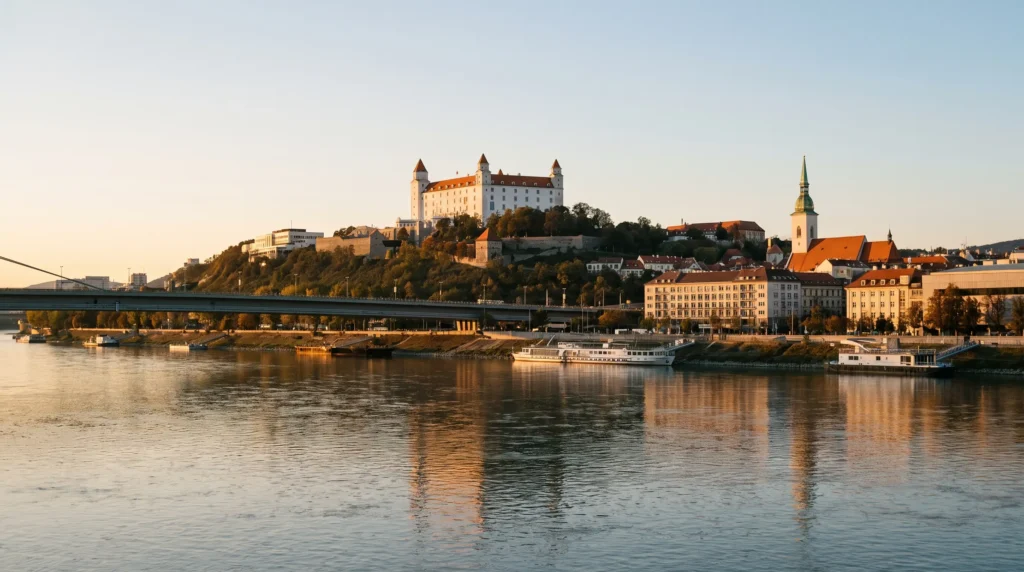
The whitewashed, rectangular castle overlooking the Danube has been burned down and rebuilt more than once across its history; today it houses the Slovak National Museum’s history exhibits and offers the best skyline views in the city, especially at sunset over the river toward Austria.
Petržalka
Across the Most SNP bridge (topped by the UFO-shaped observation tower and restaurant) sits Petržalka, one of Central Europe’s largest panel-block housing estates from the communist era, now home to roughly a third of the city’s population. It’s not conventionally pretty, but it’s a genuine look at how most Bratislavans actually live, and the riverside path along its edge is a popular running and cycling route.
Devín
A quiet outlying district built around the ruins of Devín Castle, perched on cliffs where the Danube meets the Morava River — technically the Austrian border runs right through the confluence. Easily reached by bus and a genuinely underrated half-day trip.
Karlova Ves & Dúbravka
Residential districts with university buildings, green space, and everyday Bratislava life — worth a wander if you want a break from the tourist core, though there’s little reason to base yourself here on a short trip.
Culture & People
Slovak is the official language, but given Bratislava’s position hard against Austria and Hungary, German and Hungarian are both widely understood in the region, and English gets you through nearly any tourist-facing interaction. The city’s identity is genuinely layered: Hungarian coronation capital, Habsburg-era trading town, Czechoslovak industrial center, and — only since 1993 — an independent national capital in its own right.
Bratislavans tend to be reserved with strangers at first and warm up quickly once you show any effort with basic Slovak greetings. The city’s café and wine culture runs deep — the Small Carpathians wine region starts practically at the city limits, and September’s grape harvest season brings a genuine local buzz that has nothing to do with tourism at all.
A Food Lover’s Guide to Bratislava
The national dish is bryndzové halušky — small potato dumplings, similar in shape to gnocchi, tossed with bryndza (a soft, tangy sheep’s-milk cheese) and topped with crisped bacon. It’s often washed down with žinčica, a fermented sheep’s-milk drink, though most visitors stick to the local beer or a glass of Small Carpathians wine instead.
Beyond halušky, look for kapustnica (a hearty sauerkraut-and-sausage soup, especially around Christmas), pirohy (dumplings stuffed with potato, cheese or fruit, a close cousin of Polish pierogi), and zemiakové placky — garlicky fried potato pancakes sold from street stalls. Trdelník, the spit-roasted sweet pastry rolled in sugar and nuts, is everywhere in the Old Town and genuinely Slovak-Hungarian in origin, though it’s become such a tourist-trail staple across Central Europe that locals rarely eat it themselves — buy one for the experience, not the authenticity.
For drinks, Bratislava takes its wine seriously: look for Rizling vlašský and other whites from the nearby Small Carpathians appellation, best sampled at one of the small vinárne (wine bars) tucked into Old Town cellars rather than at a tourist-menu restaurant on Main Square.
Off the Beaten Path
UFO Tower’s less-touristed twin views
Everyone photographs the UFO observation deck from below; fewer make the walk across Most SNP and back along the Petržalka embankment at golden hour, when the castle and Old Town skyline light up from across the water with almost no one else around.
Devín Castle ruins
A short bus ride from the center, these cliff-top ruins at the Danube–Morava confluence draw a fraction of Bratislava Castle’s crowds despite arguably better river views and a genuinely ancient history — the site has been fortified since Celtic and Roman times.
Blue Church (Church of St. Elizabeth)
An Art Nouveau church finished in pastel blue, tiled roof to altar, tucked a short walk outside the main tourist loop — most guidebook itineraries skip it entirely, which is exactly why it’s worth the detour.
Small Carpathians Wine Route
A cluster of wine villages just outside the city (Rača, Svätý Jur, Pezinok) accessible by local train or bus, where you can taste at small family wineries with none of the crowds of more famous European wine regions.
Day Trips from Bratislava
This is Bratislava’s single best feature for trip planning: few cities let you day-trip to two other national capitals. Vienna is about an hour away by train or bus, and roughly 75 minutes by the scenic Twin City Liner boat along the Danube — easily done as a half-day museum-and-coffeehouse run or a full day covering the Innere Stadt. Budapest is a longer but very doable trip, around two to two and a half hours each way by direct train, and pairs naturally with Bratislava on a longer Central European itinerary.
Closer to home, the Small Carpathians wine villages (see above) make an easy half-day, and Devín Castle can be combined with a riverside walk for a relaxed few hours outside the city center. If you have a car, the High Tatras mountains are a further drive but reward hikers with genuinely dramatic alpine scenery unlike anything near the capital itself.
Practical Information
Money. Slovakia uses the euro, having adopted it on 1 January 2009. Cards are widely accepted in the city center; carry some cash for smaller wine bars, market stalls, and public transit ticket machines that don’t always take cards.
Safety. The US State Department rates Slovakia at its lowest advisory tier, Level 1 — Exercise Normal Precautions, as of a February 2026 update. The main real-world risk is pickpocketing in the Old Town during peak season, plus the usual scam awareness around unsolicited requests for money; always check your own government’s current advisory before travel.
Health. No vaccinations are required for entry; routine and measles vaccinations should be current, and travelers planning extensive hiking or forest time should consider tick-borne encephalitis vaccination. Tap water in Bratislava is safe to drink.
Connectivity & practicalities. An EU-roaming SIM or eSIM covers Slovakia along with most neighboring countries. Plugs: Type C/E, 230V. Time zone: Central European Time, UTC+1 (UTC+2 in summer). As a Schengen member, there’s no passport control crossing to or from Austria or the rest of the Schengen zone, though the EU’s Entry/Exit System now applies to non-EU arrivals.
Budget Breakdown — What Bratislava Actually Costs in 2026
Bratislava is one of the better-value capitals in the EU — noticeably cheaper than Vienna, roughly on par with or slightly above Budapest and Prague for most categories.
Budget (US$45–75/day): Hostel dorm or budget guesthouse, self-catering or halušky at a no-frills lubovnicka, DPB day pass for transit, free walking tour of the Old Town.
Mid-range (US$100–180/day): Three-star Old Town hotel, sit-down dinners with local wine, castle and museum entry fees, a Twin City Liner return trip to Vienna.
Luxury (US$300+/day): Boutique or design hotel with river or castle views, tasting menus, private wine-route tours in the Small Carpathians, a chauffeured day trip to Vienna or Budapest.
Fixed costs to expect: DPB transit tickets (€0.90–€15 depending on pass length), museum entries typically €5–€15, and standard EU-style service charges — tipping 10% is customary but not obligatory where service isn’t included.
Planning Your First Trip to Bratislava
Two to three nights is enough to see Bratislava properly without rushing: a day for the Old Town and castle, a half-day for Petržalka and the UFO tower, and a half-day for either Devín Castle or a Small Carpathians wine village. Most travelers fold it into a longer Central European loop — arrive from or continue on to Vienna by train or Danube boat, or extend the loop to Budapest or Prague. If you want the fuller country picture beyond the capital — the High Tatras, wooden churches, ice caves — pair this guide with our Slovakia travel guide.
Frequently Asked Questions
Is Bratislava worth visiting, or is it just a Vienna day trip?
Both — it works brilliantly as a Vienna day trip, but it also stands on its own for a two- to three-night stay, especially if you factor in wine villages, Devín Castle, and a genuinely different, less-polished character than its Austrian neighbor.
Do I need a visa to visit Bratislava?
Slovakia is in the EU and Schengen Area. US, UK, Canadian, and Australian passport holders can enter visa-free for up to 90 days in any 180-day period; your passport should be valid at least three months beyond your departure date.
Is Bratislava safe?
Yes, generally — it carries the lowest US State Department advisory level as of early 2026, with pickpocketing in Old Town tourist areas the main practical risk to watch for.
How do I get between Bratislava and Vienna?
Train (~1 hour), bus (~1 hour), or the Twin City Liner catamaran along the Danube (about 75 minutes) — all genuinely easy, no border formalities within Schengen.
Does Bratislava have a metro?
No — public transit is entirely surface-level trams, trolleybuses, and buses run by DPB, which cover the city thoroughly despite the lack of a subway.
What’s the best time to visit for good weather without the crowds?
Late spring (May–June) or early autumn (September) give you comfortable temperatures and lighter crowds than the July–August peak, when Coronation Days and summer heat both bring bigger numbers.
Ready to Explore Bratislava?
A castle over the Danube, a coronation cathedral, a socialist housing estate turned sunset viewpoint, and two other national capitals within day-trip distance — Bratislava fits an absurd amount of Central Europe into a city you can walk across in twenty minutes. Go before everyone else stops treating it as a layover.
Explore More
- Vienna City Guide — the world’s closest neighboring capital, an hour away
- Budapest City Guide — continue the Danube route east
- Prague City Guide — Bratislava’s fellow ex-Czechoslovak capital
- Slovakia Travel Guide — the High Tatras and country beyond the capital
How this guide was built
Published as part of Facts From Upstairs’ city guide series. Built from authoritative sources — the Visit Bratislava official tourism site, Wikipedia entity pages for Bratislava, Slovakia, M. R. Štefánik Airport, public transport in Bratislava, and bryndzové halušky, the European Central Bank’s press release on Slovakia’s euro adoption, the US State Department’s Slovakia travel advisory, the UK FCDO’s Slovakia travel advice, and the US CDC’s Slovakia traveler health page. Numeric claims carry inline citations.
Sources cited on this page
- Visit Bratislava — official tourism site
- Wikipedia — Bratislava
- Wikipedia — Slovakia
- Wikipedia — M. R. Štefánik Airport
- Wikipedia — Public transport in Bratislava
- Wikipedia — Bryndzové halušky
- European Central Bank — Slovakia joins the euro area
- US State Department — Slovakia
- UK FCDO — Slovakia travel advice
- US CDC — Slovakia traveler page
More city guides you might like
Plan your trip to Bratislava
The booking tools we use ourselves. FFU may earn a commission at no extra cost to you.
Plan & book your trip to Bratislava
Booking through these searches supports our guides at no extra cost to you.