
Pamukkale Travel Guide — Turkey’s Cotton-White Terraces, Ancient Hierapolis & Sunrise Balloons
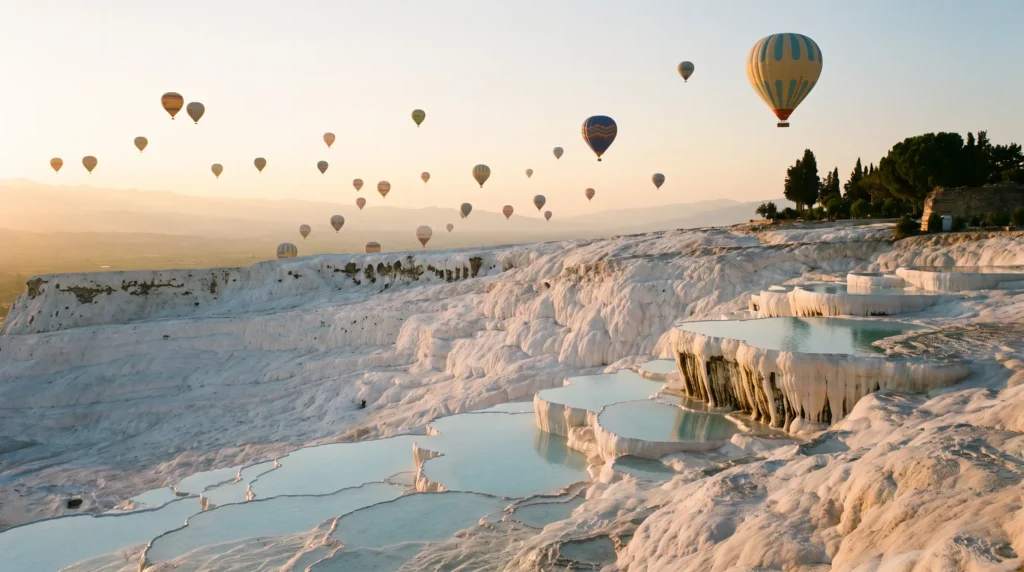
Pamukkale means “cotton castle” in Turkish, and the first time you see it you’ll understand why someone reached for that name instead of a geology textbook. A hillside in Turkey’s Aegean interior is draped in blinding-white travertine — mineral terraces built up over millennia by calcium-rich hot springs — and stacked directly on top of it sits Hierapolis, a genuine Greco-Roman spa city with a necropolis, a theatre and a gate the ancients believed led to hell. It is one of the strangest double-features in world travel: you wade barefoot through warm, chalky pools in the morning and pick your way through 2,000-year-old ruins by lunch. I’ve stood on that ridge at sunrise watching hot air balloons drift over the white terraces and honestly could not tell you which part of the view was more improbable, the geology or the archaeology. It’s also an easy trip to get wrong — go at the wrong hour and you’ll share the terraces with several tour-bus loads of day-trippers rather than the quiet, otherworldly place I’m describing. Here’s how to do it properly.
In This Guide
- Overview — Why Pamukkale Is Two Wonders in One
- Sunrise Balloon Season & Beating the Day-Trip Crowds
- Best Time to Visit Pamukkale (Season by Season)
- Getting There — DNZ Airport, Izmir & Overland Routes
- Getting Around — Dolmuş, Taxis & Walking the Terraces
- Districts — Pamukkale Village, Hierapolis & Karahayıt
- Culture & People
- A Food Lover’s Guide to Pamukkale
- Off the Beaten Path
- Day Trips — Aphrodisias, Laodicea & Denizli
- Practical Information
- Budget Breakdown — What Pamukkale Actually Costs in 2026
- Frequently Asked Questions
Overview — Why Pamukkale Is Two Wonders in One
Pamukkale sits in Turkey’s Inner Aegean region, in Denizli Province, where mineral-laden thermal springs have spent thousands of years depositing calcium carbonate down a hillside overlooking the Menderes River valley. The result is a travertine formation roughly 2,700 metres long, 600 metres wide and up to 160 metres high — cascading white terraces and shallow pools that, from a distance, genuinely look like a frozen waterfall or a cliff of cotton. Seventeen hot springs feed the system, with water temperatures ranging from a warm 35°C to a scalding 100°C, carried roughly 320 metres to the head of the terraces before it cools and deposits the mineral crust that keeps building the formation today.
What makes the site a genuine double bill is Hierapolis, the ancient spa city built directly on top of the travertine plateau. Ancient rulers recognized the therapeutic value of the hot springs and developed the site into a thermal sanctuary, and the surviving ruins — grand bath complexes, a well-preserved theatre, temples and one of the largest necropolises in Asia Minor — are spread across the plateau above the terraces. UNESCO inscribed the combined site as “Hierapolis-Pamukkale” in 1988, recognizing it for both its natural phenomena and its outstanding Greco-Roman thermal architecture — a rare joint natural-and-cultural listing.
The site draws more than two million visitors a year, which is exactly why timing your visit matters as much as the visit itself. Authorities rotate which terrace pools are open to bathers and periodically rest sections to let the mineral formations regenerate, so what you see depends partly on which part of the terrace is “live” that season. None of that diminishes the experience — it just means Pamukkale rewards a plan, not a whim.
Sunrise Balloon Season & Beating the Day-Trip Crowds
Pamukkale’s real seasonal ritual isn’t a festival date, it’s a time of day: sunrise. Hot air balloon operators run flights over the terraces and Hierapolis ruins year-round, with pickups roughly 30–60 minutes before dawn depending on the season, because that’s when winds are calmest and the light turns the white travertine gold and pink. Compared to Cappadocia’s crowded balloon fields further east, Pamukkale’s morning skies are noticeably quieter — this is still very much a secondary balloon destination, which is part of the appeal.
The other half of the ritual is simpler and free: walk onto the terraces yourself before the tour buses arrive. Pamukkale is a fixture on day-trip itineraries out of Antalya, Bodrum, Kuşadası and Marmaris, and those coaches tend to land mid-morning and clear out by mid-afternoon. Arrive at the south gate near Pamukkale village at opening time, or stay overnight and walk up before 8am, and you’ll have long stretches of terrace with only a handful of other early risers — a completely different experience from the same site at 1pm in August.
Best Time to Visit Pamukkale (Season by Season)
April – June · Spring sweet spot
Mild temperatures, green surrounding countryside, and comfortable balloon-flight conditions make late spring the strongest all-round window. Crowds build toward June as the school-holiday season approaches.
July – August · Peak heat, peak crowds
Denizli Province has a hot, dry Mediterranean-influenced summer, and midday terrace-walking in August is genuinely uncomfortable underfoot and overhead. This is also when day-trip coach traffic peaks. If you’re locked into summer travel, do the terraces at dawn and retreat to a thermal pool or shaded café by 11am.
September – October · The quiet favorite
Many locals and repeat visitors rate autumn above spring: temperatures ease, coach tourism thins out after the European summer-holiday peak, and the light for both balloon flights and terrace photography is excellent.
November – March · Cold, empty, strangely beautiful
Winter brings genuinely cold mornings and occasional light snow in the surrounding hills — a rare sight against the already-white terraces. Some open-air terrace pools are less inviting for bathing in the cold, but Karahayıt’s enclosed thermal pools stay warm year-round, and you’ll often have entire sections of Hierapolis to yourself.
Getting There — DNZ Airport, Izmir & Overland Routes
The closest airport is Denizli Çardak Airport (DNZ), served by domestic flights on Turkish Airlines and Pegasus, and low-cost carrier AJet, connecting to Istanbul’s two airports. It’s a smaller regional field — under half a million passengers a year — so onward transport is by taxi or pre-booked transfer rather than a large rental-car counter, and it’s roughly an hour’s drive from the airport into Pamukkale village.
Most international travelers instead fly into Istanbul and connect domestically to Denizli, or fly into İzmir Adnan Menderes Airport on the Aegean coast and continue by intercity bus or rental car — a longer overland leg, but İzmir has far more international connections and lets you pair Pamukkale with Ephesus and the Aegean coast on one trip. Denizli’s city center itself sits about 20 kilometres south of the Pamukkale travertine site, and long-distance otobüs (intercity coach) services from Istanbul, Antalya, Cappadocia and the Aegean resorts run into Denizli’s otogar (bus terminal), from which local dolmuş minibuses and taxis cover the last leg to Pamukkale village.
Getting Around — Dolmuş, Taxis & Walking the Terraces
Pamukkale village itself is small and entirely walkable — most guesthouses sit within a few minutes of the south entrance to the travertine terraces. Once you’re inside the archaeological zone, the only way to see the terraces and Hierapolis is on foot, and the walk from the south gate up through the terraces to the ruined city and back down covers real distance and uneven, sometimes slippery mineral ground, so wear grippy sandals you don’t mind getting wet (shoes must come off on the wet travertine sections to protect the surface).
Between Pamukkale village, Karahayıt and Denizli, shared dolmuş minibuses are the cheap local workhorse, running frequent, inexpensive routes along the main road. Taxis are readily available for door-to-door transfers, airport runs, and day trips to Aphrodisias or Laodicea. There’s no metro or tram system here — this is a small town built around one extraordinary site, not a transit city.
Districts — Pamukkale Village, Hierapolis & Karahayıt
Pamukkale Village
The base for almost every visitor: a small, low-rise town of guesthouses, pensions and terrace-view rooftop restaurants clustered around the southern entrance to the travertine site. It’s unpretentious and geared entirely around one thing — getting you onto the terraces at the right hour — which is exactly what you want.
The Travertine Terraces & Hierapolis Archaeological Zone
The main event: the white terraced pools climb the hillside to the plateau, where the ruins of Hierapolis spread out — the restored Roman theatre, the monumental necropolis with hundreds of tombs and sarcophagi, the Plutonium (a cave the ancients believed was an entrance to the underworld, tied to the toxic gas that genuinely seeps from it), and the Martyrium of St. Philip, marking the traditional site of the apostle’s death. Cleopatra’s (Antique) Pool, a separate thermal pool on the plateau with submerged ancient marble columns from an earthquake-toppled temple, is a paid add-on and one of the more memorable places in the world to go for a swim.
Karahayıt
A short drive north of the white terraces, Karahayıt’s springs run through iron-rich rock instead of pure calcium, staining the travertine deep red and orange rather than white — a striking, much less crowded counterpart to the main site. It has its own hotels with thermal pools, generally at gentler prices than properties right at the main gate, and makes a good quieter base if you don’t mind a short commute to Hierapolis.
Denizli City
The provincial capital and transport hub, home to just over a million people across the wider municipality and built on a modern textile-manufacturing economy rather than tourism. Most travelers only pass through its bus terminal, but it’s a legitimate stop for a Turkish city that hasn’t been remade for visitors — worth an afternoon if you have one to spare.
Culture & People
Pamukkale sits within a thoroughly Turkish province where daily life outside the tourist zone runs on Denizli’s textile industry rather than the travertine, and Turkish is the language you’ll hear on the street, in shops and on the dolmuş, even though English is comfortably spoken in hotels, restaurants and tour offices built around international visitors.
The area’s layered religious history is part of what makes it culturally distinct: Hierapolis was a significant early Christian site — tradition holds that the Apostle Philip was martyred here, and the Martyrium built to commemorate him still stands on the plateau — while the earlier Greco-Roman city practiced its own thermal-cult religious rites around the springs and the Plutonium’s “gate to the underworld.” Modern Pamukkale village, meanwhile, is a working Turkish community of guesthouse owners, tour guides and restaurant families whose whole economy has grown up around welcoming a couple of million visitors a year to their unlikely backyard.
A Food Lover’s Guide to Pamukkale
Pamukkale village’s restaurants lean toward classic Turkish home cooking aimed at a steady flow of international guests: expect gözleme (thin griddle-cooked flatbread stuffed with cheese, spinach or potato) made fresh at low tables, mantı (Turkish dumplings under yogurt and chili butter), grilled kebap plates, and mezze spreads of hummus, ezme and cacık to start. Rooftop restaurants around the village compete on terrace views as much as menus — book or arrive early for a table with a sightline to the white cliffs at sunset.
Denizli Province is also chicken-döner and horon-kebap territory with its own regional pride, and the wider Aegean influence means good local olive oil, fresh bread and seasonal vegetables show up on almost every table. Turkish tea (çay) is the constant companion drink, poured strong in tulip-shaped glasses; Turkish coffee is the after-dinner ritual. If you’re staying at a thermal hotel, many pair the pools with simple spa-café menus of fresh juices and light Mediterranean plates.
Off the Beaten Path
The Plutonium (Pluto’s Gate)
A small cave opening on the Hierapolis plateau that ancient visitors genuinely believed was an entrance to the underworld — carbon dioxide seeping from the earth here was toxic enough to kill animals that wandered too close, which fed the myth for centuries. It’s a quieter, eerier corner of the site that most rushed day-trippers walk straight past.
Karahayıt’s Red Springs
While the white terraces get all the postcards, Karahayıt’s iron-stained red travertine a few minutes north is a genuinely different-looking landscape and draws a fraction of the visitors.
Hierapolis Necropolis at Dusk
One of the largest ancient necropolises in Asia Minor stretches along the approach to the north gate — hundreds of tombs, sarcophagi and tumuli scattered across open ground. Most visitors rush past it heading for the terraces; walking it slowly in the late-afternoon light, with almost nobody else around, is one of the site’s best-kept secrets.
Laodicea on the Lycus
A short drive from Denizli, this excavated Roman city — one of the seven churches addressed in the Book of Revelation — gets only a fraction of Hierapolis’s visitors despite an impressive stadium, colonnaded street and church ruins still being actively excavated.
Day Trips — Aphrodisias, Laodicea & Denizli
The standout day trip from Pamukkale is Aphrodisias, an ancient Hellenistic Greek city built around a major Temple of Aphrodite, roughly one and a half to two and a half hours’ drive southwest depending on your route. UNESCO inscribed it as a World Heritage Site in 2017, and it holds one of the best-preserved ancient stadiums in the Mediterranean — about 270 metres by 60 metres, with room for roughly 30,000 spectators — alongside a monumental tetrapylon gateway and a well-preserved Roman theatre. The city was also a renowned center of marble sculpture in antiquity, and its on-site museum houses some genuinely world-class carved marble.
Laodicea on the Lycus, closer to Denizli, pairs easily with a Hierapolis morning and an Aphrodisias afternoon if you have a full day and a car or driver. Denizli city itself, with its textile bazaars and a modern Turkish urban pace, rounds out a day for anyone curious to see the region beyond its ruins and springs. Most Pamukkale-based tour operators sell a combined Pamukkale–Aphrodisias day tour, which is the simplest way to cover both without arranging your own transport.
Practical Information
Money. Turkey uses the Turkish Lira (TRY, symbol ₺), issued by the Central Bank of the Republic of Turkey. The lira has been through a long stretch of significant depreciation over the past several years, which in practice means prices in lira can look startling to convert in your head — check a live rate rather than relying on a number from before your trip, and note cards are widely accepted in hotels and tourist restaurants while small vendors and dolmuş minibuses often prefer cash.
Safety. The US State Department rates Turkey at Level 2, “Exercise Increased Caution,” citing terrorism risk in crowded public spaces and transport hubs, and specifically advises against travel within 10 kilometres of the Syrian and Iraqi borders. The UK FCDO likewise advises against all travel to areas within 10km of the Syrian border and notes that travel insurance can be invalidated if you disregard that advice. Pamukkale, in Turkey’s southwestern interior, sits far from those border zones, but it’s worth checking current advisories for your own nationality before you fly, especially if you’re combining the trip with travel elsewhere in the country.
Health. The US CDC recommends Hepatitis A vaccination for most travelers to Turkey, Hepatitis B for extended stays, and being current on routine vaccines including MMR; it also flags rabies risk from stray dogs and recommends standard food and water precautions. Bring sun protection for the exposed, reflective white terraces and good grip-sandals for the wet mineral surfaces.
Connectivity & practicalities. An eSIM or local Turkish SIM covers data reliably around Pamukkale village. Plugs: Type C and F (two round pins), 230V/50Hz — North American travelers need both an adapter and a voltage-aware charger. Time zone: Turkey Time, UTC+3 year-round with no daylight saving.
Budget Breakdown — What Pamukkale Actually Costs in 2026
Pamukkale is inexpensive by European standards and moderate by Turkish ones — you’re paying a small premium here versus, say, rural Anatolia, because the whole town’s economy runs on tourism.
Budget (US$30–55/day): a simple pension room in Pamukkale village, gözleme and kebap meals, dolmuş transport, terrace entry without extras.
Mid-range (US$75–140/day): a comfortable hotel with a thermal pool (Pamukkale village or Karahayıt), a paid swim in Cleopatra’s Pool, a driver or tour for Aphrodisias, restaurant dinners with a glass of local wine or Efes beer.
Luxury (US$220+/day): a top thermal-spa resort, a sunrise hot air balloon flight, a private guide through Hierapolis and Aphrodisias, and dinner with a view over the terraces.
Fixed costs to expect: a site-entry fee for the Hierapolis-Pamukkale archaeological zone, a separate paid entry for Cleopatra’s Pool, and balloon-flight prices that shift with fuel costs and season — book directly with an operator once you’re there or a few days ahead rather than months out, since conditions (and prices) change.
Planning Your Pamukkale Trip
Two nights is the realistic minimum: one full day for the terraces, Hierapolis and Cleopatra’s Pool at a relaxed pace, plus a sunrise slot (balloon or simply an early terrace walk) on one of your mornings. Add a third day for Aphrodisias if ancient sites are a priority — it’s a big enough site to deserve unhurried time rather than a rushed afternoon bolt-on. Pamukkale sits naturally on an Aegean-Turkey loop: pair it with the ruins at Cappadocia for Turkey’s other otherworldly landscape, continue west toward Istanbul to bookend the trip, or head to the coast for Antalya‘s beaches and old town after the ruins and springs.
Frequently Asked Questions
Do I need shoes off to walk on the travertine terraces?
Yes — visitors are required to remove shoes on the wet travertine sections to protect the mineral surface, so you’ll be walking barefoot or in sandals you can carry. Bring a small towel and expect your feet to get genuinely chalky-white by the end.
Is Pamukkale worth visiting if I’ve already seen Cappadocia?
Yes — they’re not substitutes for each other. Cappadocia is volcanic rock formations and cave architecture; Pamukkale is a living mineral formation paired with a real Greco-Roman city built directly on top of it. The balloon flights are a similar format at both, but the landscapes and history are entirely different.
Do US and UK citizens need a visa for Turkey?
Ordinary passport holders from the US, UK, most of the EU and Canada can enter visa-free for tourism for up to 90 days within any 180-day period; your passport should be valid at least six months beyond your arrival date. Requirements vary by nationality, so confirm your own country’s rules before booking.
How many days do I need at Pamukkale?
One full day covers the terraces, Hierapolis and Cleopatra’s Pool comfortably. Two nights lets you add a sunrise balloon flight or an early, crowd-free terrace walk. Three days lets you add Aphrodisias without rushing either site.
Is it safe to travel to Pamukkale right now?
Pamukkale itself, in Turkey’s southwestern interior, is well away from the border areas that current US and UK advisories flag as higher-risk. Standard travel precautions apply — check your government’s current advisory before you go, particularly if your itinerary extends elsewhere in Turkey.
Can I swim in the white terrace pools themselves?
Some terrace pools are open for wading and shallow bathing on a rotating basis to let others rest and regenerate, so what’s open changes. Cleopatra’s (Antique) Pool, with its submerged Roman columns, is a separate paid thermal pool and the classic “swim at Pamukkale” experience most photos show.
Ready to Explore Pamukkale?
A hillside of blinding-white mineral pools with a 2,000-year-old spa city stacked on top of it, best seen from a balloon at sunrise or barefoot before the coaches arrive — Pamukkale earns its reputation as one of Turkey’s strangest and most photogenic wonders. Time it for the shoulder seasons or the early morning, and it’s every bit as good in person as in the photos.
Explore More
- Cappadocia City Guide — Turkey’s other legendary sunrise balloon landscape
- Istanbul City Guide — bookend your Turkey trip in the country’s great crossroads city
- Antalya City Guide — trade ruins and springs for Turkey’s Turquoise Coast
- Turkey Travel Guide — the full country overview
How this guide was built
Published as part of Facts From Upstairs’ city guide series. Built from authoritative sources — UNESCO’s Hierapolis-Pamukkale World Heritage inscription, the Turkish Ministry of Foreign Affairs visa information pages, the US State Department and UK FCDO Turkey advisory pages, the US CDC traveler page for Turkey, and Wikipedia entity pages for Pamukkale, Denizli, Denizli Çardak Airport, Aphrodisias, the Turkish Lira, Turkey’s time zone and its mains electricity standards. Numeric claims carry inline citations.
Sources cited on this page
- Wikipedia — Pamukkale
- UNESCO — Hierapolis-Pamukkale
- Republic of Türkiye Ministry of Foreign Affairs — Visa Information
- US State Department — Turkey
- UK FCDO — Turkey
- US CDC — Turkey traveler page
- Wikipedia — Turkish Lira
- Wikipedia — Aphrodisias
- Wikipedia — Denizli
- Wikipedia — Denizli Çardak Airport
- Wikipedia — Time in Turkey
- Wikipedia — Mains electricity by country
More city guides you might like
Plan your trip to Pamukkale
The booking tools we use ourselves. FFU may earn a commission at no extra cost to you.
Plan & book your trip to Pamukkale
Booking through these searches supports our guides at no extra cost to you.