
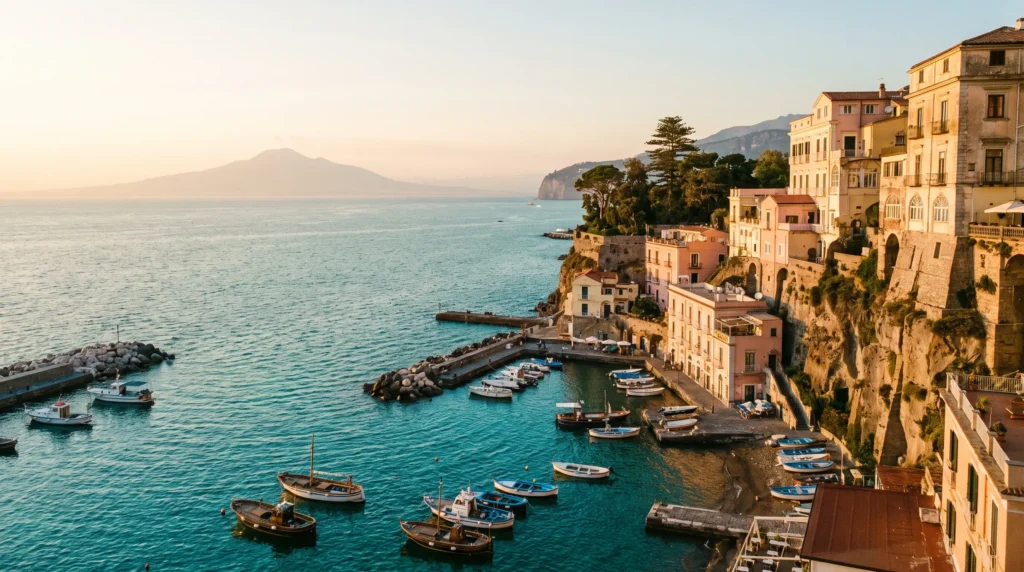
Sorrento Travel Guide — The Cliffside Town That’s Bigger Than Its Postcards
I almost skipped Sorrento the first time. The plan was Naples, then straight down the coast to Positano, and Sorrento looked on the map like a stopover, not a destination. I was wrong, and I’ve now built three separate trips around it. Sorrento sits on a cliff about 50 metres above its own harbor, on the tip of the peninsula that splits the Bay of Naples from the Amalfi Coast — which means you get Vesuvius and Pompeii on one side, Positano and Capri on the other, and a lemon-scented, mostly pedestrian old town in between that doesn’t ask you to hairpin down a cliff road every time you want dinner. It’s a town of around 15,000 people that hosts several times that many visitors most summer nights, and it shows in the prices and the crowds on the main strip. Stay two nights instead of racing through and it stops feeling like a layover and starts feeling like the smartest base in Campania.
In This Guide
- Overview — Why Sorrento Is the Balcony of the Bay of Naples
- Holy Week — Sorrento’s White and Black Processions
- Best Time to Visit Sorrento (Season by Season)
- Getting There — Naples Airport, Trains & Ferries
- Getting Around — Circumvesuviana, Buses & Boats
- Sorrento’s Neighborhoods & Districts
- Culture & People — Lemons, Wood Inlay & Neapolitan Song
- A Food Lover’s Guide to Sorrento
- Off the Beaten Path
- Day Trips — Capri, Pompeii, Positano & Beyond
- Practical Information
- Budget Breakdown — What Sorrento Actually Costs in 2026
- Planning Your First Trip to Sorrento
- Frequently Asked Questions
Overview — Why Sorrento Is the Balcony of the Bay of Naples
Sorrento occupies the tip of the Sorrentine Peninsula, the finger of land that separates the Bay of Naples from the Bay of Salerno and the Amalfi Coast, and it sits directly atop a tuff cliff roughly 50 metres above its own harbor. That geography is the whole story: Sorrento faces Vesuvius and Naples across the water on one side, and shares its peninsula with Positano and Amalfi on the other, without belonging fully to either postcard. The Romans knew it as Surrentum, it became a seat of an archbishop around 420 AD, and it was sacked by Ottoman forces in 1558 — an attack that pushed the town to rebuild its fortifications and shaped the compact, walled feel of the historic center you walk through today.
Sorrento was never part of the formal Amalfi Coast UNESCO inscription — that World Heritage Site, listed in 1997, covers the roughly 40-kilometre stretch of coastline on the peninsula’s southern, Amalfi-facing side. But Sorrento is where most people actually sleep, because it has train and ferry connections neither Positano nor Amalfi can match, real infrastructure (ATMs, pharmacies, supermarkets, a proper hospital), and a historic center that’s flat and walkable rather than built on a 45-degree slope. It became a fixture of the international Grand Tour by the 19th century and never really stopped being one — expect polished piazzas, lemon groves squeezed between hotel walls, and a harbor full of both fishing boats and hydrofoils.
What Sorrento does not have is its own dramatic coastline in the Amalfi sense — no Positano-style vertical village stacked in pastel houses. What it has instead is the best logistics on the whole peninsula and lemons so ubiquitous they’re practically a civic emblem: it’s the town that put limoncello, made from lemon rind steeped in alcohol with water and sugar, on the world’s back-bar shelves.
Holy Week — Sorrento’s White and Black Processions
If your trip lines up with Easter, build the itinerary around it: Sorrento’s Holy Week processions are among the most distinctive in Italy and unlike anything staged for tourists elsewhere on the coast. In the small hours between Holy Thursday and Good Friday, the hooded “White Procession” moves silently through the old town behind an image of the Virgin Mary searching for her son. On Good Friday evening, the “Black Procession” follows in black robes and hoods, marking her grief after finding him. Both are organized by local lay confraternities, passed down through Sorrentine families, and watched in near-total silence by locals and visitors packed along the narrow streets — no vendors, no soundtrack, just footsteps and a slow drumbeat.
Outside Easter week, June brings a livelier calendar of patron-saint feast days and open-air concerts in Piazza Tasso, and late summer through early autumn is when the lemon groves are heaviest with fruit — worth timing a “limoneto” grove visit or a limoncello-making demonstration if you’re chasing the harvest rather than the crowds.
Best Time to Visit Sorrento (Season by Season)
Late April – June · Spring shoulder (sweet spot)
Warm days, cool evenings, wildflowers on the cliff paths, and none of August’s crush. Easter itself is an exception — the processions draw crowds and hotel prices spike, so book well ahead if you want Holy Week specifically.
July – August · Peak season
Hot, humid, and the busiest the town gets — Italian domestic holidaymakers descend in August especially, and ferries to Capri and the Amalfi Coast sell out by mid-morning. Worth it for warm swimming and the liveliest atmosphere, but book transport and restaurant tables ahead and expect to pay peak rates.
September – Early October · Second shoulder season
Many locals’ favorite window: sea still warm from summer, crowds thinning, light softer for photos, and harvest season in the lemon groves. Prices ease from August’s peak without the town going quiet.
November – March · Low season
Mild by northern-European standards but genuinely quiet — a meaningful share of hotels, restaurants and the passenger ferries to Capri reduce service or close for the winter, so confirm openings before you plan a trip in this window. Good for budget travel and locals-only pace, less good if the point of the trip is boat trips and beach clubs.
Getting There — Naples Airport, Trains & Ferries
Naples International Airport (NAP), officially Aeroporto di Napoli-Capodichino, sits about 6 kilometres northeast of central Naples and is the practical gateway for Sorrento — it has direct connections across Europe on easyJet, Ryanair, Wizz Air and Volotea, plus seasonal transatlantic routes to the US and Canada. There is no direct rail link from the airport itself; the standard route is an Alibus shuttle or taxi into central Naples, then the Circumvesuviana commuter railway onward.
That railway — 142 kilometres of track serving greater Naples, owned by the Campania regional government and operated by EAV — runs its longest line the full 47 kilometres from Naples to Sorrento in about an hour, stopping en route at Herculaneum, Pompeii and Castellammare di Stabia. It’s cheap, frequent, famously crowded in peak season, and doubles as the easiest way to slot Pompeii or Herculaneum into the same day as your arrival. Alternatives include the seasonal high-speed ferries and hydrofoils from Naples’s Molo Beverello, which run in under an hour when the sea is calm, and private or shared transfers by road, which take roughly 60–75 minutes depending on Naples traffic. Rail travelers heading south from Rome or Florence connect through Napoli Centrale, then switch to the Circumvesuviana or a road transfer for the final leg.
Getting Around — Circumvesuviana, Buses & Boats
Sorrento’s historic center is compact and flat enough to walk end to end in twenty minutes, which is part of its appeal after a day of Amalfi cliff roads. For everything beyond the old town, the SITA Sud bus network is the workhorse — it’s the only public way to reach Positano and Amalfi by road, on a route that hairpins along cliffside drops and is not for anyone prone to motion sickness. Buy tickets before boarding at a tabaccheria (tobacco shop) or newsstand; drivers generally don’t sell them.
For Capri, Ischia and points along the coast, hydrofoils and ferries leave from the Marina Piccola harbor at the base of the cliff, reached from the old town by a short walk down (or a longer walk back up, or the small funicular/lift some hotels and the port use). A car is close to useless in Sorrento itself — parking is scarce and expensive, and the coast road south is slow and narrow — so most visitors rely entirely on trains, buses and boats, supplemented by taxis for late-night or luggage-heavy trips.
Sorrento’s Neighborhoods & Districts
Sorrento is our pick of Amalfi Coast bases in the full guide to where to stay in Italy.
Centro Storico (Piazza Tasso & the old town)
The pedestrianized historic core, built on a grid of narrow lanes dating to the Roman city, centered on Piazza Tasso and the main shopping street, Corso Italia. This is where most restaurants, gelaterias and inlaid-wood boutiques cluster, along with the Cathedral of Sorrento and the cloister of the Basilica di Sant’Antonino. Charming, walkable, and unavoidably touristy in peak season — go early morning or after 9pm to see it with fewer crowds.
Marina Grande
A working fishing village folded into the base of the cliff, distinct from — and quieter than — the harbor where the ferries dock. Pastel houses, net-drying boats, and some of the best simple seafood in town, a short walk but a world away from Piazza Tasso’s crowds.
Marina Piccola
The functional harbor: ferry and hydrofoil terminal, beach clubs built out on platforms over the rock (since Sorrento has little natural sand), and the base of the cliff-face lift and switchback paths up to the old town. Come here to catch a boat, not to linger, unless you’ve booked a beach club for the day.
Sant’Agnello
The town immediately east of Sorrento, technically separate but functionally an extension of it, with its own Circumvesuviana stop, quieter residential streets, and lower hotel prices for essentially the same location.
Sorrento Hills & the Lemon Groves
Inland and uphill from the center, terraced lemon groves under their characteristic straw-mat shade covers, dotted with agriturismi and limoncello producers open for tastings — the antidote to the coastal crowds, ten minutes from Piazza Tasso by foot or taxi.
Punta del Capo & Bagni della Regina Giovanna
The peninsula’s westernmost tip, a walkable hour or a short bus ride from the center, where Roman ruins spill into a natural rocky swimming cove named for a 15th-century queen. One of the few spots near town with genuinely good, free swimming.
Culture & People — Lemons, Wood Inlay & Neapolitan Song
Sorrento sits culturally within greater Naples — Neapolitan dialect is spoken alongside standard Italian, and the town shares the region’s food, superstition and warmth toward strangers, tempered by a tourism economy that’s been running since the Grand Tour era. Two crafts are distinctly Sorrentine: intarsio, elaborate wood marquetry sold across the old town in everything from jewelry boxes to furniture, and limoncello, whose modern commercial identity is tied closely to the town’s lemon groves.
The town also has an outsized claim on Italian song — “Torna a Surriento” (“Come Back to Sorrento”), one of the best-known Neapolitan songs internationally, was written about the town and is still played by buskers and restaurant trios across the old center. Between that, the Holy Week processions, and the lemon-grove agriturismi just inland, Sorrento’s culture rewards slowing down past the main shopping strip — the crowds thin fast a few streets off Corso Italia.
A Food Lover’s Guide to Sorrento
Lemons dominate, and rightly so — the local Sfusato Amalfitano variety is large, thick-skinned and famously fragrant, and shows up candied, in sorbet, baked into delicate delizia al limone (a lemon-cream sponge cake invented in the area), and of course distilled into limoncello, best drunk ice-cold as a digestivo rather than sipped warm. Seafood is the other pillar: look for fried anchovies, spaghetti alle vongole, and whatever the day’s catch is at a Marina Grande trattoria rather than a Corso Italia tourist menu.
Gnocchi alla sorrentina — potato gnocchi baked with tomato, mozzarella and basil — is the dish that actually carries the town’s name onto menus worldwide, and it’s worth eating the real, freshly made version here rather than the frozen supermarket version most people know it from. Buffalo mozzarella from the Campania plains, caprese salad, and wood-fired pizza (Naples, the birthplace of modern pizza, is an hour away) round out the table. For a splurge, several restaurants set tables on terraces directly over the water in Marina Grande or on the cliff edge — book ahead in summer, and expect to pay a premium for the view as much as the food.
Off the Beaten Path
Punta del Capo’s Roman Ruins
The scattered remains of a Roman villa complex sit right above the swimming cove at Bagni della Regina Giovanna — most day-trippers never walk the extra twenty minutes past the main viewpoint to find them.
Vico Equense & Massa Lubrense
The peninsula’s quieter towns, a short drive or bus ride from Sorrento, with real fishing-village atmosphere, better pizza prices, and — at Massa Lubrense — some of the peninsula’s best sunset views over Capri without the Sorrento crowds.
The Path of the Gods (from the Amalfi side)
Not technically in Sorrento, but reachable as a long day trip: one of Italy’s best coastal hikes, strung along the cliffs between Agerola and Positano, best done with a guide or an early start to beat both the heat and the crowds.
Lemon Grove Tastings Inland
A handful of family-run limoneti just uphill from the center offer tastings and short tours through the terraced groves under their traditional shade netting — a quiet, fragrant hour that most itineraries skip entirely in favor of the coast.
Day Trips — Capri, Pompeii, Positano & Beyond
Capri
The island sits only about 5 kilometres off the Sorrentine Peninsula and is reachable by hydrofoil in well under an hour, making it the single most popular day trip from Sorrento. Its combined population is under 13,000 yet it absorbs a huge multiple of that in summer day-trippers, so go early to beat the crowds at the Blue Grotto — the sea cave whose fame took off after a German poet’s 1826 account of “rediscovering” it. Skip the grotto queue entirely, if you’d rather, and ride the chairlift up Monte Solaro (589 metres, the island’s highest point) for the best view on the Bay of Naples instead.
Pompeii & Herculaneum
Both sites sit directly on the Circumvesuviana line between Naples and Sorrento, making a half-day or full-day stop easy to slot into a train transfer. Pompeii, buried by Vesuvius’s eruption in 79 AD and inscribed as a UNESCO World Heritage Site in 1997, now draws roughly 2.5 million visitors a year, and as of 2024 caps peak-season entry at 20,000 timed tickets a day — book ahead in summer or you may be turned away. Herculaneum is smaller and less crowded, with better-preserved buildings, and pairs well as a shorter add-on.
Positano & the Amalfi Coast
Positano is roughly 40 minutes by SITA bus or ferry (seasonal) from Sorrento, and Amalfi town itself another 30–40 minutes past that. Both are best visited by boat if the sea’s calm — it skips the switchback traffic that clogs the coast road for much of the day in summer.
Ischia
Larger and more laid-back than Capri, with thermal spa gardens rather than boutique shopping as its main draw — reachable by seasonal hydrofoil and a good pick for travelers who’ve already done Capri or want fewer crowds.
Practical Information
Money. Italy uses the Euro, adopted for cash transactions in 2002. Cards are widely accepted in restaurants and shops in Sorrento itself, but carry some cash for smaller trattorias, buses, and tabaccherie.
Safety. The US State Department rates Italy at Level 2 — Exercise Increased Caution — citing pickpocketing on crowded transit and at tourist sites rather than violent crime as the main risk to visitors. Sorrento itself is a low-crime tourist town; the usual precautions — watch bags on the Circumvesuviana and in Naples’s Garibaldi station, avoid unlicensed taxis — cover most of the real risk. Check your own government’s current advisory before travel.
Health. No special vaccinations are required for Italy beyond being current on routine shots; the US CDC recommends travelers be up to date on MMR, and suggests Hepatitis A for those eating a lot of street food or visiting rural areas. Tap water in Sorrento is safe to drink; sun protection matters more than most health precautions here.
Connectivity. An EU-roaming plan or local eSIM covers the town easily; Wi-Fi is standard in hotels and most cafés. Plugs: Type C, F and L sockets, 230V/50Hz — bring an adapter if you’re coming from North America. Time zone: Central European Time (UTC+1), shifting to CEST (UTC+2) in summer.
Budget Breakdown — What Sorrento Actually Costs in 2026
Sorrento runs pricier than inland Campania and on par with — sometimes above — the more famous Amalfi towns, because it’s the base most visitors choose for logistics.
Budget (US$90–150/day): A hostel bed or simple B&B, lunch from a rosticceria or pizza al taglio counter, Circumvesuviana and SITA bus fares, free swimming at Punta del Capo instead of a beach club.
Mid-range (US$220–400/day): A three-star hotel or Sant’Agnello guesthouse, sit-down trattoria dinners, a Capri day trip by hydrofoil, a guided Pompeii tour.
Luxury (US$600+/day): Cliffside hotels with private lift access to the water, chef’s-table seafood dinners on a Marina Grande terrace, a private boat charter around Capri or the Amalfi coastline.
Fixed costs to expect: a small municipal tourist tax added at hotel checkout (varies by hotel category), and entry fees at Pompeii, the Blue Grotto and most other paid sights. Tipping isn’t obligatory in Italy but rounding up or leaving 5–10% for good service is appreciated.
Planning Your First Trip to Sorrento
The classic first-timer split is base in Sorrento, day-trip the rest: fly into Naples, train down the Circumvesuviana with a stop at Pompeii on the way in, then spend three or four nights using Sorrento as a hub for Capri, Positano and Amalfi by bus or boat, and the lemon-grove hills for a slower day in between. Five nights covers the essentials without rushing; a week lets you add Ischia or the Path of the Gods hike. Pair it with our Italy country guide for Rome, Florence and Venice, or extend the Mediterranean cliffside theme with our Santorini or Dubrovnik guides.
Frequently Asked Questions
Is Sorrento worth visiting, or should I just stay in Positano?
Sorrento lacks Positano’s cliffside drama but wins on practicality — better train and ferry connections, flatter walking, more affordable lodging for the same trip — while still putting Positano, Amalfi and Capri within a short bus or boat ride. Many repeat visitors base in Sorrento specifically to day-trip the more photogenic, harder-to-reach towns.
Do I need a car in Sorrento?
No — and it’s actively unhelpful. Parking is scarce and expensive, the coast road is slow and narrow, and trains, SITA buses and ferries cover every popular destination. Save the rental for elsewhere in Italy.
How many days do I need for Capri as a day trip?
A full day works if you start early — first hydrofoil out, last one back — but Capri rewards an overnight if your budget allows, since the island empties out and cools down once the day-trip ferries leave in late afternoon.
Is Sorrento safe?
Yes, in the sense that matters for most travelers — violent crime is rare, and the main risk is pickpocketing in crowds, especially on the Circumvesuviana and in Naples’s train stations. Standard city-travel awareness covers it.
Do I need a visa?
US, UK, Canadian and Australian passport holders get visa-free Schengen entry, typically up to 90 days within any 180-day period; make sure your passport has at least three months’ validity beyond your departure date.
What’s the cheapest way to see the highlights?
Circumvesuviana to Pompeii on the way in, free swimming at Punta del Capo instead of a paid beach club, pizza al taglio over sit-down restaurants on Corso Italia, and the public SITA bus rather than a private driver for Positano.
Ready to Explore Sorrento?
A cliffside town with lemon groves for a backyard, a train that drops you at Pompeii on the way in, and Capri close enough to visit on a whim — Sorrento does the unglamorous logistics so the rest of the Bay of Naples can be all postcard. Book Holy Week or August a long way out if that’s your window; otherwise, the shoulder seasons are waiting with thinner crowds and the same view.
Explore More
- Italy Travel Guide — Rome, Florence, Venice and beyond
- Rome City Guide — pair the coast with the capital
- Santorini City Guide — another Mediterranean cliffside classic
- Dubrovnik City Guide — more walkable old-world coastline
How this guide was built
Published as part of Facts From Upstairs’ city guide series. Built from authoritative sources — Wikipedia entity pages for Sorrento, the Amalfi Coast, Capri, Pompeii, Naples International Airport and the Circumvesuviana railway; the European Central Bank’s euro overview; the US State Department’s Italy travel information page; the UK FCDO’s Italy travel advice; and the US CDC’s Italy traveler health page. Numeric and checkable claims carry inline citations; qualitative or experiential claims (crowd levels, atmosphere, recommendations) reflect general travel-writing judgment rather than a single cited source.
More city guides you might like
Plan your trip to Sorrento
The booking tools we use ourselves. FFU may earn a commission at no extra cost to you.
Plan & book your trip to Sorrento
Booking through these searches supports our guides at no extra cost to you.