
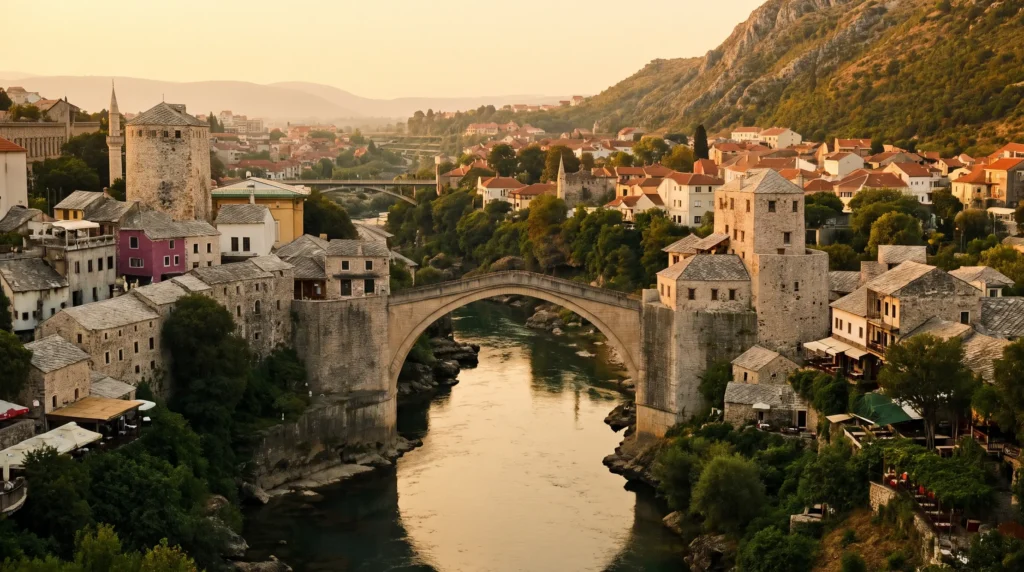
Mostar Travel Guide — The Old Bridge, the Divers & Bosnia’s Most Beautiful Scar
Mostar is a small city that asks you to hold two things in your head at once. One is the postcard: a single stone arch curving impossibly over a jade-green river, minarets and terracotta rooftops, cobblestone lanes selling copperware the way they have for five centuries. The other is the war — you can’t walk ten minutes without passing a building still pocked with shrapnel scars or a facade left half-ruined on purpose, a deliberate reminder standing next to the cafés and gelato stands. Both things are true at once, and honestly, that tension is why Mostar sticks with people longer than prettier towns do. I’ve sent friends here expecting a half-day stop between Dubrovnik and Sarajevo and gotten texts back saying they stayed two extra nights. The bridge alone is worth the detour; the city around it is why you’ll want to slow down.
In This Guide
- Overview — Why Mostar Punches Above Its Size
- The Bridge Divers & the July Cliff-Diving Festival
- Best Time to Visit Mostar (Season by Season)
- Getting There — No Airport, Two Good Ones Nearby
- Getting Around — Walk It, Nearly All of It
- Neighborhoods — Old Town, Front Line & Beyond
- Culture & People — Three Communities, One Small City
- A Food Lover’s Guide to Mostar
- Off the Beaten Path
- Day Trips — Waterfalls, Dervishes & a Stone Village
- Practical Information
- Budget Breakdown — What Mostar Actually Costs in 2026
- Frequently Asked Questions
Overview — Why Mostar Punches Above Its Size
Mostar is the largest city in Herzegovina and the seat of Herzegovina-Neretva Canton, but it’s a genuinely small place — roughly 105,000 people across the whole municipality as of the last census — which is part of the charm. The city was founded in 1452 and takes its name from the “mostari,” the bridge keepers who guarded the wooden suspension bridge that preceded the famous stone one. That stone bridge, the Stari Most (Old Bridge), was built in 1566 on the orders of Sultan Suleiman the Magnificent — a single Ottoman stone arch spanning 28.7 metres and rising about 24 metres above the Neretva River, an engineering feat that held for 427 years.
Then came 1993. During the Bosnian War, Mostar was shelled and fought over street by street — first Serb forces, then a brutal Croat-Bosniak conflict that split the city along the river — and on 9 November 1993 the Old Bridge was destroyed by tank fire. It was rebuilt using Ottoman techniques and largely the original stone, reopening on 23 July 2004, and in 2005 UNESCO inscribed the Old Bridge Area of the Old City of Mostar as a World Heritage Site — citing it as a symbol of reconciliation, international co-operation, and of the coexistence of diverse cultural, ethnic and religious communities.
What you get today is a city that photographs like a fairy tale and reads, if you pay attention, like a history lesson you can’t skip. Bullet-pocked apartment blocks stand two streets back from souvenir stalls selling copper coffee sets. The city is still informally split — a mostly Bosniak Muslim east bank, a mostly Croat Catholic west — and that isn’t ancient history, it’s the arrangement most locals grew up inside. None of it stops Mostar from being warm, walkable and cheap. It just means the Old Bridge means more here than a bridge usually does.
The Bridge Divers & the July Cliff-Diving Festival
Long before it was a UNESCO site, the Old Bridge was a dare. Local men have jumped the 24-metre drop into the Neretva’s cold current since at least the 17th century, and the city has run an organized diving competition every summer since 1968, with local divers training for years before earning the right to jump for tourists’ donations at the bridge’s midpoint most days in warm weather.
Since 2016, that homegrown tradition has shared the stage with the Red Bull Cliff Diving World Series, which returns to Stari Most most summers — typically late July — for one of the most photographed stops on its calendar, with elite divers launching from platforms up to 27 metres and roughly 25,000 spectators packing the riverbanks and old town for the weekend. If your dates line up, book accommodation well ahead — the whole old town fills up. If they don’t, you’ll still see local divers most sunny afternoons April through September; tip them, and do not try it yourself. The river runs colder and faster than it looks, and people have been seriously hurt or killed attempting the jump without training — this is genuinely one to watch, not one to copy.
Best Time to Visit Mostar (Season by Season)
Late April – June · Shoulder sweet spot
Warm days, green hills, wildflowers along the Neretva, and the divers are back in action without the peak-summer crush. This is the window I’d point most first-timers toward.
July – August · Peak, hot and crowded
Mostar earned a national heat record here — 46.2°C was measured in the city in 1901, and modern summers regularly push past 40°C at midday. The Old Bridge gets genuinely packed with day-trippers off Dubrovnik and Split coach tours between about 10am and 4pm. Come for the cliff-diving festival if the dates align, but plan sightseeing for early morning or after 6pm, and book a riverside room to escape the tour-bus tide once it leaves at dusk.
September – October · Second shoulder window
Warm days, cooling nights, thinner crowds, and grape and fig season in the surrounding vineyards. My personal pick if you can only choose one month.
November – March · Quiet and cold
Mostar’s humid subtropical climate means cool, damp winters rather than snow-globe ones, with the city averaging over 2,290 hours of sunshine a year even so. Some riverside terraces and diving-club activity pause entirely; the Old Bridge itself is beautifully empty and photographs best in flat winter light.
Getting There — No Airport, Two Good Ones Nearby
Mostar does have a small international airport (OMO), but its scheduled traffic is thin and dominated by seasonal charters serving Catholic pilgrims heading to nearby Medjugorje, so it rarely makes sense for an independent traveler’s main routing. Almost everyone arrives by road or rail from one of two better-connected airports instead.
Sarajevo International Airport (SJJ) sits roughly 120 kilometres away by road, about a two-hour drive or bus ride, and has the most international connections in the country. Dubrovnik Airport (DBV) in Croatia is a similar distance — around 150 kilometres, roughly 2.5–3 hours by road including the border crossing — and is the more common gateway for travelers stitching Mostar into a Croatian coastal trip. Split Airport is a bit further at around 120 kilometres to the city center but a popular option too, again with a border crossing en route.
Direct trains and buses link Mostar to Sarajevo daily, with the rail journey tracing the Neretva canyon and rated one of the prettiest lines in the Balkans; buses also run to Dubrovnik, Split and Zagreb. Budget extra time at the Bosnia–Croatia border — as an EU external frontier it can back up badly in summer.
Getting Around — Walk It, Nearly All of It
Mostar’s tourist core is compact enough to see almost entirely on foot — the Old Bridge, the Old Bazaar (Kujundžiluk) and the main sights sit within a fifteen-minute walk of each other, and cobblestones make anything on wheels a rough ride anyway.
For anything outside the center — the train station, bus station, Old Town’s western Croat-majority side, or the Partisan Memorial Cemetery up the hill — taxis are cheap and metered; agree on a fare for longer or informal rides. Local buses exist but run infrequently and aren’t geared to visitors. For day trips (Kravice, Blagaj, Počitelj) a rental car or an organized minivan tour is the practical choice, since public transit to those spots is sparse.
Neighborhoods — Old Town, Front Line & Beyond
Stari Grad (Old Town) — East Bank
The reason everyone comes: the Old Bridge, the Ottoman-era Old Bazaar with its copperware and rug stalls, and the 1617 Koski Mehmed Pasha Mosque with a minaret you can climb for the classic bridge-and-river view. Beautiful, touristy, and worth arriving before 9am to see without the day-trip crowds.
Kriva Ćuprija & the Radobolja
A five-minute walk from the main bridge, the smaller “Crooked Bridge” (built 1558, predating even the Stari Most) arches over the Radobolja stream in a quieter, prettier pocket that most coach-tour visitors skip entirely.
The Boulevard — The Old Front Line
Bulevar Narodne Revolucije was literally the front line of the 1990s conflict, and it still shows — shelled apartment blocks and the gutted, graffiti-covered “Sniper Tower” (a former bank skyscraper) stand a few minutes’ walk from the tourist center. It’s not comfortable, and it’s not meant to be; it’s the clearest way to understand what the postcard old town survived.
West Mostar
The mostly Croat-majority side of the city, more modern and car-oriented, with the striking Church of Mary, Mother of the Church and its bell tower offering panoramic views for those willing to climb. Less charming architecturally, but a useful reminder that Mostar is bigger than its Old Town postcard.
Partisan Memorial Cemetery
A striking, largely abandoned Brutalist-era monument complex on the hillside above the center, designed to honor WWII partisans — atmospheric, slightly eerie, and a five-minute uphill walk from the Old Town for anyone into Yugoslav-era architecture.
Culture & People — Three Communities, One Small City
Mostar’s population today is roughly split between Croats (about 48%) and Bosniaks (about 44%), with a small Serb minority — a demographic map redrawn by the 1990s war and never quite reunified since. The city still runs on two informal halves in practice — separate schools, separate football clubs, separate phone codes for years after the war ended — but daily life for visitors is warm and uncomplicated: cafés and shops on both sides welcome tourists without hesitation.
Call to prayer from the Old Town’s minarets overlaps with church bells from the west bank most days — a genuinely rare soundscape in Europe, and a quiet daily reminder of what the Old Bridge is meant to symbolize. Ask a local guide about the war if you’re curious; most are candid about it, and a walking tour led by someone who lived through the siege is one of the most valuable things you can book here.
A Food Lover’s Guide to Mostar
Bosnian food here leans Ottoman: ćevapi (grilled minced-meat fingers in fresh somun flatbread with kajmak and raw onion) is the everyday staple, best from a no-frills ćevabdžinica rather than a bridge-view restaurant. Burek and its cousins (sirnica with cheese, krompiruša with potato) make the classic breakfast, eaten standing up with a cup of yogurt to drink.
Slow down for Bosnian coffee — finely ground, unfiltered, served in a copper džezva with a lump of Turkish delight — it’s a ritual, not a caffeine hit, and rushing it is considered slightly rude. Herzegovina’s dry limestone hills also happen to produce excellent wine (Žilavka whites, Blatina reds) and some of the region’s best figs and pomegranates in late summer and autumn. Riverside restaurants along the Old Town serve grilled trout from the Neretva and Buna rivers; for something more local, look for family-run konobas a street or two back from the bridge, where prices drop and portions grow.
Off the Beaten Path
Walk the front line properly
Beyond a quick photo of the Sniper Tower, a guided “war tour” through the Boulevard and the old front-line neighborhoods — several run by former residents — gives real context you won’t get from a plaque.
Muslibegović House
A restored 17th-century Ottoman merchant’s residence turned small museum and guesthouse, showing you what a wealthy Mostar household actually looked like, minus the souvenir stalls.
Climb a minaret at dawn
The Koski Mehmed Pasha Mosque courtyard and minaret open early; being on the terrace as the Old Bridge catches first light, before the tour buses arrive, is the single best photo op in the city and costs a small entry fee.
Buna Springs beyond Blagaj’s crowds
Most visitors photograph the Tekija from the standard viewpoint and leave; walk upstream along the Buna for quieter picnic spots with the same turquoise water and none of the tour groups.
Day Trips — Waterfalls, Dervishes & a Stone Village
Mostar’s biggest asset for day-tripping is how much sits within an hour: a rental car or a single organized minivan tour can string together three very different sights before dinner.
Blagaj Tekija (~15 min)
A 16th-century Dervish monastery built directly into a limestone cliff at the point where the Buna River gushes out of the rock — one of Europe’s most dramatic river sources, and one of the most photographed buildings in the country.
Počitelj (~30 min)
A tiny fortified Ottoman-era stone village terraced up a hillside above the Neretva, often billed as Bosnia’s “open-air museum” — free to wander, with a climbable tower and pomegranate stalls in season.
Kravice Waterfalls (~40 min)
A roughly 100-metre-wide travertine waterfall dropping about 25–30 metres into a swimmable natural pool — genuinely one of the Balkans’ best-kept scenic secrets, busiest at midday in July and August, quieter at either end of the day.
Međugorje (~30 min)
A major Catholic pilgrimage town near Kravice, worth a stop if faith tourism interests you or simply to see the scale of the pilgrimage economy that also keeps Mostar’s small airport in business.
Practical Information
Money. The Convertible Mark (BAM, locally “KM”) is fixed at 1.95583 to the euro via currency board and has held that peg since the mark’s creation. Euros are sometimes accepted informally at very touristy stalls, but rates are poor — withdraw BAM from an ATM and carry cash, since cards are unreliable outside central hotels and restaurants.
Safety. The US State Department currently rates Bosnia and Herzegovina “Level 2: Exercise Increased Caution,” citing pickpocketing and property crime in tourist areas plus a general terrorism-risk note shared with much of Europe — nothing that should deter a normal visit with normal city precautions. The one Mostar-specific hazard worth naming plainly: UK authorities note that jumping from the Old Bridge yourself has caused serious injuries and deaths — leave it to the trained local divers.
Landmines. This is a real legacy of the 1992–95 war — unexploded mines remain in some rural, forested and mountainous parts of the country, decades on. Mostar’s municipality — Old Town, surrounding hills and approach roads — has been officially cleared, and the practical rule anywhere in the country is simple: stick to paved roads, marked trails and established sights, and never wander into overgrown or abandoned land off the beaten track.
Health. No special vaccinations are required to enter; routine and hepatitis A coverage is generally recommended for the region, and it’s worth a quick check with a travel clinic 4–8 weeks before you go. Tap water in Mostar is generally safe to drink.
Connectivity & logistics. An EU-roaming or regional eSIM covers Bosnia and Herzegovina reasonably well; old-town Wi-Fi is decent. Plugs: European two-pin (Type C/F), 230V. Time zone: Central European Time (UTC+1), with daylight saving observed.
Budget Breakdown — What Mostar Actually Costs in 2026
Mostar is one of the best-value stops in the Balkans — cheaper than Dubrovnik or Split just across the border, and cheaper than Sarajevo for accommodation.
Budget (US$40–70/day): Hostel dorm or budget guesthouse just outside the Old Town, ćevapi and burek meals, walking everywhere, self-guided sightseeing.
Mid-range (US$90–160/day): A riverside or Old Town guesthouse, restaurant dinners with local wine, a half-day Kravice/Blagaj/Počitelj minivan tour (roughly US$35–60 per person), museum and minaret entry fees.
Luxury (US$250+/day): A boutique riverside hotel or restored Ottoman house like Muslibegović House, a private guide for the war-history walk, a private day-trip driver, and the best table on the bridge for dinner.
Entry fees to sights (mosque/minaret, Blagaj Tekija, Kravice) run a few convertible marks each and are usually cash-only. Tipping 10% is appreciated but not obligatory.
Planning Your First Trip to Mostar
Two nights is the sweet spot for most itineraries: one full day for the Old Town, minaret climb, Kriva Ćuprija and the front-line walk, and a second for a Blagaj–Počitelj–Kravice day trip. Most travelers slot Mostar in as a stopover between Croatia’s coast and Bosnia’s capital — pair it with our Dubrovnik guide or our Croatia guide if you’re coming from the coast, or continue the Balkans loop with our Kotor guide or Montenegro guide further south.
Frequently Asked Questions
Is Mostar safe for tourists in 2026?
Yes, for the areas visitors actually go. Bosnia and Herzegovina sits at the US State Department’s “Level 2: Exercise Increased Caution,” mainly for pickpocketing and a general Europe-wide terrorism note — the Old Town itself is relaxed and walkable. The one real local hazard is jumping from the bridge yourself, which has caused injuries and deaths — watch the trained divers instead.
Do I need a visa?
US, UK, EU and Canadian passport holders can enter visa-free for up to 90 days. Check current requirements for your specific passport before you travel, since rules do change.
What about landmines — should I be worried?
Not in the city or on any established sight or road. Landmines remain a genuine hazard in some rural, forested and mountainous parts of Bosnia and Herzegovina decades after the war, but Mostar’s municipality has been officially cleared, and the rule everywhere else is simple: stay on paved roads and marked trails.
Can I jump off the Old Bridge myself?
Technically people do, but it’s genuinely dangerous without training — the drop is about 24 metres into a cold, fast-moving river, and it has caused serious injuries and deaths. Watch the Mostari Diving Club’s trained locals instead, and tip them for the show.
Is Mostar a day trip from Dubrovnik, or worth an overnight?
It’s doable as a long day trip (about 2.5–3 hours each way with the border), but you’ll be sightseeing alongside every coach tour on the same schedule. An overnight lets you see the Old Bridge at dawn and dusk without the crowds, and adds time for Blagaj, Počitelj and Kravice.
How much does Mostar cost compared to Croatia?
Noticeably less — expect roughly half the price of Dubrovnik for equivalent food and lodging, which is a big part of why it’s worth building extra nights in rather than rushing through on a bus tour.
Ready to Explore Mostar?
A bridge worth crossing borders for, divers who make it look easy, coffee that insists you slow down, and a city honest enough to leave its scars showing next to the postcards. Mostar rewards anyone willing to stay past the day-trip bus schedule — go early, go slow, and let the call to prayer and the church bells overlap while you watch the river go by.
Explore More
- Dubrovnik City Guide — the closest major coastal gateway, walled Old Town included
- Croatia Travel Guide — the coastline Mostar day-trippers pour in from
- Kotor City Guide — another walled Balkan old town, further down the Adriatic
- Montenegro Travel Guide — continue the Balkans loop south
How this guide was built
Published as part of Facts From Upstairs’ city guide series. Built from authoritative sources — UNESCO’s Old Bridge Area of the Old City of Mostar World Heritage inscription, the US State Department’s Bosnia and Herzegovina country information page, the UK FCDO’s Bosnia and Herzegovina safety and security advice, the US CDC traveler page for Bosnia and Herzegovina, the official Red Bull Cliff Diving World Series event page for Mostar, and Wikipedia entity pages for Mostar, Stari Most, the Bosnia and Herzegovina convertible mark, the country’s visa policy, and its landmine legacy. Numeric claims carry inline citations.
Sources cited on this page
- Wikipedia — Mostar
- Wikipedia — Stari Most (Old Bridge)
- UNESCO — Old Bridge Area of the Old City of Mostar
- Wikipedia — Bosnia and Herzegovina convertible mark
- Wikipedia — Visa policy of Bosnia and Herzegovina
- US State Department — Bosnia and Herzegovina
- UK FCDO — Bosnia and Herzegovina safety and security
- US CDC — Bosnia and Herzegovina traveler page
- Wikipedia — Land mines in Bosnia and Herzegovina
- Red Bull — Cliff Diving World Series, Mostar
More city guides you might like
Plan your trip to Mostar
The booking tools we use ourselves. FFU may earn a commission at no extra cost to you.
Plan & book your trip to Mostar
Booking through these searches supports our guides at no extra cost to you.