
Doha, Qatar: The Pearl-Diving Village That Became a Museum Capital on the Gulf
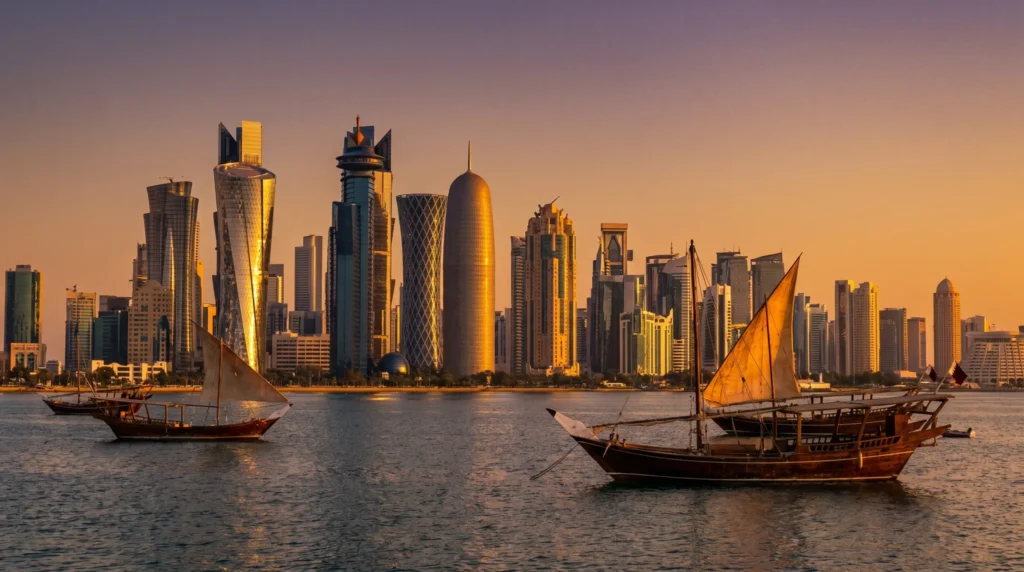
I land in Doha more often than almost any other city on earth, because Hamad International is the hinge of my long-haul life — and for years I treated it as a place to change planes rather than a place to stay. That was the mistake. The first time I actually left the terminal and stood on the Corniche at dusk, watching the West Bay towers light up across the bay while a wooden dhow ghosted past in the foreground, I understood that Doha had quietly become the most interesting capital in the Gulf. We tend to file it behind Dubai in our heads, and I want to talk you out of that. This is a city that spent its oil and gas wealth on Jean Nouvel and I. M. Pei museums rather than only on malls, that still smells of cardamom and oud in Souq Waqif after dark, and that built a driverless metro and a whole World Cup before most of us were paying attention. My favourite hour here is 5 p.m. on the Corniche, when the heat finally breaks and the whole waterfront comes out to walk. Treat this guide as the brief I would hand my own family before they boarded the red-eye into Doha.

Table of Contents
Why Doha?
Doha is the rare Gulf capital that spent its fortune on culture as hard as it spent it on skyline. Within a single generation, the discovery of oil and the world’s third-largest natural-gas reserves turned a small pearl-diving and fishing harbour into a gleaming metropolis of around 1.4 million people — the most populous municipality in Qatar, home to roughly two in five of everyone in the country. The transformation happened mostly between 1990 and 2020, making Doha one of the fastest-developed major cities on earth.
The contrast is the whole point. In one afternoon you can wander Souq Waqif, a restored century-old market still trading in spices, falcons and oud, then cross the bay to I. M. Pei’s Museum of Islamic Art — opened in 2008 and widely rated the finest collection of Islamic art outside Istanbul. A short drive away, Jean Nouvel’s desert-rose National Museum of Qatar opened in 2019, and the whole peninsula was reshaped again for the 2022 FIFA World Cup, the first ever held in the Arab world.
And the superlatives are earned, not invented: Hamad International, the city’s airport, handled a record 52.7 million passengers in 2024 and is repeatedly ranked among the best airports in the world. Come for the museums and the souq, stay for the way the West Bay towers ignite over the Corniche at dusk while wooden dhows still cross the bay below — there is simply no other city in Arabia that balances the very old and the very new quite like this.

Neighborhoods: Finding Your Doha
📍 Doha Map: Every Place in This Guide


The Corniche & Downtown
The seven-kilometre Corniche promenade is Doha’s living room — a curving waterfront where the whole city walks at dusk, dhows bob in the bay, and the West Bay towers glow opposite. The old downtown of Al Najada and the National Museum sit at its southern end.
- The Corniche promenade at sunset
- Dhow harbour and traditional boat trips
- National Museum of Qatar (south end)
Best for: first-time arrivals, sunset walks, photographers. Access: Corniche, Souq Waqif and National Museum metro stations all serve it.
Souq Waqif & Msheireb
The restored heart of old Doha, where a century-old trading souq of spice, gold, oud and falcon stalls sits beside Msheireb Downtown, a sleek new low-rise district built as the world’s first fully sustainable downtown regeneration.
- Souq Waqif lanes and the Falcon Souq
- Msheireb Museums (four restored heritage houses)
- Al Koot Fort
Best for: evening atmosphere, shopping, dining, history. Access: Souq Waqif and Msheireb metro stations (the metro interchange).
West Bay (Dafna)
Doha’s gleaming financial and hotel district — the cluster of mirrored towers you see on every postcard, packed with five-star hotels, the City Center mall and corporate headquarters along the northern Corniche.
- The skyscraper skyline at night
- City Center Doha mall
- Sheraton Park and the dhow viewpoints
Best for: business travellers, luxury hotels, skyline views. Access: West Bay and DECC metro stations on the Red Line.
Katara & The Pearl
The cultural-and-marina belt north of West Bay: Katara Cultural Village gathers theatres, galleries, an amphitheatre and pigeon towers, while the adjacent man-made island of The Pearl-Qatar lines a yacht marina with boutiques and Riviera-style cafés.
- Katara amphitheatre and mosques
- The Pearl-Qatar marina and Porto Arabia
- Katara Beach
Best for: upscale dining, marina strolls, arts events. Access: Katara & Legtaifiya metro stations, then a short tram or taxi.
Education City & Aspire
The inland west of the city, where the sprawling Education City campus, the Qatar National Library and the Aspire sports zone — anchored by the torch-shaped Torch Doha tower and Khalifa Stadium — form Doha’s knowledge-and-sport quarter.
- Qatar National Library (Rem Koolhaas)
- Aspire Park, Qatar’s largest green space
- 3-2-1 Qatar Olympic and Sports Museum
Best for: architecture fans, families, joggers. Access: Education City and Al Riffa metro stations.
Al Wakrah & the South
A historic fishing town turned suburb just south of the city, with its own restored heritage souq on the beach and the dhow-sail-shaped Al Janoub Stadium, one of the eye-catching 2022 World Cup venues.
- Souq Al Wakrah on the waterfront
- Al Janoub Stadium (Zaha Hadid)
- Al Wakrah public beach
Best for: a quieter beach day, World Cup architecture. Access: Al Wakra metro station, the southern terminus of the Red Line.
Lusail
The brand-new city rising on reclaimed land north of Doha, planned for 200,000 residents and centred on the gold-latticed Lusail Stadium that hosted the 2022 World Cup final — a marina-and-boulevard district still filling in.
- Lusail Stadium (final venue)
- Lusail Boulevard and marina
- Place Vendôme mall
Best for: new-build spectacle, football pilgrims. Access: Lusail QNB metro station, the northern terminus of the Red Line.
The Old Doha Port (Mina District)
The reborn cruise terminal at Mina, now a pastel-painted waterfront of restaurants, a fish market and an aquarium — a low-key, photogenic counterpoint to the towers, popular for an easy harbour-side evening.
- The candy-coloured Mina streets
- Mina fish market and aquarium
- Old Doha Port promenade
Best for: casual dining, families, photographers. Access: a short taxi from Souq Waqif or the Corniche.
The Food

Qatari & Gulf Classics
Qatari cooking is the food of the Gulf and the Indian Ocean trade routes — fragrant rice, slow-cooked meat and the sea. The national set-piece is machboos (also kabsa), a spiced rice with saffron, loomi (dried lime) and chicken, mutton or fish, while harees — wheat and meat pounded to a smooth savoury porridge — is the Ramadan staple. Madrouba and the sweet vermicelli balaleet round out the home table.
- Shay Al Shomous (Souq Waqif) — beloved Qatari breakfasts & balaleet (~QAR 30–60, ~$8–16)
- Parisa (Souq Waqif) — Persian-Qatari feasts under a mirrored ceiling (~QAR 90–160, ~$25–44)
- Al Aker Sweets (multiple) — knafeh and Levantine sweets (~QAR 20–45, ~$5–12)
Seafood & the Coast
With the Gulf on every side, Doha eats superb fish — grilled hammour (grouper), kingfish and prawns are the dishes to seek out, sold fresh off the boats at the Mina and Al Wakrah fish markets and cooked simply with rice and lime.
- Al Mourjan (Corniche) — long-running seafood with bay views (~QAR 90–180, ~$25–49)
- The Mina fish market grills — pick-and-cook the day’s catch (~QAR 40–80, ~$11–22)
- L’wzaar Seafood Market (Katara) — market-style fresh fish (~QAR 120–250, ~$33–69)
Beyond Machboos and Harees
The supporting cast is where Doha’s mix of South Asian, Levantine and Persian communities shows up on the plate — communal, generous and built for hospitality.
- Karak chai — sweet, spiced milky tea, the unofficial national drink (~QAR 1–3)
- Shawarma & manakish — the Levantine street-food backbone (~QAR 8–20)
- Luqaimat — golden fried dough balls in date syrup (~QAR 15–30)
- Gahwa & dates — cardamom coffee and dates, the ritual welcome (often free)
Food Experiences You Can’t Miss
- The gahwa-and-dates ritual — never refuse the first cup; a gentle shake of the cup means “no more”
- A late-evening graze through Souq Waqif, ending with karak and shisha on a terrace
- A pick-your-fish dinner grilled to order at the Mina or Al Wakrah fish market
Cultural Sights

Museum of Islamic Art
Doha’s defining monument, opened in 2008 as the final major work of architect I. M. Pei, who came out of retirement to design it on its own purpose-built island. Inside is widely rated the finest collection of Islamic art outside Istanbul, spanning fourteen centuries from Spain to China. Founded 2008. Admission a modest fee for non-residents; free for residents and under-16s. Open daily except for shorter Friday hours; allow at least two hours.
National Museum of Qatar
Jean Nouvel’s interlocking-disc building, inspired by the desert-rose crystal that forms in Qatar’s sands, opened on 28 March 2019. Eleven galleries trace the land, its people and the pearling-to-gas story across 1.5 km of looping walkways. Admission a modest fee; allow two hours. Best in the morning.
Souq Waqif
A restored century-old market of mud-rendered lanes trading spices, textiles, gold, oud and — in its own corner — live falcons, complete with a falcon hospital. Admission free. Liveliest after sunset and best explored on foot.
Katara Cultural Village
A purpose-built arts district north of West Bay gathering an open amphitheatre, the blue-and-gold mosque, galleries, the pigeon towers and a public beach. Admission free; individual events ticketed. Best in the cool of the evening.
Msheireb Museums
Four restored historic family houses in the regenerated Msheireb downtown, telling the city’s social history including a sobering gallery on the slave trade. Admission free. Allow ninety minutes; best paired with a Souq Waqif evening.
Entertainment

Dhow Cruises on the Bay
The classic Doha evening: a traditional wooden dhow drifts across the bay at sunset as the West Bay towers light up. Typical cost QAR 50–150 (~$14–41) for a shared cruise; private boats from QAR 300. Book along the Corniche or at the dhow harbour.
Souq Waqif After Dark
Free and unbeatable — the souq comes alive after sunset with shisha terraces, live oud music and people-watching. Typical cost nothing but a karak chai and a shisha (QAR 30–60).
The Pearl & Katara Dining
The marina cafés of Porto Arabia and the restaurants of Katara are where Doha goes to see and be seen after dark. Typical cost QAR 100–250 (~$27–69) for dinner.
Hotel Bars & Lounges
The only legal place for a drink — the licensed bars, rooftop lounges and live-music venues of the West Bay and Pearl five-stars. Typical cost QAR 50–90 (~$14–25) a drink.
Malls & Cinema
Air-conditioned mega-malls — Villaggio with its indoor canal, Place Vendôme, Mall of Qatar — are where locals spend the hot evenings, with cinemas, ice rinks and theme parks. Typical cost QAR 40–60 (~$11–16) per film.
Desert Safaris
Half-day and overnight 4×4 dune-bashing trips to the southern desert and inland sea leave from the city daily. Typical cost QAR 150–350 (~$41–96) per person.
Day Trips

Khor Al Adaid / Inland Sea (1h 30m by 4×4)
The UNESCO-listed “inland sea,” where the Gulf reaches deep into towering dunes near the Saudi border — reachable only by 4×4 over the sand and the country’s signature desert excursion.
Al Zubarah Fort & Town (1h 30m by car)
Qatar’s only UNESCO World Heritage Site — the excavated remains of an 18th-century pearling and trading town, guarded by a 1938 fort, about 105 km northwest of Doha.
The Pearl-Qatar & Lusail (30m by metro/car)
A half-day on the man-made island marina at The Pearl, then north to the gleaming new city and World Cup final stadium at Lusail — both reachable on the Red Line.
Al Wakrah & the South (30m by metro)
The restored heritage souq on Al Wakrah’s beach plus the dhow-sail-shaped Al Janoub Stadium make an easy southern half-day at the end of the Red Line.
Zekreet & the Film City (1h 30m by car)
The wild west coast’s eroded limestone mushrooms, the abandoned mock-village “Film City,” and Richard Serra’s monumental desert sculpture “East-West/West-East.”
Seasonal Guide
Spring (March – May)
March is the tail of the pleasant season, with warm days and balmy evenings ideal for the souq and the Corniche. By May the heat is climbing fast toward summer, so do museums and indoor sights by day and save the waterfront for after dark.
Summer (June – September)
Doha’s low season for good reason — temperatures push past 40 °C with brutal Gulf humidity, and outdoor life all but stops between mid-morning and evening. Hotel rates fall hard, the museums and malls stay cool, and it is the cheapest time to visit if you live indoors by day.
Autumn (October – November)
From mid-October the heat breaks and Doha slides into its best stretch. November brings warm, dry days in the mid-to-high 20s °C, comfortable enough for desert safaris and Corniche evenings — the start of peak season and the events calendar.
Winter (December – February)
The prime window: sunny days around 22–28 °C, cool desert nights and a packed festival, sport and concert season. It is the busiest and priciest period, so book hotels well ahead, especially around the New Year and any major sporting event.
Getting Around
The Doha Metro
Doha’s driverless metro is the easiest way around — three lines (Red, Green, Gold) covering roughly 76 km and 37 stations, including a direct link from Hamad International Airport to the city. It is clean, cheap, fully air-conditioned and the single best transport decision most visitors make.
Metrolink & Trams
Free, air-conditioned Metrolink shuttle buses connect each metro station to nearby attractions and neighbourhoods, while dedicated trams loop The Pearl, Lusail and Education City — together they cover the “last mile” the metro misses.
Karwa Smartcard / Prepaid Transit
The rechargeable Karwa Travel Card taps you onto the metro, trams and public buses and saves buying single paper tickets; buy and top up at any metro station machine. Standard metro fares are a couple of riyals a ride.
Airport Access
- Doha Metro Red Line from Hamad International — ~25–35 min, ~QAR 2 (~$0.55) to the centre
- Karwa taxi from the airport — ~20–30 min, ~QAR 40–70 (~$11–19) to West Bay
Taxis & Ride-Hailing
The turquoise state Karwa taxis are metered and reliable, and the Uber and Careem apps work citywide with up-front pricing — easier than flagging a cab in the heat. Flag-fall is a few riyals; confirm the meter is running.
Navigation Tips
Apps: Google Maps, Karwa/Uber/Careem. Qatar drives on the right, road and metro signage is bilingual Arabic-English, and the city is laid out on fast multi-lane roads with roundabouts; traffic, not distance, is the main constraint at rush hour.
Budget Breakdown: Making Your Riyal Count
| Tier | Daily | Sleep | Eat | Transport | Activities | Extras |
|---|---|---|---|---|---|---|
| Budget | $60–100 | $35–60 budget hotel | $12–22 street food | $2–6 metro | $0–15 museums & souq | $5–12 |
| Mid-Range | $150–280 | $90–160 hotel | $35–65 restaurants | $15–35 taxis | $30–80 cruise & safari | $15–35 |
| Luxury | $550+ | $300+ West Bay five-star | $100–200 fine dining | $60+ private driver | $120+ private desert & spa | $50+ |
Where Your Money Goes
Doha is cheaper to sightsee than Dubai — the Corniche, Souq Waqif, Katara, Msheireb and the metro are essentially free or near-free, and the headline museums cost only a modest entry fee. The big spends are hotels and alcohol; the riyal is pegged at QAR 3.64 to the US dollar, so prices are stable and easy to read. The metro plus free Metrolink shuttles is the single best value in the city.
Money-Saving Tips
- Ride the metro and the free Metrolink shuttles rather than taxis — fares are a couple of riyals
- Eat in Souq Waqif’s Qatari diners and the Mina fish market, where a full meal runs QAR 30–60
- Visit in the summer shoulder for hotel rates up to half the winter peak
- Stack the free sights — Corniche, souq, Katara, Msheireb Museums — into your first cool evening
Practical Tips
Language
Arabic is the official language, but English is spoken almost everywhere a visitor goes — hotels, taxis, restaurant menus, metro and bilingual road signs. A few words of Arabic (shukran, as-salaam alaykum) are warmly received but never required.
Cash vs. Cards
Cards are accepted in hotels, malls, the metro and most restaurants, but carry riyals for the souq, taxis, street food and tips. ATMs are plentiful, and the pegged riyal makes prices easy to predict.
Safety
Doha has very low street crime and is one of the safest capitals in the region for solo and family travel. However, the UK FCDO currently advises against all but essential travel to Qatar (last updated April 2026) over wider regional tensions in the Gulf, and the US State Department has issued a heightened advisory; check the latest official guidance before you fly.
What to Wear
Qatar is conservative: cover shoulders and knees in public and in malls, and dress modestly at mosques (women should carry a scarf). Beachwear is fine on hotel and resort beaches only. Lightweight, breathable cottons suit the heat.
Cultural Etiquette
Accept the gahwa-and-dates welcome graciously, use your right hand for eating and greeting, ask before photographing people (especially women), and dress and behave modestly during Ramadan, when eating, drinking or smoking in public during daylight is not permitted.
Connectivity
Buy an Ooredoo or Vodafone Qatar SIM/eSIM at the airport for cheap, fast 5G across the city; Wi-Fi is standard in hotels, malls and cafés, and free Wi-Fi covers the metro and many public areas.
Health & Medications
No vaccines are required beyond routine ones; the CDC recommends Hepatitis A and Typhoid for most travellers. Doha’s hospitals are modern; bring prescription meds in their original packaging with a doctor’s note, as some common medicines (including certain painkillers) are tightly controlled.
Luggage & Storage
Hamad International offers left-luggage and even sleep pods, and most city hotels will hold bags before check-in or after check-out — handy if you arrive on a dawn flight and want to hit the museums before your room is ready.
Frequently Asked Questions
How many days do I need in Doha?
Two full days cover the city’s headline sights comfortably — one for the Corniche, Museum of Islamic Art and Souq Waqif, a second for the National Museum, Katara and The Pearl. Add a third day for a desert safari to the inland sea, which is what most visitors end up wishing they had built in.
Is Doha good for solo travellers?
Yes — it is among the safest, easiest capitals in the Middle East for solo travel, including for women, with very low crime, an excellent metro and friendly locals. Dress modestly, use app-based taxis at night, and you will rarely feel anything but welcome.
Is the Doha Metro enough to get around?
For most visitors, yes. The three driverless lines plus free Metrolink shuttle buses reach the airport, the Corniche, the souq, the museums, West Bay, The Pearl, Katara, Lusail and Al Wakrah — you only really need taxis for late nights and a few outlying spots.
What about the language barrier?
There is barely one for English speakers. English is used throughout the tourism trade, on menus, on the metro and on bilingual road signs, so you can navigate, order and ask directions comfortably without any Arabic.
When is the best time to visit Doha?
November to March, when days sit around 22–28 °C and the events season is in full swing. Summer (June–September) is cheap but heat above 40 °C with high humidity confines outdoor life to after dark.
Can I use credit cards everywhere?
Cards work in hotels, malls, the metro and most restaurants, but carry Qatari riyals for the souq, taxis, street food and tipping. ATMs are easy to find across Doha.
Do I need to cover up or can I drink alcohol in Doha?
Dress modestly in public — cover shoulders and knees — and you are fine; full veiling is not expected of visitors. Alcohol is legal but only in licensed hotel bars and restaurants, never in the souq or public spaces, and public drunkenness is a criminal offence.
Ready to Experience Doha?
Book a cool-season evening on the Corniche, a morning at the Museum of Islamic Art and at least one desert safari to the inland sea, and Doha will quietly outshine every glossier Gulf city you compare it to. For the full country context, read the Qatar Travel Guide.
Explore More City Guides
Alex the Travel Guru
Alex has changed planes at Hamad International more times than is strictly reasonable and finally learned to break the journey for three days in the city itself. A decade of guiding the Gulf and Indian Ocean coasts goes into every FFU guide, paired with on-the-ground price checks and a stubborn preference for the souq’s karak chai over the mall’s coffee chains.
More city guides you might like
Plan your trip to Doha
The booking tools we use ourselves. FFU may earn a commission at no extra cost to you.
Plan & book your trip to Doha
Booking through these searches supports our guides at no extra cost to you.