
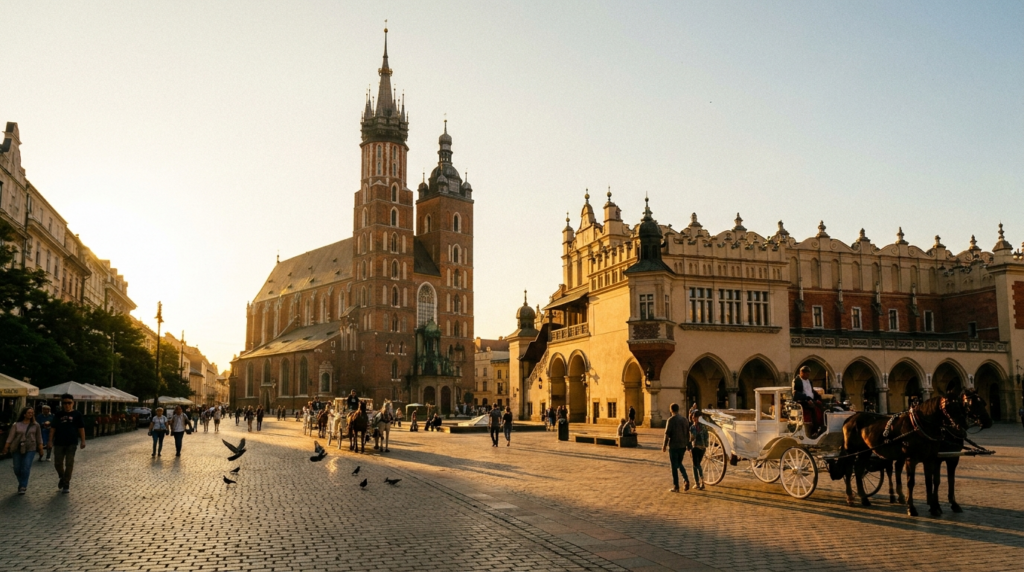
Krakow Travel Guide — Poland’s Medieval Capital, Wawel Castle & the Weight of History
Krakow is the city that convinces people Poland was on their list all along. It survived the Second World War almost physically untouched, which means the Old Town you walk through today — the Cloth Hall stalls, the church spires, the brick lanes — is the real medieval thing, not a rebuild, and it’s why UNESCO put it on the very first World Heritage List back in 1978, alongside Yellowstone and the Galápagos. But Krakow doesn’t let you forget what happened here either — Auschwitz-Birkenau sits less than an hour and a half away, and most visitors go. That combination — a genuinely beautiful, cheap, walkable European capital of culture sitting a short drive from one of humanity’s darkest sites — is what makes Krakow unlike anywhere else I send people. Go for the square, the salt mine, and the pierogi. Stay for how much it makes you think.
In This Guide
- Overview — Why Krakow Is Poland’s Must-See City
- The Szopki Nativity Competition & Christmas Markets
- Best Time to Visit Krakow (Season by Season)
- Getting There — KRK Airport & Rail Links
- Getting Around — Trams, Walking & the Old Town
- Neighborhoods — Old Town, Kazimierz, Podgórze & Beyond
- Culture & People
- A Food Lover’s Guide to Krakow
- Off the Beaten Path
- Day Trips — Auschwitz, Wieliczka & the Tatras
- Practical Information
- Budget Breakdown — What Krakow Actually Costs in 2026
- Planning Your First Trip to Krakow
- Frequently Asked Questions
Overview — Why Krakow Is Poland’s Must-See City
Krakow was Poland’s royal capital for over 500 years, and it looks it — the seat of Polish kings sat on Wawel Hill until the capital moved to Warsaw in 1596, but the coronation cathedral, the royal residence and the surrounding Old Town never stopped feeling like the country’s spiritual center. With roughly 817,000 residents, it’s Poland’s second-largest city after Warsaw.
The reason travel writers keep calling Krakow “untouched” is not an exaggeration: unlike Warsaw, which was leveled in WWII and rebuilt largely from scratch, Krakow came through the war with its historic core essentially intact. That’s why the Historic Centre of Kraków was one of the first twelve sites ever inscribed on the UNESCO World Heritage List in 1978, prized specifically for its 13th-century merchant town plan and Europe’s largest medieval market square. Rynek Główny, that square, has been a functioning marketplace since the early 14th century and is still ringed by the Cloth Hall, St. Mary’s Basilica and a skyline of church towers that hasn’t changed much in six centuries.
What makes Krakow different from a Prague or a Vienna is proximity to weight: within a 70-minute drive sits Auschwitz-Birkenau, and within 20 minutes sits the Wieliczka Salt Mine, a working mine since the 13th century with an underground cathedral carved entirely from rock salt. Both are UNESCO sites. Few cities anywhere pack a UNESCO old town, a UNESCO industrial marvel, and a UNESCO memorial site of global significance into one manageable day-trip radius. That’s Krakow’s whole pitch: beauty, history, and a reckoning, all within walking or busing distance.
The Szopki Nativity Competition & Christmas Markets
If you can time a trip for the first Thursday in December, do it. That’s when Krakow holds its Szopki Krakowskie competition — a genuinely strange and wonderful local tradition where craftspeople spend three to six months building elaborate “nativity cribs” that look like a cross between a dollhouse, a gingerbread castle, and a miniature version of St. Mary’s Basilica, all folded around a nativity scene. Entrants parade their creations to the Adam Mickiewicz monument on the Main Square, and the tradition — running since 1937, interrupted only by Nazi occupation — is recognized as UNESCO Intangible Cultural Heritage.
The competition kicks off Krakow’s Christmas market season, when roughly 80 wooden huts fill Rynek Główny with mulled wine, oscypek (smoked sheep’s cheese, grilled and topped with cranberry sauce), and pierogi stalls under fairy lights. There’s been a market on this square in some form since the early 14th century, so this isn’t a tourist invention — it’s the city doing what it’s always done, just with better lighting now.
The catch: December in Krakow means short days, temperatures that regularly sit near or below freezing, and every hotel room in the Old Town booked out well in advance. Come for the atmosphere, dress like it, and book two months ahead.
Best Time to Visit Krakow (Season by Season)
Late April – June · The sweet spot
Warming up, gardens and parks in bloom, long daylight, and prices still below peak summer. Late May into June brings mild temperatures and the fewest crowds relative to what’s coming.
July – August · Peak season
Warmest weather and the busiest Main Square you’ll see all year — tour groups stack up outside the Cloth Hall and St. Mary’s, and hotel prices climb accordingly. Still very doable, just book ahead and expect queues at Wawel and the salt mine.
September – October · The other sweet spot
Crisp air, golden light on the Old Town’s brick, harvest festivals, and crowds thinning out fast after the school-holiday rush ends. This is the season locals quietly prefer.
November – March · Cold and cultural
Genuinely cold — expect freezing or sub-freezing days from December through February — but this is also when the Christmas markets, the Szopki competition, and a slower, mistier version of the Old Town come out. Museums and indoor sights (Wawel’s interiors, Schindler’s Factory, the salt mine) work well as a winter itinerary.
Getting There — KRK Airport & Rail Links
Kraków John Paul II International Airport (KRK), in the village of Balice about 11 kilometres west of the city centre, is the gateway, with direct flights from major European hubs and a growing list of transatlantic and Middle East connections. From the airport, a direct train (Koleje Małopolskie) runs to Kraków Główny, the main station, in around 20 minutes, and city buses cover the same route more slowly and cheaply. Taxis and rideshare take 20–30 minutes depending on traffic.
Rail is also a strong option if you’re combining Krakow with the rest of Central Europe: fast intercity trains connect Kraków Główny with Warsaw (around 2–2.5 hours), and international routes reach Vienna, Prague and Budapest with a change or two. The main station sits a genuinely short walk from the Old Town, which is a rare and welcome convenience for a European rail hub.
Getting Around — Trams, Walking & the Old Town
The Old Town and Kazimierz are entirely walkable — most first-timers barely need transit inside the historic core, since Rynek Główny to Wawel Castle is about a 15-minute stroll and Kazimierz is another 15 beyond that. For anything further out — Nowa Huta, the airport, Schindler’s Factory in Podgórze — Krakow’s tram network is fast, cheap, and easy to use with single or 24-hour tickets bought from machines or an app.
Bikes are popular along the Vistula boulevards, and a city bike-share scheme covers most neighborhoods. Taxis and rideshare apps are inexpensive by Western European standards. One thing to know: the Old Town’s core is largely pedestrianized, so don’t expect (or want) to drive there — a rental car is only useful if you’re planning to strike out toward Zakopane or the Tatras independently.
Neighborhoods — Old Town, Kazimierz, Podgórze & Beyond
Stare Miasto (Old Town)
The UNESCO-listed core: Rynek Główny, the Cloth Hall, St. Mary’s Basilica with its famous hourly bugle call cut short mid-note, and the Barbican gate. Beautiful, busy, and where every first-time visitor bases themselves — just know restaurant prices on the square itself run tourist-premium.
Wawel Hill
The royal castle and cathedral complex overlooking the Vistula, where Polish kings were crowned and buried for centuries. Buy timed tickets online for the state rooms and cathedral crypts — queues at the gate can eat an hour in peak season.
Kazimierz
Founded in 1335 as a separate town, later Krakow’s Jewish quarter, and now the city’s most atmospheric neighborhood for nightlife and food — synagogues, Jewish cemeteries, street art, courtyard bars, and some of the best casual restaurants in the city. Schindler’s List was filmed extensively here and in adjoining Podgórze.
Podgórze
Across the river from Kazimierz, this was the site of the WWII-era Jewish ghetto. Today it holds the Oskar Schindler Factory Museum, the moving Ghetto Heroes Square memorial (empty chairs representing those deported), and a quieter, more residential feel than Kazimierz.
Nowa Huta
A planned socialist-realist district built after WWII around a massive steelworks, deliberately constructed to counterbalance the historically religious, bourgeois Old Town with a model communist workers’ town. Wide boulevards, Stalinist architecture, and a fascinating counterpoint to the medieval center — best explored on a themed walking or Trabant-car tour.
Zabłocie & the Vistula Boulevards
A former industrial riverside district turning into Krakow’s creative quarter, with converted factories, bars and design studios, connected to Kazimierz and the Old Town by pleasant riverside paths popular for evening walks and picnics.
Culture & People
Krakow is often called Poland’s cultural and intellectual capital — home to the Jagiellonian University, founded in 1364 and one of the oldest universities in Central Europe, whose alumni include Nicolaus Copernicus. That academic identity shows up in the city’s huge student population, its density of theaters and galleries, and a citywide love of long café conversations that outlasts any season.
The city’s Jewish history is central to understanding modern Krakow: before WWII, Kazimierz was one of Europe’s great centers of Jewish life and learning, home to a community of roughly 60,000–70,000 people, the overwhelming majority of whom were murdered in the Holocaust. Today the Jewish Culture Festival, held each summer in Kazimierz, is one of the largest and most respected celebrations of Jewish culture in the world, drawing performers and visitors internationally. Poles are generally warm to visitors, proud of their history, and — outside the most touristy square-front restaurants — appreciate an attempt at basic Polish greetings.
A Food Lover’s Guide to Krakow
Start with pierogi — dumplings stuffed with everything from potato-and-cheese (ruskie) to mushroom-and-cabbage to sweet fruit versions — available everywhere from milk bars (bar mleczny, cheap cafeteria-style canteens left over from the socialist era) to sit-down restaurants in Kazimierz. Zapiekanka, a toasted open-face baguette piled with mushrooms, cheese and toppings, is Krakow’s answer to late-night street food, best found at the stalls under the arches on Plac Nowy in Kazimierz.
Look for obwarzanek krakowski, the braided, boiled-then-baked bread ring sold from carts across the Old Town — Krakow’s answer to a bagel and a genuinely protected regional product. Oscypek, smoked salted cheese made from sheep’s milk in the Tatra highlands, shows up grilled with cranberry sauce at Christmas markets and mountain-themed restaurants. For something heartier, try bigos (hunter’s stew, slow-cooked cabbage and meat) or żurek (sour rye soup, often served in a bread bowl).
Milk bars are the best-value meal in the city — a full plate of pierogi or a bowl of żurek can cost a few dollars — and Kazimierz’s Plac Nowy is the single best square meal of casual food-stall culture in Krakow. For a splurge, the city’s fine-dining scene has grown fast, with several Michelin-recognized restaurants now operating in and around the Old Town.
Off the Beaten Path
Nowa Huta’s Socialist-Realist Core
Wide Stalinist boulevards, a preserved milk bar, and the Museum of Nowa Huta housed in a former nuclear bunker — one of the most complete surviving examples of planned socialist urban design in Europe, and a total contrast to the Old Town most visitors never leave.
Krakus Mound
A mysterious ancient earthen mound south of the center, older than written records of the city, with sweeping views over Krakow and no real crowds even in high season.
Podgórze’s Ghetto Heroes Square
Seventy oversized bronze chairs fill this square, one of the most understated and powerful WWII memorials in Europe, marking the site of the Krakow ghetto — far less visited than Schindler’s Factory a block away, and worth the quiet detour.
Bielany Forest & the Vistula Boulevards
For a break from history entirely, the riverside paths west of the center and the forested hills around Kamień Hill and the Camaldolese monastery at Bielany offer genuine countryside walking within city-transit reach.
Day Trips — Auschwitz, Wieliczka & the Tatras
Auschwitz-Birkenau
About 65–70 kilometres west of Krakow, roughly a 1 to 1.5-hour drive or organized bus tour, the former Nazi German concentration and extermination camp is a UNESCO World Heritage Site preserved specifically as testimony to the Holocaust — over one million people, the vast majority Jewish, were murdered here. Entry is free but timed tickets (often bundled with a guided tour) should be booked well ahead, especially in summer. This is not a light day — go with that expectation, and give yourself a quiet evening afterward.
Wieliczka Salt Mine
Just 14–15 kilometres southeast of Krakow — about a 20-minute train or bus ride — this working salt mine has been mined continuously since the 13th century and descends over 300 metres with more than 300 kilometres of galleries, though the tourist route covers only a small fraction of that. The highlight is the underground Chapel of St. Kinga, an entire cathedral-sized space — floor, chandeliers and wall reliefs — carved from rock salt. A lighter, easier counterpoint to Auschwitz, and easily combined in the same trip if you start early.
Zakopane & the Tatra Mountains
About 100–110 kilometres south, roughly a 2-hour drive or bus, Zakopane is Poland’s mountain resort town beneath the High Tatras — the country’s tallest range, with Rysy peak reaching 2,499 metres on the Slovak border. A funicular up Gubałówka Hill gives panoramic mountain views without a hike; serious hikers head into Tatra National Park itself. Doable as a long day trip, better as an overnight if you want real trail time.
Practical Information
Money. Poland uses the złoty (PLN), not the euro, despite EU membership — cards are accepted almost everywhere in Krakow, but carry some cash for milk bars, small stalls and rural day trips.
Safety. Poland carries a Level 1 “exercise normal precautions” advisory from the US State Department, among the lowest risk ratings given, though both the US and UK note occasional public demonstrations and advise awareness near the Ukraine border region, which is well north of Krakow. Petty theft and scams (overpriced “official” taxi touts, restaurant menu tricks near the Main Square) are the realistic risks — use licensed taxi apps and check menus before ordering.
Health. No special vaccinations are required for most travelers; routine vaccines should be up to date, and standard travel insurance is recommended as always. Tap water is generally safe to drink in Krakow.
Connectivity. An EU-wide eSIM covers Poland easily; free Wi-Fi is common in cafés and hotels. Plugs: Type C/E (European two-pin), 230V. Time zone: Central European Time, UTC+1 (UTC+2 in summer).
Budget Breakdown — What Krakow Actually Costs in 2026
Krakow remains one of the best-value city breaks in Western/Central Europe — cheaper than Vienna, Prague or Berlin for comparable quality.
Budget (US$40–70/day): Hostel dorm or budget guesthouse, milk-bar meals and zapiekanka, tram passes, free Old Town walking.
Mid-range (US$100–180/day): Boutique hotel in Kazimierz or the Old Town, sit-down restaurant dinners, Wawel and salt-mine entry tickets, one guided day trip (Auschwitz or Wieliczka, roughly US$50–90 with transport).
Luxury (US$300+/day): Historic Old Town hotels or converted palaces, Michelin-recognized dining, private guided tours, chauffeured day trips to the Tatras.
Fixed costs to expect: Auschwitz entry is free but a guided tour with transport runs extra; Wawel’s various interiors (state rooms, cathedral, crypts) sell separate tickets. Tipping 10% is appreciated but not obligatory the way it is in the US.
Planning Your First Trip to Krakow
Three full days is the sweet spot for a first visit: one for the Old Town and Wawel, one for Kazimierz, Podgórze and Schindler’s Factory, and one for a day trip to either Auschwitz or Wieliczka (doing both in one day is possible but rushed — pick one and linger). Extend to five or six nights and you can add Zakopane and the Tatras, or a slower second look at Nowa Huta. Krakow pairs naturally with a rail loop through Central Europe — many visitors combine it with our Prague guide or Budapest guide, or continue north to explore more of Poland itself, including Warsaw.
Frequently Asked Questions
Is Krakow safe for tourists in 2026?
Yes — Poland carries a Level 1 “exercise normal precautions” advisory from the US State Department, one of the lowest risk categories given. The realistic risks in Krakow are petty theft, taxi overcharging, and tourist-menu tricks near the Main Square rather than anything more serious — use licensed taxi apps and check restaurant prices before ordering.
Do I need a visa?
US, UK, Canadian, Australian and EU citizens get visa-free Schengen entry for up to 90 days in any 180-day period; make sure your passport was issued within the last 10 years and is valid at least 3 months beyond your departure date.
How much time do I need for Auschwitz-Birkenau?
Budget a full day including transport — the drive is roughly 1 to 1.5 hours each way, and a proper visit with a guided tour of both Auschwitz I and Birkenau typically runs 3.5 to 5 hours on-site. Book timed tickets well in advance, especially for summer visits.
Can I visit Wieliczka and Auschwitz on the same day?
Physically possible, but it makes for a long, emotionally lopsided day — most guides recommend picking one per day. If time is tight, Wieliczka is the shorter, lighter half-day option at 20 minutes away, leaving Auschwitz its own full day.
What’s the coldest month to avoid — or embrace — in Krakow?
January is typically the coldest, often at or below freezing with short daylight hours. It’s also one of the quietest, moodiest times to see the Old Town, just after the Christmas markets close, if you don’t mind the chill.
Is English widely spoken?
Yes, especially among younger Poles and anyone working in tourism, hospitality or the university system. Learning a few Polish phrases (dzień dobry for hello, dziękuję for thank you) goes a long way outside the main tourist strip.
Ready to Explore Krakow?
A UNESCO Old Town that survived the war intact, an underground salt cathedral twenty minutes away, mountains within day-trip range, and a history that asks something of you rather than just entertaining you — Krakow rewards visitors who come with a few unhurried days and an open mind. It’s one of the rare cities that’s both genuinely beautiful and genuinely important, and it costs a fraction of what Western Europe does to experience.
Explore More
- Prague City Guide — the classic pairing for a Central European rail loop
- Budapest City Guide — thermal baths and Danube views further south
- Vienna City Guide — imperial grandeur a short train ride away
- Czech Republic Travel Guide — more castles and old towns beyond Prague
How this guide was built
Published as part of Facts From Upstairs’ city guide series. Built from authoritative sources — UNESCO’s World Heritage listings for the Historic Centre of Kraków, the Wieliczka and Bochnia Royal Salt Mines, and Auschwitz-Birkenau; the official Kraków tourism portal (krakow.travel); the National Bank of Poland; the US State Department and UK FCDO Poland travel advisory pages; the US CDC traveler page for Poland; and Wikipedia entity pages for Kraków, its airport, and the Polish złoty. Numeric claims carry inline citations.
Sources cited on this page
- Wikipedia — Kraków
- UNESCO — Historic Centre of Kraków
- UNESCO — Wieliczka and Bochnia Royal Salt Mines
- UNESCO — Auschwitz Birkenau German Nazi Concentration and Extermination Camp
- Wikipedia — Kraków John Paul II International Airport
- US State Department — Poland
- UK FCDO — Poland
- US CDC — Poland traveler page
- National Bank of Poland — Exchange Rates
- Wikipedia — Polish złoty
- Kraków Travel — Official Tourism Portal
More city guides you might like
Plan your trip to Krakow
The booking tools we use ourselves. FFU may earn a commission at no extra cost to you.
Plan & book your trip to Krakow
Booking through these searches supports our guides at no extra cost to you.