
Tashkent Travel Guide — Uzbekistan’s Silk Road Capital, Now Visa-Free and Wide Open
Nobody puts Tashkent on their bucket list first — Samarkand’s turquoise domes get all the postcards. But I keep telling people the same thing after every trip: spend your first and last nights in Tashkent, and don’t rush through it. This is a capital that survived a 1966 earthquake by rebuilding itself as a wide, leafy, Soviet-modernist experiment, then quietly layered a 2,000-year-old bazaar, some of the most ornate subway stations on Earth, and a genuinely warm Uzbek dinner-table culture on top. It’s also, as of January 2026, visa-free for Americans for the first time in years — which means there has never been an easier moment to fly in, eat plov until you can’t move, and use this city as the launchpad for the Silk Road circuit everyone actually came for.
In This Guide
- Overview — Why Tashkent Deserves More Than a Layover
- Navruz — Tashkent’s Spring Festival
- Best Time to Visit Tashkent (Season by Season)
- Getting There — TAS Airport & Rail Links
- Getting Around — Metro, Yandex & Walking
- Neighborhoods — Old City, New City & Beyond
- Culture & People — Uzbek, Russian, Silk Road Layers
- A Food Lover’s Guide to Tashkent
- Off the Beaten Path
- Day Trips — Samarkand, Chimgan & Charvak Lake
- Practical Information
- Budget Breakdown — What Tashkent Actually Costs in 2026
- Planning Your First Trip
- Frequently Asked Questions
Overview — Why Tashkent Deserves More Than a Layover
Tashkent is the largest city in Central Asia and Uzbekistan’s capital, home to roughly 3.1 million people — a scale that surprises most first-time visitors expecting a dusty Silk Road outpost. What they find instead is a genuinely modern capital: wide Soviet-era boulevards, a metro system that opened in 1977 as the first in Central Asia, and a skyline anchored by the 375-metre Tashkent TV Tower, the 12th-tallest freestanding tower on the planet.
The city’s name means “stone village” and dates to around the 11th century, though the settlement itself likely goes back to the 1st century BC as a Silk Road trading post. It has been sacked by Genghis Khan, absorbed into Timur’s empire, folded into the Russian Empire in 1865, flattened by a devastating 1966 earthquake, and rebuilt almost from scratch as a showcase Soviet city — which is why Tashkent looks nothing like Samarkand or Bukhara. There’s no walled old city stretching for kilometers here; the medieval core survives in pockets around Chorsu Bazaar and a handful of madrasahs, wrapped in a much younger, much greener metropolis.
What Tashkent is not, is a museum piece. It’s a working capital with genuinely excellent, cheap food, some of the most photographed subway stations in the world, and — as of 2026 — a visa policy that finally makes it an easy add-on rather than a bureaucratic hurdle. Most travelers use it as the gateway to Samarkand, Bukhara and Khiva; the ones who linger an extra day or two tend to leave as the guide’s biggest fans.
Navruz — Tashkent’s Biggest Party of the Year
If you can time a trip around one date, make it 21 March, the spring equinox and Navruz — Uzbekistan’s most important holiday, a two-thousand-year-old Zoroastrian-rooted celebration of the new year that’s now a national public holiday celebrated by everyone regardless of religion. Tashkent essentially shuts down and turns itself inside out: parks like Yangi O’zbekiston and the dedicated Navruz park host concerts, folk dancing, book fairs and food stalls for three or four days running, with smaller neighborhood celebrations continuing through the month.
The signature Navruz dish is sumalak, a sweet malted-wheat paste that women traditionally stir communally in giant cauldrons overnight while singing — you’ll see it simmering in courtyards across the city in the days leading up to the holiday. Hotel prices don’t spike the way they do for European festivals, but book your Samarkand and Bukhara train legs early; domestic travel gets busy as families visit relatives for the holiday.
Best Time to Visit Tashkent (Season by Season)
March – June · Spring (peak recommended)
The best stretch of the year: daytime temperatures climb from the mid-teens to the high-20s Celsius, Navruz lands in the middle of it, and the city’s parks are at their greenest. Book Samarkand/Bukhara rail tickets a few weeks ahead around Navruz itself.
July – August · Summer (avoid if possible)
Tashkent sits in a continental basin and summer temperatures regularly clear 35°C (95°F) with brutal, dry heat. It’s doable if you front-load sightseeing into early mornings and evenings, but most seasoned visitors route around it.
September – November · Autumn (second-best window)
Mild, comfortable, and increasingly popular with travelers who’ve caught on that it’s just as pleasant as spring with fewer crowds — daytime highs easing from the low-20s into the teens Celsius as the season progresses.
December – February · Winter
Cold (down to around -5°C on the coldest nights), sometimes snowy, and the cheapest season for flights and hotels. Good for museums, bazaars and plov-heavy comfort eating; not the season for day trips to the mountains unless you’re going specifically to ski.
Getting There — TAS Airport & Rail Links
Islam Karimov Tashkent International Airport (TAS) sits about 12 kilometres from the city center and is the main international gateway to Uzbekistan, the hub for national carrier Uzbekistan Airways and the second-busiest airport in Central Asia after Almaty. Direct flights connect from Istanbul, Dubai, Moscow, Seoul, Delhi, and a growing list of European cities; travelers from North America almost always connect through one of those hubs. Terminal 2 handles international arrivals and was renovated as recently as 2018.
Overland and rail options matter more here than in most city guides, because Tashkent anchors Uzbekistan’s excellent train network. The Afrosiyob high-speed train — a Spanish Talgo unit running up to 250 km/h — covers the 344 kilometres to Samarkand in about two hours fifteen minutes, and continues on to Bukhara, with multiple daily departures in Economy, Business and VIP classes. Buy Afrosiyob tickets a few days ahead in high season; they do sell out. Overland border crossings exist to Kazakhstan and Kyrgyzstan, both a popular add-on for travelers stitching together a wider Central Asia loop.
Getting Around — Metro, Yandex & Walking
The Tashkent Metro, opened in 1977 as the first subway system in Central Asia, is both the easiest way to move around the city and a sight in its own right: four lines, roughly 70 kilometres of track and 50 stations, many finished in marble, granite, carved alabaster and Uzbek ceramic work that reads more like Soviet palace architecture than public transit. Fares are paid by contactless card or token and cost only a few thousand som per ride — genuinely one of the cheapest, most photogenic metro rides anywhere. Photography inside stations has historically required permission or been restricted in places, so check current signage before pulling out a camera.
Beyond the metro, Yandex Go (the regional ride-hailing app) is the default way to get around — cheap, metered, and far less hassle than flagging a street taxi, which the US State Department specifically advises against for unmarked cabs. The city center around Amir Timur Square and the new city district is walkable and shaded by mature trees; the old city around Chorsu is compact and best explored on foot once you’re there.
Neighborhoods — Old City, New City & Beyond
Eski Shahar (Old City)
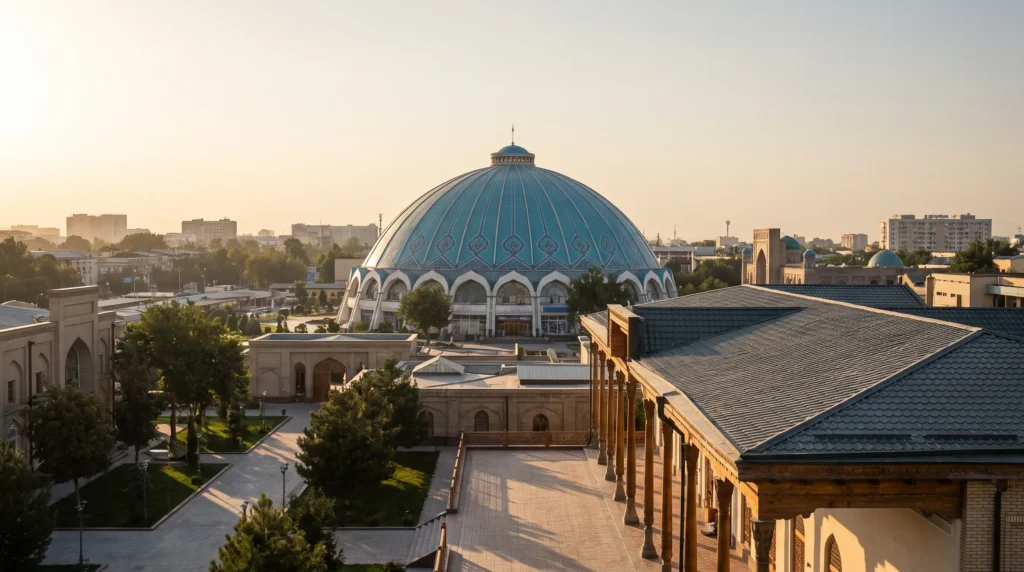
The pre-earthquake heart of Tashkent, centered on Chorsu Bazaar and its instantly recognizable turquoise dome — a market that traces its roots back some 2,000 years to Tashkent’s original Silk Road crossroads, even though the current dome structure dates to 1980. Nearby sit the Kukeldash Madrasah and a scattering of narrow, mahalla-style residential lanes — the closest thing left to pre-Soviet Tashkent.
Amir Timur Square & the New City
The formal, tree-lined civic core, laid out under Russian and then Soviet planning: Amir Timur Square itself, the State Museum of Timurid History, and a walkable stretch of parks, fountains and government buildings. This is where you’ll find the bulk of the mid-range hotels and Western-style cafes.
Mirzo Ulugbek District
Home to the Tashkent TV Tower and, just steps away, the always-busy Central Asian Plov Center — a district that mixes residential blocks with some of the city’s best-known food landmarks and university campuses.
Yunusabad
A large northern residential district that’s increasingly where expats and returning diaspora settle — modern apartment blocks, shopping centers, and some of the newer restaurant openings chasing a younger local crowd.
Yangi O’zbekiston & the Riverside Parks
A newly built park and business district along the Anhor Canal, part of a wave of redevelopment aimed at giving Tashkent a modern showcase district to match Astana or Baku — this is also a primary Navruz festival site.
Chilanzar
The dense southwestern residential district that gave the Tashkent Metro’s first line its name — worth a ride through for a look at everyday, non-touristy Tashkent life away from the center.
Culture & People — Uzbek, Russian, Silk Road Layers
Tashkent’s culture is genuinely layered rather than uniform: Uzbek is the official language and the language of daily life and hospitality, but Russian remains widely spoken and understood, a legacy of over a century under the Russian Empire and Soviet Union, and English is spreading fast in hotels, tour operations and among younger Tashkentis. Hospitality here runs deep and specific — refusing food or tea offered in a home is a genuine faux pas, and Uzbek dinner tables operate on a logic of abundance, not moderation.
Islam is the majority religion, practiced in a notably moderate, secular-inflected way shaped by seven decades of Soviet rule; you’ll see far more headscarves as fashion than as religious mandate, and alcohol is freely available. Dress is generally casual and Western in the city center, though modest coverage is appreciated at mosques and madrasahs. Navruz aside, look out for Independence Day (September 1) and the smaller neighborhood mahalla festivals that still structure a lot of local social life outside the tourist gaze entirely.
A Food Lover’s Guide to Tashkent
Plov is not just Uzbekistan’s national dish, it’s close to a civic religion, and Tashkent is where you go to see it made at industrial, communal scale: the Central Asian Plov Center (also known as Besh Qozon) near the TV Tower cooks thousands of portions daily in giant kazan cauldrons over open fire, with chefs — oshpaz — capable of feeding a thousand people from a single pot. Go for lunch, when the cauldrons and the crowd are both at full tilt, and order it with an egg or without, plus a side of shakarob (tomato-onion salad) to cut the richness.
Beyond plov: lagman (hand-pulled noodle soup, closer to Central Asian than Chinese in flavor), somsa (samosa-like pastries baked in a tandoor, sold hot off the oven from street vendors), shashlik (skewered grilled meat, often lamb), and non — the round, stamped Uzbek bread that’s treated with something close to reverence; you’ll notice it’s never placed upside down. Green tea, not coffee, is the default drink at most meals, poured from squat teapots and topped up constantly. Chorsu Bazaar is the best single stop for grazing — dried fruit, nuts, halva and fresh produce piled under that blue dome — while the newer restaurant scene in Yunusabad and around Amir Timur Square increasingly does modern, Instagram-ready takes on all of the above.
Off the Beaten Path
Tashkent Metro Station Tour
Most visitors ride the metro to get somewhere; the move is to ride it as the destination, hopping off at stations like Kosmonavtlar (space-themed mosaics), Alisher Navoi and Mustaqillik Maydoni, one of the system’s original 1977 stations, purely to look at the architecture.
Museum of Applied Arts
Housed in a lavishly tiled former merchant’s mansion, this is a quieter, far less crowded alternative to the bigger state museums, packed with embroidery, ceramics and woodwork most tourists never see.
Mahalla walks in Eski Shahar
Wander the residential lanes just behind Chorsu Bazaar and Kukeldash Madrasah — courtyard houses, neighborhood teahouses, and a texture of daily life the main sights don’t show you.
Tashkent Tower observation deck
At 375 metres it’s the tallest structure in Central Asia and one of the tallest towers in the world, and the deck gives a rare full-city view most itineraries skip in favor of Samarkand’s domes.
Day Trips — Samarkand, Chimgan & Charvak Lake
Samarkand (day trip or overnight)
The Afrosiyob puts Samarkand’s Registan, Gur-e-Amir mausoleum and the “Samarkand Blue” tilework within a two-hour-fifteen-minute train ride — technically doable as a long day trip, though most guides (this one included) recommend at least one overnight to see it properly, since Samarkand — Crossroad of Cultures was inscribed by UNESCO in 2001 and rewards unhurried time.
Chimgan Mountains & Charvak Lake
The classic nature escape from Tashkent: Charvak Lake, a turquoise reservoir roughly 60–70 kilometres northeast, and the Chimgan Mountains — dominated by 3,309-metre Greater Chimgan Peak — about 85 kilometres out, each around a 1.5–2 hour drive. Most day tours combine both: lake views and swimming (in summer) in the morning, mountain air and hiking or the Amirsoy resort’s chairlifts in the afternoon. A round-trip taxi runs well under US$50 if you’re not booking an organized tour.
Shakhrisabz
Timur’s hometown, a couple of hours south, most easily combined with a Samarkand trip. Its Historic Centre earned UNESCO inscription in 2000 for the ruins of the Ak-Saray palace and its role in the Timurid empire’s story.
Practical Information
Money. The Uzbek Som (UZS) floats freely and trades at roughly 12,000 to the US dollar, meaning even modest purchases run into six figures of som — budget for large numbers on receipts. Cards are increasingly accepted in Tashkent’s hotels, restaurants and malls; carry cash for bazaars, taxis and smaller towns.
Safety. The US State Department rates Uzbekistan Level 1, “Exercise Normal Precautions,” its lowest advisory tier. Standard advice applies: use officially marked taxis or Yandex Go rather than hailing unmarked cars, especially at night, and note it’s illegal to photograph certain government, military or security-adjacent buildings without permission. Check the UK FCDO’s current advisory before you travel as well.
Health. Drink bottled or filtered water, and check the CDC’s Uzbekistan traveler page for current vaccine recommendations before you go.
Connectivity. Local SIMs (Beeline, Ucell, Uzmobile) are cheap and easy to buy on arrival; hotel Wi-Fi in Tashkent is generally solid. Plugs: Type C and Type F, 230V/50Hz. Time zone: UTC+5, no daylight saving.
Budget Breakdown — What Tashkent Actually Costs in 2026
Tashkent remains one of the better travel values in Asia — cheaper than most of Southeast Asia’s tourist hubs, let alone Europe, though hotels in the international chains have crept up in recent years.
Budget (US$30–50/day): Hostel dorm or a simple guesthouse, metro rides and plov-center lunches, Chorsu Bazaar grazing, walking most of the center.
Mid-range (US$70–140/day): A comfortable 3–4 star hotel near Amir Timur Square, restaurant dinners, Yandex Go rides, a guided Samarkand day trip via Afrosiyob (Economy or Business class), museum entries.
Luxury (US$250+/day): International-brand hotels, private guides and drivers, VIP-class Afrosiyob tickets, a multi-day Samarkand–Bukhara–Khiva private tour extension.
Museum and madrasah entry fees are modest — usually a few dollars equivalent — and tipping 10% is appreciated but not obligatory in most restaurants.
Planning Your First Trip to Tashkent
The classic itinerary treats Tashkent as bookends: land at TAS, spend a day or two acclimatizing — Chorsu Bazaar, the metro tour, Amir Timur Square, a plov lunch — then take the Afrosiyob out to Samarkand and Bukhara for the domes and mausoleums everyone came for, adding Khiva if you have five days or more to spare, before flying home out of Tashkent. Three or four nights in the capital across the trip (split between arrival and departure) is enough; ten to fourteen days total covers the full Silk Road triangle without rushing. Pair the trip with our guides to Uzbekistan for the country-wide picture, Kazakhstan if you’re continuing north through Almaty, or Kyrgyzstan for the mountain half of a wider Central Asia loop.
Frequently Asked Questions
Is Tashkent safe for tourists in 2026?
Yes — the US State Department rates Uzbekistan at its lowest advisory level, Level 1, “Exercise Normal Precautions.” Use officially marked taxis or Yandex Go rather than hailing cars off the street, particularly at night, and check current UK FCDO and US State Department guidance before you travel.
Do US citizens need a visa for Uzbekistan?
Not anymore, for short stays. Since 1 January 2026, US citizens can enter Uzbekistan visa-free for tourism or business for up to 30 days; UK, EU, Canadian, Australian, Japanese and South Korean passport holders get similar visa-free access. Longer stays or other nationalities should check Uzbekistan’s official e-visa portal.
How many days do I need in Tashkent?
One full day covers the highlights — Chorsu Bazaar, a metro tour, Amir Timur Square, a plov lunch. Two or three days lets you add the Museum of Applied Arts, a Chimgan/Charvak day trip and a slower pace through the old city lanes.
Is Tashkent or Samarkand the better base?
They serve different purposes. Tashkent has the international airport, the best transit connections, the metro architecture and the most reliable modern infrastructure; Samarkand has the postcard monuments. Most itineraries use Tashkent as the entry/exit point and Samarkand (plus Bukhara) as the sightseeing core.
What’s the easiest way to get to Samarkand from Tashkent?
The Afrosiyob high-speed train — about two hours fifteen minutes, up to 250 km/h, with Economy, Business and VIP classes — is faster and more comfortable than driving and is the way almost everyone does it. Book a few days ahead in peak season.
What should I absolutely eat in Tashkent?
Plov at the Central Asian Plov Center, fresh non bread and dried fruit at Chorsu Bazaar, and a bowl of lagman if you find a good one.
Ready to Explore Tashkent?
A capital that rebuilt itself from an earthquake into a city of subway palaces, a bazaar that’s been trading for two thousand years, and a plov lunch that will ruin every other rice dish for you — Tashkent has quietly become one of the easiest, cheapest entry points into Central Asia there is. With the visa hassle gone for American travelers as of this year, the only real excuse left is booking the flight.
Explore More
- Uzbekistan Travel Guide — the full country picture, from Khiva to the Fergana Valley
- Kazakhstan Travel Guide — continue north into the steppe
- Kyrgyzstan Travel Guide — the mountain half of a Central Asia loop
- Tbilisi City Guide — another Silk Road-adjacent capital worth pairing on a longer trip
How this guide was built
Published as part of Facts From Upstairs’ city guide series. Built from authoritative sources — Wikipedia entity pages for Tashkent’s geography, metro, airport, TV tower, Chorsu Bazaar, Navruz and visa policy; UNESCO’s World Heritage Centre listings for Uzbekistan’s inscribed sites; the Central Bank of Uzbekistan’s exchange-rate archive; the US State Department, UK FCDO and US CDC traveler pages for Uzbekistan; Britannica’s Uzbekistan history entry; and firsthand travel-guide sources on the Afrosiyob rail line, the Chimgan/Charvak day trip and the Central Asian Plov Center. Numeric claims carry inline citations.
Sources cited on this page
- Wikipedia — Tashkent
- Wikipedia — Visa policy of Uzbekistan
- Central Bank of the Republic of Uzbekistan — Exchange rate archive
- Wikipedia — Tashkent Metro
- Wikipedia — Tashkent International Airport
- Wikipedia — High-speed rail in Uzbekistan
- Wikipedia — List of World Heritage Sites in Uzbekistan
- UNESCO — Historic Centre of Shakhrisyabz
- Wikipedia — Tashkent Tower
- Wikipedia — Navruz in Uzbekistan
- Wikipedia — Chorsu Bazaar
- Britannica — Uzbekistan, The Early Uzbeks
- US State Department — Uzbekistan Travel Advisory
- UK FCDO — Uzbekistan
- US CDC — Uzbekistan traveler page
- World Standards — Uzbekistan power plugs & voltage
- Wikipedia — Time in Uzbekistan
- Backpack Adventures — Chimgan Mountains & Charvak Lake
- Atlas Obscura — Central Asian Plov Center
- Lonely Planet — Best Time to Visit Uzbekistan
More city guides you might like
Plan your trip to Tashkent
The booking tools we use ourselves. FFU may earn a commission at no extra cost to you.
Plan & book your trip to Tashkent
Booking through these searches supports our guides at no extra cost to you.