
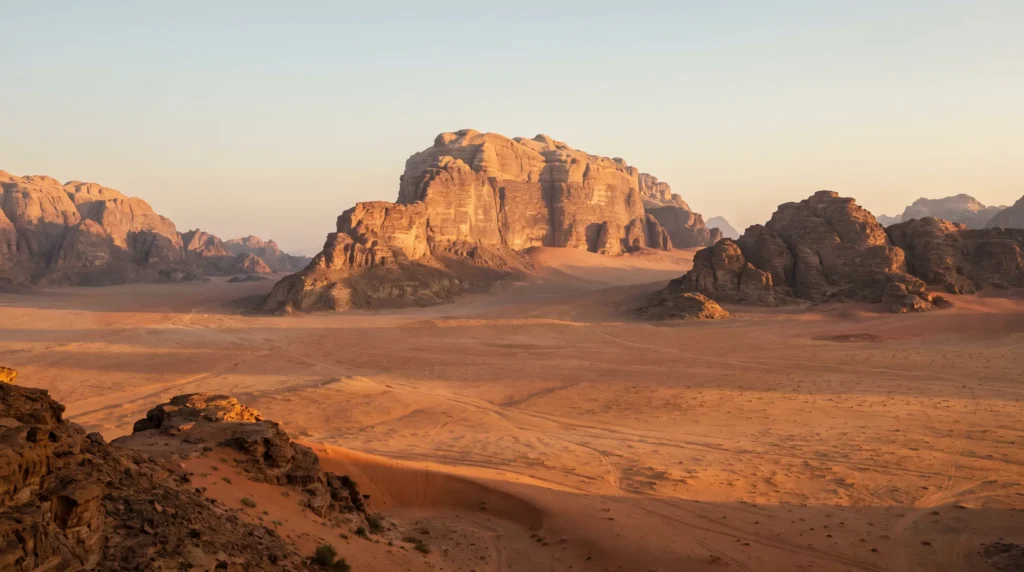
Wadi Rum Travel Guide — Jordan’s Red Desert, Bedouin Camps & the Valley of the Moon
Few sunsets anywhere compare to one watched from a sand dune in Wadi Rum, as the sandstone shifts from ochre to rust to a color that barely has a name and the temperature drops ten degrees in the time it takes to unfold a blanket. Wadi Rum is southern Jordan’s desert protected area, a 720-square-kilometre sweep of towering sandstone and granite mountains rising out of pink sand near the Saudi border. It has been a Bedouin homeland for centuries, a Nabataean and Thamudic canvas for tens of thousands of years of rock art, a T.E. Lawrence backdrop during the Arab Revolt, and — more recently — the closest thing Hollywood has found to an actual alien planet. This is not a place you tour in an afternoon and check off. It’s a place you sleep in, under more stars than you knew existed, and leave a little quieter than you arrived.
In This Guide
- Overview — Why Wadi Rum Is Unlike Anywhere Else on Earth
- Wadi Rum’s Night Sky — When Stargazing Is Best
- Best Time to Visit Wadi Rum (Season by Season)
- Getting There — Airports, Buses & Border Crossings
- Getting Around — Jeeps, Camels & Bedouin Guides
- Key Areas of Wadi Rum
- Culture & People — The Zalabia Bedouin
- A Food Lover’s Guide to Wadi Rum
- Off the Beaten Path
- Day Trips — Petra, Aqaba & the Red Sea
- Practical Information
- Budget Breakdown — What Wadi Rum Actually Costs in 2026
- Frequently Asked Questions
Overview — Why Wadi Rum Is Unlike Anywhere Else on Earth
Wadi Rum sits in the far south of Jordan, about 60 kilometres inland from the Red Sea port city of Aqaba, hard against the Saudi border. It’s Jordan’s largest wadi (valley) — 720 square kilometres of sand and rock where elevations swing from around 45 metres up to 1,750 metres, and where iron-rich Umm Ishrin sandstone has been carved by wind and flash floods into cliffs, natural arches, canyons and freestanding towers that look computer-generated even in person.
UNESCO inscribed Wadi Rum Protected Area as a mixed cultural-and-natural World Heritage Site in 2011, one of a small handful of sites on the list to earn both designations. The cultural case rests on more than 25,000 petroglyphs and 20,000 inscriptions left by Nabataean and Thamudic peoples over at least 12,000 years of continuous human presence — one of the richest open-air rock-art records on the planet. The natural case is simpler to grasp standing in it: this is one of the most complete and dramatic desert landscapes anywhere, full stop.
Modern Wadi Rum’s tourism story starts with British officer T.E. Lawrence, who moved through the valley during the 1917–18 Arab Revolt and later wrote it into legend, and gets a second boost from David Lean’s 1962 film Lawrence of Arabia, credited with kick-starting Jordanian tourism in the first place. More recently, Wadi Rum’s red sand and Mars-like inselbergs have made it Hollywood’s default alien-planet set — Ridley Scott shot most of The Martian here, and it doubled as Arrakis in Dune and as fictional planets in multiple Star Wars films. None of that is why locals call it Wadi Rum, but it’s a fair shorthand for what you’re about to see: this genuinely looks like nowhere else on Earth.
Wadi Rum’s Night Sky — When Stargazing Is Best
The single best reason to sleep in Wadi Rum rather than day-trip it is what happens after the jeep tours pack up: zero light pollution, huge open sky, and a horizon broken only by rock silhouettes. Every camp worth its salt structures the evening around it — tea around a fire, dinner pulled from a zarb pit, then blankets on the sand for the show.
Time it around the moon, not the calendar. A new-moon week gives you the darkest possible sky and the best shot at the Milky Way arching over the Seven Pillars of Wisdom; a full-moon night trades stars for the strange effect of moonlit sandstone, which has its own fans. Shoulder-season months (spring and autumn) pair the clearest, driest air with comfortable evening temperatures for lying outside for an hour rather than three; midsummer nights are warm enough to stargaze in a t-shirt, midwinter nights are cold enough that you’ll want the camp’s blankets and a hot cup of Bedouin tea within reach.
Best Time to Visit Wadi Rum (Season by Season)
March – May · Spring (peak comfort)
The desert’s sweet spot: daytime temperatures climbing from around 20°C in March to the low 30s by May, with cool, comfortable nights. Camps fill up around Easter and spring school holidays — book ahead.
Late September – November · Autumn (peak comfort, part two)
Mirror-image of spring: daytime temperatures easing down from the high 20s to the low 20s, with nights getting progressively colder toward the end of November as the first rains approach. This is many guides’ pick for the single best month, alongside April.
June – August · Summer (hot but doable)
Daytime highs regularly reach the mid-30s and can spike toward 46°C in the open desert, though nights cool into the low-to-mid 20s. Doable if you plan around the heat — jeep tours at dawn and dusk, downtime midday — but not the season to attempt a long desert trek on foot.
December – February · Winter
Mild, sunny days (10–20°C) with genuinely cold nights that can drop below freezing, and — a genuine desert oddity — the occasional dusting of snow on the rock tops most winters. Pack a proper layer if you’re camping; camps supply blankets, but the walk from the fire to your tent is bracing.
Getting There — Airports, Buses & Border Crossings
Two airports realistically serve Wadi Rum. Queen Alia International Airport (AMM) near Amman is Jordan’s main international gateway, roughly a four-hour drive south down the Desert Highway (Route 15). King Hussein International Airport (AQJ) in Aqaba is the country’s only other civilian airport, with flights to Amman and a handful of regional and international destinations — from Aqaba, Wadi Rum’s visitor center is under an hour away by road. Most travelers combining Wadi Rum with Petra fly into Amman, do Petra and the Dead Sea first, then head south.
From Petra, it’s about 104 kilometres and roughly 1.5 hours by road via the Kings Highway and Desert Highway — comfortably doable as a transfer with a tour driver or, more cheaply, a shared minibus/JETT bus connection. From Amman, budget around four hours by private car or bus along the Desert Highway. There’s no railway to Wadi Rum and no scheduled public bus running directly into the protected area — arrange a private transfer, join a tour, or take a bus to Aqaba/Rum village and connect locally. Overland travelers coming up from Saudi Arabia use the Al Mudawwara crossing well south of Wadi Rum, though this is a minor route for tourists.
Getting Around — Jeeps, Camels & Bedouin Guides
You cannot self-drive into the desert interior, and you shouldn’t want to — Wadi Rum’s roads are sand tracks that shift with the wind, and the whole point of the protected area system is that local Zalabia Bedouin guides run the access. Everyone entering pays the fee at the Wadi Rum Visitor Center on the single road in, then either drives on to Wadi Rum village or is met by a guide.
The default way to see the desert is a half-day or full-day 4×4 jeep tour (open-backed Toyota pickups with bench seats) hitting a circuit of highlights — Khazali Canyon, Um Fruth rock bridge, Anfeshieh rock inscriptions, a sand dune or two — arranged through your camp or a Wadi Rum Visitor Center-registered operator. Camel treks move at a slower, quieter pace and suit shorter distances or a sunset ride rather than full-day coverage. Serious hikers and climbers hire a certified Bedouin guide for multi-hour treks or technical routes; Wadi Rum has become one of the Middle East’s respected rock-climbing destinations, with routes first bolted in the 1980s–90s now numbering in the hundreds. Whatever you book, confirm it’s arranged through the visitor center system or a licensed camp — informal roadside “guides” outside that system are a recurring tourist-trap complaint.
Key Areas of Wadi Rum
Wadi Rum Village
The only real settlement inside the protected area, home to the Zalabia Bedouin community — around 700–800 residents — who arrived and settled here starting around 1980. This is where most jeep tours and camel treks are organized, and where you’ll find a small grocery store, a few cafés, and the last reliable phone signal before heading into the deeper desert.
The Visitor Center Corridor
The single paved road in from the Desert Highway passes through the Wadi Rum Visitor Center, where entrance fees are collected and tickets stamped, about ten minutes’ drive before the village. It’s also where most pre-booked drivers and guides meet arriving guests.
The Seven Pillars of Wisdom & Lawrence’s Spring
A cluster of sandstone towers near the village named for T.E. Lawrence’s memoir, and a short scramble away, a small spring long associated with him. More photographed than dramatic up close, but a standard first stop on nearly every jeep circuit.
Khazali Canyon
A narrow slot canyon walkable a few hundred metres in, its walls carved with genuine Thamudic and Nabataean inscriptions and petroglyphs — camels, ostriches, human figures — some of the most accessible ancient rock art in the whole protected area.
Um Fruth Rock Bridge & the Red Dunes
A natural stone arch you can climb (a short, slightly exposed scramble, doable without technical gear) and a set of towering red sand dunes nearby that are the classic “run down barefoot” jeep-tour stop.
Barrah Canyon & the Deep Desert
Further from the village, a long, wide canyon flanked by some of Wadi Rum’s most dramatic rock walls — quieter than the near-village circuit and usually reserved for full-day tours or overnight camps pitched deep in the interior, away from other groups entirely.
Jabal Umm ad Dami
Jordan’s highest peak at 1,840 metres, roughly 30 kilometres south of Wadi Rum village near the Saudi border, reachable on a long guided day hike that rewards summit-baggers with views into Saudi Arabia.
Culture & People — The Zalabia Bedouin
Wadi Rum’s human story today is overwhelmingly the story of the Zalabia, a Bedouin tribe that settled permanently in the area starting around 1980 and now makes up the majority of Wadi Rum village’s population. Nearly every camp, jeep, and guide license in the protected area traces back to a Zalabia family, and tourism has become the community’s primary livelihood — which is worth knowing when you’re deciding who to book through, since money spent with a village-based operator stays local in a very direct way.
Hospitality here runs on ritual: expect sweet, cardamom-spiced Bedouin tea offered within minutes of arriving anywhere, poured with real ceremony, and rarely accepted as a one-cup transaction — a second glass is normal, even expected. Camps range from simple shared “Martian dome” tents to genuinely upscale glamping with private bathrooms, but the desert etiquette is consistent everywhere: dress modestly outside the camp compound, ask before photographing people (not just landscapes), and don’t expect — or push for — alcohol, which conservative Bedouin-run camps generally don’t serve.
A Food Lover’s Guide to Wadi Rum
The signature Wadi Rum meal is zarb: chicken, lamb and vegetables layered in a pot, lowered into a pit oven dug in the sand, and slow-cooked for hours under embers and buried sand until it’s fall-apart tender. Nearly every camp does a version of it as the centerpiece of dinner, often with a small ceremony of digging it up in front of guests before serving.
Beyond the zarb pit, expect Jordan’s staples wherever you eat: mansaf (lamb in a fermented dried-yogurt sauce over rice, Jordan’s national dish, usually reserved for special occasions but sometimes offered), hummus, mutabbal (smoky eggplant dip), fresh flatbread baked on a metal dome (shrak), and a rotation of grilled meats and salads. Sweet, strong Bedouin tea and Arabic coffee (cardamom-forward, served in small cups) bookend meals constantly — refusing outright can read as rude, but a light sip and a polite “enough, thank you” works fine. Alcohol is scarce to nonexistent at village-run camps; bring your own if it matters to you and ask first, since some camps prohibit it outright.
Off the Beaten Path
Multi-day Trekking
Beyond the jeep circuit, hiring a Bedouin guide for a two- or three-day trek — walking between canyons, sleeping at small Bedouin-run camps or wild-camping under a rock overhang — gets you into terrain that the day-tour crowds never see, and it’s the way climbers and serious hikers experience Wadi Rum.
Rock Climbing
Wadi Rum has quietly become one of the world’s great desert climbing destinations, with hundreds of bolted and traditional routes across its sandstone towers, many first established by Bedouin guides working alongside visiting European climbers from the 1980s onward. Multi-pitch classics can take a full day; local guides double as climbing partners for anyone without their own rope team.
Sunrise on the Dunes, Away From the Crowd
The big red dune near the village gets a jeep-tour crowd by mid-morning; ask your camp about a lesser-visited dune or ridge for sunrise instead, and you’ll likely have it to yourself.
Hot Air Ballooning
Seasonal balloon flights over the valley (typically cooler months, weather-dependent) offer the one perspective a jeep can’t — the full scale of the rock formations from above, at first light.
Day Trips — Petra, Aqaba & the Red Sea
Petra
Jordan’s other unmissable site is about 104 km / roughly 1.5 hours north by road, and the pairing with Wadi Rum is the single most common Jordan itinerary — many visitors do Petra first, then Wadi Rum, or the reverse. Petra’s single-day entry runs 50 JD for foreign visitors (more for multi-day passes), separate from Wadi Rum’s fee, though both are covered by the Jordan Pass.
Aqaba & the Red Sea
About an hour south, Aqaba is Jordan’s only coastal city and its only port, with a population of roughly 95,000 in the city proper. After days of sand, it’s the natural decompression stop: Red Sea snorkeling and diving over coral reefs, beach clubs, and ferries across to Egypt’s Taba and Sharm El-Sheikh for those continuing that direction.
Wadi Musa & Little Petra
The town servicing Petra also gives easy access to Siq al-Barid (“Little Petra”), a smaller, free-to-visit Nabataean site a short drive further north — a good half-day add-on if you’re already based there.
Practical Information
Money. The Jordanian Dinar has been fixed to the US dollar since 1995 at roughly 0.709 JOD per US$1, giving Jordan unusually predictable pricing for a Middle East destination. Cards work at larger camps and in Aqaba/Petra towns, but cash is essential inside Wadi Rum itself — bring dinars, since there’s no ATM in the village or visitor center.
Safety. Here’s the honest part: as of mid-2026, the US State Department has Jordan under a Level 3 “Reconsider Travel” advisory, citing terrorism risk and regional tensions tied to the wider Iran conflict, and the UK FCDO advises against all travel within 3km of the Syrian border. Read that carefully rather than skipping past it: the specific risk areas named are the Syria and Iraq border regions, refugee camps, and a couple of named Amman neighborhoods — Wadi Rum, Petra and Aqaba sit far to the south and haven’t been named flashpoints, and Jordan’s tourism trail has stayed largely calm through past regional flare-ups. Still, check both advisories again close to your departure date, buy travel insurance that isn’t invalidated by an advisory level, and register with your embassy if you’re the type who likes a paper trail.
Health. No special vaccines are mandatory, but routine and hepatitis A/B coverage is generally recommended, along with care around insect bites (sandflies carry leishmaniasis) and around stray dogs. Drink bottled or camp-filtered water, and pack strong sun protection — there is essentially no shade in the desert interior.
Connectivity. Mobile signal is workable in Wadi Rum village and patchy-to-nonexistent in the deep desert and at overnight camps — treat a night under the stars as a genuine digital-detox stretch, not an inconvenience. Plugs: sockets are a mix of types C, F and G at 230V/50Hz — bring a universal adapter. Time zone: UTC+3 (Arabia Standard Time).
Budget Breakdown — What Wadi Rum Actually Costs in 2026
Wadi Rum’s entrance fee is a flat 5 JD (about US$7) for foreign visitors, waived entirely with a Jordan Pass. Beyond that, cost is really about the level of camp and tour you choose.
Budget (US$40–70/day): Shared “Martian dome” or Bedouin-tent camp with communal bathrooms, a basic half-day jeep tour bundled into your camp stay, meals included in the camp rate.
Mid-range (US$100–180/day): Private tent with en-suite bathroom at a more polished camp, a full-day jeep tour hitting the classic circuit, a camel ride or short guided hike added on.
Luxury (US$300+/day): High-end desert-luxury camps with private plunge pools or glass-domed tents, a dedicated Bedouin guide for a multi-day trek or climbing day, a hot-air balloon flight.
Tipping guides and camp staff 10–15%, or a flat few dinars per activity, is customary and genuinely appreciated in a tourism economy this dependent on individual families.
Planning Your Trip to Wadi Rum
The classic pairing is Petra + Wadi Rum: fly into Amman, spend a day or two on Petra and the Dead Sea, then head south for one or two nights camping in Wadi Rum before finishing on the Red Sea in Aqaba. One overnight in the desert is the minimum to justify the trip — the stargazing and the zarb dinner are the whole point, and a rushed day-tour from Aqaba shortchanges both. Pair this with a broader look at our Jordan travel guide for the full country picture, our Amman city guide for the capital end of the trip, and — if you’re continuing the region — our Egypt travel guide for the Aqaba–Sinai ferry connection.
Frequently Asked Questions
Is Wadi Rum safe to visit right now?
Jordan currently sits under a US Level 3 “Reconsider Travel” advisory tied to regional tensions and terrorism risk, and the UK advises against travel right at the Syrian border. The named risk areas are the northern border regions and specific Amman neighborhoods, not Wadi Rum, Petra or Aqaba in the far south — but check the current advisory yourself close to travel, since the situation has moved quickly before.
Do I need a visa for Jordan?
US, UK, EU and Canadian passport holders can get a visa on arrival for around JD 40 (~US$56), or buy a Jordan Pass in advance (JD 70–80) that waives the visa fee entirely if you stay at least three consecutive nights and bundles in Petra and 40-plus other sites. The pass must be bought online before you arrive — it isn’t sold at the border.
Can I visit Wadi Rum as a day trip from Aqaba or Petra?
Yes, and plenty of tour operators sell exactly that — but you’ll only see the near-village jeep circuit and miss the night sky, which is genuinely the best part. If your schedule allows even one night in a desert camp, take it.
How much walking/fitness do I need?
Almost none for the standard jeep-tour circuit — most stops involve a short walk from the vehicle. Climbing Um Fruth’s rock bridge or Jabal Umm ad Dami, or doing a multi-day trek, needs real fitness and a guide; ask your camp to match the day to your level.
Is Wadi Rum too hot in summer?
Hot, yes — daytime highs can hit the mid-40s Celsius — but manageable if you shift activity to early morning and evening and rest through the midday peak. Spring and autumn remain the more comfortable choice if your dates are flexible.
Wadi Rum or the Sahara?
Choose Wadi Rum for dramatic rock formations, a compact size that pairs easily with Petra and the Red Sea in one trip, and an established, guide-run camp system. Choose a Sahara trip (Morocco or Tunisia) for a bigger dune-only landscape and a different cultural context. Wadi Rum’s rock scenery is genuinely one of a kind either way.
Ready to Explore Wadi Rum?
A campfire, a pot buried in sand, and a sky so clear you can trace the Milky Way with your finger — Wadi Rum delivers exactly what the postcards promise, and then some. Go for the rock formations, stay up for the stars, and give it at least one night; a drive-through jeep tour just isn’t the same trip.
Explore More
- Jordan Travel Guide — Petra, the Dead Sea and the rest of the country
- Amman City Guide — Jordan’s capital, the usual gateway city
- Egypt Travel Guide — continue on via the Aqaba–Sinai ferry
- Jerusalem City Guide — the region’s other essential stop
How this guide was built
Published as part of Facts From Upstairs’ city guide series. Built from authoritative sources — UNESCO’s Wadi Rum Protected Area World Heritage inscription, the official Jordan Tourism Board entrance-fees page, the Jordan Pass official FAQ, the Central Bank of Jordan’s exchange-rate page, the US State Department and UK FCDO Jordan advisory pages, the US CDC traveler page for Jordan, and Wikipedia entity pages for Wadi Rum, Jordan and Aqaba. Numeric claims carry inline citations.
Sources cited on this page
- Wikipedia — Wadi Rum
- UNESCO — Wadi Rum Protected Area
- Wikipedia — Jordan
- Wikipedia — Aqaba
- Central Bank of Jordan — Foreign Exchange Rates
- Jordan Tourism Board — Entrance Fees
- Jordan Pass — Official FAQs
- US State Department — Jordan Travel Advisory
- UK FCDO — Jordan Travel Advice
- US CDC — Jordan Traveler Page
More city guides you might like

Plan your trip to Wadi Rum
The booking tools we use ourselves. FFU may earn a commission at no extra cost to you.
Plan & book your trip to Wadi Rum
Booking through these searches supports our guides at no extra cost to you.