
Monteverde Travel Guide — Costa Rica’s Cloud Forest Town Built by Pacifists, Quetzals & Zip Lines
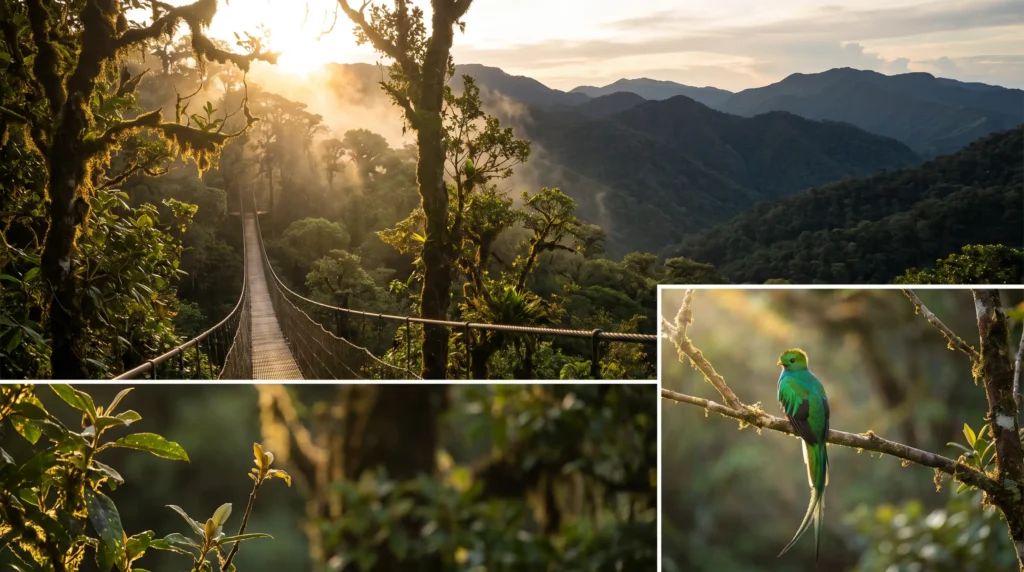
Monteverde is one of the strangest founding stories in Latin American tourism: a group of Quaker dairy farmers from Fairhope, Alabama moved here in 1951 to avoid being drafted into the Korean War, picked a foggy ridge at 1,330 meters because the climate suited cows, and then — almost by accident — preserved one of the most biodiverse patches of forest on Earth. There is no beach here, no ancient ruin, no single postcard shot. What there is: a permanent hush of mist rolling through the canopy, over 400 recorded bird species, and a real shot at seeing a resplendent quetzal — a bird so improbable-looking that the Maya considered it divine. I will be upfront about the catch before I sell you on any of it: getting here is a genuine slog, the town of Santa Elena is more functional than pretty, and this is not a place you visit for the food or the nightlife. You come for the forest, the fog, and the feeling that you have wandered into the one corner of Costa Rica that never quite decided to become a resort.
In This Guide
- Overview — Why Monteverde Is Costa Rica’s Odd One Out
- Quetzal Nesting Season — Feb–April
- Best Time to Visit Monteverde (Season by Season)
- Getting There — The Road Everyone Complains About
- Getting Around — Shuttles, Taxis & Your Own Two Feet
- Neighborhoods — Santa Elena, Cerro Plano & Monteverde Proper
- Culture & People — Quakers, Ticos & the Conservation Story
- A Food Lover’s Guide to Monteverde
- Off the Beaten Path
- Day Trips From Monteverde
- Practical Information
- Budget Breakdown — What Monteverde Actually Costs in 2026
- Frequently Asked Questions
Overview — Why Monteverde Is Costa Rica’s Odd One Out
Every other stop on a Costa Rica itinerary sells itself on a single headline feature — a volcano, a beach, a river. Monteverde sells itself on an atmosphere: a near-permanent cloud bank drifting through primary forest at a life-zone boundary where the Pacific and Caribbean slopes nearly touch. That geography is the entire point. Moisture-laden trade winds hit the Cordillera de Tilarán and condense into the mist that gives “cloud forest” its name, feeding six distinct ecological life zones inside one reserve system.
The town itself did not exist as a tourist draw until decades after its founding. In 1951, a group of Quaker families — many from Fairhope, Alabama — relocated here specifically to escape U.S. conscription ahead of the Korean War, drawn by Costa Rica’s abolished standing army and a cool highland climate suited to the dairy farming they knew. They named their new home Monteverde — “green mountain” — and, in 1972, a visiting biology graduate student named George Powell helped spearhead the creation of the Monteverde Cloud Forest Reserve to protect the watershed the community depended on. That reserve now covers more than 10,500 hectares and is one of the most-studied tropical forests on the planet, drawing more than 70,000 visitors a year to the reserve alone.
Administratively, Monteverde only became its own canton — Puntarenas Province’s twelfth — on September 29, 2021, after decades as a district split awkwardly between neighboring municipalities. The area now pulls in roughly a quarter-million tourists a year, a huge number for a canton with a resident population in the low thousands. What that means in practice: infrastructure built for a small Quaker farming community now handles a serious tourism load, and it shows in traffic, water pressure at busy hotels, and the mildly chaotic parking around Santa Elena’s zip-line operators. It is not a polished destination. It is a genuinely wild one that tourism grew up around, rather than the other way round.
Quetzal Nesting Season — February to April
If there is one date range to build a Monteverde trip around, it’s late February through April, when resplendent quetzals are actively nesting and males grow their spectacular meter-long tail streamers to attract mates. March and April are widely considered peak viewing weeks, when the birds are feeding hard on wild avocado (aguacatillo) trees to provision nestlings and are correspondingly easier to find and photograph.
The single best-regarded spot is Curi-Cancha Wildlife Reserve, a smaller, privately managed 83-hectare reserve just outside the main Monteverde reserve gate, where guides know specific fruiting aguacatillo trees along the Alondra Trail that quetzals return to year after year. Book a 6 a.m. guided walk here in quetzal season and you have a genuinely strong chance; show up at noon in September expecting the same bird and you will mostly get mist and disappointment. Honest catch: quetzals are wild animals on their own schedule, not zoo exhibits, so “strong chance” is the ceiling any guide should honestly promise you.
Best Time to Visit Monteverde (Season by Season)
Mid-December – April · Dry season (peak)
The most reliable hiking weather, clearer canopy views on the hanging bridges, and — despite the name — the reserve can still be genuinely misty most mornings, since cloud forest fog is driven by trade winds, not rainfall. This is also peak price season; book lodging and the popular canopy tours a few weeks ahead over Christmas–New Year and Easter week.
February – April · Quetzal window
Overlaps with dry season and is the best stretch for birding generally, since many resident and migrant species are most active in these months.
May – November · Green season
Afternoon downpours are near-daily, trails get muddy, and some of the smaller tour operators trim their schedules — but rates drop noticeably, the forest is at its most lush and waterfall-fed, and September–October school holidays in Costa Rica bring domestic visitors rather than international crowds. Mornings are still frequently dry and clear even in wet season; plan outdoor activities before 1 p.m.
Getting There — The Road Everyone Complains About
Nearly every visitor flies into Juan Santamaría International Airport (SJO) near San José, then travels roughly 150 kilometers northwest to Santa Elena, Monteverde’s main town — a trip that takes about three to four hours by road even though the straight-line distance is modest. The standard driving route runs the Interamericana Highway to Route 606, the steep, winding access road up into the Tilarán mountains; it was paved in 2019 and is far better than its old reputation, but rain, fog and mountain switchbacks still routinely stretch the “three hour” estimate, especially after dark.
Shared shuttle vans (roughly US$45–60 per person) run multiple times daily from San José, La Fortuna/Arenal, and the main Pacific beach towns, and are the easiest option if you are not renting a car. Public buses exist and are dramatically cheaper, but involve a transfer and a much longer ride. The jeep-boat-jeep transfer from La Fortuna — a shuttle to Lake Arenal, a short boat crossing, then a second shuttle up to Santa Elena — is the popular link between the two most-visited mountain towns in the country, typically 3–3.5 hours door to door. If you’re renting a car, a 4WD or at minimum high-clearance vehicle is genuinely worth the upcharge for the final approach, particularly in green season.
Getting Around — Shuttles, Taxis & Your Own Two Feet
Santa Elena itself is small enough to walk end to end in fifteen minutes, and most budget and mid-range lodging sits within a walkable or short-taxi radius of the town center. Cerro Plano and the road toward the reserve are more spread out and hilly; official red taxis and hotel shuttles handle this stretch cheaply (a few thousand colones for most in-town hops), and nearly every tour and hotel offers pickup as part of the booking.
There is no local bus network worth relying on for reserve visits — most travelers either arrange a hotel shuttle, book a tour that includes transport, or rent a car for the trip up from Santa Elena to the Monteverde and Santa Elena reserve entrances, both a steep 15–20 minute drive above town. Rental cars also open up Curi-Cancha, the Children’s Eternal Rainforest entrances, and the coffee-and-chocolate farms scattered along the access road, none of which are realistic on foot given the hills and frequent fog.
Neighborhoods — Santa Elena, Cerro Plano & Monteverde Proper
Santa Elena
The commercial heart and the address on nearly every hostel and budget hotel listing. Small, a little scruffy, walkable, and packed with tour desks, sodas (casual local diners) and the town’s only real concentration of nightlife — which, this being Monteverde, means a couple of low-key bars, not a strip.
Cerro Plano
The quieter, greener stretch between Santa Elena and the reserve entrances, where many of the boutique hotels, the Hummingbird Gallery, and several of the better restaurants cluster. Good middle-ground base if you want easy reserve access without Santa Elena’s tour-hawker bustle.
Monteverde Proper (near the reserve)
Confusingly, “Monteverde” as a specific settlement is a small cluster right by the original Quaker community and cheese factory, further up the hill than Santa Elena. Fewer services, but closest to the Monteverde Cloud Forest Reserve entrance itself and the original settlement’s dairy-farming roots.
The Reserve Corridor
The road connecting Santa Elena to the reserve entrances is effectively its own attraction zone: Selvatura Park, the Santa Elena Cloud Forest Reserve, Curi-Cancha, Ecological Sendero Tranquilo, and multiple canopy-tour operators line a few kilometers of increasingly forested, foggy road. Staying anywhere along this corridor cuts your commute to the trails to a few minutes.
Culture & People — Quakers, Ticos & the Conservation Story
Monteverde’s culture is genuinely a blend rarely found elsewhere in Costa Rica: descendants of the original Alabama Quaker families still run the community’s dairy cooperative and Monteverde Cheese Factory, while the majority of the canton’s roughly 5,400 residents are Costa Rican (Tico) families who arrived later as tourism grew. The Quaker meeting house is still active, and the community’s pacifist founding is part of local identity — ask a longtime resident about it and you’ll usually get the full Fairhope-to-Costa-Rica story unprompted.
Conservation is close to a civic religion here, and for good reason: the 1989 extinction of the endemic golden toad, alongside roughly 40% of the reserve’s amphibian species, tied to the chytrid fungus epidemic, is treated locally as a cautionary tale rather than a historical footnote. That history shapes how seriously guides, lodges and tour operators here take low-impact tourism compared to more commercially developed parts of the country — it is one of the few places in Costa Rica where the sustainability messaging on a hotel website is usually backed by an actual on-the-ground conservation project.
A Food Lover’s Guide to Monteverde
Monteverde will not be the culinary highlight of a Costa Rica trip, and any honest guide should say so upfront — this is a farming and forest town, not a food destination. That said, it does two things very well: coffee and dairy. Café de Monteverde and the Don Juan Coffee, Cacao & Sugarcane Tour both walk visitors through the full bean-to-cup process on working farms, with tastings at the end, and coffee has been central to the local economy since the community’s early decades. The Monteverde Cheese Factory, started by the original Quaker settlers, still sells the fresh cheeses and the “Monteverde” brand ice cream that put the community’s dairy heritage on the map.
For meals, expect standard Costa Rican staples done well: gallo pinto (rice and beans) at breakfast, a casado plate (rice, beans, salad, plantain and a protein) at lunch, and fresh trout or tilapia at the handful of sit-down restaurants along the Cerro Plano stretch. Sodas — small family-run diners — are consistently the best value and often the best food; the fancier restaurants aimed squarely at tour groups are the closest thing Monteverde has to a tourist trap, with prices well above what the same casado costs a kilometer away.
Off the Beaten Path
Curi-Cancha Reserve
Smaller and far less trafficked than the main Monteverde reserve, with a strong reputation among birders specifically for quetzal and bellbird sightings and noticeably thinner crowds on its trails.
Bosque Eterno de los Niños (Children’s Eternal Rainforest)
The largest private reserve in Costa Rica, assembled parcel by parcel starting in the late 1980s after a Swedish schoolchildren’s fundraising campaign — one of the more feel-good conservation origin stories in the region, and one that receives a fraction of the main reserve’s foot traffic.
Night walks
Roughly 70% of cloud forest wildlife is nocturnal, and a guided night tour on the reserve corridor’s private trails is genuinely one of the better wildlife encounters in the country — sleeping birds, kinkajous, olingos, tarantulas and sometimes a two-toed sloth, all findable with a guide’s spotlight in ways daytime visitors simply won’t see.
Santa Elena Cloud Forest Reserve
Community-run rather than privately operated, higher in elevation than the main Monteverde reserve, with fewer visitors and, on a clear day, views stretching to Arenal Volcano and the Gulf of Nicoya.
Day Trips From Monteverde
Monteverde’s mountain-road geography means most “day trips” are really overnight relocations, but a few are genuinely doable in a day with an early start. Lake Arenal and La Fortuna are reachable via the jeep-boat-jeep route in roughly three hours each way, making a long day trip to see the volcano possible, though most visitors instead treat this as a one-way relocation rather than a there-and-back. Closer options: the coffee and sugarcane farms along the reserve access road, the Santa Elena Cheese Factory tour, and canopy/zip-line parks like Selvatura and Sky Walk, all comfortably done as half-day outings without leaving the immediate area. Beach day trips to the Nicoya Peninsula (Samara, Montezuma) are technically possible but eat most of a day in transit given the mountain roads — better treated as the next stop on an itinerary than a round trip.
Practical Information
Money. The Costa Rican colón has strengthened notably against the US dollar through 2026, trading in the mid-to-high 450s to 460s per dollar as of early July, after the Central Bank stepped in to manage a multi-year high. US dollars are widely accepted in Monteverde’s tourist businesses, but change is often given in colones, and rural sodas and smaller vendors may prefer colones outright; carry some local cash.
Safety. The US State Department rates Costa Rica a Level 2 advisory — “exercise increased caution” — citing petty theft, occasional armed robbery, and rental-car break-ins as the main risks tourists actually encounter; Monteverde itself is low-crime relative to San José or beach resort towns, but don’t leave valuables visible in a parked rental.
Health. No vaccines are required for entry from the US, Canada or Europe; routine and hepatitis A vaccinations are commonly recommended for travelers, and mosquito-borne illness risk is low at Monteverde’s cool elevation compared to lowland Costa Rica. Bring a light rain jacket and real walking shoes — trails get slick with mud even in dry season.
Connectivity. Hotel and café Wi-Fi is decent in town, patchier at reserve-adjacent lodges; an eSIM covers most gaps. Plugs: Type A/B, 120V/60Hz — identical to the US and Canada, no adapter needed for those travelers. Time zone: UTC−6 year-round, no daylight saving.
Budget Breakdown — What Monteverde Actually Costs in 2026
Monteverde runs a bit above Costa Rica’s national average given its remote mountain location and tourism-heavy economy — most goods and fuel are trucked up that same steep access road.
Budget (US$50–90/day): Santa Elena hostel dorm or basic cabina, soda meals, one shuttle transfer, self-guided reserve entry, skipping the priciest zip-line combos.
Mid-range (US$130–230/day): Cerro Plano boutique hotel, restaurant dinners, a guided reserve or Curi-Cancha walk, one canopy tour or hanging-bridges visit (roughly $35–65), a coffee or cheese-factory tour.
Luxury (US$350+/day): Reserve-adjacent eco-lodge with private forest access, private naturalist guiding, the full Selvatura zip-line-plus-bridges-plus-Tarzan-swing combo, chef-led farm dinners.
Fixed costs to plan around: most reserves and private parks charge separate entry fees on top of any tour, guided walks cost meaningfully more than self-guided entry (and are worth it for wildlife spotting), and shuttle transfers to/from San José or La Fortuna run US$45–60 per person each way.
Planning Your First Trip to Monteverde
The classic pairing is volcano + cloud forest: fly into San José, spend two or three nights around Arenal for the volcano and hot springs, then take the jeep-boat-jeep transfer to Monteverde for two to three nights of reserve hikes, a canopy tour and a coffee farm visit, before returning to San José or continuing to the beach. Four full nights in Monteverde covers the reserve, Curi-Cancha, a night walk and a coffee tour without rushing. If quetzals are the priority, anchor the trip to February–April and book a 6 a.m. Curi-Cancha guide on arrival day. Pair the trip with our Costa Rica travel guide for the national overview, our San José city guide for your arrival hub, or continue north into Nicaragua or south into Panama for a longer Central America run.
Frequently Asked Questions
Is Monteverde worth the difficult drive?
For wildlife, birding and cloud forest specifically, yes — there’s nothing quite like it elsewhere in the country. If your priority is beaches or volcanoes, the road may not be worth a dedicated detour; it’s better paired with Arenal via the jeep-boat-jeep route than visited on its own long drive from San José.
Do I need a visa to visit Costa Rica?
US, UK, EU, Canadian and most Western passport holders enter visa-free, with an entry stamp typically granted for up to 90 days depending on nationality and immigration officer discretion; proof of onward travel is generally required.
When is the best time to see a resplendent quetzal?
February through April, during nesting season, with March and April considered peak. Curi-Cancha Reserve has the strongest local reputation for sightings, especially with an early-morning guided walk.
Is Monteverde safe?
Yes, relative to Costa Rica’s national Level 2 “exercise increased caution” advisory, which is driven mostly by petty theft and rental-car break-ins rather than violent crime against tourists; Monteverde itself is a low-crime mountain town. Standard precautions — don’t leave bags visible in a parked car, use official taxis at night — cover it.
Monteverde or Arenal — which first?
Most itineraries do both. Arenal first gives you the volcano views and hot springs with easier logistics; ending in Monteverde saves the more demanding cloud forest hikes for when you’re acclimated to the altitude and fog. The jeep-boat-jeep transfer between them is half the fun either direction.
Do the hanging bridges and zip lines feel like tourist traps?
Selvatura and Sky Walk are commercial operations, but they’re built on genuine primary cloud forest and are honestly worth doing once — the elevated bridge perspective on the canopy is not something you get from ground-level trails. Skip the add-on Tarzan swing if adrenaline extras aren’t your thing; the bridges alone justify the ticket.
Ready to Explore Monteverde?
A cloud forest built by pacifist dairy farmers, a bird that looks like it escaped a myth, and a canopy you can walk through on a suspension bridge instead of just staring up at — Monteverde rewards anyone willing to sit through the winding drive up Route 606. Go in quetzal season if you can time it, bring real shoes, and let the fog do what it’s been doing here for millions of years.
Explore More
- Costa Rica Travel Guide — the national overview, from beaches to volcanoes
- San José City Guide — your likely arrival hub and gateway airport
- Nicaragua Travel Guide — continue north through Central America
- Panama Travel Guide — continue south to the canal and the Caribbean coast
How this guide was built
Published as part of Facts From Upstairs’ city guide series. Built from authoritative sources — Wikipedia entity pages for Monteverde and the Monteverde Cloud Forest Reserve, the US State Department Costa Rica travel advisory, the US CDC traveler page for Costa Rica, the Costa Rican Embassy to the UK’s visa-exempt country list, The Tico Times’ 2026 colón exchange-rate reporting, World Standards’ Costa Rica plug/voltage/timezone reference, Selvatura Park’s own tour details, Don Juan Tours Monteverde’s coffee-tour information, and Costa Rica Focus’s resplendent quetzal viewing guide. Numeric claims carry inline citations.
Sources cited on this page
- Wikipedia — Monteverde
- Wikipedia — Monteverde Cloud Forest Reserve
- US State Department — Costa Rica Travel Advisory
- US CDC — Costa Rica traveler page
- Costa Rican Embassy to the UK — Visa-Exempt Countries
- The Tico Times — Costa Rica exchange rate, July 2026
- Costa Rica Vibes — San José to Monteverde transport
- World Standards — Costa Rica plug, voltage & timezone
- Selvatura Park — Tours
- Don Juan Tours Monteverde — Café
- Costa Rica Focus — Resplendent Quetzal Viewing Guide
More city guides you might like

Plan your trip to Monteverde
The booking tools we use ourselves. FFU may earn a commission at no extra cost to you.
Plan & book your trip to Monteverde
Booking through these searches supports our guides at no extra cost to you.