
Yerevan Travel Guide — Pink Tuff, Mount Ararat & the World’s Oldest Wine Country
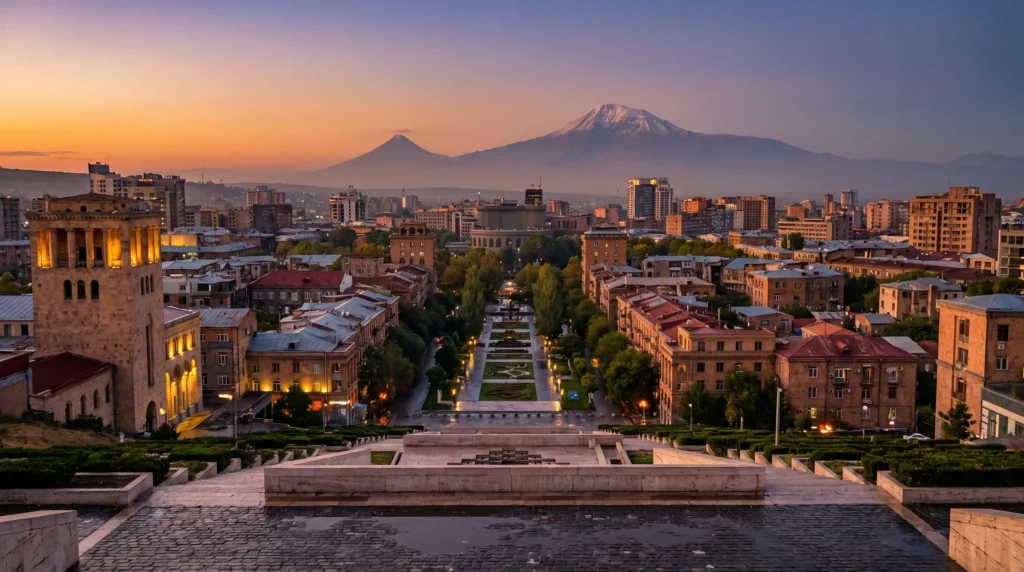
Yerevan is older than Rome, and it wants you to know it. This is a city that traces itself back to 782 BC, when King Argishti I of Urartu cut a cuneiform inscription into a fortress wall at Erebuni to mark its founding — and yet almost nothing you’ll actually walk past dates further back than the 1920s, because Soviet architect Alexander Tamanyan flattened the old town and rebuilt it as a radial city of pink and honey-colored volcanic tuff. The result is strange and lovely: wide neoclassical boulevards that feel more Vienna than post-Soviet, a giant stone Cascade staircase climbing toward the hills, and, on any clear morning, snow-capped Mount Ararat filling the entire southern horizon from a country that hasn’t owned it in a century. Add in some of the best-value food and natural wine in Eurasia, a metro that costs pennies, and a diaspora-fueled café culture that never really sleeps, and you get a capital that punches enormously above its size — Yerevan is home to over a third of Armenia’s entire population , and it feels like it.
In This Guide
- Overview — Why Yerevan Is Having a Moment
- Apricot Season & the Summer Festival Calendar
- Best Time to Visit Yerevan (Season by Season)
- Getting There — Zvartnots Airport & Open Borders
- Getting Around — Metro, Marshrutkas & Walkability
- Neighborhoods — Kentron, Kond & Beyond
- Culture & People
- A Food Lover’s Guide to Yerevan
- Off the Beaten Path
- Day Trips — Garni, Geghard & Lake Sevan
- Practical Information
- Budget Breakdown — What Yerevan Actually Costs in 2026
- Planning Your First Trip
- Frequently Asked Questions
Overview — Why Yerevan Is Having a Moment
Yerevan sits on the Hrazdan River at an elevation ranging from about 865 to 1,390 meters, which is part of why summer evenings cool off fast even after brutally hot afternoons. The city’s founding date — 782 BC, marked by King Argishti I’s Urartian fortress of Erebuni — technically makes it older than Rome, a fact every local guide will mention within the first ten minutes. But the Yerevan you’ll actually photograph is a 20th-century creation: after 1924, Armenian-Soviet architect Alexander Tamanyan redesigned the city as a series of concentric rings radiating from Republic Square, built almost entirely from pink and cream volcanic tuff quarried locally — which is why the city is nicknamed the “Pink City.”
The skyline gimmick that never gets old is Mount Ararat: Noah’s-Ark mountain, sacred to Armenians, sitting just across the closed border in Turkey and visible from most of the city on a clear day. Since the mid-2010s, Yerevan has also quietly become a serious food-and-wine destination — Armenia’s wine tradition is one of the world’s oldest, natural-wine bars have multiplied around Saryan Street, and a wave of diaspora-driven cafés and coworking spaces has given the city a genuinely international feel without the prices to match. It’s an easy, walkable, safe capital that rewards a few unhurried days rather than a rushed one.
Apricot Season & the Summer Festival Calendar
Time a visit around late June to August and you’ll hit Armenia’s apricot harvest — the fruit is such a point of national pride that its color name in several languages derives from Armenia, and stalls piled with fresh apricots and dried fruit take over Yerevan’s markets and the Vernissage flea market’s food corners. Wine lovers should aim for early October, when the annual Yerevan Wine Days festival takes over central streets with free tastings from dozens of Armenian wineries — a good excuse to pair the trip with the grape harvest happening simultaneously in wine regions like Areni to the south.
Independence Day (21 September) and Yerevan’s own city-founding celebrations (often marked in October, tied to the Erebuni anniversary) bring concerts and fireworks to Republic Square and around the Cascade. Whatever month you land in, check the calendar for one of these — Yerevan’s public squares come alive for festivals in a way that’s easy to stumble into and hard to plan around from abroad.
Best Time to Visit Yerevan (Season by Season)
Late April – June · Spring bloom
Mild days, green parks, the Cascade’s gardens in flower, and Ararat at its clearest before summer haze sets in. This is arguably the best all-round window, and prices haven’t hit peak yet.
July – August · Hot and dry
Yerevan’s continental climate means genuinely hot summers — locals escape to Dilijan or Lake Sevan on weekends, and you should plan museum mornings and terrace evenings around the midday heat. Apricot season and outdoor festival season, but also the priciest and busiest stretch.
September – October · Golden season
Many residents’ favorite: warm days, cool nights, the grape and wine harvest, and Yerevan Wine Days in early October. Book central hotels a few weeks ahead.
November – March · Winter
Cold, occasionally snowy, and the cheapest time to visit — museums and wine bars are just as good, Ararat often looks its sharpest against clear winter air, but day-trip roads to Tatev or Sevan can be affected by snow.
Getting There — Zvartnots Airport & Open Borders
Zvartnots International Airport (EVN) sits roughly 15 kilometers west of central Yerevan and is the country’s main gateway, with direct connections from Moscow, Dubai, Doha, Paris, Vienna, and a growing list of European and Middle Eastern cities as regional carriers add routes. A taxi into the center takes about 20–30 minutes depending on traffic; airport shuttle buses and ride-hailing apps (GG and Yandex Go both operate in Yerevan) are the cheaper options.
Armenia’s land borders are a mixed bag worth knowing before you plan a regional trip: the border with Georgia to the north is open and is the classic overland route (marshrutka or private transfer to Tbilisi takes roughly 5–6 hours), and the border with Iran to the south is also open. The borders with Turkey and Azerbaijan, however, remain closed. That means no overland arrival from Istanbul or Baku — flying or routing through Georgia is the only practical option from those directions.
Getting Around — Metro, Marshrutkas & Walkability
Central Yerevan is genuinely walkable — Republic Square, the Cascade, Opera Square, and the main shopping streets (Abovyan, Northern Avenue, Saryan) all sit within a 20–30-minute stroll of each other. For longer hops, the Yerevan Metro is a novelty in itself: a single line of 10 stations covering about 13.4 kilometers, opened in 1981 as the first metro in the Caucasus and still one of the cheapest rides in the world.
Marshrutkas (shared minibuses) and city buses cover routes the metro doesn’t, fares are paid in cash on board, and ride-hailing apps are cheap and reliable enough that most visitors default to them for anything outside the core. Taxis can also be flagged on the street but agree a price or confirm the meter first.
Neighborhoods — Kentron, Kond & Beyond
Kentron (City Center)
The heart of Tamanyan’s plan and where nearly every visitor bases themselves: Republic Square’s pink-tuff government buildings, the Cascade’s tiered staircase and modern-art terraces, Opera Square, and the pedestrian-friendly Northern Avenue connecting them. This is also where the best restaurants, wine bars, and boutique hotels cluster.
Kond
Yerevan’s oldest surviving residential neighborhood, a hillside tangle of narrow lanes and older houses that escaped Tamanyan’s bulldozers — genuinely atmospheric, increasingly documented by photographers before further redevelopment, and a striking contrast to the boulevards just below it.
Saryan Street & Northern Avenue
The modern nightlife and natural-wine corridor: a dense run of wine bars, cocktail spots, and design-forward cafés that has become the after-dark center of gravity for both locals and the city’s growing remote-work crowd.
Arabkir
A larger residential district north of the center, useful for cheaper long-stay apartments, everyday markets, and a more local, less touristed feel while still being a short metro or taxi ride from Kentron.
Nor Nork & the Eastern Districts
Soviet-era apartment-block neighborhoods that most visitors skip entirely — worth a look only if you’re curious about the city beyond its postcard center.
Tsitsernakaberd Hill
Technically a memorial park rather than a residential district, but it functions as its own destination: the Armenian Genocide memorial complex and museum sit on a hill overlooking the Hrazdan gorge, a solemn and essential stop rather than a photo-op.
Culture & People
Armenia’s population is roughly 3.1 million, and Yerevan alone accounts for well over a third of it — a level of primacy that shapes everything from politics to nightlife, since almost anything “national” in Armenia effectively happens here first. The Armenian diaspora, several times larger than the resident population and concentrated in Russia, the US, France, and the Middle East, means Yerevan’s cafés and businesses carry a genuinely international flavor — expect fluent Russian among older residents, and increasingly fluent English among the young, diaspora-returnee, and startup crowd.
Armenia was the first state to adopt Christianity as its official religion, and that history is felt everywhere: church bells, khachkars (carved cross-stones), and the Armenian Apostolic Church’s quiet, near-universal presence. The genocide of 1915 is a defining national memory, marked every 24 April at the Tsitsernakaberd memorial with a procession that draws much of the city — a good day to be respectful and unobtrusive with a camera. Hospitality runs deep and unhurried: a dinner invitation from a new acquaintance is common and rarely has strings attached.
A Food Lover’s Guide to Yerevan
Start with khorovats (Armenian barbecue) — pork, lamb, or chicken skewers grilled over wood coals, usually arriving with grilled tomatoes, peppers, and lavash. Khinkali-adjacent dumplings, dolma (grape-leaf or vegetable wraps), and khash (a hearty tripe soup traditionally eaten in winter with vodka) round out the meat-forward classics. Lavash — the thin, wood-fired flatbread central to Armenian meals — is UNESCO-recognized as Intangible Cultural Heritage, and you’ll see it baked fresh in tonir clay ovens across the city.
Armenia’s wine story predates almost every other wine region on Earth — archaeologists date the Areni-1 winery, in a cave south of Yerevan, to roughly 4100 BC, making it one of the oldest known wine-production sites in the world. That history has fed a genuine natural-wine renaissance concentrated on and around Saryan Street, where small producers pour indigenous varieties like Areni and Voskehat by the glass. Pair it with Armenian brandy (cognac), the country’s other great export, or with the ubiquitous street-side gata pastries and dried-fruit-and-nut lavash rolls sold at the Vernissage market and GUM food market.
Off the Beaten Path
Kond’s Back Lanes
Wander uphill from Mashtots Avenue into Kond without an agenda — it’s a working residential neighborhood, so keep it respectful, but it’s the clearest surviving window into pre-Soviet Yerevan.
GUM Food Market
Yerevan’s sprawling everyday food market, thick with dried fruit, spices, honey, and pickled vegetables sold by the kilo — far more local and far less staged than the Vernissage stalls aimed at tourists.
Cafesjian Center for the Arts (inside the Cascade)
Most visitors climb the Cascade’s outdoor terraces for the view and skip the museum built into it — a contemporary art collection with rotating exhibitions and a genuinely good sculpture garden on the way up.
Yerevan Brandy Company Tour
A tour and tasting at the historic Ararat brandy distillery, whose cellars reportedly once counted Winston Churchill among their fans — a quieter, indoor alternative to a hot afternoon outside.
Day Trips — Garni, Geghard & Lake Sevan
Armenia’s small size makes Yerevan an unusually good day-trip base. The classic combination pairs the pagan Garni Temple, a Hellenistic-style colonnaded temple about 26 kilometers from the city, with the cliff-carved Geghard Monastery roughly 40 kilometers out — a UNESCO World Heritage Site since 2000, with chapels cut directly into the surrounding rock face. Both can comfortably be done in half a day by taxi, shared marshrutka, or organized tour.
Khor Virap, a monastery about 43 kilometers south of the city, offers what’s probably Yerevan’s single best Mount Ararat photograph — the monastery sits almost at the closed Turkish border with the mountain looming directly behind it, and it’s also where Armenia’s patron saint, Gregory the Illuminator, was reportedly imprisoned before converting the Armenian king to Christianity.
Lake Sevan, one of the largest high-altitude lakes in the world, sits about 68 kilometers northeast and makes an easy full-day trip — the Sevanavank monastery peninsula, lakeside fish restaurants serving trout and crayfish, and beaches in summer. Further afield, Armenia’s other two UNESCO sites — the Cathedral and Churches of Echmiatsin, seat of the Armenian Apostolic Church, and the Monasteries of Haghpat and Sanahin in the northern Lori province — are both reachable on longer day trips or overnight detours, and Echmiatsin in particular is close enough (about 20 kilometers) to combine with an afternoon back in the city.
Practical Information
Money. The Armenian dram (AMD) floats freely and has traded in the mid-300s to the US dollar through 2026 — check the Central Bank of Armenia’s current rate before you go, since it does move. Cards are widely accepted in central Yerevan restaurants and hotels; carry cash for markets, marshrutkas, and smaller towns.
Safety. Yerevan itself is a relaxed, low-crime capital and petty street crime against tourists is uncommon. The real caution zone is regional: both the US State Department and the UK’s FCDO advise increased caution or avoidance near Armenia’s border with Azerbaijan and specific border-adjacent roads, due to periodic tension in the area — this has no practical bearing on a Yerevan city visit, but check current advisories before planning trips toward the eastern border regions.
Health. No special vaccines are required to enter, but routine vaccines plus Hepatitis A are recommended for most travelers, and Hepatitis B for longer or higher-risk stays; stick to bottled or filtered water outside good restaurants and hotels.
Connectivity. Local SIMs (Beeline, Ucom, VivaCell) are cheap and easy to buy at the airport or in the center; central Yerevan Wi-Fi is generally solid. Plugs: Type C and F, 230V/50Hz — bring a converter if you’re coming from a 110V country. Time zone: Armenia Time, UTC+4, no daylight saving.
Budget Breakdown — What Yerevan Actually Costs in 2026
Yerevan remains one of the best-value capitals in the wider region — noticeably cheaper than Tbilisi or Istanbul for comparable quality, especially on food and wine.
Budget (US$35–55/day): Hostel dorm or budget guesthouse in Kentron, khorovats or lavash-wrap lunches, metro and marshrutka transit, free walking tours and museum days.
Mid-range (US$80–150/day): Boutique hotel or serviced apartment, a couple of sit-down dinners with natural wine on Saryan Street, a half-day Garni-Geghard tour by shared taxi, occasional ride-hailing.
Upscale (US$250+/day): Design hotels near the Cascade, private guided day trips to Sevan or Tatev, tasting menus, and brandy-house private tours.
Tipping 10% is appreciated but not obligatory in restaurants; round up for taxis. Museum entry fees are modest — typically a few dollars — and often the single best value item in the whole trip.
Planning Your First Trip to Yerevan
Three full days covers the city core comfortably: a day for Kentron and the Cascade, a half-day for the Genocide Memorial at Tsitsernakaberd, and a day trip to Garni, Geghard, and Khor Virap. Five to seven days lets you add Lake Sevan and a slower pace through Kond and the wine bars. Many travelers pair Armenia with a loop through Georgia — Yerevan to Tbilisi is a straightforward overland hop across the open northern border — or continue the wider Caucasus-and-beyond circuit toward Turkey and Istanbul by air, since the direct land border stays closed.
Frequently Asked Questions
Is Yerevan safe for tourists in 2026?
Yes — Yerevan itself is a relaxed, walkable capital with low visible crime. The caution both the US State Department and UK FCDO flag is specific to areas near the Armenia–Azerbaijan border, not the city. Check current advisories if you’re planning to travel toward those border regions.
Do I need a visa?
US, UK, EU, and Canadian passport holders can enter visa-free for up to 180 days within a calendar year. Longer e-visa options exist if you need them, but most trips won’t require any advance paperwork.
Can I see Mount Ararat from Yerevan?
On a clear day, yes — it dominates the southern skyline from much of the city, even though it lies across the closed border in Turkey. Spring and clear winter days tend to offer the best visibility; summer haze can hide it for stretches.
How many days do I need in Yerevan?
Three days covers the city and one big day trip comfortably; five to seven lets you add Lake Sevan, a slower pace through the wine bars, and maybe a longer detour toward Tatev or the north.
Yerevan or Tbilisi?
They pair beautifully rather than compete — Tbilisi for a bigger, edgier nightlife scene and Old Town architecture, Yerevan for deeper antiquity, Mount Ararat views, and arguably the more interesting wine story. Most regional itineraries do both.
Is English widely spoken?
In central Yerevan’s hotels, restaurants, and with younger Armenians, yes, increasingly so. Russian remains more reliable with older residents and outside the center — a translation app is a sensible backup either way.
Ready to Explore Yerevan?
A capital older than Rome, rebuilt in pink stone, with Noah’s mountain on the horizon and some of the oldest wine on the planet poured a few streets away — Yerevan delivers an outsized trip for a small footprint and an even smaller budget. Go before the secret gets much further out.
Explore More
- Georgia Travel Guide — the Caucasus neighbor most travelers pair with Armenia
- Tbilisi City Guide — an easy overland hop across the open northern border
- Turkey Travel Guide — Ararat’s other side, reachable only by air from Armenia
- Istanbul City Guide — continue the region’s crossroads history further west
How this guide was built
Published as part of Facts From Upstairs’ city guide series. Built from authoritative sources — Wikipedia entity pages for Yerevan, Armenia, the Yerevan Metro, Armenia’s visa policy, and its UNESCO World Heritage list; UNESCO’s own listing for the Monastery of Geghard; the Central Bank of Armenia’s exchange-rate data; the US State Department and UK FCDO Armenia travel advisories; and the US CDC traveler page for Armenia. Numeric and checkable claims carry inline citations.
Sources cited on this page
- Wikipedia — Yerevan
- Wikipedia — Armenia
- Wikipedia — Visa policy of Armenia
- Wikipedia — Yerevan Metro
- Wikipedia — List of World Heritage Sites in Armenia
- UNESCO — Monastery of Geghard and the Upper Azat Valley
- Wikipedia — Zvartnots International Airport
- Central Bank of Armenia
- US State Department — Armenia Travel Advisory
- UK FCDO — Armenia travel advice
- US CDC — Armenia traveler page
More city guides you might like
Plan your trip to Yerevan
The booking tools we use ourselves. FFU may earn a commission at no extra cost to you.
Plan & book your trip to Yerevan
Booking through these searches supports our guides at no extra cost to you.