
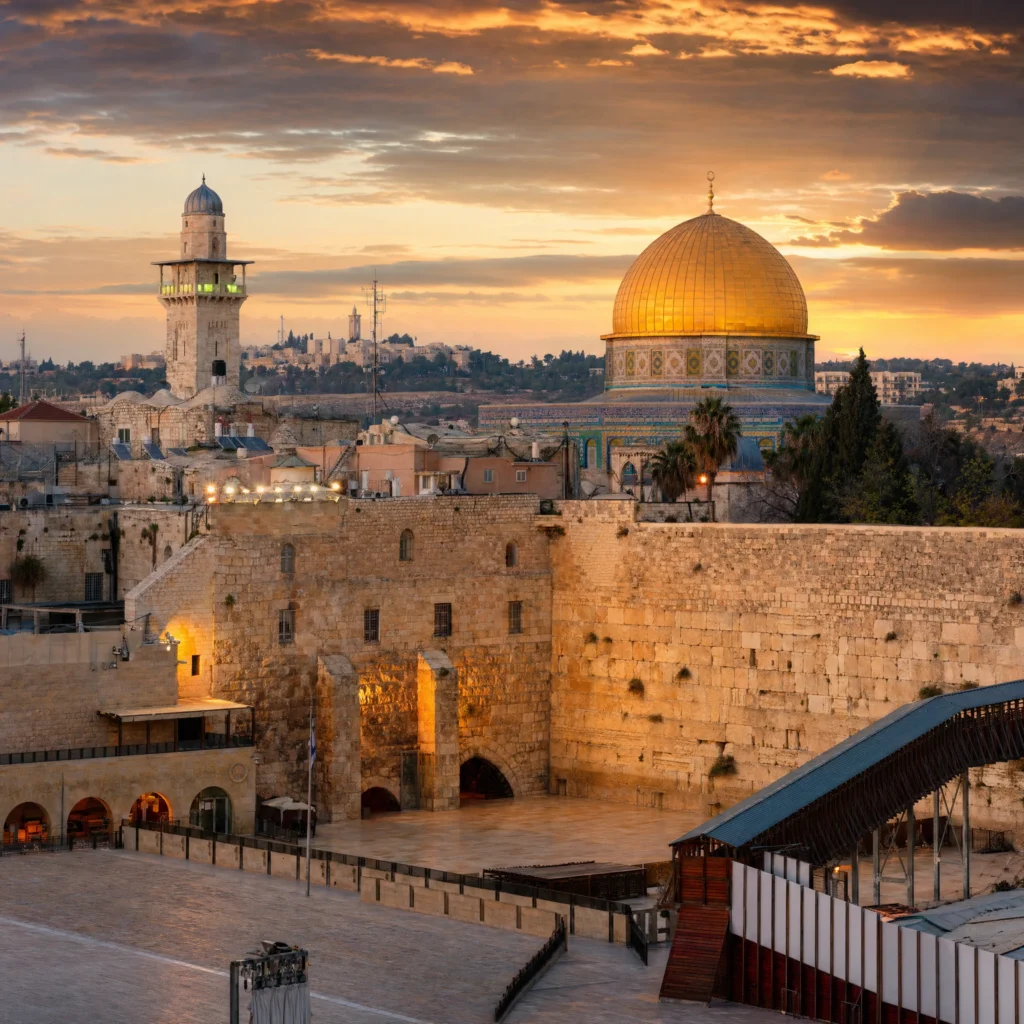
Jerusalem, Israel: Where Three Faiths Share One Walled City
Part of our Israel travel guide.
Jerusalem City Guide
📜 Table of Contents
Why Jerusalem?
Jerusalem is the largest city in Israel with roughly 975,000 residents at the end of 2024 and the only city on Earth where the holiest sites of Judaism, Christianity, and Islam sit within walking distance of one another, inside a single walled Old City that covers less than one square kilometre. That Old City has been a continuously inhabited sacred centre for more than 3,000 years, and its Ottoman-era walls, built by Sultan Suleiman the Magnificent in 1537–41, still ring four distinct quarters — Jewish, Christian, Muslim, and Armenian — each with its own language, liturgy, and street life.
The contrasts hit within metres. A Hasidic father in streimel and long coat passes a Franciscan friar in brown robes on the Via Dolorosa, while the muezzin’s call from Al-Aqsa floats over the Western Wall plaza where bar-mitzvah boys are celebrating with song. The Old City of Jerusalem and its Walls has been inscribed on the UNESCO World Heritage List since 1981 — listed on behalf of Jordan under the 1972 Convention — and has been on the World Heritage in Danger list since 1982. Outside the walls, West Jerusalem opens into Bauhaus-era garden suburbs, the spice-and-halva roar of Mahane Yehuda, and the quiet stone elegance of the German Colony; East Jerusalem unfolds north of Damascus Gate into Arabic-speaking cafés, historic hotels, and the Salah ad-Din Street commercial strip.
Jerusalem sits at 800 m elevation in the Judean Hills , which gives it dry, breezy summers and genuinely cold, occasionally snowy winters — a different climate from the Mediterranean coast just 60 km west. The city is also where three distinct calendars overlap: the Jewish lunar year that governs Shabbat and the pilgrim festivals; the Gregorian Western Christian year and its parallel Orthodox liturgical calendar running about two weeks behind; and the Muslim Hijri calendar that sets Ramadan and the two Eids. On any given week at least one of those calendars is shaping what’s open, what’s crowded, and what’s closed in a given quarter.
This guide covers the Old City’s four quarters with a licensed-guide-grade briefing on each, the best of Jerusalem’s food (from Abu Shukri’s hummus to the Mahane Yehuda night-market bar scene), the headline cultural sights (Western Wall, Church of the Holy Sepulchre, Dome of the Rock / Al-Aqsa, Yad Vashem, the Israel Museum, Tower of David, and the Mount of Olives), and the practical playbook for navigating Shabbat, security questioning, modest dress, Old City gate logistics, checkpoint awareness for West Bank day trips, and the rhythm of a city where three liturgical weeks overlap. Read on for neighborhoods, food, sights, entertainment, day trips, seasonal timing, transit, budget, practicalities, and the eight FAQs travellers most often bring with them to the gates.
🏛️ Neighborhoods: Finding Your Jerusalem
📍 Jerusalem Map: Every Place in This Guide
Old City (Jewish, Christian, Muslim, Armenian Quarters)
The 0.9-square-kilometre walled heart of Jerusalem is the densest concentration of sacred geography on Earth. Four quarters share the space inside Sultan Suleiman’s 1537–41 walls, and although the quarter names suggest clean boundaries the reality is a knot of overlapping alleys, shared water systems, and household-to-household neighbour relationships that predate most European capitals. The Jewish Quarter (south-east) contains the Western Wall plaza and the Cardo; the Christian Quarter (north-west) holds the Church of the Holy Sepulchre and the Latin Patriarchate; the Muslim Quarter (north and north-east) is the largest and most commercial, dominated by the Haram al-Sharif / Temple Mount platform; the Armenian Quarter (south-west) is the smallest and most closed, organised around the St. James Cathedral and its monastery.
- Western Wall plaza (Kotel) — 24-hour access, security check at entry
- Church of the Holy Sepulchre — 335 CE foundation, shared by six denominations
- Dome of the Rock and Al-Aqsa Mosque on the Temple Mount / Haram al-Sharif (restricted access for non-Muslims)
- Via Dolorosa — the 14 Stations of the Cross from Lions’ Gate to the Holy Sepulchre
- Cardo Maximus — excavated Roman-Byzantine colonnade beneath today’s Jewish Quarter
Best for: first-time visitors, pilgrims, history walkers. Access: Jaffa Gate (taxi drop-off and primary tourist gate), Damascus Gate (Muslim Quarter entry), Dung Gate (closest to the Kotel plaza); the City Hall / IR Ha’Ir light-rail stop is a 5-minute walk from Jaffa Gate.
Walking from one quarter to another takes ten minutes, but the audio and visual texture changes in thirty paces — a Hebrew-speaking Jewish Quarter rooftop opens onto an Armenian-language school courtyard, which in turn spills into a Muslim Quarter souq lane smelling of cardamom coffee and fresh taboun bread. Licensed guides are worth every shekel here on a first visit; the layers of biblical, Second Temple, Roman, Byzantine, early Islamic, Crusader, Mamluk, Ottoman, and British-Mandate history read as illegible stone without one.
Mamilla
The seam between West Jerusalem and the Old City: a polished open-air pedestrian mall of limestone facades, designer boutiques, and café terraces that links Jaffa Gate to King David Street. Mamilla was redeveloped in the 2000s on the site of a former commercial street that stood on the pre-1967 armistice line, and the architecture deliberately reuses salvaged Ottoman facades. This is where most five-star hotels cluster.
- Mamilla Mall (Alrov promenade) — open-air boutique shopping from Jaffa Gate
- King David Hotel — 1931 limestone landmark, prime-minister territory
- Mamilla Cemetery — medieval Muslim burial ground, currently partially redeveloped
- David Citadel Hotel — modern landmark with rooftop Old City views
Best for: upscale hotels, Old City proximity without staying inside the walls. Access: Jaffa Gate at the east end of the promenade; City Hall light-rail stop at the north-west end. Mamilla is also where most ambassadorial delegations, visiting heads of state, and conference-goers base themselves — the hotel corridor between the King David and the Waldorf has hosted presidents, prime ministers, and the occasional peace summit.
Nachlaot
A warren of 19th-century courtyard neighbourhoods west of the Old City, Nachlaot layers 50-plus small synagogues — one for every Jewish diaspora community that built a courtyard here in the 1870s–1900s — along narrow stone lanes shaded by laundry lines and bougainvillea. It’s Jerusalem’s slow bohemian quarter: musicians, artists, and Shabbat dinners that spill into courtyards.
- Ades Synagogue (1901) — the city’s great Aleppan-rite synagogue, famed for chazanut
- Gan Sacher park edge — the major West Jerusalem green lung
- Sefaradi and Yemenite small shuls along Bezalel Street
- Bezalel Fair — Friday-morning arts market on Bezalel Street
Best for: slow wandering, Shabbat atmosphere, low-key cafés and independent shops. Access: directly adjacent to Mahane Yehuda Market; Mahane Yehuda light-rail stop on Jaffa Street. Nachlaot also has some of Jerusalem’s best short-term apartment rentals, often in restored late-Ottoman courtyard houses with stone vaults and small sunlit porches — if you want to stay like a local for a week rather than like a tourist for a night, this is where to book.
German Colony (HaMoshava HaGermanit)
Tree-lined Emek Refaim Street is the spine of a genuinely European-feeling neighbourhood that was founded by the Templer religious movement from Württemberg in the 1870s. The Templer stone houses survived and were later re-inhabited; today the colony is Jerusalem’s café-brunch capital, with weekend pavement seating, boutique pastry shops, and the restored First Station cultural hub at its northern edge.
- Emek Refaim Street — the cafés, bakeries, and boutiques strip
- First Station (HaTachana HaRishona) — restored Ottoman railway station, now food-and-events hub
- Liberty Bell Park — family-friendly green space with a replica Liberty Bell
- Jerusalem Theatre — major concert and drama venue a short walk north
Best for: café culture, families, longer stays. Access: south-west of the Old City; 15 minutes by taxi, or the First Station is a 20-minute walk from Jaffa Gate along Hebron Road. The German Colony is the closest Jerusalem has to a neighbourhood where you can forget you’re in Jerusalem for an hour — stone terraces, jasmine hedges, a slow Saturday-brunch pace, and the occasional cello player at the First Station.
Mahane Yehuda Market Area
By day a kaleidoscopic fruit-spice-halva shuk where produce pyramids rise above eye level and stallholders call the same prices they’ve called for forty years; by night the same indoor-outdoor market flips into a packed bar-and-restaurant quarter with DJ decks set up inside hollowed-out stalls. The density of great casual food per square metre is unmatched in the country.
- Mahane Yehuda Market (The Shuk) — open 8:00 to late, closed Shabbat
- Agrippas Street hummus joints — Pinati, Ben Sira, Hatzot
- Casino de Paris — the shuk’s original and still best late bar
- Beer Bazaar Jerusalem — 100-plus Israeli craft beers
- Halva Kingdom — 100-metre halva counter inside the main alley
Best for: food travellers, nightlife, street photography. Access: Mahane Yehuda light-rail stop (Jaffa Street) is directly at the northern entrance. The shuk is one of the rare spots where Jerusalem’s Ashkenazi, Mizrahi, Sephardi, Ethiopian, Bukhari, Iraqi, Kurdish, Yemenite, and Arab culinary traditions sit within three metres of each other on the same alley — you can eat breakfast Kurdish, lunch Iraqi-Jewish, and dinner Palestinian-Israeli fusion without leaving the block.
Ein Kerem
A green valley village inside the municipal boundary, Ein Kerem is the traditional site of John the Baptist’s birthplace and an unexpectedly rural half-day escape from stone-clad Jerusalem. Churches and monasteries dot the hillsides, small stone restaurants spill into terraced gardens, and the Chagall windows at Hadassah Ein Kerem Hospital are a short detour.
- Church of the Visitation — commemorates Mary’s visit to Elizabeth
- Church of St. John BaHarim — traditional birthplace of John the Baptist
- Mary’s Spring — the village’s central fountain
- Hadassah Ein Kerem — Chagall stained-glass synagogue windows
Best for: Christian pilgrims, half-day escapes, rural atmosphere. Access: Egged bus 28 from the central bus station; 20-minute drive or taxi from the Old City. Several stone-walled restaurants above the village (Karma, Restobar) serve leisurely afternoon meals on terraces overlooking the valley, and the short hike down to Mary’s Spring and back is Jerusalem’s most feasible urban-rural afternoon in a single bus ride.
Mount Scopus
The northern ridge overlooking the Old City is crowned by Hebrew University’s original 1925 campus and offers the single best panoramic view in Jerusalem. You look south across the Kidron Valley to the Old City walls and the Dome of the Rock with the Judean desert unrolling beyond. It connects pedestrian-wise to the Mount of Olives to the south.
- Hebrew University Mount Scopus campus — Botanic Garden and Amphitheatre
- Mount Scopus Observation Point — the classic photo spot
- British War Cemetery (1927) — Commonwealth WWI graves
Best for: sunrise photos over the Old City, students, the Mount of Olives walking connection. Access: Egged bus lines 19 and 34 from central stations; taxi from the Old City is ~15 minutes.
Musrara
Historic late-Ottoman neighbourhood wedged on the old pre-1967 Green Line seam between West and East Jerusalem, Musrara has reinvented itself as an arts-school quarter. Photography students, documentary filmmakers, and small galleries now occupy the stone houses, and the Musrara School of Arts anchors a low-key creative ecosystem.
- Musrara School of Arts (Naggar School) — photography, new media, film
- Jerusalem Multimedia Festival — annual late-spring venues
- Tourjeman Post Museum on the Seam — divided-city-era military post
Best for: independent art, edgy architecture walks, social-history curiosity. Access: immediately north-west of Damascus Gate; 5-minute walk from the Old City.
East Jerusalem (Sheikh Jarrah, Salah ad-Din Street)
The Arabic-speaking neighbourhoods north of the Old City host the main East Jerusalem commercial strip, historic hotels, Palestinian cafés, and traditional souq-side bakeries where fresh ka’ak rings come out of the oven all morning. Sheikh Jarrah is the residential heart; Salah ad-Din Street is the shopping and banking spine. Review the current US State Department travel advisory before visiting.
- Salah ad-Din Street — the East Jerusalem main shopping street
- American Colony Hotel — 19th-century pasha’s mansion turned landmark hotel
- Rockefeller Archaeological Museum — 1938 mandate-era museum by Austen Harrison
- Azzahra Street cafés and Palestinian cuisine
Best for: context, East Jerusalem food, historical hotels. Access: Damascus Gate is the pedestrian gateway; East Jerusalem Arab Bus Cooperative runs from the Damascus Gate bus station. Note that the US State Department travel advisory (April 2026) flags parts of East Jerusalem for heightened caution at various times; situational awareness is recommended, particularly after nightfall and during periods of heightened regional tension. The American Colony Hotel has been a neutral-ground meeting place for journalists, diplomats, and writers for 125 years.
Rehavia
A leafy 1920s–1930s Bauhaus-and-stone garden suburb west of the centre, Rehavia was designed by Richard Kauffmann on European garden-city principles and is now the diplomatic-and-political quarter: the Prime Minister’s Residence on Balfour Street, the President’s Residence a short walk away, and quiet embassy-adjacent streets lined by jacaranda and cypress.
- Prime Minister’s Residence (Balfour Street)
- Gymnasia Rehavia — 1928 Hebrew high school, foundational West Jerusalem institution
- Liberty Bell Park edge — family-friendly green on the northern boundary
Best for: architecture walks, quiet boutique hotels, long strolls under trees. Access: adjacent to the city centre; bus lines 7, 18, and 32 or a 15-minute walk from Jaffa Street.
🍕 The Food
Hummus and Jerusalem Mixed Grill
Jerusalem’s hummus is its own school: dense, warm, served in wide shallow bowls with a swirl of tahini, a hand-crushed puddle of olive oil, a scatter of paprika and cumin, and fresh pita baked that morning. You eat it with your hands, scoop with raw onion or pickled chilli, and finish with a glass of mint tea. The better hummus counters are proudly mono-menu: you order by saying hummus
and adding with ful
(fava beans), with msabaha
(warm whole chickpeas in tahini), or meshulash
(all three together). Shops close when the day’s batch runs out — usually between 14:00 and 16:00 — which is why the line at Abu Shukri and Lina is queued by 11:00.
Across Agrippas Street in the shuk you meet Jerusalem’s signature meat dish, me’orav Yerushalmi — a sizzling iron-pan mixed grill of chicken hearts, chicken livers, spleen, and onion seasoned with baharat, cumin, turmeric, and black pepper, invented at Hatzot in the 1960s to use up the butcher’s offcuts and now found across the country. It is perfected within two blocks of where it was born. Ordered in pita for lunch or on a platter with fries, rice, and chopped salad for dinner, it’s one of those rare national-level dishes still anchored to the street on which it was invented.
- Lina Hummus — hummus Abu-Gosh-style, Christian Quarter institution (₪35, ~$9.40)
- Abu Shukri — hummus with msabaha and ful, inside the Muslim Quarter near the 5th Station (₪42, ~$11.30)
- Hatzot — definitive me’orav Yerushalmi in pita or platter, Agrippas Street (₪72, ~$19.35)
- Pinati — the city’s most-cited hummus (King George Street) (₪38, ~$10.20)
Shuk Street Food: Mahane Yehuda
Mahane Yehuda Market is the city’s stomach. The main covered alley (HaShuk Street) and the parallel open Iraqi Market share a century’s worth of food identities — Kurdish kubbeh soups, Iraqi slow-cooked stews, Bukhari rice pilafs, Georgian khachapuri, Palestinian ka’ak, and Moroccan-Jewish tagines. Weekday mornings see the produce in full cascade; afternoons are when the rugelach come out of the oven at Marzipan; evenings turn the lanes into a standing-room-only bar quarter. The shuk is also where Jerusalem’s next-generation chefs have chosen to open their restaurants: Machneyuda, HaSadna, and Morduch Sons sit on market-adjacent corners, and Thursday night is their busiest shift of the week.
Five practical habits will make your Mahane Yehuda meals much better. First, eat standing where the locals stand — at the Pereg spice counter, in the Iraqi Market courtyard, at the Marzipan window. Second, order coffee the way the vendor drinks it (botz, Turkish coffee grounds-in-cup, or a short espresso) rather than attempting a cappuccino at 14:00. Third, try the halva before you commit — Halva Kingdom cuts small tasting slivers from any of its 50 flavours. Fourth, check the kashrut sticker at the door if you keep kosher — most shuk stalls are kosher but not all, and the non-kosher ones are often the best late-night bars. Fifth, go back on a second night — one Mahane Yehuda dinner never maps the range; three do.
- Morduch — Kurdish kubbeh soups in beet, hamusta (chard-lemon), and red-tomato broth (₪62, ~$16.65)
- Azura — Sephardi slow-cooked stews in the Iraqi Market courtyard; sofrito, oxtail, stuffed vegetables (₪85, ~$22.85)
- Marzipan Bakery — chocolate rugelach sold warm by the kilo (₪60/kg, ~$16.10/kg)
- Machneyuda — chef-driven neo-Israeli at the market’s edge, dinner tasting (₪390, ~$104.80)
- Halva Kingdom — sesame-tahini candy slabs in 50+ flavours (₪120/kg, ~$32.25/kg)
Beyond Hummus and Mixed Grill
Jerusalem has its own dessert and snack canon that doesn’t make it onto country-level lists. Many of these are Old City Muslim Quarter specialties you won’t find elsewhere in Israel, which makes a slow morning walk along Khan el-Zeit Street (the main Muslim Quarter north-south spine) a food-walk in its own right. Others are diaspora-Jewish specialties that survived into the Jerusalem kitchen because one Kurdish, Iraqi, Yemenite, or Bukhari family kept making them for seventy years in a corner shop on Agrippas Street.
- Sfinj / Zalabia — fried dough rings sold warm at the Damascus Gate side of the Muslim Quarter (₪10, ~$2.70 each)
- Kanafeh Nabulseyeh — shredded-phyllo-and-cheese pastry with rose syrup; the Muslim Quarter’s finest (₪40, ~$10.75)
- Jerusalem bagel (ka’ak al-Quds) — elongated sesame ring served with za’atar from Damascus Gate carts (₪10, ~$2.70)
- Malabi — rose-water milk pudding with pistachio, sold chilled in cups (₪15, ~$4.00)
- Kubbeh soups — semolina or bulgur dumplings in beet, okra, or hamusta broth (₪55, ~$14.80)
- Jachnun and malawach — Yemenite Jewish pastries served Shabbat morning with grated tomato and skhug (₪45, ~$12.10)
- Sabich — Iraqi-Jewish pita stuffed with fried aubergine, egg, amba, tahini (₪32, ~$8.60)
Meat-free travellers do remarkably well in Jerusalem — much of the hummus / falafel / sabich / kubbeh canon is naturally vegetarian, and the city has one of the highest concentrations of certified-vegan restaurants in Israel. Vegan specifically is easier in West Jerusalem (Nachlaot, Mahane Yehuda, German Colony) than in East Jerusalem or the Old City Muslim Quarter, where dairy and small amounts of lamb are baked into many defaults.
Food Experiences You Can’t Miss
If you only do five food things in Jerusalem, do these — each is a different register, and each is hard to replicate anywhere else in the country.
- Take a licensed guided food tour of Mahane Yehuda (Shuk Bites, Machane Yehuda Bites, or Abraham Tours culinary walks) — about ₪280 (~$75) per person for a 2.5-hour 10-stop tasting.
- Drink Palestinian Arabic coffee with cardamom at a Muslim Quarter café right off Khan el-Zeit Street — order qahwa sada (unsweetened) or helweh (sweet); pair with a Jerusalem bagel and za’atar.
- Eat a full Arab-Jerusalem breakfast at Azzahra or the American Colony Hotel with ful, hummus, labneh, olives, fried halloumi, and fresh-baked taboun bread — expect to leave at 11:00.
- Order Friday-night dinner at a Mahane Yehuda restaurant that serves chamin (Sephardi slow-cooked stew) or cholent (Ashkenazi version) — Morduch, Sima, and Machneyuda all run Shabbat-dinner bookings that fill 10 days ahead.
- Stop at the original Marzipan Bakery before 9:00 on Friday for still-warm rugelach before the line reaches the market’s outer ring — go for the chocolate and the cinnamon, skip the fruit.
- Do a Christian Quarter breakfast walk: Austrian Hospice rooftop for a Viennese coffee and apple strudel with Old City rooftop views, then Lina Hummus at 10:30 when the first batch lands, then an Arabic coffee at the Muslim Quarter spice market — three quarters, three flavour registers, 90 minutes.
- If you’re in Jerusalem for Ramadan, wander the Muslim Quarter after iftar (sunset): Damascus Gate floods with families breaking fast, qatayef pancake vendors fire up on the hour, and the post-iftar sweets markets run until 02:00 for the late-night taraweeh prayer crowd.
Jerusalem Bakery Culture
Jerusalem’s bakeries deserve a subsection of their own. The city has three overlapping bread traditions: the Ashkenazi challah baked fresh for Friday afternoon (Bread Story, Lehem Meurav, or any Nachlaot corner shop); the Sephardi and Bukhari challot variants with sesame and poppy; and the Palestinian taboun and ka’ak baked in stone ovens in the Muslim Quarter and East Jerusalem. The Damascus Gate side of the Muslim Quarter is where you’ll find the best ka’ak al-Quds — Jerusalem’s long sesame bagel, baked in batches of thirty on wooden peels and sold warm from handcarts with a twist of za’atar. A single ring costs ₪10 (~$2.70) and will keep you fed for two hours of walking.
For Friday lunch, the city bakes its Shabbat-feast items all at once: cholent or chamin (slow-cooked bean-and-meat stews), jachnun and malawach (Yemenite pastries), kubbeh dumplings, and trays of burekas. If you want to understand how Jerusalem actually eats on a Saturday, build a Friday-morning shuk basket of burekas, hummus, halva, rugelach, cucumbers, and olives and take it back to your hotel terrace or park bench. It’s exactly the meal every third apartment in Nachlaot is assembling at the same moment.
Where to Drink in Jerusalem
Jerusalem is not primarily a drinking city, but it has serious small pockets. The Mahane Yehuda night-market bar scene is the headliner — Casino de Paris, Birman (live jazz), Beer Bazaar (100+ Israeli craft beers, rotating taps), and half a dozen unmarked hole-in-the-wall cocktail counters inside former produce stalls. Wine: the Judean Hills region has had a dramatic two-decade renaissance and several boutique wineries run tastings within 30 minutes of the city (Domaine du Castel, Tzora, Flam, Sphera). For Jerusalem-brewed beer, Herzl Beer and Shapiro Beer both have taprooms and regularly appear on shuk taps. For non-alcoholic options, the Palestinian Arabic coffee counters along Khan el-Zeit Street and the pomegranate-juice carts around Damascus Gate are as essential to Jerusalem’s drinking culture as any bar.
Where to Eat on Shabbat
A reasonable Shabbat-eating plan changes the shape of a Jerusalem trip. For Friday-night dinner, the best options are (1) a hotel Shabbat dinner with a pre-booked menu (many 4-5★ hotels do this beautifully, ₪250–400 / $67–108 per person); (2) a pre-reserved seat at a chef restaurant running a Friday-night set menu (Machneyuda, Adom, HaSadna); or (3) an Airbnb-hosted Shabbat dinner with a local family (Abraham Hostel arranges these from ₪160 / $43 per person). For Saturday lunch, the Old City Christian Quarter (Lina Hummus, the Armenian Tavern, Notre Dame de Jerusalem rooftop) and East Jerusalem (Azzahra, American Colony Summer Bar, Askadinya) are open and welcoming. By sunset Saturday, Mahane Yehuda reopens and every shuk restaurant does a big end-of-Shabbat rush.
👜 Cultural Sights
Western Wall (Kotel HaMa’aravi)
A 488-metre-long surviving retaining wall from the Second Temple complex (expanded by Herod around 19 BCE), the Western Wall is the holiest site where Jews are permitted to pray. The plaza is divided into men’s and women’s sections; prayer notes (kvitlach) are tucked between the massive Herodian ashlars, some of which weigh over 500 tonnes. Modest dress is required and men are offered paper kippot at the entry. The Western Wall Tunnels, which run along the full length of the original Herodian wall behind the plaza, are accessible by guided tour only (book 48 hours ahead, ₪40 / ~$10.75). Founded in its current form during the Herodian expansion c. 19 BCE. Admission free. Open 24 hours, every day of the year (security check at all plaza entries).
Church of the Holy Sepulchre
The traditional site of Jesus’ crucifixion, burial, and resurrection, shared by six denominations (Greek Orthodox, Latin Franciscan, Armenian, Coptic, Ethiopian, and Syriac) under the 1852 Status Quo. The keys have been held by two Muslim families since 1187 — a practical solution to the need for a neutral keyholder. The Edicule over the tomb was last restored in 2016–17 after a Greek-led international conservation project. Inside, highlights include the Stone of Anointing at the entrance, the Rotunda around the Edicule, Golgotha (the crucifixion site) up a narrow staircase to the right, and the Ethiopian monks’ rooftop chapel accessible via the Coptic stairs. Look for the famous Immovable Ladder on the exterior facade above the main entrance. First church 335 CE under Constantine; current Crusader-era structure dates to 1149 CE. Admission free. Daily 04:00–19:00 (winter); the dawn opening ceremony is a daily highlight worth setting an alarm for.
Temple Mount / Haram al-Sharif — Dome of the Rock and Al-Aqsa Mosque
The 14-hectare walled platform is Islam’s third-holiest site and Judaism’s holiest site. The gold-domed Dome of the Rock (completed 691 CE) enshrines the Foundation Stone; Al-Aqsa Mosque at the southern end is one of the earliest standing monuments of Islamic architecture, rebuilt in 1035 CE. Non-Muslim visitors may enter the plaza only during restricted windows (typically Sun–Thu 07:30–10:30 and 12:30–13:30) via the Mughrabi Bridge from the Western Wall plaza. Non-Muslim visitors may NOT enter the Dome of the Rock or the mosque, and non-Muslim prayer is not permitted under the long-standing Status Quo. Access can close at short notice during periods of tension — check that morning. Admission free when the plaza is open.
Yad Vashem — World Holocaust Remembrance Center
Israel’s national Holocaust memorial complex on Mount Herzl: the Moshe Safdie-designed Holocaust History Museum (opened 2005), the Hall of Names, the Children’s Memorial designed by Safdie as well, the Avenue of the Righteous Among the Nations, and extensive research archives. Not suitable for very young children; allow 3–4 hours. Established 1953 by Knesset law. Admission free (donations welcomed). Sun–Wed 09:00–17:00, Thu 09:00–20:00, Fri 09:00–14:00; closed Saturday and all Jewish holidays.
Israel Museum
The country’s flagship encyclopaedic museum spans archaeology, Judaica, Israeli and international fine art, and is home to the Shrine of the Book (the Dead Sea Scrolls) and the 1:50-scale model of Jerusalem in the Second Temple period. The archaeology wing is one of the most substantial in the Middle East. Founded 1965. Admission adult ₪54 (~$14.50). Open Sun–Mon and Wed–Thu 10:00–17:00, Tue 16:00–21:00, Fri 10:00–14:00, Sat 10:00–17:00.
Tower of David Museum
Set inside the medieval Citadel at Jaffa Gate, the museum narrates 4,000 years of Jerusalem history across a restored Mamluk-and-Crusader fortress whose stone layers span Hasmonean, Herodian, Byzantine, Mamluk, and Ottoman periods. The nightly Night Spectacular projection show maps the city’s history across the inner walls. Museum founded 1989 (the citadel itself is 2,000+ years old). Admission adult ₪60 (~$16.10); Night Spectacular ₪55 (~$14.80). Open Sun–Thu 09:00–16:00, Fri 09:00–14:00, Sat 10:00–17:00.
Mount of Olives
The eastern ridge facing the Old City across the Kidron Valley: the Jewish cemetery (the oldest continuously-used Jewish cemetery in the world, with graves from biblical antiquity), the Garden of Gethsemane and Church of All Nations, the Chapel of the Ascension, and the classic postcard view of the Temple Mount from the Seven Arches Hotel terrace. The conventional walk is downhill from the Seven Arches viewpoint through the cemetery to the Garden of Gethsemane and into the Old City via Lions’ Gate, a 90-minute descent with seven major churches along the route. Continuously used as a Jewish cemetery from the biblical period. Admission free (individual churches free or small donation). Best during daylight hours; most churches open 08:00–12:00 and 14:00–17:00.
Garden Tomb and City of David
Two additional sights round out a first-visit cultural itinerary. The Garden Tomb just outside Damascus Gate is an alternative Protestant site for Jesus’ burial, with a quiet garden setting and strong guided interpretation (free, donations welcomed, Sun–Thu 08:30–12:00 and 14:00–17:00). The City of David archaeological park south of the Old City walls lets you walk through Hezekiah’s 8th-century-BCE water tunnel and see the excavated pre-Israelite Jebusite city (adult ₪42, ~$11.30; tunnel shoes required). Both are a 15-minute walk from Jaffa Gate.
🎭 Entertainment
Tower of David Night Spectacular
The 45-minute projection show maps Jerusalem’s 4,000 years of history across the inner walls of the Citadel at Jaffa Gate. It runs in multiple languages (Hebrew, English, French, Spanish, Russian) and the summer 21:00 slot puts you inside stone walls under a Judean-hill sky. Typical cost ₪55 (~$14.80). Book online 48 hours ahead — seats are limited and summer slots frequently sell out two days before showtime.
Mahane Yehuda After Dark
When the produce stalls close around 19:00, the shuk’s inner lanes flip into a packed bar quarter: Casino de Paris with its graffiti-lined courtyard, Birman (jazz and live music), Beer Bazaar for 100+ Israeli craft beers on rotating tap, and a dozen smaller holes-in-the-wall with DJs inside former vegetable stalls. Typical cost no cover; beers ₪30–40 (~$8–11), cocktails ₪55–65 (~$14.80–$17.45). Thursday is local night, Friday winds down by 16:00 for Shabbat, Saturday night re-opens big around 21:00.
Jerusalem Cinematheque and Film Festival
Hillside art-house cinema in the Hinnom Valley with three screens, a riverside terrace, and a year-round programme that leans international auteur plus Israeli indie. The annual Jerusalem Film Festival in July is the city’s biggest cultural week. Typical cost ₪45 (~$12.10) per film; festival day-pass ₪180 (~$48). The festival passes sell out — book from May.
Sacred Music Festival
September brings multi-faith concerts across the Old City and Tower of David courtyard: Sufi Qawwali, Gregorian chant, Hasidic niggunim, Ethiopian Orthodox liturgy, and classical Persian all in the same week. It’s one of the few cultural programmes that deliberately bridges Jerusalem’s three religious communities. Typical cost ₪90–180 (~$24–$48) per concert; free opening and closing events each year.
First Station
The restored 1892 Ottoman-era railway station at the edge of the German Colony is now a pedestrian food-and-events hub with weekend markets, outdoor film nights, a Friday-morning farmers’ market, and a constant rotation of family-friendly programming. Typical cost free entry; food stalls ₪30–80 (~$8–$22). Great spot for families; closes for Shabbat around 15:00 Friday and reopens Saturday night.
Jerusalem Theatre and Khan Theatre
The Jerusalem Theatre (Sherover complex) hosts the Israel Philharmonic’s Jerusalem concerts, international touring productions, and a major opera and dance season; the historic Khan Theatre near the railway station programmes Hebrew-language drama in a 19th-century Ottoman caravanserai. Typical cost ₪120–300 (~$32–$80). The Jerusalem Theatre often has English surtitles on opera and visiting-production nights; verify when booking.
Ramparts Walk
Walking the top of Suleiman’s 16th-century walls is one of the best-value experiences in Jerusalem and is rarely crowded. The northern route (Jaffa Gate to Lions’ Gate via the Muslim Quarter rooftops) is the more atmospheric; the southern route runs via Zion Gate and the Armenian Quarter. Typical cost adult ₪25 (~$6.70), two-day ticket ₪40 (~$10.75). Go early in summer — the ramparts offer zero shade and afternoon heat reaches 30 °C.
Bars, Wine Tastings, and Live Music
Jerusalem’s small-format live-music scene punches above its weight. Yellow Submarine in Talpiot is the city’s main rock-and-indie venue with 3–4 shows a week (₪70–140, ~$18.80–$37.65). Beit Avi Chai near Ben Yehuda Street hosts chamber concerts and Hebrew-language spoken word. For wine, the Judean Hills winery route (Domaine du Castel, Tzora, Flam, Sphera) is within 30 minutes of the city ; most run tastings by appointment for ₪120–180 (~$32–$48) per person. In the shuk, Talbiyeh-area wine bars (Adom, Notre Dame of Jerusalem rooftop) pair well with an Old City evening.
Night Walks and Sound Tours
A licensed-guide night walk through the Old City between 19:00 and 22:00 is one of the quietest and most atmospheric experiences in Jerusalem. The Ramparts Walk is closed after dark, but the four quarters remain open and almost empty of tourists; a small-group night walk (Abraham Tours, Sandemans Night, or a private licensed guide) runs ₪80–180 (~$22–$48) per person and typically circles from Jaffa Gate via the Armenian and Jewish Quarters to the Kotel plaza and back via the Muslim Quarter.
Cinema and Culture Clubs
Beyond the Cinematheque, the Smadar Theatre in the German Colony is Jerusalem’s oldest (1928) cinema and still runs nightly screenings with an indie bent (₪45, ~$12.10). The Confederation House near the Old City walls programmes world music and Hebrew-language recitals, and the YMCA on King David Street doubles as a historic concert venue with the occasional Friday-afternoon organ recital in its 1933 chapel (free entry; come early, it fills). Hansen House in Talbiyeh is a former leprosarium now converted into a design-and-technology culture hub with rotating exhibitions, a rooftop bar, and a calendar of electronic music nights and literary evenings that rarely appears in English-language guidebooks.
🛫️ Day Trips
Dead Sea — Ein Gedi and Ein Bokek (90 minutes by Egged bus 486)
Descend 1,200 m in altitude to float in the saltiest natural water body on Earth (~34% salinity at the surface, nearly ten times that of the ocean). The Dead Sea sits at approximately 430 m below sea level — the lowest land point on the planet — and continues to drop by about 1 m per year. Combine Ein Gedi Nature Reserve (David Waterfall, freshwater springs, ibex herds, two marked hikes of 1 and 3 hours) with a public-beach float at Ein Bokek hotel strip or Mineral Beach. Bring flip-flops — the shore is sharp mineral crystal that slices bare feet — and keep water out of your eyes; the salt sting is immediate. The road from Jerusalem (Highway 1 east then Route 90 south along the shore) is desert-hot even in spring; leave Jerusalem by 07:30 in summer to hike Ein Gedi before 11:00, when trail officers start closing routes for heat. Most hotels at Ein Bokek allow day-use of their beach and pool for a ₪80–150 (~$22–$40) fee.
Bethlehem (45 minutes by taxi + Arab-bus 231)
The Church of the Nativity (UNESCO-listed 2012) is 10 km south of Jerusalem across the Bethlehem 300 checkpoint. Bethlehem is administered by the Palestinian Authority — passport required at the checkpoint, and your Israeli rental car will not cross (most rental-company policies forbid it). Christmas Eve midnight Mass at the Nativity is the year’s peak pilgrimage moment; the nearby Shepherds’ Fields and Milk Grotto complete the half-day. Check the current US State Department West Bank travel advisory the week of your visit; hire a licensed bilingual driver-guide if you’re uncertain about independent travel. Friday closures apply at some sites.
Masada and the southern Dead Sea (2 hours by rental car on Route 90)
Herod the Great’s desert fortress (UNESCO-inscribed 2001) sits 400 m above the Dead Sea’s western shore, a flat-topped mesa accessible via the Snake Path (open from 04:30 in summer) or the cable car from 08:00. The mountain-top ruins include Herod’s three-tiered northern palace and the Jewish rebel ritual baths from the First Revolt. Pair with an afternoon at Ein Gedi Nature Reserve on the return. Carry 3 L of water per person and start the Snake Path before 05:30 — Israel Nature and Parks Authority closes the trail from 10:00 on hot days.
Tel Aviv (32 minutes by Israel Railways high-speed line from Yitzhak Navon)
The fast rail link (opened 2018) runs every 30 minutes between Jerusalem’s Yitzhak Navon station and Tel Aviv HaHagana / Savidor Merkaz. Swap stone for Bauhaus, beach, and nightlife: the Carmel Market, Jaffa (Yafo) Old City, Rothschild Boulevard, Neve Tzedek, and 14 km of Mediterranean promenade. Return by 23:00 on weekdays; last trains leave Tel Aviv around 23:30 except Friday afternoons. No rail Friday afternoon to Saturday evening — plan your return carefully around that. Load a Rav-Kav card at TLV airport, Navon station, or any Jerusalem Light Rail machine before departure — the same card works on Tel Aviv buses, light rail, and regional buses. Day-tickets for Jerusalem + Tel Aviv combined transport are available.
Ramallah (60 minutes by Arab bus 218 from East Jerusalem via Qalandia)
The de-facto Palestinian Authority capital is a lively café culture around Al-Manara Square, with the Yasser Arafat Museum and the Mahmoud Darwish Museum (built on a hilltop overlooking the central West Bank hills) as the two main cultural anchors. Passport required at Qalandia checkpoint; the Arab bus departs from the Damascus Gate area. This is a West Bank Area A city. Review the current US State Department West Bank travel advisory before planning; Israeli rental cars are not permitted across the checkpoint.
🌞 Seasonal Guide
Spring (March – May)
Spring is the most demanded window of the year in Jerusalem. Temperatures sit at 10–22 °C with blooming almond and Judas trees across the Judean Hills. Passover (Pesach) runs sunset 1 April to sunset 9 April 2026 — the biggest domestic travel peak of the year; hotels lift prices 40–60% and book out 60 days ahead. Christian Holy Week follows: Palm Sunday 29 March 2026, Good Friday 3 April, Easter Sunday 5 April; Orthodox Easter falls on 12 April. The Good Friday procession along the Via Dolorosa is one of the year’s most intense Old City moments. Expect Old City alleys to be shoulder-to-shoulder on Holy Week afternoons and early Passover evenings; book everything — hotels, licensed guides, chef-restaurant Shabbat dinners — ten weeks out.
Summer (June – August)
Jerusalem sits at 800 m elevation , which keeps summer dry and breezy: 18–30 °C, often 5–8 °C cooler than Tel Aviv’s humid coast. The Jerusalem Film Festival takes over the Cinematheque in mid-July; the Israel Festival (late May – early June) brings touring theatre and dance; the Ramparts Walks extend to 21:00. Pilgrimage crowds thin after Easter, Israeli families and summer camps take over the parks and First Station, and hotel rates sit mid-to-high. This is the most comfortable season for walking the Old City.
Autumn (September – November)
Temperatures ease to 15–27 °C and the High Holy Days reshape the calendar. Rosh Hashanah falls 12–14 September 2026, Yom Kippur 23 September (a remarkable 25 hours of near-total city silence — no public transit, no flights into Ben Gurion, bikes and pedestrians on empty highways), and Sukkot 27 September to 3 October (booths on hotel balconies, outdoor dining everywhere). Sukkot is the second-highest domestic-demand peak after Passover — book 6–8 weeks ahead.
Winter (December – February)
Jerusalem winters are genuinely cold and wet at 800 m : 6–12 °C, steady rain, occasional light snowfall every 2–3 years (when it does snow, the city shuts down completely and the Old City walls under a dusting of snow become the year’s most-photographed scene). Hanukkah runs 4–12 December 2026 with nightly candle-lighting in the courtyards of Nachlaot — the walking tour of illuminated courtyard menorahs is one of the city’s quiet winter highlights. Christmas Eve midnight Mass at Bethlehem’s Church of the Nativity remains the headline Christian event (West Bank — review the current US State Department travel advisory). Orthodox Christmas falls 7 January. This is the quietest domestic-demand season except for Christmas week; pack a warm waterproof layer and expect some shorter site hours.
🚊 Getting Around
Jerusalem Light Rail (Red, Green, Blue lines)
Operated by CityPass, the Red Line runs from Mount Herzl through the city centre (Jaffa Street and Damascus Gate) to Heil HaAvir in the north-east; the Green and Blue lines were progressively extended in 2023–25 to connect Gilo, Malha, Hebrew University Givat Ram, and Ramot. A single ride is ₪8.50 (~$2.30) on the Rav-Kav card, with free transfers to buses for 90 minutes. Trains run 05:30–23:30 on weekdays; service stops about 90 minutes before Shabbat on Friday afternoon and resumes about an hour after Shabbat ends Saturday night. Stops along Jaffa Street (Jaffa Centre, City Hall, Damascus Gate, Mahane Yehuda) put almost every tourist location within a 10-minute walk.
Egged Buses and the East Jerusalem Arab Bus Cooperative
Egged is the main bus operator in West Jerusalem with hundreds of routes radiating from the Central Bus Station on Jaffa Street. The East Jerusalem Arab Bus Cooperative (also known as the Palestinian Bus) runs from the Damascus Gate bus station to East Jerusalem neighbourhoods, Bethlehem, Jericho, and Ramallah — it’s how you reach most West Bank day-trip destinations. Single fare ₪8.50 (~$2.30) on Rav-Kav (or cash to the driver on the East Jerusalem network). Egged buses do not run on Shabbat; East Jerusalem Arab buses generally continue to run.
Rav-Kav Card
Israel’s national stored-value transit card — buy at Ben Gurion airport, Yitzhak Navon station, or any Jerusalem Light Rail ticket machine for a ₪5 deposit. Load with stored value or a daily / weekly Jerusalem pass (daily ₪13.50, ~$3.65). A single card works across Jerusalem Light Rail, Egged buses, Israel Railways, Tel Aviv Light Rail, and most regional buses nationwide. Personal Rav-Kav photo cards unlock senior / student discounts.
Airport Access
- Israel Railways from Yitzhak Navon station direct to Ben Gurion Airport (TLV) — 25 minutes, ₪22.50 / ~$6.05 one-way
- Nesher 10-passenger sherut taxi, door-to-door from your hotel — 45–75 minutes, ₪80 / ~$21.50 per person
- Private taxi or Gett app — 45 minutes, ₪320–400 / ~$86–$108
Taxis
Flag-fall ₪12.80 (~$3.45) day, ₪15 (~$4.00) night. Always ask for the meter (moneh) or book through the Gett app, which locks the fare up front and is the default Israeli taxi app. Cash or card both accepted; tipping is not required but rounding up is polite. Taxis are among the few forms of transport that continue to operate throughout Shabbat in West Jerusalem.
Navigation Tips
Apps: Moovit (founded in Israel, the most reliable real-time bus and light-rail ETA tool with walking routes that include turn-by-turn inside the Old City), Google Maps (walking and driving, imperfect inside stone-roofed alleys), Gett (taxis and ride-sharing). For the Old City, carry a paper map and download an offline layer — GPS often fails under stone arches and in the covered souq alleys, and street-sign coverage is uneven in the Muslim Quarter. Most guides recommend orienting by the four main gates (Jaffa, Damascus, Dung, Lions’) rather than by cardinal directions; every alley in the Old City eventually connects back to one of the four.
Walking and Cycling
Jerusalem is a walking city, but it is a hilly one — from the Old City walls up to the Mamilla Mall involves a 20-metre elevation change, and from the Kotel plaza down to the Garden of Gethsemane drops 80 metres. Comfortable grippy walking shoes matter more than trail shoes — the Old City streets are polished limestone and slick in rain. For cycling, the Jerusalem Ring Trail around the city walls is gentle and scenic; rentals from First Station cost ₪60 (~$16.10) for a half-day.
💰 Budget Breakdown: Making Your Shekels Count
| Tier | Daily | Sleep | Eat | Transport | Activities | Extras |
|---|---|---|---|---|---|---|
| Budget | $60–90 | Abraham Hostel dorm ₪140 (~$38) | Falafel & sabich pita ₪25 (~$6.70), shuk picnic | Rav-Kav day pass ₪13.50 (~$3.65) | Free: Kotel, Holy Sepulchre; Ramparts ₪25 (~$6.70) | Coffee & snacks $5–8 |
| Mid-Range | $160–260 | 3-4★ German Colony or Mamilla ₪700 (~$188) | Hummusiya ₪65 (~$17.45) + dinner ₪140 (~$37.65) | Light rail + occasional Gett ₪70 (~$18.80) | Israel Museum + Tower of David ₪100 (~$26.90) | Beer ₪35 (~$9.40), market shopping |
| Luxury | $450+ | King David, Waldorf, or Mamilla ₪2,400+ (~$645+) | Chef menus (Machneyuda, HaSadna) ₪500+ (~$134+) pp | Private driver-guide ₪1,200+ (~$322+) per day | Licensed Old City guide ₪900 (~$242) half-day | Spa, tasting menus, wine pairings |
Where Your Money Goes
Jerusalem is noticeably cheaper than Tel Aviv for sleep and eat (hotel rates run 20–30% lower for comparable quality, and shuk meals are meaningfully cheaper than Tel Aviv’s equivalent), but activities and licensed guides cost the same across the country. The three biggest levers on a Jerusalem budget are: whether you eat in Mahane Yehuda (₪60–100, ~$16–$27 per meal) or at chef-restaurant price points (₪300+, ~$80+ per meal); whether you sleep inside the Old City or Mamilla (premium 25–40% markup for the walled-city address) or in Nachlaot / Rehavia / German Colony (15–30% less for equivalent quality); and whether you hire a licensed guide for the Old City (highly recommended on a first visit — the four quarters’ layered 4,000-year history is genuinely hard to read from signage alone). A fourth lever matters on a first visit: a half-day Bethlehem trip with a licensed bilingual driver-guide will add ₪1,400 (~$375) to your budget but is worth every shekel for the context and the checkpoint logistics alone.
Seasonal pricing adds a 40–60% surge during Passover, Sukkot, and Christmas week; shoulder-season travel (late May, early June, November, mid-January) delivers the best value-for-money without compromising on what’s open. Currency and payments: all prices on this page are in New Israeli Shekels with a USD conversion at an FX rate of 3.72 ILS / USD dated 19 April 2026 — check a live rate before you travel, shekel-dollar has moved 10–15% in either direction over 12-month windows in recent years.
Money-Saving Tips
- Buy a Rav-Kav and use the free 90-minute bus-to-light-rail transfers — every single ride stacks, and a daily pass at ₪13.50 (~$3.65) pays for itself after two trips.
- Eat your big meal at lunch: business-lunch menus at chef restaurants (HaSadna, Machneyuda, Rooftop Mamilla) run 30–40% below dinner prices.
- The Israel Pass covers Tower of David (museum), Ramparts Walk, Masada, Ein Gedi, and most national parks; it pays for itself after roughly three entries.
- Free entry everywhere it matters: Western Wall, Church of the Holy Sepulchre, Yad Vashem, Mount of Olives viewpoints, and browsing Mahane Yehuda.
- Use Abraham Tours and Sandemans free walking tours as an introduction (tipping expected, ₪50–80 / ~$14–$22 is standard for a satisfying 3-hour walk).
- Sleep in Nachlaot or the German Colony rather than Mamilla — you’re 15 minutes from Jaffa Gate on foot and you save 25–40% on accommodation.
ⓘ Practical Tips
Language
Hebrew is the state language and Arabic has special status under the 2018 Nation-State Law. English is widely spoken in hotels, tourist sites, tech-sector venues, and most West Jerusalem cafés; less so in East Jerusalem souqs where Arabic dominates. Street signs in Jerusalem are trilingual (Hebrew / Arabic / English) on major streets. Learning shalom (hello/peace), toda (thanks), and salaam (hello/peace in Arabic) goes a long way.
Cash vs. Cards
Visa and Mastercard work at roughly 95% of Jerusalem venues, including most Mahane Yehuda stalls and many Old City shops. Keep ₪100–200 in cash for tips, small taxis, Old City street snacks (Jerusalem bagels from Damascus Gate carts, sfinj rings), and the handful of market stalls that remain cash-only. ATMs: Bank Hapoalim and Leumi machines reliably accept foreign cards; always confirm the FX fee on-screen before accepting the conversion, and decline the dynamic currency conversion option.
Safety
The US State Department currently maintains a Level 3 Reconsider Travel
advisory for Israel (dated April 2026), with Level 4 Do Not Travel
zones for Gaza and parts of the northern border with Lebanon. Jerusalem itself is generally patrolled and visited, but the Old City and East Jerusalem can be subject to heightened security and periodic short-notice closures. Expect security questioning at airport entry, bus stations, and some sites — it is routine and professional. Register with the STEP program before travel.
What to Wear (Modest Dress at Holy Sites)
Modest dress is required at all religious sites: shoulders covered for all genders, knees covered for women, head covering available on loan at the Kotel (paper kippot at the entry) and inside churches. The Temple Mount / Haram al-Sharif enforces the strictest dress code (no shorts, no tank tops, no religious symbols on display). Mea She’arim and other Haredi neighbourhoods ask visitors to dress very modestly (long sleeves, long skirts) and not to drive through on Shabbat — signs are posted in English at the entry points.
Cultural Etiquette and Shabbat
Shabbat (Friday sunset to Saturday nightfall) closes most West Jerusalem shops, restaurants, and transit; raising your voice in a shuk price negotiation is the norm; don’t photograph soldiers or security installations; at the Kotel don’t turn your back on the wall as you walk away (step back first); during the call to prayer from Al-Aqsa, keep voices low on the Western Wall plaza as a courtesy to all worshippers. In the Christian Quarter, Sunday morning is a busy service hour — let processions pass.
Connectivity
Strong 4G and 5G coverage across Jerusalem. Tourist eSIMs (Airalo, Holafly) activate on arrival at TLV; local SIMs from Pelephone, Cellcom, and Partner are available at the airport and on Jaffa Street from ₪50 (~$13.45) for 30 days of data. Free Wi-Fi is the default at hotels, Jerusalem Light Rail stations, First Station, and Mamilla Mall.
Old City Gate Navigation and Checkpoint Awareness
Old City gates matter more than street names. Jaffa Gate is the taxi drop-off and main tourist entry; Damascus Gate is the main Muslim Quarter entry; Dung Gate is closest to the Kotel plaza; Zion Gate opens to Mount Zion and the Armenian Quarter; Lions’ Gate is the east gate used for the Via Dolorosa start. Jaffa Gate is 5 minutes on foot from the City Hall light-rail stop. For West Bank day trips (Bethlehem, Jericho, Ramallah), always travel with your passport, do not cross checkpoints in an Israeli rental car (most policies forbid it), and confirm the current US State Department West Bank advisory the week of travel.
Health and Water
Tap water is safe to drink everywhere in Jerusalem. Travel insurance is strongly recommended — tourist healthcare is fully out-of-pocket at rates comparable to the US. Hadassah Ein Kerem and Hadassah Mount Scopus are the major hospitals with English-speaking staff and 24-hour emergency rooms. Pharmacies (Super-Pharm, New Pharm) are widespread; emergency numbers are 100 police, 101 Magen David Adom ambulance, 102 fire.
Luggage and Storage
Large-bag storage at the Mahane Yehuda and First Station areas (Stasher-style networks) costs from ₪40 (~$10.75) per bag per day. Most hotels will hold luggage on the day of check-out. Jerusalem’s Central Bus Station (Egged) and Yitzhak Navon Railway Station have lockers, though all luggage passes security scans before lockers are released. No Old City hotel has porter pick-up on Shabbat — plan arrivals and departures accordingly.
❓ Frequently Asked Questions
How many days do I need in Jerusalem?
Three full days is the sweet spot. Day 1: Old City — Kotel, Church of the Holy Sepulchre, Ramparts Walk, and the Tower of David Museum (with Night Spectacular in the evening). Day 2: Yad Vashem in the morning (3 hours) , Israel Museum in the afternoon (including the Shrine of the Book and the Second Temple model), Mahane Yehuda for dinner and shuk-bar night. Day 3: Mount of Olives sunrise, Garden of Gethsemane and the Ascension, an East Jerusalem lunch at Azzahra, and a half-day in Bethlehem via a licensed driver-guide. Add a fourth day if you want a Dead Sea / Masada trip or a Tel Aviv day.
Is Jerusalem good for solo travellers?
Yes — Jerusalem is highly walkable, English-friendly in tourist areas, and has two superb backpacker hostels (Abraham Hostel Jerusalem and the Post Hostel) that run free daily walking tours, group Dead Sea / Masada day trips, and Friday-night Shabbat dinners that make it easy to meet other travellers. Solo female travellers should dress modestly around religious sites (long sleeves and skirts at the Kotel, full modesty at the Temple Mount / Haram al-Sharif); it’s otherwise a comfortable solo city during daylight hours and in the main entertainment zones.
Do I need a guide for the Old City?
Not strictly required, but a licensed guide transforms a first visit. The four quarters’ layered 4,000-year history is hard to read from signs alone — the difference between a self-guided walk and a licensed-guide walk is often the difference between old stone alleys
and the single most important city in world religion
. Expect ₪800–1,200 (~$215–$325) for a half-day licensed guide; group tours through Abraham Tours, Sandemans, or Green Olive start at ₪140 (~$38).
Can I actually visit the Temple Mount / Haram al-Sharif?
Non-Muslim visitors may enter the plaza during restricted windows, typically Sun–Thu 07:30–10:30 and 12:30–13:30, via the Mughrabi Bridge from the Western Wall plaza. You may NOT enter the Dome of the Rock or Al-Aqsa Mosque as a non-Muslim, and non-Muslim prayer is not permitted anywhere on the platform under the long-standing Status Quo. Access can close at short notice during periods of tension or on Muslim holy days — check that morning and expect a thorough security screening. Dress is the strictest in the city: covered shoulders, knees, no religious symbols on display.
What happens on Shabbat?
From Friday sunset to Saturday nightfall, West Jerusalem effectively stops: buses, light rail, Israel Railways, most restaurants, and most shops close. The Old City’s Christian Quarter and Muslim Quarter, East Jerusalem (Azzahra, American Colony, Askadinya), and non-kosher venues stay open. Plan a walking itinerary inside the walls, eat a long hotel Friday-night dinner with pre-booked Shabbat menu, or take a taxi to Mahane Yehuda for the post-Shabbat Saturday-night reopening around 21:00 (earlier in winter).
Is it safe to visit right now?
The US State Department has a Level 3 Reconsider Travel
advisory for Israel (dated April 2026), with Gaza and parts of the northern border rated Level 4 Do Not Travel
. Jerusalem itself remains visited by pilgrims, diplomats, and tourists, but the situation can change rapidly. Always check the State Department page within 7 days of departure, register with the STEP program, and subscribe to your embassy’s emergency alerts. Expect routine security questioning at airport entry, bus stations, and some sites — it is professional.
Can I day-trip to Bethlehem or the West Bank?
Yes — Bethlehem is 45 minutes away and administered by the Palestinian Authority. You need your passport at the Bethlehem 300 checkpoint and cannot drive an Israeli rental across (most rental-company policies forbid it). The practical options are: the East Jerusalem Arab bus 231 from Damascus Gate; a licensed bilingual driver-guide (roughly ₪1,400 / ~$375 for a half-day); or a tour operator (Abraham Tours, Green Olive). Review the current US State Department West Bank travel advisory the week of travel and confirm checkpoint conditions the morning of.
Do I need cash or will cards work?
Cards (Visa and Mastercard) work at roughly 95% of Jerusalem venues including most of Mahane Yehuda. Carry ₪100–200 in cash for tips, the occasional cash-only shuk stall, small Old City snacks (Jerusalem bagels from Damascus Gate carts, sfinj rings), and any taxi that asks for cash. Contactless is widespread on Jerusalem Light Rail ticket machines and Egged buses via Rav-Kav; many restaurants are happy to split bills across cards. ATMs at Bank Hapoalim and Leumi branches reliably accept foreign cards.
When is the best time to visit Jerusalem?
Late September to mid-November and mid-March to late April are the two best windows overall — mild temperatures, low rain risk, and major festivals (Sukkot, Passover, Christian Holy Week, Orthodox Easter) concentrated there. Avoid peak summer heat afternoons in the Judean desert day trips and the busiest week of any major pilgrim festival unless you specifically want the festival experience. Winter has the advantage of quiet sites and short lines, but cold wet weather and occasional snow closures. Summer evenings are long, dry, and comfortable — very good for Old City ramparts walks at 19:00 and shuk dinners at 21:00.
Ready to Experience Jerusalem?
Three faiths, four quarters, four thousand years — Jerusalem is a city you visit with the expectation of being changed by it. Pair it with a Tel Aviv night and a Dead Sea day and you have the most concentrated week of history, food, and landscape anywhere in the Mediterranean. For the full country context, read the Israel Travel Guide and pair this page with our coverage of Tel Aviv and Haifa before you book.
Explore More City Guides
Where to Stay
Jerusalem hotels guide — Old City vs. Mamilla vs. German Colony vs. Nachlaot, with picks at every budget tier.
Alex the Travel Guru
Alex has spent more than a decade walking cities with licensed local guides, stopping to eat where the queue is longest, and writing the bits of the playbook you only learn on your third visit. For Jerusalem the brief is unambiguous: come curious, come modestly dressed, come with a guide for the first day, and come with a two-hour window carved out for nothing but standing still. The city does the rest.
More city guides you might like
Plan your trip to Jerusalem
The booking tools we use ourselves. FFU may earn a commission at no extra cost to you.
Plan & book your trip to Jerusalem
Booking through these searches supports our guides at no extra cost to you.