
Savannah, USA: Moss-Draped Squares, Antebellum Architecture & Southern Charm
Moss-Draped Squares, Antebellum Architecture & Southern Charm
Savannah, Georgia’s oldest city, presents itself as the American South’s most romantic destination—a place where historic preservation, natural beauty, and cultural sophistication create distinctive Southern character. Founded by James Oglethorpe in 1733 with visionary town plan organizing the city around grid of public squares, Savannah was designed as urban ideal embodying Enlightenment principles. This original design vision persists, with twenty-two historic squares functioning as gathering places and neighborhoods.

The city’s position on the Savannah River connecting inland South Carolina to the Atlantic Ocean gave it commercial importance as colonial trading port. General William Sherman’s arrival in 1864 resulted in the city being spared in exchange for peaceful surrender, preserving architectural heritage that Union armies destroyed elsewhere. This accident of war history transformed Savannah into architectural museum preserving antebellum South’s infrastructure.
Contemporary Savannah functions as carefully curated heritage destination where tourism economics support preservation efforts impossible in declining industrial cities. Historic properties command premium prices, creating incentive for preservation rather than demolition. This economic dynamic has preserved the city’s character while raising complex questions about authenticity, gentrification, and who benefits from heritage tourism.
Table of Contents
Historic Squares & Urban Design
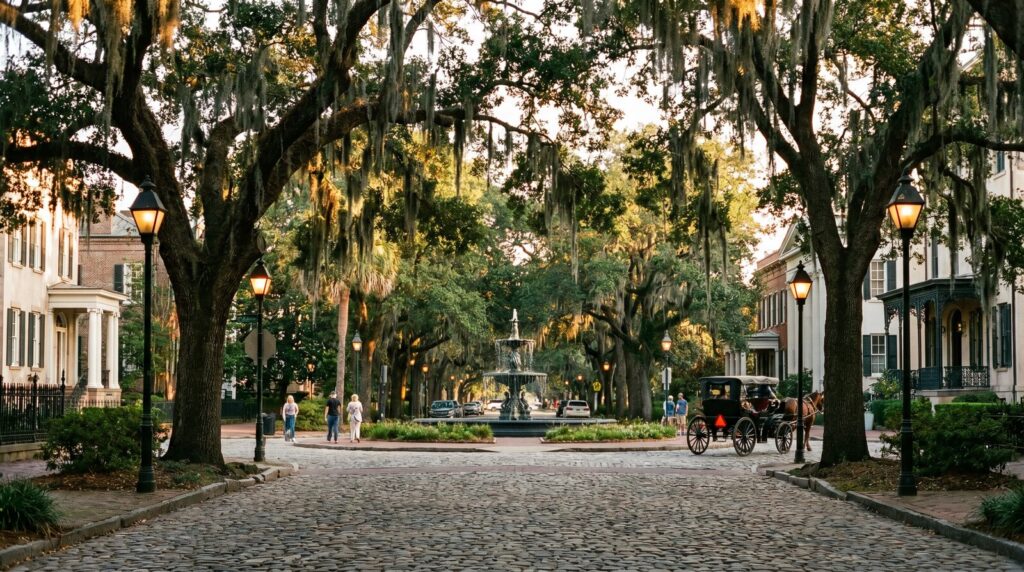
Savannah’s original urban plan by James Oglethorpe organized the city around grid of public squares designed as gathering places rather than mere traffic intersections. Each square features monumental trees, often live oaks draped with Spanish moss, surrounded by historic buildings serving religious, commercial, governmental, and residential functions. This design philosophy prioritized human-centered urban spaces decades before contemporary new urbanism identified similar principles.
Chippewa Square, appearing prominently in film “Forrest Gump” where protagonist sits on bench telling life story, has become pilgrimage site for film fans and tourists. The square contains monument to Savannah Volunteer Guards and is surrounded by historic buildings from different periods. Walking these squares reveals how urban design shapes experience and encourages lingering.
Madison Square, designed with four smaller connecting squares creating distinctive cloverleaf pattern, demonstrates complexity of Oglethorpe’s original planning. Lafayette Square, named for French Revolutionary general, features Gothic Revival Cathedral of St. John the Baptist constructed over fifty years beginning in 1876.
Forsyth Park Fountain
Victorian fountain (1858) most iconic image photographed millions of times
Chippewa Square
Square featured in “Forrest Gump” surrounded by notable historic buildings
Madison Square
Cloverleaf pattern of connected squares demonstrating sophisticated urban planning
Lafayette Square
Named for Revolutionary general, featuring Gothic Revival cathedral
Antebellum Mansions & Architecture
Savannah’s antebellum period accumulated architectural wealth reflecting slavery’s economic productivity and coastal commerce prosperity. Elegant townhouses, mansion estates, and public buildings demonstrate sophisticated architectural design drawing from Georgian, Federal, and Greek Revival styles adapted to Savannah’s climate. These buildings represent material reality of slave-based wealth creation while presenting aesthetic achievement remarkable by any standard.
The Sorrel-Weed House, constructed in 1840, features tabby construction—mixture of crushed oyster shells, lime, sand, and water—a building technique common in coastal colonial America creating distinctive appearance and remarkable durability. The house functions as museum preserving furnishings and architectural integrity from its period.
Bonaventure Cemetery, though technically not mansion, represents Savannah’s most hauntingly beautiful cemetery, with Spanish moss-draped oaks creating atmospheric landscape of elaborate Victorian monuments. Featured in novel “Midnight in the Garden of Good and Evil,” it embodies Savannah’s romantic atmosphere.
Owens-Thomas House
1819 Federal mansion with original systems and period furnishings
Sorrel-Weed House
1840 mansion featuring distinctive tabby construction
Bonaventure Cemetery
Atmospheric cemetery with Spanish moss oaks and literary fame
Historic District
16-block area containing dozens of historic properties and architectural styles
River Commerce & Waterfront Heritage
The Savannah River, flowing from inland South Carolina toward the Atlantic, provided geographic rationale for the city’s founding. Early colonial commerce relied on river navigation for exporting rice, indigo, and cotton to international markets. The river’s role in slave trade remains central to understanding Savannah’s historical wealth and moral complicity.
Historic River Street stretches approximately one mile along the waterfront with cobblestone streets reflecting original colonial-period paving. Visitors can view the river’s flow, observe contemporary river traffic, and understand geographic foundation of Savannah’s historical importance. River boat tours departing from the waterfront provide views and trips to nearby Tybee Island.
Tybee Island, accessible by car or boat from downtown, features historic lighthouse constructed in 1773, making it the oldest lighthouse in Georgia and among the oldest in United States. The island developed as beach resort destination in nineteenth century with Victorian cottages and grand hotels.
River Street
Preserved riverfront warehouses from 1700s-1800s with restaurants and galleries
Cobblestone Streets
Original colonial-era paving preserved for over two centuries
Riverboat Tours
Departing waterfront offering river views and trips to Tybee Island
Tybee Lighthouse
1773 lighthouse, oldest in Georgia, with museum and gallery views
Lowcountry Cuisine & Southern Traditions
Lowcountry cuisine, distinctive to coastal South Carolina and Georgia, evolved from African, European, and Indigenous American traditions melded through colonial period. Rice cultivation shaped regional cuisine and economy, with slave labor making production possible while extracting tremendous human cost. Contemporary understanding requires acknowledging historical reality while appreciating culinary sophistication that emerged.
Bouillabaisse-style stews, hoppin’ John (black-eyed peas with rice), okra-based gumbo, and Low Country boils represent signature dishes sustaining regional cuisine traditions. Frogmore Stew, alternative name for Low Country boil, combines fresh shrimp, corn, potatoes, and sausage, creating communal eating tradition suitable for outdoor gatherings.
Sweetgrass basket weaving, West African tradition brought by enslaved people, continues to be practiced in Lowcountry with artisans creating woven baskets from locally harvested sweetgrass. These baskets, functional and beautiful, represent cultural continuity and artistic tradition surviving through centuries.
Shrimp & Grits
Gulf shrimp with creamy grits and gravy, iconic Lowcountry dish
Frogmore Stew
One-pot meal: shrimp, corn, potatoes, sausage for communal gatherings
Hoppin’ John
Black-eyed peas with rice, traditional New Year’s food
Sweetgrass Baskets
West African tradition: handwoven baskets from harvested sweetgrass
Planning Your Visit
Savannah’s location on Georgia coast, approximately 160 kilometers south of Charleston, South Carolina, makes it accessible by car, air, or train. Savannah/Hilton Head International Airport serves the region with flights from major American cities. The drive from Atlanta (approximately 4 hours) offers scenic routes through Georgia countryside. Train service via Amtrak connects to other major cities.
Historic District walking is feasible for exploration, with downtown streets forming manageable grid and most attractions within two kilometers. Trolley tours offer alternative to walking, providing guided experiences and transportation for those preferring mobility assistance. Bike rentals allow coverage of greater distances while maintaining active exploration.
Savannah’s restaurant and accommodation scene offers options across price ranges, from luxury properties in historic mansions to budget hotels. Mid-range options provide good value with comfortable conditions and historic appeal. Reservation during peak season is essential, with prices increasing substantially during major celebrations.
Forsyth Park
Largest public park with iconic fountain, walking paths, and surrounding restaurants
Bonaventure Cemetery
Historic cemetery with Spanish moss oaks and literary cultural significance
Tybee Island
Beach resort 30 km east with lighthouse, restaurants, and Atlantic access
nearby Beaufort
Charming South Carolina town 50 km north with historic character
Discover Savannah’s Romantic Southern Soul
Savannah invites you to walk beneath Spanish moss-draped oaks through historic squares designed with poetry in mind, explore antebellum mansions revealing regional history, taste Lowcountry cuisine celebrating coastal bounty, and experience the American South’s most authentically preserved colonial city.
Start planning your Savannah adventure today with Facts From Upstairs.
🚕 Getting Around Savannah
Savannah’s Historic District is one of the most walkable neighborhoods in America — the original 1733 city plan created a grid of tree-shaded squares that makes navigation intuitive and every block a pleasure to stroll. Most major attractions, restaurants, and galleries sit within the 2.5-square-mile landmark district, and the flat terrain makes it accessible for all fitness levels.
The free DOT (Downtown Transit) shuttle loops through the Historic District and connects to the City Market, Forsyth Park, and the riverfront — hop on at any marked stop. Pedicabs (bicycle taxis) are a fun and atmospheric way to get around the squares, especially in the evening. For rideshares, Uber and Lyft both operate throughout the city.
For exploring beyond downtown, Tybee Island (Savannah’s beach) is just 20 minutes east via Highway 80 — drive, take the Chatham Area Transit (CAT) bus, or join a guided trip. Wormsloe Historic Site, with its iconic mile-long avenue of live oaks draped in Spanish moss, is 15 minutes south by car. Day trips to Hilton Head Island (45 minutes) and Charleston (2 hours north on I-95) are popular extensions. Ghost tours by trolley or on foot are a Savannah staple — the city is famously one of America’s most haunted.
🍽️ Where to Eat & Drink in Savannah
Savannah’s food scene is a deep dive into Lowcountry cuisine — a tradition rooted in Gullah-Geechee culture, tidal creek seafood, and Southern hospitality. Start with shrimp and grits, the region’s iconic dish, served at virtually every restaurant but done exceptionally well at The Grey (a James Beard Award-winning restaurant in a restored 1938 Greyhound bus station) and Alligator Soul in a candlelit underground space.
For classic Southern comfort, Mrs. Wilkes’ Dining Room has been serving family-style lunches since 1943 — fried chicken, collard greens, mac and cheese, black-eyed peas, and cornbread all passed around communal tables. The line forms early, and it is worth every minute of the wait. On the casual end, Zunzi’s serves a cult-favorite South African-inspired sandwich called the Conquistador that draws lines around the block.
Savannah’s cocktail culture benefits from an unusual perk — open container laws allow you to carry drinks in to-go cups on the streets of the Historic District. Artillery is the city’s premier craft cocktail bar, housed in a 200-year-old building with inventive seasonal menus. The Distillery on Martin Luther King Jr. Boulevard is a relaxed local favorite. For a sweet finish, grab a Leopold’s Ice Cream — a Savannah institution since 1919 with flavors like Tutti Frutti and Savannah Socialite. The City Market area buzzes with restaurants, live music venues, and art galleries on weekend evenings.
❓ Frequently Asked Questions About Savannah
What is the best time to visit Savannah in 2026?
March to May is peak season — azaleas and dogwoods bloom across the squares, temperatures hover around 20–27°C, and the city hosts its legendary St. Patrick’s Day celebration (one of the largest in the US, typically mid-March). October and November offer beautiful fall weather and the Savannah Film Festival. Summers (June–August) are hot and humid (35°C+), though hotel prices drop and crowds thin out. Winter is mild and pleasant for walking tours.
Is Savannah safe for tourists?
The Historic District and tourist areas are generally very safe, with a strong police presence and well-lit streets. As with any city, be aware of your surroundings after dark in less-trafficked areas south of Forsyth Park. The squares, riverfront, and City Market remain lively and secure well into the evening. Savannah’s walkability and open community spaces create a welcoming atmosphere.
How many days do I need in Savannah?
Two to three days covers the Historic District squares, the riverfront, Forsyth Park, Bonaventure Cemetery, a ghost tour, and plenty of Lowcountry dining. Add an extra day for Tybee Island beach time or Wormsloe Historic Site. Savannah also pairs perfectly with a Charleston road trip — the two cities are 2 hours apart and complement each other beautifully.
What is Gullah-Geechee culture?
The Gullah-Geechee are descendants of West and Central Africans who were enslaved on the coastal Sea Islands and lowcountry plantations. Their culture — including distinct language, cuisine (like red rice and okra soup), sweetgrass basket weaving, and spiritual traditions — has profoundly shaped Savannah’s identity. The Pin Point Heritage Museum south of downtown tells this story movingly, and Gullah-influenced dishes appear on menus throughout the city.
How do I get to Savannah?
Savannah/Hilton Head International Airport (SAV) serves direct flights from major US cities including New York, Chicago, Dallas, and Atlanta. The airport is just 20 minutes from the Historic District. Amtrak’s Silver Service connects Savannah to the East Coast corridor (New York, DC, Charleston, Jacksonville). Driving from Atlanta takes about 4 hours via I-16, and the scenic coastal route from Charleston along US-17 is a beautiful 2.5-hour drive through the Lowcountry.
🌍 Explore More Destinations
If Savannah’s moss-draped squares and Lowcountry soul won your heart, these guides continue the journey:
- Charleston, USA: Holy City, Rainbow Row & Lowcountry Cuisine — Savannah’s sister city just 2 hours north, with its own distinct Southern charm and legendary food scene.
- Sedona, USA: Red Rock Country & Desert Stargazing — Another American gem where natural beauty and artistic community create something magical.
- Antigua Guatemala: Volcanoes & Colonial Ruins — Colonial architecture and vibrant culture in a dramatically different setting.
- Bath, England: Roman Baths & Georgian Architecture — Another beautifully preserved city where elegant architecture tells centuries of history.