
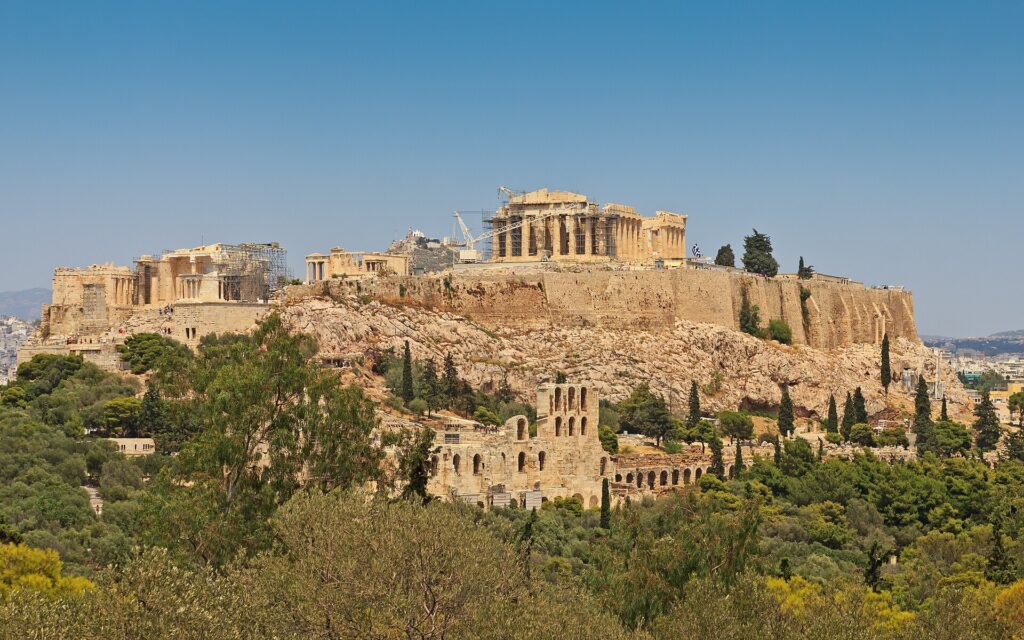
FFU Editorial Note: Site information cross-checked against UNESCO World Heritage Centre, Visit Greece, and the Hellenic Ministry of Culture. Operator pricing and ferry schedules verified May 2026. Last verified: 8 May 2026. This list is part of our full Greece travel guide.
Greece is split between Athens-and-Peloponnese mainland Greece, the Cycladic islands of postcards, the Ionian islands of olive groves and Italian-influenced architecture, and the Dodecanese near the Turkish coast. Each is a different country. Below: 30 things worth structuring a trip around, organized by region with the practical detail before booking.
Part of the FFU Greece cluster: Greece overview · Best time to visit · 10-day itinerary · Where to stay
Athens (6)
1. The Acropolis at opening or last hour
The Parthenon is the building all Western architecture argues with. Arrive at 8 a.m. opening or in the last 90 minutes before close (sites stop entry 30 min before close) — midday is brutal heat and tour-bus density. €20 base, €30 combo with the other major Athens sites (Ancient Agora, Hadrian’s Library, Roman Forum, Kerameikos). Book online to skip the queue. Plan 2 hours minimum.
2. National Archaeological Museum
The single most important museum of ancient Greek art on earth. The Mycenaean gold (Mask of Agamemnon), the Antikythera mechanism (the 2,000-year-old astronomical computer), the bronze charioteer of Delphi. €12. Plan 3 hours minimum; serious collectors plan a half-day. Closed Tuesday mornings; check before you go.
3. Plaka + Anafiotika village walk
Plaka is Athens’s old quarter under the Acropolis — narrow lanes, tavernas, neo-classical houses. Anafiotika, climbing the Acropolis’s north slope, is a tiny Cycladic-style island village inside Athens — built in the 1840s by stonemasons from Anafi who’d been brought to build the new royal palace. Walk it at sunset. Free, just pick the streets behind Mnisikleous and head up.
4. Sunset at Lycabettus Hill
The highest point in central Athens — 277 metres, with a small white chapel at the top and one of the great urban panoramas in Europe. The Acropolis below at sunset, the Saronic Gulf beyond. Walk up (40 min, well-marked path) or take the funicular from Kolonaki (€10 round trip). Have a drink at the summit café-restaurant.
5. The Athens Festival at Odeon of Herodes Atticus
Watching theatre, opera, or concerts in a 2nd-century AD stone amphitheatre carved into the south slope of the Acropolis. The Athens & Epidaurus Festival runs June through August — the program drops in March and the best nights book out within days. €15–€80 depending on production. The acoustic is genuinely extraordinary; you can hear a whisper from the stage in the back row.
6. Tavern crawl in Psyrri or Exarchia
Psyrri is the gritty-cool quarter just north of Monastiraki — old workshops turned into bars and tavernas. Exarchia (a few blocks east) is the anarchist-academic neighbourhood, intense and authentic. Walk through both, eat at Telis (Psyrri, pork chops only, €15 for two), Diporto (the legendary subterranean hole-in-the-wall), or Cookoovaya (Exarchia, modern Greek). Athens drinks late — these neighbourhoods peak after 11 p.m.
Santorini & the western Cyclades (5)
7. Sunset in Oia (but not at the obvious spot)
Oia’s caldera-edge sunset is on every list and the obvious spot (the ruined Byzantine castle) hosts 2,000 people on summer nights. Walk 10 minutes north to the windmill at the Ammoudi Bay overlook for an equal view with 30 people instead of 2,000. Or even better: book a sailing trip that returns to Oia at sunset and watch from the water (€80–€140 per person, half-day catamaran with food).
8. Akrotiri archaeological site (the “Greek Pompeii”)
The Bronze Age Minoan settlement on Santorini’s southern tip, buried by the 1600 BC volcanic eruption that may have inspired the Atlantis myth. The frescoes (now in Athens’s archaeological museum) are among the world’s earliest sophisticated paintings. The site is covered (climate-controlled), so summer-heat-friendly. €12, plan 90 min. Combine with Red Beach (5 min away).
9. Sail to Folegandros
The quieter Cycladic alternative to Santorini, 90 min by ferry. A single hilltop village (Chora) sitting on a cliff over the sea, three or four restaurants, swimmable beaches reached by hiking trails. The Cyclades you remember from photographs of the 1970s. 2 nights minimum.
10. Milos’s lunar beaches
Volcanic rock formations have made Milos’s beaches genuinely unique. Sarakiniko (the white-rock moonscape), Tsigrado (descend a rope ladder to a hidden cove), Kleftiko (only by boat — pirate caves and arches). Best done as a day-long catamaran trip from Adamas (€100, 8 hours, lunch and snorkel gear).
11. Naxos’s Apollo gate + Mount Zas hike
Naxos is the largest Cyclades island and the most “real” — Greeks live here year-round, beaches are family-relaxed, mountain villages produce excellent kitron liqueur. The Apollo Gate (Portara) on the harbour is the surviving 6th-century BC marble doorway of an unfinished temple — best at sunset. Mount Zas (1,001m) is a 4-hour return hike to the highest peak in the Cyclades, with views of the entire archipelago.
Mykonos & the eastern Cyclades (4)
12. Little Venice + the windmills, Mykonos
The waterfront houses on Mykonos Town’s western edge sit directly on the sea — wave-spray hits the window panes. The five 16th-century windmills above are the photograph. Best at sunset. Drink at Caprice or Galleraki, or walk past for the silence.
13. Mykonos beach club day at Scorpios or Nammos
The famous Mykonos beach clubs (Scorpios, Nammos, Principote) are a destination in themselves — DJ sets, sunbed-and-bottle service, sunset rituals. €25–€60 for a sunbed pair, drinks add up fast. Book ahead in July–August. The cheaper, equally-good move: Paradise Beach Club for the public-beach version.
14. Day trip to Delos
The sacred birthplace of Apollo and Artemis, an entire UNESCO-listed city ruined and uninhabited since the 1st century AD. 30 min by boat from Mykonos (€25 round trip + €12 entry). The Terrace of the Lions, the Roman houses with mosaics, the theatre. Plan 3 hours; bring water and a hat — no shade and no facilities.
15. Paros + Naoussa
The Cyclades island that gets it right: less crazy than Mykonos, more lively than Naxos, world-class restaurants, a fishing-village-turned-luxury-port at Naoussa. Try Mario for fish, Soso for modern Greek, Sigi Ikhthyos for waterside seafood. Beaches at Kolymbithres (rock-formation Caribbean colors) and Faragas (long sandy stretch).
Crete (5)
16. Knossos archaeological site
The Bronze Age Minoan palace south of Heraklion — Europe’s oldest city, the labyrinth of King Minos myth. The reconstructions are controversial (Sir Arthur Evans rebuilt sections in concrete in the 1900s), but the site is genuinely massive and the frescoes are extraordinary. €15. Combine with the Heraklion Archaeological Museum 30 min away to see the original frescoes (Bull-leaping, La Parisienne) — €10 combo €20.
17. The Samaria Gorge hike
Europe’s longest gorge, 16 km from the Omalos plateau down to Agia Roumeli on the Libyan Sea. Allow 5–7 hours of walking, mostly downhill but rocky. €5 entry; ferry from Agia Roumeli to Sougia or Hora Sfakion (€12), bus back over the mountains. Open May 1 to October 31, weather-dependent. Don’t attempt in summer midday — start at the 7 a.m. opening.
18. Chania old town
Crete’s prettiest harbour. Venetian-era lighthouse (the lighthouse you’ve seen on every Crete postcard), Ottoman mosque, narrow lanes through restored merchants’ houses. The waterfront tavernas are tourist-priced — walk three streets back for honest food. Salis for wine and small plates, Tamam for traditional Cretan, Theseus for fish.
19. Elafonissi pink-sand beach
Western Crete’s pink-sand beach (the colour comes from crushed coral). Knee-deep turquoise water, accessible by a 1.5-hour drive from Chania. Goes from “spectacular” to “completely overrun” in summer; arrive before 10 a.m. or after 4 p.m. Combine with Falassarna beach for a different version of the same idea.
20. Heraklion Archaeological Museum
One of the great archaeological museums of the world — five millennia of Cretan civilization in chronological order. The Phaistos Disc, the bull-leaping fresco, the snake goddesses, the Vasiliki ware. €10. Plan 3 hours minimum. Combine with Knossos for the full Minoan day.
Mainland + the Peloponnese (6)
21. Meteora monasteries
Six 14th–16th-century Eastern Orthodox monasteries built on top of vertical sandstone pillars, 4-hour drive north of Athens. UNESCO. Visit at least two — Megalo Meteoro (the largest, oldest, full collection of religious art) and Roussanou (smaller, more intimate). €3 each. Modest dress required. The Meteora train from Athens to Kalambaka is one of the great rail journeys in Europe.
22. Delphi — the navel of the ancient world
The 8th-century-BC oracle site on the slopes of Mount Parnassus, where the Pythia delivered prophecies that decided wars and city-state fates. The Temple of Apollo, the theatre, the stadium, plus the museum with the Charioteer of Delphi (one of the great surviving bronze sculptures of antiquity). €12 + €9 museum or €18 combo. 2.5 hours from Athens by car or organized tour.
23. Mycenae + the Lion Gate
The Bronze Age citadel of Agamemnon, in the Peloponnese near Nafplio. The Lion Gate (1250 BC) is the oldest monumental sculpture in Europe. The Treasury of Atreus tholos tomb (a corbelled-stone dome, the largest of its kind for 1400 years until the Pantheon) is just down the road. €12. 90 min from Athens.
24. Nafplio — Greece’s most beautiful town
The first capital of independent Greece (1828–1834), with three Venetian fortresses, a stunning waterfront, neoclassical mansions, and the kind of evening volta (promenade) tradition that’s disappearing elsewhere. 1.5 hours from Athens. Stay 1–2 nights, day-trip to Mycenae and Epidaurus from here.
25. Olympia archaeological site
Where the original Olympic Games were held, 776 BC to 393 AD. The stadium remains, the Temple of Zeus foundations, the Heraion (where the modern Olympic flame is still lit). The on-site museum has the Hermes of Praxiteles — one of the great surviving original Greek sculptures. €12. 4 hours from Athens, easier as part of a Peloponnese loop.
26. The Mani peninsula’s tower houses
Southern Peloponnese, the rugged middle finger of land. Stone tower-houses (built for clan blood-feuds in the 18th–19th centuries), wild coastline, 4th-century Byzantine churches in tiny villages. Areopoli is the regional centre; stay in Vatheia for the most photographable village. Drive only — public transport doesn’t reach.
Detours, Ionian, and one-offs (4)
27. Corfu old town
The Ionian Sea’s largest city, with Venetian, French, and British architectural layers. Two Venetian fortresses, a French-built esplanade, the British-era cricket field still in use. The 16th-century Spianada square is the largest in the Balkans. UNESCO. Worth 2–3 days.
28. Hydra (no cars allowed, ever)
Saronic Gulf island 90 min by ferry from Athens. Cars and motorbikes are banned by law — you walk, hire a donkey, or take a water taxi. Painters and writers (Leonard Cohen lived here) drove the village’s artistic reputation. Day-trip from Athens (1.5 hr ferry) or stay overnight for the empty-after-day-trippers magic.
29. Zagori villages
Northern Greece, near the Albanian border — 46 stone villages tucked into the Pindus mountains, connected by 18th-century stone bridges over rushing rivers. The Vikos Gorge (deepest in Europe by depth-to-width ratio) is the headline natural feature. Hiking centre. Best in October for the autumn colours, May for the wildflowers.
30. Thessaloniki food crawl + Modiano Market
Greece’s second city, far less touristed than Athens, arguably better food. Walk the Modiano Market (recently renovated), eat at Tsinari (the city’s oldest taverna, 1869), Bakaliarakia tou Damigou for fried cod, To Yiazi for modern Greek. The waterfront’s White Tower is the city symbol; the Rotunda (4th-century Roman building) has some of the best surviving early Christian mosaics in the world.
Continue planning: Greece overview · Best time to visit · 10-day itinerary · Where to stay
FFU contains affiliate links. We earn a commission when you book through them — at no extra cost to you.
Plan your trip
- Tours & experiences: browse Greece tours and experiences on Klook.
- Airport pickup: pre-book an airport transfer with GetTransfer.
- Car hire: compare rental cars on GetRentacar.
- Bag storage: store your bags with RadicalStorage.
Disclosure: some links above are affiliate links — booking through them supports Facts From Upstairs at no extra cost to you.