
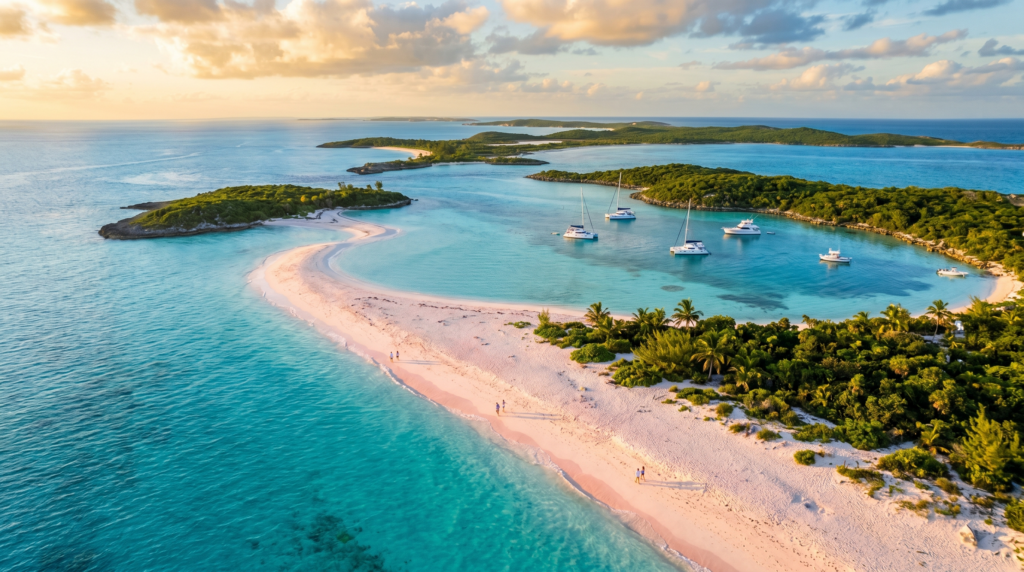
Bahamas Travel Guide — 700 Islands of Pink Sand, Swimming Pigs & the Clearest Water in the Atlantic
The Bahamas isn’t one place — it’s a 700-island archipelago scattered across 100,000 square miles of impossibly clear water, where the difference between a cruise-port day trip and the trip of a lifetime is simply knowing which boat to get on. Nassau gets the crowds; the Out Islands get the magic. This guide is built to push you past the megaresorts toward pink-sand beaches, swimming pigs, the world’s second-deepest blue hole, and conch shacks where lunch is speared that morning.
📋 In This Guide
- Overview — Why the Bahamas rewards island-hoppers
- June: the Bahamas’ quiet value sweet spot
- Best time to visit (season by season)
- Getting there — Nassau, Grand Bahama & direct Out Island flights
- Getting around — planes, ferries & water taxis
- Top islands — New Providence, Exumas, Eleuthera, Abacos
- Culture & people — Junkanoo, rake-and-scrape, conch
- A food lover’s guide to the Bahamas
- Off the beaten path
- Practical information
- Budget breakdown — what the Bahamas costs in 2026
- Planning your first trip
- Frequently asked questions
Overview — Why the Bahamas Rewards Island-Hoppers
Lying just 50 miles off the coast of Florida, the Bahamas is the closest slice of the tropics to the United States — and the most misunderstood. Most visitors never leave New Providence (Nassau) or a cruise-ship beach day, and conclude the country is busy, built-up and expensive. They’re seeing maybe one percent of it.
The reality is an archipelago of more than 700 islands and 2,000 cays, of which only around 30 are inhabited. The water is the headline act: a shallow, sandy-bottomed bank that turns the sea every shade of turquoise, aquamarine and milk-glass blue, so clear that boats look like they’re floating on air. Beyond Nassau lie the “Family Islands” (or Out Islands) — Eleuthera’s pink-sand beaches, the Exumas’ swimming pigs and sandbars, the Abacos’ sailing cays, Andros’s blue holes and bonefish flats. This is where the Bahamas stops being a port of call and becomes one of the great island-hopping destinations on Earth.
The trade-off is logistics and cost. Distances are real, inter-island travel takes planning, and prices — especially in Nassau and at the resorts — run high. Get those two things right and the Bahamas delivers experiences you simply can’t buy anywhere else.
June: The Bahamas’ Quiet Value Sweet Spot
If you’re reading this in June, you’ve landed on one of the smartest months to go. June is technically the first month of hurricane season, but historically it’s far calmer than the August–October peak, and the reward is significant: hotel rates fall well below the winter highs, beaches empty out, and the sea is at its warmest and clearest for snorkelling and diving. Crucially, it’s before the deep-summer heat and humidity of July and August. For travellers who want winter-quality water without winter-season prices or crowds, late spring into early summer is the bullseye — just keep an eye on forecasts and consider travel insurance.
Best Time to Visit the Bahamas (Season by Season)
Mid-December – Mid-April — Peak (dry & perfect, but pricey)
The classic window: daytime temperatures of 75–80°F (24–27°C), low humidity, calm seas and minimal rain. It’s also the most expensive and crowded time, with hotels and flights at their highest. Book months ahead, especially around the holidays and US spring break.
May & November — Shoulder (the smart traveller’s choice)
Warm, largely dry and noticeably cheaper, with thinner crowds. November in particular is a serene stretch after hurricane season winds down but before winter prices kick in — arguably the best overall value-to-weather ratio of the year.
June – October — Summer & hurricane season
Hot and humid (high 80s to low 90s°F) with afternoon showers and the highest hurricane risk from August to October. The upside is real: room rates can drop 30–50%, and you can have world-famous beaches almost to yourself. June and early July carry the lowest storm risk of the season.
Getting There — Nassau, Grand Bahama & Direct Out Island Flights
The Bahamas is exceptionally easy to reach from the US East Coast. Lynden Pindling International (NAS) in Nassau is the main hub, with frequent flights from Miami, Fort Lauderdale, Orlando, Atlanta, Charlotte, New York and beyond. Grand Bahama (FPO) near Freeport is the second gateway.
The key insight: you don’t always have to route through Nassau. Several Out Islands have their own airports with direct or one-stop service from Florida — for example, American and Delta fly nonstop from Miami to North Eleuthera (ELH), gateway to Harbour Island’s pink sand. Flying direct to your island saves a connection, a transfer and often a night in Nassau.
- Air: Nassau (NAS) and Freeport (FPO) for the main islands; North Eleuthera (ELH), Governor’s Harbour (GHB), Marsh Harbour (MHH, Abacos) and George Town (GGT, Exuma) for direct Out Island access.
- Sea: Cruise ships dock at Nassau and the private islands; some travellers arrive by private boat or ferry from Florida.
- Passport: valid for at least six months, plus a return/onward ticket and proof of accommodation.
Getting Around — Planes, Ferries & Water Taxis
This is the part that makes or breaks a Bahamas trip. There are no road bridges between island groups, so moving around means flying, ferrying or boating.
- Inter-island flights: Regional carriers (Bahamasair, Western Air, Pineapple Air, Southern Air Charter) connect Nassau to the Out Islands. Expect roughly US$125–150 each way and 25–60 minute hops to Eleuthera, the Exumas, the Abacos and Andros.
- Bahamas Ferries: Air-conditioned fast ferries run from Nassau to North Eleuthera, Harbour Island, the Abacos and more. A daily car ferry runs Nassau–Governor’s Harbour (about US$155, ~3 hours).
- Water taxis: Short, frequent and cheap — the Eleuthera–Harbour Island water taxi costs about US$5 and leaves every few minutes.
- On-island: Nassau’s jitney buses cost just $2–5; elsewhere you’ll rent a car, scooter or golf cart, or rely on taxis (fixed government rates).
Planning tip: pick one or two island groups per trip rather than trying to see everything. Backtracking through Nassau eats days and budget.
Top Islands — Where to Base Yourself
New Providence (Nassau & Paradise Island)
The capital and arrival hub: colonial forts and pastel Bay Street, the mega-resort Atlantis on Paradise Island, Cable Beach, and the best flight connections. Good for a night or two and easy first-timer comforts — but it’s the least “Out Island” part of the country.
The Exumas
A 120-mile chain of cays famed for sandbars, James Bond-blue water and Pig Beach, where wild pigs swim out to greet boats. Base in George Town (Great Exuma) and take boat tours to swimming pigs, nurse sharks at Compass Cay, iguanas and the Thunderball Grotto.
Eleuthera & Harbour Island
Sixty miles east of Nassau, this is the Bahamas’ most photogenic duo: Eleuthera’s wild beaches and the Glass Window Bridge, plus tiny Harbour Island with its three-mile pink-sand beach and New England-style village of Dunmore Town.
The Abacos
A sailing and boating paradise of cays and reefs around Marsh Harbour, with candy-striped lighthouses, loyalist settlements and protected anchorages. Still rebuilding in places after Hurricane Dorian, but firmly back on the map.
Andros & Grand Bahama
Andros is the largest, least-developed island — blue holes, bonefishing flats and the world’s third-largest barrier reef. Grand Bahama offers Lucayan National Park’s caves and beaches with easy access from Florida.
Culture & People — Junkanoo, Rake-and-Scrape & Island Time
Bahamian culture is a Caribbean–African–British blend with a rhythm all its own. The signature is Junkanoo, an exuberant street parade of cowbells, goatskin drums, brass and towering crepe-paper costumes that erupts on Boxing Day (December 26) and New Year’s Day in Nassau — one of the great festivals of the Americas. Year-round, you’ll hear rake-and-scrape, the country’s roots music made with a saw, accordion and goatskin drum.
Daily life is friendly and unhurried. English is universal, though locals speak a lilting Bahamian dialect among themselves. Sundays are quiet and church-centred, especially on the Out Islands. A little patience with “island time” goes a long way — ferries and flights can shift, and that’s part of the deal.
A Food Lover’s Guide to the Bahamas
Bahamian food is built around the sea, and one ingredient rules them all: conch (pronounced “konk”). You’ll find it everywhere, prepared every way.
- Conch salad — raw conch diced with citrus, onion and pepper, made to order at waterfront shacks; the national dish.
- Cracked conch & conch fritters — battered and fried, the islands’ favourite bar snack.
- Fresh seafood — grouper, snapper, spiny lobster (in season) and stone crab, often served with peas ‘n’ rice and johnnycake.
- Bahamian staples — boil fish for breakfast, guava duff for dessert, and an ice-cold Kalik or Sands beer to wash it down.
Eat where the boats land: the “Fish Fry” at Arawak Cay in Nassau and small family shacks across the Out Islands serve the best (and best-value) food in the country.
Off the Beaten Path
- Dean’s Blue Hole, Long Island — the world’s second-deepest blue hole at 663 feet, a freediving mecca dropping straight down from a shallow turquoise bay.
- The swimming pigs of Exuma — now famous, but still surreal: wild pigs paddling out to your boat on uninhabited Big Major Cay.
- The Glass Window Bridge, Eleuthera — a narrow neck of rock where the deep navy Atlantic crashes against the calm turquoise bank, side by side.
- Andros blue holes — inland and ocean blue holes for divers, plus world-class bonefishing on endless flats.
- Lucayan National Park, Grand Bahama — one of the world’s longest underwater cave systems, with mangrove kayaking and Gold Rock Beach above.
Practical Information
- Money: the Bahamian dollar is pegged 1:1 to the US dollar and the two are used interchangeably. Cards are widely accepted in Nassau and resorts; carry cash for Out Island shacks, taxis and ferries.
- Tipping: 15% is standard; many hotels add a gratuity, so check the bill.
- Connectivity: 4G is good in Nassau and patchier on remote cays; eSIMs and local BTC/Aliv SIMs work well.
- Health & safety: tap water is generally safe in Nassau and Freeport; bottled water is common on Out Islands. Nassau has areas to avoid at night — use normal city sense; the Out Islands are very safe.
- Power: US-style 120V outlets — no adapter needed for US travellers.
- Departure tax is included in most airfares.
Budget Breakdown — What the Bahamas Costs in 2026
The Bahamas is not a budget destination, but costs vary enormously between Nassau’s resorts and a simple Out Island guesthouse. Rough per-person, per-day estimates in USD:
| Style | Accommodation | Food | Total / day |
|---|---|---|---|
| Out Island value | $90–150 guesthouse | $25–40 (shacks) | $130–200 |
| Mid-range | $150–300 hotel | $40–70 | $200–350 |
| Resort / luxury | $400–1,000+ | $80–150+ | $500–1,200+ |
Big variables: inter-island flights ($125–150 each way), boat tours (Exuma pig trips run roughly $150–250), and season — summer rates can be half of winter. Self-catering on the Out Islands and eating at fish fries are the biggest savers.
Planning Your First Trip
For a first visit, resist the urge to see it all. A proven week: two nights in Nassau (forts, Fish Fry, easy connections), then fly or ferry to one Out Island group — the Exumas for swimming pigs and sandbars, or Eleuthera/Harbour Island for pink sand and village charm — and stay put. You’ll spend less, travel less, and actually relax. Book inter-island flights and the first Out Island night well ahead in peak season, and build in a buffer day before your international departure in case a regional flight shifts.
Frequently Asked Questions
Do US citizens need a visa or passport for the Bahamas?
No visa is required for US or Canadian visitors for stays of up to eight months. You do need a passport valid for at least six months, plus a return or onward ticket and proof of accommodation.
Is the Bahamas safe to visit?
The Out Islands are very safe and laid-back. Nassau has some neighbourhoods to avoid after dark — use standard city caution, stick to tourist and beach areas at night, and you’ll be fine.
What’s the cheapest way to see the Bahamas?
Travel in summer or shoulder season, base yourself on a single Out Island in a guesthouse, eat at fish fries and shacks, and limit inter-island flights. Nassau’s jitney buses ($2–5) and Out Island water taxis ($5) keep local transport cheap.
Where are the swimming pigs?
On Big Major Cay in the Exumas, reached by boat tour from George Town (Great Exuma) or by liveaboard. Most tours combine the pigs with nurse sharks, iguanas and snorkelling.
Bahamas or another Caribbean island?
Choose the Bahamas for the clearest water, easiest access from the US, and unmatched island-hopping. For lush mountains, rainforest and a lower price point, compare it with our guides to Jamaica, Cuba and the Dominican Republic.
Ready to Explore the Bahamas?
Short hops from Florida, 700 islands to choose from, and water you have to see to believe. Start planning with us — tell us your dates and travel style and we’ll help you build the perfect island-hopping route. Plan your trip →
Explore More
How This Guide Was Built
Researched and written by the Facts From Upstairs team, last updated . Prices and entry rules change — always confirm current details with official sources before you travel.
More country guides you might like
Plan your trip to Bahamas
The booking tools we use ourselves. FFU may earn a commission at no extra cost to you.
Plan & book your trip to Bahamas
Booking through these searches supports our guides at no extra cost to you.