
Languages of Djibouti
All languages of Eastern Africa →fluent beta classical · classes by phone with Maya at ranas.ai/maya
Djibouti Travel Guide — Lake Assal, Whale Sharks & the Strangest Landscape in Africa
Djibouti is the country most people can’t place on a map and can’t stop talking about once they’ve been. It’s a sliver of a nation wedged between Somalia, Ethiopia and Eritrea, barely bigger than Massachusetts, with a population smaller than a mid-sized American city. And yet it holds the lowest point in Africa, a lake so salty it crusts into white shelves you can walk on, limestone chimneys that look like they belong on another planet, and a gulf where juvenile whale sharks — some of the youngest ever recorded anywhere — gather every winter to feed. I’ll be straight with you: this is not an easy country to visit casually. You’ll need an e-visa arranged in advance, the heat is genuinely brutal for most of the year, and there are real security caveats near the Eritrean border. But if you want a piece of the planet that still feels unclaimed, Djibouti delivers it in a way almost nowhere else on Earth can.
In This Guide
- Overview — Why Djibouti Is Africa’s Strangest, Most Overlooked Corner
- Whale Shark Season in the Gulf of Tadjoura
- Best Time to Visit Djibouti (Season by Season)
- Getting There — JIB Airport & Overland Routes
- Getting Around — 4x4s, Fixers & Ferries
- Top Regions — Djibouti City, the Afar Triangle & the Gulf
- Culture & People — Somali, Afar, French & the Khat Hour
- A Food Lover’s Guide to Djibouti
- Off the Beaten Path
- Practical Information
- Budget Breakdown — What Djibouti Actually Costs in 2026
- Frequently Asked Questions
Overview — Why Djibouti Is Africa’s Strangest, Most Overlooked Corner
Djibouti sits at one of the most strategically important pinch points on the planet, controlling the Bab-el-Mandeb strait between the Red Sea and the Gulf of Aden — which is exactly why France, the US, Japan, Italy and China all keep a military presence here. That military and shipping economy quietly funds a country of roughly 1.1 million people that most travelers have never considered visiting, even though it borders Ethiopia, Somalia and Eritrea and sits directly across the water from Yemen.
What draws the small but growing trickle of visitors is geology, not beaches. The country sits at the junction of three tectonic plates pulling apart, which is why it packs in Lake Assal — a hypersaline crater lake 155 metres below sea level, the lowest point in Africa and the third-lowest on Earth after the Dead Sea and the Sea of Galilee — alongside otherworldly limestone formations at Lac Abbé and a desert floor at Grand Bara flat enough to have hosted stages of the Paris-Dakar Rally.
Djibouti currently has zero UNESCO World Heritage-inscribed sites — one of only twelve African countries with none — but it has ten places on its tentative list, including Lake Assal itself, the Neolithic rock art at Abourma, and Lac Abbé’s landscape, and UNESCO has been actively helping the country prepare its first formal nomination. This is a country still writing its own travel-guide entry, in other words — which is precisely the appeal for anyone who’s already done the obvious East African circuit.
Whale Shark Season in the Gulf of Tadjoura
Every year between roughly November and February, plankton blooms in the Gulf of Tadjoura draw in aggregations of whale sharks, with sightings typically peaking in December and January when the water is calmest. What makes this different from whale shark sites elsewhere is the age of the animals: Djibouti’s gulf hosts some of the youngest whale sharks recorded anywhere on Earth, averaging around four metres long, with juveniles as small as two metres sometimes spotted feeding right at the surface.
Snorkel boats head out from Djibouti City each morning to spots like Ras Korali, where volcanic cliffs drop straight into turquoise water — a stark, almost lunar backdrop that’s rarely seen at other whale shark destinations. Sightings aren’t guaranteed on any single outing, but the season is reliable enough that most operators run trips daily through the peak window, and it pairs naturally with the Gulf’s reef diving and Moucha and Maskali islands just offshore.
Best Time to Visit Djibouti (Season by Season)
November – February · Cool season (peak)
Daytime temperatures ease into the 25–30°C range and this is when whale sharks gather in the Gulf of Tadjoura and diving conditions are calmest. It’s also the only season most first-timers should target — book dive boats and 4×4 desert trips a few weeks ahead, since Djibouti’s tourism infrastructure is small and fills up fast around the whale shark window.
March & October · Shoulder
Warmer and quieter, with fewer other travelers competing for guides and vehicles. Whale sharks may still linger into March; October is drier heat rather than the coming winter’s mild spell.
June – September · Hot season (avoid if you can)
This is when the country earns its reputation as one of the hottest inhabited places on Earth, with the low-lying Afar Triangle regularly pushing well past 40°C in the shade. If you must travel in these months, plan around early mornings and evenings, hydrate aggressively, and expect Lac Abbé and Grand Bara excursions to be genuinely punishing rather than merely warm.
Getting There — JIB Airport & Overland Routes
Djibouti–Ambouli International Airport (JIB) sits about 6 kilometres from Djibouti City and is the country’s only real international gateway. It’s flown by Air Djibouti, Ethiopian Airlines, Air France, flydubai, Qatar Airways, Turkish Airlines and EgyptAir, with routes connecting through Addis Ababa, Dubai, Doha, Istanbul, Cairo and Paris — there is no nonstop service from North America, so most travelers connect via the Gulf or Ethiopia. Worth knowing before you land: roughly three-quarters of the airport’s total traffic is military, a reminder of just how many foreign forces are based here.
Overland entry is possible from Ethiopia (the classic route pairs Djibouti with an Addis Ababa trip, often by the Addis–Djibouti railway or shared taxi) and from Somaliland, though both routes demand more planning and current border-security checking than flying in. Almost everyone arranges the e-visa before departure rather than counting on arrival processing.
Getting Around — 4x4s, Fixers & Ferries
Djibouti has almost no independent tourist infrastructure for self-driving to its headline sights, so the standard approach is hiring a driver-guide with a 4×4 for excursions to Lake Assal, Lac Abbé and Grand Bara — nearly all of these routes involve stretches of unpaved, corrugated desert track that rental sedans simply cannot handle. Most travelers book multi-day loops out of Djibouti City through a local operator rather than attempting to self-navigate.
Within Djibouti City itself, shared taxis (usually old Toyotas or Peugeots, identifiable by their beige-and-blue paint) and app-based rides cover the compact downtown easily; agree fares before you get in if the meter isn’t running. Small boats and the occasional ferry connect the capital to Tadjoura and Obock across the gulf, and diving/snorkel operators run their own boats out to Moucha Island and the whale shark grounds.
Top Regions — Djibouti City, the Afar Triangle & the Gulf
Djibouti City
The capital and largest urban centre, a compact grid of French colonial architecture, the Central Market, and the Plateau du Serpent overlooking the port. It’s less a sightseeing destination than a base — good seafood, a genuine café culture left over from French administration, and the jumping-off point for every excursion in this guide.
Lake Assal & the Afar Triangle
The country’s signature landscape: a hypersaline lake 155 metres below sea level, ringed by black lava fields and white salt shelves so bright they’re disorienting at midday. Salt caravans still cross this basin on camelback bound for Ethiopian highland markets, much as they have for centuries.
Lac Abbé
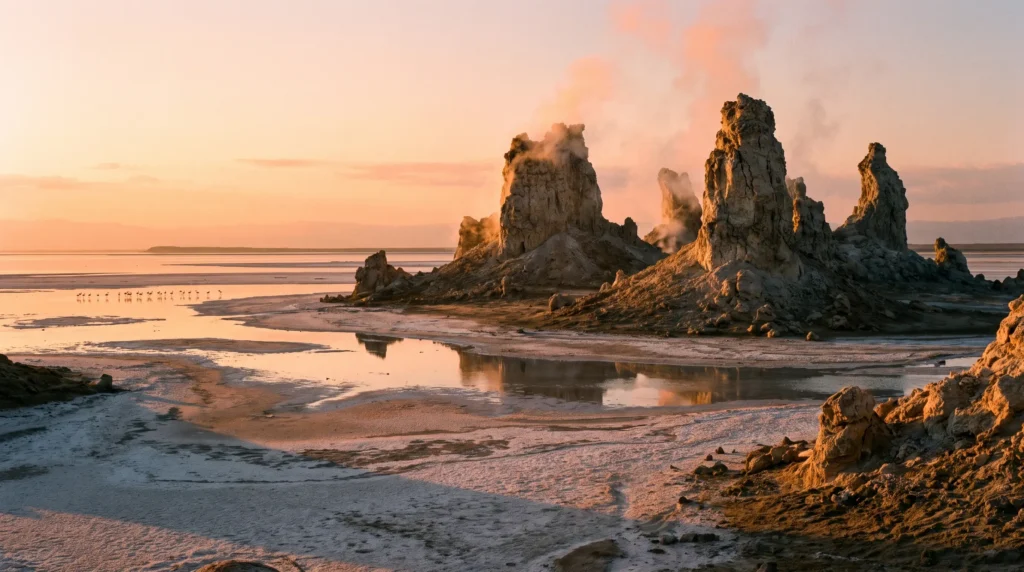
A remote, half-dry lake on the Ethiopian border studded with limestone chimneys formed by hot-spring mineral deposits — otherworldly enough that it’s frequently namechecked as a filming-style landscape. Sunrise here, with steam rising off the chimneys and flamingos picking through the shallows, is the single most photographed moment in Djibouti.
Gulf of Tadjoura & Moucha Island
The whale shark grounds, plus reef diving, the Seven Brothers volcanic islets further out, and Moucha and Maskali islands for an easy day of snorkelling and grilled fish just offshore from the capital.
Tadjoura
Often called the oldest town in the country, a whitewashed old quarter across the gulf from the capital, historically a gateway for pilgrims heading to Mecca and still known locally for its collection of mosques.
Grand Bara Desert
A vast, cracked-clay desert plain flat enough that stages of the Paris-Dakar Rally once ran across it — now more commonly crossed on ultramarathon routes or as a stark stop between Lake Assal and Lac Abbé.
Day Forest National Park
A surprising highland juniper forest in the Goda Mountains above Tadjoura, cool by Djiboutian standards and home to the endemic Djibouti francolin — a rare green counterpoint to the desert everywhere else.
Obock
The original French colonial foothold before the capital moved, now a sleepy fishing town and a quieter gateway to the northern Gulf of Tadjoura coastline and the Eritrean border region — check current advisories before heading this far north.
Culture & People — Somali, Afar, French & the Khat Hour
Djibouti’s population is roughly 60% Somali and 35% Afar, with a small Arab minority, and about 94% of the country is Muslim. French and Arabic are the official languages of government and schooling, while Somali and Afar are the everyday national languages spoken at home and in markets — a linguistic layering that traces straight back to the colonial French Territory of the Afars and the Issas, independent since 27 June 1977.
The single biggest daily cultural rhythm to know before you arrive is khat: the mildly stimulant leaf, chewed socially through the afternoon, structures much of daily commerce and public life, with shops and offices slowing to a near-halt once the daily khat flights land and distribution begins. Dress conservatively, especially outside the capital and around mosques, and always ask before photographing people or religious sites.
A Food Lover’s Guide to Djibouti
The national dish is skoudehkaris: rice cooked in a rich, spiced meat broth (usually goat or camel), often the centrepiece of a shared family meal. Fresh grilled fish and seafood are excellent and cheap along the coast, a legacy of the country’s long Red Sea and Gulf of Aden shoreline. Somali and Yemeni influences run through the cuisine — expect sambusas, spiced tea, and flatbreads alongside French-inflected touches like good coffee and fresh baguettes left over from the colonial era.
Camel milk and camel meat are genuinely mainstream here rather than novelty items, reflecting the country’s pastoralist Afar and Somali traditions. As with neighbouring Somalia and Yemen, alcohol is limited outside hotels and a handful of restaurants catering to the expatriate and military community, given the country’s overwhelmingly Muslim population.
Off the Beaten Path
Abourma Rock Art
A remote cluster of Neolithic petroglyphs in the Tadjoura region depicting cattle and human figures — one of the ten sites on Djibouti’s UNESCO tentative list, reachable only with a guide and 4×4.
Seven Brothers Islands
A remote volcanic archipelago in the Bab-el-Mandeb strait, a serious liveaboard-diving destination with strong currents, pelagic life, and almost no other boats on site.
Lac Abbé at Dawn
Most day-trippers see Lac Abbé at midday; camping overnight near the limestone chimneys and watching the mineral-white spires catch the sunrise is a different — and far less crowded — experience entirely.
The Grand Bara Ultramarathon Route
Runners and overlanders occasionally cross the flat desert pan self-supported; for everyone else it’s a stark, silent stopover between the salt lake and the chimneys, and one of the few places in the country where you’ll see genuinely no one else.
Practical Information
Money. The Djiboutian Franc has been fixed to the US dollar for decades at roughly 177.7:1, and US dollars are widely accepted in the capital. Cards work in a handful of hotels; carry cash for everything else, including all excursions outside the city.
Safety. The US State Department rates Djibouti Level 2, “Exercise Increased Caution,” citing terrorism risk, and specifically advises reconsidering travel within about 10 miles of the Eritrean border in the Tadjoura and Obock regions. The UK FCDO similarly flags terrorism and piracy risk in the Gulf of Aden, plus poor driving standards linked to khat use, and advises against all travel to parts of the country. Check your government’s current advisory before booking, and skip the far north near Eritrea unless you have a specific, well-planned reason to go.
Health. The CDC recommends malaria prophylaxis for all of Djibouti, along with up-to-date routine vaccines, Hepatitis A and B, typhoid, and a polio booster; rabies is present in dogs, so pre-exposure vaccination is worth discussing for longer or rural trips. Avoid swimming in untreated freshwater due to schistosomiasis risk, and see a travel clinic at least a month before departure.
Connectivity. Data coverage is solid in Djibouti City and patchy to nonexistent in the desert interior — download offline maps before any Lake Assal or Lac Abbé excursion. Plugs: European-style, 220V. Time zone: UTC+3, no daylight saving.
Budget Breakdown — What Djibouti Actually Costs in 2026
Djibouti is not a backpacker-cheap destination — the military and expat economy keeps hotel and vehicle-hire prices closer to Gulf levels than to neighbouring East African countries.
Budget (US$70–120/day): Simple guesthouse in Djibouti City, local skoudehkaris and street food, shared taxis, joining a group day trip to Lake Assal rather than a private vehicle.
Mid-range (US$180–320/day): A comfortable hotel, a private driver-guide for the Lake Assal–Lac Abbé loop, a whale shark snorkel excursion, and restaurant meals with the odd seafood splurge.
Luxury (US$500+/day): Multi-day Seven Brothers liveaboard diving, private overnight camping at Lac Abbé with a dedicated cook and vehicle, and top-end Djibouti City hotel stays.
Budget for the e-visa fee before you even land — a short-stay visa runs about US$23 and a transit visa about US$12 — plus cash reserves, since ATMs and card acceptance thin out fast outside the capital.
Planning Your First Trip to Djibouti
The classic first-timer route is a tight loop: land at JIB, spend a day acclimatising in Djibouti City, then head out for two to three days covering Lake Assal, Grand Bara and Lac Abbé with a driver-guide, before finishing with a couple of days on the Gulf of Tadjoura for whale sharks and diving if you’re travelling in the November–February window. Five to seven days covers the highlights without rushing the desert legs, which are physically taxing regardless of season. Many travellers pair Djibouti with neighbouring Ethiopia via the Addis–Djibouti rail corridor, or continue on to Oman or Egypt for more Red Sea diving on the same trip.
Frequently Asked Questions
Is Djibouti safe for tourists in 2026?
Djibouti City and the standard tourist circuit (Lake Assal, Lac Abbé, the Gulf of Tadjoura) are generally manageable with a reputable local operator, but both the US State Department and UK FCDO flag real terrorism and piracy risks, and specifically caution against travel near the Eritrean border in the Tadjoura and Obock regions. Check current government advisories before you book and travel with a trusted guide rather than independently in remote areas.
Do I need a visa?
Yes — almost all nationalities, including US, UK and EU passport holders, need to apply for an e-visa in advance; it is not issued on arrival for ordinary passports. Short-stay e-visas run up to 90 days and cost around US$23.
When can I see the whale sharks?
Roughly November through February, with December and January the most reliable window, in the Gulf of Tadjoura just offshore from Djibouti City.
How hot does it actually get?
Genuinely extreme from June through September, with the low-lying Afar Triangle regularly exceeding 40°C. November to February is far more comfortable and is when almost all visitors should aim to go.
Djibouti or a more established East African destination?
Choose Djibouti for genuinely unusual geology, a whale shark season most travelers have never heard of, and a country still writing its own tourism story. Choose somewhere like Kenya or Tanzania if you want established safari infrastructure and an easier logistical first trip to the region.
Do I need a guide for Lake Assal and Lac Abbé?
Effectively yes. The tracks are unpaved, poorly marked, and cross genuinely harsh desert with little to no phone signal — nearly every visitor books a driver-guide and 4×4 out of Djibouti City rather than self-driving.
Ready to Explore Djibouti?
A salt lake below sea level, limestone spires that look beamed in from another world, and juvenile whale sharks gathering in a gulf most of the world has never heard of — Djibouti rewards exactly the kind of traveller who reads this far into a guide for a country this size. Sort the e-visa early, brace for the heat outside of winter, and go see the lowest point in Africa while it’s still this quiet.
Explore More
- Ethiopia Travel Guide — the bordering highlands and the Addis–Djibouti rail route
- Egypt Travel Guide — more Red Sea diving further north
- Oman Travel Guide — across the Gulf of Aden on the Arabian Peninsula
- Kenya Travel Guide — pair the Horn of Africa with East African safari country
How this guide was built
Published as part of Facts From Upstairs’ country guide series. Built from authoritative sources — Djibouti’s Agence Nationale du Tourisme, UNESCO’s World Heritage Centre pages for Djibouti’s tentative list, the US State Department’s Djibouti travel advisory and country information page, the UK FCDO’s Djibouti travel advice, the US CDC’s Djibouti traveler health page, and Wikipedia entity pages for Djibouti’s geography, Lake Assal and its international airport, alongside specialist reporting on the Gulf of Tadjoura whale shark aggregation. Numeric and checkable claims carry inline citations.
Sources cited on this page
- Agence Nationale du Tourisme de Djibouti
- UNESCO World Heritage Centre — Djibouti
- US State Department — Djibouti Travel Advisory
- US State Department — Djibouti Country Information
- UK FCDO — Djibouti Travel Advice
- US CDC — Djibouti Traveler Health Page
- Djibouti e-Visa — Official Application Portal
- Wikipedia — Djibouti
- Wikipedia — Lake Assal
- Wikipedia — Djibouti–Ambouli International Airport
- Travel2Djibouti — Whale Shark Season Guide
- Oceanographic Magazine — Whale Sharks of Djibouti
More country guides you might like
Plan your trip to Djibouti
The booking tools we use ourselves. FFU may earn a commission at no extra cost to you.
Plan & book your trip to Djibouti
Booking through these searches supports our guides at no extra cost to you.