
Languages of Mauritania
All languages of Western Africa →fluent beta classical · classes by phone with Maya at ranas.ai/maya
Mauritania Travel Guide — The Sahara’s Eye, Ancient Ksour & the World’s Longest Train
I’ll be honest about Mauritania before I say anything else: it is not an easy trip, and anyone telling you otherwise is selling something. It is also one of the most genuinely extraordinary places I’ve ever pointed a camera at — a country that is roughly 90% Sahara desert, home to a 40-kilometre bullseye of rock visible from space, four medieval caravan towns slowly losing a war against sand dunes, and a train nearly three kilometres long that hauls iron ore across the desert and, if you ask nicely, hauls you too. This isn’t a beach-week country. It’s a country for people who want the Sahara without the Instagram queue at the dune — but that means going in with real information about visas, safety zones and logistics, not vibes. That’s what this guide is for.
In This Guide
- Overview — Why Mauritania Is the Sahara’s Least-Visited Frontier
- The Cool-Season Window — Why Timing Is Everything Here
- Best Time to Visit Mauritania (Season by Season)
- Getting There — NKC, the E-Visa & Border Realities
- Getting Around — 4x4s, Guides & the Iron Ore Train
- Top Regions — Coast, Adrar & the Deep Sahara
- Culture & People — Moors, Griots & the Three Glasses of Tea
- A Food Lover’s Guide to Mauritania
- Off the Beaten Path
- Practical Information
- Budget Breakdown — What Mauritania Actually Costs in 2026
- Frequently Asked Questions
Overview — Why Mauritania Is the Sahara’s Least-Visited Frontier
Mauritania sits where North Africa quietly becomes West Africa — an Islamic republic of roughly 5.5 million people wedged between Western Sahara, Algeria, Mali, Senegal and a long stretch of Atlantic coastline. About 90% of the country is Sahara desert, and that single fact explains almost everything else about traveling here: the population clusters along the coast and the Senegal River valley, the interior is genuinely empty in the way “empty” rarely means anymore, and getting off the paved road means a 4×4, a guide, and a plan.
The country gained independence from France on 28 November 1960, and its capital, Nouakchott, was essentially built from scratch starting in 1958 — a fishing village turned Saharan capital that now holds close to a third of the national population. Ethnically it’s a country of two broad worlds sharing one territory: Moorish communities (Beidane and Haratin, roughly two-thirds of the population between them) and sub-Saharan African communities — Halpulaar, Soninke, Wolof and others — concentrated toward the south.
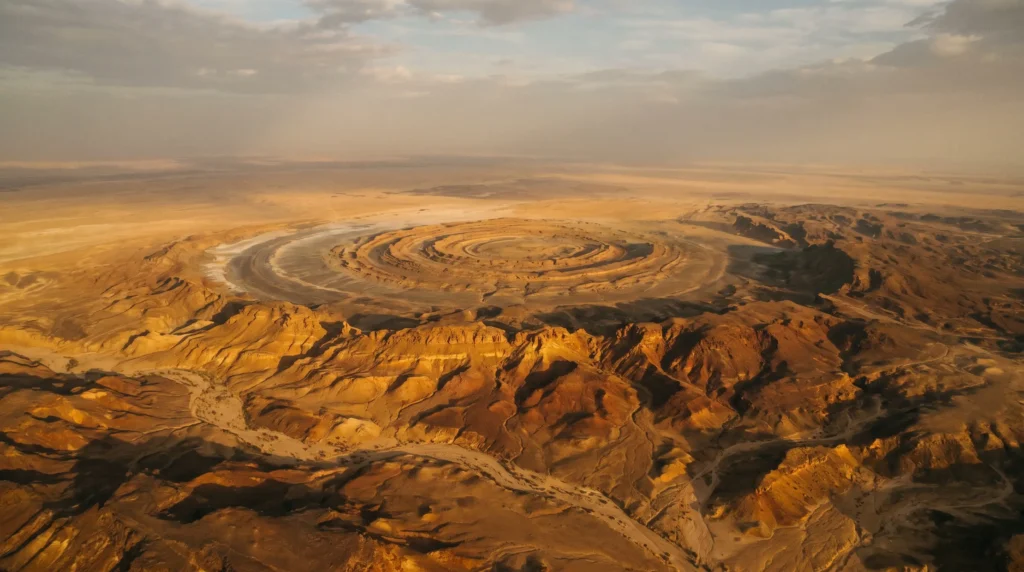
What actually pulls travelers here is a short but genuinely spectacular list: the Richat Structure, a 40-kilometre geological bullseye nicknamed the “Eye of the Sahara” and visible from orbit; four medieval caravan towns — Ouadane, Chinguetti, Tichitt and Oualata — inscribed together as a single UNESCO World Heritage site in 1996; Banc d’Arguin National Park, one of the world’s most important bird sanctuaries, UNESCO-listed since 1989; and the SNIM iron ore train, up to roughly 2.5 kilometres of freight wagons that locals and a small stream of travelers ride between Zouérate and the coast. None of it is polished for tourists. All of it is real.
The Cool-Season Window — Why Timing Is Everything Here
There is no lobster-festival equivalent in Mauritania — the “event” you’re planning around is the weather itself, and it is not negotiable. Daytime desert temperatures from June through September routinely become genuinely dangerous for hiking, driving breakdowns and dehydration, and most guides and 4×4 outfits scale back or refuse interior desert routes during the hottest stretch. The realistic travel window for the Adrar and the ksour towns is roughly late November through February, when daytime heat is manageable and nights in the desert turn properly cold.
This isn’t just a comfort preference — it’s the same window that keeps the logistics (vehicle reliability, water planning, guide availability) sane. If a trip to Chinguetti or the Richat Structure is on your list, build the whole itinerary around these months first and fill in everything else around that, rather than the other way around.
Best Time to Visit Mauritania (Season by Season)
Late November – February · Cool dry season (best for the desert interior)
The only season serious travelers should plan interior desert routes around — Chinguetti, Ouadane, the Richat Structure, Terjit. Daytime highs are workable, nights are cold enough for a proper sleeping bag, and this is also the meningitis-belt dry season the CDC flags for vaccination planning if you’re headed inland.
March – May · Warming, harmattan dust
Temperatures climb and the harmattan wind can blow fine Saharan dust that reduces visibility and grounds some regional flights. Coastal Nouakchott and Nouadhibou stay more comfortable than the interior.
June – September · Hot season, brief rains in the far south
The desert interior becomes genuinely punishing and best avoided for overland travel. The far south, along the Senegal River near Rosso and Kaédi, gets a short rainy season that greens the Sahel strip but adds humidity and mosquito activity — this is also the period when malaria risk is highest across most of the country.
October · Transition
Heat is easing but not gone; a workable but imperfect shoulder month if late November isn’t an option.
Getting There — NKC, the E-Visa & Border Realities
Nouakchott–Oumtounsy International Airport (NKC), opened in 2016 to replace the old city-centre airport, is the country’s main international gateway, with regional connections typically routing through Paris, Casablanca, Istanbul or Dakar. Nouadhibou in the north has a smaller international airport used mainly for the iron-ore-train and Banc d’Arguin route.
The visa situation changed significantly in 2025 and it’s worth reading carefully before you book anything: since 5 January 2025, Mauritania requires most non-exempt nationalities (including US, UK, EU and Canadian passport holders) to apply for an e-Visa online before boarding their flight — visa-on-arrival is no longer possible, and Mauritanian embassies abroad now direct applicants to the same online portal rather than issuing visas themselves. Processing has been reported to take anywhere from a few days to a couple of weeks, so apply well ahead of your flight, not the week before. A small number of nationalities (mostly regional neighbors like Senegal, Mali, Algeria and Tunisia) remain visa-exempt.
Whichever passport you hold, a yellow fever vaccination certificate is required for entry, your passport needs at least six months’ validity and a blank page for the stamp, and current guidance still recommends carrying enough USD or EUR cash to cover visa-related and on-the-ground costs, since local currency generally cannot be brought in or taken out. Overland entry from Senegal via the Rosso or Diama border crossings is used by regional travelers, but land routes from Mali and the Western Sahara direction sit inside zones both the US State Department and UK FCDO currently advise against.
Getting Around — 4x4s, Guides & the Iron Ore Train
Mauritania has one properly reliable paved artery: the coastal road linking Nouakchott and Nouadhibou. Beyond that, travel into the Adrar, Tagant or the far east genuinely requires a private 4×4 with an experienced driver-guide — this isn’t a rental-car-and-GPS country, and most operators who run the Chinguetti/Ouadane/Richat Structure circuit build it as a multi-day guided trip rather than a self-drive one.
The standout way to move through the north is also one of the world’s odder tourist experiences: the SNIM iron ore train between Zouérate and the port of Nouadhibou, a single 704-kilometre line whose loaded trains can stretch close to 2.5 kilometres and carry over 200 wagons. Locals ride it as basic transport; travelers ride it (usually in an open ore wagon, occasionally in a battered passenger car) as a genuine Sahara endurance experience — hours of desert night, no facilities, iron dust in everything. It is unforgettable and it is not comfortable; go in knowing that. Domestic flights connect Nouakchott with Nouadhibou and a few regional airstrips but schedules are thin, so build slack into any itinerary that depends on them.
Top Regions — Coast, Adrar & the Deep Sahara
Nouakchott
The capital and obligatory first (and often last) stop — a young, sprawling Saharan city of close to 1.5 million people with a genuinely fascinating fishing port where wooden pirogues land the day’s catch each afternoon, plus the Grande Mosquée and a low-key market scene. Most visitors use it as a logistics base rather than a destination in itself.
Nouadhibou & the Ship Graveyard
The country’s second city, a scrappy port town best known as the gateway to Banc d’Arguin and the northern terminus of the iron ore train, plus a genuinely surreal ship graveyard of rusting hulks in the bay.
Banc d’Arguin National Park
A UNESCO-listed coastal wilderness of sand dunes, mudflats and shallow lagoons that hosts staggering numbers of migratory Palearctic wading birds each winter — one of the most important bird sanctuaries on the planet, accessed by boat with local Imraguen fishing guides.
Chinguetti
The best-known of the four ancient ksour, a 13th-century caravan and religious town built around a square-minaret mosque, historically ranked among Islam’s seventh-holiest cities by local tradition, now half-swallowed by advancing dunes at its edges.
Ouadane & the Richat Structure
Ouadane is the quieter, more ruined twin of Chinguetti, and the usual base for reaching the Richat Structure — the 40-kilometre “Eye of the Sahara” rock formation whose concentric rings are best appreciated from the air or from higher ground nearby. Read the safety section before planning this leg — parts of the Adrar region sit in zones flagged for essential-travel-only by the UK FCDO.
Tichitt & Oualata
The remotest two of the four ksour — Tichitt in the Tagant plateau, Oualata far to the east near the Malian border, famous for its ochre-and-white geometric house decoration. Both see a fraction of Chinguetti’s already tiny visitor numbers, and Oualata in particular sits close to zones both the US State Department and UK FCDO currently advise against visiting; check current guidance before including it.
The Senegal River Valley (South)
A completely different Mauritania — green, agricultural, Sahelian rather than Saharan, centred on towns like Rosso and Kaédi near the Senegal border, and the heartland of the country’s Halpulaar and Soninke communities.
Culture & People — Moors, Griots & the Three Glasses of Tea
Mauritania’s population splits broadly between Moorish communities — Beidane (often called “White Moors”) and Haratin — who together make up roughly two-thirds of the country, and sub-Saharan African communities including Halpulaar, Soninke and Wolof, concentrated toward the south. Islam shapes daily rhythm almost everywhere, and Hassaniya Arabic-speaking Moorish culture carries a rich oral tradition of griots (chroniclers and musicians) and poetry passed down through specific hereditary families.
The single most useful cultural ritual to understand before you arrive is tea. Mauritanian mint tea is served in three specific rounds, each brewed stronger or sweeter than the last, and each round carries its own informal meaning — it’s a genuine social institution, not a drink you can politely rush through. Dress modestly, especially outside Nouakchott’s more cosmopolitan pockets; women commonly wear the flowing malafa wrap, and men the boubou. Photography of people, and especially of women, should always be asked for first.
A Food Lover’s Guide to Mauritania
Mauritanian food sits at the crossroads of Maghrebi and West African cooking. Thieboudienne — rice cooked in a rich tomato-and-fish broth with vegetables, shared with neighboring Senegal — is close to a national dish, especially along the coast. Mechoui (whole roasted lamb or goat) appears at celebrations and in the desert towns, often cooked over embers and shared communally by hand.
Dates from the Adrar’s oases are a staple and a point of local pride, especially around the Chinguetti and Ouadane region. Zrig — sweetened, slightly fermented camel or goat milk, thinned with water — is the classic desert refreshment and a genuine taste of nomadic life rather than a tourist novelty. And circle back to the tea: three rounds, taken slowly, is as much a part of a Mauritanian meal as anything on the plate.
Off the Beaten Path
The Iron Ore Train, Full Route
Riding the SNIM train the entire way between Zouérate and Nouadhibou — rather than just a short hop — is one of the most extreme, least-packaged rail journeys still possible anywhere, and remains a rite of passage for hardcore overland travelers.
Terjit Oasis
A palm-shaded gorge near Atar with natural pools and shade that feels almost implausible after hours of open desert driving — a favorite rest stop on the Adrar circuit.
Tichitt
Even among the four ksour, Tichitt gets the fewest visitors of all, reachable only by serious 4×4 travel across the Tagant plateau.
Diawling National Park
A wetland reserve near the Senegal River delta, a quieter counterpart to Banc d’Arguin with its own strong birdlife, rarely visited by international travelers.
Practical Information
Money. The Mauritanian ouguiya (MRU) is one of only two non-decimal currencies left in the world, divided into 5 khoums rather than 100 subunits. Cards are unreliable outside a handful of Nouakchott hotels and businesses, ATMs are scarce beyond the capital, and local currency generally cannot be imported or exported — bring USD or EUR cash for visa costs and as a backup throughout.
Safety. This is the section not to skim. As of mid-2025 the US State Department rates Mauritania Level 3, “Reconsider Travel,” citing terrorism and crime, with specific areas rated Level 4, “Do Not Travel,” including zones near the Mali border and areas north of the Tropic of Cancer. The UK FCDO similarly advises against all travel to eastern Mauritania and areas within 25km of the Mali border, and against all but essential travel to a longer list of provinces including Adrar and Tagant — which is precisely where Chinguetti, Ouadane and the Richat Structure sit. This doesn’t mean don’t go — thousands of travelers visit the Adrar circuit safely every cool season with reputable local guides — but it does mean: check your government’s current advisory the week before you fly, travel with an established local operator rather than improvising, and buy travel insurance that doesn’t exclude travel-against-advisory zones, because standard policies often do.
Health. A yellow fever vaccination certificate is required for entry; the CDC also recommends hepatitis A and B, typhoid, and meningococcal vaccination (especially December–June, in the meningitis belt), plus malaria prophylaxis for all areas except the far northern regions of Dakhlet Nouadhibou and Tiris Zemmour. Avoid unchlorinated freshwater (schistosomiasis risk) and drink only treated or bottled water. Medical facilities outside Nouakchott are very limited; evacuation insurance is worth having for any desert-interior itinerary.
Connectivity. An unlocked phone with a local SIM works reasonably in Nouakchott and Nouadhibou; expect no signal for long stretches of desert travel. Plugs: French-style, 220–230V. Time zone: GMT, no daylight saving.
Budget Breakdown — What Mauritania Actually Costs in 2026
Mauritania isn’t cheap in the way you might expect from a low-income Sahel-adjacent country, because the interior essentially requires paid logistics — a vehicle, fuel, a driver and often a guide — rather than backpacker infrastructure.
Budget (US$60–100/day): Basic guesthouses in Nouakchott or Nouadhibou, local street food (thieboudienne, mechoui by the plate), shared transport where available, minimal guided excursions.
Mid-range (US$150–300/day): A multi-day guided Adrar circuit split among a small group (4×4, driver-guide, basic auberges in Chinguetti/Ouadane), better hotels in Nouakchott, the iron ore train as a guided day/overnight experience.
Full desert expedition (US$350+/day): A private or small-group 4×4 expedition covering the Richat Structure, all four ksour access points that are currently advised as reachable, and Banc d’Arguin by boat, with an experienced specialist operator and comprehensive insurance.
Expect to pay the e-Visa fee and carry hard currency for most of the trip; tipping guides and drivers on multi-day desert trips is standard and appreciated.
Planning Your First Trip to Mauritania
Do not attempt a first Mauritania trip solo and improvised — book the Adrar/Richat Structure circuit through an established local or specialist Saharan operator, apply for your e-Visa weeks in advance, and check both your government’s advisory and your travel insurance’s exclusions before finalizing dates. A realistic first itinerary is Nouakchott (2 nights) to acclimatize and sort logistics, then a guided 4–5 night loop through Atar, Chinguetti, Ouadane and the Richat Structure viewpoint, closing with a day or two around Nouadhibou and Banc d’Arguin if time and current advisories allow. If you want more Sahara afterward, our Morocco guide covers the desert’s better-infrastructured northern edge; if you’d rather add the Sahel and coast, our Senegal guide picks up directly across the border with shared food and river culture. Travelers chasing the wider Sahara theme might also like our Chad guide or our Egypt guide for the desert’s other great civilization.
Frequently Asked Questions
Is Mauritania safe to visit in 2026?
The US State Department currently rates it Level 3, “Reconsider Travel,” with some areas at Level 4, and the UK FCDO advises against all travel to eastern Mauritania and areas near the Mali border, plus essential-travel-only in several other provinces including parts of Adrar and Tagant. Many travelers do visit the Adrar/ksour circuit safely with reputable operators, but check current advisories immediately before booking and again before flying — this isn’t a country to wing it in.
Do I need a visa?
Yes, for almost every nationality outside a short list of regional neighbors. Since January 2025, Mauritania requires a pre-departure e-Visa applied for online — visa-on-arrival has been discontinued, so apply well ahead of travel.
Do I need any vaccinations?
Yellow fever vaccination is a hard entry requirement. The CDC also recommends hepatitis A/B, typhoid, meningococcal (especially in the December–June dry season) and malaria prevention for all areas outside the two far-northern regions.
Can I visit the Richat Structure and Chinguetti independently?
Technically yes, but it’s a bad idea in practice — there’s no self-drive infrastructure, mobile signal disappears for long stretches, and parts of the wider Adrar region carry current essential-travel-only advisories. Almost everyone visits with an established local guide and a proper 4×4, and that’s the sensible choice.
What’s the iron ore train actually like to ride?
Long, cold at night, dusty, and completely unforgettable — hours through open desert in a metal ore wagon with no facilities, on a train that can stretch close to 2.5 kilometres. Bring warm layers, water, and low expectations for comfort.
Mauritania or Morocco for a Sahara trip?
Morocco for infrastructure, ease and a gentler introduction to the desert; Mauritania for something far rawer, far less visited, and considerably more logistically demanding — go there once you know what you’re signing up for.
Ready to Explore Mauritania?
A 40-kilometre eye carved into the Sahara, four caravan towns being slowly reclaimed by dunes, and a train that measures itself in kilometres rather than carriages — Mauritania rewards travelers who do the homework first. Sort the e-Visa early, book with a real desert operator, check the current safety picture right up to departure, and go in the cool season. It is not an easy country. It is an unforgettable one.
Explore More
- Morocco Travel Guide — the Sahara’s better-infrastructured northern edge
- Senegal Travel Guide — shared food and river culture just across the border
- Chad Travel Guide — another deep-Sahara frontier
- Egypt Travel Guide — the desert’s other great ancient civilization
How this guide was built
Published as part of Facts From Upstairs’ country guide series. Built from authoritative sources — Wikipedia entity pages for Mauritania, Nouakchott, the Richat Structure, the Mauritania Railway, the Mauritanian ouguiya and the country’s visa policy; UNESCO’s World Heritage Centre listings for Banc d’Arguin National Park and the Ancient Ksour of Ouadane, Chinguetti, Tichitt and Oualata; the US State Department’s Mauritania travel information page; the UK FCDO’s Mauritania travel advice; and the US CDC’s Mauritania traveler health page. Numeric and checkable claims carry inline citations.
Sources cited on this page
- Wikipedia — Mauritania
- Wikipedia — Nouakchott
- Wikipedia — Richat Structure
- Wikipedia — Mauritania Railway
- Wikipedia — Mauritanian ouguiya
- Wikipedia — Visa policy of Mauritania
- Wikipedia — Ancient Ksour of Ouadane, Chinguetti, Tichitt and Oualata
- UNESCO — Banc d’Arguin National Park
- UNESCO — Ancient Ksour of Ouadane, Chinguetti, Tichitt and Oualata
- US State Department — Mauritania
- UK FCDO — Mauritania
- US CDC — Mauritania traveler page
More country guides you might like
Plan your trip to Mauritania
The booking tools we use ourselves. FFU may earn a commission at no extra cost to you.
Plan & book your trip to Mauritania
Booking through these searches supports our guides at no extra cost to you.