
Languages of Somalia
All languages of Eastern Africa →fluent beta classical · classes by phone with Maya at ranas.ai/maya
Somalia Travel Guide — The Longest Coastline in Mainland Africa, and Why Almost No One Is Allowed to See It
I write these guides because I love the moment a place stops being an abstraction and starts being real to someone. Somalia is the hardest one I’ve had to write, because I can’t do that here — not honestly. This is a country with the longest coastline on Africa’s mainland, a 5,000-year-old gallery of ochre-red cattle painted onto granite outside Hargeisa, and a literary culture that fills a book fair with ten thousand people every July. It is also a country every major government currently tells its citizens not to visit, for reasons that are serious and specific, not bureaucratic caution. So this guide does something different from the rest of the site: it’s a genuine, respectful primer on Somalia’s geography, history and culture — written so you understand the place — alongside a clear-eyed look at why “should I go” isn’t really the question right now, and what the honest answer is for the parts of the Somali territories where the calculus is different.
In This Guide
- Overview — A Country of Nomads, Poets and One Very Long Coast
- The Hargeisa International Book Fair
- Climate & the Question of “Best Time to Visit”
- Getting There — Airports, Visas & the eVisa System
- Getting Around — What Movement Actually Looks Like
- Regions — Somaliland, Puntland & Federal Somalia
- Culture & People — Clans, Poetry & the Somali Diaspora
- A Food Lover’s Guide to Somalia
- Off the Beaten Path — Laas Geel & Beyond
- Practical Information
- What It Costs — For Those Who Do Travel There
- Frequently Asked Questions
Overview — A Country of Nomads, Poets and One Very Long Coast
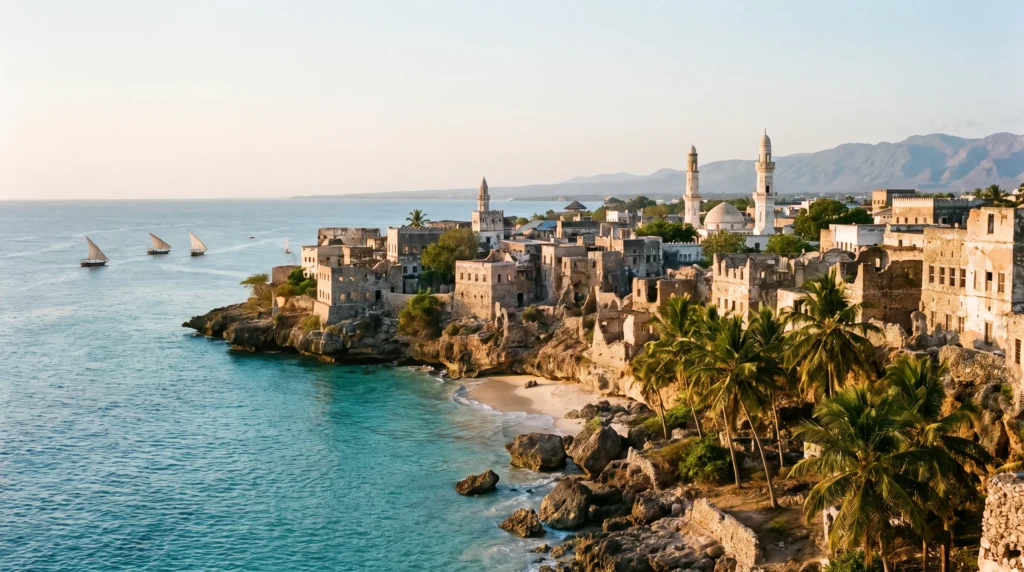
Somalia sits on the Horn of Africa, bordered by Djibouti, Ethiopia and Kenya, wrapped by the Gulf of Aden to the north and the Indian Ocean to the east — the combination that gives it the longest coastline of any country on Africa’s mainland. The country covers roughly 637,657 square kilometers and is home to an estimated 19.7 million people, with the capital Mogadishu — a city of roughly 2.7 million — serving as the seat of a federal parliamentary government that has been rebuilding state institutions since the collapse of central authority in 1991.
Somalia became independent on 1 July 1960, when the former Italian Trust Territory united with the State of Somaliland, itself independent five days earlier as a former British protectorate. That union — and its unraveling after the civil war began in 1991 — is the single most important fact for understanding the country today: Somaliland in the northwest declared its own independence in 1991 and functions as a de facto separate, considerably more stable territory, while Puntland in the northeast operates as an autonomous federal state, and southern and central Somalia remain the areas most affected by the long-running conflict between the federal government and the Al-Shabaab insurgency.
Economically, Somalia is one of the world’s least-developed countries, running largely on livestock exports, remittances from a large global Somali diaspora, and a strikingly modern telecommunications and mobile-money sector. Culturally, it is one of the most linguistically and ethnically homogeneous nations in Africa, built around a shared language, a shared Islamic faith, and an oral poetic tradition that Somalis themselves often describe as a national obsession. None of that changes the fact that this is currently one of the most dangerous places on earth to travel as a foreigner outside a small number of areas — which is the lens the rest of this guide keeps front and center.
The Hargeisa International Book Fair — Somaliland’s Biggest Cultural Week
If there’s one event that captures a side of Somali life the news rarely shows, it’s the Hargeisa International Book Fair, held annually in late July in Somaliland’s capital. Founded in 2008 by writer Jama Musse Jama, it grew from around 200 attendees to roughly 10,000 within six years, and the 2026 edition is scheduled to open on 25 July. For a week, Hargeisa fills with poetry readings, panel discussions, translated literature, painting, storytelling and drama — a deliberate, sustained push to rebuild a culture of reading and writing after decades of conflict, and a genuine point of pride across the Somali-speaking world.
It’s a useful corrective to the single-story version of Somalia: a country that, even amid everything else, has sustained one of the region’s largest literary festivals for going on two decades. It’s also a small window into why Somaliland specifically draws the modest, security-conscious trickle of visitors who do go — a different risk profile from the rest of the Somali territories, discussed in detail below.
Climate & the Question of “Best Time to Visit”
Somalia’s traditional calendar runs on four seasons rather than two: Jilaal, the long dry season from roughly December to March; Gu, the main rains from April to June; Xagaa, a cooler, cloudier dry spell from July to September; and Deyr, the shorter secondary rains from October to December. Annual mean temperature sits close to 30°C nationwide, and rainfall is sparse and uneven — as little as 50–150mm a year in the north against 400–700mm in the south. Jilaal is generally considered the most comfortable stretch, with Hargeisa’s higher elevation taking the edge off the heat.
But climate is a distant second consideration here. The security situation — not the calendar — is what actually determines whether and where travel is possible, and it can shift quickly with little warning, as the FCDO’s recent notes on fighting near Mogadishu illustrate. Anyone with a legitimate reason to travel should be checking current advisories and local security briefings in the weeks before departure, not planning around rainfall averages.
Getting There — Airports, Visas & the eVisa System
Aden Adde International Airport in Mogadishu is the country’s main international gateway, alongside Hargeisa’s Egal International Airport for Somaliland-bound travelers. Since 1 September 2025, all foreign visitors to federally-controlled Somalia — including infants — must obtain an approved electronic visa or travel authorization (eVisa/eTAS) through evisa.gov.so before departure; the old visa-on-arrival option at federal airports has ended, and arriving without pre-approval means being denied entry. Applications require passport details valid at least six months beyond arrival, a photo, and stated purpose of travel and accommodation.
Somaliland runs its own, separate system: it does not recognize the federal eVisa and has continued to offer its own visa-on-arrival in Hargeisa for a defined list of nationalities (including the US, UK, EU and Canada) at a cost historically around US$60, alongside e-visa options through Somaliland’s own missions abroad. Given both governments’ advisories, most airlines serving the region are regional carriers routed through hubs like Nairobi, Addis Ababa, Dubai or Istanbul rather than direct long-haul flights from Europe or North America.
Getting Around — What Movement Actually Looks Like
In the areas where any travel is considered lower-risk — chiefly Hargeisa and parts of Somaliland’s northwest — movement between towns happens by shared minivan or private hire car, on roads that are frequently unpaved and slow going. Domestic flights connect Somaliland and Puntland’s main towns to Mogadishu, but overland travel between regions, and any movement in central and southern Somalia, is a different proposition entirely and is generally undertaken only with professional security arrangements, vetted local fixers, and armed escort where that is standard practice — not something a first-time independent traveler should attempt.
Within Hargeisa itself, day-to-day movement is normally by hired car and driver rather than public transport, and even there, a local guide familiar with current conditions is standard practice rather than an optional extra.
Regions — Somaliland, Puntland & Federal Somalia
Somaliland (northwest)
A self-declared independent territory since 1991, unrecognized by the UN but functioning with its own government, currency and passport stamp, and home to around 6.2 million people. Somaliland has largely avoided the direct conflict that has affected southern Somalia and is, by a wide margin, the part of the Somali territories where any organized, security-briefed visits currently happen — centered on Hargeisa and the ancient rock art at Laas Geel. The FCDO still advises against all but essential travel even here, and against all travel to most of the rest of Somaliland.
Hargeisa
Somaliland’s capital and largest city, sitting at roughly 1,300 meters elevation, which keeps temperatures more manageable than the coast. It’s the base for the book fair, a growing hotel scene, and day trips to Laas Geel, roughly 55 kilometers away.
Puntland (northeast)
An autonomous federal member state since 1998, covering the Horn’s eastern tip. Puntland has its own security forces and administration, and has historically been associated with the coastal piracy networks of the 2000s and 2010s — largely suppressed since but a reminder of why the coastline itself remains an active maritime risk zone.
Mogadishu & south-central Somalia
The federal capital and the seat of the internationally recognized government, and also the area facing the most direct and sustained Al-Shabaab activity, including attacks on hotels, government buildings and the airport perimeter. This is squarely inside the Do Not Travel / advise-against-all-travel zone for essentially all foreign visitors without a specific institutional mission and dedicated security arrangements.
Jubaland & the south
Bordering Kenya, another federal member state affected by ongoing insurgent activity and cross-border security operations. Not an area covered by any responsible general-audience travel guidance.
The honest summary: if the word “Somalia” makes you think of a single undifferentiated danger zone, that’s not quite right — Somaliland is a genuinely different governance and security environment from Mogadishu or Jubaland. But “genuinely different” still means “advise against all but essential travel” in the best case, not “go ahead.”
Culture & People — Clans, Poetry & the Somali Diaspora
Somalis are one of Africa’s most ethnically and linguistically unified populations, sharing the Somali language and overwhelmingly practicing Sunni Islam, with social and political life still organized substantially around a clan-family system that predates and outlasted colonial borders. Somali culture is famously, deeply oral: praise poetry, epic verse and political commentary have historically traveled through recited and sung poetry rather than the written word, and that oral tradition is precisely what events like the Hargeisa Book Fair are trying to carry into print and preserve for younger generations.
Decades of conflict since 1991 have also produced one of the world’s largest and most economically significant diasporas — Somali communities in Minneapolis, London, Toronto, Nairobi and the Gulf states send remittances that remain a pillar of the domestic economy. That diaspora is, in practice, how most people with living family ties actually experience “travel to Somalia” today — visiting relatives, weddings and funerals — a different calculation from tourism, but one that still runs through the same advisories and the same eVisa system, and still warrants the same caution.
A Food Lover’s Guide to Somalia
Somali cuisine reflects the country’s position on old trade routes between the Arabian Peninsula, the Indian Ocean and the African interior. A typical meal centers on rice (often the fragrant bariis iskukaris, spiced rice with meat) or on pasta — a lasting Italian colonial-era influence — alongside slow-cooked goat or camel meat, and canjeero, a spongy, slightly sour flatbread similar to Ethiopian injera, usually eaten at breakfast with honey or oil.
Somali tea (shaah), heavily spiced with cardamom, cinnamon and cloves, is a constant social ritual, alongside strong, cardamom-laced coffee. Camel milk is a staple, particularly among the pastoral communities that still make up a significant share of the population. Sambusas — spiced meat or vegetable pastries, a near-relative of the samosa — are the classic street snack. As with everything else here, the honest note is that experiencing this food properly, for the vast majority of would-be visitors, currently means Somali restaurants in diaspora hubs like Minneapolis, London or Nairobi rather than a trip to Mogadishu.
Off the Beaten Path — Laas Geel & Beyond
Laas Geel
On the outskirts of Hargeisa, granite rock shelters hold some of Africa’s best-preserved rock art: cattle in ceremonial robes, painted roughly 5,000 years ago, discovered by a French archaeological team in late 2002 and preserved in remarkable condition thanks to the overhangs that shield the paintings from weathering. Somalia has not ratified the World Heritage Convention, so despite its significance, Laas Geel currently sits outside UNESCO’s protection framework — though Somalia has been actively revising its Tentative List with UNESCO’s support in recent years, working toward eventual recognition for sites including a proposed Mogadishu lighthouse and two natural areas.
Berbera
Somaliland’s Red Sea-facing port town, with faded Ottoman- and colonial-era architecture and beaches on the Gulf of Aden — visited, when it is, as a guided day or overnight trip from Hargeisa rather than independently.
The camel markets
Somalia has one of the largest camel populations of any country on earth, and livestock markets remain a genuine, unvarnished window into pastoral Somali life for the rare visitor accompanied by a trusted local guide.
Practical Information
Money. The Somali shilling trades at roughly 26,000 to the US dollar, but the US dollar itself circulates widely, and mobile money — chiefly the SMS-based EVC Plus system — now handles a large share of everyday transactions, partly because physical shilling notes in circulation have become old and unreliable. Carry cash in small denominations and expect card acceptance to be essentially nonexistent outside a handful of upscale Hargeisa hotels.
Health. The CDC flags an enhanced-precautions polio notice for Somalia and recommends prescription malaria prevention for all areas, up-to-date routine vaccines, and hepatitis A/B and typhoid coverage; cholera transmission is described as widespread, and medical facilities outside major towns are extremely limited. Comprehensive medical evacuation insurance is not optional here — both the US and UK advisories specifically flag the cost and difficulty of medevac.
Safety. See the advisory box at the top of this guide — it is not boilerplate. Landmines and unexploded ordnance remain a hazard in parts of the country, and documented risks include kidnapping, targeted attacks on hotels and government buildings, and, per the US State Department, cases of passport confiscation by family members preventing departure. Consensual same-sex relations are criminalized, with the State Department noting sentences of three months to three years.
Connectivity. Mobile networks are surprisingly capable in Hargeisa and Mogadishu given the circumstances, a byproduct of the same telecom sector that underpins EVC Plus. Time zone: East Africa Time, UTC+3, no daylight saving.
What It Costs — For Those Who Do Travel There
Somalia has no meaningful tourism pricing tier structure, because it is not a tourism destination in any conventional sense. For the journalists, aid workers, diaspora visitors and researchers who do travel there with proper preparation, realistic daily costs run US$150–400+, dominated by vetted security arrangements and driver/guide fees rather than accommodation or food, which are comparatively inexpensive. Hargeisa’s small hotel sector spans simple guesthouses to a few newer higher-end properties; costs in Mogadishu, where most visits involve compound-based accommodation and armed transport, run considerably higher. There is no meaningful “budget backpacker” version of this trip, and any plan that doesn’t include a security budget line isn’t a realistic plan.
Planning — What a Responsible Approach Actually Looks Like
If you have a genuine, specific reason to travel to Somalia or Somaliland — work, research, family — start with your government’s current advisory (linked above), then work with organizations that have existing on-the-ground security infrastructure rather than freelancing logistics. For readers whose interest is really in the wider Horn of Africa and East African region, our Ethiopia guide and Kenya guide cover neighboring countries that are considerably more accessible for general travel, and our Tanzania guide and Egypt guide round out the region if a Horn-and-East-Africa itinerary is what you’re actually after.
Frequently Asked Questions
Is it safe to travel to Somalia right now?
No — the US State Department rates Somalia Level 4: Do Not Travel, its highest risk category, and the UK FCDO advises against all travel to the country, including Somaliland, with a narrow “all but essential travel” exception for three northwestern regions. Check current advisories before making any plans.
Is Somaliland safer than the rest of Somalia?
Relatively, yes — Somaliland has largely avoided the direct conflict affecting southern and central Somalia and is where the small amount of organized visits (Hargeisa, Laas Geel) currently take place. But official guidance still advises against all but essential travel there at best, and against all travel to most of it, so “relatively safer” is not the same as “safe for casual tourism.”
Do I need a visa for Somalia?
Yes. Federal Somalia requires a mandatory eVisa/eTAS applied for online before arrival as of September 2025 — there is no more visa-on-arrival at federal airports. Somaliland runs a separate system and has continued offering visa-on-arrival in Hargeisa for a defined list of nationalities.
What vaccines do I need?
The CDC recommends prescription antimalarials for all areas, a polio booster given recent poliovirus detection, hepatitis A/B, typhoid, and all routine vaccines current; cholera transmission is described as widespread and rabies pre-exposure vaccination is worth considering. Consult a travel medicine clinic well before any trip.
Can I visit Laas Geel?
Laas Geel, near Hargeisa in Somaliland, is one of the very few sites in the Somali territories that organized, security-briefed visits currently reach, typically as a guided day trip from Hargeisa with a local operator. It still falls inside FCDO’s “essential travel only” zone, so it requires the same caution as anywhere else in the region, just with a shorter list of open questions.
Why write a guide to a country you can’t recommend visiting?
Because “don’t go” and “don’t understand” are different things. Somalia has a real geography, a real history and a real culture that deserve an honest, non-sensationalized explanation — and readers with diaspora ties, professional reasons, or just curiosity about the Horn of Africa deserve a source that doesn’t either romanticize the risk or erase the country entirely.
The Honest Bottom Line
Somalia holds genuine wonders — 5,000-year-old rock art, the continent’s longest mainland coastline, a poetic tradition that fills a book fair every July — alongside a security situation that every major government currently rates as extreme. Respect both facts. Check the current advisory from your own government before any trip, work only with organizations with established security infrastructure if you must travel, and if what you’re really craving is the wider region, there is a great deal of East Africa you can visit far more freely.
Explore More
- Ethiopia Travel Guide — Somalia’s western neighbor, and one of the Horn’s most accessible destinations
- Kenya Travel Guide — the safari-and-coast neighbor to the southwest
- Tanzania Travel Guide — more East African coast and wildlife
- Egypt Travel Guide — the Horn’s Red Sea and Nile neighbor to the north
How this guide was built
Published as part of Facts From Upstairs’ country guide series. Given the current security situation, this guide was built with a different priority than most FFU country guides: verified official advisories first, cultural and geographic accuracy second, and no invented recommendations. Sources consulted include the US State Department’s Somalia travel advisory, the UK FCDO’s Somalia travel advice, the US CDC traveler health page for Somalia, FAO SWALIM’s climate-of-Somalia reference, and Wikipedia entity pages for Somalia, Somaliland, the Somali shilling, Somalia’s visa policy, Laas Geel and the Hargeisa International Book Fair. Numeric and checkable claims carry inline citations.
Sources cited on this page
- US State Department — Somalia Travel Advisory
- UK FCDO — Somalia Travel Advice
- US CDC — Somalia Traveler Page
- FAO SWALIM — Climate of Somalia
- Wikipedia — Somalia
- Wikipedia — Somaliland
- Wikipedia — Somali Shilling
- Wikipedia — Visa Policy of Somalia
- Wikipedia — Laas Geel
- Wikipedia — Hargeisa International Book Fair
More country guides you might like
Plan your trip to Somalia
The booking tools we use ourselves. FFU may earn a commission at no extra cost to you.
Plan & book your trip to Somalia
Booking through these searches supports our guides at no extra cost to you.