
Languages of Sudan
All languages of Northern Africa →fluent beta classical · classes by phone with Maya at ranas.ai/maya
Sudan Travel Guide — Nubian Pyramids, the Nile’s Confluence & a Country Currently Closed by War
I want to be upfront about something before we go any further: this is not a guide telling you to book a flight to Sudan right now. It’s a guide about a genuinely extraordinary country — more pyramids than Egypt, the meeting point of the Blue and White Nile, Red Sea reefs few divers have ever seen — written honestly at a moment when its government and Britain’s Foreign Office are both telling their citizens not to go there. I’ve written close to a hundred of these guides, and most of them end with “go now, before it changes.” This one ends the opposite way: know this place, understand why it matters, and hold the trip until it’s safe to take. That’s still a story worth telling well.
In This Guide
- Overview — Africa’s Third-Largest Country, and Its Hardest Decade
- Cool Season & Nubian Wrestling — Sudan’s Traditional Calendar
- Best Time to Visit Sudan (Season by Season, for When Travel Resumes)
- Getting There — Airports, Airspace & the Current Reality
- Getting Around — What Normally Works, and What Doesn’t Right Now
- Top Regions — Nile, Nubia, Red Sea & the Areas to Avoid
- Culture & People — Arab, Nubian, Beja and Beyond
- A Food Lover’s Guide to Sudan
- Off the Beaten Path — Even by Sudan’s Standards
- Practical Information
- Budget Breakdown — Why We Can’t Give You Real Numbers Right Now
- Frequently Asked Questions
Overview — Africa’s Third-Largest Country, and Its Hardest Decade
Sudan is enormous — Africa’s third-largest country by area, at roughly 1.89 million square kilometers, stretching from a Red Sea coastline in the northeast to borders with Egypt, Libya, Chad, the Central African Republic, South Sudan, Ethiopia and Eritrea. Its capital, Khartoum, sits at one of the most striking geographic points on the continent: the confluence of the Blue Nile, arriving from the Ethiopian highlands, and the White Nile, arriving from the Great Lakes region, merging into the single Nile that continues north to Egypt and the Mediterranean.
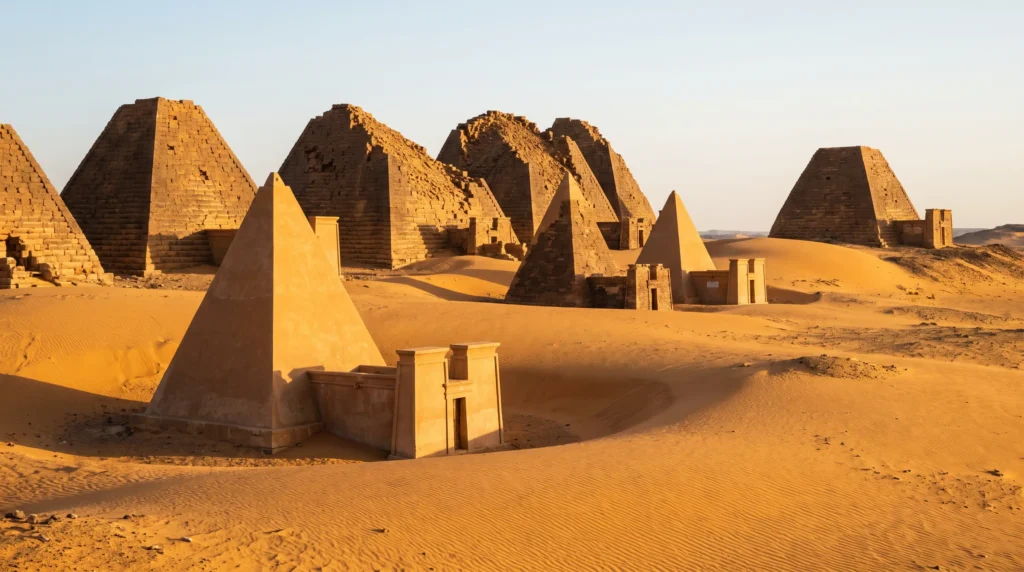
Long before it was Sudan, this stretch of the Nile was Nubia and the Kingdom of Kush — a civilization powerful enough to rule Egypt itself as its 25th Dynasty, and prolific enough to leave behind more pyramids than Egypt did, over 200 of them clustered at Meroë alone. Sudan gained independence from joint British-Egyptian rule on 1 January 1956, and its modern history since has been turbulent: decades of north-south civil war that ended with South Sudan’s 2011 secession, the 2019 overthrow of Omar al-Bashir’s three-decade rule, and, since April 2023, a devastating civil war between the Sudanese Armed Forces and the paramilitary Rapid Support Forces.
That war is the reason this guide reads differently than our others. Sudan is currently one of the world’s largest displacement and humanitarian crises, and its tourism infrastructure — modest even before 2023 — is not operating as a going concern. So we’re writing this the way we’d want a guide written about a place we love that’s going through something terrible: honestly, respectfully, with the safety information first, and with real hope that the country and its people get to show the rest of us Meroë, the Nile and Sudanese hospitality again before too long.
Cool Season & Nubian Wrestling — Sudan’s Traditional Calendar
In ordinary times, Sudan’s travel rhythm followed the desert’s, not the Nile flood’s: the cool, dry months from November through February were when caravans, archaeologists and the handful of visitors who made it out to Meroë and Karima did their traveling, before summer heat in the Nubian desert becomes genuinely dangerous. Friday afternoons in Omdurman, just across the Nile from Khartoum, were built around the Hamed al-Nil tomb, where Sufi dervishes in green and red robes gather for a hypnotic, drumming, whirling ceremony that was — before the war closed off greater Khartoum to visitors entirely — one of the most photographed cultural scenes in the country.
Eastern Sudan around Kassala has its own calendar built around Nubian wrestling matches, a centuries-old sport still practiced among Beja communities near the dramatic granite spires of the Taka Mountains. None of this is currently accessible to foreign travelers given the security situation, but it’s worth knowing what the country’s cultural clock has looked like for generations — and what, hopefully, it will look like again.
Best Time to Visit Sudan (Season by Season, for When Travel Resumes)
We’re including this section for planning purposes and historical accuracy — not as a nudge to go now. Whenever the advisories lift, here’s how Sudan’s climate breaks down.
November – February · Cool, dry season
The most livable stretch of the year across the Nubian desert and Khartoum, with daytime temperatures that are merely hot rather than extreme. This was traditionally the window for desert travel to Meroë, Karima and the pyramid fields, and for any Nile river travel.
March – June · Hot, dry season
Temperatures climb sharply, regularly into the mid-40s Celsius in central and northern Sudan — this window was always considered hard-core-only even before current conditions, best avoided for casual travel.
July – October · Rainy season
The south and center see the Nile’s summer flood pulse and seasonal rains; humidity rises, some roads become difficult, and this remains the least practical season for overland travel in normal times, on top of everything else.
Getting There — Airports, Airspace & the Current Reality
Khartoum International Airport, historically Sudan’s main international gateway, was effectively out of service for most of the war after fighting damaged the facility and Sudanese airspace closures followed; the airport only received its first international scheduled flight again in spring 2026, and domestic service resumed even more recently than that. Port Sudan, on the Red Sea coast, became the country’s de facto main airport during the conflict and continues to carry the bulk of Sudan’s international connections, with routes to regional hubs like Jeddah, Cairo and Addis Ababa and a slowly returning roster of carriers. None of this changes the advisory picture — airport reopenings reflect shifting front lines, not a return to normal civilian travel conditions.
Overland routes exist via Egypt in the north and, in calmer periods, via Ethiopia in the southeast, but border crossings sit inside or adjacent to active conflict zones for long stretches and are not something to attempt without current, on-the-ground guidance from your own government’s travel advisory — not a blog post.
Getting Around — What Normally Works, and What Doesn’t Right Now
In peacetime, Sudan’s size made internal flights and river routes the practical way to cover ground: domestic flights linked Khartoum with Port Sudan and provincial towns, buses and shared taxis served the paved highway network along the Nile corridor, and felucca-style river travel connected Nile towns the way it does in Egypt. Nubian towns north of Khartoum — Karima, Dongola, Kerma — were reachable by a mix of desert highway and local transport.
Right now, none of this should be read as a “how to get around” for an active trip. Front lines have shifted repeatedly since 2023, road and rail access varies region to region and week to week, and landmines and unexploded ordnance are a documented hazard in and around former conflict areas even where fighting has since moved on. This section exists to describe the country’s normal geography, not to suggest a self-drive itinerary today.
Top Regions — Nile, Nubia, Red Sea & the Areas to Avoid
Khartoum & Omdurman
The capital region sits exactly at the Blue Nile/White Nile confluence and has, since 2023, been at the center of the heaviest fighting in the country. This is emphatically not a current travel destination; we describe it here only because it’s the geographic and historic heart of Sudan and where any future recovery of tourism will likely restart.
Northern State & Nubia (Karima, Dongola, Meroë region)
North of Khartoum along the Nile lies ancient Nubia — Gebel Barkal’s sacred mountain and its Napatan-era temples and pyramids, the pyramid fields of Meroë further downstream, and the archaeological remains at Kerma, one of the oldest urban settlements in sub-Saharan Africa. This region has, at various points, seen less direct fighting than Khartoum or Darfur, but “less fighting” is not the same as safe, and it remains inside the scope of the current do-not-travel advisories.
Red Sea State (Port Sudan & Suakin)
Port Sudan is the country’s main functioning port and, during the war, its most active international air gateway. Nearby Suakin is a centuries-old coral-stone port town that was once East Africa’s principal pilgrimage and trade port to Mecca, now largely in ruins but architecturally striking. Offshore, the Red Sea coast holds some of the least-dived reef in the entire Red Sea system, including Sanganeb, an atoll reef so distinct it earned UNESCO natural World Heritage status alongside Dungonab Bay–Mukkawar Island.
Eastern Sudan (Kassala & the Taka Mountains)
Home to Beja communities and the dramatic granite Taka Mountains rising straight out of the plain behind Kassala town — a genuinely spectacular landscape, historically one of Sudan’s more relaxed regions relative to the capital.
Darfur & Kordofan
Western Sudan has borne the worst of the current conflict, including well-documented, large-scale violence against civilians and mass displacement. There is no version of this guide, now or likely for some time, that treats Darfur or Kordofan as travel destinations. If you are researching this region, the humanitarian and news coverage from established outlets and aid organizations is the right resource — not a travel guide.
Culture & People — Arab, Nubian, Beja and Beyond
Sudan’s roughly 51.8 million people span an unusually wide cultural range for one country: Sudanese Arab communities concentrated along the Nile corridor, Nubian communities with roots tracing back to the Kingdom of Kush, Beja pastoralist groups in the east, and Fur, Zaghawa and dozens of other peoples further west. Arabic and English are the official languages, though Beja, various Nubian languages, Fur and others remain everyday languages in their home regions. The overwhelming majority of Sudanese are Sunni Muslim, and Sudan’s Sufi orders — expressed most visibly in the Omdurman dervish ceremonies — sit alongside a more austere strand of Islamic practice that briefly became state law under Sharia between 1983 and 2020, before Sudan’s transition to a secular legal framework.
Hospitality runs deep in Sudanese culture, expressed through the shared coffee ceremony and an instinct to feed guests generously even in hard times — a trait aid workers and the handful of journalists still operating in the country consistently describe, even amid the current crisis. It’s one more reason this war is such a loss, and one more reason to hope for its end.
A Food Lover’s Guide to Sudan
Sudanese cuisine sits at a crossroads of Arab, Nubian, Egyptian and East African influence, built around grains that have been cultivated in the Nile valley for millennia. Ful medames — slow-cooked fava beans dressed with oil, tomato and spice — is the everyday breakfast staple, eaten across the wider region but claimed proudly here. Kisra, a thin, tangy sorghum flatbread with roots in ancient Nubian foodways, plays the same table role that injera does in Ethiopia, used to scoop stews like mullah, a slow-cooked meat-and-vegetable sauce.
Sudanese coffee — the jebena ceremony, spiced with ginger and sometimes cardamom and poured from a long-necked clay pot — is a genuine cultural institution and a point of Sudanese pride, alongside strong, sweet tea sold from small roadside stalls known as sittat al-shai. It’s a food culture worth knowing about even at a remove, and one more reason a future trip here is worth planning for.
Off the Beaten Path — Even by Sudan’s Standards
Gebel Barkal and the Napatan Sites
A sacred mountain the ancient Egyptians and Kushites both associated with the god Amun, surrounded by temple ruins and pyramid fields at Nuri, El-Kurru, Sanam and Zuma — collectively inscribed as a single UNESCO World Heritage listing in 2003. Even in Sudan’s best tourism years, this site saw a tiny fraction of Giza’s visitor numbers.
Kerma
One of the oldest urban centers documented in sub-Saharan Africa, predating even the height of Egyptian influence in the region, with a massive mudbrick temple structure known as the Western Deffufa still standing.
Sanganeb & Dungonab Bay
A Red Sea atoll and adjacent bay recognized by UNESCO for their exceptional coral reef ecosystems and importance to manta ray and dugong populations — reef diving that, under normal conditions, ranks among the least-visited and best-preserved in the entire Red Sea.
Suakin
A crumbling coral-stone port city that once rivaled Jeddah as a pilgrimage gateway to Mecca, now largely abandoned to the elements — an atmospheric, little-photographed ruin on the Red Sea coast near Port Sudan.
Practical Information
Safety — read this first. The US State Department rates Sudan Level 4, “Do Not Travel,” citing armed conflict, kidnapping, crime, terrorism and landmines, and the US Embassy in Khartoum remains suspended. The UK FCDO advises against all travel to Sudan, with the British Embassy in Khartoum closed and no evacuation support currently operating. Do not treat any other part of this guide as a substitute for checking your own government’s current advisory immediately before any travel decision.
Health. Malaria risk exists countrywide, and yellow fever vaccination is required for entry; the CDC also flags active, widespread cholera transmission, dengue, schistosomiasis and other water- and insect-borne risks, and recommends hepatitis A/B, typhoid and meningococcal coverage on top of routine vaccines. The CDC also notes more than half of health facilities in the country were non-operational as of its most recent assessment — meaning emergency care cannot be relied upon even outside active conflict zones.
Visas. Most nationalities need an e-visa or embassy-issued visa in advance, plus police registration shortly after arrival; a handful of exemptions exist for people with Sudanese family ties. None of this matters practically while the advisories above are in effect.
Money. The Sudanese pound has been in a prolonged devaluation since an official reset in 2021, worsened badly by wartime economic disruption; parallel-market rates have diverged sharply from official ones at various points. Card payments and ATMs cannot be assumed to function reliably; this is not a cash-machine kind of country right now.
Connectivity. Internet and mobile networks have been repeatedly disrupted by the conflict, with reported blackouts in affected regions. Assume unreliable connectivity rather than planning around it.
Budget Breakdown — Why We Can’t Give You Real Numbers Right Now
Every other FFU country guide gives you budget tiers in US dollars per day. We’re not doing that for Sudan, on purpose. A functioning tourism economy — hotels quoting stable rates, tour operators with predictable pricing, a currency you can budget against — is what those numbers require, and Sudan doesn’t currently have that. The Sudanese pound has been through a formal devaluation and years of wartime instability, official and parallel exchange rates have diverged, and large parts of the country’s hospitality infrastructure are either closed, repurposed, or inaccessible.
What we can say honestly: Sudan was, in the years before the war, one of the least expensive countries in the region to travel in, largely because so little tourism infrastructure existed to mark prices up. That’s a fact about its past, not a promise about its present. Treat any specific daily-budget figure you see elsewhere for Sudan right now with real skepticism.
Planning Your First Trip to Sudan
Here’s our honest planning advice: don’t plan an active itinerary yet. Bookmark this guide, follow the US State Department and UK FCDO advisory pages for Sudan, and revisit the question once both have meaningfully downgraded their guidance. In the meantime, if it’s the Nile, ancient Nubian/Kushite history and Red Sea diving pulling at you, our Egypt travel guide covers the northern half of that same Nile story — Luxor, Aswan and Egypt’s own Nubian monuments — with a fully functioning, safely accessible tourism industry today. Our Ethiopia guide picks up the Blue Nile at its source in the highlands, and our Jordan guide is a good match if ancient desert archaeology is the draw. When Sudan does reopen to travelers, we’ll rewrite this guide top to bottom — and we’re genuinely looking forward to that day.
Frequently Asked Questions
Is it safe to travel to Sudan right now?
No — both the US State Department (Level 4, “Do Not Travel”) and the UK FCDO (advises against all travel) currently warn against travel to Sudan, citing active armed conflict, crime, kidnapping, terrorism and landmines, with embassies in Khartoum suspended or closed. Check your own government’s current advisory before making any decision.
What’s the current status of the war in Sudan?
A civil war between the Sudanese Armed Forces and the Rapid Support Forces has been ongoing since April 2023, producing a major humanitarian crisis and mass displacement; front lines and control of specific cities and regions, including Khartoum, have shifted over time. Follow established news sources for current, on-the-ground developments rather than relying on any single travel guide.
Are Khartoum’s airport and flights operating?
Partially and intermittently. Khartoum International Airport, closed or severely limited for most of the war, received its first international scheduled flight again in spring 2026, while Port Sudan’s airport has functioned as the country’s main gateway throughout the conflict. Flight status reflects the shifting security situation, not a return to normal travel conditions.
How many pyramids does Sudan actually have?
Sudan has more pyramids than Egypt — around 220 at Meroë alone, part of some 255 built by the Kushite kingdoms across Nubia, smaller and steeper than Giza’s but remarkable in sheer number. The Meroë site and the related Gebel Barkal/Napatan sites are both UNESCO World Heritage listed.
Do I need a visa for Sudan?
In normal circumstances, yes — an e-visa or embassy-issued visa is required for nearly all nationalities, along with police registration after arrival. Given the current advisories, visa mechanics are a secondary concern to the safety situation itself.
When will Sudan be safe to visit again?
We genuinely don’t know, and we won’t guess — that call belongs to the State Department, the FCDO and, most of all, to a durable peace for the people of Sudan. What we can promise is that we’ll update this guide as soon as the official advisories meaningfully change.
A Country Worth Waiting For
Sudan holds one of the deepest, least-visited ancient histories on the continent — a civilization that once ruled Egypt, a pyramid field bigger than Giza’s, a Red Sea coastline barely touched by dive tourism, and a confluence of two Niles that shaped human settlement here for thousands of years. None of that is going anywhere. Right now, the responsible move is to read, learn, and wait for the advisories to change — and to keep Sudan on the list for when they do.
Explore More
- Egypt Travel Guide — the Nile’s northern half, Nubian monuments and safely accessible ancient history today
- Ethiopia Travel Guide — the Blue Nile’s highland source and its own ancient kingdoms
- Jordan Travel Guide — for the desert-archaeology pull, safely, right now
- Kenya Travel Guide — East African wildlife and culture with a mature, open tourism industry
How this guide was built
Published as part of Facts From Upstairs’ country guide series. Built from authoritative sources — the US State Department’s Sudan travel advisory, the UK FCDO’s Sudan travel advice, the US CDC’s Sudan traveler health page, UNESCO’s World Heritage Convention listing for Gebel Barkal and the Napatan region, and Wikipedia entity pages covering Sudan’s geography and history, the Sudanese pound, Khartoum International Airport, the Pyramids of Meroë, Sudan’s UNESCO site list, Sudanese cuisine, and Sudan’s visa policy. Given the seriousness of current conditions, this guide leads with the official safety advisories and treats destination content as background reference rather than an active-trip recommendation. Numeric and factual claims carry inline citations.
Sources cited on this page
- US State Department — Sudan Travel Advisory (Level 4)
- UK FCDO — Sudan Travel Advice
- US CDC — Sudan Traveler Health Page
- UNESCO — Gebel Barkal and the Sites of the Napatan Region
- Wikipedia — List of World Heritage Sites in Sudan
- Wikipedia — Sudan
- Wikipedia — Sudanese Pound
- Wikipedia — Khartoum International Airport
- Wikipedia — Pyramids of Meroë
- Wikipedia — Sudanese Cuisine
- Wikipedia — Visa Policy of Sudan
More country guides you might like


Plan your trip to Sudan
The booking tools we use ourselves. FFU may earn a commission at no extra cost to you.
Plan & book your trip to Sudan
Booking through these searches supports our guides at no extra cost to you.