
Languages of Suriname
All languages of South America →fluent beta classical · classes by phone with Maya at ranas.ai/maya
Suriname Travel Guide — Rainforest, Rivers & South America’s Most Overlooked Multicultural Nation
I get asked to justify Suriname more than almost anywhere else I write about, and I love that, because the justification writes itself. It is the smallest country in South America, the only one where Dutch is the official language, and it has no ethnic majority at all — Javanese, Hindustani, Afro-Surinamese, Maroon, Indigenous, Chinese and Lebanese communities all coexist without one group dominating the other. Over 90% of the country is still intact rainforest, more forest cover than anywhere else on the planet, and in June 2025 the World Health Organization certified it malaria-free — the first country in the entire Amazon region to get there. None of this is a secret exactly. It just never made it onto anyone’s list, which is precisely why the jungle lodges are empty, the historic waterfront in Paramaribo doesn’t feel like a museum, and a canoe ride upriver to a Maroon village still feels like an actual discovery rather than a stop on a circuit. It is not an easy country to visit — flights are limited, the interior takes real effort to reach, and infrastructure thins out fast once you leave the coast — but that friction is exactly what keeps it this way.
In This Guide
- Overview — Why Suriname Is South America’s Best-Kept Open Secret
- Owru Yari — Suriname’s Firecracker New Year
- Best Time to Visit Suriname (Season by Season)
- Getting There — PBM, River Borders & the Ferry to French Guiana
- Getting Around — Buses, Bushtaxis & Boats
- Top Regions — Paramaribo, the Plantations & the Deep Interior
- Culture & People — No Ethnic Majority, One Nation
- A Food Lover’s Guide to Suriname
- Off the Beaten Path
- Practical Information
- Budget Breakdown — What Suriname Actually Costs in 2026
- Frequently Asked Questions
Overview — Why Suriname Is South America’s Best-Kept Open Secret
Suriname is the smallest sovereign country in South America by both land area and population, and the only one on the continent where Dutch is the official language — a legacy of Dutch colonial rule that ended with independence on 25 November 1975. That single historical accident makes the country feel unlike anywhere else nearby: street signs and government business run in Dutch, but the street soundtrack is Sranan Tongo, Sarnami Hindi, Javanese, Ndyuka and half a dozen other languages layered on top, because Suriname’s population has no single ethnic majority — Asian-descended (Hindustani and Javanese) communities, Afro-Surinamese, Maroon descendants of self-liberated enslaved people, Indigenous peoples and smaller European and Chinese communities all share the country roughly evenly.
The headline geographic fact is the forest: more than 90% of Suriname’s roughly 165,940 square kilometres remains rainforest, giving it the highest forest-cover percentage of any country on Earth. That forest holds three UNESCO World Heritage Sites — the 1.6-million-hectare Central Suriname Nature Reserve inscribed in 2000, the Historic Inner City of Paramaribo inscribed in 2002, and the Jodensavanne Archaeological Site, a 17th-century Jewish settlement added in September 2023 as the country’s third listing.
What Suriname does not have is tourism infrastructure at any real scale — no resort strips, no cruise piers, barely any English signage outside the capital. That is both the catch and the appeal. You will need to plan ahead, budget for domestic flights or long river transfers to reach the interior, and accept that things run on their own schedule. In exchange you get a genuinely untouristed slice of the Amazon basin, a UNESCO-listed colonial waterfront that still functions as a real city center, and a level of cultural layering — Dutch, Caribbean, South Asian, West African, Javanese, Indigenous — that no single-culture destination can match.
Owru Yari — Suriname’s Firecracker New Year
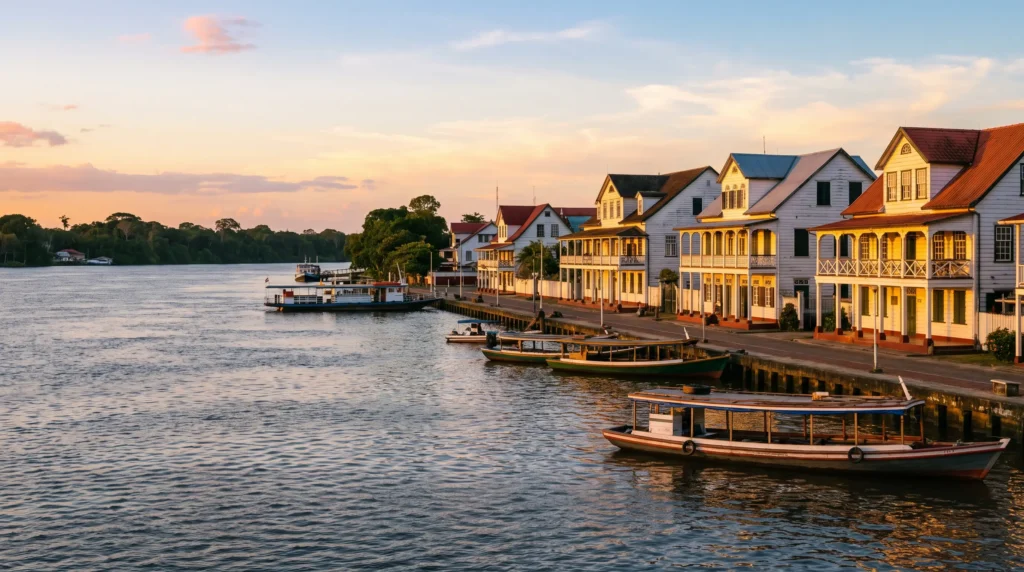
If you want to see Suriname at its loudest and most unified, be in Paramaribo on 31 December for Owru Yari — Sranan Tongo for “Old Year.” Unlike most countries’ countdown-to-midnight approach, Surinamese New Year’s Eve is an all-day event: from around 11 a.m. the historic downtown fills with families, strings of firecrackers (“pagara”) are set off block by block through the afternoon and evening in what’s known as the Pagara Estafette — a relay of noise and smoke believed to chase out bad luck before the year turns — building to fireworks at midnight over the Suriname River waterfront.
It sits outside the ideal weather window (December falls in the short rains), but if New Year’s is your trip anchor, nowhere else in the region does it with this much unrestrained, all-day street energy. If you’d rather time a visit to the dry season proper, the same UNESCO-listed waterfront hosts Suriname’s other major cultural flashpoints across the year: Holi Phagwa (the Hindu festival of colors, usually March) and Divali, both celebrated as national holidays by Surinamese of every background, not just Hindus — a good snapshot of how thoroughly the country’s festival calendar has become shared property.
Best Time to Visit Suriname (Season by Season)
Mid-August – November · Long dry season (peak)
The most reliable stretch for river travel, jungle lodges and interior flights — trails are passable, river levels are manageable for boat transfers, and this is generally considered the best all-round window to visit.
February – March · Short dry season
A shorter, slightly cooler dry spell that many locals actually prefer to the long dry season — good for a shoulder-season trip with fewer visitors and a fresher landscape.
April – August · Wet season
The rainy season runs roughly late April to mid-August, with May and June the wettest months. River levels rise, which is actually useful for reaching some interior lodges by boat, but expect afternoon downpours and muddier trails. This period overlaps with Galibi’s leatherback turtle nesting season, which runs roughly February through July-August, so turtle-watching trips cluster here despite the rain.
December – early February · Short rains
Lighter, more intermittent rain than the main wet season, bookended by Owru Yari at the very start and Holi Phagwa near the end.
Getting There — PBM, River Borders & the Ferry to French Guiana
Johan Adolf Pengel International Airport (PBM), also called Zanderij, sits about 45 kilometres south of Paramaribo and is the country’s only real international gateway, with the capital reachable by road in roughly an hour. The core international routes are KLM and Surinam Airways nonstop from Amsterdam, and Surinam Airways to Miami, alongside regional connections to Belém, Georgetown, Cayenne and Panama City on Copa. There is no direct flight from North America outside Miami, so most US and Canadian travelers connect through Amsterdam, Miami or Panama City.
Overland, Suriname borders Guyana to the west and French Guiana to the east, and both crossings involve water rather than a bridge. Eastbound, small ferries and long motorized canoes shuttle travelers across the Maroni River between Albina (Suriname) and Saint-Laurent-du-Maroni (French Guiana) throughout the day, a crossing of ten to fifteen minutes. Westbound, the Guyana border crossing runs via a ferry across the Corantijn River. Both borders are straightforward in daylight but come with limited operating hours, so plan crossings for the morning.
Getting Around — Buses, Bushtaxis & Boats
Paramaribo itself is compact and walkable, especially the UNESCO-listed historic core, and taxis and ride apps cover the rest of the city cheaply. Beyond the capital, the road network thins out fast: shared “bushtaxis” (minivans) connect coastal towns like Nieuw Nickerie and Albina for a few SRD, while a rental car (best booked in Paramaribo, roughly US$50–80/day) gives more flexibility for day trips to Commewijne’s old plantations or Brownsberg.
The interior is a different world entirely — there are almost no roads south of the coastal strip, so reaching rainforest lodges, the Central Suriname Nature Reserve or Maroon river villages means either a small domestic flight to an airstrip or, more commonly, a road transfer to a river landing followed by hours in a dugout canoe with an outboard motor. Budget a full day of travel each way for genuinely remote interior lodges — it’s slow, but the river approach is half the experience.
Top Regions — Paramaribo, the Plantations & the Deep Interior
Paramaribo
The capital and home to roughly half the country’s population, built around a UNESCO-listed historic inner city of Dutch colonial wooden architecture along the Suriname River — Fort Zeelandia, the Presidential Palace square, and streets lined with white clapboard buildings that feel more Caribbean-Dutch than anything else in South America.
Commewijne District
A short ferry ride across the river from Paramaribo, Commewijne holds the ruins of former cacao, coffee and sugar plantations, reachable by bike or car for an easy half-day of colonial-era history without the crowds of a formal heritage site.
Central Suriname Nature Reserve
A 1.6-million-hectare block of untouched primary rainforest in the west-central interior, built from three older reserves (Raleighvallen, Eilerts de Haan and Tafelberg) and inscribed by UNESCO in 2000. The signature hike is Voltzberg, a granite dome you climb before dawn for a sunrise view over unbroken canopy — one of the best short treks in the Guianas.
Brownsberg Nature Park
The most accessible rainforest reserve from Paramaribo — a few hours by road — with waterfalls, howler and spider monkeys, and views over the vast Brokopondo Reservoir, one of the largest artificial lakes in the world by surface area at roughly 1,560 square kilometres, created by damming the Suriname River in the early 1960s.
Galibi Nature Reserve
On the northeastern coast near the French Guiana border, Galibi hosts one of the largest leatherback turtle nesting colonies on Earth, alongside green, hawksbill and olive ridley turtles coming ashore roughly February through August.
Bigi Pan
A wetland reserve on the northwest coast known for scarlet ibis and flamingo colonies — a serious birding destination that barely registers outside specialist circles.
Jodensavanne & the Suriname River Interior
South of Paramaribo, Jodensavanne holds the ruins of a 17th-century Sephardic Jewish plantation settlement and synagogue, one of the earliest Jewish communities of consequence in the Americas, inscribed by UNESCO in 2023. Further upriver, Maroon villages along the Suriname and Marowijne Rivers — descendants of Africans who escaped Dutch plantation slavery and built autonomous societies deep in the forest — welcome respectful visitors through community-run lodges.
Culture & People — No Ethnic Majority, One Nation
Suriname’s 2012 census put the population at roughly 42.6% Asian-descended (mostly Hindustani and Javanese), 37.4% Afro-Surinamese, 13.4% multiracial, 3.8% Indigenous and a small European and Chinese share — meaning no single group forms a majority, a genuinely unusual demographic makeup for a country its size. Religious life mirrors that diversity: Christianity (roughly 48%), Hinduism (about 22%) and Islam (about 14%) all have significant followings, giving Suriname among the highest proportional Hindu and Muslim populations in the Americas.
Maroon communities — the Ndyuka, Saramaccaner and related groups descended from enslaved Africans who fled inland and won recognized autonomy from Dutch colonial authorities — maintain distinct languages, art and river-village life along the interior’s Suriname and Marowijne Rivers. Suriname’s national holiday calendar reflects the country’s mixed heritage directly: Divali and Holi Phagwa sit alongside Christmas and Eid as official days off, each celebrated across communities rather than siloed within one.
A Food Lover’s Guide to Suriname
Surinamese food is the clearest expression of the country’s mixed heritage on a plate: Javanese, Indian, Chinese, Creole and Indigenous cooking sit side by side on the same menu, often the same block. Start with pom — a Creole baked dish of grated tayer root and chicken, usually saved for holidays but sold daily in Paramaribo. Roti here means the full Hindustani meal — curried chicken or goat wrapped in flatbread with potato and long beans — while bakabana (fried plantain with peanut sauce) is the essential street snack.
Javanese influence shows up in bami and nasi goreng, sold from warungs across the capital, and saoto soup — a Javanese chicken broth with egg and bean sprouts — is a Paramaribo staple worth seeking out. Moksi meti, a mixed-meat Creole dish, and Chinese-Surinamese fried noodle joints round out a food scene that punches well above the country’s population. Wash it down with a locally brewed Parbo beer.
Off the Beaten Path
Voltzberg Dome, Central Suriname Nature Reserve
A pre-dawn climb up a granite inselberg deep in the reserve, rewarded with an unbroken sea of rainforest canopy stretching to the horizon and virtually no other visitors on the trail.
Jodensavanne
The ruins of the Americas’ earliest architecturally significant synagogue and its adjoining cemeteries, on a quiet bend of the Suriname River — a genuinely obscure UNESCO site even by UNESCO standards.
Maroon river villages
Community-based lodges upriver on the Suriname and Marowijne Rivers offer canoe transport, traditional wood-carving demonstrations and river life largely unchanged for generations — arranged through local operators rather than drop-in visits.
Bigi Pan flamingos
A mangrove-and-wetland boat trip on the northwest coast for scarlet ibis and flamingo colonies, popular with birders and almost no one else.
Practical Information
Money. The Surinamese dollar (SRD) floats and has weakened significantly against the US dollar in recent years, trading around 37 SRD to US$1 as of July 2026 — check the Central Bank of Suriname’s current rate before you go, since it moves. Cards work in Paramaribo’s hotels and larger restaurants but are unreliable elsewhere; carry cash, including some small-denomination USD, for the interior.
Safety. The US State Department rates Suriname at its lowest advisory level, “exercise normal precautions,” but flags pickpocketing and robbery in Paramaribo’s business and shopping districts, limited police presence outside the capital, and advises against walking alone at night near tourist hotels. Check current guidance from your own government before travel.
Health. Suriname was certified malaria-free by the WHO in June 2025, the first country in the Amazon region to achieve that status, so malaria prophylaxis is no longer the default recommendation it once was — though your doctor should have the final say. Yellow fever vaccination is required for entry if you’re arriving from a country with risk of transmission, and the CDC recommends it broadly for travelers to Suriname regardless. Mosquito-borne illnesses beyond malaria remain present — pack strong repellent, and check for any active chikungunya or dengue advisories before you travel, since outbreaks do occur periodically.
Connectivity & logistics. A local SIM or regional eSIM is worth arranging in Paramaribo; connectivity drops off fast in the interior, where many lodges run generator power only. Plugs: Type C and F, 127V. Time zone: UTC-3 year-round, no daylight saving.
Budget Breakdown — What Suriname Actually Costs in 2026
Suriname sits mid-pack for South America — pricier than you’d expect for how little tourism infrastructure exists, mainly because interior travel (flights, boat transfers, guided lodges) carries a real cost premium.
Budget (US$50–90/day): Guesthouse in Paramaribo, street food and warung meals, bushtaxis and shared transport, day trips rather than overnight interior stays.
Mid-range (US$120–220/day): A comfortable Paramaribo hotel, restaurant meals, a rental car for Commewijne and Brownsberg day trips, and a two- to three-night package at an accessible interior lodge with guided transport included.
Luxury/interior expedition (US$400+/day): Multi-day trips into the Central Suriname Nature Reserve or a Maroon river village with private guiding, domestic flights or dedicated boat charters, and full-board lodges — this is where costs stack up fastest, since remoteness is the product.
Build in a buffer for the Tourist Card fee, yellow fever vaccination if needed, and tipping 10% where service isn’t already included.
Planning Your First Trip to Suriname
The classic first-timer split is capital + canopy: fly into PBM, spend two to three nights in Paramaribo covering the UNESCO waterfront, Fort Zeelandia and a Commewijne plantation day trip, then head into the interior for three to four nights — Brownsberg if time or budget is tight, the Central Suriname Nature Reserve if you can spare the extra transfer day. Ten days lets you add Galibi for turtle season or a Maroon river village upstream. Given the Dutch colonial thread running through the whole country, it pairs naturally with our Netherlands guide for the other end of that history, or with our Brazil guide if you’re continuing on into the wider Amazon basin next door.
Frequently Asked Questions
Is Suriname safe for tourists in 2026?
The US State Department rates it at its lowest advisory tier, “exercise normal precautions,” which puts it on par with much of Western Europe on paper. The real-world caveats are petty crime (pickpocketing, robbery) in parts of Paramaribo and very thin police coverage once you leave the capital — standard city-smart precautions apply, and always check current advisories before you travel.
Do I need a visa to visit Suriname?
Most nationalities, including US, UK, EU and Canadian passport holders, need to arrange an online Tourist Card or e-visa in advance rather than getting one on arrival — it’s single-entry, generally valid around 90 days, and comes with a fee. Apply well before your flight, since airlines will check for it at check-in.
What language do people actually speak in Suriname?
Dutch is the official language of government, business and education — Suriname is the only country outside Europe where that’s the case — but Sranan Tongo functions as the everyday lingua franca, and Sarnami Hindi, Javanese and several Maroon and Indigenous languages are all widely spoken at home. English gets you by in Paramaribo’s tourism-facing businesses but thins out fast elsewhere.
Is it really true Suriname is malaria-free now?
Yes — the WHO certified Suriname malaria-free in June 2025, the first country in the Amazon region to reach that status, after driving cases down from around 15,000 a year in 2001 to essentially zero. Other mosquito-borne illnesses still circulate, so repellent and covering up at dusk remain sensible regardless.
When’s the best time to visit?
Mid-August through November, the long dry season, is the most reliable window for interior travel and river transfers. February–March offers a shorter, cooler dry spell with fewer visitors if you want to dodge the peak.
Suriname’s rainforest or Brazil’s Amazon — which one for a first rainforest trip?
Choose Suriname for scale-appropriate, low-crowd access — a short domestic hop or river transfer gets you into genuinely pristine, malaria-free primary forest with almost no other visitors. Choose Brazil’s Amazon for sheer scale, more developed lodge infrastructure and easier connections if you’re combining it with a longer South America itinerary.
Ready to Explore Suriname?
A UNESCO-listed Dutch colonial waterfront, a rainforest that covers more of its country than anywhere else on Earth, and a New Year’s Eve street party unlike anything else in the hemisphere — Suriname rewards the extra planning it demands. Go before the rest of the region catches on to what’s sitting quietly next door.
Explore More
- Brazil Travel Guide — the wider Amazon basin next door
- Netherlands Travel Guide — the other end of Suriname’s colonial history
- Ecuador Travel Guide — another compact gateway into Amazon rainforest
- Costa Rica Travel Guide — more rainforest, more developed eco-tourism infrastructure
How this guide was built
Published as part of Facts From Upstairs’ country guide series. Built from authoritative sources — Wikipedia’s Suriname, Brokopondo Reservoir and Jodensavanne entity pages, UNESCO’s listings for the Central Suriname Nature Reserve, the Historic Inner City of Paramaribo and the Jodensavanne Archaeological Site, the World Health Organization’s malaria-free certification announcement, the Central Bank of Suriname’s exchange-rate statistics, the US State Department’s Suriname travel advisory and country information page, the UK FCDO’s Suriname travel advice, and the US CDC traveler page for Suriname. Numeric claims carry inline citations.
Sources cited on this page
- Wikipedia — Suriname
- UNESCO — Central Suriname Nature Reserve
- UNESCO — Historic Inner City of Paramaribo
- UNESCO — Jodensavanne Archaeological Site
- UNESCO — The Making of a World Heritage Site in Suriname
- Wikipedia — Johan Adolf Pengel International Airport
- Wikipedia — Brokopondo Reservoir
- Wikipedia — Jodensavanne
- World Health Organization — Suriname certified malaria-free
- Central Bank of Suriname — Exchange Rate Statistics
- US State Department — Suriname Travel Advisory
- US State Department — Suriname Country Information
- UK FCDO — Suriname Travel Advice
- US CDC — Suriname Traveler Page
More country guides you might like
Plan your trip to Suriname
The booking tools we use ourselves. FFU may earn a commission at no extra cost to you.
Plan & book your trip to Suriname
Booking through these searches supports our guides at no extra cost to you.