
Languages of Moldova
All languages of Eastern Europe →fluent beta classical · classes by phone with Maya at ranas.ai/maya
Moldova Travel Guide — Europe’s Wine Cellar, Cave Monasteries & the Continent’s Least-Visited Corner
I get asked “wait, where is that?” more about Moldova than any other place I’ve written up for this site, and I understand why — it’s a landlocked sliver between Romania and Ukraine that most people can’t place on a map, with a population smaller than Chicago’s metro area. But underneath Chișinău and the vineyard hills sits one of the strangest wonders in Europe: a wine cellar so vast it has its own internal street names and traffic signs, because 200 kilometres of tunnels genuinely needs them. Add a cliffside cave monastery still inhabited by monks, a capital city that feels like a quiet Balkan secret, and food built on the same DNA as Romania’s, and you’ve got a country that rewards curiosity out of all proportion to how little most travelers know about it. It isn’t a place to visit lightly — I’ll get into the honest catches — but I haven’t met anyone who regretted going.
In This Guide
- Overview — Why Moldova Is Europe’s Most Overlooked Country
- National Wine Day — Moldova’s Biggest Weekend of the Year
- Best Time to Visit Moldova (Season by Season)
- Getting There — RMO Airport & Overland Routes
- Getting Around — Marshrutkas, Trains & Rental Cars
- Top Regions — Chișinău, Wine Country & the Dniester
- Culture & People — Romanian, Russian, Gagauz & More
- A Food Lover’s Guide to Moldova
- Off the Beaten Path
- Practical Information
- Budget Breakdown — What Moldova Actually Costs in 2026
- Frequently Asked Questions
Overview — Why Moldova Is Europe’s Most Overlooked Country
Moldova is a small, landlocked country squeezed between Romania and Ukraine, with a population of roughly 2.4 million and Romanian as its official language. It declared independence from the Soviet Union in 1991, and that Soviet hangover is still part of the texture of a visit — Lada taxis, concrete apartment blocks, and a slice of the country east of the Dniester River, Transnistria, that still flies Soviet-style imagery and isn’t recognized as independent by any UN member state. Since 2020 the country has pushed hard toward Europe under President Maia Sandu, becoming an EU candidate country in 2022 and opening accession talks in 2023 — so this is a nation actively in motion, not a museum piece.
What Moldova lacks in famous monuments it makes up for with one genuinely world-class claim to fame: wine. The country sits on some of the oldest viticultural soil in Europe, and its underground cellars are, quite literally, record-setting — Mileștii Mici was entered into the Guinness World Records in 2005 for the largest wine collection on Earth, spread through roughly 200 kilometres of tunnels carved from a former limestone quarry. Nearby Cricova runs a further 120 kilometres of cellars holding tens of millions of litres. Above ground, the country’s single UNESCO World Heritage inscription — the Struve Geodetic Arc, a chain of 19th-century survey points running from Norway to the Black Sea — has one of its 34 marker stations near the village of Rudi in northern Moldova.
What you won’t find is crowds, polished tourist infrastructure, or English signage outside Chișinău’s centre. This is a place for travelers who want to see a European country before it fully arrives on the circuit — cheap, quietly hospitable, and stranger than its size suggests.
National Wine Day — Moldova’s Biggest Weekend of the Year
Time an early-October trip around National Wine Day (Ziua Națională a Vinului), held the first weekend of October in central Chișinău — 3–4 October in 2026. More than 70 wineries set up tasting pavilions across the city centre, pouring indigenous varietals you won’t find on any shelf outside the region — Fetească Neagră, Fetească Albă, Rară Neagră — alongside folk music, grape-treading contests and free entry to the festival grounds.
It’s the one weekend a year when the country’s wine identity, usually experienced one cellar tour at a time, gets condensed into a single walkable, glass-in-hand afternoon. Hotels in Chișinău fill up and prices rise, so book ahead if you’re planning around it — but it’s also the easiest single day to understand why Moldovans consider winemaking closer to a national religion than an industry.
Best Time to Visit Moldova (Season by Season)
May – June · Green, mild, and quiet
Spring brings warm days, long light and blooming countryside without the summer heat. Vineyards are green rather than harvested, but this is a comfortable, uncrowded window for city walking and day trips to Orheiul Vechi.
September – early October · The sweet spot
Grape harvest, National Wine Day, mild temperatures and golden countryside make early autumn the single best stretch to visit — this is when Moldova’s identity as a wine country is most visible and most edible.
July – August · Hot and dry
Summer temperatures regularly push into the low-to-mid 30s°C. Manageable if you pace days around the heat, but not the season locals recommend for serious touring.
November – March · Cold, grey, cheap
Winters are cold with occasional snow; this is the off-season in every sense, though Chișinău’s Christmas market period brings a brief burst of life to the capital. Energy infrastructure has been strained in recent winters amid regional tensions, so check current conditions before a deep-winter trip.
Getting There — RMO Airport & Overland Routes
Chișinău International Airport (IATA code RMO, formerly KIV, ICAO LUKK) sits about 13 kilometres southeast of the city centre and is Moldova’s only airport with scheduled passenger service. There are no direct flights from North America; most travelers connect through Istanbul, Vienna, Warsaw, Bucharest or another European hub, with FlyOne, Wizz Air, HiSky and Turkish Airlines among the main carriers serving the route.
Overland, buses and shared taxis connect Chișinău to Bucharest (around 4–5 hours) and Iași across the Romanian border, and trains run to Bucharest as well. Since Russia’s invasion of Ukraine, direct overland routes into Ukraine are not advisable for casual tourism, and the border situation can shift — check current conditions before planning an overland Ukraine leg. All visitors should hold a passport valid at least three months beyond their departure date and, per UK guidance, proof of onward travel.
Getting Around — Marshrutkas, Trains & Rental Cars
Moldova is compact — you can cross the whole country in a day — but public transport is basic by Western European standards. Shared minibuses called marshrutkas link Chișinău to every town and most villages for a few dollars, departing when full rather than on a fixed schedule; they’re cheap and frequent but not built for comfort or reliability on a tight itinerary.
Chișinău itself is walkable in the centre, with trolleybuses and buses covering the rest for pocket change. For day trips to Orheiul Vechi, wine country, or the northern reaches near Soroca, a rental car (roughly US$25–45/day) or a hired driver gives far more flexibility than public transport — roads are serviceable on main routes and rougher on rural ones. Ride-hailing apps operate in Chișinău and are the easiest way to move around the capital itself.
Top Regions — Chișinău, Wine Country & the Dniester
Chișinău
The capital and largest city, home to roughly 695,000 people, rebuilt largely in Soviet style after World War II but softened by wide tree-lined boulevards, a lively café culture around Ștefan cel Mare Boulevard, and a genuinely good central market scene. It’s low-key rather than dramatic — most visitors use it as a base for wine-country day trips rather than a multi-day destination in itself.
Cricova & Mileștii Mici (Wine Country)
Two of the world’s largest wine cellars sit within an hour of the capital. Cricova runs about 120 kilometres of underground galleries holding more than 40 million litres of wine, with internal streets named after grape varieties. Mileștii Mici, the Guinness record-holder, stretches roughly 200 kilometres and holds close to two million bottles, including a reserve collection prized by visiting dignitaries. Tours run by golf cart or small train through galleries that stay a constant, cool 12–14°C year-round — bring a layer even in summer.
Orheiul Vechi
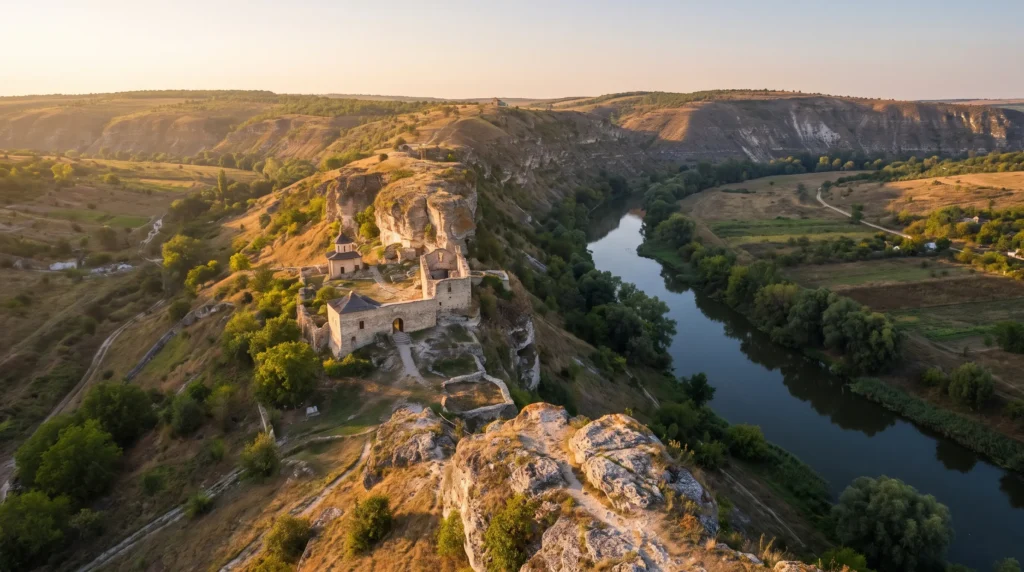
An open-air archaeological and monastic complex about 60 kilometres northeast of Chișinău, layering more than 2,000 years of history — Geto-Dacian fortifications, a Golden Horde settlement, and a still-active 15th-century cave monastery carved into limestone cliffs above the Răut River. It’s the single most photogenic stop in the country and an easy half-day or full-day trip from the capital.
Transnistria
A breakaway strip east of the Dniester River, unrecognized by any UN member state, running its own currency, border checks and Soviet-nostalgic capital in Tiraspol. It’s a genuinely strange day trip for the curious, but both the US and UK governments currently advise against travel there given the risk of conflict spillover from the region — treat it as an advanced-traveler detour, not a default stop.
Soroca & the North
Home to a well-preserved 15th-century fortress on the Dniester and known informally as the unofficial “capital” of Moldova’s Roma community, whose ornate hillside mansions are a striking, if controversial, local landmark. Further north, the village of Rudi holds the Moldovan station of the UNESCO-listed Struve Geodetic Arc, alongside its own historic monastery.
Gagauzia & the South
An autonomous Turkic-speaking region centred on Comrat, with its own distinct Orthodox Christian, Turkic-language culture unlike anywhere else in Moldova — a genuine off-circuit curiosity for travelers who’ve already done the wine trail.
Culture & People — Romanian, Russian, Gagauz & More
Romanian is the official language and the mother tongue of the majority, but Russian remains widely spoken and understood, particularly in Chișinău and the north and east; Ukrainian is common near the Ukrainian border, and the Gagauz people of the south speak a Turkic language of their own. Orthodox Christianity dominates religious life, and church holidays — Easter especially, celebrated on the Orthodox calendar — shape the social calendar more than secular ones.
Hospitality here runs generous and food-forward: being invited into a Moldovan home usually means being fed more than you can manage and having your wine glass refilled before you notice it’s empty. The Soviet era is still a living memory for older generations, and it shows up in architecture, transit and attitudes rather than as something performed for tourists — this is a country still actively renegotiating its identity between its Romanian roots, Soviet past and European future, and conversations about all three are common if you’re curious and respectful.
A Food Lover’s Guide to Moldova
Moldovan food shares deep roots with Romanian cuisine, built around hearty, filling staples. Mămăligă — a dense cornmeal polenta — anchors most traditional meals, often served alongside brânză (sheep’s cheese), sour cream and slow-cooked meat stews. Plăcinte, savory or sweet stuffed pastries filled with cheese, potato, cabbage or fruit, are the go-to street snack and bakery staple.
Zeamă, a sour chicken noodle soup, is the closest thing to a national comfort food, and sarmale — cabbage rolls stuffed with meat and rice — show up at every celebration. But the real headline is what’s in the glass: wine is woven into daily life at a level most Western visitors aren’t used to, with vineyards dating back millennia and household wine production still common in villages. Round out a meal with local brandy (divin) and, if you’re near Chișinău’s central market, fresh produce and honey sold straight off the farm.
Off the Beaten Path
Rudi & the Struve Geodetic Arc
A quiet northern village holding one of only 34 surviving stations of a 19th-century scientific survey chain stretching across ten countries from Norway to the Black Sea — Moldova’s sole entry on the UNESCO World Heritage List, and a spot almost no foreign tourists make the effort to reach.
Saharna Monastery
A cliffside monastery complex along a forested gorge in central Moldova, with waterfalls and hiking trails that see a fraction of Orheiul Vechi’s visitor numbers despite similarly dramatic scenery.
Gagauzia’s Villages
Comrat and the surrounding autonomous region offer a genuinely different cultural texture — Turkic language, distinct folk costume and cuisine — reachable as a long day trip or overnight from Chișinău.
Village Wine Cellars
Beyond Cricova and Mileștii Mici, small family wineries across the countryside welcome visitors for home-style tastings that feel nothing like the industrial-scale cellar tours — ask a local guide or your guesthouse host for an introduction.
Practical Information
Money. The Moldovan leu (MDL) trades at roughly 17–18 to the US dollar; rates fluctuate, so check the National Bank of Moldova’s published rate before a trip. Cards are widely accepted in Chișinău hotels, restaurants and larger shops, but cash is essential in villages, markets and smaller towns.
Safety. The US State Department rates Moldova Level 2 (Exercise Increased Caution) as of 2026, citing the unresolved Transnistria situation and, at times, reports of stray drone or missile debris landing in Moldovan territory amid the war in neighboring Ukraine — with no indication Moldova itself is being targeted. The UK’s FCDO separately advises against all travel to Transnistria and notes the country has faced energy-supply strain amid regional tensions in recent winters. Chișinău and the main tourist circuit are calm day to day, but check current advisories close to departure — this is a fast-moving situation, not a settled one.
Health. No unusual vaccination requirements beyond routine and MMU coverage, but the CDC flags mosquito, tick and flea-borne illness as a general regional risk, so bring repellent for rural areas and cave/monastery visits. Stick to bottled or filtered water outside major hotels.
Connectivity. An eSIM or local SIM covers the country cheaply; Chișinău Wi-Fi is generally solid, rural coverage patchier. Plugs: European two-pin (Type C/F), 230V. Time zone: Eastern European Time (UTC+2/+3 with DST).
Budget Breakdown — What Moldova Actually Costs in 2026
Moldova is one of the cheapest countries in Europe to visit, on par with or below its regional peers.
Budget (US$30–55/day): Hostel or budget guesthouse in Chișinău, market food and cafeteria-style meals, marshrutka travel, self-guided wine-country day trips by shared transport.
Mid-range (US$60–120/day): Comfortable city-centre hotel, restaurant meals with wine, a guided Cricova or Mileștii Mici cellar tour with tasting, a rental car or private driver day trip to Orheiul Vechi.
Luxury (US$180+/day): Boutique hotels, private wine-country tours with premium tastings, a driver for the full week, and stays built around National Wine Day or harvest season.
Wine cellar tours (with tastings) typically run US$15–40 depending on group size and vintage selection; a private driver for a full-day Orheiul Vechi trip runs roughly US$50–80. Tipping 10% is appreciated in restaurants but not obligatory.
Planning Your First Trip to Moldova
The classic first-timer route is Chișinău + wine country + Orheiul Vechi over three to four days: base yourself in the capital, spend a day at Cricova or Mileștii Mici, a day at Orheiul Vechi’s cave monastery, and a day exploring Chișinău’s markets and cafés. Add Soroca’s fortress or a Gagauzia detour if you have a week. Moldova pairs naturally with a longer Eastern Europe loop — many visitors combine it with our Romania guide for Bucharest and Transylvania, or our Bucharest city guide for the easiest overland gateway in. If wine is what drew you here, our Georgia guide covers the Caucasus’ own ancient wine tradition, and our Bulgaria guide rounds out a wider Balkan-adjacent itinerary.
Frequently Asked Questions
Is Moldova safe for tourists in 2026?
Chișinău and the main tourist circuit (wine country, Orheiul Vechi) are calm and low-crime day to day. The US State Department currently rates the country Level 2 (Exercise Increased Caution) over the unresolved Transnistria conflict and occasional stray debris linked to the war in neighboring Ukraine; both the US and UK advise against travel to Transnistria specifically. Check current advisories close to your departure date — this situation shifts.
Do I need a visa?
US, UK, EU, Canadian and many other passport holders can enter visa-free for up to 90 days within any 180-day period, provided your passport is valid at least three months beyond your stay.
Can I visit Transnistria as a tourist?
Day trips to Tiraspol are technically possible and some tour operators run them, but both the US and UK governments currently advise against travel to the region given the risk of conflict spillover — this isn’t a casual add-on for a first Moldova trip.
How many days do I need in Moldova?
Three to four days covers the essentials — Chișinău, one wine cellar, and Orheiul Vechi. A week lets you add Soroca, Gagauzia or a slower wine-country pace without rushing.
Is Moldova part of the EU or Schengen?
No. Moldova is an EU candidate country (since 2022, with accession talks opened in 2023) but is not a Schengen member — its border rules and 90-day visa-free allowance are entirely separate from the Schengen 90-day count.
What’s the easiest way to see the wine cellars?
Book an organized half-day tour from Chișinău to Cricova or Mileștii Mici — both run English-language tastings and are easily reached by pre-arranged driver or organized tour, less easily by public transport.
Ready to Explore Moldova?
Two hundred kilometres of wine tunnels, a cave monastery still lived in by monks, and a capital that hasn’t yet learned to perform for tourists — Moldova rewards exactly the kind of traveler who reads a guide this far down the page. Go before the rest of Europe catches on, and go with a healthy respect for the region it sits in.
Explore More
- Romania Travel Guide — Bucharest, Transylvania and the easiest overland gateway to Moldova
- Bucharest City Guide — the closest major international hub for onward or connecting travel
- Georgia Travel Guide — the Caucasus’ own ancient wine-country rival
- Bulgaria Travel Guide — round out a wider Eastern Europe itinerary
How this guide was built
Published as part of Facts From Upstairs’ country guide series. Built from authoritative sources — Wikipedia entity pages for Moldova, Chișinău International Airport, the Struve Geodetic Arc, Mileștii Mici and Cricova wineries, and Moldova’s visa policy; the UNESCO World Heritage Centre listing for the Struve Geodetic Arc; the National Bank of Moldova for currency data; the US State Department and UK FCDO Moldova advisory pages; the US CDC traveler page for Moldova; Moldova’s official tourism board (moldova.travel); and the official National Wine Day event site. Numeric claims carry inline citations.
Sources cited on this page
- Wikipedia — Moldova
- Wikipedia — Chișinău International Airport
- Wikipedia — Mileștii Mici (winery)
- Wikipedia — Cricova (winery)
- Wikipedia — Old Orhei
- Wikipedia — Visa Policy of Moldova
- UNESCO World Heritage Centre — Struve Geodetic Arc
- National Bank of Moldova
- US State Department — Moldova Travel Advisory
- UK FCDO — Moldova Travel Advice
- US CDC — Moldova Traveler Page
- Visit Moldova — Official Tourism Board
- National Wine Day of Moldova — Official Event Site
More country guides you might like
Plan your trip to Moldova
The booking tools we use ourselves. FFU may earn a commission at no extra cost to you.
Plan & book your trip to Moldova
Booking through these searches supports our guides at no extra cost to you.