
Languages of Monaco
All languages of Western Europe →fluent beta classical · classes by phone with Maya at ranas.ai/maya
Monaco Travel Guide — Casino Square, Grand Prix Streets & Europe’s Smallest Superpower
Monaco is roughly the size of New York’s Central Park, and it packs a sovereign monarchy, a Michelin-starred restaurant scene, a Formula 1 circuit, and one of the world’s most storied casinos into that space. It is the second-smallest country on Earth after Vatican City, ruled by the House of Grimaldi since 1297 with only brief interruptions — which makes it, almost unbelievably, one of the oldest ruling dynasties still on a throne anywhere. I’ll be honest about what Monaco is and isn’t: it is not a budget destination, it is not a beach-holiday sprawl, and if you show up during Grand Prix week without a hotel booked a year out, you will not find one. What it is: a genuinely walkable half-day (or full day) of belle-époque architecture, a clifftop aquarium built by a prince, and the strange thrill of standing on the exact hairpin turn where F1 cars have been braking since 1929. Go for an afternoon from Nice, or stay a night and watch the harbor lights come on — either way, it rewards curiosity more than it rewards a big wallet.
In This Guide
- Overview — Why Monaco Punches So Far Above Its 2 Square Kilometres
- Grand Prix Week — Monaco’s One Unmissable (or Unavoidable) Event
- Best Time to Visit Monaco (Season by Season)
- Getting There — No Airport, No Problem
- Getting Around — Elevators, Escalators & a Boat Across the Harbor
- Top Quarters — Monaco-Ville, Monte Carlo, La Condamine & Beyond
- Culture & People — A Country Where the Locals Are the Minority
- A Food Lover’s Guide to Monaco
- Off the Beaten Path
- Practical Information
- Budget Breakdown — What Monaco Actually Costs in 2026
- Planning Your First Trip to Monaco
- Frequently Asked Questions
Overview — Why Monaco Punches So Far Above Its 2 Square Kilometres
Monaco is a sovereign city-state wedged onto a strip of the French Riviera, bordered on three sides by France and on the fourth by the Mediterranean — a coastline just 3.83 kilometres long, among the shortest of any country. At 2.1 square kilometres it is the second-smallest state in the world after Vatican City, and it is the most densely populated. The House of Grimaldi has ruled here, with brief interruptions, since 1297, and the current constitutional monarchy under Prince Albert II runs alongside an elected 24-member National Council.
What built modern Monaco was a casino. The Monte Carlo Casino opened in 1865 (an earlier version dated to 1856), designed in part by Charles Garnier — the architect behind the Paris Opera — and it transformed a struggling principality into one of the wealthiest places on the planet. Monaco levies no income tax on individuals, and GDP per capita reached roughly $256,000 in 2023 — among the highest anywhere. Tourism and gaming, banking and finance, and real estate are the three pillars; banking assets alone run more than eight times the size of the entire economy.
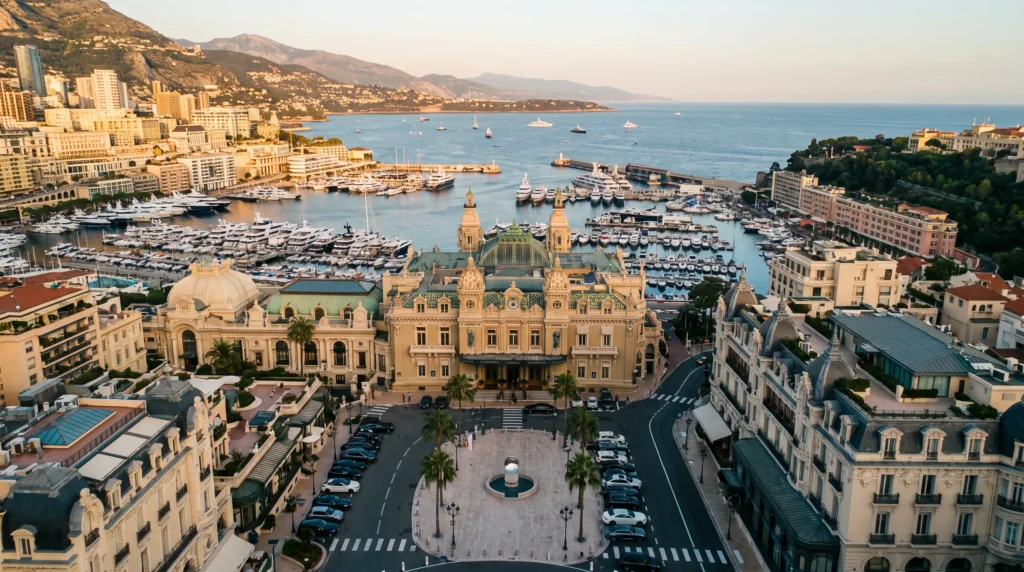
None of that is why most visitors come, though. They come because Monaco condenses an entire Riviera weekend into an afternoon: a hilltop old town with a working royal palace, a belle-époque casino square straight out of a Bond film, a clifftop aquarium a prince built, and — for one week a year — actual Formula 1 cars ripping through streets you were walking on the day before.
Grand Prix Week — Monaco’s One Unmissable (or Unavoidable) Event
The Monaco Grand Prix has run since 1929, making it one of the oldest motor races still on the calendar, and it forms part of motorsport’s unofficial “Triple Crown” alongside the Indianapolis 500 and Le Mans 24 Hours. The circuit is just 3.337 kilometres of public street looped 78 times — tight hairpins, a tunnel under the Fairmont hotel, barriers close enough to touch — which is exactly why drivers call it one of the most demanding tracks in the sport despite its low average speeds. Traditionally run in late May around Ascension weekend, the race shifts to the first weekend of June from 2026 onward.
Here is the honest catch: if you are not going specifically for the race, avoid this week entirely. Grandstands go up along the harbor a month in advance, hotel rates in Monaco and neighboring Nice and Menton triple or worse, and much of the principality is fenced off to non-ticket-holders. If you are chasing the race, book accommodation as much as a year ahead, and know that even standing-room “general admission” zones (around the pool and Rocher lookout) sell out. Everyone else: come the week before or after, when the grandstand skeletons are still up as a novelty but the crowds and prices have not yet arrived.
Best Time to Visit Monaco (Season by Season)
March – May · Spring (recommended)
Mild temperatures, blooming gardens, and the Riviera at its most photogenic — this is the sweet spot, provided you dodge Grand Prix week itself (late May into early June from 2026). Book well ahead if your dates overlap the race.
June – August · Summer (peak, hot & crowded)
Temperatures commonly reach the mid-to-high 20s Celsius, the harbor fills with superyachts, and Larvotto Beach gets genuinely busy. Hotel prices peak alongside cruise-ship days in nearby ports. The Monte-Carlo Summer Festival brings open-air concerts in July and August.
September – October · Fall (best value)
Warm sea, thinner crowds, and two of Monaco’s best events: the Monaco Yacht Show in late September and the Monte-Carlo Jazz Festival in November. Prices ease from summer peaks.
November – February · Winter (quietest & cheapest)
Cool but rarely cold, this is when Monaco is most itself: locals outnumber tourists, the Monte-Carlo International Circus Festival takes over a Fontvieille big top in January, and Monaco’s National Day on 19 November fills Casino Square with fireworks and a rare public glimpse of the royal family on the palace balcony.
Getting There — No Airport, No Problem
Monaco has no airport of its own. Nearly everyone arrives via Nice Côte d’Azur Airport (NCE), about 22 kilometres west along the coast (roughly 32 kilometres by road once you follow the highway around the headlands). Helicopter transfers with Monacair run the route in about 7 minutes and are a genuine, if pricey, Monaco tradition dating to the 1980s; the train is the fastest ground option at 20–25 minutes via Nice-Ville to Monaco-Monte-Carlo station; and the budget option is SNCF’s regional TER train or Bus 100 along the coast, both well under €5.
Driving in from Italy is straightforward too — the border town of Ventimiglia is about half an hour east along the A8 autoroute, making Monaco an easy add-on to an Italian Riviera itinerary. Cruise ships also call at Monaco’s port, tendering passengers directly into La Condamine for day visits. There is no passport control between France and Monaco; the border is entirely open, and Schengen entry rules apply as if you were arriving in France.
Getting Around — Elevators, Escalators & a Boat Across the Harbor
Monaco is small enough to cross on foot in under an hour end to end, but it is also stacked vertically on cliffside terrain, so “walkable” comes with stairs. The principality has quietly built one of the world’s densest networks of free public elevators and escalators connecting its hillside quarters — genuinely useful rather than a novelty, especially hauling luggage up from the train station, which itself sits underground.
The local bus network (Compagnie des Autobus de Monaco) covers every quarter for a couple of euros a ride, and a small electric shuttle boat, the Bateau Bus, crosses the harbor between La Condamine and Fontvieille in a few minutes flat — a nice way to skip the walk around the port. Taxis exist but are expensive even by Riviera standards. A rental car is close to pointless inside Monaco itself: parking is scarce and pricey, and everything worth seeing is elevator-and-foot distance apart.
Top Quarters — Monaco-Ville, Monte Carlo, La Condamine & Beyond
Monaco-Ville (Le Rocher)
The old town, perched on “the Rock” above the harbor, and the seat of government. Home to the Prince’s Palace, where the Changing of the Guard happens daily at 11:55am, the Cathedral of Our Lady Immaculate (Princess Grace and past Grimaldi rulers are entombed here), and the clifftop Oceanographic Museum, inaugurated in 1910 by Prince Albert I and directed for three decades by Jacques Cousteau. The museum’s aquarium alone holds around 4,000 fish species and 200 invertebrate families.
Monte Carlo
The largest and most famous quarter, built around Casino Square: the Belle Époque Monte Carlo Casino itself, the Paris Opera-adjacent Opéra de Monte-Carlo tucked inside the same building, and the Hôtel de Paris and Café de Paris across the square. This is Monaco’s postcard shot — and also its most expensive real estate by far. Non-VIP gaming rooms open from 2pm to 1am daily, with dress codes tightening after 7pm; Monégasque citizens themselves are actually barred by law from entering the gaming rooms.
La Condamine
The harbor district between the Rock and Monte Carlo, home to Port Hercule’s superyacht berths, the lively Place d’Armes market, and — during race week — much of the Grand Prix circuit’s pit straight and hairpin.
Fontvieille
The reclaimed-land quarter to the west: a marina, the Stade Louis II football stadium, the heliport, and the Princess Grace Rose Garden, planted with thousands of rose varieties in tribute to the late princess.
Larvotto
Monaco’s beach quarter — small artificial sand coves, a Japanese Garden gifted for the country’s 700th anniversary, and the closest thing to a lazy beach afternoon the principality offers.
Moneghetti & the Jardin Exotique
Uphill and inland, this quarter holds the Jardin Exotique’s cactus-covered cliffside gardens, prehistoric caves, and views back down over the entire principality that are arguably the best in Monaco.
Culture & People — A Country Where the Locals Are the Minority
Monaco is unusual among nations in that native Monegasques are outnumbered inside their own borders: roughly 70% of residents are foreign-born, and by nationality the French (around 47%) and Italians (around 16%) each outnumber ethnic Monegasques (also around 16%). French is the official language, but Italian is spoken everywhere and Monégasque — a dying Ligurian dialect once native to the Rock — survives mostly in street signs and ceremonial use.
The zero income tax policy is the open secret behind who actually lives here — it has drawn wealthy residents from across Europe for decades — but the ceremonial culture is genuinely old-world: the Changing of the Guard at the Palace, the ritual of the Rock’s Cathedral, and Monaco’s National Day on 19 November, when the Prince addresses crowds from the Palace balcony and the evening ends in fireworks over the harbor. Dress modestly for the Cathedral and Palace grounds, and don’t photograph the Palace guards up close during ceremonial duty.
A Food Lover’s Guide to Monaco
Monégasque cuisine sits at the crossroads of French and Ligurian Italian cooking. The signature street snack is barbagiuan — small fried pastries stuffed with Swiss chard, ricotta, and rice, sold at market stalls and considered Monaco’s unofficial national dish. Pair it with socca, the chickpea-flour flatbread shared with next-door Nice, and fougasse monégasque, a sweet, orange-blossom-scented bread studded with anise and nuts, traditionally eaten around Christmas.
At the other end of the spectrum, Monaco has one of the highest concentrations of Michelin stars per capita anywhere, led by Alain Ducasse’s Le Louis XV inside the Hôtel de Paris. The Place d’Armes market in La Condamine is the best low-cost way to eat well — fresh produce, cheese, olives, and prepared Niçoise and Monégasque dishes side by side, well outside Casino Square pricing.
Off the Beaten Path
Jardin Exotique & the Observatory Caves
Beyond the cactus gardens themselves, a stalactite-filled cave system under the cliff and a small prehistoric anthropology museum round out one ticket most day-trippers skip entirely in favor of the Casino photo op.
Princess Grace Rose Garden
A genuinely peaceful pocket of Fontvieille, easy to have almost to yourself even on a busy Casino Square day.
Èze village
Technically in France, but a short drive or bus ride from Monaco along the Moyenne Corniche: a medieval hilltop village with the kind of Riviera panorama postcards are made from, and a fraction of Monaco’s crowds.
The Naval Museum & Prince’s car collection
A collection of the ruling family’s vintage and race cars, tucked into Fontvieille and consistently overlooked in favor of the Oceanographic Museum next door on the Rock.
Practical Information
Money. Monaco uses the euro and even mints its own euro coins despite sitting outside the EU. Cards are accepted essentially everywhere; carry some cash only for small market stalls. Standard 20% VAT applies to goods and services, and travelers carrying €10,000 or more in cash must declare it at the border.
Safety. Monaco itself is exceptionally low-crime and heavily monitored by CCTV and police — one reason wealthy residents choose it. The relevant government advisories cover Monaco jointly with France and currently sit at a general “exercise increased caution” level, driven mainly by pickpocketing risk in crowded transit hubs and tourist sites, plus the standard terrorism and demonstration cautions that apply across France. Check your own government’s current advice before travel.
Health. No special vaccines are required; routine immunizations (including up-to-date measles coverage) should be current, and Hepatitis A/B are commonly recommended by health authorities for travelers. Tap water is safe to drink and pharmacies are plentiful.
Connectivity. EU/UK roaming plans generally work seamlessly given the France border; an eSIM covers everyone else. Plugs: French-style Type E, 230V. Time zone: Central European Time (UTC+1), with daylight saving in summer.
Budget Breakdown — What Monaco Actually Costs in 2026
Monaco is routinely ranked among the most expensive places on Earth to eat, sleep, and gamble — plan accordingly, and don’t be shy about basing yourself just over the border.
Budget (US$90–160/day): Base in Nice, Menton, or Beausoleil (technically the next town, a short walk from Casino Square) and day-trip in by train or bus; eat at the Place d’Armes market; skip paid attractions in favor of the free harbor and Rock walks.
Mid-range (US$250–450/day): A modest hotel actually inside Monaco, the Oceanographic Museum and Jardin Exotique, one sit-down dinner off Casino Square, casual gaming-room entry.
Luxury (US$800+/day): Hôtel de Paris or Hôtel Hermitage, dinner at Le Louis XV or an equivalent Michelin table, VIP casino salons, a helicopter transfer in from Nice instead of the train.
One quirk worth budgeting for: entry to the casino’s public gaming rooms carries a cover charge and a passport check, and the more exclusive salons cost more again — the free-to-look lobby and Belle Époque architecture are reason enough to visit even if you don’t play a hand.
Planning Your First Trip to Monaco
Most first-timers see Monaco as a day trip, and honestly, a day is enough to hit the highlights: train in from Nice in the morning, walk the Rock (Palace, Cathedral, Oceanographic Museum), ride the elevators down to Casino Square for lunch and a look inside the casino lobby, then finish at the Place d’Armes market before the train back. If you want more than a highlight reel, two nights lets you add the Jardin Exotique, a Larvotto beach afternoon, and an evening in Casino Square once the day-trippers have cleared out. Monaco pairs naturally with a wider French Riviera loop — base in Nice and add Èze, Antibes, and Cannes, or continue our full France travel guide for the rest of the country beyond the coast.
Frequently Asked Questions
Do I need a visa to visit Monaco?
There’s no border control between France and Monaco, so entry follows French/Schengen rules. US, UK, EU, and Canadian passport holders typically enter visa-free for stays up to 90 days; check current requirements before you travel.
Is Monaco part of the European Union?
No — Monaco is a sovereign microstate, not an EU member, though it uses the euro and mints its own coins under a monetary agreement with the EU.
Can I gamble at the Monte Carlo Casino as a tourist?
Yes — non-VIP gaming rooms are open to visitors from 2pm to 1am daily with a cover charge and passport check, and dress codes tighten in the evening. Interestingly, Monaco’s own citizens are legally barred from the gaming floor.
Is Monaco too expensive for a budget traveler?
Staying overnight in Monaco itself is genuinely costly, but seeing it isn’t: the Rock, harbor, gardens, and Casino Square exterior cost nothing, and basing yourself in Nice or Menton and day-tripping in keeps costs close to any other Riviera stop.
Should I visit during the Monaco Grand Prix?
Only if the race itself is the point of your trip — hotels book out up to a year ahead and prices multiply. Otherwise, aim for the week before or after, or a different season entirely.
Is Monaco safe?
Very — it’s one of the most heavily policed and monitored places in Europe. The main practical risk is pickpocketing in crowded tourist spots and transit hubs, the same as anywhere on the French Riviera.
Ready to Explore Monaco?
A clifftop museum a prince built, an elevator system that saves your knees, a casino square you’ve seen in a dozen films before you ever set foot in it — Monaco delivers an outsized day (or two) for a place you can walk end to end before lunch. Just book around the Grand Prix, not into it, unless racing is exactly why you’re going.
Explore More
- Nice City Guide — Monaco’s gateway city, 22km down the coast
- France Travel Guide — the rest of the French Riviera and beyond
- Italy Travel Guide — the Italian Riviera is a half-hour drive east
- Malta Travel Guide — Europe’s other glamorous Mediterranean microstate
How this guide was built
Published as part of Facts From Upstairs’ country guide series. Built from authoritative sources — Wikipedia’s Monaco, Demographics of Monaco, Economy of Monaco, Monte Carlo Casino, Monaco Grand Prix, and Oceanographic Museum entity pages, the US State Department’s France & Monaco travel advisory, the UK FCDO Monaco travel advice, and the US CDC traveler page for Monaco. Numeric claims carry inline citations.
More country guides you might like

Plan your trip to Monaco
The booking tools we use ourselves. FFU may earn a commission at no extra cost to you.
Plan & book your trip to Monaco
Booking through these searches supports our guides at no extra cost to you.