
Languages of Taiwan
All languages of Eastern Asia →fluent beta classical · classes by phone with Maya at ranas.ai/maya
Taiwan Travel Guide — Night Markets, Marble Gorges & Sky Lanterns
Taiwan Travel Guide
📋 In This Guide
- Overview — Why Taiwan Belongs on Every Bucket List
- 🏮 Pingxi Sky Lantern Festival 2026
- Best Time to Visit Taiwan (Season by Season)
- Getting There — Flights & Arrival
- Getting Around
- Top Cities & Regions
- Taiwanese Culture & Etiquette
- A Food Lover’s Guide to Taiwan
- Off the Beaten Path
- Practical Information
- Budget Breakdown
- Planning Your First Trip to Taiwan
- Frequently Asked Questions
Overview — Why Taiwan Belongs on Every Bucket List
Taiwan is the East Asian country that most travellers underestimate until they arrive. It is sweet-potato-shaped, roughly the size of the Netherlands and Belgium combined, and it packs marble gorges, subtropical coastline, volcanic hot springs, a 3,952-metre mountain spine topped by Yushan (Jade Mountain), and some of the densest, friendliest street food on Earth into a single island you can cross end-to-end by high-speed rail in under two hours.
The country stretches 394 kilometres from Keelung in the north to Cape Eluanbi in the south and 144 kilometres at its widest point, yet the Central Mountain Range slices it into two distinct worlds. The western coastal plains hold roughly 90% of the 23.4-million population across Taipei, Taichung, Tainan and Kaohsiung. The east coast — Hualien, Taitung, and the Pacific cliff line — stays rural, indigenous, and startlingly green. Offshore, the Penghu, Kinmen, Matsu, Green Island, and Orchid Island archipelagoes extend Taiwanese territory far toward Fujian and out into the Pacific.
Two contrasts define the place. First, infrastructure runs with Japanese-grade precision: the Taiwan High Speed Rail posts an on-time rate above 99.6%, MRT trains announce stops in four languages (Mandarin, Taiwanese Hokkien, Hakka, and English), and 7-Eleven handles everything from utility bills to HSR bookings to parcel pickup. Second, everyday manners are warmer and more improvisational than in Japan or Korea — shopkeepers chat, strangers walk you to the bus stop, and the night-market vendor who just sold you oyster omelette is perfectly happy to draw a map to the next stall on the back of a napkin.
Taiwan also punches disproportionately for its size on cuisine. It is the birthplace of bubble tea (invented in Taichung in 1986), home to the global Din Tai Fung xiaolongbao dynasty, and a Buddhist-influenced vegetarian superpower with an estimated 13–14% meat-free population — the highest share in Asia. Tainan still serves the 1895-era danzai noodles that defined Taiwanese street food, while Taipei runs a dense stack of Michelin-starred dim sum parlours and craft-cocktail bars. A full night-market dinner — beef noodle soup, scallion pancake, papaya milk — still costs under NT$300 (~$9 USD), which is why repeat visitors treat Taiwan less like a destination and more like a personal cafeteria with marble cliffs bolted on.
🏮 Pingxi Sky Lantern Festival 2026 — You’re Right on Time
Every February Taiwan’s most photographed image repeats itself: thousands of paper lanterns — each inked with handwritten wishes — lifting off simultaneously from the Pingxi Valley rail line, drifting through the mist above the old coal-mining town of Shifen and igniting the night sky over the disused Japanese colonial railway. The 2026 edition runs from Lunar New Year’s Eve through Yuanxiao (the 15th day of the lunar calendar), bracketing two of Taiwan’s most travel-heavy weeks and drawing roughly 400,000 visitors across the festival window.
- First mass release: February 17, 2026 (Lunar New Year, Shifen Old Street)
- Peak window: February 17 – March 3, 2026, with six scheduled release nights
- Peak night: Yuanxiao Lantern Festival, March 3, 2026 — the largest single release
- Shifen Old Street: main stage, biggest crowds, continuous daytime private releases
- Pingxi Old Street: quieter square one stop down the branch line
- Jingtong Station: southern terminus, easiest crowd escape
The parallel Taipei Lantern Festival lights the Zhongzheng District with large-scale installations across the same two-week window, and the rotating Taiwan Lantern Festival — hosted by a different city each year, with 2026’s host confirmed through the Tourism Bureau — adds a third venue for travellers who want the spectacle without the Pingxi rail bottleneck. Tainan’s parallel Yanshui Beehive Fireworks Festival on the same Yuanxiao night is Taiwan’s loudest alternative: millions of bottle rockets fired point-blank into crowds wearing motorcycle helmets, held annually since the 1880s.
Best Time to Visit Taiwan (Season by Season)
Spring (Mar–May)
Spring is Taiwan’s narrow sweet spot: daytime temperatures climb from 18°C to 26°C, Yangmingshan cherry and calla-lily blooms peak in late February through March, and Mazu’s annual nine-day pilgrimage from Dajia Jenn Lann Temple (April) turns central Taiwan into a rolling street festival that moves roughly 340 km across four counties. The downside is the plum-rain (meiyu) season: humid, grey afternoons concentrated in mid-May with 10–14 rainy days per month. The reward is the best window for hiking Taroko’s rim trails, Yushan’s summit route, and the Caoling Historic Trail before summer typhoons and landslides close them.
Summer (Jun–Aug)
Hot, sticky, and typhoon-prone — the west-coast cities run 27–34°C with 80%+ humidity and daily afternoon thunderstorms. Taipei Dragon Boat Festival races at Dajia Riverside Park anchor mid-June, Ghost Month (August) brings temple opera, beach-avoidance superstition, and heavy night-market crowds, and Kenting at the southern tip keeps surfable swell through the season. Build one flexible day into any July or August itinerary: a single direct-hit typhoon closes the HSR and east-coast rail for 24–48 hours and cancels domestic flights outright.
Autumn (Sep–Nov)
The sweetest weather of the year. Temperatures settle at 22–28°C, humidity drops sharply, and typhoon risk tapers after mid-September. October and November are the best months to attempt a full west-coast HSR plus east-coast gorge loop; Alishan cloud-sea sunrises and Hehuanshan’s 3,275-metre ridge are most reliable. The Mid-Autumn Festival in late September or early October fills parks with families grilling street-side barbecue — a specifically Taiwanese variation that has no analogue elsewhere in the Sinosphere and turns every residential lane into a roadside cookout.
Winter (Dec–Feb)
Cool, damp, and cheaper. Taipei runs 13–20°C with persistent drizzle; Kaohsiung and Kenting stay warm at 18–22°C. Lunar New Year (mid-February 2026) overlaps with the Pingxi Sky Lantern and Taiwan Lantern Festivals but closes many family-run restaurants for the first three days. Beitou, Wulai and Jiaoxi hot-spring resorts hit peak occupancy; book two weeks ahead. Yangmingshan dusts with rare snow one or two mornings a year, shutting down every mountain road instantly.
Shoulder-season tip: Late October through late November delivers the best weather and the smallest crowds. Avoid Lunar New Year week itself if you want open kitchens and functioning night markets; target the two weeks immediately after for dry air and empty temples.
Getting There — Flights & Arrival
Most international travellers arrive at Taoyuan International, located 40 km west of central Taipei. Kaohsiung in the south and Taichung’s smaller airport both handle regional flights from Japan, Korea, and Southeast Asia — useful for open-jaw itineraries that skip backtracking up the west coast.
- Taoyuan International (TPE) — Taoyuan Airport MRT reaches Taipei Main Station in 35–40 minutes for NT$150
- Kaohsiung International (KHH) — Kaohsiung MRT Red Line, ~15 minutes to city centre
- Taipei Songshan (TSA) — city-centre airport handling Tokyo Haneda, Seoul Gimpo, and Shanghai Hongqiao; Taipei Metro Brown Line at the terminal door
Flight times: 13–14 hours nonstop from LAX or SFO on EVA Air or China Airlines; 14–16 hours from London or Paris, usually with a Bangkok or Hong Kong stop; 3.5–4 hours from Singapore or Bangkok on direct EVA Air or China Airlines flights.
Flag carriers: China Airlines, EVA Air, and premium newcomer Starlux Airlines (launched 2020, now serving Tokyo, LAX, SFO and Bangkok).
Visa / entry: 66 countries — including the US, Canada, UK, Australia, Japan, and most EU members — enter visa-free for up to 90 days. No pre-arrival registration is required for short-stay visitors, though the Taiwan Customs online declaration saves 10 minutes on arrival.
Getting Around — High-Speed Rail, IC Cards & the West-Coast Spine
Taiwan’s west coast is built around the Taiwan High Speed Rail (THSR), which connects Taipei to Kaohsiung in well under two hours and makes same-day city hops realistic from a single base. The east coast relies on the older, slower Taiwan Railway Administration (TRA) network through Hualien and Taitung, and the remote mountain interior is served by branch lines, buses, and scooter rental. The island is small enough that virtually everything on a first-timer’s list can be reached without renting a car.
- Taiwan High Speed Rail (THSR): top speed 300 km/h
- Taipei → Kaohsiung (HSR): 1 hour 45 minutes
- Taipei → Taichung (HSR): ~50 minutes
- Taipei → Hualien (TRA Puyuma): ~2 hours 10 minutes
Rail / transit pass: the THSR 3-Day Pass for foreign passport holders costs NT$2,500 (~$77 USD) and earns its keep only if you plan one Taipei–Kaohsiung round trip plus a side leg inside three days. Point-to-point early-bird fares booked online run 10–35% below list price and usually beat the pass for slower itineraries.
IC cards: EasyCard (Taipei / national), iPASS (Kaohsiung / national), and icash 2.0 (convenience-store-focused) all work interchangeably across every MRT system, TRA local trains, YouBike share bikes, intercity buses, and retail. One card covers the entire country; buy at any airport or station kiosk for NT$100 deposit.
Apps: Google Maps handles transit routing nationwide; Bus+ (台灣公車通) shows live bus arrivals down to the village level; T Express is the official THSR booking app.
Top Cities & Regions
📍 Map of Taiwan: Every Place in This Guide
🗼 Taipei
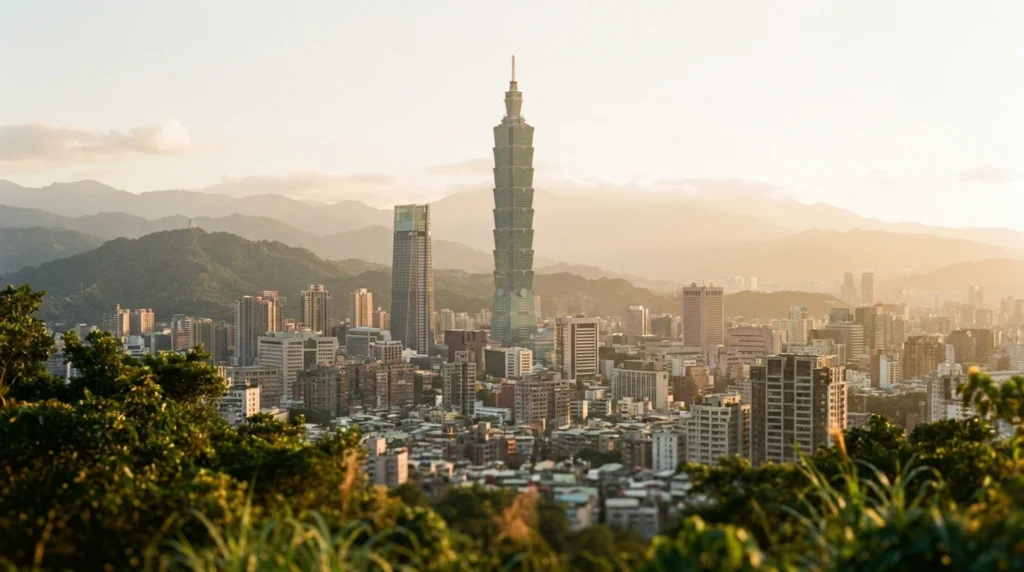
Capital, political centre, night-market capital, and gateway to Yangmingshan’s volcanic slopes and the hot-spring enclaves of Beitou and Wulai. Taipei is the densest, most walkable and most English-literate of Taiwan’s cities; plan four nights minimum to cover its major neighbourhoods, its museum row around Shilin, and the surrounding day-trip circuits through Jiufen, Pingxi and Keelung.
- Taipei 101 observatory and the Xinyi district skyline at blue hour
- Longshan Temple in the old Wanhua quarter — the city’s spiritual anchor since 1738
- Shilin and Raohe night markets, each good for a long evening of stall-hopping
Signature dishes: beef noodle soup, xiaolongbao at Din Tai Fung’s Xinyi flagship, and bubble tea from Chun Shui Tang’s Fuxing branch.
🚢 Kaohsiung
Taiwan’s southern port city — warmer year-round than Taipei, architecturally bolder, and home to the country’s most ambitious waterfront redesign, with the Weiwuying National Centre for the Arts anchoring the skyline. Kaohsiung pairs well with a Kenting beach extension at the island’s southern tip and with the narrow-gauge branch line down to Fangliao.
- Pier-2 Art Center — a converted warehouse district with outdoor sculpture walks
- Lotus Pond with its twin Dragon and Tiger Pagodas and the Confucius Temple
- Cijin Island ferry and seafood street — 10 minutes across the harbour on the NT$30 public ferry
Signature dishes: danzai noodles, papaya milk, and milkfish breakfast sets from the Liuhe Night Market.
🏯 Tainan
Taiwan’s oldest city and its culinary soul — four centuries of Dutch, Ming and Qing heritage compressed into walkable, scooter-friendly lanes. Tainan served as Taiwan’s capital from 1683 to 1887, and every food writer who visits returns convinced it beats Taipei on street food per square metre.
- Anping Old Fort (Fort Zeelandia, built 1624 by the Dutch East India Company)
- Chihkan Tower (Fort Provintia) in the old city core, built 1653
- Shennong Street’s restored Qing-era shophouses and the National Museum of Taiwanese Literature
Signature dishes: coffin bread, milkfish congee, beef soup (niu rou tang), and the original danzai noodles at Du Hsiao Yueh (est. 1895).
🫖 Taichung
Central Taiwan’s creative hub, the birthplace of bubble tea in 1986, and the logical jumping-off point for Sun Moon Lake, Cingjing Farm, and the Alishan Forest Railway. The Taichung HSR station, 30 minutes by feeder rail from the old city, makes it the fastest regional base.
- National Taichung Theater by Toyo Ito — curvilinear concrete, free to enter
- Rainbow Village folk-art lane painted by a single veteran, now over 100 years old
- Fengjia Night Market, Taiwan’s largest by stall count
Signature dishes: bubble tea at Chun Shui Tang’s original Sichuan Road shop, Taichung sun cake (taiyang bing), and pineapple cakes from the old JiaJia bakery lane.
🏞️ Hualien & Taroko
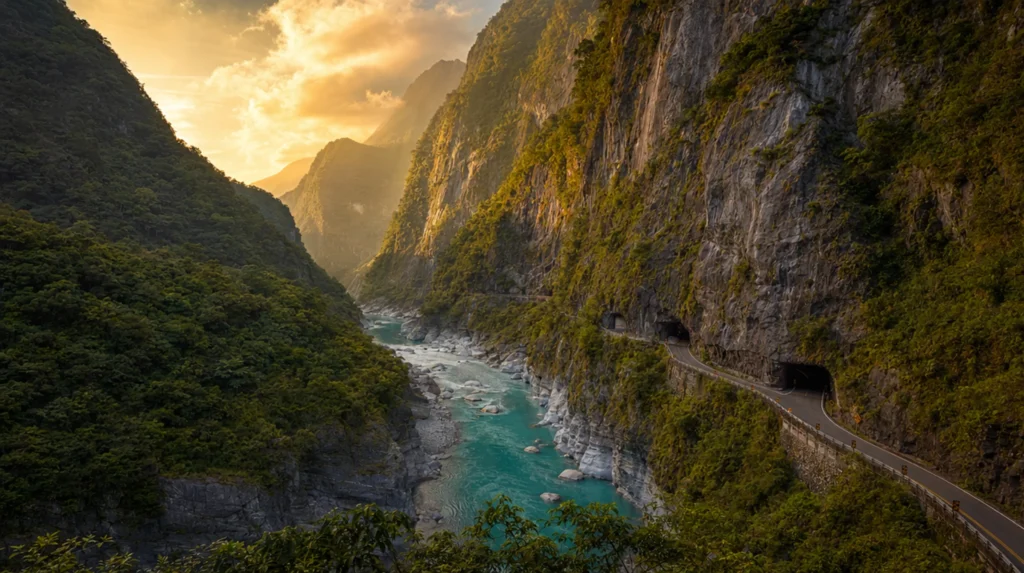
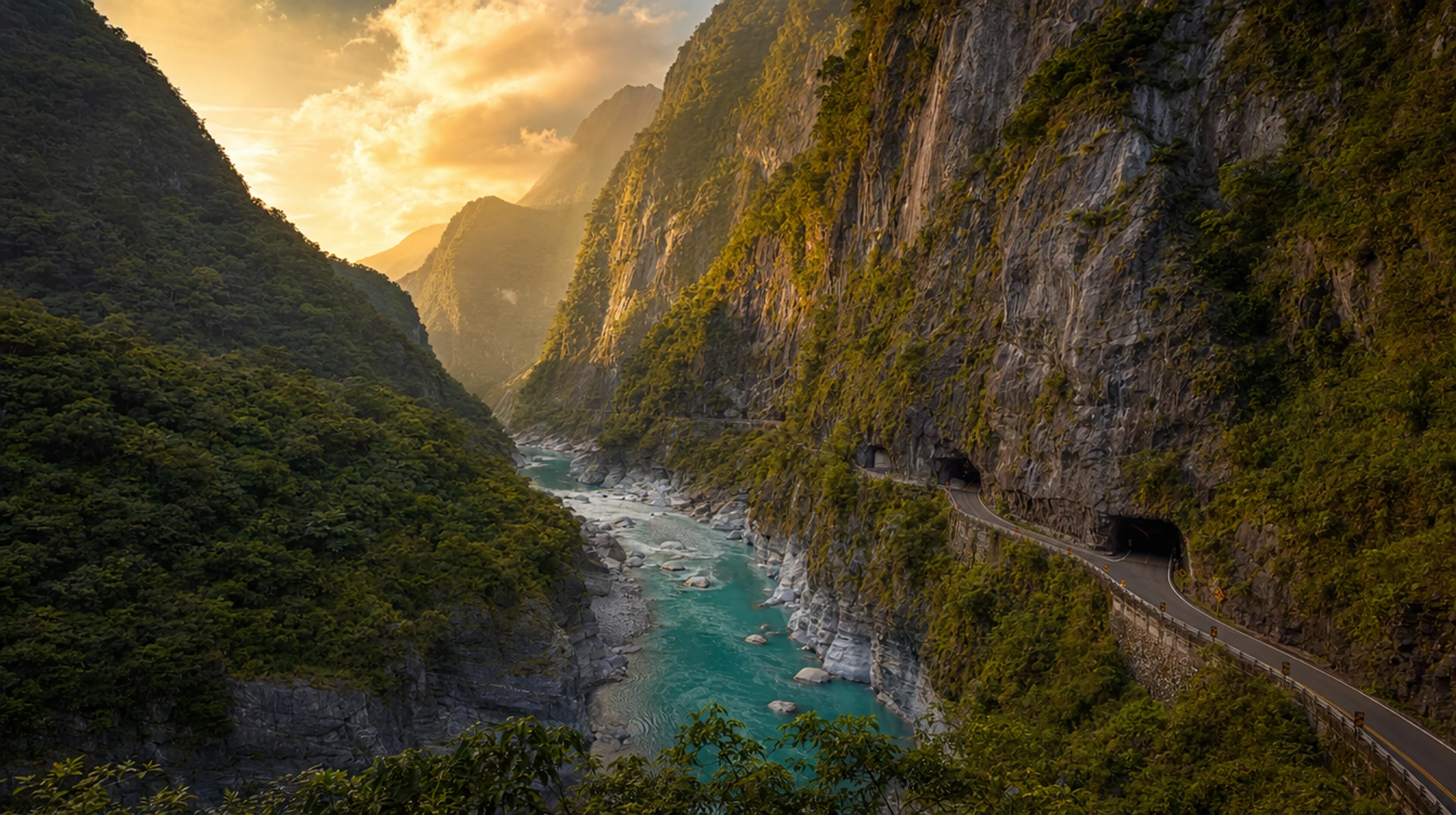
East-coast gateway to Taroko Gorge — 19 kilometres of marble canyon walls carved by the Liwu River over millions of years. Hualien itself is a laid-back grid city with an excellent night market; the gorge is the real draw. Parts of Taroko National Park remain closed or restricted following the April 2024 Hualien earthquake; check park alerts and book a guided driver before travelling.
- Swallow Grotto (Yanzikou) Trail along the sheer gorge wall
- Qingshui Cliffs dropping 800 metres straight into the Pacific
- Qixingtan black-pebble beach north of Hualien city
🌄 Sun Moon Lake & Nantou
Taiwan’s largest freshwater lake, wrapped in Thao indigenous villages and high-mountain tea country. Nantou County behind it holds Cingjing Farm’s alpine meadows at 1,700 metres and the Alishan sunrise railway. The lake ropeway, ferry loop, and 29-km bike trail around the shore combine into a full day without driving.
- Sun Moon Lake Ropeway to the Formosan Aboriginal Culture Village
- Wenwu Temple overlooking the northern shore
- Cingjing Farm alpine meadows at 1,700 metres
Signature dishes: president fish (zongtong yu) from the lake, and high-mountain Oolong tea grown on the surrounding ridges of Lugu and Shanlinxi.
Taiwanese Culture & Etiquette — What to Know Before You Go
The Essentials
- Remove shoes when entering private homes, temple inner halls, and most homestays and guesthouses; a rack, tray, or pile of slippers at the door is the signal. Hotel rooms generally keep the shoes-on convention.
- Queue quietly on MRT platforms — stand right, walk left on escalators, and leave the dark-blue priority seats empty even on an empty carriage. Locals almost never fill them.
- Eating, drinking and chewing gum are prohibited on MRT platforms and trains, enforced by fines up to NT$7,500. Water included. Sealed beverages must stay in your bag for the duration of the journey.
- Tipping is not customary. Mid-range restaurants and above add a 10% service charge automatically; rounding up taxi fares is appreciated but never expected, and hotel bellhops do not expect gratuity.
- At temples, keep phones silent, step over (never on) the raised wooden doorsill, enter through the right-hand dragon door, and exit through the left-hand tiger door — the middle door is reserved for deities and senior clergy.
Night-Market Etiquette
- Cash only at most stalls. Pull NT$100 and NT$500 notes before arriving — 7-Eleven ATMs work for foreign Visa, Mastercard and Plus cards if you run dry mid-market.
- Order by pointing at the photo menu or at the food already on display in the front vitrine. Mandarin is welcome but not required. A nod and a finger-count for quantity will handle 95% of transactions.
- Stand-and-eat is the norm. Vendors expect you to finish on the spot at the counter or stool, and to return the bowl, chopsticks, or fold-out stool to the stall before moving on.
- Carry a small bag for your own trash. Night markets have very few public bins and littering draws fines of up to NT$6,000 under the Waste Disposal Act.
A Food Lover’s Guide to Taiwan
Taiwan may be the best-value food country in Asia. A full night-market dinner costs under NT$300 (~$9 USD), a sit-down beef noodle bowl runs NT$180–260, and the queue-out-the-door dumpling houses of Yongkang Street rarely cross NT$400 per person. The cuisine itself is a layered inheritance: Hokkien and Hakka village cooking from Fujian province brought by 17th-century settlers, five decades of Japanese colonial refinement between 1895 and 1945 that introduced bento culture and ramen-style noodles, a wave of post-1949 mainland regional chefs who brought Sichuan, Shandong and Jiangsu techniques with the Republic of China government, and a 13–14% vegetarian population that sustains entire parallel Buddhist kitchens. Indigenous Austronesian traditions survive in the east-coast Hualien and Taitung food scenes: millet wine, flying fish, wild mountain pig.
Practical advice: the highest-density eating neighbourhoods are Taipei’s Yongkang Street and Raohe Night Market, Tainan’s Guohua Street and Shennong Street, Taichung’s Fengjia Night Market, and Kaohsiung’s Liuhe Night Market. Each opens roughly 5 p.m. and runs to midnight; go hungry, grazing style, across at least six stalls. Cash is universal, English menus are common, and vegetarian (素) signage is easy to spot.
Must-Try Dishes
| Dish | Description |
|---|---|
| Beef noodle soup (牛肉麵) | Taiwan’s unofficial national dish: hand-pulled wheat noodles, braised beef shank, and a soy-spice broth. Taipei hosts an annual Beef Noodle Festival every November. |
| Xiaolongbao (小籠包) | Soup dumplings perfected at Din Tai Fung (founded Taipei, 1958); the house standard is 18 pleats per skin, measured against an 8-gram weight target. |
| Bubble tea (珍珠奶茶) | Milk tea with chewy tapioca pearls, invented in Taichung in 1986 at either Chun Shui Tang or Hanlin — the two shops’ competing claims are themselves a tourist stop. |
| Lu rou fan (滷肉飯) | Finely diced braised pork belly over rice; the comfort-food baseline sold at every neighbourhood diner for NT$40–70. |
| Stinky tofu (臭豆腐) | Fermented tofu, deep-fried, topped with pickled cabbage and chili sauce. The olfactory gateway to serious night-market eating. |
| Oyster omelette (蚵仔煎) | Small oysters folded into a translucent sweet-potato-starch batter with greens and a sweet chili glaze. Signature of the Tainan and Keelung night markets. |
Convenience-Store Culture
Taiwan has roughly 13,700 convenience stores, the highest density of any country in the world. 7-Eleven and FamilyMart dominate the market, with Hi-Life filling the third-place niche. These are not just corner shops: Taiwanese convenience stores pay utility bills, dispense HSR tickets, print documents, sell hot tea-eggs and microwaved bento, accept e-commerce package pickup, and function as round-the-clock rest stops for cyclists, hikers, scooter travellers, and exhausted tourists on Lunar New Year night when everything else is shut. Many stores have seating areas with free WiFi, hot water dispensers, and microwave access — a functioning coffee shop for the price of a NT$50 bento.
- Chains: 7-Eleven, FamilyMart, Hi-Life
- Signature items: tea eggs (chá yè dàn) simmered in the front-counter pot, oden-style hot-pot skewers pulled from a broth vat, microwaved lu rou fan bento boxes, fresh soy milk and hot taro bread from the morning pastry rack, plus full-service bill payment, HSR ticketing, and iCash top-up at the register.
Off the Beaten Path — Taiwan Beyond the Guidebook
Alishan Forest Railway
The narrow-gauge 1912 Japanese logging line climbs from 30 metres to 2,274 metres through three vegetation zones — broadleaf hardwood, camphor, and cloud-forest cypress — with switchbacks and spiral tunnels that the Swiss rack-rail network openly admires. The main line partially reopened in 2024 after a 15-year landslide closure and now runs scheduled passenger service from Chiayi to Fenqihu and onward toward Alishan Station on select weekends. Book seats several weeks ahead; the pre-dawn sunrise cloud-sea run from Alishan Station to Zhushan viewpoint is Taiwan’s single most oversubscribed train.
Lukang
A Qing-dynasty port town an hour south of Taichung, preserved intact because the harbour silted up and main trade routes bypassed it after the Japanese annexation in 1895. Longshan Temple (1786), Mazu Temple, the Nine-Turn Lane of deliberately curved alleys built to break the sea wind, the Folk Arts Museum in the old Koo family mansion, and a handful of cake shops still hand-pressing pineapple cakes and phoenix-eye pastries make this one of the best-preserved historic street grids on the west coast.
Matsu Islands
A military-outpost archipelago 20 km off the Fujian coast, reached by overnight ferry from Keelung or a 50-minute flight from Taipei Songshan. Fortified Cold-War tunnels, traditional Eastern Min stone-block villages, and the April–June “blue tears” bioluminescent algal bloom in Nangan’s coves are the main draws. The bloom peaks around the new moon and in moonless weather windows — plan travel dates around the lunar calendar, and bring a dedicated low-light camera or long-exposure phone app.
Kinmen
Taiwan’s former Cold-War frontline sits 2 km off Xiamen. The island still wears its military past openly: Cold-War-era tunnels bored through granite, PLA artillery-shell fragments repurposed into cleavers by the famous Maestro Wu forge (one shell yields roughly 60 cleavers), Fujian-style swallowtail-roof villages, and the 70-year-old Kinmen Kaoliang sorghum distillery that makes the country’s most prized clear liquor at 58% ABV.
Orchid Island (Lanyu)
A volcanic island 90 km off Taitung, home to the Tao indigenous people and their handpainted tatala fishing boats, which the community still launches in annual flying-fish ceremonies. Reached by ferry from Houbihu or Taitung Fugang harbour (2–3 hours, typhoon-dependent), it offers reef snorkelling, goat-grazed coastal roads, no traffic lights, and a strict cultural protocol — ask before photographing tatala boats, Tao underground homes, or community elders. Best visited April through June, before summer typhoons cut the ferry service entirely.
Practical Information
Taiwan is one of the easiest countries in Asia to navigate logistically: infrastructure is English-signposted in the big cities, transit cards are universal, and tourist support offices sit inside every HSR station and airport terminal. The table below compresses the essentials.
| Currency | New Taiwan Dollar (NT$ / TWD); 1 USD ≈ NT$32.5 as of April 2026 |
| Cash needs | Useful at night markets, small noodle shops, temples, and rural bus stops. Cities are otherwise cashless via EasyCard, iPASS, or LINE Pay contactless. |
| ATMs | 7-Eleven and FamilyMart ATMs accept most foreign Visa, Mastercard, and Plus-network cards; the transaction fee runs around NT$100 per withdrawal. |
| Tipping | Not customary. Mid-range restaurants and above add a 10% service charge automatically; rounding up taxi fares is optional and appreciated. |
| Language | Mandarin Chinese official; Taiwanese Hokkien widely spoken among older locals; Hakka and 16 indigenous languages recognised. English signage is excellent in Taipei, patchy elsewhere. Google Translate camera handles menus well. |
| Safety | Taiwan ranked 33rd of 163 countries on the 2024 Global Peace Index — the second-safest country in East Asia after Japan |
| Connectivity | Free Taipei Free and iTaiwan public WiFi in stations and major landmarks; 4G and 5G eSIMs from Chunghwa Telecom and Taiwan Mobile available at Taoyuan airport Arrivals. |
| Power | Type A and B plugs, 110V, 60 Hz — identical to US and Canadian sockets |
| Tap water | Officially potable in Taipei, Kaohsiung, and Taichung according to Taiwan Water Corporation; most locals still boil or filter by long-standing habit. |
| Healthcare | National Health Insurance covers residents; visitors should carry travel insurance. Taipei and Kaohsiung hospitals staff English-speaking international wards 24/7. |
Budget Breakdown — What Taiwan Actually Costs
Taiwan delivers exceptional value across every tier. Public transit is inexpensive, convenience-store meals cost a few dollars, night markets feed you for the price of a latte back home, and hotel prices run well below comparable Japanese cities. The three tiers below assume a couple sharing a room and splitting transport costs; solo travellers typically add 30–40% to accommodation.
💚 Budget Traveller
Dorm bed in a Taipei hostel NT$700–900, night-market dinners NT$150–250, EasyCard-funded MRT hops NT$20–40 each, occasional YouBike share rides at NT$10 per 30 minutes. A full day in Taipei or Kaohsiung can run NT$1,200–1,800 (~$37–55 USD) including accommodation. Breakfast at 7-Eleven (NT$50 rice ball plus hot soy milk) stretches the budget further, and intercity travel by TRA local train is roughly a third the cost of HSR for the same route.
💙 Mid-Range
Three-star or boutique hotel NT$2,500–4,500 per night, sit-down restaurant meals NT$300–600, one HSR leg per day, a day-tour driver for Taroko or Alishan at NT$4,500–6,000 split across a group. A comfortable mid-range day costs roughly NT$3,000–5,000 (~$92–155 USD). Covers paid museum entries (the National Palace Museum is NT$350), a Taroko day-tour driver, a cable-car or ropeway ticket, and a steady bubble-tea habit.
💜 Luxury
Mandarin Oriental Taipei rooms from NT$15,000, Michelin-starred omakase NT$5,000+ per person, a private Taroko guide NT$8,000 per day, Beitou hot-spring ryokan suites NT$10,000–20,000. Budget NT$8,000+ (~$245+ USD) daily for a Beitou hot-spring ryokan stay, HSR business class, one Michelin-level dinner, and 1:1 English-speaking guiding. Taiwan has roughly 38 Michelin-starred restaurants as of the 2024 guide, concentrated heavily in Taipei.
| Tier | Daily (USD) | Accommodation | Food | Transport |
|---|---|---|---|---|
| Budget | $37–55 | Hostel dorm | Night markets | MRT + EasyCard |
| Mid-Range | $92–155 | 3-star hotel | Sit-down restaurants | HSR standard class |
| Luxury | $245+ | 5-star / ryokan | Michelin / omakase | Private driver + HSR business |
Planning Your First Trip to Taiwan
Taiwan rewards short, focused itineraries. The island is small enough that a week can comfortably cover Taipei plus one regional anchor, and a 10–14-day trip can loop the full west-coast HSR backbone plus the east-coast gorge circuit without retracing a single leg. The five steps below cover the logistical essentials before you book flights.
- Decide your trip length: a week covers Taipei plus one regional loop; 10–14 days fits the full west-coast HSR plus east-coast gorge circuit without backtracking or doubling up on HSR fares.
- Book flights into Taoyuan (TPE) and — for longer trips — return from Kaohsiung (KHH) on an open-jaw ticket to avoid doubling the west-coast HSR run.
- Arrange your eSIM before departure, or collect a Chunghwa Telecom tourist SIM at Taoyuan Arrivals immediately before leaving baggage claim. Unlimited 10-day plans run NT$500–700.
- Buy an EasyCard at any MRT vending machine, load NT$500, and use it for every metro, bus, YouBike, 7-Eleven purchase, and some HSR journeys nationwide.
- Reserve weekend HSR seats, Taroko Gorge guided-driver bookings, and Alishan Forest Railway seats several weeks ahead — these are the real bottleneck resources during peak autumn and Lunar New Year.
Classic 10-Day Itinerary: Taipei 4 nights · Hualien + Taroko 2 · Sun Moon Lake 1 · Tainan 1 · Kaohsiung 2. Fly out of KHH for an open-jaw itinerary.
Cities & Regions to Explore
Frequently Asked Questions
Is Taiwan expensive to visit?
No — Taiwan sits comfortably below Japan, South Korea, and Singapore on overall cost. A full night-market dinner runs under NT$300 (~$9 USD), HSR tickets cost roughly half their Japanese shinkansen equivalents on the same distance, and mid-range Taipei hotels rarely exceed NT$4,500 a night. Budget $50–70 USD per day for backpacker style; $120 USD buys a comfortable mid-range trip with restaurant meals.
Do I need to speak Mandarin?
No. English works well at Taoyuan airport, in major Taipei hotels, and at tourist-heavy venues. Outside Taipei, install Pleco (offline Chinese dictionary) and use Google Translate’s camera mode for menus and street signage. Point-and-smile handles roughly 95% of transactions, and night-market vendors are long accustomed to foreign diners.
Is the THSR 3-Day Pass worth it?
Only sometimes. The NT$2,500 pass pays off if you do a Taipei–Kaohsiung round trip plus a side leg inside three days. For slower 7-day itineraries, point-to-point early-bird fares purchased online 8+ days ahead come out roughly 10–35% cheaper than the pass.
Is Taiwan safe for solo travellers?
Yes — Taiwan routinely ranks in the world’s ten safest countries for solo travel. Violent crime is negligible, MRT and taxis run safely after midnight in every major city, and night markets are welcoming for solo women travellers. Standard urban caution applies around Taipei’s bar districts on Friday and Saturday nights.
When is the best season to visit?
October and November deliver the most stable weather — 22–28°C, low humidity, and minimal typhoon risk. February adds the Pingxi Sky Lantern Festival and the Taiwan Lantern Festival, both worth planning around. Avoid July through early September if typhoons disrupting your flights or rail would derail the whole plan.
Can I get by as a vegetarian or vegan?
Easily. Taiwan has an estimated 13–14% vegetarian population, the highest share in Asia, thanks to Buddhist tradition and a well-developed parallel food economy. Look for the 素 (sù) character on storefronts for fully vegetarian kitchens — every neighbourhood has at least one, and Taipei has dedicated vegan listings in Google Maps.
What about typhoons?
Typhoon season peaks from July through September. A direct hit typically closes the HSR and east-coast rail for 24–48 hours rather than cancelling multiple days of flights outright. Keep the Central Weather Administration app installed on your phone and build at least one flexible day into any July or August itinerary.
Ready to Explore Taiwan?
Start with Taipei, add a Taroko Gorge detour, and let the night markets do the rest. Taiwan rewards unstructured days and repeat visits — most travellers are already planning their second trip before the flight home.
Explore More
Cities we cover in Taiwan
Cities to explore in Taiwan
Deep-dive guides to specific cities, neighbourhoods, and food scenes — written with the same magazine voice.
More country guides you might like
Plan your trip to Taiwan
The booking tools we use ourselves. FFU may earn a commission at no extra cost to you.
Plan & book your trip to Taiwan
Booking through these searches supports our guides at no extra cost to you.