
Languages of Turkmenistan
All languages of Central Asia →fluent beta classical · classes by phone with Maya at ranas.ai/maya
Turkmenistan Travel Guide — The Door to Hell, the White Marble City & Central Asia’s Strangest Superlative
I’m going to say the quiet part first: you cannot just show up in Turkmenistan. There’s no backpacking through on a whim, no visa-on-arrival for a spontaneous long weekend — you need a letter of invitation, a licensed guide for essentially the whole trip, and a passport stamp process that rewards patience over impulsiveness. And yet I keep telling people it’s worth the paperwork, because nowhere else on the planet gives you a capital city clad floor-to-skyline in white marble, a burning crater in the middle of a desert the size of a small country, and Silk Road ruins that once outpopulated Baghdad — with almost no other tourists standing between you and any of it. Turkmenistan isn’t a place you drift into. It’s a place you plan for, and then never quite stop talking about.
In This Guide
- Overview — Why Turkmenistan Is Central Asia’s Most Closed-Off Marvel
- Turkmen Horse Day — The Akhal-Teke Festival That Stops the Capital
- Best Time to Visit Turkmenistan (Season by Season)
- Getting There — Ashgabat’s One Real Runway
- Getting Around — Why You Won’t Be Doing It Alone
- Top Regions — Marble, Desert & Silk Road Ruins
- Culture & People — Carpets, Horses & a Cult of Personality
- A Food Lover’s Guide to Turkmenistan
- Off the Beaten Path
- Practical Information
- Budget Breakdown — What Turkmenistan Actually Costs in 2026
- Frequently Asked Questions
Overview — Why Turkmenistan Is Central Asia’s Most Closed-Off Marvel
Turkmenistan is roughly the size of Spain, sits between the Caspian Sea and the borders of Iran, Afghanistan, Uzbekistan and Kazakhstan, and is home to just over seven million people — the smallest population of any Central Asian republic. More than 80% of that territory is swallowed by the Karakum (“Black Sand”) Desert, which is exactly as dramatic as it sounds: dune seas, nomadic herding routes, and — at its heart — a crater that has been on fire since 1971.
The country declared independence from the Soviet Union in 1991 and has since been governed as a unitary presidential republic with a heavily centralized, personality-driven style of leadership; UN-recognized “permanent neutrality” since 1995 shapes its foreign policy and its extreme caution about tourism. That caution is the whole story of visiting: Turkmenistan wants visitors, but on its own terms, funneled through licensed operators, registered itineraries and a genuinely striking amount of state-built infrastructure.
And what that infrastructure produces is bizarre in the best way. The capital, Ashgabat, holds a Guinness World Record for the highest density of white marble-clad buildings anywhere on Earth — 543 buildings sheathed in more than 4.5 million square metres of marble across a 22-square-kilometre zone. A few hours north, the Darvaza gas crater still glows in the dark desert, even as authorities work to extinguish it. And scattered across the desert edges are three UNESCO World Heritage Sites tracing Silk Road cities that once rivaled Constantinople. Nowhere else packages “extremely online in a state-media sense” and “extremely ancient” quite this tightly.
Turkmen Horse Day — the Akhal-Teke Festival That Stops the Capital
Time a spring trip around the last Sunday of April — Turkmen Horse Day, a national holiday established in 1992 that celebrates the Akhal-Teke, the shimmering, golden-coated horse breed that appears on Turkmenistan’s national emblem and is considered one of the oldest horse breeds alive. Ashgabat and the newer city of Arkadag fill with equestrian competitions, beauty pageants for the horses themselves, parades and folk performances, plus art and photography competitions built entirely around the breed.
It’s a rare window where the state’s love of spectacle actually works in a visitor’s favor — the pageantry is genuine, the horses are extraordinary to see up close, and hotel capacity in Ashgabat gets tight, so a spring booking should lock in accommodation early through your tour operator.
Best Time to Visit Turkmenistan (Season by Season)
March – May · Peak season
Mild, green-edged desert, Nowruz (Persian New Year) celebrations on 21 March, and Turkmen Horse Day in late April. This is the most comfortable window for desert time and city walking alike, and the one most tour operators recommend booking earliest.
June – August · Extreme desert heat
Ashgabat and the Karakum regularly push past 40°C, and the desert can be genuinely dangerous without a well-prepared guide. Doable, but this is a season for people who specifically want to see the Darvaza crater under brutal open sky rather than first-timers.
September – November · Shoulder sweet spot
Temperatures ease back down, harvest season brings melons and grapes to markets, and the light across the desert and marble city alike is softer for photography. Along with spring, this is the window most guides quietly recommend.
December – February · Cold, quiet, cheap
Ashgabat can see near-freezing nights and the desert turns genuinely cold after dark. Fewer visitors, lower tour prices, but pack for a proper winter — this isn’t a Gulf-style mild desert climate.
Getting There — Ashgabat’s One Real Runway
Ashgabat International Airport (ASB) is the country’s only meaningful international gateway. Turkmenistan Airlines is the dominant carrier, running the bulk of scheduled departures along with domestic hops, while foreign carriers keep a thin but real presence: Turkish Airlines from Istanbul, flydubai from Dubai, S7 Airlines from Russia, and China Southern. Turkmenistan Airlines also runs seasonal routes to Frankfurt, London Gatwick, Abu Dhabi, Jeddah and Beijing, so European and Gulf connections exist — they’re just infrequent, and worth booking well ahead.
Overland crossings exist from Uzbekistan (useful for pairing with a Silk Road itinerary through Bukhara and Khiva), Kazakhstan and Iran, but every one of them requires your entry to be pre-arranged and matched to the visa and letter of invitation you’re carrying — there is no showing up at a land border and figuring it out. Whichever route you choose, build it around your tour operator’s plan rather than the other way around.
Getting Around — Why You Won’t Be Doing It Alone
This is the section where Turkmenistan differs most from every other country in this guide series: independent, self-directed travel is not really a workable option here. Visas are tied to a letter of invitation, and in practice that invitation comes from a licensed tour operator running a fixed or semi-fixed itinerary, with a driver-guide who handles logistics, checkpoints and the registration paperwork you’re required to complete within your first few working days in the country.
Within that structure, movement is comfortable: private cars and minivans cover Ashgabat, the Karakum and the Silk Road ruins, Turkmenistan Airlines flies domestic routes between Ashgabat and Mary, Dashoguz, Turkmenbashy and Balkanabat, and rail lines connect the major cities at a slower, scenic pace. Once you accept that a guide is part of the deal rather than an inconvenience, it stops feeling restrictive and starts feeling like the reason the trip runs so smoothly.
Top Regions — Marble, Desert & Silk Road Ruins
Ashgabat
The White Marble City, and reason enough on its own: the Guinness-record marble district, the Arch of Neutrality, the Wedding Palace shaped like a giant star atop a globe, and the National Museum of Turkmenistan. Evenings here are surreal — floodlit marble and gold statuary against near-empty boulevards built for a much bigger crowd than actually walks them.
Karakum Desert & the Darvaza Gas Crater
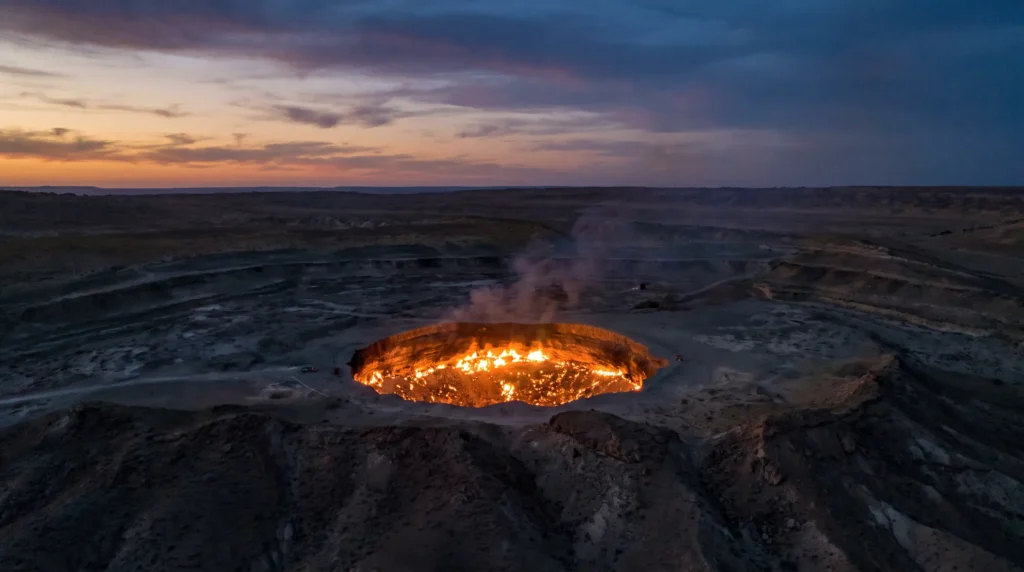
The bucket-list detour: a roughly 260-kilometre drive north of Ashgabat to the “Door to Hell,” a 60–70 metre-wide, 30 metre-deep crater that has been burning since a 1971 drilling accident. Most itineraries camp overnight nearby so you see the flames after dark, which is when the crater actually earns its nickname.
Ancient Merv (Mary Region)
A UNESCO World Heritage Site since 1999 and once one of the largest cities on Earth, with a medieval population that reportedly outstripped Constantinople and Baghdad. Sprawling mudbrick ruins, mausoleums and fortress walls span a site far larger than a single afternoon can properly cover.
Konye-Urgench (Dashoguz Region)
UNESCO-listed since 2005, this former Khorezmian capital holds the tallest minaret in Central Asia along with mausoleums, caravanserai gates and a fortress, all first recorded in written sources as far back as the 3rd century BC.
Nisa
Just outside Ashgabat, the Parthian Fortresses of Nisa were inscribed by UNESCO in 2007 and served as a capital of the Parthian Empire — a civilization that once rivaled Rome. Easily paired with an Ashgabat city day given the short drive.
Turkmenbashy & the Caspian Coast
Turkmenistan’s Caspian Sea port city and gateway to the Avaza tourism zone, a government-built strip of beach resorts meant to turn the coastline into a holiday destination in its own right. Quieter and more low-key than the capital, with sea breeze standing in for marble.
Mary & Balkan Provinces
Beyond their headline ruins, these provinces hold the everyday Turkmenistan of cotton and melon fields, herding communities, and small-town bazaars where the carpet and craft traditions covered below are easiest to see in practice.
Culture & People — Carpets, Horses & a Cult of Personality
Turkmenistan is overwhelmingly Muslim — around 95% of the population identifies as Sunni Muslim, with small Christian and non-religious minorities. Turkmen carpet weaving is arguably the country’s deepest cultural export: each tribal group — Tekke, Yomut, Ersari among others — has its own geometric patterns handed down through generations, and the craft is treated as close to sacred.
The Akhal-Teke horse sits alongside the carpet as a genuine national symbol, appearing on the state emblem and celebrated every year on Turkmen Horse Day. Public life is also unmistakably shaped by the personality-driven style of government mentioned above — portraits, monuments and state messaging are everywhere in a way that can feel startling to first-time visitors, and it’s worth going in with curiosity rather than judgment, since your guide is generally happy to explain context you won’t get from a plaque.
A Food Lover’s Guide to Turkmenistan
Turkmen cuisine grew out of a semi-nomadic, herding culture, and it shows: the food leans heavily on mutton and lamb, and the national centerpiece is plov — rice slow-cooked with lamb or beef, carrots, onions and spices, served at celebrations as a symbol of hospitality. Alongside it, shashlik — skewered, charcoal-grilled mutton, lamb or chicken with raw onion and a vinegar-forward sauce — is sold everywhere from street stalls to sit-down restaurants.
Bread is central to every meal — round, tandoor-baked chorek is treated with real reverence, and it’s considered poor form to waste or discard it. Melons are a point of national pride, especially around the September harvest, when markets in Mary and Dashoguz overflow with them. Green tea accompanies nearly everything, poured in small portions and refilled constantly rather than left to sit full.
Off the Beaten Path
Yangykala Canyon
A striped, Grand Canyon-like formation of red, orange and cream rock in the Balkan region near the Caspian — dramatic, almost entirely undeveloped, and rarely photographed compared to the Darvaza crater despite arguably rivaling it.
Kow Ata Underground Lake
A warm, mineral-rich lake inside a cave system south of Ashgabat, reached via a long staircase into the dark — a genuinely odd swim and a popular half-day trip for travelers based in the capital.
Darvaza’s Quieter Craters
Most visitors only ever hear about the burning gas crater, but Darvaza actually has a cluster of craters nearby — a bubbling mud crater and a water crater — that almost nobody stops for on the way to the famous one.
Arkadag
Turkmenistan’s newly built “smart city,” constructed from scratch in the desert and opened in the 2020s — visiting it feels like touring a government’s vision of the future before most of the world has heard the city’s name.
Practical Information
Visa & entry. A letter of invitation, arranged through a licensed Turkmenistan travel agency, is required before you can apply for a visa; applications can now be lodged up to six months ahead, with standard processing running roughly 10–14 working days. Expect a registration requirement (and fee) within your first few working days in-country, handled by your tour operator or hotel.
Money. The manat is officially pegged at 3.5 to the US dollar, but a much weaker parallel exchange rate circulates informally; cash currency exchange outside official banks is legally restricted, so let your tour operator or hotel guide you on where to change money rather than seeking out a street rate yourself.
Safety. The US State Department rates Turkmenistan Level 1 — Exercise Normal Precautions — as of early 2025, with violent crime rare, though hotel rooms and communications may be monitored and photographing government buildings or military sites is restricted. Carry your passport at all times and ask your guide before photographing anything that looks official. UK travelers should also check the FCDO’s current guidance before booking.
Health. Routine vaccines plus Hepatitis A/B and typhoid are commonly recommended; medical care outside Ashgabat is limited, so evacuation-inclusive travel insurance is worth having.
Connectivity. Internet access is heavily restricted and slow by international standards; treat connectivity as a bonus, not a given, and tell people at home to expect quiet. Time zone: UTC+5, no daylight saving.
Budget Breakdown — What Turkmenistan Actually Costs in 2026
Because travel here runs through licensed operators rather than self-booked hostels and buses, “budget travel” in the backpacker sense barely exists — your daily cost is really a tour-package cost.
Budget (US$100–160/day): Joining a small-group tour with shared transport, mid-range hotels, and a fixed multi-city itinerary covering Ashgabat, Darvaza and one UNESCO site.
Mid-range (US$180–280/day): A private driver-guide, better hotels, and a fuller itinerary reaching Merv, Konye-Urgench or the Caspian coast alongside the capital and the crater.
Luxury (US$350+/day): Fully bespoke routing, top-tier Ashgabat hotels, private domestic flights between regions, and flexible timing built around events like Turkmen Horse Day.
Whatever tier you choose, factor in the letter-of-invitation and visa fees as a fixed upfront cost, and budget cash for the arrival registration fee and any exchanges your operator recommends.
Planning Your First Trip to Turkmenistan
The realistic first-timer route is a loop: fly into Ashgabat, spend two or three nights in the capital and at Nisa, drive north to overnight at the Darvaza gas crater, then continue on to Konye-Urgench or double back through Mary for Ancient Merv before flying out. A week covers the highlights without rushing; ten days lets you add the Caspian coast at Turkmenbashy or Yangykala Canyon. Because Turkmenistan sits at the crossroads of the old Silk Road, it pairs naturally with a longer Central Asia itinerary — book your visa and letter of invitation first, since that timeline dictates everything else. Many travelers combine it with our Uzbekistan guide for Bukhara, Samarkand and Khiva, or continue north into Kazakhstan.
Frequently Asked Questions
Is Turkmenistan safe to visit in 2026?
Yes, in the sense that measures against tourists are rare and the US State Department rates it Level 1 — Exercise Normal Precautions. The bigger challenge is bureaucratic rather than physical: registration rules, photography restrictions and monitored communications require more caution and preparation than most destinations.
Do I really need a licensed guide the whole time?
In practice, yes. Entry visas are tied to a letter of invitation that almost always comes through a licensed tour operator, and independent, unaccompanied travel isn’t a realistic option here the way it is elsewhere in Central Asia.
Is the Darvaza gas crater still on fire?
It has been burning since a 1971 drilling accident, but the government began actively working to extinguish it in 2022, and by 2025–2026 reports described the flames as significantly reduced from their historic size. Go with realistic expectations — it’s still an eerie, worthwhile sight, just not guaranteed to match the dramatic older photos you’ve seen online.
What’s the deal with the currency and exchange rates?
The manat is officially pegged at 3.5 to the US dollar, but that rate does not reflect what the currency is actually worth on the ground, where a much weaker parallel rate circulates informally. Currency rules are taken seriously by authorities, so handle all exchanges through channels your tour operator or hotel recommends rather than informal street offers.
Turkmenistan or Uzbekistan for a first Central Asia trip?
Choose Uzbekistan first if you want easier logistics, e-visas and independent travel between Silk Road cities. Choose Turkmenistan if the white marble capital and the burning desert crater are non-negotiable bucket-list items and you’re comfortable with a guided, pre-arranged itinerary — or better yet, do both back to back.
Can solo travelers or backpackers visit?
Solo travelers visit regularly, but “backpacking” in the loose, unplanned sense isn’t really how it works — you’ll be solo within a structured tour itinerary rather than freewheeling between hostels, and that’s worth setting expectations around before you book.
Ready to Explore Turkmenistan?
A city sheathed entirely in white marble, a crater that’s been quietly burning since before most of us were born, and Silk Road ruins with barely another visitor in sight — Turkmenistan asks for more planning than almost anywhere else in this guide series, and pays it back with a trip that genuinely looks like nowhere else on Earth.
Explore More
- Uzbekistan Travel Guide — Bukhara, Samarkand and Khiva along the same Silk Road
- Kazakhstan Travel Guide — continue north across the steppe
- Kyrgyzstan Travel Guide — Central Asia’s mountain counterpoint to the desert
- Azerbaijan Travel Guide — across the Caspian Sea
How this guide was built
Published as part of Facts From Upstairs’ country guide series. Built from authoritative sources — Wikipedia entity pages for Turkmenistan, the Darvaza gas crater, the Turkmen manat, Ashgabat International Airport and Turkmenistan’s UNESCO World Heritage Sites; the official Turkmenistan government portal (turkmenistan.gov.tm); the Guinness World Records entry for Ashgabat’s marble buildings; the US State Department and UK FCDO Turkmenistan travel advisory pages; the US CDC traveler page for Turkmenistan; Britannica’s Turkmenistan cultural life article; and VisaVerge’s Turkmenistan visa guide. Numeric and checkable claims carry inline citations.
Sources cited on this page
- Wikipedia — Turkmenistan
- Wikipedia — List of World Heritage Sites in Turkmenistan
- Wikipedia — Darvaza gas crater
- Wikipedia — Turkmen manat
- Wikipedia — Ashgabat International Airport
- Wikipedia — Turkmen cuisine
- Turkmenistan Government Portal — National Holiday of the Turkmen Horse
- Guinness World Records — Highest density of white marble-clad buildings
- US State Department — Turkmenistan
- UK FCDO — Turkmenistan
- US CDC — Turkmenistan traveler page
- Britannica — Turkmenistan Cultural Life
- VisaVerge — Turkmenistan Visa Guide 2026
More country guides you might like

Plan your trip to Turkmenistan
The booking tools we use ourselves. FFU may earn a commission at no extra cost to you.
Plan & book your trip to Turkmenistan
Booking through these searches supports our guides at no extra cost to you.