4–6 months ahead
Top ryokans (Tawaraya, Gora Kadan, Hoshinoya), peak sakura week (April 1–10), peak koyo week (Nov 18–25), and any major festival dates.
6–8 weeks ahead
Mid-range Tokyo, Kyoto, and Osaka hotels in shoulder months. Most accommodation. Use Booking.com [TODO: affiliate] with the “free cancellation” filter.
2–3 weeks ahead
Off-season (June, late September, December non-NY week). Capsule hotels. Business hotels.
Day-of
Possible only for true business hotels in non-peak periods. Don’t rely on this in cherry blossom or autumn leaf weeks.
FAQ
What’s a typical mid-range hotel cost in 2026?
¥10,000–¥18,000/night ($65–$120) in Tokyo, Kyoto, or Osaka for a clean 3-star. Higher in peak weeks.
Should I get a JR Pass-friendly hotel?
Hotels near Shinkansen stations (Tokyo, Shinagawa, Shin-Osaka, Hiroshima, Kyoto) are easier to use efficiently. Cost the same as elsewhere; save 30 minutes per move.
Are Airbnbs legal in Japan?
Yes since 2018, but heavily regulated. Most listings are now properly registered “minpaku” properties. Cost-similar to budget hotels in 2026 — Airbnb’s no longer the cheap alternative it was. Still good for groups of 4+ or longer stays.
Should I book accommodation with breakfast?
Generally no. Convenience-store breakfasts (Lawson, Family Mart, 7-Eleven) at ¥500 are excellent and authentically Japanese. Cafe culture is also strong. Hotel breakfasts are usually ¥2,500–¥5,000 — bad value unless you’re at a ryokan where it’s part of the experience.
What about onsen ryokan vs urban ryokan?
Onsen ryokan (in hot spring towns like Hakone, Kinosaki, Beppu) are the full experience — natural hot baths, kaiseki, often private outdoor onsen. Urban ryokan in Tokyo or Kyoto are atmospheric but you usually share bathrooms and won’t get the natural hot spring water.
Article by FFU Editorial · Last verified: 1 May 2026 · Found a factual error? Email a correction and we’ll update within 48 hours.
The full Japan guide
- Japan country overview
- 25 best things to do in Japan
- 14-day Japan itinerary
- Best time to visit Japan
Capsule hotels in Japan have evolved — the modern ones are spa-clean, well-designed, and ¥4,000–¥8,000 per night. They’re ideal for solo travelers, anyone catching an early Shinkansen, or as a one-night experience.
- nine hours chain (Tokyo Narita, Tokyo Akasaka, Kyoto, Sendai) — Marc Newson designs, women-only floors
- The Millennials Shibuya — bigger than typical capsules, 25 ㎡ “pods”, workspace included
- First Cabin — first-class airline-cabin format, more spacious
- Capsule Hotel Anshin Oyado (Tokyo, Shimbashi) — onsen on the top floor
Booking strategy
4–6 months ahead
Top ryokans (Tawaraya, Gora Kadan, Hoshinoya), peak sakura week (April 1–10), peak koyo week (Nov 18–25), and any major festival dates.
6–8 weeks ahead
Mid-range Tokyo, Kyoto, and Osaka hotels in shoulder months. Most accommodation. Use Booking.com [TODO: affiliate] with the “free cancellation” filter.
2–3 weeks ahead
Off-season (June, late September, December non-NY week). Capsule hotels. Business hotels.
Day-of
Possible only for true business hotels in non-peak periods. Don’t rely on this in cherry blossom or autumn leaf weeks.
FAQ
What’s a typical mid-range hotel cost in 2026?
¥10,000–¥18,000/night ($65–$120) in Tokyo, Kyoto, or Osaka for a clean 3-star. Higher in peak weeks.
Should I get a JR Pass-friendly hotel?
Hotels near Shinkansen stations (Tokyo, Shinagawa, Shin-Osaka, Hiroshima, Kyoto) are easier to use efficiently. Cost the same as elsewhere; save 30 minutes per move.
Are Airbnbs legal in Japan?
Yes since 2018, but heavily regulated. Most listings are now properly registered “minpaku” properties. Cost-similar to budget hotels in 2026 — Airbnb’s no longer the cheap alternative it was. Still good for groups of 4+ or longer stays.
Should I book accommodation with breakfast?
Generally no. Convenience-store breakfasts (Lawson, Family Mart, 7-Eleven) at ¥500 are excellent and authentically Japanese. Cafe culture is also strong. Hotel breakfasts are usually ¥2,500–¥5,000 — bad value unless you’re at a ryokan where it’s part of the experience.
What about onsen ryokan vs urban ryokan?
Onsen ryokan (in hot spring towns like Hakone, Kinosaki, Beppu) are the full experience — natural hot baths, kaiseki, often private outdoor onsen. Urban ryokan in Tokyo or Kyoto are atmospheric but you usually share bathrooms and won’t get the natural hot spring water.
Article by FFU Editorial · Last verified: 1 May 2026 · Found a factual error? Email a correction and we’ll update within 48 hours.
The full Japan guide
- Japan country overview
- 25 best things to do in Japan
- 14-day Japan itinerary
- Best time to visit Japan
If you splurge once on the trip, splurge on a ryokan night. The 5 ryokans below are all places that have been operating for 100+ years and define their region:
- Hoshinoya Kyoto — boat-only access along the Hozugawa river, modernist take on traditional Japanese aesthetic. ¥85,000+ per person.
- Tawaraya, Kyoto — 320 years old, hosted Steve Jobs, Charlie Chaplin, the Imperial Family. ¥80,000+ per person.
- Gora Kadan, Hakone — former imperial summer villa, 24 rooms with private rotenburo. ¥70,000+ per person.
- Asaba, Shuzenji — 530 years old, Noh stage on a pond, kaiseki that’s a cultural artifact. ¥60,000+ per person.
- Kayotei, Yamanaka Onsen — 10 rooms, founded 1953, Relais & Châteaux member. ¥55,000+ per person.
For more accessible ryokan stays in the ¥30,000–¥45,000 range, look at Hakone, Beppu, or Kinosaki Onsen.
Capsule hotels worth booking
Capsule hotels in Japan have evolved — the modern ones are spa-clean, well-designed, and ¥4,000–¥8,000 per night. They’re ideal for solo travelers, anyone catching an early Shinkansen, or as a one-night experience.
- nine hours chain (Tokyo Narita, Tokyo Akasaka, Kyoto, Sendai) — Marc Newson designs, women-only floors
- The Millennials Shibuya — bigger than typical capsules, 25 ㎡ “pods”, workspace included
- First Cabin — first-class airline-cabin format, more spacious
- Capsule Hotel Anshin Oyado (Tokyo, Shimbashi) — onsen on the top floor
Booking strategy
4–6 months ahead
Top ryokans (Tawaraya, Gora Kadan, Hoshinoya), peak sakura week (April 1–10), peak koyo week (Nov 18–25), and any major festival dates.
6–8 weeks ahead
Mid-range Tokyo, Kyoto, and Osaka hotels in shoulder months. Most accommodation. Use Booking.com [TODO: affiliate] with the “free cancellation” filter.
2–3 weeks ahead
Off-season (June, late September, December non-NY week). Capsule hotels. Business hotels.
Day-of
Possible only for true business hotels in non-peak periods. Don’t rely on this in cherry blossom or autumn leaf weeks.
FAQ
What’s a typical mid-range hotel cost in 2026?
¥10,000–¥18,000/night ($65–$120) in Tokyo, Kyoto, or Osaka for a clean 3-star. Higher in peak weeks.
Should I get a JR Pass-friendly hotel?
Hotels near Shinkansen stations (Tokyo, Shinagawa, Shin-Osaka, Hiroshima, Kyoto) are easier to use efficiently. Cost the same as elsewhere; save 30 minutes per move.
Are Airbnbs legal in Japan?
Yes since 2018, but heavily regulated. Most listings are now properly registered “minpaku” properties. Cost-similar to budget hotels in 2026 — Airbnb’s no longer the cheap alternative it was. Still good for groups of 4+ or longer stays.
Should I book accommodation with breakfast?
Generally no. Convenience-store breakfasts (Lawson, Family Mart, 7-Eleven) at ¥500 are excellent and authentically Japanese. Cafe culture is also strong. Hotel breakfasts are usually ¥2,500–¥5,000 — bad value unless you’re at a ryokan where it’s part of the experience.
What about onsen ryokan vs urban ryokan?
Onsen ryokan (in hot spring towns like Hakone, Kinosaki, Beppu) are the full experience — natural hot baths, kaiseki, often private outdoor onsen. Urban ryokan in Tokyo or Kyoto are atmospheric but you usually share bathrooms and won’t get the natural hot spring water.
Article by FFU Editorial · Last verified: 1 May 2026 · Found a factual error? Email a correction and we’ll update within 48 hours.
The full Japan guide
- Japan country overview
- 25 best things to do in Japan
- 14-day Japan itinerary
- Best time to visit Japan
Osaka is more compact and informal than Tokyo. Two main areas to consider:
Namba / Dotonbori (Minami) — food, neon, energy
Vibe: Dotonbori canal, kuidaore food culture, neon at night, the “south” of Osaka.
Best for: Food-focused travelers · short stays where you want to be in the action
Watch out for: Loud at night near the canal · go a few blocks back for quiet sleep
Hotel picks: Cross Hotel Osaka (rooftop pool) · Swissotel Nankai · Mimaru Osaka Namba (apartment-style)
Umeda / Shin-Osaka (Kita) — transit, business, departures
Vibe: Skyscrapers, department stores, the Shinkansen platform, easier for catching trains out of the city.
Best for: Travelers using Osaka as a hub for day trips (Kyoto, Nara, Himeji, Koyasan)
Hotel picks: The Ritz-Carlton Osaka · Conrad Osaka · Hilton Osaka · Remm Shin-Osaka (budget, attached to Shin-Osaka Shinkansen station)
Ryokan recommendations (where to splurge)
If you splurge once on the trip, splurge on a ryokan night. The 5 ryokans below are all places that have been operating for 100+ years and define their region:
- Hoshinoya Kyoto — boat-only access along the Hozugawa river, modernist take on traditional Japanese aesthetic. ¥85,000+ per person.
- Tawaraya, Kyoto — 320 years old, hosted Steve Jobs, Charlie Chaplin, the Imperial Family. ¥80,000+ per person.
- Gora Kadan, Hakone — former imperial summer villa, 24 rooms with private rotenburo. ¥70,000+ per person.
- Asaba, Shuzenji — 530 years old, Noh stage on a pond, kaiseki that’s a cultural artifact. ¥60,000+ per person.
- Kayotei, Yamanaka Onsen — 10 rooms, founded 1953, Relais & Châteaux member. ¥55,000+ per person.
For more accessible ryokan stays in the ¥30,000–¥45,000 range, look at Hakone, Beppu, or Kinosaki Onsen.
Capsule hotels worth booking
Capsule hotels in Japan have evolved — the modern ones are spa-clean, well-designed, and ¥4,000–¥8,000 per night. They’re ideal for solo travelers, anyone catching an early Shinkansen, or as a one-night experience.
- nine hours chain (Tokyo Narita, Tokyo Akasaka, Kyoto, Sendai) — Marc Newson designs, women-only floors
- The Millennials Shibuya — bigger than typical capsules, 25 ㎡ “pods”, workspace included
- First Cabin — first-class airline-cabin format, more spacious
- Capsule Hotel Anshin Oyado (Tokyo, Shimbashi) — onsen on the top floor
Booking strategy
4–6 months ahead
Top ryokans (Tawaraya, Gora Kadan, Hoshinoya), peak sakura week (April 1–10), peak koyo week (Nov 18–25), and any major festival dates.
6–8 weeks ahead
Mid-range Tokyo, Kyoto, and Osaka hotels in shoulder months. Most accommodation. Use Booking.com [TODO: affiliate] with the “free cancellation” filter.
2–3 weeks ahead
Off-season (June, late September, December non-NY week). Capsule hotels. Business hotels.
Day-of
Possible only for true business hotels in non-peak periods. Don’t rely on this in cherry blossom or autumn leaf weeks.
FAQ
What’s a typical mid-range hotel cost in 2026?
¥10,000–¥18,000/night ($65–$120) in Tokyo, Kyoto, or Osaka for a clean 3-star. Higher in peak weeks.
Should I get a JR Pass-friendly hotel?
Hotels near Shinkansen stations (Tokyo, Shinagawa, Shin-Osaka, Hiroshima, Kyoto) are easier to use efficiently. Cost the same as elsewhere; save 30 minutes per move.
Are Airbnbs legal in Japan?
Yes since 2018, but heavily regulated. Most listings are now properly registered “minpaku” properties. Cost-similar to budget hotels in 2026 — Airbnb’s no longer the cheap alternative it was. Still good for groups of 4+ or longer stays.
Should I book accommodation with breakfast?
Generally no. Convenience-store breakfasts (Lawson, Family Mart, 7-Eleven) at ¥500 are excellent and authentically Japanese. Cafe culture is also strong. Hotel breakfasts are usually ¥2,500–¥5,000 — bad value unless you’re at a ryokan where it’s part of the experience.
What about onsen ryokan vs urban ryokan?
Onsen ryokan (in hot spring towns like Hakone, Kinosaki, Beppu) are the full experience — natural hot baths, kaiseki, often private outdoor onsen. Urban ryokan in Tokyo or Kyoto are atmospheric but you usually share bathrooms and won’t get the natural hot spring water.
Article by FFU Editorial · Last verified: 1 May 2026 · Found a factual error? Email a correction and we’ll update within 48 hours.
The full Japan guide
- Japan country overview
- 25 best things to do in Japan
- 14-day Japan itinerary
- Best time to visit Japan
Kyoto is much smaller than Tokyo — most central neighborhoods are within 10 minutes of each other by taxi. The choice is really atmosphere and aesthetic.
Gion / Higashiyama — atmospheric old Kyoto
Vibe: Wooden machiya houses, lantern-lit lanes, geisha walking between teahouses at dusk, temples within walking distance.
Best for: First-timers who want the Kyoto of guidebooks · romantic trips · evening atmosphere
Watch out for: Very expensive ryokans here · photography rules on private streets (read signage)
Hotel picks: The Hiiragiya (a 200-year-old ryokan) · Tawaraya (legendary, ¥80,000+ per person) · Park Hyatt Kyoto (modern luxury with Kiyomizu view) · The Celestine Kyoto Gion (mid-range)
Search Gion ryokans → [TODO: Booking.com affiliate]
Pontocho / Kawaramachi — central, food, river-walking
Vibe: Pontocho Alley restaurants along the Kamogawa River, Nishiki Market for food, easy walk to Gion or downtown.
Best for: Food-focused travelers · those who want to walk to dinner without taking transit
Hotel picks: The Thousand Kyoto · Hotel Kanra Kyoto · Solaria Nishitetsu (budget)
Kyoto Station — transit-first, less atmospheric
Vibe: Modern department-store-attached hotels next to the Shinkansen platform.
Best for: Travelers doing day trips to Nara, Osaka, or other regions · efficient itineraries · the very last night before catching a 7am train
Hotel picks: Hotel Granvia Kyoto · Citadines · Mitsui Garden
Arashiyama — quiet, scenic, west of city
Vibe: Bamboo grove, Tenryu-ji, mountain temples, river views.
Best for: Repeat visitors · slow travelers · those who want to do Arashiyama at dawn before the day-trippers
Hotel picks: Hoshinoya Kyoto (boat-only access ryokan up the Hozugawa river) · Suiran Luxury Collection · Ranzan
Where to stay in Osaka
Osaka is more compact and informal than Tokyo. Two main areas to consider:
Namba / Dotonbori (Minami) — food, neon, energy
Vibe: Dotonbori canal, kuidaore food culture, neon at night, the “south” of Osaka.
Best for: Food-focused travelers · short stays where you want to be in the action
Watch out for: Loud at night near the canal · go a few blocks back for quiet sleep
Hotel picks: Cross Hotel Osaka (rooftop pool) · Swissotel Nankai · Mimaru Osaka Namba (apartment-style)
Umeda / Shin-Osaka (Kita) — transit, business, departures
Vibe: Skyscrapers, department stores, the Shinkansen platform, easier for catching trains out of the city.
Best for: Travelers using Osaka as a hub for day trips (Kyoto, Nara, Himeji, Koyasan)
Hotel picks: The Ritz-Carlton Osaka · Conrad Osaka · Hilton Osaka · Remm Shin-Osaka (budget, attached to Shin-Osaka Shinkansen station)
Ryokan recommendations (where to splurge)
If you splurge once on the trip, splurge on a ryokan night. The 5 ryokans below are all places that have been operating for 100+ years and define their region:
- Hoshinoya Kyoto — boat-only access along the Hozugawa river, modernist take on traditional Japanese aesthetic. ¥85,000+ per person.
- Tawaraya, Kyoto — 320 years old, hosted Steve Jobs, Charlie Chaplin, the Imperial Family. ¥80,000+ per person.
- Gora Kadan, Hakone — former imperial summer villa, 24 rooms with private rotenburo. ¥70,000+ per person.
- Asaba, Shuzenji — 530 years old, Noh stage on a pond, kaiseki that’s a cultural artifact. ¥60,000+ per person.
- Kayotei, Yamanaka Onsen — 10 rooms, founded 1953, Relais & Châteaux member. ¥55,000+ per person.
For more accessible ryokan stays in the ¥30,000–¥45,000 range, look at Hakone, Beppu, or Kinosaki Onsen.
Capsule hotels worth booking
Capsule hotels in Japan have evolved — the modern ones are spa-clean, well-designed, and ¥4,000–¥8,000 per night. They’re ideal for solo travelers, anyone catching an early Shinkansen, or as a one-night experience.
- nine hours chain (Tokyo Narita, Tokyo Akasaka, Kyoto, Sendai) — Marc Newson designs, women-only floors
- The Millennials Shibuya — bigger than typical capsules, 25 ㎡ “pods”, workspace included
- First Cabin — first-class airline-cabin format, more spacious
- Capsule Hotel Anshin Oyado (Tokyo, Shimbashi) — onsen on the top floor
Booking strategy
4–6 months ahead
Top ryokans (Tawaraya, Gora Kadan, Hoshinoya), peak sakura week (April 1–10), peak koyo week (Nov 18–25), and any major festival dates.
6–8 weeks ahead
Mid-range Tokyo, Kyoto, and Osaka hotels in shoulder months. Most accommodation. Use Booking.com [TODO: affiliate] with the “free cancellation” filter.
2–3 weeks ahead
Off-season (June, late September, December non-NY week). Capsule hotels. Business hotels.
Day-of
Possible only for true business hotels in non-peak periods. Don’t rely on this in cherry blossom or autumn leaf weeks.
FAQ
What’s a typical mid-range hotel cost in 2026?
¥10,000–¥18,000/night ($65–$120) in Tokyo, Kyoto, or Osaka for a clean 3-star. Higher in peak weeks.
Should I get a JR Pass-friendly hotel?
Hotels near Shinkansen stations (Tokyo, Shinagawa, Shin-Osaka, Hiroshima, Kyoto) are easier to use efficiently. Cost the same as elsewhere; save 30 minutes per move.
Are Airbnbs legal in Japan?
Yes since 2018, but heavily regulated. Most listings are now properly registered “minpaku” properties. Cost-similar to budget hotels in 2026 — Airbnb’s no longer the cheap alternative it was. Still good for groups of 4+ or longer stays.
Should I book accommodation with breakfast?
Generally no. Convenience-store breakfasts (Lawson, Family Mart, 7-Eleven) at ¥500 are excellent and authentically Japanese. Cafe culture is also strong. Hotel breakfasts are usually ¥2,500–¥5,000 — bad value unless you’re at a ryokan where it’s part of the experience.
What about onsen ryokan vs urban ryokan?
Onsen ryokan (in hot spring towns like Hakone, Kinosaki, Beppu) are the full experience — natural hot baths, kaiseki, often private outdoor onsen. Urban ryokan in Tokyo or Kyoto are atmospheric but you usually share bathrooms and won’t get the natural hot spring water.
Article by FFU Editorial · Last verified: 1 May 2026 · Found a factual error? Email a correction and we’ll update within 48 hours.
The full Japan guide
- Japan country overview
- 25 best things to do in Japan
- 14-day Japan itinerary
- Best time to visit Japan
FFU Editorial Note: Neighborhood character profiles cross-checked against current operator listings on Booking.com, Agoda, and tabelog. Last verified: 1 May 2026.
The single biggest determinant of how Tokyo feels is which neighborhood you sleep in. Stay in Shinjuku and you’ll think Tokyo is neon, food, and chaos. Stay in Yanaka and you’ll swear it’s a quiet old-Edo village. Same city. Same trip. Different memories. Below is a breakdown of where to stay in Tokyo, Kyoto, and Osaka — by neighborhood character, transport, and price band — so you can match the base to the trip.
Part of the FFU Japan cluster: Japan overview · 25 things to do · 14-day itinerary · Best time to visit
Affiliate disclosure: Hotel links are affiliate links. We earn a small commission at no cost to you.
Where to stay in Tokyo
Tokyo is a city of 35 million across 23 wards. Most travelers should stay near a Yamanote Line (loop train) or Tokyo Metro hub. Below are the seven neighborhoods that actually matter for first-time and second-time visitors.
Shinjuku — first-timers, transit hub, neon energy
Vibe: Skyscrapers, izakaya alleys, Golden Gai bars, the world’s busiest train station, neon Kabukicho.
Best for: First trip · easy day trips (Shinjuku is the JR/private rail nexus for Hakone, Kawaguchi, Nikko) · nightlife
Watch out for: The east side around Kabukicho can feel sketchy at 1am. The hotels at the south exit (Park Hyatt, Keio Plaza) are calmer than the east side.
Hotel picks: Park Hyatt Tokyo (luxury icon — yes, the Lost in Translation one) · Hyatt Regency · Citadines for mid-range · Kimi Ryokan for budget
Search Shinjuku hotels → [TODO: Booking.com affiliate]
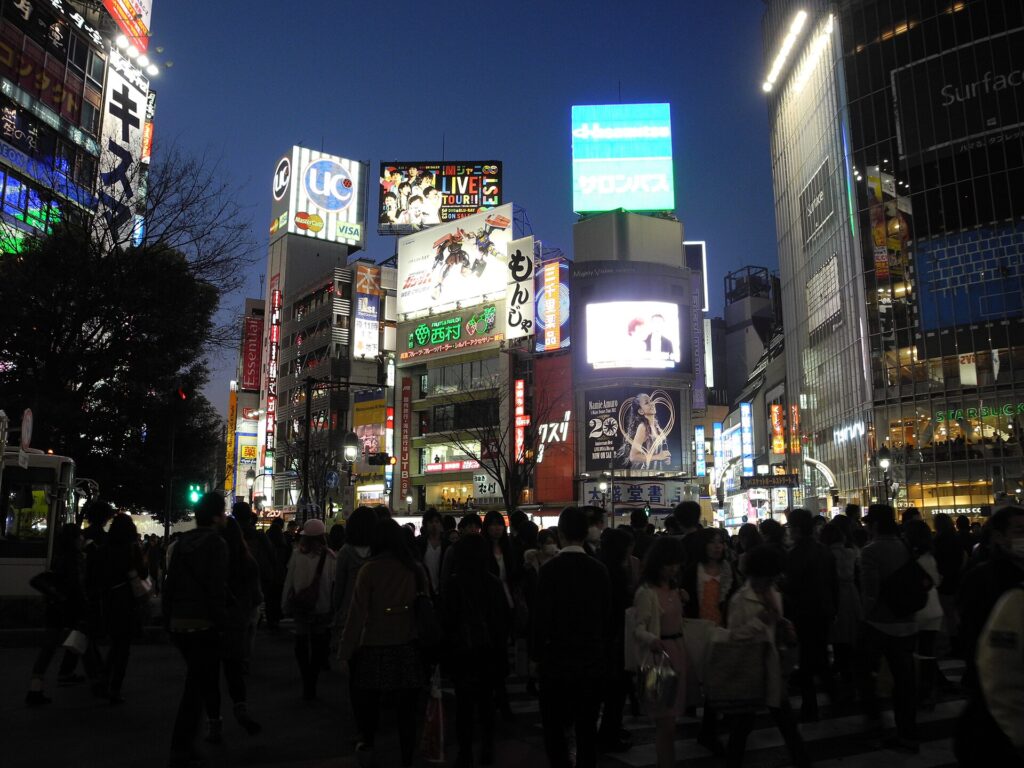
Shibuya — younger energy, fashion, food, the Scramble
Vibe: The youngest, most sensorily overloaded part of central Tokyo. Lots of restaurants, fashion, Shibuya Sky, Harajuku next door.
Best for: 20s–30s travelers · fashion shopping · the city you’ve seen in a thousand photos
Watch out for: Hotels right at the Scramble are loud · Friday/Saturday weekend chaos
Hotel picks: Cerulean Tower Tokyu Hotel (skyline rooms) · Trunk Hotel (boutique) · Sequence Miyashita Park (mid-range, on top of a green park)
Ginza — quieter luxury, walkable old Tokyo, central
Vibe: Tree-lined boulevards, department stores, the world’s densest concentration of Michelin restaurants, Imperial Palace next door.
Best for: Older travelers · returning visitors · luxury shopping and dining
Watch out for: Quiet on Sundays — pedestrian-only weekend afternoons are wonderful but most stores have early closes
Hotel picks: Imperial Hotel Tokyo (legendary) · Mandarin Oriental (one of Tokyo’s two best views) · Hyatt Centric Ginza (mid-range) · Solaria Nishitetsu (budget)
Asakusa — old Tokyo, Senso-ji, traditional
Vibe: Wooden buildings, Senso-ji bells at dawn, ryokan-style hotels, riverside walks.
Best for: Travelers who want quiet · ryokan experience without leaving the city · easier sleep schedules
Watch out for: 25 minutes by train from Shinjuku/Shibuya · less night life
Hotel picks: The Gate Hotel Asakusa Kaminarimon (terrace views of Senso-ji) · Khaosan Tokyo Origami (budget) · Ryokan Asakusa Shigetsu (traditional)
Roppongi — international, art, expensive
Vibe: Mori Art Museum, embassies, late-night dining, controversial nightlife.
Best for: Repeat visitors · art-focused trips (the Roppongi Art Triangle of Mori + National Art Center + Suntory Museum) · adults-only travelers
Watch out for: Roppongi Crossing at 2am · expensive everything
Hotel picks: The Ritz-Carlton Tokyo · Grand Hyatt Tokyo · Andaz Toranomon Hills
Tokyo Station / Marunouchi — for transit ease and JR Pass holders
Vibe: Business-hotel land, but the most central transit point in Japan, Imperial Palace 5 minutes away.
Best for: Day-trippers using Shinkansen heavily · efficient travelers · the final night before a Narita departure
Hotel picks: Four Seasons Tokyo at Marunouchi · Aman Tokyo (luxury icon, the most-photographed Japanese-aesthetic hotel in the country) · The Tokyo Station Hotel · Mimaru Tokyo (apartment-style, mid-range)
Yanaka / Nezu / Yanesen — local Tokyo, low-key, undertouristy
Vibe: Old wooden houses, cats, small temples, narrow lanes that feel pre-war.
Best for: Repeat visitors who want a different Tokyo · slow travelers · longer stays
Watch out for: Far from nightlife · less hotel inventory
Hotel picks: Hanare (a single ryokan room scattered across multiple traditional houses — unique concept) · Sawanoya Ryokan · Hotel Graphy Nezu
Where to stay in Kyoto
Kyoto is much smaller than Tokyo — most central neighborhoods are within 10 minutes of each other by taxi. The choice is really atmosphere and aesthetic.
Gion / Higashiyama — atmospheric old Kyoto
Vibe: Wooden machiya houses, lantern-lit lanes, geisha walking between teahouses at dusk, temples within walking distance.
Best for: First-timers who want the Kyoto of guidebooks · romantic trips · evening atmosphere
Watch out for: Very expensive ryokans here · photography rules on private streets (read signage)
Hotel picks: The Hiiragiya (a 200-year-old ryokan) · Tawaraya (legendary, ¥80,000+ per person) · Park Hyatt Kyoto (modern luxury with Kiyomizu view) · The Celestine Kyoto Gion (mid-range)
Search Gion ryokans → [TODO: Booking.com affiliate]
Pontocho / Kawaramachi — central, food, river-walking
Vibe: Pontocho Alley restaurants along the Kamogawa River, Nishiki Market for food, easy walk to Gion or downtown.
Best for: Food-focused travelers · those who want to walk to dinner without taking transit
Hotel picks: The Thousand Kyoto · Hotel Kanra Kyoto · Solaria Nishitetsu (budget)
Kyoto Station — transit-first, less atmospheric
Vibe: Modern department-store-attached hotels next to the Shinkansen platform.
Best for: Travelers doing day trips to Nara, Osaka, or other regions · efficient itineraries · the very last night before catching a 7am train
Hotel picks: Hotel Granvia Kyoto · Citadines · Mitsui Garden
Arashiyama — quiet, scenic, west of city
Vibe: Bamboo grove, Tenryu-ji, mountain temples, river views.
Best for: Repeat visitors · slow travelers · those who want to do Arashiyama at dawn before the day-trippers
Hotel picks: Hoshinoya Kyoto (boat-only access ryokan up the Hozugawa river) · Suiran Luxury Collection · Ranzan
Where to stay in Osaka
Osaka is more compact and informal than Tokyo. Two main areas to consider:
Namba / Dotonbori (Minami) — food, neon, energy
Vibe: Dotonbori canal, kuidaore food culture, neon at night, the “south” of Osaka.
Best for: Food-focused travelers · short stays where you want to be in the action
Watch out for: Loud at night near the canal · go a few blocks back for quiet sleep
Hotel picks: Cross Hotel Osaka (rooftop pool) · Swissotel Nankai · Mimaru Osaka Namba (apartment-style)
Umeda / Shin-Osaka (Kita) — transit, business, departures
Vibe: Skyscrapers, department stores, the Shinkansen platform, easier for catching trains out of the city.
Best for: Travelers using Osaka as a hub for day trips (Kyoto, Nara, Himeji, Koyasan)
Hotel picks: The Ritz-Carlton Osaka · Conrad Osaka · Hilton Osaka · Remm Shin-Osaka (budget, attached to Shin-Osaka Shinkansen station)
Ryokan recommendations (where to splurge)
If you splurge once on the trip, splurge on a ryokan night. The 5 ryokans below are all places that have been operating for 100+ years and define their region:
- Hoshinoya Kyoto — boat-only access along the Hozugawa river, modernist take on traditional Japanese aesthetic. ¥85,000+ per person.
- Tawaraya, Kyoto — 320 years old, hosted Steve Jobs, Charlie Chaplin, the Imperial Family. ¥80,000+ per person.
- Gora Kadan, Hakone — former imperial summer villa, 24 rooms with private rotenburo. ¥70,000+ per person.
- Asaba, Shuzenji — 530 years old, Noh stage on a pond, kaiseki that’s a cultural artifact. ¥60,000+ per person.
- Kayotei, Yamanaka Onsen — 10 rooms, founded 1953, Relais & Châteaux member. ¥55,000+ per person.
For more accessible ryokan stays in the ¥30,000–¥45,000 range, look at Hakone, Beppu, or Kinosaki Onsen.
Capsule hotels worth booking
Capsule hotels in Japan have evolved — the modern ones are spa-clean, well-designed, and ¥4,000–¥8,000 per night. They’re ideal for solo travelers, anyone catching an early Shinkansen, or as a one-night experience.
- nine hours chain (Tokyo Narita, Tokyo Akasaka, Kyoto, Sendai) — Marc Newson designs, women-only floors
- The Millennials Shibuya — bigger than typical capsules, 25 ㎡ “pods”, workspace included
- First Cabin — first-class airline-cabin format, more spacious
- Capsule Hotel Anshin Oyado (Tokyo, Shimbashi) — onsen on the top floor
Booking strategy
4–6 months ahead
Top ryokans (Tawaraya, Gora Kadan, Hoshinoya), peak sakura week (April 1–10), peak koyo week (Nov 18–25), and any major festival dates.
6–8 weeks ahead
Mid-range Tokyo, Kyoto, and Osaka hotels in shoulder months. Most accommodation. Use Booking.com [TODO: affiliate] with the “free cancellation” filter.
2–3 weeks ahead
Off-season (June, late September, December non-NY week). Capsule hotels. Business hotels.
Day-of
Possible only for true business hotels in non-peak periods. Don’t rely on this in cherry blossom or autumn leaf weeks.
FAQ
What’s a typical mid-range hotel cost in 2026?
¥10,000–¥18,000/night ($65–$120) in Tokyo, Kyoto, or Osaka for a clean 3-star. Higher in peak weeks.
Should I get a JR Pass-friendly hotel?
Hotels near Shinkansen stations (Tokyo, Shinagawa, Shin-Osaka, Hiroshima, Kyoto) are easier to use efficiently. Cost the same as elsewhere; save 30 minutes per move.
Are Airbnbs legal in Japan?
Yes since 2018, but heavily regulated. Most listings are now properly registered “minpaku” properties. Cost-similar to budget hotels in 2026 — Airbnb’s no longer the cheap alternative it was. Still good for groups of 4+ or longer stays.
Should I book accommodation with breakfast?
Generally no. Convenience-store breakfasts (Lawson, Family Mart, 7-Eleven) at ¥500 are excellent and authentically Japanese. Cafe culture is also strong. Hotel breakfasts are usually ¥2,500–¥5,000 — bad value unless you’re at a ryokan where it’s part of the experience.
What about onsen ryokan vs urban ryokan?
Onsen ryokan (in hot spring towns like Hakone, Kinosaki, Beppu) are the full experience — natural hot baths, kaiseki, often private outdoor onsen. Urban ryokan in Tokyo or Kyoto are atmospheric but you usually share bathrooms and won’t get the natural hot spring water.
Article by FFU Editorial · Last verified: 1 May 2026 · Found a factual error? Email a correction and we’ll update within 48 hours.

