
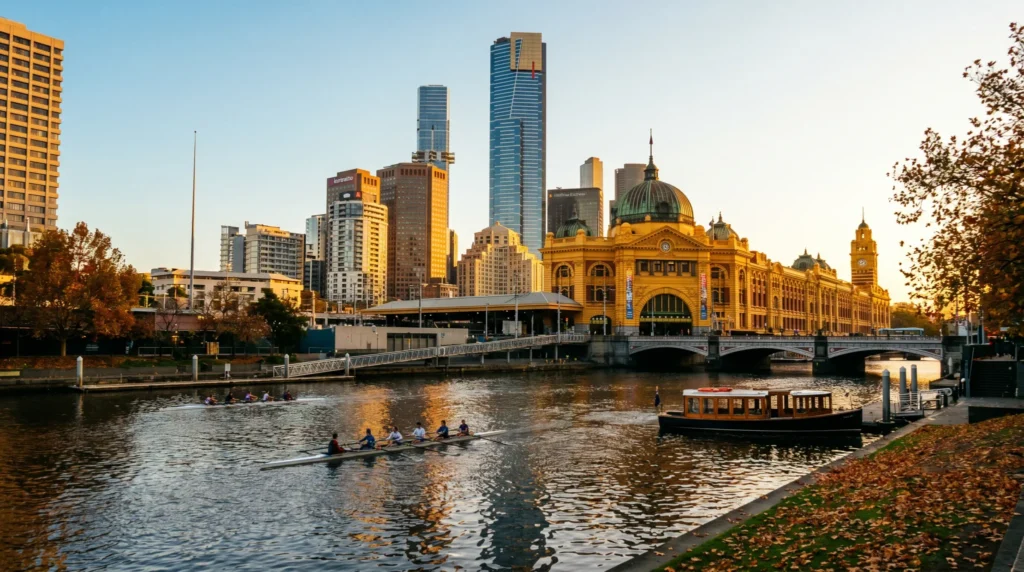
Melbourne, Australia: Laneways, Trams & Four Seasons in One Day
I have lost whole afternoons in Melbourne’s laneways, ducking from a graffiti alley into a coffee bar that roasts its own beans, and that is exactly why I keep coming back. We rate this as Australia’s most rewarding city to wander on foot: a Hoddle-grid centre wrapped in free trams, a food scene built by 233 spoken languages, and stadiums that fill to six figures on a Saturday. I want this guide to feel like a friend handing you their notebook — where to eat banh mi, when the penguins come ashore, and why locals shrug at “four seasons in one day.” I also acknowledge the Wurundjeri Woi Wurrung people, on whose Country this city stands.

Table of Contents
Why Melbourne?
Melbourne rewards the wanderer more than any other Australian city. Founded in 1835 on Wurundjeri Woi Wurrung Country and built on the rigid Hoddle Grid in 1837, its centre is a walkable rectangle of 30-metre boulevards stitched together by graffitied laneways.
With around 5.44 million residents in Greater Melbourne, it is now Australia’s largest metropolis, having overtaken Sydney in recent census growth. Where Sydney sells its harbour, Melbourne sells its layers: 233 languages, a gold-rush grandeur, and a coffee obsession that locals treat as a civic duty.
Time Out crowned it the best city in the world for 2026, and once you have spent a wet evening tram-hopping between a basement jazz bar and a rooftop, the case makes itself.

Neighborhoods: Finding Your Melbourne
📍 Melbourne Map: Every Place in This Guide


CBD & the Laneways
The Hoddle Grid centre packs arcades, rooftop bars and the densest laneway art on earth into a tight square. This is where free trams, Flinders Street Station and Federation Square all meet.
- Hosier Lane street-art wall
- Degraves Street coffee strip
- Royal Arcade (1869)
Best for: first-timers and night owls. Access: any city tram — it is all inside the Free Tram Zone.
Fitzroy & Collingwood
Melbourne’s first suburb, established in 1839, Fitzroy is the bohemian heart: Brunswick Street is wall-to-wall vintage shops, vinyl and small bars.
- Brunswick Street strip
- Rose Street Artists’ Market
- Gertrude Street galleries
Best for: live music and indie shopping. Access: tram 11 or 96.
Carlton & Lygon Street
Three kilometres from the CBD, Carlton is the birthplace of Melbourne’s café culture; Lygon Street’s Toto’s opened Australia’s first pizzeria in 1961.
- Lygon Street “Little Italy”
- Carlton Gardens (World Heritage)
- Cinema Nova
Best for: Italian dining and students. Access: tram 1 or 6.
St Kilda
Six kilometres south-east on the bay, St Kilda pairs Luna Park (open since 1912) with Acland Street cake shops and a little-penguin colony on the pier breakwater.
- St Kilda Pier penguins
- Luna Park
- Acland Street bakeries
Best for: beach days and sunsets. Access: tram 96.
Footscray & Richmond
For the real multicultural pulse, head to Footscray in the west — Time Out named it among the world’s coolest neighbourhoods — or Richmond’s Victoria Street “Little Saigon” in the east.
- Footscray Market
- Victoria Street pho
- Bridge Road outlets
Best for: cheap eats and Vietnamese food. Access: Footscray and Richmond rail stations.
The Food

Coffee Culture
Espresso landed on Lygon Street with Australia’s first commercial coffee machine, and the city has never looked back; the flat white is a point of fierce local pride.
- Federal Coffee Palace — arcade flat white (A$4.50, ~US$3)
- Degraves Espresso — laneway long black (A$4.50, ~US$3)
- Market Lane, QVM — single-origin filter (A$5, ~US$3.30)
Vietnamese & Asian
Dim sim was invented in Melbourne in the 1940s, and Footscray and Richmond now serve some of Australia’s best banh mi and pho.
- Footscray Market stalls — banh mi (A$8)
- Victoria Street, Richmond — pho (A$15)
- Chinatown yum cha — dumplings (A$12)
Beyond Coffee and Banh Mi
The pavlova-versus-New-Zealand debate still simmers, and the AFL meat pie is a Saturday institution at the MCG.
- Pavlova — meringue dessert (A$10)
- AFL meat pie — stadium classic (A$7)
- Maritozzi — Hector’s Deli cream bun (A$8)
- Queen Victoria Market produce — cheese and deli (varies)
Food Experiences You Can’t Miss
- A morning at Queen Victoria Market, open since 1878
- Lygon Street pasta crawl
- A laneway coffee tour on foot
Cultural Sights

Royal Exhibition Building
Built in 1879–1880, this was Australia’s first building inscribed on the UNESCO World Heritage List, in 2004, and it hosted the opening of the first federal Parliament on 9 May 1901. Admission is free to the surrounding Carlton Gardens; guided dome tours are ticketed.
Melbourne Cricket Ground (MCG)
The largest stadium in the Southern Hemisphere holds 100,024 and has hosted Test cricket since 1877 and the 1956 Olympics. Tours run daily; match tickets vary by code.

Federation Square & the NGV
Opened on 26 October 2002, “Fed Square” draws around 9.7 million visitors a year and houses ACMI and the NGV Australia. The free National Gallery of Victoria, founded in 1861, is the country’s oldest art museum.
Eureka Skydeck & Shrine of Remembrance
The 297-metre Eureka Tower offers Skydeck views from level 88, while the Shrine of Remembrance, dedicated on 11 November 1934, anchors the Kings Domain.
Entertainment & Nightlife

Laneway & Rooftop Bars
The CBD hides hundreds of small bars behind unmarked doors; rooftops along Flinders Lane and Bourke Street are the warm-weather move. Typical cocktail A$20–24. No booking needed midweek.
Live Music
Melbourne has one of the densest live-music scenes per capita anywhere; Fitzroy and Collingwood pubs host gigs nightly. Cover A$10–30.
Comedy Festival
The Melbourne International Comedy Festival, established in 1987, is the largest stand-alone comedy festival in the world and takes over the city each March–April.
Theatre & Arts
The Arts Centre and Southbank precinct stage opera, ballet and major touring musicals year-round. Tickets from A$40.
Day Trips from Melbourne

Great Ocean Road (3 hours by car)
This 240 km coastal route, built 1919–1932 by returned WWI servicemen as the world’s largest war memorial, ends at the Twelve Apostles.
Phillip Island (2 hours by car)
Home to the world’s largest little-penguin colony — around 40,000 birds — with a nightly Penguin Parade.
Yarra Valley (1 hour by car)
Over 80 wineries plus Healesville Sanctuary make this Victoria’s premier cool-climate wine region.
Sovereign Hill, Ballarat (90 minutes by car)
An open-air museum recreating the 1850s gold rush, complete with panning and a A$500,000 gold pour.
Mornington Peninsula (1 hour by car)
Pinot vineyards and the geothermal Peninsula Hot Springs make a relaxed coastal escape.
Seasonal Guide
Spring (September – November)
Spring brings the Melbourne Cup, blooming gardens and the Spring Racing Carnival; mild days suit walking tours.
Summer (December – February)
Beach weather and the Australian Open in January — but the famous “four seasons in one day” means pack a layer.
Autumn (March – May)
The sweet spot: golden light, the Comedy Festival and fewer crowds. My favourite time to visit.
Winter (June – August)
Cool and grey, but the AFL season fills the MCG and the laneway bars feel cosiest. Snow last fell in the CBD in 1986.
Getting Around
Trams & the Free Tram Zone
Melbourne runs the world’s largest urban tram network — about 250 km of track and 24 routes — and the entire CBD sits inside a Free Tram Zone introduced in January 2015.
Trains & myki
Metro trains radiate from Flinders Street, while Southern Cross handles V/Line regional and interstate services. Touch on and off with a myki card; a 2-hour fare is A$5.70 with a daily cap around A$11.40.
myki Cards
Buy a myki at any station or 7-Eleven for A$6 (adult), then top up; it covers trams, trains and buses across metro Melbourne.
Airport Access
- SkyBus from Melbourne Airport (MEL) — ~30 minutes, about A$23
- Rideshare or taxi — ~25 minutes, about A$55–70
Taxis & Rideshare
Uber, Bolt and DiDi all operate; flag-fall is around A$4.20. Use rideshare late at night when trams thin out.
Navigation Tips
Apps: PTV (timetables) and Google Maps. The grid is simple, but trams stop on the street — watch for the green “safety zone” islands.
Budget Breakdown: Making Your Aussie Dollar Count
| Tier | Daily | Sleep | Eat | Transport | Activities | Extras |
|---|---|---|---|---|---|---|
| Budget | A$90 | A$45 hostel | A$25 | A$11 myki | A$5 free sights | A$4 coffee |
| Mid-Range | A$180 | A$130 hotel | A$45 | A$11 myki | A$30 | A$10 |
| Luxury | A$420 | A$300 hotel | A$90 | A$25 rideshare | A$70 | A$20 |
Where Your Money Goes
Accommodation and dining dominate; transport is cheap thanks to the daily myki cap and the Free Tram Zone. Many headline sights — the NGV, Royal Botanic Gardens and Federation Square — are free.
Money-Saving Tips
- Stay inside the Free Tram Zone and skip transit fares
- Eat at Footscray or Victoria Street for A$10–15 meals
- Visit free museums and gardens on weekdays
Practical Tips

Language
English is universal, but you will hear Mandarin, Vietnamese, Greek and Italian on any tram — a reflection of 233 community languages.
Cash vs. Cards
Cards and phone payments are accepted almost everywhere; carry a little cash only for market stalls and tips.
Safety
Australia sits at the lowest US travel advisory level; Melbourne is very safe, with standard big-city care after dark. Dial 000 for emergencies.
What to Wear
Layers, always — the “four seasons in one day” reputation is earned. Pack a compact rain shell year-round.
Cultural Etiquette
Tipping is not expected; round up for great service. Stand left on escalators and let tram passengers off first.
Connectivity
Free public Wi-Fi blankets the CBD; local SIMs from Telstra, Optus or Vodafone are cheap and easy at the airport.
Health & Sun
Tap water is safe; the UV is fierce, so SPF 30+ and a hat are essential from October to March.
Driving
Australia drives on the left. Watch for the city’s unique “hook turn” — right turns made from the left lane to keep tram tracks clear.
Frequently Asked Questions
How many days do I need in Melbourne?
Four days minimum: two for the city and laneways, one stadium or market day, and one for the Great Ocean Road or Yarra Valley. Five lets you add Phillip Island.
Is Melbourne good for solo travellers?
Excellent — it is very safe, easy to navigate on foot and tram, and the café and bar culture is welcoming to solo diners.
Do I need a myki card for the trams?
Not inside the Free Tram Zone, which covers the whole CBD. For anywhere beyond it, buy a A$6 myki and touch on and off.
What about the language barrier?
There is none — English is the working language, though Melbourne’s diversity means you will hear dozens of others.
When is the best time to visit?
Autumn (March–May) and spring (September–November) offer the mildest weather and the best festivals, with thinner crowds than summer.
Can I use credit cards everywhere?
Yes — tap-to-pay is near-universal. Keep a little cash only for market stalls.
Is Melbourne hosting the 2026 Commonwealth Games?
No. Victoria cancelled its hosting in July 2023 and Glasgow stepped in, so ignore older guides that say otherwise.
Ready to Experience Melbourne?
Lace up, grab a myki, and let the laneways pull you in. For the full country context, read the Australia Travel Guide.
Explore More City Guides
Where to Stay

Alex the Travel Guru
Alex has been writing the Facts From Upstairs travel desk for a decade, with a particular soft spot for cities you have to walk to understand. Melbourne is the one he keeps going back to — for the coffee, the trams, and the laneways that never quite reveal everything at once.
More city guides you might like
Plan your trip to Melbourne
The booking tools we use ourselves. FFU may earn a commission at no extra cost to you.
Plan & book your trip to Melbourne
Booking through these searches supports our guides at no extra cost to you.