
Languages of Slovakia
All languages of Eastern Europe →fluent beta classical · classes by phone with Maya at ranas.ai/maya
Slovakia Travel Guide — High Tatras, Hilltop Castles & the Most Castle-Dense Country in Europe
I think Slovakia is the most underrated country in Central Europe, and I will keep saying it until people stop confusing it with Slovenia. My first morning in Bratislava I drank a coffee under the castle walls for the price of a bus ticket back home, then drove two hours east and was standing under the granite spires of the High Tatras — a genuine alpine range that most travellers have never heard of. We have more castles per capita here than almost anywhere on earth, a capital you can cross on foot in twenty minutes, hiking that rivals the Alps at a third of the price, and a wine country nobody outside the region has discovered. This is the brief I would hand my own brother before he flew into Vienna and drove the forty minutes across the Danube to Bratislava.

In This Guide
- Overview — Why Slovakia Belongs at the Top of Your 2026 Shortlist
- High Tatras Winter — Slovakia’s 2026 Ski & Festival Calendar
- Best Time to Visit Slovakia (Season by Season)
- Getting There — Flights, BTS Airport & the Vienna Back Door
- Getting Around — Trains, the Free-Travel Scheme & Mountain Buses
- Top Cities & Regions
- Slovak Culture & Etiquette
- A Food Lover’s Guide to Slovakia
- Off the Beaten Path — Caves, Wooden Churches & Wine Roads
- Practical Information
- Budget Breakdown
- Planning Your First Trip to Slovakia
- Frequently Asked Questions
Overview — Why Slovakia Belongs at the Top of Your 2026 Shortlist
Slovakia is a compact, mountainous, landlocked country of 49,035 km² wedged between Poland, Ukraine, Hungary, Austria and the Czech Republic — roughly the size of Denmark or the US state of West Virginia. About 5.41 million people live here as of the end of 2025, and the country has only existed in its current borders since 1 January 1993, when Czechoslovakia split peacefully into the Czech Republic and Slovakia in the so-called “Velvet Divorce.” Despite being one of the EU’s younger states, it is one of its most settled: a member of the European Union since 1 May 2004, the Schengen Area since 21 December 2007, and the Eurozone since 1 January 2009.
The first story is the mountains. Despite its small size, Slovakia is genuinely alpine: the High Tatras (Vysoké Tatry) are the highest range of the entire Carpathian arc, with the country’s roof, Gerlachovský štít, reaching 2,655 metres. The Tatras are the smallest high-mountain range in the world by area, yet they pack in glacial lakes, granite spires and chamois into a band barely 26 km long — and you can be standing on a ridge above 2,000 m within three hours of the capital. Around 40% of the country is forested and nine national parks protect roughly a quarter of its territory.
The second story is the castles. Slovakia has one of the highest densities of castles and châteaux in the world — well over 100 castles and 400-plus manor houses scattered across the country, including Spiš Castle, one of the largest castle complexes in Central Europe at roughly four hectares. Eight UNESCO World Heritage sites span the country, from the painted Gothic altar of St. James’s Church in Levoča (the tallest wooden altar in the world at 18.6 m, carved by Master Paul of Levoča) to the wooden churches of the Carpathians and the karst caves of the Slovak Karst.
The third story is the value. Slovakia is one of the cheapest members of the Eurozone: a hearty plate of bryndzové halušky (the national sheep-cheese dumplings) costs a few euros in a mountain koliba, a Tatras cable-car day-pass is a fraction of an equivalent in the Alps, and Bratislava — only 60 km from Vienna — offers a beer for a euro or two within sight of an EU capital. The result is a country where genuine alpine adventure, medieval history and Central European city life come bundled at Balkan prices, all within a day’s drive of one another.

High Tatras Winter — Slovakia’s 2026 Ski & Festival Calendar
If you can shape your trip around one Slovak season, make it winter in the High Tatras. The country’s flagship ski region runs reliably from December to early April, anchored by two resorts: Jasná Nízke Tatry on Chopok in the Low Tatras — the largest ski resort in Central Europe, with around 50 km of pistes, 30 lifts and a vertical drop of roughly 1,000 m — and Tatranská Lomnica in the High Tatras, whose cable car climbs to Lomnický štít at 2,634 m, one of the highest lift-served points in the Carpathians.
The mountains buy you reliable snow that the Alps increasingly cannot guarantee, at well under half the price. A day lift-pass at Jasná runs roughly €45–55 in peak season versus €70+ at comparable Alpine resorts. Beyond skiing, the Tatras are spectacular for winter walking, ice-climbing at Hrebienok’s ice-sculpture park (the annual Tatry Ice Master sculpts a temple from Tatra ice each winter), and the thermal-spa culture of nearby Liptov, where outdoor pools steam at the foot of snowy ridges.
The wider 2026 calendar is loaded. The Košice Peace Marathon, the oldest marathon in Europe (first run in 1924), takes place the first Sunday of October; Christmas markets fill the squares of Bratislava and Košice through Advent; and folk-festival season — including the huge Východná Folklore Festival, the country’s biggest, held early July — animates the summer.

Best Time to Visit Slovakia (Season by Season)
Slovakia is a four-season country with a continental climate — warm summers, cold snowy winters, and two sharply defined shoulder seasons. The lowlands of the south and the Danube basin are markedly warmer than the northern mountains, which can hold snow on the high Tatra ridges into June. Bratislava averages around 10.5°C annually; Poprad, the gateway to the Tatras at 670 m, runs several degrees colder year-round.
Spring (March–May) — Waterfalls, Wildflowers & Empty Castles
Spring is the quiet sweet spot. By May the lowland temperatures sit at a pleasant 18–22°C, Bratislava’s terraces reopen, the Slovak Paradise gorges run full with snowmelt waterfalls, and the castles are crowd-free before the summer rush. The High Tatras remain wintry well into April — many high trails stay officially closed until 15 June for safety and wildlife protection.
Summer (June–August) — Hiking, Folk Festivals & the Warm South
Summer is the peak season for the mountains. From mid-June, when the high Tatra trails open, through September the hiking is superb, the Liptov and Orava lake regions fill with families, and the southern lowlands around Bratislava and the Danube hit 28–32°C. July brings the country’s biggest folklore festival at Východná and a packed calendar of medieval-castle re-enactments. Note that the Tatras can see sudden cold-front thunderstorms even in August — always check the mountain forecast and turn back by early afternoon.
Autumn (September–November) — Foliage, Wine & the Best Light
September is arguably the single best month: warm, stable weather, the Tatra trails still fully open, and the start of the wine harvest in the Small Carpathians around Pezinok and Modra. October brings spectacular beech-forest foliage across the Carpathians and the famous Košice marathon. By November the mountains are cold and grey; it is the low season everywhere except the spa towns.
Winter (December–February) — Tatras Ski Season & Christmas Markets
Winter belongs to the slopes and the squares. The Jasná and Tatra resorts run from December to early April with the most reliable snow in December–February; Bratislava and Košice host atmospheric Christmas markets through Advent; and the Liptov thermal spas (Bešeňová, Tatralandia) are at their most magical with steam rising into freezing air. Lowland temperatures hover around 0°C; the high Tatras can drop below −20°C with serious avalanche risk off-piste.
Getting There — Flights, BTS Airport & the Vienna Back Door
The single most useful fact about reaching Slovakia is that you often shouldn’t fly to Slovakia at all — you should fly to Vienna. Vienna International Airport (VIE) is only about 60 km from central Bratislava, with direct buses (RegioJet, Slovak Lines) running roughly hourly and taking around an hour for €5–10. Vienna’s vast long-haul network makes it the de-facto international gateway for the Slovak capital.
That said, Slovakia has its own airports. Bratislava Airport (BTS / M. R. Štefánik), 9 km north-east of the city, is the country’s busiest, served mainly by Ryanair and Wizz Air on European low-cost routes; it handled well over two million passengers in 2024. Košice Airport (KSC) in the east is the second gateway, with connections to Vienna, Prague, Bratislava, London and Warsaw and easy onward access to the Tatras and Spiš. A bus from BTS to central Bratislava costs about €1, or a taxi €15–20.
Overland is easy and scenic. Bratislava sits on the main Vienna–Budapest rail corridor — Vienna is about 1 hour by train, Budapest around 2.5 hours, and Prague roughly 4 hours by direct RegioJet or ZSSK service. A summer Twin City Liner catamaran even runs up the Danube between Vienna and Bratislava. Schengen membership means no passport checks at any of Slovakia’s land borders.
Getting Around — Trains, the Free-Travel Scheme & Mountain Buses
Slovakia is small and well-connected, and you do not need a car to see the highlights — though one helps for the castles and wine roads. The state railway ZSSK (Železničná spoločnosť Slovensko) runs the backbone network, with the main west–east line linking Bratislava, Trenčín, Žilina, Poprad (for the Tatras) and Košice. The Bratislava–Košice express takes about 5–6 hours; Bratislava–Poprad around 4 hours. Private operator RegioJet competes on the same corridor with cheaper, more comfortable trains.
Trains & the Free-Travel Scheme
Slovak train fares are very low, and there is a famous quirk worth knowing: free rail travel on ZSSK trains is available to students, pensioners and children who register, and — crucially — to citizens and residents of any EU country in those categories, including over-62s. Even for everyone else, a ticket from Bratislava to the Tatras costs only around €12–18. In the High Tatras themselves, the historic narrow-gauge Tatra Electric Railway links Štrbské Pleso, Starý Smokovec and Tatranská Lomnica.
Buses, Cars & the Vignette
Intercity buses (RegioJet, Slovak Lines, FlixBus) fill the gaps the rail network misses, especially to smaller castle towns and the Slovak Paradise. Driving is on the right; a digital motorway vignette (eknown) is mandatory on highways — about €17 for 10 days, buyable online at eznamka.sk. Mountain roads are well maintained but can be snowbound November–April, when winter tyres are legally required.
Top Cities & Regions of Slovakia
📍 Map of Slovakia: Every Place in This Guide
Slovakia’s highlights string along the country’s spine from the Danube in the south-west to the Spiš region in the east. The classic first-trip plan is a long weekend in Bratislava, a few days in the High Tatras from Poprad, and a loop east through Spiš Castle and Levoča to Košice — all linked by the main railway line and none more than five hours apart.


Bratislava — The Walkable Danube Capital
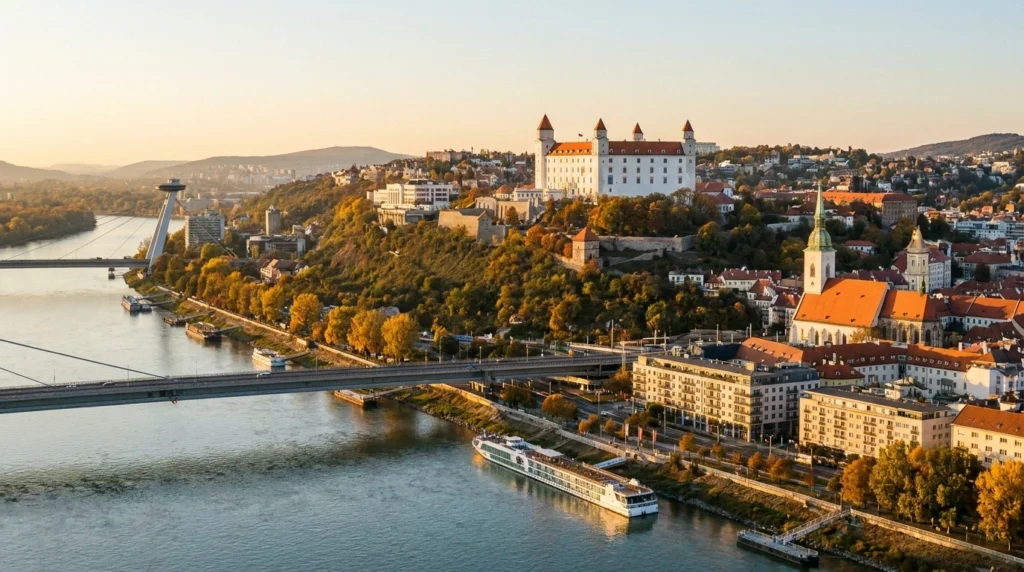
Bratislava is Slovakia’s capital and largest city — around 475,000 people, sitting on the Danube where Slovakia, Austria and Hungary nearly meet. The pedestrianised Old Town is the draw: Gothic St. Martin’s Cathedral (where 19 Hungarian kings and queens were crowned), the Baroque Primate’s Palace, Michael’s Gate, and the four-towered castle on its hill. Quirky bronze statues give the streets their charm, and the beer-hall and café culture is among the cheapest of any EU capital.

High Tatras & Poprad — Slovakia’s Alpine Heart
The High Tatras are Slovakia’s signature landscape and a national park since 1949 (TANAP, the country’s oldest). The gateway town is Poprad, from which the Tatra Electric Railway climbs to Štrbské Pleso, Starý Smokovec and Tatranská Lomnica. The hiking is genuinely alpine: glacial lakes, the cable car to Lomnický štít (2,634 m), and serious ascents to Rysy (2,503 m) for fit walkers.
Spiš Castle & Levoča — The UNESCO East
The Spiš region in eastern Slovakia holds the country’s most spectacular ruin. Spiš Castle (Spišský hrad) is one of the largest castle complexes in Central Europe — roughly four hectares of white limestone walls sprawling across a hilltop, a UNESCO site since 1993 along with the nearby town of Spišské Podhradie, the ecclesiastical town of Spišská Kapitula, and the church at Žehra. A short drive away, the walled town of Levoča (UNESCO 2009) preserves a Renaissance square dominated by St. James’s Church, home to the world’s tallest Gothic wooden altar (18.62 m), carved 1507–1517 by Master Paul of Levoča.
Košice — The Eastern Capital
Košice is Slovakia’s second city — around 230,000 people — and the cultural capital of the east, a former European Capital of Culture (2013). Its long, spindle-shaped main square is one of the most handsome in Central Europe, anchored by the Cathedral of St. Elisabeth, the largest church in Slovakia and the easternmost Gothic cathedral in Europe. The square’s singing fountain, State Theatre and café terraces make it a relaxed base for exploring the eastern castles, the Slovak Karst caves and the Tokaj wine region that spills over from Hungary.
Small Carpathians & the Wine Road
Just north of Bratislava, the Small Carpathians (Malé Karpaty) wine region runs through the historic towns of Svätý Jur, Pezinok and Modra — Slovakia’s oldest and best-known wine country, famous for crisp whites like Grüner Veltliner and the indigenous Devín grape. The Small Carpathian Wine Route links dozens of cellars, and the region is an easy half-day escape from the capital by train, with castle ruins like Červený Kameň (“Red Stone”) thrown in.
- Pezinok and Modra cellars on the Small Carpathian Wine Route
- Červený Kameň castle, with its vast Renaissance wine vaults
Slovak Paradise & Liptov — Gorges, Lakes & Spas
The Slovak Paradise (Slovenský raj) national park, west of Spiš, is a maze of forested gorges threaded with ladders, chains and catwalks alongside waterfalls — the Suchá Belá and Hornád gorges are among Europe’s most exhilarating hiking. To the west, the Liptov region wraps the Low Tatras around the Liptovská Mara reservoir, combining the Jasná ski resort, the Demänovská cave system, and the big thermal aquaparks of Bešeňová and Tatralandia — Slovakia’s family-holiday heartland in every season.
- Suchá Belá and Hornád gorges in the Slovak Paradise (one-way, ladder-climbing routes)
- Demänovská Cave of Liberty and the Jasná ski area in the Low Tatras
Slovak Culture & Etiquette — What to Know Before You Go

Slovakia is a young country with deep roots: it became independent only in 1993 after the peaceful “Velvet Divorce” split Czechoslovakia, yet its folk identity stretches back to Great Moravia and the Carpathian shepherd culture. Catholicism remains the dominant faith and shapes the calendar of festivals, but everyday social life is relaxed, family-centred and built around the outdoors. A little awareness of the etiquette below goes a long way with hosts who take hospitality seriously.
The Essentials
- Remove your shoes when entering a Slovak home — slippers (papuče) are almost always offered.
- Greet with a firm handshake and direct eye contact; use titles and surnames until invited to first names.
- Slovaks can seem reserved with strangers but are warmly hospitable once introduced — refusing offered food or a shot of slivovica (plum brandy) can mildly offend.
- Tipping is modest: round up or leave about 10% in restaurants; tell the server the total amount you want to pay as you hand over the money.
- Don’t confuse Slovakia with Slovenia, and don’t refer to it as part of the former “Eastern Bloc” — Slovaks see themselves firmly as Central European.
Folk Culture & the Fujara
- Slovak folk traditions are unusually living — village folklore ensembles, embroidered costumes (kroje) and the summer festival circuit are taken seriously.
- The fujara, a giant shepherd’s overtone flute up to 2 m long, is inscribed on UNESCO’s Intangible Cultural Heritage list.
- The valaška shepherd’s axe and the bagpipe (gajdy) round out the pastoral musical tradition of the Carpathian highlands.
- Easter Monday’s šibačka custom — sprinkling water and a gentle whip of woven willow — survives strongly in villages.
A Food Lover’s Guide to Slovakia

Slovak cooking is hearty Central European mountain food — sheep’s cheese, potatoes, dumplings, smoked meats and cabbage — built for cold winters and shepherd’s appetites, and almost absurdly cheap. The undisputed national dish is bryndzové halušky: soft potato dumplings smothered in tangy sheep’s-milk bryndza cheese and topped with fried bacon. The cuisine reflects centuries of overlapping influences — Hungarian goulash and paprika, Austrian schnitzels and strudels, Czech dumplings and pork — folded into a distinctly highland larder where bryndza sheep’s cheese, smoked oštiepok and bacon do much of the heavy lifting.
Eating is one of the great bargains of European travel here: a generous plate of the national dish in a pub rarely tops a few euros, and even a sit-down restaurant meal with a glass of local wine stays comfortably in single figures across most of the country. Portions are large, lunch (obed) is the main meal of the day, and most pubs run a cheap weekday denné menu — soup plus a main for a handful of euros — that is the savviest way to eat well on a budget.
Must-Try Dishes
| Dish | Description |
|---|---|
| Bryndzové halušky | The national dish: potato dumplings in sheep’s-cheese sauce with crispy bacon. |
| Kapustnica | Rich sauerkraut soup with smoked sausage and mushrooms, traditional at Christmas. |
| Bryndzové pirohy | Filled dumplings (pierogi) stuffed with the same tangy sheep’s cheese. |
| Vyprážaný syr | Fried breaded cheese with tartar sauce and fries — the beloved cheap classic. |
| Segedínsky guláš | Pork goulash with sauerkraut and sour cream, served with bread dumplings (knedľa). |
| Trdelník & medovník | Sweet spit-roasted “chimney cake” and rich honey layer cake for dessert. |
Drinks & Where to Eat
Wash it all down with Slovak wine — the country has six wine regions, the best-known being the Small Carpathians and Slovak Tokaj — or with Kofola, the home-grown cola that outsells global brands in Slovakia and the Czech Republic. The spirit of choice is slivovica (plum brandy) or borovička (juniper). For the most authentic eating, head for a koliba — a rustic log-cabin restaurant in the mountains serving sheep’s-cheese dishes, grilled meats and local beer at a fraction of Western European prices. Bratislava’s Old Town and Košice’s main square also have a fast-growing wave of modern bistros, third-wave coffee houses and craft-beer taprooms for travellers who want something lighter than the traditional fare. Wherever you eat, save room for a trdelník from a street griddle or a slice of medovník honey cake with your afternoon coffee.
- Drinks: Slovak Grüner Veltliner and Devín wines, Zlatý Bažant and Šariš beers, Kofola cola, slivovica and borovička spirits.
- Where: mountain kolibas, Bratislava beer halls, and the cellars of the Small Carpathian Wine Route.
Off the Beaten Path — Caves, Wooden Churches & Wine Roads

For a small country, Slovakia carries an outsized share of UNESCO World Heritage — eight inscriptions in all, most of them gloriously uncrowded. Once you step beyond Bratislava and the Tatras, the rewards pile up fast: nail-free timber churches, ice caves, silver-mining towns and painted villages that see a fraction of the visitors they would draw anywhere else in Europe. A rental car and two or three unhurried days in the centre and east open up the country’s most memorable corners.
The Wooden Churches of the Carpathians
Scattered across northern and eastern Slovakia are some of Europe’s most extraordinary all-timber churches, built without a single nail. Eight Roman Catholic, Protestant and Greek Orthodox wooden churches of the Slovak Carpathians are jointly inscribed as a UNESCO World Heritage site, including the Greek Catholic church at Bodružal and the wooden articular church at Hronsek.
The Slovak Karst Caves
The caves of the Slovak Karst and Aggtelek Karst form a transboundary UNESCO site of over 1,000 caves, of which a dozen Slovak caves are open to visitors. The standout is the Dobšiná Ice Cave, with its permanent ice floor up to 25 m thick, and the dripstone Domica system on the Hungarian border.
Banská Štiavnica — The Silver Town
Banská Štiavnica, a UNESCO-listed former silver-mining town in central Slovakia, is one of the most beautiful and least-visited places in the country — a perfectly preserved medieval mining settlement of cobbled lanes, a hilltop “New Castle,” and 18th-century mining academies, set among the artificial lakes (tajchy) that powered the mines.
Bardejov & the East
The walled town of Bardejov in the far north-east is a UNESCO-listed medieval gem, with one of the best-preserved fortified squares in Central Europe and a cluster of Gothic burgher houses around St. Giles’s Church. Nearby, the spa quarter of Bardejovské Kúpele and the wooden churches of the Šariš region complete one of Slovakia’s most rewarding and overlooked corners.
Čičmany — The Painted Village
Čičmany, a tiny village in the north-west, is famous for its dark log houses painted with white geometric folk patterns — the same lace-like motifs that the Slovak Olympic team has worn on its kit. It is one of the most photogenic and distinctive villages in Central Europe.
Practical Information
Slovakia is an easy, low-friction destination for most visitors: it is in both the EU and the Schengen zone, uses the euro, has safe tap water and excellent mobile coverage, and runs reliable, cheap public transport between its main towns. The essentials below cover money, connectivity and safety; the one thing worth planning around is the seasonal closure of the high mountain trails, covered in the planning section. EU and UK citizens travel visa-free and need only a valid passport or ID card.
| Currency | Euro (€); Slovakia adopted the euro on 1 January 2009 at 30.1260 SKK. |
| Cash needs | Cards widely accepted in cities; carry some cash for mountain kolibas, rural buses and small castle entries. |
| ATMs | Plentiful in towns; use bank-branded ATMs (Tatra banka, VÚB, Slovenská sporiteľňa) and decline dynamic currency conversion. |
| Tipping | Round up or 10% in restaurants; state the total amount when paying. |
| Language | Slovak; English common in Bratislava and the Tatras, German near Austria. Google Translate covers menus and signs. |
| Safety | Very safe; petty pickpocketing in tourist spots is the main risk. EU emergency number 112. |
| Connectivity | Strong 4G/5G; EU roaming works for European SIMs. Prepaid SIMs from Orange, O2 or Telekom are cheap. |
| Power | Type C and Type E plugs, 230V / 50 Hz. |
| Tap water | Safe to drink everywhere; mountain-spring water is excellent. |
| Healthcare | Good public and private care; EHIC/GHIC covers EU/UK visitors. Pharmacies (lekáreň) widespread. |
Budget Breakdown — What Slovakia Actually Costs
Slovakia is one of the best-value destinations in the Eurozone, and the headline saving is the mountains: the High Tatras and Slovak Paradise cost nothing to hike, and the trains and buses that reach them are among the cheapest in Europe. Your daily spend is driven far more by how you sleep and how many cable cars and castle tickets you buy than by food, which stays cheap at every tier. The figures below are per person, per day, excluding international flights.
Budget Traveller
On €40–65 a day you can stay in Bratislava or Poprad hostels, eat vyprážaný syr and halušky in pubs, ride trains across the country for a handful of euros, and hike the Tatras for free. Slovakia is one of the cheapest Eurozone countries, and a weekday denné menu keeps lunch under five euros.
Mid-Range
€80–140 a day covers a comfortable 3-star hotel or guesthouse, restaurant meals with wine, cable-car day-passes in the Tatras, castle entries and a rental car for the wine and castle roads. This is the sweet spot for most first-timers, blending the freedom of a car for the eastern UNESCO sites with the value of trains for the main corridor.
Luxury
From €250 a day you can book the best spa hotels in the Tatras and Liptov, fine-dining in Bratislava, private guides and ski-in/ski-out chalets at Jasná — still far below comparable Alpine prices in Austria or Switzerland just across the border.
| Tier | Daily (EUR) | Accommodation | Food | Transport |
|---|---|---|---|---|
| Budget | €40–65 | Hostel / guesthouse €15–30 | Pubs & kolibas €10–18 | Trains/buses €5–12 |
| Mid-Range | €80–140 | 3-star hotel €55–90 | Restaurants €25–40 | Rental car + vignette €40 |
| Luxury | €250+ | Spa hotel / chalet €180+ | Fine dining €60+ | Private driver / ski pass €60+ |
Planning Your First Trip to Slovakia
Slovakia rewards a little structure because its highlights are strung along a single east–west axis rather than clustered around one city. The most common mistake is trying to see everything in a long weekend; the country is compact, but the mountain roads and the gorge hikes take time. Decide first whether your trip is a city break, a mountain holiday or a full cross-country loop, then build around the rail corridor and the Tatra trail season. The steps below walk through it.
- Fly to Bratislava (BTS), Košice (KSC), or Vienna (VIE) + the €5 airport bus to Bratislava.
- Decide your axis: a Bratislava city break, a Tatras hiking/ski trip from Poprad, or a full west-to-east loop.
- Book the main rail corridor (ZSSK or RegioJet); reserve Tatra cable-car slots online for clear days.
- If you’ll drive, buy the digital motorway vignette online before you set off and pack winter tyres Nov–Apr.
- Time high-mountain hikes for 15 June–31 October; otherwise plan around cable cars, valleys and the resorts.
Classic 7-Day Itinerary: 2 days Bratislava + Small Carpathians wine, 1 day travelling east, 2 days High Tatras hiking from Poprad, 1 day Spiš Castle and Levoča, 1 day Košice and home.
Frequently Asked Questions
Is Slovakia expensive to visit?
No — Slovakia is one of the cheapest members of the Eurozone. Budget travellers manage on €40–65 a day, mid-range on €80–140. Hiking is free, trains are very cheap, and a hearty plate of the national dish costs only a few euros. Bratislava and the High Tatras in peak season are the priciest spots; the east is cheaper still.
Do I need to speak Slovak?
Not really. English is widely spoken in Bratislava, the High Tatras and among younger Slovaks; German is common near the Austrian border. Slovak is a West Slavic language closely related to Czech. Learning ďakujem (thank you) and prosím (please) is appreciated, and Google Translate handles menus and signs well.
Is the train worth it, or should I rent a car?
For the main cities and the Tatras, the train is excellent value and very cheap — and free for registered EU pensioners, students and children. Rent a car only if you want to chase the castles, wooden churches and wine roads off the rail line. The two combine well: train east, then a one- or two-day car rental for the Spiš and Šariš regions.
Is Slovakia safe for solo travellers?
Yes — Slovakia is a very safe country with low violent-crime rates and a strong record for solo and female travellers. Petty pickpocketing in tourist areas is the main concern. The EU-wide emergency number 112 works in English, and the hiking infrastructure in the Tatras is well-marked and well-patrolled by mountain rescue (HZS).
When is the best time for the High Tatras?
For hiking, mid-June to early October, when the high trails are officially open; September offers the most stable weather and clearest air. For skiing, December to early April, with the most reliable snow in January and February at Jasná and Tatranská Lomnica.
Can I get by as a vegetarian or vegan?
Increasingly, yes, especially in Bratislava and Košice, which have dedicated vegetarian and vegan restaurants. Traditional rural cooking is meat- and cheese-heavy, but vyprážaný syr (fried cheese), potato dishes and pierogi give vegetarians options everywhere. Vegans should plan ahead in mountain villages.
What’s the difference between Slovakia and Slovenia?
They are two entirely different countries, often confused because of their similar names and flags. Slovakia is in Central Europe, landlocked, with the High Tatras and a capital (Bratislava) on the Danube; Slovenia is a smaller Alpine-Adriatic country to the south-west with a short coastline and the capital Ljubljana. The two foreign ministries reportedly forward each other’s misdirected mail.
Explore More — City Guides & Related Reading
- Vienna City Guide — Just 60 km from Bratislava and its de-facto international gateway; the obvious twin-city pairing.
- Budapest City Guide — 2.5 hours by train south down the Danube; the natural onward leg.
- Prague City Guide — Slovakia’s former federal partner, four hours west; pair the two for a Czechoslovak loop.
- Warsaw City Guide — Across the High Tatras to the north; an easy add-on through the Polish Tatra resorts.
- Paris City Guide — For travellers connecting through Western Europe before the Central-European leg.
- Rome City Guide — A classic Mediterranean counterpoint to Slovakia’s alpine castles and caves.
- All Country Guides
More country guides you might like

Plan your trip to Slovakia
The booking tools we use ourselves. FFU may earn a commission at no extra cost to you.
Plan & book your trip to Slovakia
Booking through these searches supports our guides at no extra cost to you.