
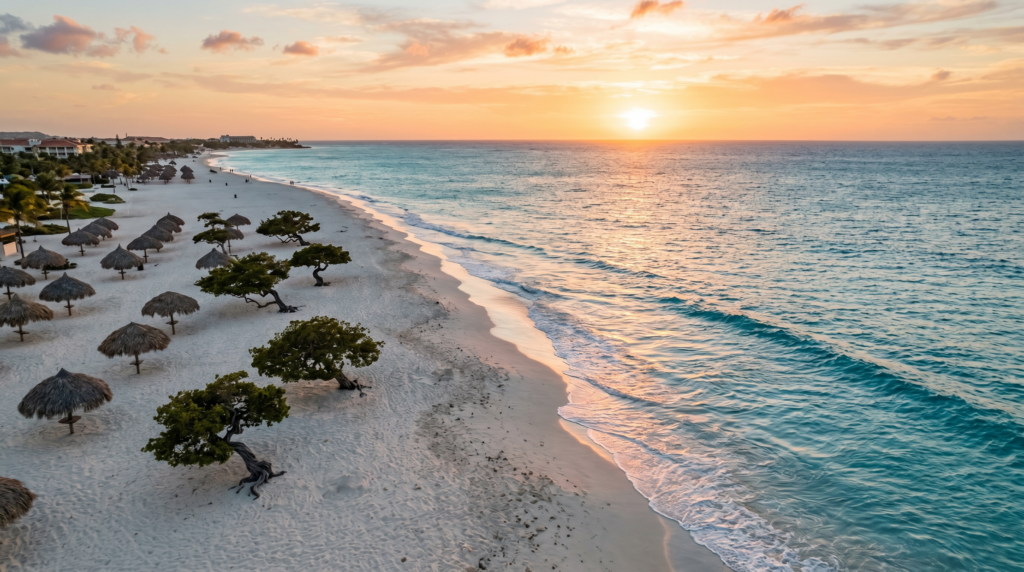
Aruba Travel Guide — One Happy Island of White Sand, Divi-Divi Trees & Year-Round Sun Outside the Hurricane Belt
Aruba sells itself on a single, hard-to-beat promise: sunshine you can count on. Sitting just 12 degrees north of the equator and safely outside the hurricane belt, this small Dutch-Caribbean island trades lush rainforest for cactus-studded desert, powder-white beaches and a constant cooling trade wind. It’s polished, easy and famously friendly — but get past the high-rise hotel strip and you’ll find rugged national-park coastline, a pastel capital with serious food, and some of the calmest, clearest swimming water in the region.
📋 In This Guide
- Overview — Why Aruba is the Caribbean’s safest bet for sun
- Outside the hurricane belt — why it matters
- Best time to visit (season by season)
- Getting there
- Getting around
- Where to go — beaches, Oranjestad & Arikok
- Culture & people — Papiamento & the Dutch connection
- A food lover’s guide to Aruba
- Off the beaten path
- Practical information
- Budget breakdown — what Aruba costs in 2026
- Planning your first trip
- Frequently asked questions
Overview — Why Aruba Is the Caribbean’s Safest Bet for Sun
Aruba is the “A” of the ABC Islands — Aruba, Bonaire and Curaçao — a trio of Dutch-Caribbean islands strung along the coast of Venezuela. Unlike the lush, mountainous islands further north, Aruba is arid and flat, a cactus-and-divi-divi desert ringed by extraordinary beaches. That dryness is the secret to its reputation: very little rain, almost no humidity by Caribbean standards, and relentless sunshine cooled by steady trade winds.
For travellers, Aruba is the easy button. It’s safe, walkable in places, set up for tourism, and overwhelmingly English-friendly. The flip side is that it can feel built-up and pricey along the Palm Beach high-rise strip. The trick is to balance the comforts of the hotel zone with the wild side — Arikok National Park’s rugged northeast coast, the pastel streets and restaurants of Oranjestad, and the quieter beaches of the south.
Outside the Hurricane Belt — Why It Matters
Here’s Aruba’s single biggest selling point, and the reason it’s a smart choice in the summer and autumn when much of the Caribbean is on storm watch: the island sits at roughly 12 degrees north, below the Atlantic hurricane belt, and has never recorded a direct hurricane hit. While islands further north brace through the June–November season, Aruba keeps delivering dry, sunny, swimmable days. If you want a guaranteed-sun Caribbean trip in hurricane season — without the gamble — this is the island to book.
Best Time to Visit Aruba (Season by Season)
December – April — Peak (perfect weather, highest prices)
Averages around 82°F (28°C), constant breeze, warm 79–81°F water and almost no rain. It’s the busiest and most expensive stretch, drawing North American snowbirds; book well ahead.
April – May & September – November — Shoulder (best value)
Still hot, dry and sunny but cheaper and quieter. Spring and autumn offer the best balance of weather and price, with thinner crowds at the big resorts.
October – December — “Rainy” season (still good)
Aruba’s wettest months are mild by tropical standards: short evening showers that clear fast, with much less rain than islands to the north. Prices are often at their lowest, and the sun still dominates.
Getting There
Queen Beatrix International Airport (AUA) in Oranjestad is one of the best-connected airports in the Caribbean, with frequent nonstop flights from across the US (Miami, New York, Newark, Charlotte, Atlanta, Boston, Chicago and more), Canada, and Europe via Amsterdam.
- US pre-clearance: Aruba has US Customs and Border Protection pre-clearance, so flights from Aruba arrive in the US as domestic — you clear US immigration before you fly home, saving time on arrival.
- ED Card: complete the mandatory online Embarkation/Disembarkation card up to seven days before arrival (it can’t be done at the airport), including the $20 sustainability fee for travellers aged 8 and over.
- Cruise: ships dock right in downtown Oranjestad, steps from shops and beaches.
Getting Around
Aruba is small — about 20 miles long — so you can see a lot in a few days.
- Rental car: the best way to reach Arikok, the lighthouse and the south. Roads are good; a standard car is fine for most sights, though the wild northeast coast and Natural Pool need a 4×4 or a guided tour.
- Arubus: reliable, cheap public buses connect the airport, Oranjestad and the hotel strips at Eagle and Palm Beach.
- Taxis: plentiful with fixed government rates (no meters) — confirm the fare before you ride.
- On foot & bike: the 4-mile Linear Park promenade links the airport area to the cruise port along the water.
Where to Go — Beaches, Oranjestad & Arikok
Eagle Beach & Palm Beach
Aruba’s headline beaches. Eagle Beach is a wide, low-rise stretch of brilliant white sand framed by the photogenic, wind-bent fofoti (divi-divi) trees — regularly ranked among the world’s best. Palm Beach is the buzzier high-rise zone, with calm water, watersports, restaurants and casinos.
Oranjestad
The pastel Dutch-colonial capital, with the Renaissance Marina, Linear Park, shopping, and a genuinely good food scene. Don’t miss the private Renaissance Island and its resident flamingos.
Arikok National Park
Covering nearly a fifth of the island, Arikok protects Aruba’s wild side: caves with Arawak rock drawings, lava and limestone formations, the rugged windward coast, and secluded bays like Boca Prins and Dos Playa. Admission is about $15; the Natural Pool (Conchi) is the star, reached by 4×4, on horseback or hiking.
The South — Baby Beach & San Nicolas
At the island’s tip, Baby Beach is a shallow, sheltered lagoon ideal for families and snorkellers. Nearby San Nicolas has become Aruba’s street-art capital, with vivid murals across its walls.
Culture & People — Papiamento & the Dutch Connection
Aruba is a constituent country within the Kingdom of the Netherlands, which shapes everything from the orderly infrastructure to the Dutch street signs. But the island’s heart is Papiamento, a melodic creole blending Portuguese, Spanish, Dutch, English and African languages — learn “bon bini” (welcome) and “masha danki” (thank you very much) and you’ll get warm smiles everywhere.
The population is one of the most diverse in the Caribbean, drawing on Arawak, Dutch, Spanish and dozens of other roots. The vibe is relaxed, safe and welcoming — the “One Happy Island” slogan is touristy, but the friendliness is real. Carnival, in the weeks before Lent, is the cultural high point: weeks of parades, music and elaborate costumes.
A Food Lover’s Guide to Aruba
Aruban food mirrors the island’s mix — Dutch, Latin, Caribbean and Indonesian (a legacy of the Dutch colonial network) all on one menu.
- Keshi yena — the national dish: a whole Edam or Gouda cheese stuffed with spiced, sweet-savoury chicken.
- Fresh seafood — red snapper, mahi-mahi, conch (“karko”) stew, and the local catch grilled simply.
- Pastechi & pan bati — flaky stuffed pastries and a soft cornmeal pancake, the everyday staples.
- Dutch & Indonesian touches — bitterballen at happy hour and a rijsttafel (rice table) feast, alongside an ice-cold Balashi, the local beer.
Zeerover in Savaneta — a no-frills dock where you order fish by weight straight off the boats — is a local institution worth the drive.
Off the Beaten Path
- The Natural Pool (Conchi) — a volcanic-rock pool on Arikok’s wild coast, sheltered from the crashing surf; reach it by 4×4, horseback or a sweaty hike.
- San Nicolas street art — Aruba’s “Sunrise City” turned open-air gallery, with murals from the annual Aruba Art Fair.
- California Lighthouse & the north tip — dramatic dunes and the rugged uninhabited coast, best at sunset.
- Baby Beach snorkelling — a calm, shallow lagoon at the south end, great for beginners and families.
- Flamingos at Renaissance Island — the famous private-island flamingo beach (day passes are limited — book ahead).
Practical Information
- Money: the Aruban florin is pegged to the US dollar and dollars are accepted everywhere; cards are widely used. Carry small change for buses and tips.
- Tipping: 15–18% is standard; service charge is sometimes added — check the bill.
- Power: 120V, US-style plugs — no adapter needed for US travellers.
- Safety: Aruba is one of the safest Caribbean islands; use normal precautions with valuables on the beach.
- Health: tap water is desalinated and safe to drink — among the best in the Caribbean.
- Sun & wind: the breeze masks a strong sun — reef-safe sunscreen and a hat are essential.
Budget Breakdown — What Aruba Costs in 2026
Aruba leans upmarket, but self-catering and shoulder-season timing pull costs down. Rough per-person, per-day estimates in USD:
| Style | Accommodation | Food | Total / day |
|---|---|---|---|
| Budget / self-catering | $90–150 condo/apt | $25–40 | $130–220 |
| Mid-range | $260–450 hotel | $40–70 | $300–450 |
| Resort / luxury | $500–1,000+ | $80–150+ | $600–1,200+ |
A typical mid-range week runs around $2,900 per person before flights. Biggest savers: a condo with a kitchen, eating where locals do (Zeerover, food trucks, pastechi stands), and visiting in spring or autumn.
Planning Your First Trip
Aruba is an easy first Caribbean trip: fly into AUA, base yourself near Eagle or Palm Beach, and rent a car for two of your days to explore. A good week mixes beach mornings with a day in Arikok (Natural Pool, caves, wild coast), an evening in Oranjestad, and a trip south to Baby Beach and San Nicolas’s murals. Complete your ED Card before you fly, pack reef-safe sunscreen, and don’t over-schedule — the island rewards slow days. With US pre-clearance, your journey home is refreshingly painless.
Frequently Asked Questions
Do US citizens need a visa for Aruba?
No. US and Canadian travellers can visit for up to 90 days without a visa, but everyone must complete the mandatory online ED Card (with a $20 sustainability fee for ages 8+) within seven days before arrival.
Is Aruba safe from hurricanes?
Effectively, yes. Aruba sits below the Atlantic hurricane belt and has never had a direct hurricane hit, which makes it one of the safest Caribbean bets during the June–November storm season.
Is Aruba expensive?
It’s one of the pricier Caribbean islands, especially along Palm Beach. You can cut costs with a self-catering condo, local eateries, public buses, and shoulder-season travel (spring or autumn).
Do I need a car in Aruba?
Not for a pure beach trip — buses and taxis cover the hotel zones. But a rental car (or 4×4/tour) is the best way to reach Arikok National Park, the Natural Pool, the lighthouse and the south.
Aruba, Bonaire or Curaçao?
Choose Aruba for the best beaches and easiest tourism infrastructure, Bonaire for world-class diving, and Curaçao for colourful colonial Willemstad. All three sit outside the hurricane belt.
Ready to Explore Aruba?
Guaranteed sun, world-class beaches and zero hurricane worry — Aruba is the Caribbean on easy mode. Tell us your dates and travel style and we’ll help you build the perfect island week. Plan your trip →
Explore More
How This Guide Was Built
Researched and written by the Facts From Upstairs team, last updated . Prices and entry rules change — always confirm current details with official sources before you travel.
More country guides you might like
Plan your trip to Aruba
The booking tools we use ourselves. FFU may earn a commission at no extra cost to you.
Plan & book your trip to Aruba
Booking through these searches supports our guides at no extra cost to you.