
Languages of Haiti
All languages of Caribbean →fluent beta classical · classes by phone with Maya at ranas.ai/maya
Haiti Travel Guide — The Citadelle, Kanaval & a Country Currently Under a Do-Not-Travel Advisory
I need to be straight with you before anything else: this is not a “go book your flight” guide. Haiti is the birthplace of the only nation in history founded by a successful slave revolt, home to a mountaintop fortress that has no real equivalent anywhere else in the Americas, and the origin point of an art, music and spiritual tradition that has shaped the whole Caribbean. It is also, right now, a country under the US State Department’s highest-level “Do Not Travel” advisory and the UK Foreign Office’s advice against all travel. I’ve written this guide the way I’d want a well-traveled friend to write it for me: honest about why the country matters, honest about why almost nobody should be visiting it as a tourist this year, and useful if you have a genuine reason to go anyway — family, aid work, diaspora ties — or if you simply want to understand a place that gets talked about constantly and explained rarely.
In This Guide
- Overview — A Nation of Firsts, Under a Do-Not-Travel Advisory
- Kanaval — Haiti’s Carnival Season
- Climate & Seasons (For Context, Not a Booking Recommendation)
- Getting There — Why It’s Currently So Difficult
- Getting Around — Realistic Constraints
- The Regions — What They’re Known For
- Culture & People — Kreyòl, Vodou, Art
- A Food Lover’s Guide to Haiti
- Beyond the Capital
- Practical Information
- On Budget — Why We’re Not Giving Tourist Price Tiers
- Frequently Asked Questions
Overview — A Nation of Firsts, Under a Do-Not-Travel Advisory
Haiti occupies the western third of the island of Hispaniola, which it shares with the Dominican Republic, and is both the most populous nation in the Caribbean and its third-largest by land area, at roughly 27,700 square kilometers. It declared independence on January 1, 1804, becoming the first sovereign state in the Caribbean and the only country ever established directly by a successful uprising of enslaved people. That history is not a footnote — it is the reason the Citadelle Laferrière exists, the reason Haitian Creole and Haitian Vodou developed the way they did, and the reason Haiti’s art and music carry a distinct, unmistakable identity across the wider Caribbean and its diaspora.
It’s also, right now, a country in genuine crisis. Since 2020, the capital Port-au-Prince — home to roughly 1.2 million people in the city proper and an estimated 2.6 to 3.7 million across its metro area — has been largely paralyzed by gang violence, with kidnappings and worse occurring regularly and, per multiple accounts, sometimes with the complicity of police or officials. A national state of emergency has been in place since March 2024, and commercial US flights into the capital remain suspended. This guide holds both truths at once: Haiti’s culture, history and landscape are genuinely extraordinary, and almost nobody reading this should be planning a leisure trip there this year.
Kanaval — Haiti’s Carnival Season
In ordinary times, the weeks before Ash Wednesday belong to Kanaval — Haiti’s carnival, historically centered on Port-au-Prince and, for its arts-focused version, the southern coastal town of Jacmel, famous for elaborate papier-mâché masks and costumes made by local artisan collectives. Kanaval blends French carnival tradition, African drumming and call-and-response rara music into something that has influenced carnival culture across the francophone Caribbean.
I’m describing it here because it matters to understanding Haitian culture, not as an invitation to attend this year. With Port-au-Prince under sustained gang control in parts of the city and a Do Not Travel advisory in effect, large public gatherings are exactly the kind of event current guidance says to avoid. If and when the security situation changes, Kanaval is worth returning to this guide to reconsider.
Climate & Seasons (For Context, Not a Booking Recommendation)
We’re including Haiti’s seasonal pattern for context and for the day the advisory eventually eases — not as a signal that any particular month is a good time to book a trip right now.
December – March · Driest months
The coolest, driest stretch of the year across most of the country, historically the period locals and the diaspora associate with Kanaval season and the easiest overland travel conditions.
April – June · Transitional
Rain becomes more frequent as the wet season builds; humidity rises noticeably by June.
June – November · Hurricane season
Haiti sits squarely in the Atlantic hurricane belt during these months, and the country’s deforested hillsides and limited infrastructure make it especially vulnerable to storm damage and flooding when systems do hit — a vulnerability that has compounded the country’s other crises in past storm seasons.
Getting There — Why It’s Currently So Difficult
Toussaint Louverture International Airport (PAP), in the Tabarre area of Port-au-Prince, is Haiti’s main international gateway — but it has faced repeated closures and suspensions since 2024 due to gang violence near the airport perimeter and, in one case, a shooting incident that led a regional carrier to suspend its Port-au-Prince flights entirely in late 2025. Commercial US airlines are currently barred from flying into Port-au-Prince under the ongoing advisory.
Cap-Haïtien, in the north, has at times remained more accessible by air than the capital, and travelers with essential reasons to visit — family emergencies, humanitarian work — typically route through it rather than Port-au-Prince where possible, in coordination with organizations experienced in current conditions. This is not a recommendation for leisure travelers; it’s context for the people who have no choice but to go.
Getting Around — Realistic Constraints
In normal circumstances, Haiti’s road network connects its regions with shared “tap-tap” pickup-truck taxis, motorcycle taxis, and a limited number of rental cars in the north and south. Roads between regions can be slow and rough outside the capital’s ring, and inter-city travel has traditionally required a full day for routes that look short on a map.
Right now, ground movement within and around Port-au-Prince is constrained by gang-controlled territory that shifts unpredictably, and roadblocks tied to civil unrest are common and can turn violent with little warning. Anyone with essential travel needs inside the country should be working with organizations or contacts who track conditions in real time, not planning routes from a guidebook.
The Regions — What They’re Known For
Port-au-Prince
The capital and the country’s political, economic and cultural center, home to the National Museum’s collections and a once-thriving gallery scene in neighborhoods like Pétion-Ville. It is also the epicenter of the current gang crisis and the area the advisory speaks to most directly.
Cap-Haïtien & the North
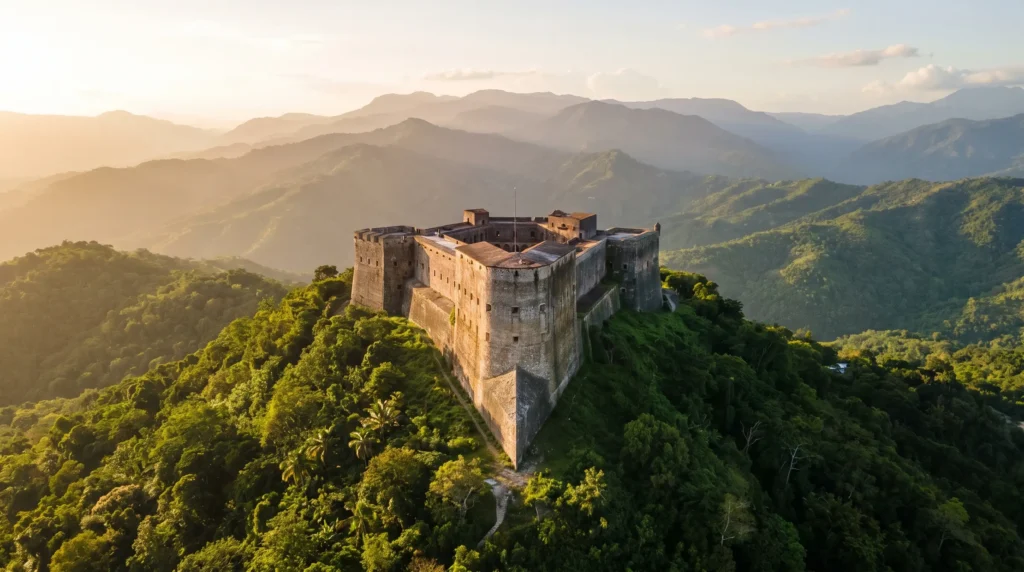
Haiti’s second city and historic capital of the north, the gateway to the Citadelle Laferrière and the ruins of Sans-Souci Palace at nearby Milot — together inscribed by UNESCO in 1982 as the National History Park. The Citadelle itself, built between 1805 and 1820 under Henri Christophe on a 910-metre mountaintop with walls rising 40 metres, was constructed to defend the newly independent nation from a French invasion that never came — at an estimated cost of 20,000 lives among the workers who built it. It remains one of the most extraordinary fortifications in the Western Hemisphere and, in calmer years, one of the Caribbean’s great underrated sights.
Jacmel & the Southeast
A 19th-century coffee-and-coastal town known for gingerbread-style architecture, a strong artisan and papier-mâché tradition, and its role as the historic home of Kanaval’s arts scene.
Île-à-Vache & the Southern Peninsula
A small island off Les Cayes and the mountainous southern peninsula more broadly have long been described as Haiti’s quietest, most beach-oriented corner — historically less affected by the capital’s gang conflict, though conditions across the country can shift quickly and should never be assumed stable without current verification.
Artibonite & the Central Plateau
Haiti’s agricultural heartland, centered on rice cultivation along the Artibonite River, and home to the town of Saut-d’Eau, site of an annual pilgrimage that blends Catholic and Vodou devotion at its waterfalls.
Culture & People — Kreyòl, Vodou, Art
Haitian Creole (Kreyòl) and French are both official languages, with Kreyòl — a language born from the encounter between French colonists and enslaved Africans from many different nations — spoken as a first language by the overwhelming majority of the population. Haitian Vodou, an Afro-Caribbean spiritual tradition with roots in West African religions and folded together with Catholic imagery over centuries, remains central to Haitian identity, alongside a Catholic and growing Protestant majority.
Haiti’s visual art tradition — vivid, often symbolic painting associated with the “Haitian naïve” or Cap-Haïtien and Port-au-Prince schools — has been internationally recognized since the mid-20th century, and the country’s music runs from rara processional bands to konpa, the dominant popular dance genre across the Haitian diaspora. This is a nation whose cultural output has shaped the wider Caribbean and francophone world far beyond what its current headlines suggest.
A Food Lover’s Guide to Haiti
Haitian cuisine is built on bold, slow-marinated flavor. Griot — chunks of pork marinated in citrus and Scotch bonnet, then braised and fried — is close to a national dish, usually served with diri ak djon djon (rice cooked with tiny black Haitian mushrooms that turn it a distinctive dark grey) or plain white rice and beans. Pikliz, a fiery pickled cabbage and Scotch bonnet relish, tops nearly everything.
Street food staples include akra (malanga fritters) and fritay platters — a mix of fried plantain, pork and akra sold from roadside stalls. Haiti’s coffee, grown in the mountains, has a long export history, and Barbancourt, a Haitian sugarcane rum distilled since the late 19th century, is one of the country’s best-known exports.
Beyond the Capital
Bassin Bleu
A series of turquoise waterfall pools near Jacmel, reached by a short hike, and one of the country’s most photographed natural sites in calmer times.
Sans-Souci Palace, Milot
The ruined royal palace of King Henri Christophe, built in the early 1800s and destroyed by an 1842 earthquake, inscribed alongside the Citadelle as part of the same UNESCO site.
Saut-d’Eau
A waterfall in the Central Plateau that draws an annual pilgrimage each July blending Catholic and Vodou ritual — one of the most distinctive religious gatherings in the Caribbean.
All of the above are described here for cultural and geographic context. None of them should be treated as a current itinerary while the Do Not Travel advisory stands — conditions and accessibility can change abruptly and vary sharply between regions.
Practical Information
Money. The Haitian Gourde (HTG) floats against the US dollar and has depreciated substantially over the past decade — from roughly 63 gourdes per dollar a decade ago to around 130 per dollar in 2026. US dollars circulate informally in parts of the country, but the gourde is the official currency issued by the Banque de la République d’Haïti.
Safety. This is the section that matters most: both the US State Department (Level 4, Do Not Travel) and the UK FCDO (advises against all travel) currently place Haiti at their highest advisory tiers, citing rampant crime, widespread kidnapping, gang-related terrorism designations, and unpredictable civil unrest. Check your government’s current advisory before any travel — this article is not a substitute for that.
Health. The CDC currently rates Haiti a routine “practice usual precautions” health destination, but flags a diphtheria outbreak as of mid-2026, recommends malaria chemoprophylaxis for all areas, hepatitis A/B and typhoid vaccination, full MMR coverage given rising global measles activity, and standard precautions against dengue, Zika and waterborne illness including leptospirosis. Medical evacuation insurance is strongly advised given the state of healthcare infrastructure.
Entry. Passport holders from the US, Canada, EU and UK can normally enter visa-free for up to three months with a passport valid at least six months and a US$10 entry fee, though this is separate from — and does not override — the current advisory against travel.
On Budget — Why We’re Not Giving Tourist Price Tiers
Most FFU country guides break costs into budget, mid-range and luxury daily tiers. We’re not doing that here, deliberately. With commercial flights into the capital suspended, a Level 4 Do Not Travel advisory in effect, and no functioning inbound leisure-tourism market to draw real pricing data from, any per-day dollar figure we published would be a guess dressed up as a fact — exactly what we try never to do.
What we can say honestly: the gourde’s steep depreciation over the past decade means local prices for Haitians are, in dollar terms, generally low by regional standards. But that has no practical bearing on the cost of a trip most people should not currently be taking. If the security situation changes meaningfully, we’ll update this section with verified figures.
Planning Around Haiti Right Now
If you have an essential reason to travel to Haiti — visiting family, humanitarian or diaspora work — the standard advice applies doubly: register with your embassy’s traveler program, coordinate arrival and ground transport in advance through people who track current conditions, avoid Port-au-Prince where any alternative exists, and keep a low profile. For everyone else, the more honest planning advice is to look elsewhere in the region this year. Haiti’s Caribbean neighbors remain open and welcoming: our Dominican Republic guide covers the other side of the same island, our Cuba guide and Jamaica guide cover nearby islands with deep Afro-Caribbean cultural traditions of their own, and our Bahamas guide covers the region’s easiest beach-first trip from North America.
Frequently Asked Questions
Is it safe to travel to Haiti in 2026?
No government currently says yes. The US State Department rates Haiti Level 4: Do Not Travel, its highest advisory level, and the UK FCDO advises against all travel to the country. Check current advisories before making any decision, and don’t rely on this or any single article as your safety source.
Do I need a visa to enter Haiti?
Citizens of the US, Canada, most EU countries and the UK can normally enter visa-free for up to three months with a passport valid six-plus months and a US$10 entry fee — a separate question from whether travel is currently advisable.
Can I even fly to Haiti right now?
Commercial US airlines are currently barred from Port-au-Prince, and regional carriers have suspended and resumed service repeatedly amid airport-area violence. Any flight plans should be verified directly with the carrier and cross-checked against the current State Department and FCDO pages, not against older information.
What language do people speak in Haiti?
Haitian Creole (Kreyòl) and French are both official; Kreyòl is the first language of the vast majority of the population.
What currency does Haiti use?
The Haitian Gourde (HTG), issued by the Banque de la République d’Haïti and floating at roughly 130 to the US dollar in 2026, though its value has fallen substantially over the past decade.
Why does this guide talk about the Citadelle if I shouldn’t go?
Because understanding what a place is — its history, its culture, its landmarks — is worthwhile even when visiting isn’t currently advisable, and because advisories do change. This guide exists so that when conditions genuinely improve, there’s an honest starting point already written.
What You Can Do Instead of Booking a Trip
Haiti is not a destination we can responsibly tell you to visit this year. If the Citadelle, Kanaval or Haitian cuisine and culture caught your interest, the most useful thing to do with that interest right now is to learn more, support reputable organizations doing humanitarian or development work in Haiti, and keep an eye on official advisories rather than travel-blog optimism. If you’re specifically drawn to the Caribbean’s Afro-diasporic culture, cuisine and history, our Jamaica and Cuba guides are a genuine, currently-visitable way to explore adjacent traditions.
Explore More
- Dominican Republic Travel Guide — the other, currently-open side of Hispaniola
- Cuba Travel Guide — another Caribbean nation with a revolutionary history and deep Afro-Caribbean culture
- Jamaica Travel Guide — more Caribbean music, food and coastline
- Bahamas Travel Guide — an easy, currently low-risk Caribbean trip from North America
How this guide was built
Published as part of Facts From Upstairs’ country guide series. Built from authoritative sources — Wikipedia’s Haiti, Port-au-Prince, Citadelle Laferrière, Toussaint Louverture International Airport and Visa policy of Haiti entity pages; the Banque de la République d’Haïti (brh.ht) for currency data; the US State Department’s Haiti country information page; the UK FCDO’s Haiti travel advice page; and the US CDC’s Haiti traveler health page. Given Haiti’s current safety situation, this guide deliberately omits invented tourist pricing and treats every numeric and factual claim as something to verify against the cited source rather than assume. It leads with a prominent, sourced safety advisory rather than burying it, and does not encourage travel while that advisory stands.
Sources cited on this page
- US State Department — Haiti Travel Advisory
- UK FCDO — Haiti Travel Advice
- US CDC — Haiti Traveler Health Page
- Banque de la République d’Haïti
- Wikipedia — Haiti
- Wikipedia — Port-au-Prince
- Wikipedia — Citadelle Laferrière
- Wikipedia — Toussaint Louverture International Airport
- Wikipedia — Visa Policy of Haiti
More country guides you might like



Plan your trip to Haiti
The booking tools we use ourselves. FFU may earn a commission at no extra cost to you.
Plan & book your trip to Haiti
Booking through these searches supports our guides at no extra cost to you.