
Languages of Bosnia & Herzegovina
All languages of Southern Europe →fluent beta classical · classes by phone with Maya at ranas.ai/maya
Bosnia & Herzegovina Travel Guide — Ottoman Old Towns, Emerald Rivers & Europe’s Best-Value Adventure
Bosnia and Herzegovina is the Balkans at their most rewarding: a small, mountainous country where Ottoman bazaars meet Austro-Hungarian boulevards, emerald rivers thunder through limestone canyons, and a single plate of ćevapi costs less than a coffee back home. It carries the weight of a recent, painful history with grace, and rewards curious travellers with some of Europe’s warmest hospitality, wildest landscapes and lowest prices.
📋 In This Guide
- Overview — Where East meets West in the Balkans
- June: the green-season sweet spot
- Best time to visit (season by season)
- Getting there
- Getting around
- Where to go — Sarajevo, Mostar & the wild south
- Culture & people — three faiths, one country
- A food lover’s guide to Bosnia
- Off the beaten path
- Practical information
- Budget breakdown — what Bosnia costs in 2026
- Planning your first trip
- Frequently asked questions
Overview — Where East Meets West in the Balkans
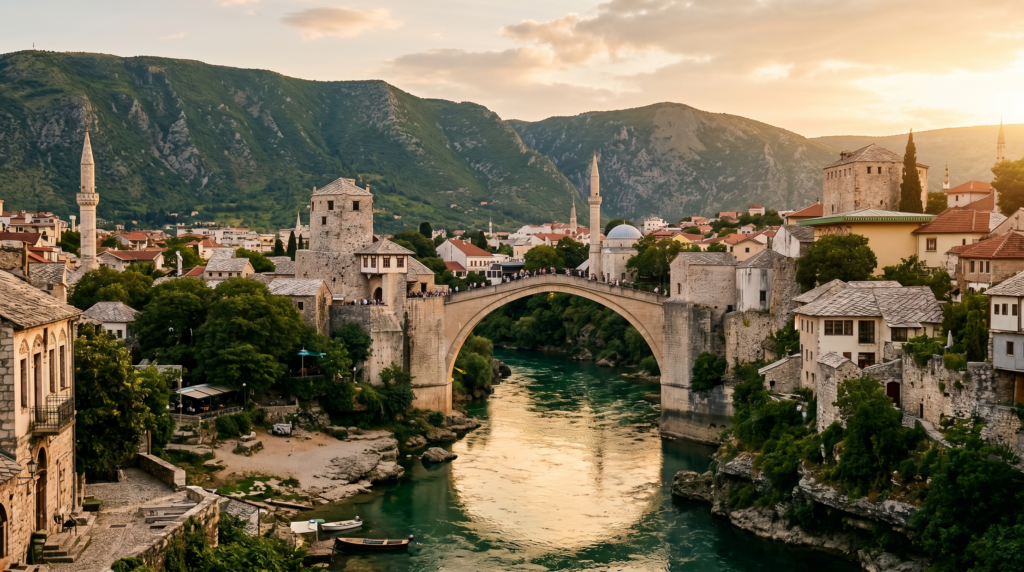
Few countries pack as much contrast into such a small space. In Sarajevo, you can stand at a single spot and see an Ottoman mosque, an Orthodox church, a Catholic cathedral and a synagogue within a few hundred metres — the reason the capital is nicknamed the “Jerusalem of Europe.” An hour and a half south, Mostar’s rebuilt Old Bridge arches over the impossibly green Neretva, and beyond it lie waterfalls, dervish houses and canyon rivers made for rafting.
Bosnia is still emerging as a mainstream destination, which is exactly its appeal: prices are among the lowest in Europe, the landscapes are wild and uncrowded, and the welcome is genuine. It’s also a country shaped by the 1990s war, a history locals discuss openly and that thoughtful visitors should approach with respect — understanding it is part of understanding the place.
June: The Green-Season Sweet Spot
Early summer is arguably the best time to be here. In June the mountains are green, the rivers run full and cold for rafting on the Una, Tara and Neretva, and the heat hasn’t yet peaked. Just as importantly, it’s before the late-June-to-August crush, when Mostar’s Old Bridge and Sarajevo’s Baščaršija fill with day-trippers and prices climb. Come now for long, warm days, lush scenery and a country that still feels like a discovery — at a fraction of Western European cost.
Best Time to Visit Bosnia (Season by Season)
May, June, September & October — Shoulder (best overall)
The sweet spot: warm, settled weather, green landscapes or autumn colour, full rivers and manageable crowds. Ideal for combining cities with hiking, rafting and road trips.
July & August — Peak (hot & busy)
Hot in the lowlands and at its most crowded, especially in Mostar and Sarajevo’s old town, with the highest prices — though the mountains stay pleasantly cool.
November – April — Low & winter
The cheapest months, quiet and atmospheric in the cities. Winter brings affordable skiing at Jahorina and Bjelašnica, the old 1984 Olympic resorts above Sarajevo.
Getting There
Sarajevo International Airport (SJJ) has connections across Europe (via hubs like Vienna, Istanbul, Munich and Zagreb), and Tuzla and Mostar handle some budget routes. Many travellers arrive overland.
- By air: connect through a European hub to Sarajevo; book ahead as routes are limited.
- By bus: excellent long-distance coaches link Bosnia with Croatia (Dubrovnik, Split, Zagreb), Serbia and Montenegro — a popular and scenic way in.
- Passport: valid at least three months beyond departure; US visitors get 90 days visa-free, separate from the Schengen clock.
Getting Around
- Intercity buses: the backbone of travel — cheap, frequent and reliable. Sarajevo to Mostar takes about 2.5 scenic hours for roughly 11 KM.
- Rental car: the best way to reach waterfalls, national parks and mountain villages; roads are decent but winding, so allow extra time.
- Trains: limited but the Sarajevo–Mostar line is one of Europe’s most beautiful rail journeys when running.
- In cities: Sarajevo has trams and an easily walkable centre; Mostar’s old town is compact and pedestrian.
Where to Go — Sarajevo, Mostar & the Wild South
Sarajevo
The soulful capital: the Ottoman Baščaršija bazaar, copper-smiths and ćevapi grills, the Latin Bridge where the spark for World War I was lit, and moving war-history sites like the Tunnel of Hope. Walkable, atmospheric and full of cheap, excellent food.
Mostar & Herzegovina
Mostar’s 16th-century Old Bridge (Stari Most), rebuilt after the war and famous for its daredevil divers, anchors the cobbled old town. Nearby: Blagaj’s cliffside dervish house, the Kravice Waterfalls, and the stone village of Počitelj.
The National Parks & Rivers
Una National Park in the northwest is a rafting and waterfall paradise; the Tara and Neretva canyons offer more white water; and Sutjeska protects primeval forest and the country’s highest peaks.
Jajce, Travnik & the Centre
Jajce has a waterfall tumbling through the middle of town and the Pliva lakes nearby; Travnik and Počitelj add Ottoman fortresses and old-world charm for road-trippers.
Culture & People — Three Faiths, One Country
Bosnia’s identity is built on its mix of peoples — Bosniaks (predominantly Muslim), Croats (Catholic) and Serbs (Orthodox) — whose mosques, churches and synagogues share the same streets. This coexistence is the country’s great cultural gift, and it sits alongside the memory of the 1992–95 war, which thoughtful visitors will encounter at museums and memorials. Locals are remarkably open about that history; meeting it with curiosity and respect is part of travelling here well.
Day to day, life centres on coffee — thick, unhurried Bosnian (Turkish-style) coffee is a social ritual, not a caffeine hit. Hospitality is heartfelt, the pace is slow, and a few words of “hvala” (thank you) go a long way. The languages — Bosnian, Croatian and Serbian — are mutually intelligible, and younger people often speak good English.
A Food Lover’s Guide to Bosnia
Bosnian food is hearty, grill-heavy and astonishingly cheap — a highlight of any trip.
- Ćevapi — little grilled minced-meat sausages served in fluffy somun bread with raw onion and kajmak; the national obsession, often under €5.
- Burek & pita — flaky filled pastries (meat burek, cheese sirnica, potato krompiruša) sold by weight.
- Bosanski lonac & đuveč — slow-cooked meat-and-vegetable pots, comfort food at its best.
- Sweets & coffee — baklava and tufahija, washed down with Bosnian coffee from a copper džezva, or a shot of homemade rakija.
Off the Beaten Path
- Kravice Waterfalls — a wide, swimmable horseshoe of falls in Herzegovina, a perfect summer day trip from Mostar.
- Blagaj Tekija — a serene 16th-century dervish house built into a cliff at the source of the Buna River.
- Rafting the Una or Tara — emerald white water through dramatic canyons, with the Tara billed as Europe’s deepest.
- Lukomir — Bosnia’s highest and most remote village, a window into traditional highland life near Sarajevo.
- Jajce’s town-centre waterfall — a 20-metre cascade right in the heart of a medieval town.
Practical Information
- Money: the convertible mark (KM/BAM) is fixed at 1 EUR = 1.96 KM. It’s largely a cash economy — carry KM for buses, markets and small cafes, though cards work in cities.
- Language: Bosnian/Croatian/Serbian; English is common among younger people and in tourism.
- Power: 230V, European two-pin plugs — US travellers need an adapter (and voltage-compatible devices).
- Safety: Bosnia is very safe for travellers. The main legacy risk is landmines in some rural areas — stick to marked paths and roads in the countryside.
- Connectivity: good 4G; cheap local SIMs and eSIMs are easy to get.
- Tipping: round up or leave around 10% for good service.
Budget Breakdown — What Bosnia Costs in 2026
Bosnia is one of the best-value destinations in Europe. Rough per-person, per-day estimates:
| Style | Accommodation | Food | Total / day |
|---|---|---|---|
| Backpacker | €7–15 hostel dorm | €8–15 | ~€30–40 |
| Budget | €15–30 private room | €12–20 | €40–60 |
| Comfortable | €45–80 hotel | €25–40 | €100–130 |
A ćevapi lunch runs €4–5, an intercity bus a few euros, and most museums and sights are inexpensive. Few European countries stretch a budget further.
Planning Your First Trip
A classic first visit pairs Sarajevo and Mostar over four or five days, with day trips to Kravice, Blagaj and Počitelj from Mostar and the war-history and Baščaršija highlights in Sarajevo. With a week and a rental car, add Una National Park or Jajce for waterfalls and rafting. Carry cash in convertible marks, book buses a day ahead in summer, and leave time for the country’s real pleasure: a slow coffee while the old town drifts by.
Frequently Asked Questions
Do US citizens need a visa for Bosnia and Herzegovina?
No — US citizens can visit visa-free for up to 90 days within a 180-day period, with a passport valid at least three months beyond departure. Bosnia is not in the Schengen Area, so this time is separate.
Is Bosnia and Herzegovina safe to visit?
Yes, it’s very safe for travellers, with low crime. The one rural caution is landmines left from the 1990s war in some areas — stay on marked paths and roads outside towns.
Is Bosnia expensive?
It’s one of the cheapest countries in Europe. Budget travellers manage on €40–60 a day, and a fantastic meal can cost under €5.
How many days do I need?
Four to five days covers Sarajevo and Mostar with day trips; a week lets you add a national park or the central towns for waterfalls and rafting.
Can I use euros?
Some tourist businesses accept euros, but the official currency is the convertible mark (fixed at 1 EUR = 1.96 KM). Carry marks in cash, especially outside the cities.
Ready to Explore Bosnia & Herzegovina?
Ottoman old towns, emerald rivers and Europe’s best value — Bosnia is the Balkans before the crowds catch on. Tell us your dates and travel style and we’ll help you build the perfect route. Plan your trip →
Explore More
How This Guide Was Built
Researched and written by the Facts From Upstairs team, last updated . Prices and entry rules change — always confirm current details with official sources before you travel.
More country guides you might like
Plan your trip to Bosnia & Herzegovina
The booking tools we use ourselves. FFU may earn a commission at no extra cost to you.
Plan & book your trip to Bosnia & Herzegovina
Booking through these searches supports our guides at no extra cost to you.
Curated multi-day tours to Bosnia & Herzegovina — Exoticca →