
Adelaide Travel Guide — Wine, Wildlife & the World’s Second-Biggest Arts Festival
Adelaide is the Australian city everyone underrates until they’ve actually been. It has no convict past — it was founded in 1836 as a planned free settlement, laid out by Colonel William Light in a tidy grid ringed by parklands that still wrap the whole CBD today. It’s a genuine capital city of close to 1.5 million people, yet you can walk from the cathedral quarter to the Central Market to a tram that drops you on a beach in half an hour. What sold me on it wasn’t a single landmark — it’s the ring of world-class wine country that starts less than an hour from the office towers, the fact that in February and March the entire city turns into the second-largest arts festival on the planet, and a slower, friendlier pace than Sydney or Melbourne ever offer. It’s not flashy. It’s just very, very good at the things that make a trip actually good.
In This Guide
- Overview — Why Adelaide Rewards a Real Visit
- Fringe Season — Festival State, February to April
- Best Time to Visit Adelaide (Season by Season)
- Getting There — ADL Airport & Overland Routes
- Getting Around — Trams, the O-Bahn & Walkability
- Neighborhoods — CBD, North Adelaide, the Coast & Beyond
- Culture & People — Kaurna Country to Festival City
- A Food Lover’s Guide to Adelaide
- Off the Beaten Path
- Day Trips — Barossa, Adelaide Hills & Kangaroo Island
- Practical Information
- Budget Breakdown — What Adelaide Actually Costs in 2026
- Frequently Asked Questions
Overview — Why Adelaide Rewards a Real Visit
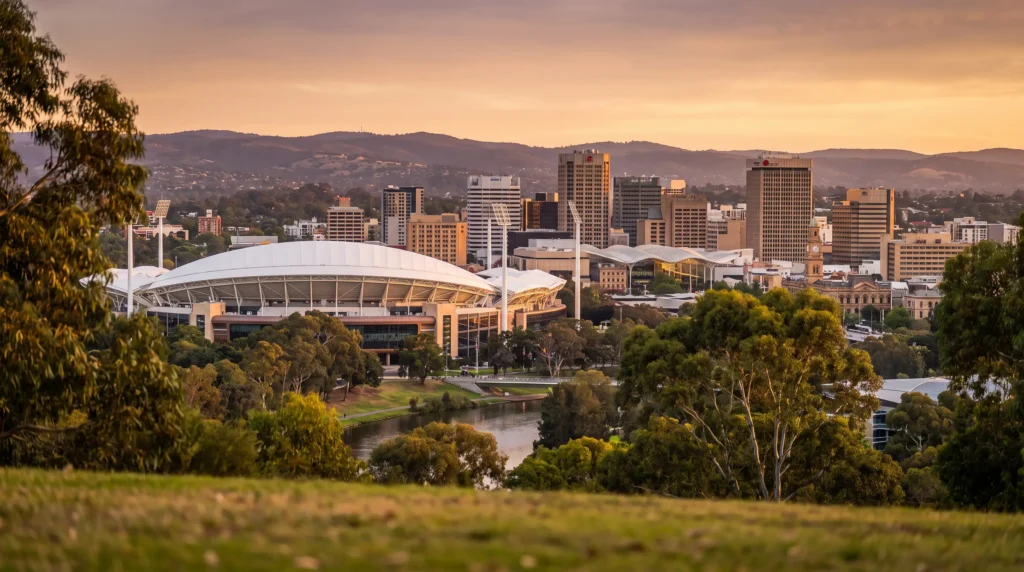
Adelaide sits on Kaurna Country, known traditionally as Tarndanya, on a coastal plain between Gulf St Vincent and the Mount Lofty Ranges. Founded on 28 December 1836 as the planned capital of a free colony — South Australia never took convict transports — it was designed from day one by Colonel William Light with a strict city grid completely encircled by parklands, a layout that still defines how the CBD feels today: compact, green-edged, and easy to walk end to end.
It’s Australia’s fifth-largest city and home to roughly three-quarters of South Australia’s entire population, a metro area of about 1.47 million people. It’s also, quietly, one of the most livable cities anywhere, and it houses the headquarters of the Australian Space Agency — a fact that surprises most first-time visitors who arrive expecting a sleepy wine-town stopover.
What makes Adelaide different from Sydney or Melbourne isn’t a single sight — it’s proximity. World-class wine regions, a wildlife-dense island, cool hills and a beach tram all sit within an hour of the CBD, and none of them come with the crowds or prices those two bigger cities carry. The catch: because Adelaide isn’t the “obvious” Australian stop, a lot of first-timers skip it entirely, book three nights in Sydney and Melbourne, and never learn what they missed.
Fringe Season — Festival State, February to April
Time a trip around Adelaide Fringe, which runs 20 February to 22 March 2026 — the world’s second-largest annual arts festival after Edinburgh’s, and the biggest in Australia. More than 7,000 artists stage thousands of comedy, cabaret, circus, theatre and visual-art shows across hundreds of venues citywide, and it’s now sold over a million tickets in each of the last several years running. It overlaps with the more curated, higher-culture Adelaide Festival, so late February gives you both ends of the arts spectrum at once.
Sports fans should also flag AFL Gather Round, 9–12 April 2026, when the entire Australian Football League relocates to South Australia for one weekend — 18 teams, 9 games, and a genuinely city-wide Festival of Footy atmosphere. Book accommodation for either event three to four months out; hotel rates spike hard and rooms sell out.
Best Time to Visit Adelaide (Season by Season)
February – April · Festival season & early autumn
Warm, mostly dry, and the busiest calendar of the year — Fringe, the Adelaide Festival, WOMADelaide and Gather Round all land in this window. Book well ahead and expect peak pricing.
September – November · Spring
Mild days, green hills, wildflowers, and shoulder-season rates. This is the sleeper pick for wine-region day trips, before summer heat sets in.
December – January · Summer
Hot and dry — Adelaide’s Mediterranean climate means summer max temperatures regularly push past 30°C, occasionally into the 40s during heatwaves. Beach season at Glenelg and Henley, but plan indoor hours around the hottest afternoons and check for total fire ban days if heading to the Hills.
June – August · Winter
Cool and the wettest stretch of the year — Adelaide’s average annual rainfall of around 536mm is concentrated here — but also the cheapest hotel rates and quiet, moody wine-region visits with fewer other tourists at the cellar door.
Getting There — ADL Airport & Overland Routes
Adelaide Airport (ADL) sits about 6 kilometres west of the CBD, handling roughly 9 million passengers a year as Australia’s fifth-busiest airport, with around 250 flights a day. Direct international routes include Singapore Airlines to Singapore, Qatar Airways to Doha, Emirates to Dubai, Malaysia Airlines to Kuala Lumpur, Air New Zealand to Auckland, Fiji Airways to Nadi, and China Southern/China Eastern to Guangzhou and Shanghai; a new United Airlines route to San Francisco started in December 2025. Most travellers from North America or Europe will connect via Sydney, Melbourne, Singapore or Dubai. Domestic routes to Sydney, Melbourne, Brisbane and Perth run all day; Melbourne is 730 kilometres away and Sydney 1,373 kilometres, both under two hours by air.
A taxi or rideshare from the airport to the CBD takes about 15 minutes; a public bus (the JetBus/J1/J2 routes) covers the same run cheaply if you’re travelling light. Adelaide is also a stop on the Indian Pacific and Ghan long-distance trains, both terminating or passing through en route to Perth, Sydney or Darwin, for travellers building a bigger rail itinerary.
Getting Around — Trams, the O-Bahn & Walkability
The CBD is genuinely walkable — Light’s original grid is only about 1.5 kilometres wide, wrapped by parklands you’ll cross on foot constantly. Adelaide Metro’s tram line runs from Victoria Square in the city centre out to Glenelg Beach, a scenic roughly 30-minute ride that’s one of the easiest half-day beach trips of any Australian capital.
The city’s genuine transit oddity is the O-Bahn Busway: a 12-kilometre dedicated concrete guideway opened in 1986 that let regular buses run at up to 100 km/h into the north-eastern suburbs. It held the title of world’s longest busway until 2011 and remains, by most accounts, the fastest. Beyond the tram and O-Bahn, Adelaide Metro’s bus and train network covers the metro area well, and ride-hailing apps work everywhere. Renting a car matters mainly for the wine regions and Kangaroo Island — inside the city itself you won’t need one.
Neighborhoods — CBD, North Adelaide, the Coast & Beyond
The CBD & North Terrace
The cultural boulevard of the city — art gallery, museum, State Library and university campuses lined up along one street, a few minutes’ walk from Rundle Mall’s shops and buskers and the Adelaide Central Market’s produce halls.
Adelaide Central Market precinct
One of the oldest continuously operating produce markets in the country, opened on 23 January 1870 and now home to more than 76 stalls plus the adjoining Central Market Arcade’s specialty shops, pulling in over 8.5 million visitors a year. Go hungry, go early, and expect it to anchor at least one meal of your trip.
North Adelaide
Leafy, Victorian-terraced, and home to Adelaide Oval — the AFL and cricket ground perched right against the parklands and the River Torrens, with a walking bridge linking it straight back to the CBD. Melbourne Street here is a quieter café-and-wine-bar strip worth a wander.
Glenelg
The city’s beach suburb, linked to the CBD by the historic tram line. Jetty, sand, seafood restaurants, and the spot where South Australia’s colonists first landed in 1836 — a genuinely pleasant half-day out.
Adelaide Hills
Cooler, greener, and just twenty minutes from the CBD by car — Hahndorf’s German-heritage main street, Mount Lofty’s summit views back over the whole city, and a growing cool-climate wine scene distinct from the Barossa’s bigger reds.
Port Adelaide
The historic maritime quarter, with heritage warehouses, the South Australian Maritime Museum, and a slower, salt-air pace — worth a half-day for anyone who’s done the CBD’s greatest hits already.
Unley & the inner south
King William Road’s boutique strip and a residential belt of leafy streets — good for understanding how locals actually live day to day, just south of the parklands ring.
Culture & People — Kaurna Country to Festival City
Adelaide sits on the traditional lands of the Kaurna people, whose name for the site — Tarndanya — predates the 1836 settlement by tens of thousands of years; look for Kaurna dual-naming on street and place signage across the city as part of ongoing reconciliation efforts. Waves of postwar migration from Italy, Greece, Vietnam and beyond shaped the city’s food and neighborhood character, especially around the Central Market and the CBD’s east end.
Culturally, Adelaide punches enormously above its population: alongside Fringe and the Adelaide Festival, the city hosts WOMADelaide (world music) each March and a packed year-round events calendar that’s earned it the informal title of Australia’s “Festival City.” Locals are famously low-key and proud of it — expect friendliness without Sydney or Melbourne’s bigger-city edge.
A Food Lover’s Guide to Adelaide
Start at the Adelaide Central Market — the produce is the story here, from South Australian cheeses and seafood to the small bakeries and delis that have anchored stalls for generations. A pie floater — a meat pie dropped upside-down into a bowl of pea soup — is the city’s oddball classic; you’ll find it at old-school pie carts around town.
Adelaide’s real food strength, though, is wine paired straight with the source. Barossa Valley shiraz, Adelaide Hills cool-climate whites and McLaren Vale reds all pour within an hour of the CBD, and the city’s restaurant scene — concentrated on Peel Street, Leigh Street and Melbourne Street — leans hard into showcasing them alongside modern Australian and South Australian seafood, especially King George whiting and Coffin Bay oysters. The National Wine Centre on North Terrace is a good primer before heading out to the actual vineyards.
Off the Beaten Path
Cleland Wildlife Park
Up in the Adelaide Hills, a walk-through reserve where you can hand-feed kangaroos and hold a koala under supervision — far less commercial than city-based wildlife attractions elsewhere in Australia.
Second Valley & the Fleurieu coast
South of McLaren Vale, a string of quiet coastal villages with none of the Kangaroo Island crowds — good for a slow coastal drive combined with a wine-region day trip.
Central Market Arcade’s specialty traders
Most visitors do the main market hall and leave; the attached Arcade’s smaller specialty shops get a fraction of the foot traffic and reward a proper browse.
Kuitpo Forest & the Adelaide Hills back roads
Pine forest trails and waterfalls a short drive south of the city, largely used by locals rather than tour buses — good for hiking without the Cleland-park crowds.
Day Trips — Barossa, Adelaide Hills & Kangaroo Island
Barossa Valley
About 60 kilometres northeast of the CBD, roughly an hour’s drive, Barossa is one of the world’s great wine regions — more than 150 wineries and 80 cellar doors, including the world’s oldest continuously producing shiraz, grenache, mataro, cabernet sauvignon and semillon vines. Doable as a day trip, but an overnight lets you actually relax between cellar doors instead of watching the clock.
Adelaide Hills
Closer still — Hahndorf, Mount Lofty and the Hills’ cool-climate wineries are a 20–40 minute drive, easy to combine with Cleland Wildlife Park in a single half-day loop.
McLaren Vale
South of the city along the Fleurieu Peninsula, McLaren Vale pairs reds and Mediterranean-style produce with coastline views — a good alternative or add-on to Barossa if you have an extra day.
Kangaroo Island
Australia’s third-largest island and a genuine wildlife destination — sea lions, koalas and abundant birdlife with minimal fencing between you and them. It’s a longer day: Cape Jervis, the ferry departure point, is about 110 kilometres and roughly two hours’ drive from central Adelaide, then a 45-minute SeaLink ferry crossing to Penneshaw. Most visitors do it as an overnight or two-night trip rather than a single day, given the travel time on both ends and how spread out the island’s sights are.
Practical Information
Money. The Australian Dollar (AUD) is the currency, issued as polymer banknotes in $5, $10, $20, $50 and $100 denominations by the Reserve Bank of Australia — polymer note technology was actually developed in Australia. Cards are accepted almost everywhere, including the Central Market’s stalls; carry some cash for smaller cellar doors and market stands regardless.
Safety. The US State Department rates Australia at Level 1 — “exercise normal precautions” — its lowest advisory tier. Standard city-travel sense applies in the CBD at night; the bigger real risks in South Australia are heat and sun exposure in summer and driving fatigue on long rural day trips, not crime.
Health. No special vaccines are required to enter Australia, though routine vaccines should be current and the CDC recommends Hepatitis B for unvaccinated travellers under 60; the CDC also currently flags a diphtheria outbreak affecting the Northern Territory, Western Australia and South Australia, so confirm your Td/Tdap booster is current before you go. Sun protection matters more than most travellers expect — Adelaide’s UV index runs high even on mild-feeling days.
Visas. US citizens apply for the ETA (subclass 601) through the Australian ETA app — AUD$20, processed in minutes, valid 12 months for multiple entries of up to three months each. UK and most EU passport holders use the free eVisitor (subclass 651) instead.
Connectivity & plugs. An Australian eSIM (Telstra or Optus network) covers the city and wine regions comfortably; Kangaroo Island’s coverage is patchier. Australia uses Type I plugs at 230V, 50Hz. Time zone: ACST, UTC+9:30 standard, shifting to ACDT (UTC+10:30) for daylight saving over the Southern Hemisphere summer.
Budget Breakdown — What Adelaide Actually Costs in 2026
Adelaide is noticeably cheaper than Sydney or Melbourne for comparable quality — one of its quieter selling points.
Budget (US$70–120/day): Hostel dorm or budget CBD hotel, Central Market lunches and pub meals, tram and bus fares, free walking tour of North Terrace.
Mid-range (US$160–300/day): Boutique CBD or North Adelaide hotel, a Barossa or Adelaide Hills half-day wine tour (roughly US$100–160 with tastings), restaurant dinners on Peel or Melbourne Street, one paid attraction like Cleland Wildlife Park.
Luxury (US$450+/day): A Barossa vineyard stay, a private Kangaroo Island overnight with a wildlife lodge, chef-led degustation dinners, and a private guided cellar-door circuit.
Fixed costs to budget for: Kangaroo Island ferry fares (higher with a car aboard than as a foot passenger), cellar-door tasting fees at premium wineries (often waived with a bottle purchase), and Fringe/Festival-season ticket prices on top of accommodation.
Planning Your First Trip to Adelaide
The efficient first-timer split is city + wine + island: two nights in the CBD or North Adelaide for the Central Market, North Terrace and Glenelg tram ride, one or two nights in the Barossa or Adelaide Hills for cellar doors, then two nights on Kangaroo Island for wildlife before flying home from ADL. Five nights covers the basics without rushing; seven to eight lets you add McLaren Vale or time it around Fringe. Adelaide also pairs naturally with a longer Australian itinerary — continue on to our Melbourne guide for the Great Ocean Road leg, or to our Sydney guide if you’re bookending with the harbour city.
Frequently Asked Questions
Is Adelaide safe for tourists in 2026?
Yes — the US State Department rates all of Australia at Level 1, its lowest risk tier, meaning “exercise normal precautions.” Standard city-travel awareness applies, but crime isn’t the main risk factor for visitors — heat, sun and rural driving distances are the bigger practical concerns.
Do I need a visa to visit Adelaide?
Yes, nearly everyone needs some form of visa or electronic authorization to enter Australia. US citizens use the ETA (subclass 601) via the Australian ETA app for AUD$20; UK and most EU citizens use the free eVisitor (subclass 651). Apply before you fly — both are usually approved within minutes but airlines will check for one at check-in.
How many days do I need in Adelaide?
Two full days covers the CBD, Central Market and Glenelg comfortably. Add at least one overnight for the Barossa or Adelaide Hills, and two more days if Kangaroo Island is on your list — the ferry and travel time make it a poor fit for a rushed single day.
Can I do Kangaroo Island as a day trip from Adelaide?
Technically yes, but it’s a long one: roughly two hours to Cape Jervis, a 45-minute ferry each way, plus the island itself is large and sights are spread out. Most visitors get far more out of an overnight or two-night stay.
Adelaide or Melbourne?
Choose Adelaide for wine country on the doorstep, a walkable compact CBD, and February–April festival energy without Melbourne-scale crowds; choose Melbourne for bigger-city culture, laneway food scenes and more direct international flight options. Plenty of visitors — reasonably — do both, since they’re under two hours apart by air.
What’s the best time to visit for wine touring?
September to November (spring) and March to April (post-vintage, festival season) both work well — spring for mild touring weather, autumn for harvest atmosphere and Fringe overlap. Peak summer heat can make long days in the vineyards uncomfortable.
Ready to Explore Adelaide?
A city small enough to walk end to end, wine country close enough for a lunchtime cellar-door detour, and — if you time it right — the second-biggest arts festival on Earth happening in the streets around you. Adelaide doesn’t shout about any of this, which is exactly why it’s worth going before everyone else catches on.
Explore More
- Melbourne City Guide — 730km away and under two hours by air, for the Great Ocean Road leg
- Sydney City Guide — pair Adelaide’s wine country with the harbour city
- Fiji Travel Guide — a direct Fiji Airways route connects ADL straight to Nadi
- Auckland City Guide — a direct Air New Zealand hop across the Tasman
How this guide was built
Published as part of Facts From Upstairs’ city guide series. Built from authoritative sources — Wikipedia entity pages for Adelaide, Adelaide Airport, Adelaide Central Market, O-Bahn Busway, Adelaide Metro, Adelaide Fringe, Barossa Valley and AS/NZS 3112; the South Australian Tourism Commission (tourism.sa.gov.au) and Adelaide Fringe’s official site; the Reserve Bank of Australia’s banknotes pages; the Australian Department of Home Affairs’ ETA visa page; the US State Department’s Australia travel advisory; the US CDC’s Australia traveler health page; and SeaLink Kangaroo Island’s ferry information page. Numeric claims carry inline citations.
Sources cited on this page
- Wikipedia — Adelaide
- Wikipedia — Adelaide Airport
- Wikipedia — Adelaide Central Market
- Wikipedia — O-Bahn Busway
- Wikipedia — Adelaide Metro
- Wikipedia — Adelaide Fringe
- Wikipedia — Barossa Valley
- Wikipedia — AS/NZS 3112 (plugs & voltage)
- Adelaide Fringe — official site
- South Australian Tourism Commission
- Reserve Bank of Australia — Banknotes
- Australian Department of Home Affairs — ETA subclass 601
- US State Department — Australia Travel Advisory
- US CDC — Australia traveler health page
- SeaLink Kangaroo Island — Getting to Kangaroo Island
More city guides you might like
Plan your trip to Adelaide
The booking tools we use ourselves. FFU may earn a commission at no extra cost to you.
Plan & book your trip to Adelaide
Booking through these searches supports our guides at no extra cost to you.