
Languages of Bangladesh
All languages of Southern Asia →fluent beta classical · classes by phone with Maya at ranas.ai/maya
Bangladesh Travel Guide — River Deltas, Royal Bengal Tigers & the World’s Longest Beach
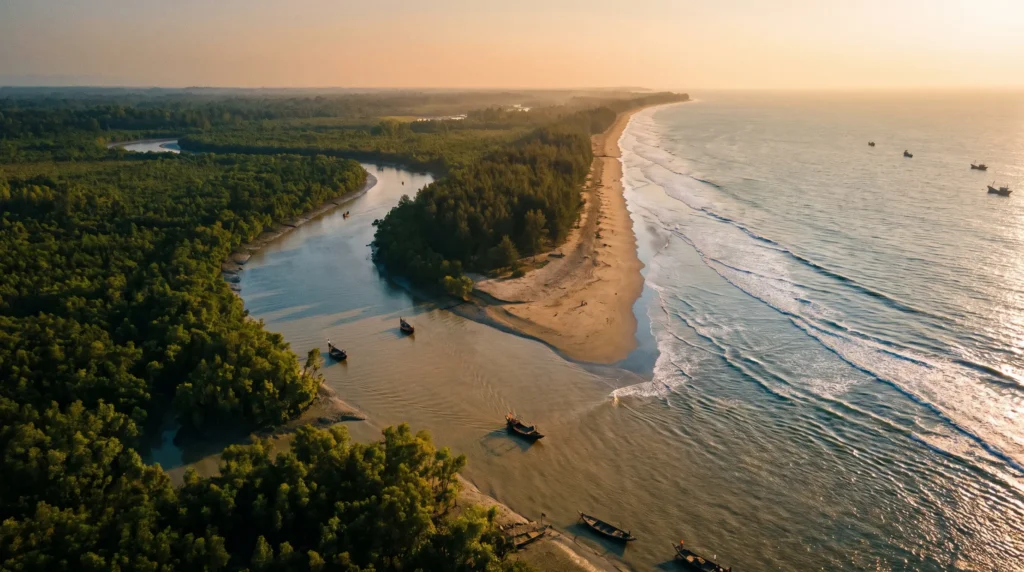
I’ll be honest about how Bangladesh usually gets talked about first: floods, density, garment factories. Then I’ll tell you what actually happens when you go — you ride a wooden boat through the largest mangrove forest on Earth listening for a Bengal tiger you’ll almost certainly never see, you stand on a beach that runs unbroken for something like 120 kilometres, and you eat better fish than you’ve had anywhere else in South Asia, cooked by someone who insists you have a second helping whether you want one or not. Bangladesh is the world’s eighth most populous country, packed into a river delta smaller than England, and it gets a fraction of the tourists that India, Nepal or Sri Lanka do. That’s not because it has less to offer — it’s because almost nobody outside the region thinks to look. I’m not going to pretend this is an easy trip. The current US advisory sits at Level 3, “Reconsider Travel,” the monsoon can flood roads without warning, and the visa process has real friction. But for travelers who do their homework and go in with realistic expectations, Bangladesh delivers something increasingly rare: a huge, complicated, generous country that hasn’t been remotely packaged for you yet.
In This Guide
- Overview — Why Bangladesh Rewards the Travelers Who Show Up
- Pohela Boishakh — Bengali New Year on April 14
- Best Time to Visit Bangladesh (Season by Season)
- Getting There — DAC, Land Borders & Visas
- Getting Around — Rickshaws, Trains & River Launches
- Top Regions — Delta, Coast & Hills
- Culture & People — Language, Faith & Liberation
- A Food Lover’s Guide to Bangladesh
- Off the Beaten Path
- Practical Information
- Budget Breakdown — What Bangladesh Actually Costs in 2026
- Frequently Asked Questions
Overview — Why Bangladesh Rewards the Travelers Who Show Up
Start with the geography, because everything else follows from it. Bangladesh sits almost entirely inside the Ganges-Brahmaputra-Meghna delta, the largest river delta on the planet, bordered on three sides by India and briefly by Myanmar to the southeast, with the Bay of Bengal completing the frame. That delta geography means the country is laced with more navigable rivers than roads in places, which is exactly why a river journey — not a bus ticket — is still the classic way to see rural Bangladesh. It also means the country is genuinely vulnerable to flooding and cyclones, a fact locals live with matter-of-factly and travelers should respect rather than romanticize.
Independence came in 1971, after a nine-month Liberation War against Pakistan, and that history sits close to the surface everywhere — in monuments, in conversation, in the pride people take in the Bengali language that the war was partly fought to protect. Today it’s the world’s eighth-most populous country by most counts, home to roughly 175 million people in an area smaller than the US state of Iowa, which makes Dhaka one of the most densely packed capitals anywhere and gives the whole country a permanent, good-natured crush of humanity.
The travel case rests on three pillars most visitors have never connected to this country: the Sundarbans, the world’s largest mangrove forest and last redoubt of the wild Bengal tiger; Cox’s Bazar, widely cited as the world’s longest unbroken natural sea beach; and a set of medieval Islamic and Buddhist ruins — Bagerhat and Paharpur — that predate almost anything comparable in neighboring India. None of it is polished for tourists yet. That’s the trade-off, and for the right traveler, the entire appeal.
Pohela Boishakh — Bengali New Year on April 14
If you can only time one trip around a single date, make it 14 April, when Bangladesh celebrates Pohela Boishakh, the Bengali New Year, fixed on that date by a mid-20th-century calendar reform. Dhaka empties into the streets for it: the centerpiece is the Mangal Shobhajatra, a UNESCO-recognized procession led by Dhaka University fine arts students carrying giant papier-mâché masks and animal effigies through the old town, followed by open-air fairs, folk music and a genuinely infectious sense of civic joy.
The catch is that April also sits right at the edge of pre-monsoon storm season, so pack for sudden downpours and book Dhaka hotels well ahead — rooms fill fast around the holiday. If April doesn’t fit your calendar, the two Eid holidays (dates shift yearly on the Islamic lunar calendar) are the other major closures to plan around: transport gets packed as the whole country heads home to family, so buy tickets early or simply avoid traveling those specific days.
Best Time to Visit Bangladesh (Season by Season)
November – February · Cool & dry (peak)
The most comfortable window by far: daytime temperatures in the pleasant 20s (°C), minimal rain, and the best conditions for the Sundarbans river trips and Cox’s Bazar beach time. This is also when winter migratory birds arrive in the wetlands, a genuine draw for birders. Book Sundarbans launch tours and Cox’s Bazar hotels ahead for the December–February peak.
March – May · Hot, pre-monsoon
Temperatures climb fast and afternoon thunderstorms — sometimes severe nor’westers — become common, especially by May. Pohela Boishakh (14 April) falls in this window and is worth the heat. This is also the cheapest hotel season outside monsoon proper.
June – October · Monsoon
The defining season: heavy, sustained rain, lush green paddies, and a real risk of localized flooding, especially in low-lying and northeastern districts like Sylhet. River transport can be disrupted and road travel slows. Some travelers love the drama of it — the delta is genuinely beautiful flooded — but build slack into any itinerary and don’t count on tight connections.
Getting There — DAC, Land Borders & Visas
Hazrat Shahjalal International Airport (DAC) in Dhaka’s Kurmitola district, about 17 kilometres from downtown, is the country’s main international gateway and hub for national carrier Biman Bangladesh Airlines, with connections from the Gulf, Southeast Asia, South Asia and a handful of long-haul European routes. There is no nonstop service from North America; most Western travelers connect via the Gulf (Doha, Dubai, Abu Dhabi) or through Southeast Asian or South Asian hubs. Secondary international airports at Chittagong (Shah Amanat) and Sylhet mainly serve regional and diaspora routes.
Visas are the part to plan for, not wing. Bangladesh’s official e-visa portal is visa.gov.bd, and applying online in advance — allow several weeks — is the more reliable route for most nationalities. A visa-on-arrival option exists at Dhaka’s airport for travelers from a defined list of countries including the US, UK, most of the EU, Canada and Australia, but it is issued at immigration officers’ discretion rather than guaranteed, and typically requires proof of a return ticket, hotel booking and sufficient funds. Do not arrive assuming you’ll simply be waved through — apply for the e-visa ahead of time if you can.
Overland, the main crossings link Bangladesh to India at Benapole–Petrapole (near Kolkata/Jessore) and several points near Sylhet and Tripura; direct buses run Dhaka–Kolkata via Benapole. There is no practical overland route into Myanmar for tourists.
Getting Around — Rickshaws, Trains & River Launches
Dhaka traffic is legendary, and not in a good way — budget far more time than distance suggests for any cross-city trip, and consider the (limited but expanding) Dhaka Metro Rail for a few key corridors. Ride-hailing apps (Uber, and the locally dominant Pathao) work well in Dhaka and Chittagong and are the easiest way to avoid fare haggling.
Between cities, Bangladesh Railway’s intercity trains are comfortable, cheap and a genuinely pleasant way to watch the delta scroll past — book AC chair or first class where available. Long-distance buses cover routes trains don’t, including down to Cox’s Bazar, though road quality and driving standards vary; stick to reputable operators for overnight buses. For the south and the delta interior, river transport isn’t a novelty, it’s infrastructure — the old Rocket paddle steamers and modern launches still connect Dhaka to river towns, and hiring a boat is the only way into the Sundarbans proper. Domestic flights (Dhaka to Cox’s Bazar, Chittagong, Sylhet, Jessore) are inexpensive and worth it to skip a long, rough road day.
Top Regions — Delta, Coast & Hills
Dhaka
Chaotic, overwhelming, and worth two or three days regardless. Old Dhaka’s Shakhari Bazaar lanes, the pink Ahsan Manzil palace, Lalbagh Fort and the din of Sadarghat’s river port give you the densest, most alive version of the country in one neighborhood. It’s also the base for day trips to Sonargaon.
Cox’s Bazar
The country’s marquee beach destination, built around a stretch of sand widely described as the world’s longest unbroken natural sea beach at roughly 120 kilometres. It’s touristy by Bangladeshi standards (which still means far quieter than Southeast Asia’s beach towns), with beach resorts, Himchari National Park nearby, and boat access to Saint Martin’s Island.
The Sundarbans (Khulna)
A UNESCO World Heritage mangrove forest — inscribed in 1997 — spanning roughly 10,000 square kilometres across Bangladesh and India, with the larger share — about 6,000 square kilometres — on the Bangladesh side. Multi-day launch trips out of Khulna or Mongla are the way in: expect narrow creeks, spotted deer, crocodiles, and the outside chance — genuinely rare — of a Bengal tiger sighting; current camera-trap estimates put roughly 106 tigers on the Bangladesh side.
Sylhet
Rolling tea estates, misty hills near the Indian border, and the shrine of Hazrat Shah Jalal, the Sufi saint the Dhaka airport is named for. Srimangal, the tea capital, makes a relaxed two-to-three-night base for estate walks and seven-layer tea.
Bagerhat & Khulna heritage towns
The Historic Mosque City of Bagerhat, a 15th-century brick city of some 300-plus mosques and mausoleums, is a UNESCO World Heritage Site and an easy pairing with a Sundarbans trip since both stage out of Khulna. The Shait Gumbad Mosque, its centerpiece, is one of the most striking pieces of Islamic architecture in South Asia.
Rajshahi & the north
Home to Paharpur’s Somapura Mahavihara, an 8th-century Buddhist monastery and Bangladesh’s other UNESCO cultural site, plus the ancient city ruins at Mahasthangarh. Quiet, rural, and almost entirely free of foreign visitors.
Chittagong Hill Tracts — a region to research carefully, not simply visit
Rangamati, Khagrachari and Bandarban are genuinely beautiful — forested hills, tribal cultures unlike anywhere else in Bangladesh, lakes formed by the Kaptai dam. They’re also currently rated Level 4 “Do Not Travel” by the US State Department due to kidnapping risk and separatist activity, and the UK FCDO advises against all but essential travel there. I’m not including it as a recommended stop in this guide for that reason — check current advisories yourself before considering it, and if you go, go with an established local operator who handles the required permits.
Culture & People — Language, Faith & Liberation
Bengali (Bangla) is the official language and, for many Bangladeshis, a source of national pride bound up directly with independence — the 1952 Language Movement, in which students protesting for Bengali’s official status were killed by Pakistani police, is commemorated every 21 February and is recognized by UNESCO as International Mother Language Day. English is widely spoken in tourism, business and among the young in cities, so language is rarely a real barrier for visitors.
The country is overwhelmingly Muslim, with meaningful Hindu, Buddhist and Christian minorities, and religious observance shapes daily rhythm — five daily calls to prayer, closures around Eid, and modest dress expectations outside beach resorts and upscale hotels. Hospitality runs deep and is not performative: being invited into someone’s home for tea or a meal is common and genuinely meant, and Bangladeshis take real pleasure in a foreigner’s interest in their country. Liberation War history — the 1971 war, the Liberation War Museum in Dhaka, memorials nationwide — is not a museum footnote here; it’s living memory for the older generation and formative identity for everyone younger.
A Food Lover’s Guide to Bangladesh
Rice and fish are the backbone of Bangladeshi cuisine — unsurprising in a river delta — and hilsa (ilish), a silvery river fish, is close to a national obsession, especially steamed with mustard seed paste (shorshe ilish). Expect biryani that rivals anywhere in South Asia, particularly Dhaka’s kacchi biryani, slow-cooked with mutton and fragrant rice. Street food runs to fuchka (crisp shells filled with spiced tamarind water, the local cousin of pani puri) and jhalmuri, a spicy puffed-rice snack sold from carts everywhere.
Sweets are serious business: rossogolla and its Bangladeshi cousins, plus mishti doi, a caramelized sweetened yogurt, are dessert staples worth seeking out at an old-school mishti shop rather than a hotel buffet. Sylhet’s seven-layer tea (visually striped, genuinely photogenic) is a novelty worth the detour, and roadside cha (milk tea) stalls are where a huge amount of actual Bangladeshi social life happens — sit down, you’ll be talking to strangers within minutes.
Off the Beaten Path
Saint Martin’s Island
Bangladesh’s only coral-fringed island, a few hours by boat from Cox’s Bazar or Teknaf, with a laid-back, almost castaway feel that’s increasingly rare in the region — go before it develops further.
Sonargaon
A former medieval capital an hour from Dhaka, with the Panam City ghost-town of decaying colonial-era merchant mansions and the excellent Folk Art Museum. An easy, underrated half-day trip from the capital.
Srimangal’s tea gardens
Beyond the manicured estates near town, the Lawachara National Park rainforest holds gibbons and a genuinely different Bangladesh — cool, green, quiet, nothing like Dhaka’s roar.
Mahasthangarh
Reputedly the oldest urban archaeological site in Bangladesh, a fortified ancient city near Bogura that predates Paharpur and draws essentially no foreign visitors at all.
Practical Information
Safety. Be direct with yourself about this one: the US State Department currently rates Bangladesh Level 3, “Reconsider Travel,” citing kidnapping, unrest, crime and terrorism risk, with the Chittagong Hill Tracts at Level 4, “Do Not Travel.” In practice, the areas most travelers actually visit — Dhaka’s main districts, Cox’s Bazar, the Sundarbans, Sylhet — see plenty of domestic and regional tourism and few incidents targeting foreigners specifically, but avoid all political rallies and demonstrations, which can turn violent without warning, register with your embassy’s traveler program, and buy insurance that includes evacuation coverage. Check your own government’s current advisory before booking, not just before flying.
Health. The CDC recommends Hepatitis A for all travelers and Typhoid especially if visiting rural areas or eating with local families; malaria prophylaxis is recommended specifically for the Chittagong Hill Tracts region, and dengue transmission occurs nationwide, so pack strong repellent regardless of itinerary. Drink bottled or treated water only.
Money. The Taka (BDT) trades at roughly 123 per US dollar as of July 2026; bring some US dollars in cash as backup, since ATMs are reliable in Dhaka and major towns but sparser elsewhere, and cards are far from universally accepted outside upscale hotels.
Connectivity & logistics. Local SIMs (Grameenphone, Robi) are cheap and easy to set up at the airport. Modest dress is expected outside resort areas, especially for women — covering shoulders and knees is the safe default. Plugs are UK/European-style, 220V. Time zone is UTC+6. For registered tour operators, hotel listings and official event calendars, the Bangladesh Tourism Board is the government’s primary resource for visitors.
Budget Breakdown — What Bangladesh Actually Costs in 2026
Bangladesh is one of the least expensive countries in South Asia to travel in — cheaper day-to-day than India’s tourist circuit and a fraction of what a comparable trip through Southeast Asia now costs.
Budget (US$25–45/day): Local guesthouses, rice-and-fish set meals from local restaurants, rail travel in ordinary class, ride-hailing apps around cities.
Mid-range (US$60–120/day): Business-class hotels in Dhaka or Cox’s Bazar, a multi-day Sundarbans launch tour (a major but worthwhile splurge), domestic flights, private drivers for day trips.
Luxury (US$200+/day): Top-end Cox’s Bazar resorts, private guided Sundarbans expeditions with dedicated naturalists, a driver-guide for the whole trip.
Tipping isn’t deeply ingrained but is increasingly appreciated in tourist-facing businesses; round up for drivers and guides. Bargaining is standard in markets and for rickshaws, less so for set-price restaurant meals or hotels.
Planning Your First Trip to Bangladesh
Ten to twelve days covers the essentials without rushing: two or three in Dhaka (with a Sonargaon day trip), three or four built around a Sundarbans launch tour and Bagerhat’s ruins staging out of Khulna, and three or four on the coast at Cox’s Bazar, with an optional Saint Martin’s Island add-on. If you have more time, Sylhet’s tea country makes an excellent final loop before flying home from Dhaka. Many travelers combine Bangladesh with a longer South Asia circuit — our India travel guide covers Kolkata and the eastern circuit that connects naturally by land or short flight, our Nepal guide pairs the delta with the Himalaya for a total geographic contrast, and our Sri Lanka guide is a strong follow-on for a beach-and-heritage combination without the current advisory considerations.
Frequently Asked Questions
Is Bangladesh safe for tourists in 2026?
The honest answer is nuanced. The US State Department currently rates the country Level 3, “Reconsider Travel,” and the Chittagong Hill Tracts specifically at Level 4, “Do Not Travel.” The areas most tourists actually visit — Dhaka’s main districts, Cox’s Bazar, the Sundarbans, Sylhet — are visited regularly by domestic and regional travelers without major incident, but avoid all demonstrations and political gatherings, use registered guides and drivers, and check your government’s current advisory before you book, not just before you fly.
Do I need a visa, and how hard is it to get?
Yes. Applying online via the official e-visa portal, visa.gov.bd, well ahead of travel is the more reliable route for most nationalities. Visa-on-arrival exists for travelers from a defined list of countries but is discretionary and typically requires proof of onward travel, accommodation and sufficient funds — don’t rely on it as your only plan.
Will I actually see a tiger in the Sundarbans?
Almost certainly not, and any operator promising a sighting is overselling it. Camera-trap surveys put the Bangladesh-side tiger population at roughly 106 animals across a vast, dense mangrove forest. Go for the ecosystem, the boat journey and the deer, crocodiles and birdlife — treat a tiger sighting as a genuine bonus, not the point.
When’s the best time to avoid both heat and monsoon rain?
November through February, hands down — cool, dry, and the peak season for a reason. If you want the Pohela Boishakh (14 April) energy, accept that you’re trading comfort for the festival.
Bangladesh or India for a first South Asia trip?
India for a bigger, more tourism-ready circuit with far more infrastructure; Bangladesh for a rawer, cheaper, far-less-visited version of similar cultural terrain, best attempted once you’re comfortable traveling in the region or with a local guide for at least part of the trip.
What should I absolutely not skip?
A multi-day Sundarbans launch trip and old Dhaka’s Shakhari Bazaar — both give you something genuinely unlike anywhere else on Earth within the first 48 hours of the trip.
Ready to Explore Bangladesh?
A river delta you can navigate by wooden boat, a beach that seems to run to the horizon and past it, and ruins that predate most of what’s on India’s better-known trail — Bangladesh asks more of its visitors than most destinations, and gives back more for the asking. Do the planning properly, respect the current advisories, and go while it’s still one of the least-crowded corners of South Asia.
Explore More
- India Travel Guide — the neighboring circuit, from Kolkata to the Himalayan foothills
- Nepal Travel Guide — trade river delta for high Himalaya
- Sri Lanka Travel Guide — South Asia’s more tourism-ready beach-and-heritage pairing
- Bhutan Travel Guide — the region’s other tightly controlled, high-reward destination
How this guide was built
Published as part of Facts From Upstairs’ country guide series. Built from authoritative sources — Wikipedia entity pages for Bangladesh, the Sundarbans, Cox’s Bazar, Pohela Boishakh and Hazrat Shahjalal International Airport; UNESCO’s World Heritage Centre listings for the Sundarbans, the Historic Mosque City of Bagerhat and the Ruins of the Buddhist Vihara at Paharpur; Bangladesh Bank’s official exchange rate data; the Bangladesh Tourism Board; the official Bangladesh e-visa portal; the US State Department’s Bangladesh travel advisory; the UK FCDO’s Bangladesh travel advice; and the US CDC’s Bangladesh traveler health page. Numeric and safety claims carry inline citations; where current figures could not be independently confirmed, they are described qualitatively rather than guessed.
Sources cited on this page
- Wikipedia — Bangladesh
- Wikipedia — List of World Heritage Sites in Bangladesh
- UNESCO — The Sundarbans
- UNESCO — Historic Mosque City of Bagerhat
- UNESCO — Ruins of the Buddhist Vihara at Paharpur
- Wikipedia — Sundarbans
- Wikipedia — Cox’s Bazar
- Wikipedia — Hazrat Shahjalal International Airport
- Wikipedia — Pohela Boishakh
- Bangladesh Bank — Exchange Rate Data
- Bangladesh Tourism Board
- Bangladesh Official Visa Portal
- US State Department — Bangladesh Travel Advisory
- UK FCDO — Bangladesh Travel Advice
- US CDC — Bangladesh Traveler Health Page
More country guides you might like
Plan your trip to Bangladesh
The booking tools we use ourselves. FFU may earn a commission at no extra cost to you.
Plan & book your trip to Bangladesh
Booking through these searches supports our guides at no extra cost to you.