
Bridgetown Travel Guide — Barbados’ Historic Capital, Rum’s Birthplace & the Careenage
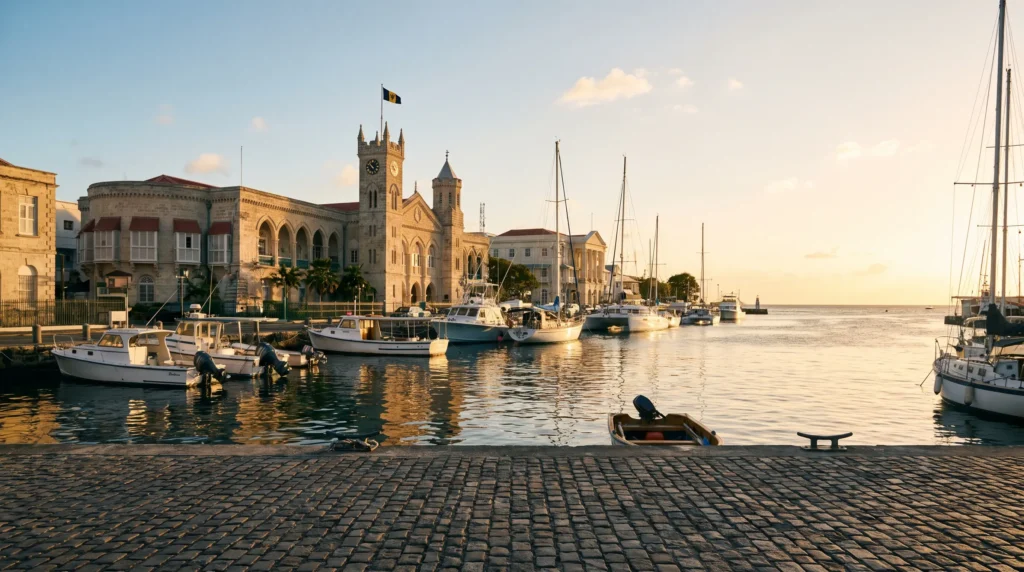
Bridgetown is the kind of capital that makes you slow down and read the plaques. English settlers landed here in 1628, and the old town they built still runs on the same tangle of lanes around a natural harbor called the Careenage — no grid, no right angles, just streets that curve the way the water told them to. UNESCO agreed it was worth protecting in 2011, inscribing Historic Bridgetown and its Garrison as a World Heritage Site for exactly that reason: it’s one of the earliest fortified colonial ports in the Caribbean, and it shows its age honestly. I like Bridgetown precisely because it isn’t trying to be a resort strip — the resorts are up the west coast, and this is where Barbados actually governs, trades, and lives. You can stand in National Heroes Square, walk five minutes to a rum shop older than most countries, and be on a beach by lunch. It’s compact, it’s walkable, and it rewards a slower pace than the cruise-ship day-trippers ever give it.
In This Guide
- Overview — Why Bridgetown Is More Than a Cruise Stop
- Crop Over — Barbados’ Biggest Festival
- Best Time to Visit Bridgetown (Season by Season)
- Getting There — BGI Airport & Cruise Port
- Getting Around — Buses, ZRs & Driving on the Left
- Neighborhoods — Historic Core to the Platinum Coast
- Culture & People — Bajan Identity, Parliament & Cricket
- A Food Lover’s Guide to Bridgetown
- Off the Beaten Path
- Day Trips From Bridgetown
- Practical Information
- Budget Breakdown — What Bridgetown Actually Costs in 2026
- Frequently Asked Questions
Overview — Why Bridgetown Is More Than a Cruise Stop
Bridgetown is the capital and largest city of Barbados, sitting in the parish of Saint Michael on the island’s southwestern coast. English settlers arrived on 5 July 1628 and built their town around a swampy tidal inlet they crossed with a makeshift crossing — hence the name — which today survives as the Careenage, the small craft harbor at the city’s heart. The city was granted official city status in 1842, though its real claim to fame predates that by two centuries: its Parliament Buildings house the third-oldest continuously operating parliament in the Commonwealth.
What earns Bridgetown its UNESCO status isn’t a single monument but the whole layout — a serpentine, organically grown street pattern that stands in deliberate contrast to the gridded Spanish and Dutch colonial towns elsewhere in the region. Historic Bridgetown and its Garrison were inscribed as a World Heritage Site in 2011 for exactly this: one of the Caribbean’s earliest fortified port towns, and the nearby Garrison, which once housed the Eastern Caribbean headquarters of the British Army and Navy.
The city itself is tiny — about 15 square miles of metro area at barely a few feet above sea level — and that scale is the whole appeal. You can walk from the historic core to National Heroes Square to the Garrison in an afternoon, then catch a bus to a west-coast beach before dinner. Bridgetown isn’t trying to be Barbados’ beach resort; that job belongs to Holetown and the Platinum Coast up the road. Bridgetown is where the island’s actual history, government and daily commerce happen, and it’s worth at least two full days before you head for the sand.
Crop Over — Barbados’ Biggest Festival
If you can time a visit around one thing, make it Crop Over, Barbados’ signature festival with roots tracing back to 1687, when sugar plantations marked the end of the annual cane harvest. The tradition lapsed after the Second World War, was revived in 1970, and became an official national festival in 1974, run in partnership with the Barbados tourism authorities. It now runs from June through the first Monday in August, building through calypso and soca competitions, food fairs and costume-band processions to its finale, Grand Kadooment — a nationwide parade of masquerade bands that in 2026 falls on 3 August.
Crop Over sits inside Barbados’ broader Season of Emancipation (mid-April to late August), which gives the whole summer a current of cultural pride running under the party. Book Bridgetown accommodation early if your dates overlap Kadooment weekend — hotels fill and prices climb across the island, not just downtown.
Best Time to Visit Bridgetown (Season by Season)
December – April · Dry season (peak)
The most reliable weather, lower humidity and the busiest, priciest stretch of the year — Christmas through Easter books up fastest. Barbados runs a tropical climate with fairly constant temperatures year-round, so “peak” here is about rainfall and crowds more than heat.
May – June · Shoulder season
Warm, increasingly humid, fewer crowds and softer prices before the festival season and hurricane season both ramp up.
June – November · Wet season & Atlantic hurricane season
Barbados’ wet season runs roughly June through December, with short, heavy afternoon showers rather than all-day washouts. Barbados sits at the eastern edge of the Caribbean hurricane belt — direct hits are infrequent, but this is peak Atlantic storm season, so travel insurance matters and it’s worth watching the forecast if you’re booking July–October. Crop Over (June–early August) makes this the liveliest window despite the rain risk.
Getting There — BGI Airport & Cruise Port
Grantley Adams International Airport (BGI) sits about 13 kilometres southeast of downtown Bridgetown and is Barbados’ only international gateway, with direct flights from Toronto, New York, Miami, London and other hubs across North America, the UK and the wider Caribbean. The airport handled roughly 2.4 million passengers in 2025 and ranks among the busiest in the Lesser Antilles. Taxis and pre-booked transfers cover the 15–20 minute run into the city.
Bridgetown’s Deep Water Harbour is also one of the Eastern Caribbean’s major cruise ports, dredged and modernized in 2002 to take today’s larger ships right into the city center. That means many visitors arrive on foot, straight off the ship and into the historic district, with National Heroes Square a short walk from the terminal gates.
Getting Around — Buses, ZRs & Driving on the Left
The historic core of Bridgetown is entirely walkable — the Careenage, National Heroes Square, Parliament and the main shopping streets sit within a few blocks of each other. Beyond downtown, Barbados runs on the left side of the road, a holdover from British rule, which catches out drivers from the US, Canada and continental Europe more than they expect.
Public Transport Board buses and privately-run “ZR” vans (minibuses, easy to spot and cheap) connect Bridgetown to every coast; flag them down on the main routes. Taxis are widely available and unmetered — agree the fare before you get in. Rental cars open up the east coast and interior at your own pace, but budget for the left-hand adjustment; many visitors instead book a driver or day-tour operator for trips outside the city, which sidesteps the issue entirely.
Neighborhoods — Historic Core to the Platinum Coast
The Careenage & National Heroes Square
Bridgetown’s historic heart: the small craft harbor that gave the city its name, ringed by National Heroes Square, the Parliament Buildings and the Cathedral Church of Saint Michael and All Angels. This is the UNESCO-listed core, and the best introduction to the city on foot.
The Garrison
A former British military headquarters turned museum district just south of downtown — parade grounds, the Barbados Museum, and the Garrison Savannah racetrack, all part of the same 2011 UNESCO inscription as the old town.
Fontabelle & Kensington Oval
Just north of the center, home to Kensington Oval, the cricket ground that hosted the 2007 Cricket World Cup final — still the spiritual home of Bajan cricket and worth a match if the calendar lines up.
St. Lawrence Gap & the South Coast
Bridgetown’s nightlife extension — a strip of restaurants, bars and small hotels a short taxi ride south, with calmer, more affordable beaches than the west coast.
Oistins
A working fishing town turned Friday-night institution: the Oistins Fish Fry draws locals and visitors alike for fried fish, cou-cou and live music at rows of stalls near the water.
Holetown & the Platinum Coast
Up the west coast, this is where the first English settlers actually landed in 1625, and today it’s the glossiest stretch of Barbados — calm turquoise water, the island’s priciest resorts, and the Holetown Festival each February commemorating that landing.
Speightstown
Further north still, a quieter historic fishing town with colonial-era warehouses and a slower pace than Holetown — a good half-day trip for a sense of “old Barbados” without the crowds.
Culture & People — Bajan Identity, Parliament & Cricket
Barbados counts roughly 282,000 people nationwide, the overwhelming majority of Afro-Caribbean descent tracing back to the sugar plantation era, alongside smaller communities of European, Middle Eastern and East Asian heritage. English is the official language, but everyday conversation runs through Bajan Creole — a distinct dialect with its own rhythm and vocabulary that takes a day or two of tuned ears to follow comfortably.
Barbados gained independence from Britain on 30 November 1966 and became a republic, replacing the monarch as head of state, on the same date in 2021. That pride in self-governance runs deep — Bridgetown’s Parliament Buildings are the third-oldest continuously sitting parliament in the Commonwealth, a genuinely unusual claim for a country of this size. Cricket is close to a civic religion; Kensington Oval hosted the 2007 World Cup final, and a Test match there is one of the best ways to spend an afternoon with locals.
A Food Lover’s Guide to Bridgetown
The national dish is cou-cou and flying fish — a cornmeal-and-okra cou-cou reminiscent of soft polenta, served alongside steamed or fried flying fish in a light Creole gravy. Flying fish are such a symbol of the island that they appear on Barbadian currency and in the tourism board’s own logo, and tradition still serves this plate on Fridays.
That same Friday-night tradition is best experienced at the Oistins Fish Fry, a short drive south of the city, where dozens of stalls grill fresh catch to a soundtrack of live music and a genuinely local crowd. Look also for macaroni pie (a baked, cheese-heavy Bajan take on mac and cheese that shows up at every Sunday lunch), and pudding and souse — spiced sweet potato with pickled pork, traditionally a Saturday dish. Barbados calls itself the birthplace of rum, and Mount Gay’s Bridgetown-area distillery tours are the obvious pilgrimage; pair a rum shop crawl downtown with a cold Banks beer, the local lager since the 1960s.
Off the Beaten Path
Harrison’s Cave
An underground network of flowstone and stalactites in the central uplands, first noted in historical records in 1795 and rediscovered in the early 1970s before opening to the public as a tram tour in 1981. The Great Hall alone rises more than 50 feet, and the tram stops periodically so you can get close to the formations on foot.
Animal Flower Cave
A sea cave at the island’s northern tip with tidal pools you can swim in, named for the sea anemones once found inside — a dramatic, far-quieter counterpoint to Harrison’s Cave.
Chalky Mount & the Scotland District
A hillside potters’ village in the rugged, un-Caribbean-looking Scotland District — rolling, eroded terrain that looks nothing like the flat coral limestone of the south and west coasts.
Hunte’s Gardens
A lush private garden built into a collapsed cave gully — a genuinely surprising, tucked-away spot most itineraries skip entirely.
Day Trips From Bridgetown
Barbados is small enough that almost anywhere qualifies as a day trip. Bathsheba, on the rugged east coast, is the island’s surf hub — the Soup Bowl draws international surfers, and the giant boulders scattered along the beach make it one of the most photographed spots on the island. Pair it with the nearby Andromeda Botanic Gardens and a stop at St. Nicholas Abbey, a restored 17th-century plantation great house with its own rum distillery, near Farley Hill National Park. Most of these sit an hour or less from Bridgetown by rental car or tour van — the east coast’s wilder scenery is a deliberate contrast to the calm west-coast beaches, and worth the winding drive.
Practical Information
Money. The Barbados dollar has been pegged at BBD 2 to US$1 since 1975, and US dollars are accepted almost everywhere — just confirm which dollar a quoted price means. Cards work in most hotels, restaurants and shops; carry small cash for buses, ZR vans and the Oistins fish stalls.
Safety. The US State Department rates Barbados Level 1, “Exercise Normal Precautions,” describing it as generally a safe destination. Petty crime — purse snatching, pickpocketing — is the main concern in tourist areas and crowded festival crowds; avoid walking alone on beaches at night and don’t display valuables. Check current advisories before you travel.
Health. The CDC recommends routine vaccines plus Hepatitis A and B and typhoid for many visitors, and flags dengue and Zika as mosquito-borne risks — pack a DEET repellent of 20% or more. Follow standard food and water precautions at street stalls, and note that traffic runs on the left.
Connectivity. An eSIM covers most of the island; Wi-Fi is solid in Bridgetown and resort areas. Plugs: Type A/B, US-style, 115V — American devices need no adapter. Time zone: Atlantic Standard Time, UTC-4, no daylight saving.
Budget Breakdown — What Bridgetown Actually Costs in 2026
Barbados runs at the pricier end of the Caribbean — closer to the Bahamas or a US beach town than to Jamaica or the Dominican Republic.
Budget (US$70–120/day): guesthouse or hostel-style stay near St. Lawrence Gap or the south coast, ZR vans and buses, Oistins fish fry dinners, self-catered lunches.
Mid-range (US$180–320/day): boutique hotel in or near Bridgetown, restaurant dinners, a Harrison’s Cave or catamaran tour, a rental car for a day trip to Bathsheba or St. Nicholas Abbey.
Luxury (US$500+/day): a Platinum Coast resort in Holetown, private catamaran charters, Mount Gay heritage tastings, chef’s-table dining.
Expect a standard 10–15% service charge on restaurant bills (check if it’s already added before tipping again), and a departure tax built into most airline tickets.
Planning Your Trip to Bridgetown
Most first-time visitors give Bridgetown itself one to two days — enough for the Careenage, the Garrison and a rum shop crawl — before splitting the rest of the week between the calm west coast around Holetown and the wilder east coast at Bathsheba. If Crop Over dates line up with your trip, build in extra nights and book early. Barbados pairs naturally with a wider Eastern Caribbean itinerary; see our guides to Saint Lucia for a mountainous contrast, Jamaica for more Caribbean depth, or Aruba if you want the drier southern Caribbean on the same trip.
Frequently Asked Questions
Is Bridgetown safe for tourists in 2026?
Yes, in general — the US State Department rates Barbados Level 1, its lowest advisory tier, and describes it as generally safe. Petty theft is the main risk in crowded tourist and festival areas; use normal city precautions and avoid empty beaches after dark.
Do I need a visa to visit Bridgetown?
US citizens need only a valid passport for stays of up to six months; no visa is required. UK, EU and Canadian passport holders also generally enter visa-free for tourism — confirm your specific entry terms before booking.
What’s the best time to see Crop Over?
The festival builds from June through the first Monday in August, with Grand Kadooment — the big costume-band finale — landing on 3 August in 2026. Book accommodation well ahead if your trip overlaps that final week.
Is Bridgetown walkable?
The historic UNESCO core — the Careenage, National Heroes Square, Parliament and the Garrison — is entirely walkable in an afternoon. Reaching the beaches and other neighborhoods means a bus, ZR van or taxi.
Bridgetown or a west-coast resort — where should I stay?
Stay in or near Bridgetown for history, cricket and rum-shop culture within walking distance; choose Holetown or the Platinum Coast for calmer beaches and resort amenities. Many visitors split a week between the two.
What’s the easiest local dish to try first?
Cou-cou and flying fish, the national dish — or if it’s a Friday, skip straight to the Oistins Fish Fry for the same flavors with live music and a local crowd.
Ready to Explore Bridgetown?
A UNESCO old town you can walk in an afternoon, a Friday fish fry that’s more block party than dinner, and rum shops older than most nations — Bridgetown packs serious history into a small, easy footprint. Go slow, tip well, and let the Careenage set the pace.
Explore More
- Barbados Travel Guide — the full island beyond the capital
- Saint Lucia Travel Guide — the Eastern Caribbean’s mountainous neighbor
- Jamaica Travel Guide — more Caribbean soul
- Aruba Travel Guide — the dry, sunny southern Caribbean
How this guide was built
Published as part of Facts From Upstairs’ city guide series. Built from authoritative sources — UNESCO’s Historic Bridgetown and its Garrison inscription, the Central Bank of Barbados, the US State Department Barbados country page, the US CDC traveler page for Barbados, and Wikipedia entity pages for Bridgetown, Barbados, Grantley Adams International Airport, Crop Over, Harrison’s Cave, Cou-cou and Oistins. Numeric claims carry inline citations.
Sources cited on this page
- UNESCO — Historic Bridgetown and its Garrison
- Central Bank of Barbados — the exchange rate peg
- US State Department — Barbados
- US CDC — Barbados traveler page
- Wikipedia — Bridgetown
- Wikipedia — Barbados
- Wikipedia — Grantley Adams International Airport
- Wikipedia — Crop Over
- Wikipedia — Harrison’s Cave
- Wikipedia — Cou-cou
- Wikipedia — Oistins
- World Standards — Barbados electrical plug & voltage
More city guides you might like
Plan your trip to Bridgetown
The booking tools we use ourselves. FFU may earn a commission at no extra cost to you.
Plan & book your trip to Bridgetown
Booking through these searches supports our guides at no extra cost to you.