
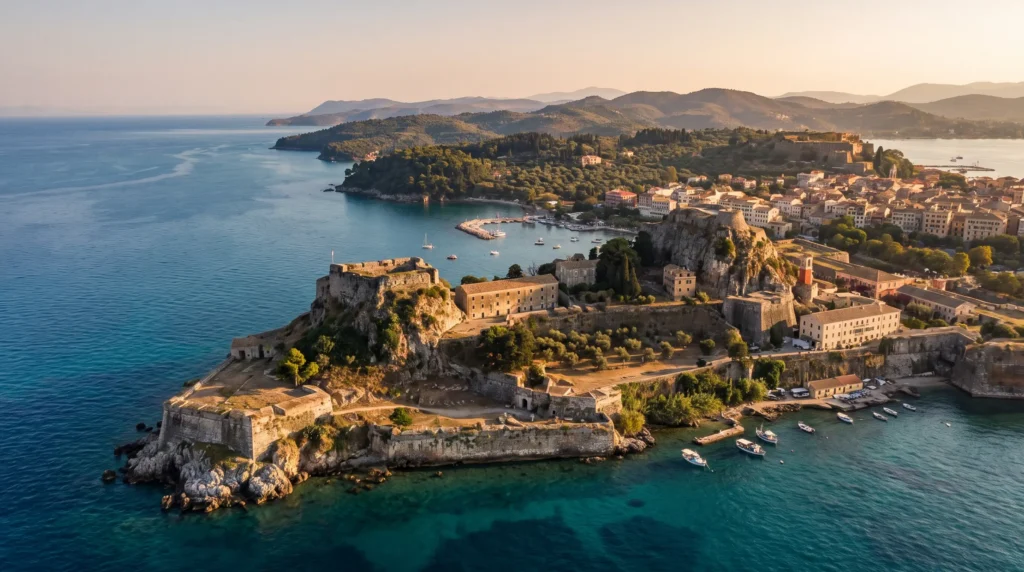
Corfu Travel Guide — Venetian Streets, Ionian Green & Greece’s Most Un-Greek Island
Corfu is the Greek island that spent four centuries never being Greek, and you can feel it the second you walk into the Old Town. There’s a cricket pitch on the main square, a French-built arcade of cafés along the Liston, alleyways that look airlifted from Venice, and church bells that ring in a rhythm the rest of Greece doesn’t share — because the Ottomans never took this island, and the Venetians, French and British did instead. Add in the greenest landscape in the Aegean-adjacent world (Corfu sits in the Ionian, which is wetter and lusher than its Cycladic cousins), olive groves planted by Venetian decree, and a coastline that ranges from postcard coves to package-tourism strips, and you get an island that rewards picking your spot carefully. I’ve walked the Old Town at 7am before the tour groups land and eaten kumquat liqueur off a strip-mall folding table in Ipsos — both are Corfu, and only one of them is worth your time.
In This Guide
- Overview — Why Corfu Doesn’t Feel Like the Rest of Greece
- Holy Saturday: the Botides Pot-Smashing Festival
- Best Time to Visit Corfu (Season by Season)
- Getting There — CFU Airport & Ferries
- Getting Around — Buses, Rentals & Walking the Old Town
- Neighborhoods & Coastlines
- Culture & People — Venetian, French, British, Greek
- A Food Lover’s Guide to Corfu
- Off the Beaten Path
- Day Trips From Corfu
- Practical Information
- Budget Breakdown — What Corfu Actually Costs in 2026
- Frequently Asked Questions
Overview — Why Corfu Doesn’t Feel Like the Rest of Greece
Corfu (Kerkyra to Greeks) is the second-largest of the Ionian Islands, sitting in the Ionian Sea off Greece’s northwest coast, close enough to Albania that the strait between them narrows to a few kilometres in places. That geography kept it out of Ottoman hands for the entire period the rest of Greece spent under Ottoman rule — instead Corfu passed from the Byzantines to Venice for roughly four centuries (1386–1797), then briefly to France, then to Britain as a protectorate, before finally joining the modern Greek state in 1864.
The result is a townscape UNESCO inscribed as the Old Town of Corfu in 2007: three Venetian-engineered forts built to hold the entrance to the Adriatic, a mainly neoclassical housing stock layered over the Venetian bones, and a level of preservation UNESCO specifically flags as unusually intact for a fortified Mediterranean port. Walk the Liston — the arcaded street the French modeled on Paris’s Rue de Rivoli — and you’re in Italy. Watch a cricket match on the Spianada, the vast central green the Venetians kept clear for cannon fire and the British then used for cricket, and you’re in England. Order a kumquat liqueur and you’re nowhere else on Earth; the fruit was a 19th-century British import that only really took to Corfiot soil.
Inland and along the coasts, Corfu is markedly greener than the Cyclades — thick with olive groves the Venetians paid farmers to plant, cypress-lined hills, and a interior that peaks at Mount Pantokrator, 906 metres, with views to Albania and (on clear days) Italy. The catch: this is also one of the most heavily package-touristed islands in Greece, and the east coast strips (Benitses, Ipsos, Dassia) can feel more like the Costa del Sol than the Ionian. Pick your base with intent and Corfu delivers something genuinely different from a Santorini or Mykonos trip; pick it on autopilot and you’ll get an all-inclusive with a view.
Holy Saturday: the Botides Pot-Smashing Festival
If your trip lines up with Orthodox Easter — the date shifts every year and often falls a week or more after Western Easter — plan to be in the Old Town on Holy Saturday morning. At 11am, church bells across the city ring together and locals throw large clay water jugs, called botides, from balconies onto the streets of Spianada Square, smashing them to pieces while philharmonic bands play.
The custom blends Venetian and Orthodox roots: Venetians once threw out old household items on New Year’s Day hoping for new ones; Corfiots adapted it to Holy Saturday and swapped junk for jugs, meant to symbolize the earthquake that followed Christ’s resurrection. Spectators grab shards as good-luck keepsakes. It’s chaotic, loud, and one of the few Greek Easter traditions that’s genuinely unique to a single island — worth building an itinerary around if the calendar cooperates.
Best Time to Visit Corfu (Season by Season)
Late May – June · Shoulder sweet spot
Warm, mostly dry, the countryside still green from spring rain, and prices well below July–August peaks. This is the window locals themselves recommend, and it’s when hotel availability is best in the Old Town rather than just the resort strips.
July – August · Peak season
Hot (regularly 30°C+), busiest beaches, highest prices, and the Old Town at its most crowded with cruise-ship day-trippers and charter-flight arrivals. Book accommodation months ahead if you’re committed to these months.
September – early October · Second shoulder
Sea still warm from summer, crowds thinning, prices easing — arguably the best value window of the year, and a strong pick if your dates are flexible.
November – April · Off-season
Corfu’s Mediterranean climate means mild but genuinely rainy winters — this is the wettest major Greek island, and many coastal tavernas and resort hotels close entirely from November to Easter. The Old Town itself stays open year-round and is atmospheric with the crowds gone, but pair it with indoor plans, not a beach trip.
Getting There — CFU Airport & Ferries
Ioannis Kapodistrias International Airport (CFU) sits about 2.7km south of Corfu Town — a 10-minute taxi or bus ride. Aegean Airlines runs year-round domestic connections to Athens; the bulk of international traffic is seasonal charter and low-cost routings from the UK and Europe via Ryanair, easyJet, Jet2 and TUI, plus Air France and Austrian Airlines. The airport handled roughly 4.34 million passengers in 2024, with the UK, Germany and domestic Greek traffic as the top origin markets. That charter-heavy mix means winter flight options thin out dramatically — outside summer, routing through Athens is often the only reliable option.
By sea, ferries link Corfu Town to Igoumenitsa on the Greek mainland in about 90 minutes-2 hours (multiple daily crossings, cheap and easy for a Greece-mainland combination trip), and to Italian ports — Brindisi, Bari and Ancona — as an overnight or day crossing, a classic way to combine Corfu with an Italy trip without flying.
Getting Around — Buses, Rentals & Walking the Old Town
Corfu Town’s Old Town is entirely walkable and largely pedestrianized — narrow Venetian alleys (locally, kantounia) that a car has no business entering anyway. For the rest of the island, KTEL green buses run inter-town routes from the mainland-style bus terminal, while blue urban buses cover the immediate suburbs; both are cheap but infrequent outside peak season.
A rental car or scooter (roughly €35–55/day for a small car in season) is genuinely the best way to see Corfu properly — Paleokastritsa, the northeast villages, and Mount Pantokrator’s viewpoints are all a slog without one. Taxis are metered but scarce at peak times; agree fares for longer trips in advance. Given the winding mountain roads and a fair number of scooter-related tourist accidents each summer, rent from a reputable operator and don’t ride in flip-flops.
Neighborhoods & Coastlines
Old Town (Corfu Town)
The UNESCO-listed core: the Old and New Fortresses, the Liston’s café arcade, Spianada Square, and a maze of Venetian streets that lead down to the harbor. Base here for atmosphere and walkability; it’s also the most expensive and most cruise-crowded part of the island by day.
Kanoni & Vlacherna
A short drive or bus ride south of town, this is Corfu’s single most photographed view: the tiny white Vlacherna Monastery on its own causeway-linked islet, with Pontikonisi (“Mouse Island”) just beyond. Come early or late to avoid the tour-bus crush at the viewpoint.
Paleokastritsa
The postcard northwest coast — dramatic cliffs, turquoise coves, and a clifftop monastery dating to 1225 with its own small museum. Local legend places this bay as the spot where Odysseus met Nausicaä, and the offshore rock as his petrified ship. Beautiful, but it’s the island’s busiest beach cluster in summer — arrive by 9am or skip midday entirely.
The Northeast (Kassiopi, Kalami, Kouloura)
Quieter, more upmarket, and long favored by British visitors — this is Durrell country, where the Durrell family’s 1930s Corfu memoirs are set. Kalami and Kouloura are tiny, gorgeous, and increasingly expensive; Kassiopi has a livelier village core with a working harbor.
Sidari & the Northwest
Sandstone rock formations (the “Canal d’Amour”) and a livelier, younger nightlife scene aimed squarely at package tourists. Fine for a beach day, not the place for a quiet dinner.
Benitses, Ipsos & Dassia (East Coast)
The island’s most built-up package-holiday strip — convenient to the airport and Corfu Town, but dense with all-inclusive resorts and lower on character. Useful as a budget base if beach time matters more than atmosphere.
The South (Lefkimmi, Kavos)
Kavos is Corfu’s dedicated party-town beach resort — loud, cheap, aimed at 18–30s. Lefkimmi and the surrounding south are calmer, more agricultural, and largely ignored by foreign tourists.
Culture & People — Venetian, French, British, Greek
Corfu’s identity is layered rather than singular. Four centuries of Venetian rule left the architecture, the Catholic minority (small but historic), and loanwords in the local dialect. The brief French period (1797–1814, with interruptions) left the Liston and an early taste for grand civic planning; the British protectorate (1814–1864) left cricket on the Spianada, ginger beer as a genuine local drink, and Corfu’s oldest bank buildings. None of this erased Greek Orthodox identity underneath — if anything, Corfiots wear the mash-up as a point of pride rather than confusion.
The island’s patron saint, Spyridon, gets four annual processions through the Old Town where his preserved relics are carried in a silver casket — the biggest falls on Palm Sunday and Holy Saturday, tying back into the Easter calendar. Corfiot philharmonic bands (there are several, each tied to a neighborhood or church) are a genuinely distinctive local institution, with a level of civic pride around them that outsiders often don’t expect from a beach-holiday island.
A Food Lover’s Guide to Corfu
Corfiot cuisine breaks from mainland Greek habits in ways that trace straight back to Venice. The signature dish is sofrito — thin slices of veal in a garlic-white-wine-vinegar sauce, a clear Venetian import. Equally essential is pastitsada, a slow-cooked beef or rooster stew in a rich tomato-cinnamon-clove sauce served over thick pasta, and bourdeto, a spicy fish stew (usually scorpionfish) in a red-pepper sauce distinct from mainland fish soups.
Corfu is also one of the few places in Greece that makes kumquat products — the tiny citrus arrived from China via a British resident in the 1800s and now shows up as liqueur, spoon-sweet preserves and candied fruit, sold everywhere from Paleokastritsa gift shops to Old Town delis. Pair meals with local wine (the indigenous Kakotrygis white is worth seeking out) or a bottle of Corfu-brewed ginger beer, a genuine relic of the British era still made on the island. For a casual lunch, look for a taverna serving tsigareli (spicy greens) alongside the mains — a good sign the kitchen is cooking Corfiot rather than generic tourist-Greek.
Off the Beaten Path
Angelokastro
A Byzantine hilltop fortress above Paleokastritsa with sweeping coastal views and a fraction of the crowds at the beach below — a 20–30 minute uphill walk from the nearest parking, which filters out most day-trippers.
Mount Pantokrator
The island’s summit at 906 metres, reachable by a winding drive through mountain villages, with a monastery at the top and views stretching to Albania and, on a clear day, the Italian coast.
The Achilleion Palace
Built from 1888–1891 for Empress Elisabeth of Austria (“Sisi”) as a private retreat after a personal tragedy, later bought by Kaiser Wilhelm II as a summer diplomatic residence; it’s now a museum, and its gardens (anchored by a statue of the “Dying Achilles”) are quieter and stranger than the Old Town’s headline sights. Bond fans may recognize it from a 1981 For Your Eyes Only casino scene.
Interior villages (Sinarades, Doukades, Pelekas)
A short drive from any coast puts you in stone-built inland villages that see a fraction of the coastal traffic — good for a slower lunch and a sense of the island beyond the beach economy.
Day Trips From Corfu
Paxos and Antipaxos — a summer boat excursion (roughly 1–2 hours by speedboat, more by ferry) to Corfu’s tiny, car-light southern neighbors, known for turquoise coves even more saturated than Corfu’s own.
Saranda and Butrint, Albania — a genuinely easy cross-border day trip: fast ferries run Corfu Town to Saranda in under an hour, connecting to the Butrint archaeological site, one of the Mediterranean’s better-preserved ancient cities. Confirm current visa/entry rules for Albania before booking, since they sit outside Schengen.
Igoumenitsa and Epirus, mainland Greece — the short ferry hop to Igoumenitsa opens up mainland Epirus, including the Zagorochoria villages and Vikos Gorge, for travelers willing to rent a car on arrival.
Practical Information
Money. Euro (EUR); Greece adopted the currency in 2001 with notes and coins circulating from 2002. Cards are widely accepted in Corfu Town and resort areas; carry cash for smaller village tavernas and beach kiosks.
Safety. Greece sits at “Exercise Normal Precautions” on the US State Department’s advisory scale (Level 1, per its most recent update). Petty theft (pickpocketing on buses, at ferry ports, in crowded Old Town lanes) is the main real risk; violent crime against tourists is rare. Summer wildfire risk is a genuine seasonal hazard across Greece — follow local advisories if traveling July–September.
Health. No special vaccines are required beyond routine immunizations; the US CDC flags a global measles alert worth checking your MMR status against, and standard mosquito/tick precautions for rural and hiking areas. Tap water is generally safe in Corfu Town; bottled water is the norm in smaller villages regardless.
Connectivity. An EU-roaming SIM or eSIM covers Corfu well in towns and along the coast; mountain villages and some coves have patchy signal. Plugs: Type C/F (European two-round-pin), 230V. Time zone: Eastern European Time (UTC+2, UTC+3 with daylight saving).
Budget Breakdown — What Corfu Actually Costs in 2026
Corfu sits mid-pack for Greek islands — pricier than mainland Greece, generally a notch below Santorini or Mykonos at the luxury end, but with plenty of package-holiday pricing at the budget end thanks to the charter-flight economy.
Budget (US$70–120/day): Guesthouse or budget hotel in Corfu Town or an east-coast resort strip, taverna lunches, KTEL buses, one paid attraction (Achilleion or a fortress) per day.
Mid-range (US$150–280/day): Boutique hotel or Airbnb with a view, a rental car for a few days (€35–55/day), sit-down dinners with local wine, a Paxos boat excursion (~€60–90).
Luxury (US$450+/day): Northeast-coast villa or five-star resort, private boat charters, chef-led tasting menus, a driver for day trips instead of self-driving the mountain roads.
Fixed costs to expect: a small municipal/overnight-stay tax added at hotel checkout, and typically 10% service either included or expected on top at restaurants. Ferries and fast boats to Paxos or Albania are cash-and-card bookable at the Old Port.
Planning Your First Trip to Corfu
The classic first-timer split is Old Town + one coast: fly into CFU, spend two or three nights in the Old Town for the fortresses, the Liston and Kanoni, then relocate to Paleokastritsa or the northeast (Kalami, Kassiopi) for three or four nights of beach and boat time, with a rental car picked up on the move day. Five nights covers the essentials; eight to ten lets you add a Paxos day trip or the Saranda/Butrint crossing into Albania. Corfu also pairs naturally with a wider Greek-islands trip — many travelers combine it with Athens as a mainland bookend, or a longer Ionian-to-Cyclades run that continues to Santorini. If you’re arriving via the Italy ferry route, our Italy travel guide covers the Brindisi and Bari side of that crossing.
Frequently Asked Questions
Is Corfu safe for tourists in 2026?
Yes — Greece overall sits at the US State Department’s lowest advisory tier, “Exercise Normal Precautions.” The realistic risks are petty theft in crowded tourist areas and summer wildfires, not violent crime. Use licensed taxis, watch belongings on buses and at the ports, and check current advisories before travel.
Do I need a visa for Corfu?
Greece is part of the Schengen Area, so US, UK, Canadian, Australian and most other visa-exempt nationalities can enter for up to 90 days within any 180-day period without a visa. That 90-day allowance is shared across the entire Schengen Area, not per country — check your recent Schengen travel history before booking a long trip.
How many days do you need in Corfu?
Five nights covers the Old Town plus one coastal base comfortably; eight to ten lets you add a Paxos or Albania day trip and see the interior villages and Mount Pantokrator without rushing.
Corfu or Santorini?
Choose Corfu for Venetian architecture, green scenery, and a genuinely different Greek-island flavor with fewer whitewashed-cube postcards; choose Santorini for the caldera views and sunset drama Instagram trained you to expect. Corfu is also generally cheaper and less crowded outside its own package-tourism strips.
What’s the cheapest way to see Corfu properly?
Base in the Old Town on foot, use KTEL buses for day trips to Paleokastritsa and Kassiopi, eat where the menu is handwritten and in Greek first, and save a rental car for a single dedicated day covering Angelokastro, Pantokrator and the interior villages.
Can I combine Corfu with mainland Greece or Italy?
Easily — ferries run to Igoumenitsa on the Greek mainland in under two hours, and to Italian ports (Brindisi, Bari, Ancona) as a day or overnight crossing, making Corfu a natural bridge stop between the two countries.
Ready to Explore Corfu?
Venetian fortresses, a monastery on its own islet, kumquat liqueur nobody else in Greece bothers making, and a Holy Saturday tradition that involves smashing clay pots off six-storey balconies — Corfu earns its reputation as the Greek island that never quite acts Greek. Pick your coast with intent, and it delivers something the Cyclades simply can’t.
Explore More
- Athens City Guide — pair the Ionian with a mainland Greece capital stop
- Santorini City Guide — continue on to the Cyclades’ caldera views
- Italy Travel Guide — the Brindisi/Bari ferry side of the Corfu crossing
- Albania Travel Guide — Saranda and Butrint, an hour away by fast ferry
How this guide was built
Published as part of Facts From Upstairs’ city guide series. Built from authoritative sources — UNESCO’s Old Town of Corfu World Heritage inscription, Wikipedia entity pages for Corfu island, Ioannis Kapodistrias International Airport, Paleokastritsa and the Achilleion Palace, the European Central Bank’s 2001 press release on Greece’s euro adoption, the European Commission’s Schengen visa policy page, the US State Department’s Greece travel advisory, the US CDC’s Greece traveler health page, and GreekReporter’s 2026 coverage of the Corfu Botides Easter tradition. Numeric and checkable claims carry inline citations.
Sources cited on this page
- UNESCO — Old Town of Corfu
- Wikipedia — Corfu
- Wikipedia — Ioannis Kapodistrias International Airport
- Wikipedia — Paleokastritsa
- Wikipedia — Achilleion Palace
- European Central Bank — Greece joins the euro (2001)
- European Commission — Schengen visa policy
- US State Department — Greece
- US CDC — Greece traveler page
- GreekReporter — Corfu Botides Holy Saturday tradition (2026)
More city guides you might like
Plan your trip to Corfu
The booking tools we use ourselves. FFU may earn a commission at no extra cost to you.
Plan & book your trip to Corfu
Booking through these searches supports our guides at no extra cost to you.