
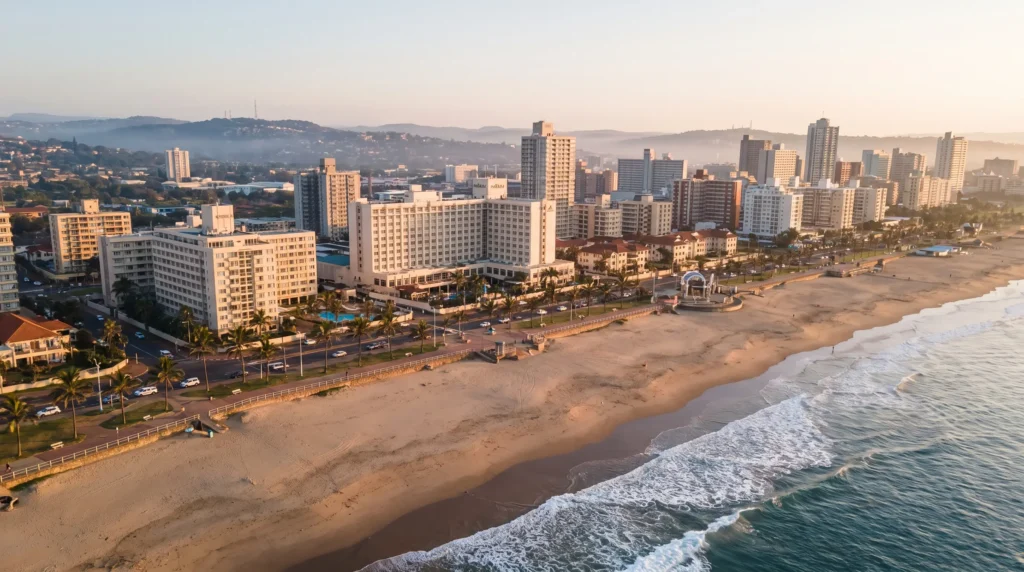
Durban Travel Guide — Zulu Kingdom Meets the Indian Ocean on Africa’s Warmest Coast
Durban is the South African city that doesn’t get the postcard treatment Cape Town does, and honestly, that’s the appeal. This is South Africa’s third-largest city and its busiest port, a subtropical sprawl on the Indian Ocean where you can bodysurf warm swells at dawn, eat a curry-stuffed loaf of bread invented three streets from where you’re standing, and be inside a rhino-filled game reserve by lunchtime. It’s the most ethnically layered city in the country — Zulu, Indian, colonial-British and Cape Malay influences collide in the food, the markets and the soundtrack — and it wears that mix more openly than anywhere else in South Africa. I won’t pretend it’s polished: the beachfront can feel rough around the edges after dark, load shedding still bites, and the crime headlines aren’t fiction. But nowhere else in the country gives you this much warm ocean, this much curry, and this much unfiltered Zulu-Indian-colonial history for so little money.
In This Guide
- Overview — Why Durban Is South Africa’s Most Underrated City
- The Durban July — Africa’s Biggest Social Event Hits Town
- Best Time to Visit Durban (Season by Season)
- Getting There — King Shaka International & the N2
- Getting Around — Uber, Minibus Taxis & the Golden Mile
- Neighborhoods — Beachfront, Berea & Umhlanga
- Culture & People — Zulu, Indian & Colonial Durban
- A Food Lover’s Guide to Durban
- Off the Beaten Path
- Day Trips from Durban
- Practical Information
- Budget Breakdown — What Durban Actually Costs in 2026
- Frequently Asked Questions
Overview — Why Durban Is South Africa’s Most Underrated City
Durban sits on South Africa’s east coast in KwaZulu-Natal province, and it has always been the country’s odd one out: a subtropical port city with palm-lined avenues, warm Indian Ocean water year-round, and a demographic mix — roughly half Black African, a quarter Indian/Asian, and the rest White and Coloured communities — that makes it feel closer to a Southeast Asian port town than to Pretoria or Bloemfontein. It’s South Africa’s third-largest city and, through the eThekwini Metropolitan Municipality that absorbed more than 120 surrounding towns, home to a metro population estimated around 4.2 million.
Founded as a trading post in 1824 and named for Sir Benjamin D’Urban, the city grew on sugar, indentured labor from India, and its harbor — still the busiest port in the region. That layered history shows up everywhere: British colonial facades downtown, some of the largest mosques and temples outside Asia, and Zulu heritage running through everything from language to the beadwork sold along the promenade. UNESCO named Durban Africa’s first City of Literature, recognizing a storytelling tradition that runs from oral Zulu praise-poetry to a modern publishing scene.
What Durban doesn’t have is Cape Town’s polish or its tourist infrastructure — and that’s genuinely part of the draw. Prices are lower, crowds are thinner, and the “Durban Poison” nickname for the city’s laid-back, slightly rough charm isn’t just about the local cannabis strain. You come here for lifeguard-patrolled surf beaches, a curry culture unmatched anywhere else in Africa, and a launchpad into Zululand’s battlefields and game reserves that most Cape Town-only itineraries never touch.
The Durban July — Africa’s Biggest Social Event Hits Town
If you’re reading this in early July, time it around one date: the Hollywoodbets Durban July, South Africa’s richest and most famous horse race, run at Hollywoodbets Greyville Racecourse on 4 July 2026 for its landmark 130th edition. It’s less a horse race than the country’s biggest fashion party — extravagant hats, designer showcases, and a theme (2026’s is “Country Allure”) that turns the entire infield into a runway. Even if you skip the actual race, the build-up week fills Durban’s hotels, restaurants and nightlife with a buzz you won’t find the rest of the year.
July also lands squarely in Durban’s mild, dry winter — warm days, cool evenings, and none of the muggy midsummer humidity — which makes it one of the most comfortable months to combine racetrack glamour with beach time and a Zululand safari extension.
Best Time to Visit Durban (Season by Season)
June – August · Dry winter (best all-round value)
Durban’s climate is humid subtropical, so “winter” here means mild, dry days around 17°C rather than anything cold — this is the most comfortable stretch for walking, hiking the Drakensberg foothills, and safari day trips, with none of summer’s downpours. It’s also whale-watching season along the KZN coast and, in 2026, when the Durban July lands.
September – November · Spring shoulder
Warming up, jacaranda season inland, fewer crowds than summer, and reliably good surf as the water starts to climb back toward swimmable.
December – February · Hot, wet peak summer
Average summer temperatures around 24°C but with real humidity and Durban’s roughly 1,000mm of annual rainfall concentrated in short, heavy afternoon storms. This is peak domestic holiday season — schools are out, the Golden Mile is packed, and hotel rates jump accordingly, especially over the December–January break.
March – May · Autumn shoulder
Rain tapering off, sea still warm from summer, prices easing — a genuinely underrated window that most guides skip past.
Getting There — King Shaka International & the N2
King Shaka International Airport (DUR) opened in 2010, 35 kilometres north of the city centre near La Mercy, and is South Africa’s third-busiest airport after Johannesburg and Cape Town. Direct international service is limited but real: Emirates flies Dubai–Durban, Qatar Airways connects via Doha, and Turkish Airlines links to Istanbul, alongside domestic and regional routes on Airlink, FlySafair, CemAir and LIFT. Most travelers from the US, UK or elsewhere in Europe connect through Johannesburg’s O.R. Tambo, a roughly hour-long domestic hop from Durban.
The airport transfer into the city runs 30–45 minutes by car via the N2 highway; metered airport shuttles, pre-booked transfers and Uber all operate reliably. Durban is also the terminus of South Africa’s coastal road network — the N2 links south to the Wild Coast and Cape Town, and north toward Richards Bay and the Zululand battlefields, making Durban a natural start or end point for a KZN road trip.
Getting Around — Uber, Minibus Taxis & the Golden Mile
Durban was not built for pedestrians the way Cape Town’s City Bowl was, and public transit is patchy — the informal minibus taxi network moves most of the city but isn’t set up for visitors without local knowledge of the routes. In practice, Uber and Bolt are the default way tourists get around, and they’re cheap enough that most visitors never touch a rental car within the city itself.
The Golden Mile beachfront promenade is genuinely walkable and pleasant by day, connecting uShaka Marine World in the south to the northern beaches, with a dedicated cycle and jogging lane. The MyCiTi-style GO! Durban rapid bus network is still being expanded, so don’t count on it as your primary transport. If you’re heading out to the Midlands, battlefields or game reserves, renting a car (or booking a driver) for that leg specifically is the more common approach — driving standard in South Africa is on the left.
Neighborhoods — Beachfront, Berea & Umhlanga
The Golden Mile & Beachfront
Durban’s signature stretch: lifeguard-patrolled swimming beaches, a paved promenade, surf schools, and landmarks like uShaka Marine World and the swooping arch of Moses Mabhida Stadium just inland. Busy and touristy by day; stick to well-lit, populated areas if you’re out after dark.
Durban CBD & Warwick Junction
The historic core — Victoria Street Market’s spice stalls, old colonial architecture, mosques and temples — and also the most chaotic, dense part of the city. Best visited on a guided walking tour, especially through the muti (traditional medicine) traders and bead sellers of Warwick Junction.
Berea, Morningside & Glenwood
Leafy, hillside residential neighborhoods just inland from downtown, where most visitors actually end up staying. Florida Road in Morningside is Durban’s restaurant-and-nightlife strip; Glenwood has an indie, arty edge with cafés and vintage shops.
Umhlanga
The upscale northern suburb built around the red-and-white uMhlanga Rocks Lighthouse, completed in 1954 and still an active navigation beacon. The O’Connor Promenade boardwalk, high-end hotels, and the Gateway mega-mall make this Durban’s most polished, resort-like base — closer to King Shaka Airport too.
The Bluff & South Durban
A working-class peninsula facing the harbor, known for some of Durban’s best surf breaks and a much quieter, local pace than the main beachfront.
Musgrave & the Botanic Gardens
Home to Durban Botanic Gardens, established in 1849 and recognized as Africa’s oldest surviving botanic garden — 15 hectares of cycads, orchids and heritage trees a short drive from the CBD.
Inanda & the Valley of a Thousand Hills
Inland townships and rolling Zulu heartland scenery, including the Inanda Heritage Route linking sites tied to both Gandhi and Nelson Mandela’s political awakening. Best visited with a local guide rather than independently.
Culture & People — Zulu, Indian & Colonial Durban
Durban’s population breaks down as roughly 51% Black African, 24% Indian/Asian, 15% White and 9% Coloured — the highest concentration of South Africans of Indian descent anywhere in the country, tracing back to indentured labourers brought to work Natal’s sugar cane fields from 1860 onward, followed by a second wave of Gujarati traders. Durban is routinely described as home to the largest Indian population outside India itself, a claim rooted in that 19th-century migration history and still visible in the city’s temples, mosques and markets today.
isiZulu and English dominate daily life, and Zulu cultural identity runs deep across KwaZulu-Natal — this is, after all, the historic Zulu Kingdom, and the province’s name literally means “place of the Zulu.” Expect praise-singing, beadwork traditions with genuine symbolic meaning (not just tourist souvenirs), and a deep-rooted respect for izangoma (traditional healers) that coexists comfortably with the city’s churches, mosques and Hindu temples. Warwick Junction’s muti traders are a living part of that tradition, not a museum piece — ask permission before photographing people or stalls.
A Food Lover’s Guide to Durban
Durban’s defining dish is bunny chow: a hollowed-out quarter, half or full loaf of white bread filled with curry, dating to the 1940s and created within the city’s Indian community — the name itself likely comes from “Bania,” the Indian merchant caste associated with the dish’s early vendors. Order it “bean” for the original vegetarian version or go for mutton, chicken or prawn; Cathedral Curry Works and the original Kapitan’s-lineage spots downtown are the pilgrimage stops, though every neighborhood has its own beloved hole-in-the-wall.
Beyond bunny chow, Durban curry runs hotter and more masala-forward than curries elsewhere in South Africa — look for mutton curry, breyani (Durban’s take on biryani) and fish curry along the coast. Victoria Street Market is the place to buy the spice blends that make it possible. Add in boerewors rolls and braai culture from the Afrikaner tradition, fresh Indian Ocean seafood along the Bluff and Umhlanga, and Zulu staples like umngqusho (samp and beans) — Durban’s food scene is genuinely the most diverse in the country, and it’s cheap by international standards.
Off the Beaten Path
Warwick Junction Market Tours
Nine interlinked markets around Durban’s main transport hub — herb traders, bead sellers, the Bovine Head Market, muti stalls — best explored with a local guide who can navigate both the crowds and the etiquette.
Inanda Heritage Route
The Phoenix Settlement where Gandhi developed his philosophy of passive resistance, and the Ohlange Institute where Nelson Mandela cast his first vote in 1994 — a quietly powerful pairing most visitors never hear about.
KwaMuhle Museum
A small, sobering museum on Durban’s system of urban racial control under apartheid and its predecessor “Durban System,” housed in the former Native Administration building.
Cato Manor
A historic multiracial settlement forcibly cleared under apartheid, now a working-class community with memorial sites and craft markets — visit with a community-based tour operator.
Day Trips from Durban
Hluhluwe-iMfolozi Park
South Africa’s oldest proclaimed nature reserve and a genuine Big Five park, roughly 2.5 hours (236km) north of Durban via the N2 — the reserve is internationally known for its role in saving the southern white rhino from near-extinction. Doable as a very long day trip, but an overnight lets you do both morning and evening game drives.
iSimangaliso Wetland Park & St Lucia
South Africa’s first UNESCO World Heritage Site, inscribed in 1999, stretching 280km of coastline from Mozambique’s border down to Lake St Lucia, roughly 235km north of Durban by road. Hippo and crocodile boat cruises on the estuary, whale and dolphin watching offshore, and some of the country’s most pristine dune forest — worth an overnight rather than a rush.
Zululand Battlefields
Isandlwana and Rorke’s Drift, sites of the pivotal 1879 Anglo-Zulu War battles, sit a few hours inland and are best visited with a specialist battlefields guide who can bring the terrain and the history to life.
The Drakensberg
The uKhahlamba-Drakensberg mountain range is roughly 2.5–3 hours inland — dramatic basalt peaks, San rock art, and serious hiking, best as an overnight given the drive.
Valley of a Thousand Hills & Midlands Meander
Closer in: rolling Zulu countryside, craft studios, cheesemakers and farm stalls along the Midlands Meander route, plus panoramic viewpoints over the valley within an hour of the city.
Practical Information
Money. The South African Rand (ZAR) floats freely, so check current exchange rates before you travel rather than relying on a fixed figure — cards are widely accepted in malls and restaurants, but carry cash for markets, minibus taxis and townships. Travelers must declare cash over ZAR 25,000 on entry or exit.
Safety. The US State Department rates South Africa Level 2 — “Exercise Increased Caution” — citing crime, unrest and kidnapping risk nationwide, and violent crime including robbery and carjacking is a real and common concern, not a tourist myth. Use Uber/Bolt rather than walking after dark, avoid displaying valuables, stick to guided tours in the CBD, Warwick Junction and townships, and don’t swim or walk isolated beach stretches alone at night. Enroll in your government’s traveler alert program before you go.
Health. Durban city itself is not a malaria area, but the uMkhanyakude district in far-northern KwaZulu-Natal — which includes parts of the iSimangaliso/St Lucia region — does require antimalarial precautions; check your specific itinerary with a travel clinic. Hepatitis A and typhoid vaccination are commonly recommended, avoid swimming in rivers and lakes due to schistosomiasis risk, and stick to bottled or filtered water when in doubt.
Connectivity. Local SIM or eSIM data is cheap and coverage is strong in the city; load shedding (scheduled power cuts) can still affect Wi-Fi and traffic lights, so keep a power bank handy. Plugs: Type M (and increasingly Type N), 230V. Time zone: South African Standard Time, UTC+2, no daylight saving.
Budget Breakdown — What Durban Actually Costs in 2026
Durban is one of the more affordable major coastal cities anywhere, especially for visitors earning in USD, GBP or EUR against a floating Rand.
Budget (US$30–55/day): Backpacker hostel or guesthouse, bunny chow and street food, Uber/minibus taxi rides, free beach time, self-guided Golden Mile walks.
Mid-range (US$80–160/day): Boutique guesthouse in Morningside or Umhlanga, restaurant dinners on Florida Road, a guided Warwick Junction market tour, a half-day Valley of a Thousand Hills tour.
Luxury (US$250+/day): Beachfront hotel in Umhlanga, private guided battlefields or Hluhluwe-iMfolozi safari day trip, fine-dining seafood, a Durban July hospitality package if your dates line up.
Fixed costs to plan around: park entry fees for Hluhluwe-iMfolozi and iSimangaliso, guide fees for township and market tours (worth every rand for safety and context), and car rental if you’re doing the battlefields or Midlands independently. Tipping 10% is standard at restaurants.
Planning Your First Trip to Durban
The classic first-timer split is coast + kingdom: base three nights in Umhlanga or Morningside for the Golden Mile, Florida Road and Botanic Gardens, then head inland for two to three nights combining Hluhluwe-iMfolozi’s Big Five drives with the Zululand battlefields or iSimangaliso’s wetlands. A week covers the essentials comfortably; ten days lets you add the Drakensberg or Midlands Meander. Pair it with our Cape Town guide for the winelands-and-mountain half of a South Africa trip, our South Africa country guide for the bigger picture, or extend north into Mauritius or Zimbabwe for a wider southern Africa itinerary.
Frequently Asked Questions
Is Durban safe for tourists in 2026?
Durban requires more street smarts than Cape Town’s tourist zones. South Africa overall carries a Level 2 “Exercise Increased Caution” US advisory for crime, and Durban is no exception — stick to well-populated beachfront areas by day, use Uber/Bolt rather than walking at night, and take guided tours through the CBD, Warwick Junction and townships.
Do I need a visa to visit Durban?
US, UK, EU and most Commonwealth passport holders get visa-free entry for up to 90 days for tourism. Your passport must be valid at least 30 days beyond your departure date and have two consecutive blank visa pages.
Do I need malaria medication for Durban?
Not for Durban city itself — the malaria risk zone in KwaZulu-Natal is concentrated in the far-north uMkhanyakude district. If your trip extends into that area (parts of the iSimangaliso/St Lucia region and further north), talk to a travel clinic about prophylaxis.
Durban or Cape Town?
Choose Durban for warm year-round swimming, curry culture and easy access to Zulu heritage and Big Five game reserves on a tighter budget. Choose Cape Town for mountain-and-winelands scenery and more developed tourist infrastructure. Many visitors do both — they’re roughly a two-hour flight apart.
What’s the one dish I have to try?
Bunny chow — a hollowed loaf of bread filled with curry, invented in Durban’s Indian community in the 1940s. Order it “bean” for the traditional vegetarian version.
Is the water safe to swim in?
Durban’s main beaches are lifeguard-patrolled and shark-netted, and swimming is genuinely one of the city’s best features — just heed lifeguard flags and rip current warnings, and avoid isolated stretches after dark for safety rather than water-quality reasons.
Ready to Explore Durban?
Warm ocean swims before breakfast, a curry-stuffed loaf for lunch, rhinos by the following afternoon — Durban packs more contrast per kilometre than almost anywhere else in South Africa, at a fraction of Cape Town’s price tag. It asks a little more street-smarts of you in return, which is exactly why it hasn’t been polished into something else yet.
Explore More
- South Africa Travel Guide — the country-wide picture, from Kruger to the Cape
- Cape Town City Guide — pair the Indian Ocean with the Cape’s mountains and wine country
- Zimbabwe Travel Guide — Victoria Falls as a southern Africa add-on
- Mauritius Travel Guide — an Indian Ocean island extension from KwaZulu-Natal
How this guide was built
Published as part of Facts From Upstairs’ city guide series. Built from authoritative sources — Wikipedia entity pages for Durban, King Shaka International Airport, Durban Botanic Gardens, Umhlanga Rocks Lighthouse and Bunny Chow; UNESCO’s iSimangaliso Wetland Park–Maputo National Park inscription; the South African Reserve Bank’s current market rates; the official Hollywoodbets Durban July site; Wikivoyage’s Hluhluwe-iMfolozi Park entry; the US State Department’s South Africa travel advisory and country information page; and the US CDC’s South Africa traveler health page. Numeric and checkable claims carry inline citations.
Sources cited on this page
- Wikipedia — Durban
- Wikipedia — King Shaka International Airport
- Wikipedia — Durban Botanic Gardens
- Wikipedia — Umhlanga Rocks Lighthouse
- Wikipedia — Bunny Chow
- UNESCO — iSimangaliso Wetland Park–Maputo National Park
- Wikivoyage — Hluhluwe-iMfolozi Park
- Hollywoodbets Durban July — official site
- South African Reserve Bank — current market rates
- US State Department — South Africa
- US CDC — South Africa traveler page
More city guides you might like
Plan your trip to Durban
The booking tools we use ourselves. FFU may earn a commission at no extra cost to you.
Plan & book your trip to Durban
Booking through these searches supports our guides at no extra cost to you.