
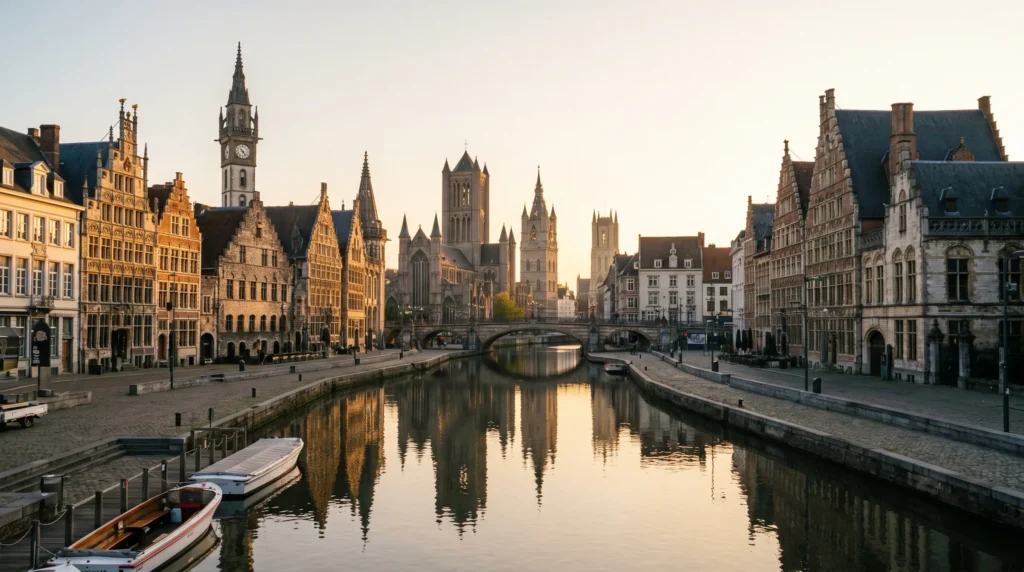
Ghent Travel Guide — Belgium’s Medieval Showstopper Without the Bruges Crowds
Everyone I know who’s done the classic Brussels-Bruges long weekend has skipped Ghent, and every one of them was wrong to. Ghent has the same canals, the same guild houses, the same fairy-tale skyline as Bruges — a belfry, a cathedral, and a castle all within a ten-minute walk of each other — except it’s a real, working city of roughly 265,000 people rather than a preserved-in-amber museum piece. A big chunk of that population is students, because Ghent University has been filling this town with bicycles and cheap beer since 1816, which means the medieval core empties out for lectures on weekday mornings and fills back up with actual Belgian life every evening — not just tour groups. I’ll be honest about the one catch up front: Ghent doesn’t do the visual hard-sell Bruges does, so if you’re only after the postcard shot, Bruges still wins that specific contest. But if you want the same architecture with better food, better nightlife, and a fraction of the crowds, this is the one.
In This Guide
- Overview — Why Ghent Is Belgium’s Most Underrated City
- Gentse Feesten — Ten Days That Take Over the City
- Best Time to Visit Ghent
- Getting There — Airports, Trains & Brussels Connections
- Getting Around — Walk, Bike or Tram
- Neighborhoods — Patershol, Graslei & Beyond
- Culture & People — A Student City With an Anarchic Streak
- A Food Lover’s Guide to Ghent
- Off the Beaten Path
- Day Trips From Ghent
- Practical Information
- Budget Breakdown — What Ghent Actually Costs in 2026
- Planning Your First Trip to Ghent
- Frequently Asked Questions
Overview — Why Ghent Is Belgium’s Most Underrated City
Ghent sits in East Flanders, about halfway between Brussels and Bruges, and it spent the late Middle Ages as one of the largest and richest cities in northern Europe — a cloth-trading powerhouse of some 50,000 people back in 1300, bigger at the time than London. That wealth is why the skyline still works: the Belfry, Saint Bavo’s Cathedral and Gravensteen castle all cluster within a few blocks of each other, and the Graslei and Korenlei waterfronts along the river Leie are lined with the kind of stepped-gable guild houses that Instagram was basically invented for.
The single biggest reason to make the detour, though, is inside the cathedral: the Ghent Altarpiece, also called the Adoration of the Mystic Lamb, painted by the Van Eyck brothers and considered one of the most important works in the history of Western art. It’s been stolen, forged, hidden in a salt mine during World War II and is still, remarkably, mostly all here.
What separates Ghent from Bruges isn’t the architecture — it’s the pulse. Ghent University, founded in 1816, keeps a huge student population cycling through the old town on bicycles, which means real bars, real late-night food, and prices that haven’t been fully tuned to tour-bus budgets. Bruges is gorgeous and I’d never talk anyone out of visiting it. Ghent is gorgeous and lived-in, and for a lot of travelers that combination wins.
Gentse Feesten — Ten Days That Take Over the City
If you’re reading this in mid-July, you’re about to get lucky: the 2026 Ghent Festivities (Gentse Feesten) run 17–26 July, ten free days of live music, street theatre, puppet buskers, fairground rides and open-air dance parties that spill across the entire historic centre. It draws around 2 million visitors over its run, with the busiest nights pulling crowds well past 250,000 people, and it’s been ranked among Europe’s largest popular festivals — behind only Valencia’s Fallas and Munich’s Oktoberfest by one count.
The modern festival dates to 1969, though informal predecessors go back to the medieval city and a documented 1843 iteration, and organizers are proud that it’s kept a scrappy, anarchic streak even as it’s grown to fill the whole inner city. Book accommodation well ahead if your dates overlap, expect noise until sunrise in the centre, and know that most of it — the stages, the beer tents, the street performers — costs nothing to attend.
Missing July? Ghent also runs a Light Festival, but only every three years — the last one has passed and the next full edition isn’t until 2027, so don’t plan a trip around it for 2026.
Best Time to Visit Ghent
April – June · Spring shoulder
Mild temperatures, longer daylight, blooming courtyard gardens, and the university term still running so the city feels alive without festival-level crowds. This is the sweet spot for photographers and anyone who wants Graslei without a scrum of tripods.
Mid-late July · Gentse Feesten
The loudest, busiest, most fun ten days of the year — and the priciest for hotel rooms in the centre. Great if that’s exactly what you want, less great if you’d rather hear yourself think over dinner.
September – October · Autumn sweet spot
Students return, café terraces stay open into the evening, and the light on the canals turns golden. Fewer tourists than summer, still comfortable temperatures. Many locals will quietly tell you this is the actual best month.
November – March · Low season
Cold, grey, and genuinely atmospheric — the Christmas market and ice rink around the Cathedral and Korenmarkt run through December, and hotel rates drop. Pack for rain regardless of season; Belgium’s weather doesn’t read the calendar.
Getting There — Airports, Trains & Brussels Connections
Ghent has no international airport of its own. Brussels Airport (BRU) in Zaventem is Belgium’s main international gateway and the default landing point, handling over 26 million passengers a year with connections across Europe and beyond. From there, a direct train runs into Brussels-Central, where you change onto a fast, frequent SNCB/NMBS service to Gent-Sint-Pieters station — the whole hop typically clears within roughly an hour door to door. Budget carriers also fly into Brussels South Charleroi Airport, which is farther out and needs a shuttle bus plus train connection.
Once you’re in Belgium, Ghent is absurdly easy to reach by rail: Brussels to Gent-Sint-Pieters covers about 50 kilometres in as little as 35 minutes, with dozens of direct trains running daily. Eurostar travelers from London or Amsterdam typically change trains in Brussels for the short final leg. Gent-Sint-Pieters station itself sits about a 15–20 minute tram ride from the historic centre, so budget a little extra time (or a taxi) on arrival with luggage.
Getting Around — Walk, Bike or Tram
The historic centre is largely car-free for shopping and sightseeing, which is exactly what makes Ghent so pleasant to just wander. Nearly everything on a typical visitor’s list — the Belfry, Cathedral, Gravensteen, Graslei — sits within a 15-minute walk of the rest, so most people never need public transport inside the core.
For anything farther out, De Lijn runs an efficient tram and bus network connecting Gent-Sint-Pieters station to the centre and outer neighborhoods; single tickets and day passes are sold via app or at station kiosks. Ghent is also a genuinely serious cycling city — dedicated lanes, bike-share docks and rental shops are everywhere, and a bicycle is the fastest way to cover the university quarter and the outer canals. Boat trips along the Leie and Lys give the classic waterline view of the guild houses if you’d rather sit than pedal.
Neighborhoods — Patershol, Graslei & Beyond
Graslei & Korenlei
The postcard shot: two facing quaysides on the river Leie lined with medieval and Renaissance guild houses. Best at golden hour or after dark when the facades are lit, and the obvious starting point for any first walk through the city.
Patershol
A tight tangle of cobbled lanes just behind Gravensteen castle, once the tanners’ and dyers’ quarter, now Ghent’s densest concentration of restaurants — a good place to wander hungry with no reservation and just pick a door.
Sint-Baafsplein & the Cathedral Quarter
Home to Saint Bavo’s Cathedral and the Ghent Altarpiece, the Belfry with its cloth hall, and the medieval Vrijdagmarkt square nearby — the civic and religious heart of the old city, and the busiest patch for day-trippers.
Gravensteen & the Castle Moat
The Castle of the Counts, a genuinely moated medieval fortress you can walk the ramparts of, sits right at the edge of Patershol — climb it for one of the best rooftop views over the old town.
Overpoort & the University Quarter
South of the centre, this is student Ghent: cheap bars, late kebab shops, and the single street (Overpoortstraat) that turns into the city’s rowdiest nightlife strip on weekday evenings during term.
Dampoort & Muide
Up-and-coming, more residential, and where a lot of the city’s newer breweries, design studios and canal-side apartments are landing as rents climb in the centre — worth a visit if you want to see where Ghent is heading next.
Sint-Pietersplein & the Abbey
South of Sint-Pieters station, an open square anchored by Saint Peter’s Abbey, with the Museum of Fine Arts (MSK) and the contemporary S.M.A.K. museum a short walk away for anyone wanting art beyond the medieval.
Culture & People — A Student City With an Anarchic Streak
Ghent sits in Flanders, Belgium’s Dutch-speaking region, and Dutch (in its Flemish form) is what you’ll hear on the street — though French, English and German are all official languages somewhere in Belgium’s patchwork federal system, and English gets you through nearly any tourist interaction here without trouble.
The city’s identity leans deliberately unpretentious next to Bruges’ polish or Brussels’ bureaucracy. A big share of that comes from Ghent University’s roughly two-centuries-old presence, which keeps the population young, and from the survival of the Gentse Feesten’s rowdier instincts even as the festival has become one of Europe’s biggest. The Belfry itself, along with its attached cloth hall and the small “Mammelokker” gatehouse, is inscribed on UNESCO’s list of Belfries of Belgium and France — a shared 56-site listing recognizing the civic bell towers medieval Flemish and French cities built as symbols of independence from feudal and church authority. That’s the throughline worth knowing: Ghent’s medieval wealth bought it civic pride, and the city has never really lost the habit.
A Food Lover’s Guide to Ghent
Order waterzooi at least once — a creamy stew of chicken or fish with leeks, carrots and potato, Ghent’s signature dish and the kind of thing every restaurant in Patershol claims to make best. Pair it with local fries from a proper frituur, and don’t skip a cone of Gentse neuzen (“Ghent noses”), the raspberry-flavored cuberdon candies sold from small carts around the centre — an odd, slightly gelatinous, genuinely addictive local specialty.
Ghent’s mustard tradition runs deep too: Tierenteyn-Verlent, a shop trading since the 1800s near the Belfry, still hand-scoops its sharp mustard into jars you bring yourself. On the beer side, look for Gruut, a Ghent brewery that makes its beers with a medieval blend of herbs called gruit instead of hops — a genuinely distinctive local twist in a country that otherwise runs on Trappist and abbey ales. Overpoort and the university quarter are the place for cheap, late, unpretentious eating; Patershol and the Graslei waterfront are where you sit down and linger.
Off the Beaten Path
STAM — Ghent City Museum
Housed in a former abbey, STAM tells the city’s history from medieval cloth boom to modern student town — a good rainy-afternoon counterpoint to the postcard sights.
Dulle Griet
A massive medieval siege cannon parked on Vrijdagmarkt, said to be one of the largest bombards ever built — an odd, easy-to-miss curiosity most day-trippers walk right past.
Small & Great Beguinages
Quiet walled enclosures of small whitewashed houses once home to religious lay women, tucked away from the tourist flow and genuinely peaceful — a different register of “historic Ghent” than the busy centre.
Design Museum Gent
A sleeper favorite blending an 18th-century mansion with a sharp contemporary wing, covering furniture and industrial design from rococo to right now.
Rabot Towers
A pair of squat 15th-century water gate towers on the northern canal ring, well outside the main tourist loop and rarely crowded.
Day Trips From Ghent
Bruges is the obvious pairing — about 50 kilometres away and roughly 25–30 minutes by direct train, letting you compare the two great Flemish canal cities in a single day if you’re short on time. Antwerp, Belgium’s fashion and diamond capital, is a similarly quick hop and swaps medieval charm for Rubens, riverfront architecture and a livelier bar scene. Brussels itself is barely 35 minutes away by train, making the EU capital’s Grand Place, museums and Art Nouveau architecture an easy half-day add-on. With a little more time, Kortrijk and the Flemish Ardennes around Oudenaarde make for a slower, greener day away from the canal-city crowds.
Practical Information
Money. Belgium uses the Euro, and cards are accepted almost everywhere in Ghent, including small cafés and market stalls — carrying some cash is still sensible for the smallest vendors.
Safety. The US State Department rates Belgium a Level 2 advisory overall, asking travelers to “exercise increased caution” due to terrorism risk generally across Europe — this is a country-wide baseline rating, not a Ghent-specific warning, and Ghent itself is a relaxed, walkable city by day and night. The UK’s FCDO advice currently flags occasional national strike action as the more likely disruption travelers will actually encounter, which can affect trains and flights with short notice — worth a quick check before you travel.
Health. No special vaccinations are required for Belgium; the CDC’s routine advice applies (MMR, DTaP, flu) plus a general note that measles cases are rising in a number of countries this year, so confirm your MMR status is current before departure.
Connectivity & power. An EU-roaming SIM or eSIM covers you cheaply across the whole trip; city Wi-Fi and café Wi-Fi are both reliable. Belgium runs on 230V with Type E sockets (two round pins, socket-side grounding pin), so North American and UK devices need an adapter. Time zone: Central European Time, UTC+1 (UTC+2 in summer).
Budget Breakdown — What Ghent Actually Costs in 2026
Ghent runs noticeably cheaper than Bruges or Brussels for equivalent quality, largely because of its student population and the fact it hasn’t been fully priced for tour buses.
Budget (€70–100/day): hostel dorm or budget guesthouse, frituur fries and bakery lunches, walking or cycling everywhere, free museum-free days where offered, one paid attraction.
Mid-range (€150–250/day): boutique canal-view hotel, sit-down waterzooi dinners in Patershol, Belfry and Gravensteen entry, a canal boat trip, De Lijn day pass for outer neighborhoods.
Luxury (€400+/day): historic guild-house or Gravensteen-view suite, tasting menus, private guided tours of the Altarpiece and cathedral vaults, day-trip car and driver to Bruges or the Ardennes.
Expect Gentse Feesten week and the December Christmas market period to push hotel rates well above these baselines — book early if your dates land in either window.
Planning Your First Trip to Ghent
Two full days covers Ghent’s essentials comfortably: the Altarpiece and Belfry on day one, Gravensteen and a Patershol dinner, then Graslei, STAM and a canal boat on day two. Three or four days lets you add a day trip and slow down for the university quarter’s bars. Most visitors land via Belgium‘s main gateway in Brussels and either base there and day-trip to Ghent, or flip it and base in Ghent for cheaper rooms with Brussels just 35 minutes away. If you’re building a longer Benelux loop, Ghent also pairs naturally with a train hop north into the Netherlands and on to Amsterdam for a canal-city trilogy that shows just how differently three neighboring countries built the same idea.
Frequently Asked Questions
Is Ghent worth visiting, or should I just do Bruges?
Do both if you can — they’re barely 25–30 minutes apart by train. If forced to pick one, choose Bruges for the single most postcard-perfect medieval townscape in Belgium, and Ghent for the same architectural DNA plus a livelier, cheaper, more lived-in city around it.
Do I need a visa to visit Ghent?
Most US, UK, Canadian and EU-adjacent nationalities can enter Belgium visa-free for up to 90 days within any 180-day period under the Schengen rules — check your specific nationality’s requirements before booking.
How many days do I need in Ghent?
Two days covers the highlights well; three or four lets you add a day trip to Bruges, Antwerp or Brussels without feeling rushed on either end.
Is Ghent’s city centre walkable?
Very — the historic core is largely car-free and compact enough to cover most major sights on foot, with bikes and trams handling anything farther out.
When is Gentse Feesten in 2026, and is it worth planning around?
17–26 July 2026, free to attend, and worth it if you like crowds, live music and street theatre — book a room well ahead, and expect noise in the centre most of the night.
Is Ghent expensive?
Noticeably cheaper than Bruges or Brussels for comparable quality, thanks partly to its large student population keeping food and bar prices realistic outside the most touristed squares.
Ready to Explore Ghent?
A moated castle, a five-century-old masterpiece behind cathedral glass, guild houses lit up over the water at dusk, and a student-city energy that keeps the whole thing from feeling like a museum — Ghent quietly does everything its famous neighbor does, then adds a real city around it. Go before everyone else figures that out.
Explore More
- Belgium Travel Guide — the full country, from coast to Ardennes
- Brussels City Guide — 35 minutes away by train, the EU capital next door
- Amsterdam City Guide — extend the canal-city trilogy north
- Netherlands Travel Guide — continue the Benelux loop
How this guide was built
Published as part of Facts From Upstairs’ city guide series. Built from authoritative sources — Wikipedia’s Ghent, Belgium, Belfries of Belgium and France, Gentse Feesten and Brussels Airport entity pages, the official Visit Gent tourism board and its Ghent Festivities calendar, the Ghent Light Festival’s own site, Belgium’s national rail operator SNCB/NMBS, the US State Department and UK FCDO Belgium travel pages, the US CDC traveler page for Belgium, and World Standards’ electrical-standards reference for Belgium. Numeric claims carry inline citations.
Sources cited on this page
- Wikipedia — Ghent
- Wikipedia — Belgium
- Wikipedia — Belfries of Belgium and France
- Wikipedia — Gentse Feesten
- Wikipedia — Brussels Airport
- Visit Gent — official tourism board
- Visit Gent — Ghent Festivities 2026 calendar
- Ghent Light Festival — official site
- SNCB/NMBS — Brussels–Ghent train info
- US State Department — Belgium
- UK FCDO — Belgium
- US CDC — Belgium traveler page
- World Standards — Belgium power plug & voltage
More city guides you might like

Plan your trip to Ghent
The booking tools we use ourselves. FFU may earn a commission at no extra cost to you.
Plan & book your trip to Ghent
Booking through these searches supports our guides at no extra cost to you.