
Hamburg Travel Guide — Warehouses, Waterways & Germany’s Coolest Port City
I keep telling people Hamburg is the German city nobody asks about and everybody should. It’s a city-state in its own right — same constitutional standing as Berlin — built on a river delta with more bridges than any city has a right to need, and it has spent eight centuries getting rich off a harbor that still runs around the clock. You can stand on a warehouse rooftop in a UNESCO-listed district built on wooden piles, walk fifteen minutes to a concert hall shaped like a breaking wave, and end the night on a street where the Beatles played teenage bar residencies before anyone had heard of them. The catch — and I’ll say it up front — is weather: this is the North Sea, not the Mediterranean, and grey drizzle is a real possibility even in July. Pack a shell jacket, not just sunscreen, and Hamburg will reward you completely.
In This Guide
- Overview — Why Hamburg Is Germany’s Best-Kept Open Secret
- Port Anniversary — The World’s Largest Harbor Festival
- Best Time to Visit Hamburg (Season by Season)
- Getting There — HAM Airport & the ICE Network
- Getting Around — HVV, Ferries & Bikes
- Neighborhoods — Speicherstadt, St. Pauli & Beyond
- Culture & People — Hanseatic, Maritime, Media City
- A Food Lover’s Guide to Hamburg
- Off the Beaten Path
- Day Trips from Hamburg
- Practical Information
- Budget Breakdown — What Hamburg Actually Costs in 2026
- Frequently Asked Questions
Overview — Why Hamburg Is Germany’s Best-Kept Open Secret
Hamburg is officially the Free and Hanseatic City of Hamburg, one of only three German city-states alongside Berlin and Bremen, with its own state government and a population close to 1.9 million spread across seven boroughs — Germany’s second-largest city after Berlin, and the anchor of a wider metro region of more than 5.4 million people. None of that fully explains why the place feels the way it does, which is somewhere between a working port and a design magazine.
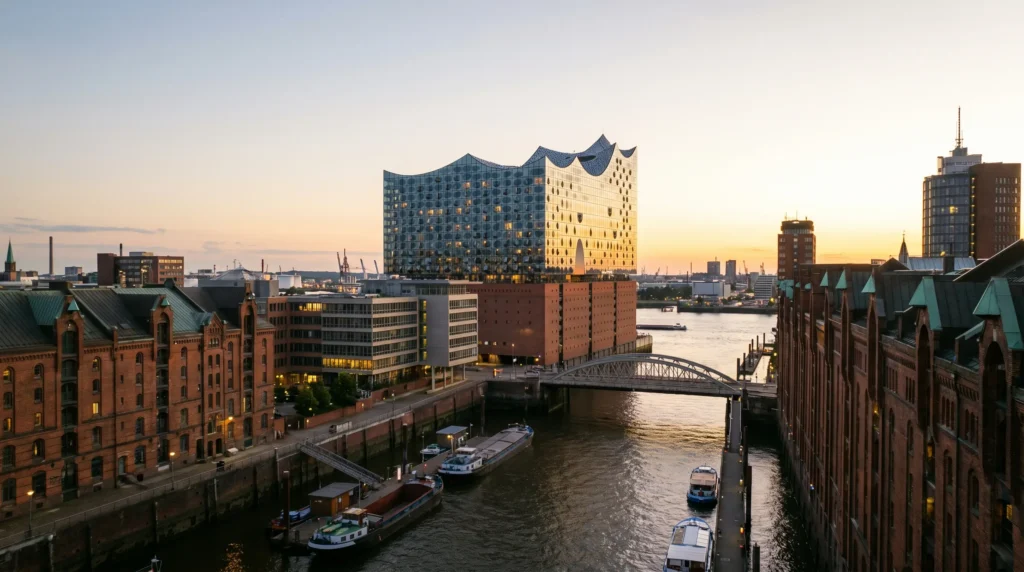
The port is the reason Hamburg exists: it’s Europe’s third-largest, after Rotterdam and Antwerp, and container ships still queue up the Elbe past the city center every day. Rather than fencing that industry off from visitors, Hamburg built its two headline attractions right on top of it. The Speicherstadt — the largest historic warehouse district built on timber piles anywhere in the world, raised between 1885 and 1927 along a network of short connecting canals — sits directly beside the Kontorhausviertel office quarter and the ship-prowed Chilehaus, and together they were inscribed as a UNESCO World Heritage Site in 2015. At the water’s edge, the Elbphilharmonie concert hall rises 108 meters out of a converted 1963 warehouse — a wave-shaped glass crown that took a decade and a spiraling budget to finish, but has become the single image most people now associate with the city.
What Hamburg doesn’t do is oversell itself. There’s no single must-see monument dragging in coach tours; instead there’s a genuinely lived-in city of canals (more of them than most visitors expect, crossed by roughly 2,500 bridges), a red-light district that’s also a serious live-music scene, and a population that will greet you with a flat, friendly “Moin” whether it’s morning, noon or night. It’s more reserved than Berlin and considerably wetter than Munich — but for anyone who likes their travel with a working harbor still attached, it’s hard to beat.
Port Anniversary — The World’s Largest Harbor Festival
If you can build a trip around one weekend, make it the Hafengeburtstag, or Port Anniversary — held 8–10 May in 2026, marking the port’s 837th year. The festival traces itself back to a 1189 charter from Emperor Frederick Barbarossa granting Hamburg toll-free shipping rights up the Elbe to the North Sea — the deal that effectively created the port — and it now bills itself as the largest harbor festival in the world, drawing more than a million visitors over the weekend.
Expect tall ships and cruise liners parading up the Elbe, a genuinely charming “tugboat ballet” where working harbor tugs spin and spray water in choreographed formation, fireworks over the Landungsbrücken, and food stalls the entire length of the harbor promenade. Book accommodation early — hotel rates spike and rooms near the water sell out weeks ahead. If early May doesn’t fit your calendar, the same energy shows up in a smaller dose at Hamburg Cruise Days later in the year.
Best Time to Visit Hamburg (Season by Season)
May – September · The reliable window
This is when Hamburg makes its best case: long daylight, beer gardens along the Alster lakes, harbor ferries doubling as scenic cruises, and the Port Anniversary kicking the season off in May. Summer highs typically sit in the low-to-mid 20s°C, so pack layers, not just swimwear.
October – November · Shoulder season
Cooler, wetter, and noticeably quieter on the tourist front — a good stretch for museum-heavy itineraries and Speicherstadt walks without the crowds, at lower hotel rates.
Late November – December · Christmas markets
Hamburg runs several distinct Christmas markets simultaneously, from the historic one beside the Rathaus to the adults-only “Santa Pauli” version on the Reeperbahn. Cold, often damp, genuinely festive — book central hotels well ahead.
January – March · The honest low season
Short days, the coldest and greyest stretch of the oceanic climate that defines Hamburg’s weather, and the best hotel prices of the year. Fine for museums, the Elbphilharmonie, and indoor food markets; not the season for harbor views.
Getting There — HAM Airport & the ICE Network
Hamburg Airport (HAM), also known as Helmut Schmidt Airport, sits about 8.5 kilometres north of the city center and is northern Germany’s busiest, with direct flights across Europe and a smaller set of intercontinental connections. The S-Bahn (S1 line) runs straight from the airport terminal into the city center in about 25 minutes, which makes taxis and transfers almost unnecessary.
Hamburg’s real trump card is rail. Hauptbahnhof is one of the busiest stations in Germany and a core node on the Deutsche Bahn ICE high-speed network: the fastest Berlin–Hamburg run takes about 1 hour 48 minutes, with more than thirty trains a day on the route. Direct or near-direct trains also reach Copenhagen and Amsterdam, making Hamburg a genuinely easy add-on to a wider Northern Europe itinerary rather than a detour.
Getting Around — HVV, Ferries & Bikes
Hamburg’s transit authority, the HVV, runs an integrated U-Bahn, S-Bahn, bus and harbor-ferry network on a single ticket system — and yes, the public ferries genuinely count as commuter transit while doubling as a free-ish harbor tour, particularly line 62 past the container terminals and the Elbphilharmonie. The Hamburg CARD bundles unlimited travel on buses, trains and harbor ferries with museum and attraction discounts, and is worth it for anyone doing more than a day or two of sightseeing.
The city center, Speicherstadt, HafenCity and St. Pauli are all comfortably walkable to each other, and Hamburg is a serious cycling city with dedicated lanes and bike-share docks throughout — a bike is the fastest way to cover the Alster lakes’ shoreline paths in an afternoon. Driving is the least useful option here; parking is scarce and expensive in the center, and you won’t need a car for anything covered in this guide.
Neighborhoods — Speicherstadt, St. Pauli & Beyond
Altstadt & Neustadt
The historic core: the Rathaus (city hall), the Alster lakes’ shopping arcades, and the starting point for most walking tours. Busy, central, and the natural base for a first visit.
HafenCity & Speicherstadt
Europe’s largest inner-city redevelopment project sits directly beside the UNESCO-listed warehouse district — cobbled canal-side lanes, the Elbphilharmonie, the Maritime Museum, and Miniatur Wunderland all within a fifteen-minute walk of each other. Come at dusk when the warehouses light up over the water.
St. Pauli & the Reeperbahn
Hamburg’s red-light and nightlife district by reputation, but also one of the city’s most important live-music neighborhoods — the Beatles played extended residencies in St. Pauli clubs in 1960–62 before their UK breakthrough, and the area’s venues, from dive bars to the Elbphilharmonie’s louder cousin clubs, still draw serious music tourism. FC St. Pauli’s stadium and its skull-and-crossbones fan culture anchor the neighborhood’s rebellious identity.
Sternschanze & Karolinenviertel
The “Schanze” is Hamburg’s alternative, café-and-vintage-shop quarter — a former slaughterhouse district turned into one of the city’s best areas for a slow brunch, small bars and independent boutiques.
Ottensen & Altona
West of St. Pauli, a formerly independent Danish/Prussian border town now folded into Hamburg proper, with a laid-back, family-friendly, market-heavy feel and its own S-Bahn hub.
Eppendorf & Winterhude
The genteel Alster-lake neighborhoods — leafy, residential, good for a picnic-and-rowboat afternoon away from the harbor crowds.
Blankenese
A former fishing and pilot village on the Elbe’s steep west bank, now a wealthy suburb of stepped lanes, thatched cottages and river views — one of the most photogenic half-day trips inside the city limits.
Culture & People — Hanseatic, Maritime, Media City
Hamburg’s self-image runs through its Hanseatic League past: centuries as a self-governing trading city have left it with a reputation among Germans for being reserved, understated and quietly wealthy — old money that doesn’t shout. The all-purpose local greeting “Moin” (used any time of day, sometimes doubled as “Moin moin”) is a small but real marker of that identity; using it correctly earns instant local goodwill.
It’s also Germany’s media capital — home to major publishing houses, broadcasters and the national news-magazine industry — and a genuine music city, from the Elbphilharmonie’s classical programming to St. Pauli’s club scene that gave the Beatles their formative stage. Football runs deep too: HSV and FC St. Pauli split the city’s loyalties, with St. Pauli’s punk, left-leaning fan culture a genuine subculture rather than a marketing pose. Expect direct, unfussy service and a city that doesn’t perform hospitality — it just quietly delivers it.
A Food Lover’s Guide to Hamburg
Start at the Fischmarkt, the Sunday-morning fish market on the harbor that’s been running for centuries — arrive early (it starts before dawn and wraps by mid-morning), grab a Fischbrötchen (a bread roll stuffed with herring, shrimp or Bismarck herring), and watch the market traders’ theatrical sales patter, which is half the entertainment.
The signature hot dish is Labskaus — corned beef, mashed potato and beetroot worked into a pink-tinged mash, topped with a fried egg, a rollmop and gherkins — a genuinely divisive sailor’s dish worth trying once. Pair it with Aalsuppe (eel soup, though modern versions often skip the eel), and finish with a Franzbrötchen, Hamburg’s cinnamon-swirl pastry sold in every bakery in town. Wash it down with Astra, the local beer with a defiantly unglamorous can, brewed in the city since the 19th century, or duck into one of the harbor’s craft-beer bars that have sprung up around HafenCity.
Off the Beaten Path
Miniatur Wunderland
The Guinness World Record holder for the largest model railway on Earth, tucked into a Speicherstadt warehouse: more than 16 kilometres of track, over 1,230 digitally controlled trains, and miniature versions of the Elbphilharmonie itself. It sounds like a kids’ attraction and is actually one of the most-booked sights in the city — reserve a timed ticket days ahead.
Elbphilharmonie Plaza
The free public viewing platform wrapping the concert hall at the point where the old warehouse meets the new glass structure — no ticket required, just a timed entry slot, and one of the best harbor views in the city for zero euros.
Övelgönne
A tiny riverside village of sea-captains’ cottages on the Elbe, reachable by harbor ferry, with a historic ship museum harbor and sand “beach” bars looking straight across the shipping lane at passing container vessels.
Cap San Diego
A retired 1961 cargo freighter permanently docked on the Elbe and open as a floating museum — you can even book a cabin and sleep aboard, one of the more offbeat overnight stays in Germany.
Day Trips from Hamburg
Lübeck
An hour by train, Lübeck’s Altstadt is itself a UNESCO World Heritage Site and the historic capital of the Hanseatic League — brick Gothic churches, marzipan shops and a skyline that inspired Thomas Mann. The single best half-day trip from Hamburg.
Lüneburg
A gabled, canal-lined former salt-trading town about 30 minutes south by train, with a lively student population and none of the crowds of the bigger-name destinations nearby.
Sylt
Germany’s fashionable North Sea island, reached by direct train (cars go on the “Autozug” rail-shuttle across the causeway) — dunes, thatched-roof villages and a beach-club scene that’s more Hamptons than Hanseatic.
Bremen
A little over an hour away, Bremen brings its own UNESCO-listed Rathaus and Roland statue, plus the Town Musicians of Bremen statue for anyone traveling with kids.
Practical Information
Money. Germany uses the Euro. Card payments are standard in restaurants, hotels and shops, but smaller cafés, market stalls and some bars remain cash-preferred — carry some euros for the Fischmarkt and neighborhood spots.
Safety. The US State Department rates Germany at Level 2, “Exercise Increased Caution,” a rating driven mainly by the general European terrorism-threat baseline rather than anything Hamburg-specific, and recommends normal vigilance in transit hubs, markets and major public events. The UK FCDO’s Germany advice, last updated in April 2026, likewise stresses that no destination can be guaranteed risk-free and to keep travel insurance current. Day-to-day, Hamburg is a low-crime, well-lit European city; use normal city sense in St. Pauli late at night.
Health. No special vaccines are required for Germany; the US CDC recommends travelers be current on routine vaccinations (MMR, polio, DTaP) and considers Hepatitis A for travelers eating widely from markets and street stalls. Tap water is safe to drink throughout the city.
Connectivity. An EU-roaming or regional eSIM covers Germany easily; city-center 4G/5G coverage is strong. Plugs: Type F (Schuko), 230V, 50Hz — the same two-round-pin standard used across most of continental Europe. Time zone: Central European Time (UTC+1), CEST (UTC+2) in summer.
Budget Breakdown — What Hamburg Actually Costs in 2026
Hamburg sits in the mid-to-upper range for German cities — pricier than Leipzig or Dresden, roughly on par with Munich, cheaper than the most expensive pockets of Western Europe.
Budget (US$70–120/day): Hostel dorm or budget guesthouse, Fischbrötchen and bakery lunches, HVV day ticket, free Elbphilharmonie Plaza and Speicherstadt walks.
Mid-range (US$160–280/day): Three-star hotel in Altstadt or Ottensen, sit-down restaurant dinners, Hamburg CARD covering transit and museum discounts, Miniatur Wunderland ticket, one harbor boat tour.
Luxury (US$400+/day): HafenCity or Alster-view hotel, Elbphilharmonie concert tickets, tasting-menu dinners, private harbor charter.
Fixed costs to expect: a modest city tourism tax added to hotel bills, and museum/attraction entry fees that add up quickly if you’re not on a Hamburg CARD. Tipping around 5–10%, rounding up the bill, is standard and appreciated but not obligatory.
Planning Your First Trip to Hamburg
Three nights covers the essentials: a full day in HafenCity and Speicherstadt (Miniatur Wunderland, the Elbphilharmonie Plaza, a canal walk), a day split between the Altstadt and a St. Pauli evening, and a half-day out to Blankenese or a full-day rail trip to Lübeck. Five to seven nights lets you add Sylt or Bremen and slow down around the Alster lakes. Hamburg pairs naturally with a wider Northern Europe route — it’s under two hours from Berlin by ICE, and direct trains also reach Copenhagen and Amsterdam, so it works equally well as a standalone city break or a leg in a longer Germany itinerary.
Frequently Asked Questions
Is Hamburg safe for tourists in 2026?
Yes, by ordinary European-city standards. The US State Department’s Level 2 rating for Germany reflects a general regional terrorism baseline rather than a Hamburg-specific concern, and the UK FCDO’s guidance is similarly general — both recommend normal vigilance in crowds, transit hubs and at major events. Use standard late-night sense around the Reeperbahn.
Do I need a visa?
US, UK, Canadian and EU passport holders can enter Germany visa-free under the Schengen Agreement for up to 90 days in any 180-day period. Confirm your specific requirements before booking if you hold a different passport.
How many days do I need in Hamburg?
Three nights is a solid, unhurried introduction to the harbor, Speicherstadt and St. Pauli; five to seven lets you add a day trip to Lübeck or Sylt without rushing.
Is Hamburg expensive compared to Berlin?
Roughly comparable to slightly pricier — hotels and dining skew a touch higher than Berlin, though transit and museum passes (the Hamburg CARD) help offset it for sightseeing-heavy visits.
What’s the weather really like?
Oceanic and changeable — mild winters, cool summers, and rain possible in any month. Summer highs typically run 20–22°C; pack a rain shell for any season.
Can I do Hamburg as a day trip from Berlin?
Technically yes — the fastest ICE is under two hours each way — but it wastes the city. Give it at least one overnight if you can.
Ready to Explore Hamburg?
A working port city that built a UNESCO-listed warehouse district and a wave-shaped concert hall right on top of its shipping lanes, and still greets you with a plain “Moin” instead of a sales pitch — Hamburg rewards visitors who come for substance over spectacle. Bring a rain jacket, book Miniatur Wunderland ahead, and time it around the Port Anniversary if you can.
Explore More
- Germany Travel Guide — the full country beyond Hamburg’s harbor
- Berlin City Guide — under two hours away by ICE
- Copenhagen City Guide — continue north by direct train
- Amsterdam City Guide — another great canal-and-harbor city
How this guide was built
Published as part of Facts From Upstairs’ city guide series. Built from authoritative sources — Wikipedia entity pages for Hamburg, Hamburg Airport, the Elbphilharmonie and Miniatur Wunderland; the UNESCO World Heritage Centre listing for the Speicherstadt and Kontorhaus District with Chilehaus; the official Hamburg Tourism Board (hamburg-travel.com and hamburg.com, including its Port Anniversary pages); the US State Department and UK FCDO Germany travel advisories; the US CDC traveler page for Germany; Trainline’s Berlin–Hamburg ICE schedule data; and World Standards’ electrical-standards reference for Germany. Numeric claims carry inline citations.
Sources cited on this page
- Wikipedia — Hamburg
- UNESCO — Speicherstadt and Kontorhaus District with Chilehaus
- Hamburg Tourism Board — UNESCO World Heritage Sites in Hamburg
- Hamburg Tourism Board — official travel guide
- Wikipedia — Elbphilharmonie
- Wikipedia — Miniatur Wunderland
- Hamburg.com — Port Anniversary / Hafengeburtstag
- Wikipedia — Hamburg Airport
- Trainline — Hamburg to Berlin Hbf train times
- US State Department — Germany
- UK FCDO — Germany travel advice
- US CDC — Germany traveler page
- World Standards — Germany power plug & voltage
More city guides you might like
Plan your trip to Hamburg
The booking tools we use ourselves. FFU may earn a commission at no extra cost to you.
Plan & book your trip to Hamburg
Booking through these searches supports our guides at no extra cost to you.