
Hangzhou Travel Guide — West Lake, Longjing Tea Hills & the City Marco Polo Called Heaven
Marco Polo allegedly called Hangzhou “the finest and most splendid city in the world,” and for about a century in the 1200s it may genuinely have been the largest city on Earth. Today it’s a city of roughly 12 million people that still organizes its entire identity around a lake barely six and a half square kilometers in size. I’ve walked the Su Causeway at six in the morning with tai chi practitioners and at nine at night with couples renting paddle boats, and both versions are the same city being completely honest about what it loves. Hangzhou is also, quietly, one of the easiest big Chinese cities to visit for the first time: a 45-minute bullet train from Shanghai, a metro system that’s genuinely tourist-friendly, and a downtown you can walk for days without running out of temples, tea houses, or excuses to sit by water. The catch — and there’s always a catch — is that this is still mainland China: expect a visa unless your passport is on a fairly short list, expect no Google or Instagram without a VPN, and expect to plan around a national holiday crowd that can turn West Lake’s edges into a very slow-moving crowd scene.
In This Guide
- Overview — Why Hangzhou Is China’s Favorite City to Escape To
- Pre-Qingming Tea Season — Hangzhou’s Tastiest Weeks
- Best Time to Visit Hangzhou (Season by Season)
- Getting There — Xiaoshan Airport & the Shanghai Bullet Train
- Getting Around — Metro, Bike-Share & Walking the Lake
- Neighborhoods — West Lake, Wushan Hill & Beyond
- Culture & People — Silk, Song Dynasty Ghosts & Tech
- A Food Lover’s Guide to Hangzhou
- Off the Beaten Path
- Day Trips from Hangzhou
- Practical Information
- Budget Breakdown — What Hangzhou Actually Costs in 2026
- Frequently Asked Questions
Overview — Why Hangzhou Is China’s Favorite City to Escape To
Ask a Shanghainese friend where they go for a weekend and the answer, more often than not, is Hangzhou — capital of Zhejiang province, sitting where the Grand Canal meets Hangzhou Bay. The city carries real historical weight: it was the capital of the Southern Song dynasty from 1138 to 1276, and by most estimates was the largest city on the planet for stretches of the 12th and 14th centuries. That imperial-capital confidence never really left — it’s why a lake this size gets three UNESCO inscriptions attached to its metropolitan area: the West Lake Cultural Landscape itself (2011), the Grand Canal, whose sections here date to construction begun around 610 AD (2014), and the Archaeological Ruins of Liangzhu City on the northern edge of town, a Neolithic site that pushed back the accepted timeline of organized Chinese civilization by roughly a thousand years when it was inscribed in 2019.
Modern Hangzhou is also the headquarters city of Alibaba, and that tech-money layer sits directly on top of the historic one without much friction — glass towers in the Qianjiang New Town CBD across the river, pagoda silhouettes on the hills fifteen minutes away by metro. The city hosted the 2016 G20 summit and the 2022 Asian Games (postponed by COVID-19 to September–October 2023, though it kept the “Hangzhou 2022” name), both of which triggered a wave of infrastructure — new metro lines, a cleaned-up waterfront, better English signage — that makes it noticeably easier to navigate solo than it was a decade ago.
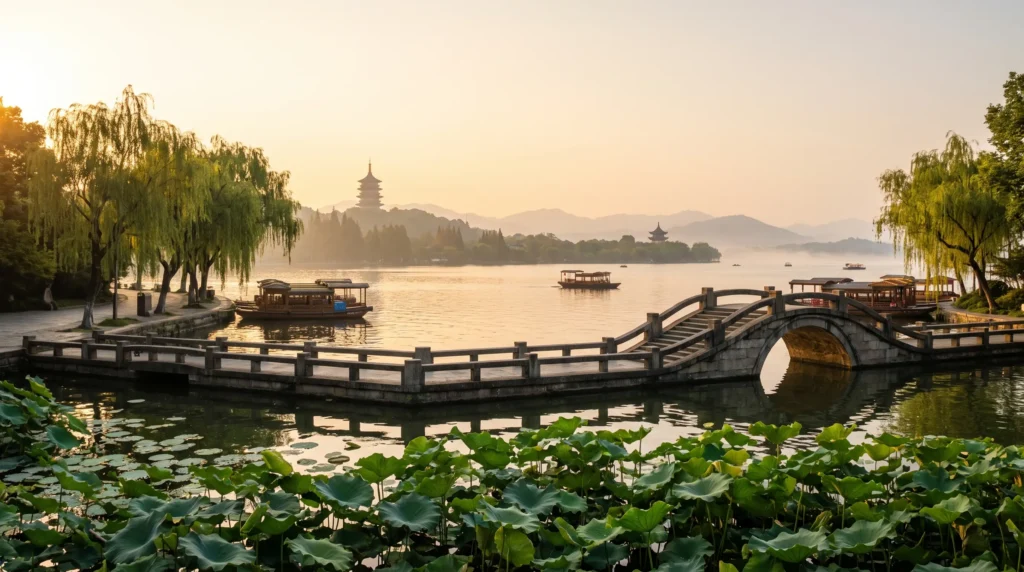
What you’re actually here for is simpler than any of that: West Lake itself, ringed by willow-lined causeways, temple-covered hills, and tea plantations that produce the most famous green tea in China. It photographs like a classical scroll painting because classical scroll paintings were, quite literally, painted here. The honest caveat is that everyone else knows this too — this is one of the most-visited domestic destinations in China, and the lake’s edges on a warm Saturday or during a national holiday can feel more like a theme park queue than a poem.
Pre-Qingming Tea Season — Hangzhou’s Tastiest Weeks
If you can time a trip around one narrow window, make it the days before Qingming Festival in early April, when the hillside villages around West Lake pick the year’s first flush of Longjing (Dragon Well) tea. The “Mingqian” (pre-Qingming) harvest uses only the earliest, most tender shoots, hand-picked and then pan-fried at 80–100°C for 12 to 15 minutes into the tea’s signature flat, hand-pressed leaves — it’s the most prized and expensive grade of the year, and the only zone allowed to legally call itself Xihu Longjing is a protected 168-square-kilometer area around the lake.
Visit the Longjing Village tea fields or the China National Tea Museum in these weeks and you’ll see pickers working the terraces at dawn, roadside stalls selling this year’s harvest still warm from the wok, and — legend has it — the eighteen imperial tea bushes the Qianlong Emperor supposedly designated on a Qing-dynasty visit, tea from which is still treated as a collector’s item. It overlaps neatly with peach blossom and willow season along the Su Causeway, so early-to-mid April genuinely is the single best short window to be here.
Best Time to Visit Hangzhou (Season by Season)
March – May · Spring (peak)
Mild temperatures, peach blossoms and willow catkins along the causeways, and the pre-Qingming tea harvest in late March/early April. This is the most popular window, so book lakeview hotels early and expect crowds on weekends.
June – August · Hot, humid summer
Hangzhou’s mean climate is humid subtropical, and summer here earns the “hot” half of that description — expect high heat and humidity with a plum-rain (meiyu) spell in June. Locals visit the lake at dawn or dusk and spend midday in air-conditioned tea houses; you should too.
September – November · Autumn (best value)
Clear skies, comfortable temperatures, and the city’s beloved sweet osmanthus blossoms scenting entire neighborhoods around Mid-Autumn Festival. Widely considered the best combination of weather and crowds. Avoid the first week of October — China’s Golden Week national holiday sends domestic tourism into overdrive nationwide, and Hangzhou is a top-three domestic target.
December – February · Chilly, drier winter
Overcast and cool rather than brutally cold — mean annual temperature is around 17°C (62.6°F) — and “Lingering Snow on Broken Bridge,” one of the classic Ten Scenes of West Lake, only happens a handful of days a year, which is part of its poetic appeal. Also avoid the week of Chinese New Year (late Jan/Feb, date shifts yearly) unless you enjoy fully booked trains.
Getting There — Xiaoshan Airport & the Shanghai Bullet Train
Hangzhou Xiaoshan International Airport (HGH) sits about 27 km east of downtown and runs four terminals handling both domestic and a growing international network — Emirates, Qatar Airways and Singapore Airlines among the long-haul carriers — with roughly 50 million passengers a year, making it one of China’s busiest airports. Most international visitors, though, arrive a different way entirely: via Shanghai. Shanghai Pudong and Hongqiao airports have vastly more long-haul connections, and from Hongqiao (or Shanghai proper) the Shanghai–Hangzhou high-speed railway covers the roughly 186 km in as little as 45 minutes on the fastest G-series trains, with several hundred departures a day in each direction. Flying into Shanghai and training down is genuinely the easiest way to do this trip.
Hangzhou East railway station, rebuilt and reopened in 2013, is the city’s main high-speed hub, a “top class” 30-track station connecting to Beijing, Shanghai, Nanjing, Fuzhou and beyond, and it links directly into the metro network (Lines 1, 4, 6 and 19). Buy high-speed tickets through Trip.com or 12306 (China Rail’s own app) in advance during holiday periods — same-day tickets on popular routes do sell out.
Getting Around — Metro, Bike-Share & Walking the Lake
Hangzhou Metro opened in 2012 and has grown into a genuinely useful 13-line, roughly 500-kilometer network carrying an average of 2.46 million riders a day — clean, cheap, and increasingly signed in English. It’s famous locally for having China’s only rainbow-color-ordered line map among its first seven routes. For West Lake itself, though, the metro only gets you to the edges — the lake loop is built for walking, cycling, or the public bike-share docks scattered every few hundred meters (Hangzhou more or less invented China’s modern municipal bike-share system). Electric taxis and ride-hailing apps (Didi) fill the gaps, and short lake-loop electric shuttle boats connect the causeways for those who’d rather glide than walk. Download Alipay or WeChat Pay before you land — cash is a fallback, not the default, almost everywhere in this city now.
Neighborhoods — West Lake, Wushan Hill & Beyond
West Lake (Xihu) Scenic Area
The reason you came. A 6.39 km² lake ringed by hills on three sides, crossed by the willow-lined Su Causeway (built 1089) and Bai Causeway, and dotted with the “Ten Scenes of West Lake” — poetic four-character viewpoints like “Autumn Moon over the Calm Lake” that have been formally named since imperial times. Rebuilt Leifeng Pagoda (original 975 AD, collapsed 1924, rebuilt 2002) anchors the White Snake legend on the south shore; Lingyin Temple, founded around 326 AD in the hills to the west, is one of China’s most important Chan Buddhist sites.
Hefang Street & Wushan Hill (Old Town)
A pedestrianized Qing-dynasty-style street of tea shops, herbal medicine halls and street snacks just south of the lake, backing onto Wushan Hill’s City God Pavilion for the best free skyline view in town. Touristy, loud, and worth an hour anyway for the snack density alone.
Gongchen Bridge & the Grand Canal District
The southern terminus of the Grand Canal, where stone-arch Gongchen Bridge and a strip of restored canal-side warehouses now hold museums (including a dedicated canal museum) and evening lantern-lit boat rides — a quieter, more local counterpoint to the lake crowds.
Xixi National Wetland Park
A 10 km² network of waterways, reed marshes and old fishing villages inside the city limits, explored almost entirely by hand-poled boat. The anti-West-Lake experience: green, quiet, and about a third of the tourist density.
Qianjiang New Town
The glass-and-steel CBD across the Qiantang River, home to Alibaba-adjacent tech offices, the Hangzhou Grand Theatre and the city’s newest skyline — useful for understanding that Hangzhou isn’t only a museum piece.
Liangzhu
On the city’s northern edge, the Archaeological Ruins of Liangzhu City site and its museum present dam systems, jade artifacts and city planning dated to roughly 3300–2300 BCE — evidence UNESCO cited as proof of “5,000 years of Chinese civilization” when it inscribed the site in 2019.
Culture & People — Silk, Song Dynasty Ghosts & Tech
Hangzhou’s cultural identity runs on two parallel tracks that rarely feel in conflict: the Southern Song capital’s legacy of silk weaving, tea culture, and literati garden design, and a 21st-century identity as China’s e-commerce capital, headquarters to Alibaba and a magnet for the country’s tech talent. Locals speak Hangzhounese, a Wu-Chinese dialect distinct enough from standard Mandarin that older residents in particular use it daily, though Mandarin is universal for visitors and officialdom.
The city leans hard into its literary past — poets Su Shi and Bai Juyi, both former local governors, are credited with building the lake’s two main causeways and are still honored across the scenic area today. The legend of the White Snake, one of China’s four great folk tales, is set at Leifeng Pagoda and West Lake, and locals will happily point you to the exact bridge (Broken Bridge) where its central romance supposedly began. Hangzhou also hosted the 2022 Asian Games (held Sept–Oct 2023) and the 2016 G20 Summit, both of which the city treats as points of civic pride — new parks and waterfront promenades from that era are still some of the best public space in town.
A Food Lover’s Guide to Hangzhou
Hangzhou cuisine (Hangbang) is one of China’s classical culinary traditions, built around freshwater fish, bamboo shoots, and a lighter, slightly sweet hand than its Sichuan or Cantonese cousins. The signature dish is Dongpo pork — a slab of braised pork belly named for poet-governor Su Dongpo (Su Shi), simmered for hours in soy sauce, rice wine, sugar and ginger until it collapses at the touch of a spoon. Order it at Louwailou, the lakeside restaurant most associated with the dish, though it’s on menus across the old town.
Other essentials: West Lake fish in vinegar sauce (Xihu cuyu), a whole freshwater fish poached and glazed in a sweet-sour sauce; Longjing shrimp, river shrimp stir-fried with the same prized local tea leaves; and beggar’s chicken, a whole chicken stuffed and baked in clay and lotus leaves, theatrically cracked open tableside. Street-food essentials around Hefang Street include cong bao kuai (scallion pancake pockets) and candied hawthorn skewers. And of course, tea: a proper Longjing tea-house sitting, with unlimited hot-water refills over a couple of hours, is as much a Hangzhou cultural experience as any temple.
Off the Beaten Path
Longjing Village Tea Terraces
Beyond the museum version of Hangzhou’s tea culture, the actual terraced hillsides around Longjing Village are open for walking, and small family-run tea houses will pour you a cup grown from the hill you’re sitting on.
Xixi Wetland’s Back Channels
Skip the main entrance crowds and hire a hand-poled boat toward the park’s quieter western sections, where fishing-village architecture and egrets outnumber tour groups.
Liangzhu Museum
One of the least-visited major sites in the city relative to its significance — a genuinely important Neolithic capital with almost none of West Lake’s crowds.
Nine Creeks Meandering (Jiuxi Yanshu)
A forested valley trail southwest of the lake following a stream through bamboo and tea groves — a genuine escape fifteen minutes from the tour-bus circuit.
Day Trips from Hangzhou
Wuzhen & Xitang Water Towns
Canal towns of stone bridges, whitewashed houses and gondola-style boats, roughly 60–90 minutes away by bus or car — the “Venice of the East” cliché, but earned. Wuzhen in particular has hosted the World Internet Conference and keeps a genuinely well-preserved old quarter.
Shanghai
A 45-minute-to-90-minute bullet train ride puts the Bund and Pudong’s skyline within easy reach for a full-day round trip if your itinerary is tight.
Qiandao Lake (Thousand Island Lake)
A man-made reservoir a couple of hours southwest, dotted with over a thousand forested islands — a popular weekend nature escape for Hangzhou residents, with boat tours and lakeside resorts.
Huangshan (Yellow Mountain)
Further afield (around 2.5–3 hours by high-speed rail), but one of China’s most iconic granite-peak-and-cloud-sea landscapes for those with an extra day or two to spare.
Practical Information
Money. The renminbi (yuan, ¥/CNY) floats within a managed band rather than being pegged to the dollar. Mobile payment via Alipay or WeChat Pay is the default for nearly every transaction, from street food to metro fares — set up the tourist version of Alipay linked to a foreign card before you arrive. Carry some cash as backup for small vendors who prefer it.
Visa. As of 2026, nationals of the UK and roughly 49 other countries (most of Europe, plus Canada, Australia, New Zealand, Japan and South Korea among others) can enter China visa-free for stays up to 30 days on an ordinary passport; the policy runs through the end of 2026. US passport holders are notably not on that list and need a standard tourist visa arranged in advance — apply well ahead of travel.
Safety. The US State Department rates China (including Hangzhou) at Level 2 — Exercise Increased Caution, citing arbitrary enforcement of local law and the risk of exit bans imposed without transparent process; it also warns that detained US citizens may have limited consular access, and that China does not recognize dual US-Chinese nationality. Street crime against tourists in Hangzhou itself is low by most travelers’ accounts, but keep a low profile on political topics and avoid demonstrations.
Health. Tap water isn’t considered drinkable, even in major cities — stick to bottled or boiled. The CDC recommends being current on routine vaccines plus Hepatitis A and B for most travelers, with typhoid advised for those visiting rural areas.
Connectivity. Google, Instagram, WhatsApp and most Western apps are blocked — install a reputable VPN before you land, not after. Plugs: mostly Type A/I (some Type C), 220V. Time zone: China Standard Time, UTC+8, single national time zone, no daylight saving.
Budget Breakdown — What Hangzhou Actually Costs in 2026
Hangzhou runs noticeably cheaper than Shanghai or Beijing for comparable quality, especially outside the lakeview hotel strip.
Budget (US$35–60/day): Hostel or budget hotel a few metro stops from the lake, noodle and dumpling meals, metro and bike-share for getting around, free lake-loop walking.
Mid-range (US$90–160/day): Three- or four-star hotel near West Lake, a proper Hangbang restaurant dinner with Dongpo pork, a Longjing tea-house sitting, a Xixi Wetland boat ticket.
Luxury (US$300+/day): Lakeview five-star properties directly on Xihu, private tea-plantation tours, a driver for day trips to Wuzhen or Qiandao Lake.
Fixed costs to expect: most West Lake sights (the causeways, the lake itself) are free to walk, but individual attractions like Lingyin Temple and Leifeng Pagoda charge separate entry fees, and boat rides on the lake are priced per route. Tipping isn’t customary in mainland China outside high-end international hotels.
Planning Your First Trip to Hangzhou
The easiest first-timer structure: fly into Shanghai, spend two or three days there, then take the 45-minute bullet train down to Hangzhou for three or four nights — enough time for a full lake loop, Lingyin Temple, a tea-house afternoon in Longjing Village, and a day trip to Wuzhen or Xixi Wetland. If you’re building a longer China itinerary, our Shanghai guide pairs naturally as the gateway, and our Beijing guide or Xi’an guide extend the trip north into the capital and the Terracotta Army heartland. For the full national picture — visas, regional overview, more cities — see our China travel guide.
Frequently Asked Questions
Is Hangzhou safe for tourists in 2026?
Day-to-day street safety around West Lake and the main tourist areas is generally good. The larger risk flagged by the US State Department is arbitrary enforcement of local law and exit bans applied to foreign nationals without transparent process, plus limited consular access if detained — keep documentation in order, avoid political discussions and demonstrations, and check current advisories before you go.
Do I need a visa to visit Hangzhou?
Depends on your passport. As of 2026, around 50 countries — most of Europe, plus the UK, Canada, Australia, New Zealand, Japan and South Korea — get 30-day visa-free entry through the end of 2026. US citizens are not on that list and need to arrange a standard tourist visa before travel.
How do I get from Shanghai to Hangzhou?
High-speed train — the fastest G-series services cover it in about 45 minutes, with hundreds of daily departures, making it an easy day trip or one-way leg of a longer itinerary.
Is West Lake worth the hype?
Yes, with a caveat: go at dawn or on a weekday to see why it’s inspired a thousand years of Chinese poetry and painting. On a warm holiday weekend, the causeways can feel more crowded than scenic — plan your visit around that.
How many days do I need in Hangzhou?
Two full days covers the lake loop, one major temple and a tea-house stop; three to four lets you add Xixi Wetland, Liangzhu, and a water-town day trip without rushing.
Can I use Google Maps or my usual apps there?
No — Google services, WhatsApp, Instagram and most Western social/mapping apps are blocked in mainland China. Install a VPN before arrival and download Alipay (for payments) and a China-compatible maps app in advance.
Ready to Explore Hangzhou?
A lake that’s been famous for a thousand years, tea terraces you can walk into straight off the hillside, and a bullet train that makes it a 45-minute afterthought from Shanghai — Hangzhou is one of the rare places where the postcard version and the real version are basically the same. Go before the next Golden Week crowd beats you to the causeway.
Explore More
- Shanghai City Guide — the 45-minute bullet-train gateway
- Beijing City Guide — the capital, the Great Wall and the Forbidden City
- Xi’an City Guide — the Terracotta Army and the old Silk Road capital
- China Travel Guide — the full national overview
How this guide was built
Published . Built from authoritative sources — Wikipedia entity pages for Hangzhou, West Lake, the Shanghai–Hangzhou high-speed railway, Hangzhou Xiaoshan International Airport, Hangzhou East railway station, Hangzhou Metro, Longjing tea, Renminbi and the 2022 Asian Games; UNESCO World Heritage Centre listings for the West Lake Cultural Landscape, the Grand Canal, and the Archaeological Ruins of Liangzhu City; China’s National Immigration Administration for current visa-exemption rules; the US State Department’s China travel advisory; and the US CDC’s China traveler health page. Numeric and checkable claims carry inline citations.
Sources cited on this page
- Wikipedia — Hangzhou
- UNESCO — West Lake Cultural Landscape of Hangzhou
- UNESCO — The Grand Canal
- UNESCO — Archaeological Ruins of Liangzhu City
- Wikipedia — Hangzhou Xiaoshan International Airport
- Wikipedia — Hangzhou East Railway Station
- Wikipedia — Shanghai–Hangzhou High-Speed Railway
- Wikipedia — Hangzhou Metro
- Wikipedia — Renminbi
- Wikipedia — Longjing Tea
- Wikipedia — West Lake
- Wikipedia — 2022 Asian Games
- China National Immigration Administration — Unilateral Visa Exemption
- US State Department — China Travel Advisory
- US CDC — China Traveler Health Page
More city guides you might like

Plan your trip to Hangzhou
The booking tools we use ourselves. FFU may earn a commission at no extra cost to you.
Plan & book your trip to Hangzhou
Booking through these searches supports our guides at no extra cost to you.