
Innsbruck Travel Guide — Where the Alps Meet a Renaissance Old Town
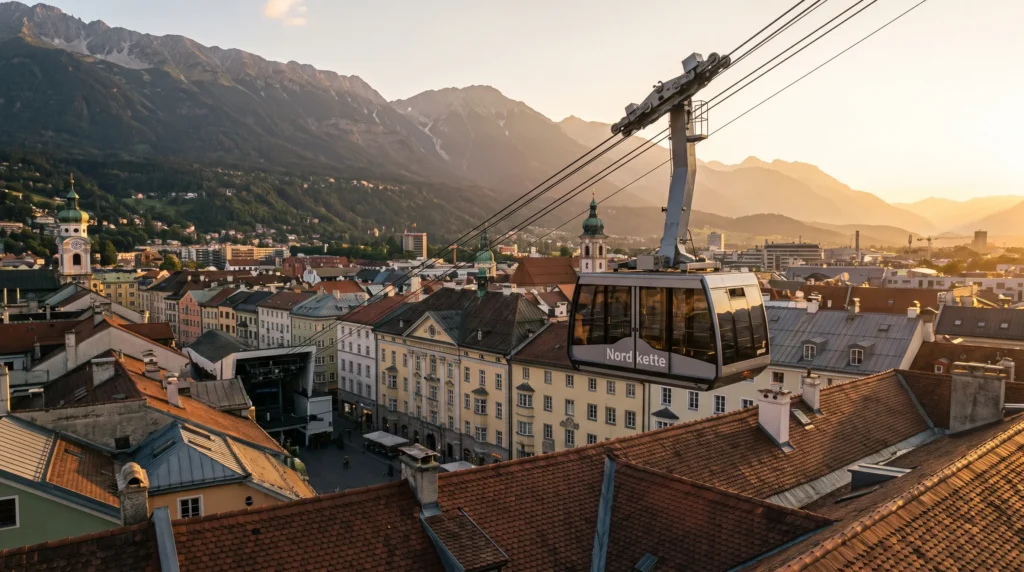
Innsbruck is the only city I know where you can be standing under a gilded balcony built for a 16th-century emperor and, forty minutes later, be on a mountain ridge above 2,300 metres with the whole Inn Valley laid out beneath you. That’s the entire pitch: a genuinely grand Habsburg-era old town, wedged into a valley so narrow that the Nordkette range rises almost straight out of the rooftops. It’s a small city — barely 132,000 people — but it’s hosted the Winter Olympics twice, which tells you everything about how seriously the mountains around it are taken. I’ve sent people here as a two-night add-on to Munich and had them come back saying it was the best two nights of the trip. The catch is that Innsbruck rewards movement — sit still in the old town and you’re seeing a pretty postcard; get on a cable car or a regional train and you’re seeing why people actually live here.
In This Guide
- Overview — Why Innsbruck Punches Above Its Size
- Innsbruck’s Christmas Markets — Under the Golden Roof
- Best Time to Visit Innsbruck (Season by Season)
- Getting There — Airport, Trains & the Brenner Corridor
- Getting Around — Trams, the Sightseer Bus & the Nordkette Cable Cars
- Neighborhoods — Altstadt, Wilten, Hungerburg & More
- Culture & People — Tyrolean Identity & Olympic Legacy
- A Food Lover’s Guide to Innsbruck
- Off the Beaten Path
- Day Trips from Innsbruck
- Practical Information
- Budget Breakdown — What Innsbruck Actually Costs in 2026
- Frequently Asked Questions
Overview — Why Innsbruck Punches Above Its Size
Innsbruck sits in the Inn Valley at 574 metres, hemmed in on both sides by the Alps so tightly that the Nordkette range’s cliffs are visible from the middle of the old town — no postcard trickery involved. The city’s name literally means “bridge over the Inn,” and it grew up as a medieval crossing point before becoming, in 1363, a Habsburg possession and eventually Emperor Maximilian I’s favored residence — which is why a small Alpine city ended up with a genuinely imperial old town.
The signature landmark is the Golden Roof (Goldenes Dachl), a balcony of 2,657 fire-gilded copper tiles that Maximilian I had built so he could watch tournaments in the square below — small in person, disproportionately photographed, and the anchor of every old-town walk. Around it: pastel Gothic townhouses, arcaded streets, and the Baroque Cathedral of St. James, all backed by mountains that most European capitals would kill for.
What makes Innsbruck unusual among Alpine towns is that it’s a real, working university city — not just a ski-season resort. The University of Innsbruck, founded in 1669, keeps the population young and the bars and cafés running year-round, not just in high season. And it’s an Olympic city twice over — host of the Winter Games in 1964 and 1976, the Winter Paralympics in 1984 and 1988, and the inaugural Winter Youth Olympics in 2012 — which is why a city this size has world-class ski jumps, bobsled tracks and ice arenas built into its everyday infrastructure. The trade-off for all that Alpine drama is that Innsbruck isn’t a beach-lazy, do-nothing destination — it wants you to be outside, moving, most of the year.
Innsbruck’s Christmas Markets — Under the Golden Roof
If you can time a trip for late November through December, do it. The main Altstadt Christmas market runs from 15 November to 23 December, with wooden stalls set up directly beneath the Golden Roof — mulled wine (Glühwein), roasted chestnuts, Tyrolean handicrafts, and enough fairy lights against medieval stonework to make even cynics stop and take a photo. A second market, higher up at Hungerburg with panoramic city views, runs from 20 November into early January.
The tradition runs deep — Innsbruck’s Nikolaus market dates back to 1657, and the modern Christkindlmarkt in its current form has been a fixed city institution since 1973. Combine it with skiing: by mid-December the ski areas are usually running, so you can hit the slopes by day and the market by dusk. Book old-town accommodation well ahead for the first two December weekends — this is peak season, and it’s not a secret.
Best Time to Visit Innsbruck (Season by Season)
December – March · Winter (peak)
Skiing, the Christmas market, and the Four Hills Tournament ski jump at Bergisel in early January. Snow is reliable at altitude even when the valley floor is bare. Rooms are tightest and priciest around Christmas/New Year and during Four Hills week.
April – May · Shoulder
Lower prices, unpredictable weather — could be spring sunshine or a late snow dump. Good for budget-conscious travelers who don’t need guaranteed skiing or guaranteed hiking.
June – September · Summer (secondary peak)
The hiking season: alpine meadows, long daylight, the Nordkette and Stubai Glacier both fully accessible, and the old town at its liveliest with outdoor cafés. This is when Innsbruck feels most like a genuine city break rather than a ski trip.
October – November · Off-season
Quiet, cool, and the cheapest window — many cable cars and mountain huts reduce hours or close for maintenance before the snow arrives. Fine for a short city-focused visit, less good if the mountains are the main draw.
Getting There — Airport, Trains & the Brenner Corridor
Innsbruck Airport sits only about 4 kilometres from the city center, in the suburb of Kranebitten — one of the shortest airport-to-old-town hops of any European city, though it’s a smaller regional airport with fewer direct long-haul routes than Munich or Vienna. For most travelers coming from outside Europe, the more practical routing is to fly into Munich and take the train south — Innsbruck Hauptbahnhof is roughly 100 kilometres from Munich Hauptbahnhof, with direct EC/ICE/Railjet services covering it in about two hours and roughly nine direct trains running each day.
Innsbruck also sits directly on the Brenner Pass rail and motorway corridor, the main route between Germany/Austria and Italy — which means direct or near-direct trains from Verona, Bologna and Venice as well as from Vienna, Salzburg and Zurich. Driving in is straightforward via the A12/A13 Austrian motorway network, though a vignette (toll sticker) is required on Austrian highways.
Getting Around — Trams, the Sightseer Bus & the Nordkette Cable Cars
The old town and immediate surroundings are entirely walkable — most first-time visitors barely need transit inside the Altstadt. For everything else, Innsbruck runs a compact, easy tram and bus network (IVB), plus the “Sightseer” hop-on hop-off route that links the major attractions including the Bergisel ski jump and Ambras Castle.
The genuinely special piece of infrastructure is the Nordkettenbahnen — three linked cable car sections (Hungerburgbahn, Seegrubenbahn, Hafelekarbahn) that climb from the valley floor, right at the edge of downtown, to a high-alpine station at 2,256 metres in about 20 minutes total, gaining nearly 1,700 metres of elevation along the way. It’s one of the few places in the world where you can leave a city-center tram stop and be looking down at that same city from above 2,000 metres inside half an hour. The Innsbruck Card, sold at tourist offices, bundles transit with cable cars and museum entries and is worth doing the math on if you’re hitting three or more attractions in a day.
Neighborhoods — Altstadt, Wilten, Hungerburg & More
Altstadt (Old Town)
The postcard core: the Golden Roof, Helblinghaus, the Cathedral of St. James, narrow arcaded lanes and — in winter — the main Christmas market. Almost entirely pedestrian, dense with cafés, and the obvious base for a first visit, though it’s also the most touristy and priciest patch of the city.
Hungerburg
Perched above the city on the Nordkette’s lower slopes, reached by the striking Zaha Hadid-designed Hungerburgbahn funicular. Quieter, residential, with the best panoramic views of the old town and Inn Valley and the gateway to the high-alpine cable cars.
Wilten
South of the center, home to the Bergisel ski jump, the Wilten Basilica (an interior worth the detour on its own), and a more local, less touristed stretch of restaurants and bars near the university district.
Mariahilf & St. Nikolaus
The colorful riverside row of houses directly across the Inn from the old town — one of the most-photographed views in the city, and a genuinely lived-in neighborhood of small guesthouses and local bars rather than a museum piece.
Saggen
An elegant, leafy residential district of Gründerzeit-era villas near the university and botanical gardens — a good look at how well-off Innsbruck actually lives, away from the tourist core.
Pradl
East of downtown, more workaday and mixed, with some of the city’s best-value ethnic food options and a genuine neighborhood feel rather than a curated one.
Culture & People — Tyrolean Identity & Olympic Legacy
Innsbruck is the capital of Tyrol, and Tyrolean identity here is real, not costume-department — traditional dress (Tracht: dirndls and lederhosen) still gets worn unironically at festivals and even some formal occasions, and mountain guiding and skiing are treated as serious regional heritage rather than tourist theater. The city’s Olympic double-hosting (1964 and 1976) left a permanent civic pride around winter sport that still shows up every January when the Four Hills Tournament ski jumping event rolls through Bergisel.
The university adds a different layer — with a large student population since 1669, Innsbruck has more late-night bars, indie cafés and contemporary art spaces than a city of 132,000 usually supports. Expect a fairly formal, punctual, German-speaking culture with excellent English in anything tourism-adjacent, and a genuine outdoor-sport ethic — don’t be surprised if your waiter disappears to go ski touring before their evening shift.
A Food Lover’s Guide to Innsbruck
Tyrolean food is hearty, mountain-farm cooking built for cold weather. Start with Tiroler Gröstl — pan-fried potatoes, onions and leftover roast meat, usually topped with a fried egg — and Speckknödel, bacon-studded bread dumplings served in broth or with sauerkraut. Kasspatzln, the local answer to mac and cheese (soft egg noodles baked with mountain cheese and topped with crispy onions), shows up on nearly every traditional menu.
For something sweet, Kaiserschmarrn — shredded caramelized pancake dusted with sugar and served with stewed plums — is a dessert-as-main-course institution, and Marillenknödel (apricot dumplings) show up in summer when the fruit is in season. Zirbenschnaps, a pine-liqueur digestif, is the after-dinner local specialty worth trying once. The old town has a dense cluster of traditional Gasthäuser serving all of the above, while the Wilten and university areas are where to find better-value, less tourist-priced versions of the same dishes.
Off the Beaten Path
Bergisel Ski Jump
Zaha Hadid’s 2002 redesign of the historic Olympic ski jump — a sculptural steel-and-concrete tower with a café at the top — is as much an architecture pilgrimage as a sports venue, and it’s usually far less crowded than the Golden Roof despite arguably better views over the city.
Ambras Castle
A Renaissance castle on the city’s southeastern edge built by Archduke Ferdinand II, with one of the oldest museum collections in the world (the Kunst- und Wunderkammer curiosity cabinet) and grounds most day-trippers skip entirely in favor of the old town.
Alpenzoo
Europe’s highest-altitude zoo, on the lower slopes of the Nordkette, focused entirely on Alpine species — a good half-day if traveling with kids and an easy add-on to the Hungerburgbahn ride up.
Saggen & the Botanical Garden
A quiet residential wander past university buildings and Gründerzeit villas that almost no visitors bother with — worth an hour if you want to see Innsbruck without another tourist in the frame.
Day Trips from Innsbruck
Swarovski Kristallwelten (Wattens)
Opened in 1995 roughly 20 kilometres east of Innsbruck, this part-museum, part-art-installation crystal experience — built around a giant grass-covered giant’s face — is one of the most-visited attractions in Austria and an easy half-day by train and shuttle bus or a 20-minute drive.
Hall in Tirol
A beautifully preserved medieval old town just outside Innsbruck, historically the region’s salt-mining and minting hub — quieter, cheaper and arguably prettier than Innsbruck’s own Altstadt, and easily combined with Swarovski Kristallwelten in a single day since both sit on the same side of the valley.
Stubai Glacier
Roughly 45 minutes by car or bus up the Stubai Valley, this is Austria’s largest glacier ski area and one of the few in the Alps with snow guaranteed nearly year-round — a serious cable car ride up to genuine high-alpine terrain, waterfalls and meadows on the way.
Seefeld
A Nordic-skiing and hiking plateau about 30 minutes from Innsbruck by direct train, calmer and more family-oriented than the glacier resorts, and a good pick if the goal is scenery and a slower pace rather than steep terrain.
Practical Information
Money. Austria uses the euro (€), adopted in 1999; cards are accepted almost everywhere, though smaller mountain huts and market stalls sometimes prefer cash.
Safety. The US State Department rates Austria Level 1 — Exercise Normal Precautions — its lowest advisory tier, with standard cautions about pickpocketing on public transport and in stations rather than anything Innsbruck-specific. Winter mountain safety is the real consideration here — stick to marked runs and check avalanche conditions before any backcountry skiing.
Health. No special vaccines are required; routine immunizations should be current, and the CDC notes Hepatitis B is recommended for unvaccinated travelers under 60, with tick-borne encephalitis (TBE) worth considering if you’ll be hiking extensively in tick habitat. Tap water is safe to drink throughout the city.
Connectivity & plugs. An EU-wide eSIM covers Austria easily; city Wi-Fi is generally good, mountain-hut Wi-Fi is not. Plugs are the two-round-pin European standard (Type C/F), 230V. Time zone: Central European Time (UTC+1), UTC+2 during daylight saving.
Budget Breakdown — What Innsbruck Actually Costs in 2026
Innsbruck sits mid-pack for Western Europe — pricier than most of Central/Eastern Europe, cheaper than Zurich or the top Swiss resorts next door.
Budget (US$70–120/day): Hostel dorm or budget guesthouse outside the Altstadt, Gasthaus lunch specials, tram/bus day pass, hiking over cable cars where trails allow.
Mid-range (US$180–320/day): Three-star old-town hotel, sit-down Tyrolean dinners, a Nordkette cable car round trip (this is the one splurge worth budgeting for), and a day-trip train ticket or two.
Luxury (US$500+/day): Alpine spa hotels, private ski guiding, Stubai Glacier heli-skiing add-ons, and fine-dining tasting menus in the old town.
Fixed costs to expect: a highway vignette if you’re renting a car, lift tickets that scale sharply with how high you go on the Nordkette, and winter high-season room rates that can run 30–50% above shoulder season. Tipping around 10% is standard, usually rounded up rather than left on the table.
Planning Your First Trip to Innsbruck
Two to three nights covers the essentials: a day in the Altstadt and up the Nordkette, a half-day at Swarovski Kristallwelten or Hall in Tirol, and — depending on season — either a ski day or a Stubai Glacier/Seefeld excursion. Most visitors pair Innsbruck with a longer trip through Munich, just two hours north by direct train, or continue on to Vienna to see the rest of Austria’s Habsburg heritage. For a broader planning base, our full Austria travel guide covers the country beyond Tyrol, and skiers extending westward often continue into Zurich and the Swiss Alps.
Frequently Asked Questions
Is Innsbruck safe for tourists in 2026?
Yes — Austria carries the US State Department’s lowest advisory tier (Level 1, Exercise Normal Precautions), with only standard pickpocket warnings around transit hubs. The main real risk is mountain-related — stay on marked trails and pistes and check conditions before any backcountry activity.
Do I need a visa?
US, UK and Canadian passport holders don’t need a visa for short stays — Austria is in the Schengen Area, which allows visa-free entry for up to 90 days within any rolling 180-day period. A new ETIAS travel authorization is expected to phase in for these nationalities later in 2026 — check current requirements before you fly, since exact rollout dates have shifted before.
Do I need to be an experienced skier to enjoy Innsbruck?
Not at all, and honestly, summer may be the better first visit if you’re not a skier — the Nordkette cable cars, old town, and day trips to Swarovski Kristallwelten or Hall in Tirol all work year-round. Winter beginners have plenty of gentle terrain too, particularly around Seefeld.
Innsbruck or Salzburg?
Salzburg wins on Baroque grandeur and Mozart/Sound of Music pull; Innsbruck wins if you actually want to get into the mountains without a long transfer — the Nordkette starts at the edge of downtown. Do both if you have the time; they pair naturally on an Austria itinerary via our Austria guide.
Can I visit Innsbruck as a day trip from Munich?
It’s possible — direct trains run about two hours each way, roughly nine per day — but it’s tight for seeing the old town plus the Nordkette. One overnight makes a much better trip than a rushed day return.
What’s the cheapest way to do the Nordkette?
Ride the Hungerburgbahn funicular up to Hungerburg for the view and skip the higher (pricier) Seegrubenbahn/Hafelekarbahn sections if budget is tight — you still get a genuinely dramatic panorama over the old town for a fraction of the full round-trip cost.
Ready to Explore Innsbruck?
A gilded balcony built for an emperor, a cable car that takes you from a tram stop to 2,000-plus metres in twenty minutes, and a Christmas market that’s been running in some form since 1657 — Innsbruck packs Alpine drama and Habsburg history into a city small enough to properly get to know in two or three days. Go for the mountains, stay for the fact that the old town somehow keeps up with them.
Explore More
- Austria Travel Guide — the full country beyond Tyrol
- Munich City Guide — two hours north by direct train
- Vienna City Guide — Austria’s Habsburg capital
- Zurich City Guide — continue west into the Swiss Alps
How this guide was built
Published as part of Facts From Upstairs’ city guide series. Built from authoritative sources — Wikipedia’s entity pages for Innsbruck, Austria, the Nordkette Cable Car, Swarovski Kristallwelten and the Bergisel Ski Jump; Innsbruck Tourism’s official visitor and Christmas market pages; the Austrian Federal Ministry for European and International Affairs’ visa guidance; the US State Department’s Austria travel advisory; and the US CDC’s Austria traveler health page. Numeric claims carry inline citations.
Sources cited on this page
- Wikipedia — Innsbruck
- Wikipedia — Austria
- Wikipedia — Nordkette Cable Car
- Wikipedia — Swarovski Kristallwelten
- Wikipedia — Bergisel Ski Jump
- Innsbruck Tourism — Official Visitor Site
- Innsbruck Tourism — Christmas Markets
- Innsbruck Tourism — History of the Christmas Markets
- Austrian Federal Ministry for European and International Affairs — Visa Info
- US State Department — Austria
- US CDC — Austria Traveler Page
More city guides you might like
Plan your trip to Innsbruck
The booking tools we use ourselves. FFU may earn a commission at no extra cost to you.
Plan & book your trip to Innsbruck
Booking through these searches supports our guides at no extra cost to you.