
Languages of Iran
All languages of Southern Asia →fluent beta classical · classes by phone with Maya at ranas.ai/maya
Iran Travel Guide — Persepolis, Isfahan’s Turquoise Squares & the Bucket-List Country You Need to Research Before You Dream About
I need to say the honest thing before anything else, because that is the whole job of this guide: as of this writing, the US State Department rates Iran a Level 4 — Do Not Travel destination, its highest warning tier, and the UK Foreign Office advises against all travel there too. That is not a technicality I’m burying in the fine print — it shapes every paragraph below. And yet Iran is also, by almost any honest measure, one of the most culturally staggering countries on the planet: turquoise-domed mosques that stop conversations mid-sentence, a 29-site UNESCO haul that ranks it 10th globally, ruins at Persepolis older than most countries’ entire recorded history, and a hospitality culture — ta’arof — so elaborate it has its own etiquette rules. This guide exists to give you the real picture of both halves: the country’s genuine wonder, and the genuine risk of visiting it right now. Read it as research, not as an invitation to book tonight.
In This Guide
- Overview — Persia’s Layers, and Why the Advisory Matters
- Nowruz — Persian New Year and Iran’s Festival Calendar
- Best Time to Visit Iran (Season by Season)
- Getting There — IKA, Visas & the Agency Requirement
- Getting Around — Domestic Flights, Trains & Shared Taxis
- Top Regions — Tehran, Isfahan, Yazd & Beyond
- Culture & People — Ta’arof, Faith & a Young Population
- A Food Lover’s Guide to Iran
- Off the Beaten Path
- Practical Information — Safety, Money & What to Wear
- Budget Breakdown — What Iran Actually Costs in 2026
- Frequently Asked Questions
Overview — Persia’s Layers, and Why the Advisory Matters
Iran is a country the size of Alaska and France combined, spanning 1.65 million square kilometres from the Caspian Sea’s rainforests in the north to the Persian Gulf’s date-palm coast in the south. Roughly 92 million people live there, more than 60% of them ethnic Persian alongside sizable Azerbaijani, Kurdish, Lur, Arab, Baloch and Turkmen communities, which is part of why the country feels less like one culture than a federation of them. The name itself is a reminder of scale: this is the heartland of one of history’s oldest continuous civilizations, predating the word “Persia” by millennia and outlasting the empire that gave the West that name.
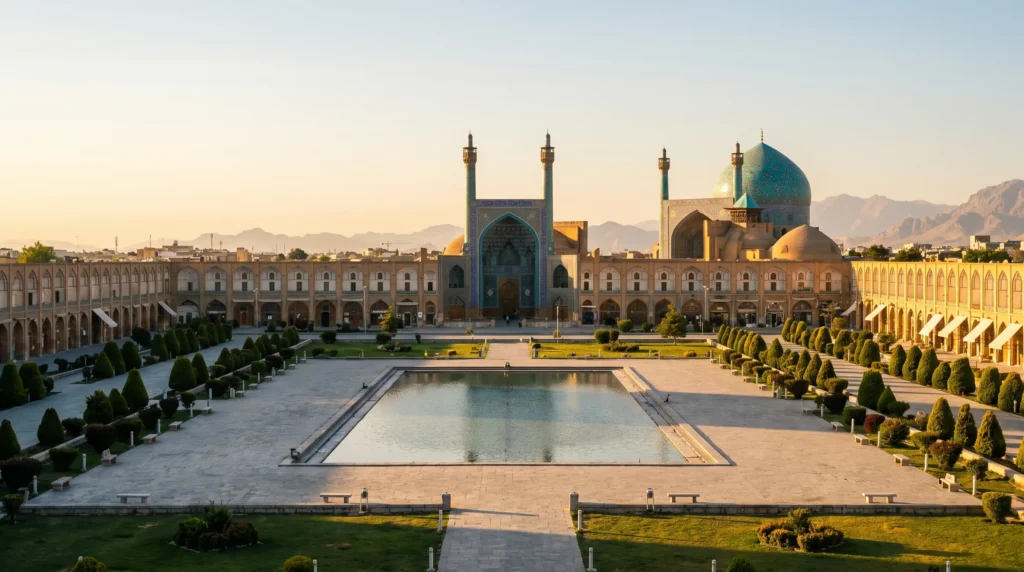
The travel case is not subtle. Twenty-nine UNESCO World Heritage sites — the tenth-most of any country on Earth — span Achaemenid ruins, Safavid city squares, Islamic architecture, and natural sites like the ancient Hyrcanian Forests along the Caspian coast. Isfahan’s central square alone would headline most countries’ entire tourism pitch. Hospitality here runs so deep it has a name — ta’arof, the ritual of polite refusal and insistence that governs everything from paying a taxi fare to accepting tea — and visitors who make it through the visa process consistently report it as one of the warmest receptions anywhere they’ve traveled.
But this guide would be dishonest by omission if it led with the ruins and buried the risk. Iran currently sits at Level 4 on the US State Department’s four-tier advisory scale — “Do Not Travel,” the same tier as active conflict zones — with no operating US embassy, and the UK FCDO advises against all travel for the same reasons: arbitrary detention, exit bans, and a security situation that can shift with no warning, especially given ongoing regional tensions. Dual nationals face the sharpest edge of that risk. Everything from here on is written with that context sitting underneath it, not instead of it.
Nowruz — Persian New Year and Iran’s Biggest Celebration
If there is one date that defines the Iranian calendar, it’s Nowruz, the Persian New Year, which falls at the exact moment of the spring equinox — March 20 in 2026 — and traces back more than 3,000 years to pre-Islamic, Zoroastrian roots. It is a secular, cultural holiday rather than a religious one, celebrated by an estimated 300 million people from the Balkans through Central Asia, and inside Iran itself it triggers roughly a ten-day closure of schools and many workplaces.
Families spring-clean their homes (“khaneh tekani”), set a symbolic haft-sin table with seven items starting with the Persian letter S, and gather for the countdown to the equinox itself. Persepolis, built in part to host Nowruz celebrations under the Achaemenid kings some 2,500 years ago, still feels like the spiritual home of the holiday even though modern crowds gather mostly in city squares and family homes rather than the ruins themselves. It is also, practically speaking, one of the worst weeks to try to travel independently — domestic transport books out and prices spike as the entire country goes home for the holiday, so if a Nowruz trip is on your radar, it needs to be locked in with your agency months ahead, not weeks.
Best Time to Visit Iran (Season by Season)
Mid-March – May · Spring (peak)
The best all-round window: wildflowers in the Zagros foothills, mild temperatures in Isfahan and Shiraz, and (late March onward) the tail of Nowruz energy in the streets. Book well ahead if your dates bracket the holiday itself.
June – August · Summer
Brutal in the interior — Yazd and the central deserts regularly push past 40°C (104°F) — though the Caspian coast and higher-altitude Tehran are more bearable. Persian Gulf humidity on Qeshm and Hormuz islands is heavy this time of year.
September – October · Autumn (second peak)
Nearly as good as spring: harvest season, comfortable sightseeing temperatures in the historic cities, and thinner crowds than the Nowruz rush.
November – February · Winter
Cold and sometimes snowy in Tehran and the northwest — Tabriz and the Zagros get real winter — but the southern deserts and Persian Gulf coast turn genuinely pleasant, and Yazd’s badgirs (windcatcher towers) look their best against a crisp blue sky.
Getting There — IKA, Visas & the Agency Requirement
Imam Khomeini International Airport (IKA), about 35 kilometres southwest of Tehran, handles essentially all of the country’s international arrivals, while the older Mehrabad Airport closer to downtown is now mostly domestic. Iran Air and Mahan Air are the main national carriers; the bulk of international connections route through Turkish, Gulf and other regional airlines, with a much thinner set of direct European links than a country this size would normally have — a direct downstream effect of sanctions on the aviation sector. There are no direct flights from the United States, and routing through the US is not an option for most itineraries either — expect a connection through Istanbul, Doha, or another regional hub.
The visa itself is the real gatekeeper. US, UK and Canadian passport holders cannot use Iran’s e-visa or visa-on-arrival systems at all; visas for these nationalities must be arranged in advance through a licensed Iranian tour operator, historically bundled with a pre-approved itinerary and a licensed guide. Rules loosened somewhat in late 2025 to allow more independent movement once a visa is issued, but the core requirement — book through a registered Iranian agency, stay in registered hotels, expect the process to take roughly two months — has not gone away, and specific requirements change with political conditions, so verify current rules directly with an agency and your government’s advisory page before committing to dates.
Getting Around — Domestic Flights, Trains & Shared Taxis
Iran is enormous, and most licensed tour itineraries lean on domestic flights to link Tehran, Isfahan, Shiraz and Yazd without burning days on the road — a one-hour hop replaces what can be a 10-hour drive. Iran Air, Mahan Air and several smaller domestic carriers connect the major cities cheaply, though aging fleets (another sanctions side-effect, since new Boeing and Airbus aircraft are largely unavailable) mean it’s worth booking through your ground agency rather than independently.
The rail network connects Tehran with Mashhad, Isfahan and Yazd overnight, a comfortable and scenic way to cover ground while you sleep. Within cities, Tehran has a genuinely good metro; elsewhere, licensed private drivers arranged through your tour operator are the norm for foreign visitors rather than self-drive or app-based ride-hailing, both of which are logistically difficult given the sanctions on foreign payment systems.
Top Regions — Tehran, Isfahan, Yazd & Beyond
Tehran
The sprawling, mountain-backed capital and gateway for almost every visit. The Grand Bazaar, the Golestan Palace complex, and the crown jewels vault at the National Jewelry Treasury are the headline stops, alongside a genuinely excellent contemporary art and film scene most visitors don’t expect.
Isfahan
The single site most people build a trip around: Naqsh-e Jahan Square, a UNESCO-listed plaza roughly 560 by 160 metres, ringed by the Shah Mosque, the private Sheikh Lotfollah Mosque, the Ali Qapu Palace and the entrance to the Isfahan Grand Bazaar, all built under Shah Abbas the Great between 1598 and 1629. Add the Khaju and Si-o-se-pol bridges over the (often dry) Zayandeh River, and Isfahan alone can fill three unhurried days.
Shiraz & Persepolis
Shiraz is Iran’s city of poets and gardens — the tombs of Hafez and Saadi draw a steady stream of Iranian pilgrims as much as foreign tourists — and it’s the base for visiting Persepolis, the ceremonial capital of the Achaemenid Empire founded around 515 BC under Darius I and inscribed by UNESCO in 1979. The stone reliefs of tribute-bearing delegations lining the Apadana staircase are, without much exaggeration, one of the great sights of the ancient world.
Yazd
A desert city built almost entirely from mudbrick, famous for its badgir windcatcher towers, its Zoroastrian fire temple (said to hold a flame burning since around 470 AD), and the eerie hilltop Towers of Silence outside town. It’s also one of the most walkable, atmospheric old cities in the country after dark.
Kashan
A smaller detour between Tehran and Isfahan built around restored Qajar-era merchant houses with painted plaster ceilings and wind-tower courtyards — quieter and easier than the big three, and a good counterweight if the headline cities start to blur together.
Caspian Coast (Gilan & Mazandaran)
A green, humid, rice-paddy world that looks nothing like the “desert country” image most outsiders carry — this is also where you’ll find pockets of the ancient Hyrcanian Forests, a UNESCO natural site with tree lineages dating back tens of millions of years.
Tabriz
The historic bazaar here, one of the oldest and largest covered markets in the Middle East, is UNESCO-listed in its own right, and the city serves as the cultural capital of Iran’s Azerbaijani minority.
Culture & People — Ta’arof, Faith & a Young Population
Around 99% of Iranians are Muslim, the large majority Shia, with small but historic Christian, Zoroastrian and Jewish communities woven through cities like Isfahan and Yazd. The population skews notably young and highly educated, and the gap between private life and public expectation — what happens behind a family’s front door versus on the street — is one of the more striking things first-time visitors notice.
Ta’arof, Iran’s system of ritualized politeness, takes some getting used to: a shopkeeper may refuse payment two or three times before genuinely expecting it, and hosts will insist you eat more long after you’re full. It comes from real generosity, not performance, but as a guest you’re expected to eventually accept graciously rather than take every refusal at face value.
Dress expectations are non-negotiable for women, tourists included — a headscarf covering the hair and loose clothing covering arms and legs in public are legally mandated. In practice, enforcement has loosened considerably in cosmopolitan Tehran in recent years, while holy cities like Qom and Mashhad expect noticeably stricter coverage; dress for the most conservative place on your itinerary, not the most relaxed one.
A Food Lover’s Guide to Iran
Persian food runs on rice, herbs and slow-cooked stews rather than heat. Chelo kabab — saffron-butter rice with grilled lamb or chicken skewers — is the closest thing to a national dish, but the stews (khoresh) are where the depth is: fesenjan simmers chicken in a rich pomegranate-walnut sauce, while ghormeh sabzi layers a small forest of herbs with dried lime and kidney beans.
Breakfast is flatbread — sangak or barbari — with feta-like cheese, walnuts and sour cherry jam, and tea (chai) is poured constantly and sweetened with rock candy (nabat) rather than sugar. Persian ice cream (bastani sonnati), threaded with saffron, rosewater and pistachio, is worth seeking out on its own merits, and pomegranates, pistachios and dates from Iran’s own orchards show up everywhere, because the country is a genuine agricultural powerhouse for all three.
Off the Beaten Path
Qeshm & Hormuz Islands
In the Persian Gulf off the southern coast, Hormuz Island’s mineral-streaked “Rainbow Valley” cliffs look almost artificially colored, and Qeshm’s Star Valley and mangrove forests are a completely different Iran than the Silk Road cities up north.
Kandovan
A village near Tabriz where families still live in centuries-old homes carved directly into volcanic rock cones — often compared to Cappadocia, with a fraction of the visitors.
Alamut Valley
The dramatic mountain valley where the Nizari Ismaili “Assassins” built their fortress strongholds in the 11th century, now a trekking destination for travelers willing to go well past the standard four-city circuit.
Abyaneh
A red-mud-brick mountain village near Kashan where locals still speak a Middle Persian dialect and older women wear a distinctive floral headscarf pattern found nowhere else in the country.
Practical Information — Safety, Money & What to Wear
Safety — read this whole paragraph. The US State Department rates Iran Level 4, “Do Not Travel,” its most serious warning tier, citing risk of wrongful detention, terrorism and civil unrest; there is no US embassy in Iran, and the Swiss protecting-power section that normally assists American citizens has at times been closed, meaning US citizens in difficulty may need to contact the US Embassy in Bern, Switzerland instead of anyone on the ground. The UK FCDO separately advises against all travel to Iran, warning that dual nationals and anyone with UK connections can face detention risk, that consular support in an emergency will be limited or unavailable, and that airspace and land borders have closed with little notice amid regional instability. Iran does not recognize dual nationality for consular purposes — a US or UK citizen who also holds Iranian nationality (including through a parent) will be treated by Iranian authorities as solely Iranian, with no outside consular access. Anyone considering a trip should read their own government’s current advisory in full, not just this summary, since conditions have shifted quickly in the recent past.
Money. International sanctions mean foreign Visa, Mastercard and Amex cards do not work anywhere in Iran — no ATMs, no card terminals. Trips are typically budgeted and paid for in cash (US dollars or euros, exchanged locally) for the full duration, arranged in advance with your ground agency. The rial itself has been through severe inflation, and the government began a redenomination in late 2025 (10,000 old rials become 1 new rial), with both currencies circulating in parallel for a transition period — expect prices quoted in the colloquial “toman” (1 toman = 10 rials) to add a layer of mental math.
Health. The CDC recommends being up to date on routine vaccines plus Hepatitis A for all travelers and Hepatitis B for most; typhoid is worth considering, especially outside major hotels, and travelers heading to Sistan-Baluchestan province near the Pakistan border should discuss malaria prophylaxis with a travel clinic. Dog-associated rabies is present, so treat any bite or scratch as an emergency.
Connectivity & comms. Many Western apps and social platforms are restricted; a VPN is standard practice for travelers, though its legal status is informal rather than guaranteed. Plugs: European-style two-pin, 220V. Time zone: Iran Standard Time, UTC+3:30, with its own seasonal clock changes.
Budget Breakdown — What Iran Actually Costs in 2026
Because independent budget travel is constrained by the visa and cash-only realities above, most foreign visitors travel on some form of package built around a licensed agency, which changes the usual backpacker-vs-luxury math.
Guided budget (US$60–100/day): Simple guesthouses, shared group tours, public transport and street-food-adjacent meals (kababi stalls, bakeries), still requires pre-arranged visa sponsorship.
Mid-range (US$120–220/day): Comfortable 3–4 star hotels, private or small-group guide and driver, restaurant meals, one or two domestic flights to save road time.
Higher-end (US$300+/day): Boutique heritage hotels in restored Isfahan and Yazd courtyard houses, private guide and vehicle for the full trip, flexible itinerary changes.
Remember: bring the entire trip’s cash budget with you in pristine, unmarked US dollar or euro notes, plus a real buffer, since there is no way to withdraw more once you’re there.
Planning Your First Trip to Iran
A first visit almost always follows the classic loop: fly into Tehran, then Isfahan, Yazd and Shiraz (for Persepolis) in some order, typically 10–14 days total once you factor in the domestic flights or overnight trains between them. Start the visa and agency-booking process at least three months out — longer around Nowruz — and build in a rest day after arrival before the sightseeing pace picks up. Given the advisory situation, treat trip insurance, a detailed emergency plan independent of any embassy, and a conversation with people who’ve traveled there very recently as non-negotiable steps before committing to dates, not optional extras. If the Silk Road angle appeals to you, our guides to Uzbekistan and Azerbaijan cover neighboring stretches of that same trade-route history with a much simpler entry process.
Frequently Asked Questions
Is it safe to visit Iran right now?
Both the US State Department (Level 4, “Do Not Travel”) and the UK FCDO (advise against all travel) currently warn against travel to Iran, citing risks of wrongful detention, regional instability and very limited consular support. This guide is written to inform planning and dreaming, not to talk anyone into ignoring their government’s current advice — check the live advisory pages before making any decision.
Can Americans and Brits even get a visa?
Yes, but not the easy way — no e-visa, no visa-on-arrival. US, UK and Canadian citizens must apply in advance through a licensed Iranian travel agency, generally tied to a guided itinerary, with processing taking around two months.
Are dual nationals at extra risk?
Yes, significantly. Iran does not recognize dual nationality — anyone Iran considers an Iranian citizen (including through parentage) is treated as solely Iranian on Iranian soil, with no outside consular access if detained. Both the US and UK advisories single this group out specifically.
What should I actually bring cash-wise?
All of it. Foreign bank cards do not work anywhere in the country due to sanctions, so trips are paid for with cash brought in and exchanged locally, arranged with your ground agency in advance — plan the full budget before you land, with a healthy buffer.
Do women really have to wear a headscarf?
Legally, yes, for all women including tourists, though on-the-ground enforcement varies a lot by city — looser in parts of Tehran, notably stricter in holy cities like Qom and Mashhad. Pack for the strictest stop on your itinerary.
What’s the single most worthwhile sight if I can only pick one?
Naqsh-e Jahan Square in Isfahan, without much debate — a 17th-century plaza the length of five football pitches, ringed by two of the most beautiful mosques in the Islamic world and a working bazaar gate.
A Bucket-List Country, Read With Open Eyes
Iran holds some of the most extraordinary architecture and hospitality on the planet, and it also holds a Level 4 “Do Not Travel” advisory for real, current reasons. Both of those things are true at once, and neither cancels the other out. If Persepolis and Isfahan’s turquoise domes are on your list, keep researching, keep checking the live advisories, talk to travelers who’ve gone recently through licensed agencies — and let this guide be the starting point for informed planning, not the final word.
Explore More
- Turkey Travel Guide — Ottoman and Persian history collide at the region’s easiest-entry crossroads
- Azerbaijan Travel Guide — Caspian neighbor with its own Silk Road heritage
- Uzbekistan Travel Guide — the other great Silk Road architecture circuit, far simpler to visit
- Oman Travel Guide — Persian Gulf calm on the opposite shore
- Istanbul City Guide — the closest major city to feel the Persian cultural echo
How this guide was built
Published as part of Facts From Upstairs’ country guide series. Built from authoritative sources — Wikipedia’s Iran, UNESCO World Heritage Sites in Iran, Persepolis, Naqsh-e Jahan Square, Nowruz, Iranian rial, Visa policy of Iran, Imam Khomeini International Airport and Hijab in Iran entity pages; the US State Department’s Iran travel advisory; the UK FCDO’s Iran travel advice; and the US CDC’s Iran traveler health page. Given Iran’s current advisory status, safety and entry information should always be re-verified against the live government pages before any trip is booked. Numeric and factual claims carry inline citations.
Sources cited on this page
- Wikipedia — Iran
- Wikipedia — List of World Heritage Sites in Iran
- Wikipedia — Persepolis
- Wikipedia — Naqsh-e Jahan Square
- Wikipedia — Nowruz
- Wikipedia — Iranian rial
- Wikipedia — Visa policy of Iran
- Wikipedia — Imam Khomeini International Airport
- Wikipedia — Hijab in Iran
- US State Department — Iran Travel Advisory
- UK FCDO — Iran Travel Advice
- US CDC — Iran Traveler Health Page
More country guides you might like
Plan your trip to Iran
The booking tools we use ourselves. FFU may earn a commission at no extra cost to you.
Plan & book your trip to Iran
Booking through these searches supports our guides at no extra cost to you.