
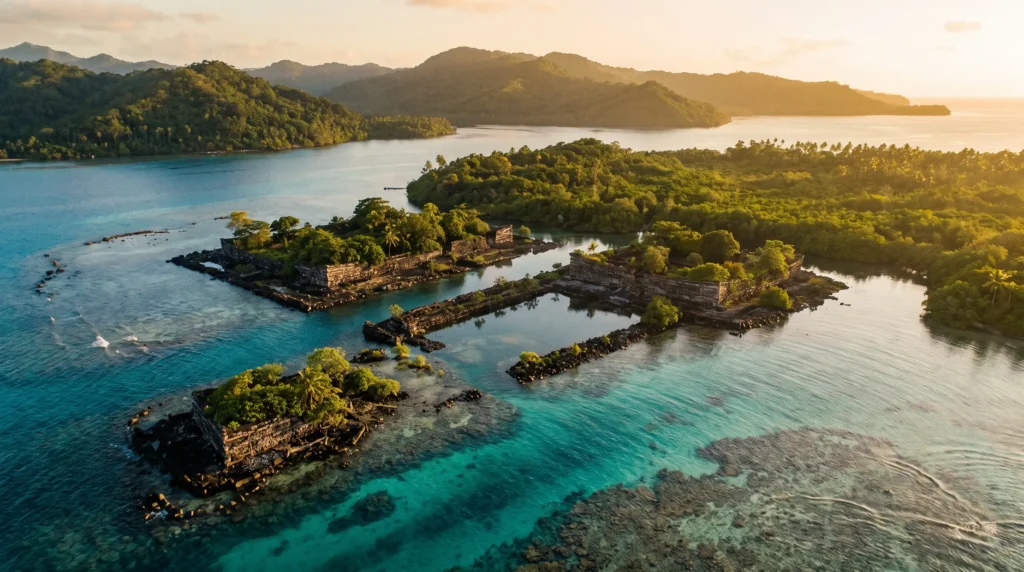
Micronesia Travel Guide — Ghost Fleets, Manta Rays & the Pacific’s Best-Kept Diving Secret
I need to get one thing out of the way immediately, because it trips up almost everyone: the Federated States of Micronesia is not a single island, and it is not the same thing as the wider geographic region called “Micronesia” that also includes Guam, Palau, and the Marshall Islands. It’s one country, four states — Yap, Chuuk, Pohnpei, and Kosrae — strung across nearly 2,700 kilometers of open Pacific, with a combined land area you could almost fit inside a mid-sized city. And yet inside that scattering of islands sits one of the greatest shipwreck dive sites on Earth, a stone city built on an artificial reef nine centuries ago, and a manta ray sanctuary where the animals show up on schedule like they’re clocking in for a shift. Getting there is genuinely a project — you will fly Pacific routes most travelers have never heard of, on flights that stop at other islands most travelers have never heard of. But nowhere else rewards the effort quite like this.
In This Guide
- Overview — Why the FSM Is the Pacific’s Quietest Diving Superpower
- Yap Day, March 1 — Stone Money & the Island That Time Half-Forgot
- Best Time to Visit Micronesia (Season by Season)
- Getting There — The Island Hopper & Why This Trip Takes Planning
- Getting Around — Inter-State Flights, Boats & Not Much Else
- Top Regions — Yap, Chuuk, Pohnpei & Kosrae
- Culture & People — Four States, Four Languages, One Compact
- A Food Lover’s Guide to Micronesia
- Off the Beaten Path
- Practical Information
- Budget Breakdown — What Micronesia Actually Costs in 2026
- Frequently Asked Questions
Overview — Why the FSM Is the Pacific’s Quietest Diving Superpower
The Federated States of Micronesia became fully self-governing in 1986 under a Compact of Free Association with the United States — the US handles defense, FSM citizens can live and work in the US indefinitely, and the country runs its own federal government from the purpose-built capital of Palikir on Pohnpei. That relationship explains a lot for travelers before you even land: the currency is the US dollar, English is the official language everywhere, and United Airlines is essentially the only way in.
Spread across four states — Yap, Chuuk, Pohnpei, and Kosrae — and 607 islands totaling barely 702 square kilometers of land, the FSM occupies an ocean footprint close to a million square miles. Each state has its own airport, its own culture, and its own reason to visit: Chuuk Lagoon holds the largest concentration of shipwrecks anywhere on the planet, sunk in three days during a single World War II air raid. Pohnpei has Nan Madol, a UNESCO World Heritage site built from stacked basalt columns on nearly a hundred artificial islets, predating European contact by centuries. Yap has kept more of its pre-colonial culture intact than almost anywhere in the Pacific, including giant stone discs still used as currency for major transactions. Kosrae has rainforest, waterfalls, and close to nobody.
What the FSM does not have is tourism infrastructure in the conventional sense — no resort strips, no cruise piers, and only a handful of hotels per island. That’s the tradeoff: this is a destination for people who want world-class diving and genuine cultural access, and are willing to fly on small planes to island airstrips to get it.
Yap Day, March 1 — Stone Money & the Island That Time Half-Forgot
If your trip has any flexibility, aim it at Yap Day, held every March 1 — a legal holiday in Yap State that’s been running in some form since 1968, when it was created specifically to keep traditional Yapese culture from eroding. The festival opens with a conch-shell blast and a presentation of stone money, then rolls into village dance performances, coconut-husking and log-pulling competitions, traditional tattooing demonstrations, and canoe-building displays that most Yapese families still practice as living skills, not museum pieces.
The reason this matters more here than almost anywhere else in the Pacific: Yap is widely considered to have the most intact traditional culture left in Micronesia, and Yap Day is the one weekend a year it’s performed at full scale for anyone who shows up. It also happens to fall in the driest, calmest stretch of the year, so you’re not trading festival access for bad diving conditions.
Best Time to Visit Micronesia (Season by Season)
December – April · Driest and calmest
This is the sweet spot: lower rainfall, calmer seas for the Chuuk Lagoon wreck sites and Yap’s manta cleaning stations, and it overlaps with the FSM’s most productive manta ray mating season, when courtship “trains” of males following a single female put on the best show at Yap’s cleaning stations.
May – June · Transitional
Rainfall starts climbing, seas are still generally manageable, and this is a quieter, cheaper stretch before the wetter months set in — good for Kosrae’s rainforest hikes when the trails aren’t at their soggiest.
July – December · Typhoon season
The Pacific typhoon season runs July through December, and the FSM sits in a track that occasionally gets direct hits or near-misses, alongside routine flooding, drought cycles, and landslides depending on the year. Travel insurance with evacuation coverage is not optional here — flights can be disrupted for days, and each state has only basic medical facilities. Manta rays are still present year-round even outside mating season, so this isn’t a dead window for diving, just a riskier one for logistics.
Getting There — The Island Hopper & Why This Trip Takes Planning
United Airlines is, in practical terms, the only way to reach the FSM by air, and its famous “Island Hopper” route is the main artery: a single Boeing 737 flight running between Honolulu and Guam that stops at Majuro and Kwajalein in the Marshall Islands, then Kosrae, Pohnpei, and Chuuk in the FSM, before continuing on to Guam. The full westbound run takes around 16 hours gate-to-gate including ground stops, and it’s genuinely the only scheduled air service many of these islands have — it also functions as the regional cargo and medevac flight. Most travelers fly it as part of a multi-island itinerary rather than a straight-through journey; you can disembark at any state, spend your trip there, and catch a later rotation onward.
Each state has its own international airport — Pohnpei (PNI), Chuuk (TKK), Kosrae (KSA), and Yap (YAP) — and you must specify your destination state when booking, since there’s no single “Micronesia” airport. Yap is usually reached via Guam rather than the Island Hopper route. Whichever way you fly in, carry cash: airports have no ATMs and don’t take cards for the departure tax charged when you leave each island.
Getting Around — Inter-State Flights, Boats & Not Much Else
There is no ferry network or road connecting the four states — flying is the only realistic way to move between Yap, Chuuk, Pohnpei, and Kosrae, generally on the same United rotation that brought you in, since schedules run only a few days a week. Book inter-state legs well ahead; seats are limited and there’s no walk-up alternative if you miss a connection.
On each island, distances are short enough that a rental car or a hotel shuttle covers most needs — Pohnpei and Kosrae have paved ring roads reaching the main sights; Yap and Chuuk’s outer islands often require a boat or a dive operator’s transfer. Most visitors book dive packages that bundle airport transfers and daily boat trips, which simplifies logistics considerably given how limited public transport options are.
Top Regions — Yap, Chuuk, Pohnpei & Kosrae
Yap
The cultural heartland of the FSM, famous for giant stone discs called rai still used in ceremonial exchanges, and for a resident manta ray population visible at shallow cleaning stations essentially year-round — a rarity among manta destinations, most of which depend on seasonal migration. Yap established one of the world’s first manta ray sanctuaries in 2008, covering thousands of square miles of protected water out to 12 nautical miles offshore. Village life here still runs on traditional protocols — ask permission before entering a village or photographing ceremonies.
Chuuk (Truk Lagoon)
The single biggest reason technical and recreational wreck divers put the FSM on a bucket list. In February 1944, US carrier aircraft launched Operation Hailstone against what was then Japan’s main Pacific fleet anchorage, sinking a dozen warships and roughly three dozen merchant vessels in three days — today nicknamed the “Ghost Fleet of Truk Lagoon.” Many wrecks sit remarkably intact in under fifteen meters of clear water, still carrying trucks, aircraft, and personal effects, now grown over with coral and patrolled by reef sharks and turtles.
Pohnpei
Home to Palikir, the national capital, and to Nan Madol — a ceremonial city of more than 90 artificial islets built from massive basalt columns stacked in a header-stretcher pattern between roughly 1200 and 1500 CE, the seat of the Saudeleur dynasty. UNESCO inscribed it as a World Heritage Site in 2016 — and placed it on the List of World Heritage in Danger the same year, citing invasive vegetation dislodging the stonework, canal siltation, and sea-level rise as active threats. Pohnpei is also lush and mountainous, with waterfalls, pepper farms (Pohnpei pepper has a genuine following among chefs), and its own manta and reef diving.
Kosrae
The quietest and least-visited of the four, nicknamed the “Island of the Sleeping Lady” for a mountain silhouette said to resemble a reclining woman, with a population of well under ten thousand across the whole state. Rainforest trails wind to hidden waterfalls and swimming holes, mangrove channels invite kayaking and paddleboarding, and the ruins of Leluh — an ancient walled city occupied from roughly 1250 to 1850 AD — sit almost untouched near the modern town. Reef diving here is excellent and largely uncrowded, protected by an extensive mooring-buoy system that keeps boat anchors off the coral.
Culture & People — Four States, Four Languages, One Compact
English is the FSM’s official and common language, but each state has its own home language — Yapese, Chuukese, Pohnpeian, and Kosraean — and its own distinct traditions, which is part of why the country’s four states operate as a federation rather than a single unified culture. Land tenure, chiefly systems, and gift-exchange customs still shape daily life, especially in Yap, where caste-like village hierarchies and stone-money exchanges remain socially significant rather than performed for visitors.
Respectful visiting matters here more than in heavily touristed Pacific destinations: dress modestly in villages, ask before photographing people or ceremonies, and follow your guide’s lead on what’s appropriate to enter or touch, particularly around sacred or ceremonial sites like Nan Madol and Leluh. Church attendance is high across all four states — Sundays are quiet, and some businesses close.
A Food Lover’s Guide to Micronesia
Diets across the FSM lean on what the reef, the lagoon, and the breadfruit tree provide: fresh reef fish and tuna grilled or in coconut-milk stews, taro and breadfruit as the everyday starch, and coconut in nearly everything, savory and sweet. Pohnpei is known regionally for a distinctively hot black pepper grown on the island’s volcanic slopes, exported in small quantities and prized by chefs who track it down.
Sakau (also called kava in other Pacific islands) is Pohnpei’s ceremonial and social drink, pounded from a pepper-family root and drunk at markets and gatherings — mildly sedative, an acquired taste, and a genuine cultural experience if a local invites you to try it. Betel nut chewing is common and visible across all four states. Restaurant options are limited outside hotels and dive lodges, so a lot of good eating on smaller islands happens through home-hosted meals arranged via your accommodation.
Off the Beaten Path
Chuuk’s outer atolls
Beyond the wreck-diving hub of Weno, atolls like the Hall Islands and the Mortlocks see almost no visitors and offer traditional village life largely unchanged by tourism — access requires local boat charters and advance arrangement.
Kosrae’s Tafunsak interior
Jungle gorges and waterfall hikes on an island where “only the most adventurous travelers venture,” according to regional dive and travel writers — a fair description for a state with one of the smallest visitor counts in the entire Pacific.
Yap’s outer islands
Ulithi and Fais atolls, reachable by infrequent field-trip ships or charter, preserve navigation and canoe-building traditions that UNESCO and Pacific researchers consider among the last living examples of traditional wayfinding in the region.
Nan Madol at dawn
Even on Pohnpei, where Nan Madol is the marquee sight, arriving early avoids both the heat and the handful of other visitors — this is a UNESCO site that most of the traveling world has still never heard of.
Practical Information
Money. The US dollar is the official and only currency — no exchange needed for American travelers, and other nationalities should bring or withdraw USD before arriving, since ATMs are scarce outside main towns and airports have none at all.
Safety. The US State Department rates the FSM at its lowest advisory tier, recommending only normal precautions; the practical risks here are environmental rather than criminal — typhoons, flooding, and landslides during the July–December wet season, plus a genuinely limited news environment where breaking information travels by social media or word of mouth.
Health. Only basic medical care is available, limited to state-run hospitals on each of the four main islands and one private hospital on Pohnpei — evacuation insurance is strongly recommended for anything serious. CDC recommends travelers be current on routine vaccines plus hepatitis A and typhoid, and has flagged dengue activity in Yap State in recent years — check the current CDC notice before you fly.
Connectivity. Internet is slow and limited even in main towns; don’t expect to work remotely from any of the four states. Plugs: US-style, 120V. Time zones: Chuuk and Yap sit at UTC+10; Pohnpei and Kosrae at UTC+11 — a genuinely confusing detail worth double-checking when booking inter-state flights.
Budget Breakdown — What Micronesia Actually Costs in 2026
This is not a cheap backpacker destination — remoteness drives up flights, food, and gear, and there’s little budget infrastructure to bring costs down.
Budget (US$70–120/day): Guesthouse or basic hotel room, local meals of fish, rice and taro, minimal or no diving, getting around by hotel shuttle or occasional rental.
Mid-range (US$150–260/day): Dive-lodge package with meals and two boat dives included (roughly US$120–160 for a two-tank trip), a rental car for a day on Pohnpei or Kosrae, a Nan Madol or Leluh guided tour.
Luxury / liveaboard (US$350+/day): Multi-day Chuuk Lagoon liveaboard trips, premium dive resorts on Yap with dedicated manta-viewing boats, private guided cultural tours.
Fixed costs to plan for: departure taxes payable in cash when leaving each island, and the Island Hopper or inter-island flight fares themselves, which are the single biggest line item in most itineraries.
Planning Your First Trip to Micronesia
Most first-timers pick one or two states rather than attempting all four — Chuuk for wreck diving alone is a full trip, and pairing it with Pohnpei for Nan Madol adds a cultural anchor without much extra flying, since both sit on the same Island Hopper rotation. Divers chasing mantas year-round should prioritize Yap instead, ideally timed around the December–April mating season. Budget generous buffer days around inter-state flights — schedules run only a few times a week, and missing a connection can cost you days, not hours.
If you’re building a longer Pacific itinerary, our Philippines guide and Maldives guide cover two of the other reef- and wreck-diving destinations most often compared to the FSM, while our Fiji guide and Samoa guide are the closest culturally-adjacent Pacific island nations we cover.
Frequently Asked Questions
Is Micronesia the same place as Guam or Palau?
No — the Federated States of Micronesia is one country made up of Yap, Chuuk, Pohnpei, and Kosrae. Guam and the Commonwealth of the Northern Mariana Islands are separate US territories, and Palau and the Marshall Islands are separate sovereign nations, even though all of them sit within the broader Micronesia region of the Pacific.
Do I need a visa?
Most nationalities get 30 days visa-free on arrival, extendable to 60. US, Marshallese, and Palauan citizens can stay far longer under the Compact of Free Association — effectively indefinitely for Americans — while EU citizens get 90 days per 180-day period under a 2016 visa-waiver agreement. Everyone needs a passport valid well beyond their stay, proof of onward travel, and sufficient funds.
Do I need to be an advanced diver for Chuuk Lagoon?
Not for most of the well-known wrecks — many sit in under fifteen meters of water and are accessible to Open Water-certified divers with a reputable operator, though deeper penetration dives into wreck interiors are reserved for advanced or technical certification.
Micronesia or Palau for diving?
Choose the FSM’s Chuuk Lagoon for unmatched WWII wreck diving and Yap for near-guaranteed manta encounters; choose Palau for its famous Rock Islands, Jellyfish Lake, and arguably easier logistics and more developed dive tourism infrastructure. The FSM feels rawer and less discovered — that’s both the appeal and the catch.
What’s the biggest planning mistake first-timers make?
Underestimating how infrequent inter-state and connecting flights are. Build in buffer days, book dive packages well ahead of a trip, and don’t schedule a tight connection through Guam or Honolulu on the same day you fly out of an outer state.
Ready to Explore Micronesia?
A stone city built on a coral reef, a sunken fleet frozen in 1944, manta rays that show up like clockwork, and four islands where almost nobody else is visiting. Micronesia asks more of you logistically than most destinations — but for wreck divers, culture-seekers, and anyone chasing a Pacific that still feels genuinely undiscovered, it delivers in a way few places left on Earth still can.
Explore More
- Philippines Travel Guide — another Pacific archipelago built for reef and wreck diving
- Maldives Travel Guide — the Indian Ocean’s answer to manta ray diving
- Fiji Travel Guide — Pacific island culture with more developed tourism infrastructure
- Samoa Travel Guide — traditional Polynesian village life and a similarly slow pace
How this guide was built
Published as part of Facts From Upstairs’ country guide series. Built from authoritative sources — Wikipedia’s entity pages for the Federated States of Micronesia, Chuuk Lagoon, Kosrae, the Island Hopper route, Yap Day, and the country’s visa policy; UNESCO’s World Heritage listing for Nan Madol; the US State Department’s FSM travel advisory; the US CDC’s FSM traveler health page; the FSM Embassy’s visitor FAQ; and Yap’s official dive and tourism site for manta ray sanctuary details. Numeric and checkable claims carry inline citations.
Sources cited on this page
- Wikipedia — Federated States of Micronesia
- UNESCO — Nan Madol: Ceremonial Centre of Eastern Micronesia
- US State Department — Federated States of Micronesia Travel Advisory
- US CDC — Micronesia traveler health page
- FSM Embassy — Frequently Asked Questions
- Wikipedia — Chuuk Lagoon
- Wikipedia — Island Hopper
- Wikipedia — Yap Day
- Wikipedia — Visa Policy of Micronesia
- Wikipedia — Kosrae
- Yap Visitors Bureau — Diving in Yap (Manta Ray Sanctuary)
More country guides you might like

Plan your trip to Micronesia
The booking tools we use ourselves. FFU may earn a commission at no extra cost to you.
Plan & book your trip to Micronesia
Booking through these searches supports our guides at no extra cost to you.